
Our readers keep the lights on and the weekend projects moving. As an Amazon Associate, I earn from qualifying purchases.
Thick hardwood slabs punish cheap blades. A dull or wandering band saw blade turns an afternoon of resawing walnut into a frustrating fight with burn marks and wasted stock. The right blade for dense lumber must deliver aggressive chip clearance, maintain a straight kerf under tension, and resist overheating during long cuts.
I’m Rikta — the co-founder and writer behind FitlyFast. I analyze woodworking consumables by scouring metallurgy data, customer stress-test reviews, and real-world cutting reports to separate blades that merely fit from blades that perform.
After comparing tooth geometry, steel composition, and heat-treatment methods across seven contenders, I’ve zeroed in on the models that earn a place in a serious hardwood shop. This guide ranks the best band saw blade for hardwood based on cut quality, durability, and value for the demanding woodworker.
How To Choose The Best Band Saw Blade For Hardwood
Selecting a blade for hardwood is not the same as picking one for soft pine or plywood. Dense species like oak, maple, and cherry demand specific tooth configurations and steel grades to cut efficiently without bogging your motor or leaving a rough surface. Focus on four factors before buying.
Tooth Pitch (TPI) Determines Cut Speed vs. Finish
For resawing thick hardwood, a lower TPI (2 to 4) provides deeper gullets that clear sawdust and prevent binding. Higher TPI blades (6 to 14) produce smoother edges but cut slower and clog on thick stock. A 3 or 4 TPI blade is the sweet spot for 4-inch-plus hardwoods.
Steel Composition and Heat Treatment
Standard carbon steel blades dull quickly in abrasive hardwoods. Silicon-alloy or bi-metal construction resists heat buildup and holds an edge longer. Induction-hardened tooth tips (like those on Timber Wolf blades) offer a measurable hardness advantage over flame-hardened competitors.
Blade Width, Thickness, and Tension Compatibility
Wider blades (3/4 inch or 1/2 inch) track straighter under tension, which is critical for resaw accuracy. Thicker blades (0.025 to 0.032 inch) resist flex but require a saw powerful enough to tension them properly. Always match blade dimensions to your saw’s wheel diameter and tension range.
Quick Comparison
On smaller screens, swipe sideways to see the full table.
| Model | Category | Best For | Key Spec | Amazon |
|---|---|---|---|---|
| Timber Wolf 1/2″ x 80″, 3 TPI | Silicon Steel | Thick resaw cuts | 3 TPI, thin kerf | Amazon |
| Timber Wolf 3423VPC 93.5″ | Alloy Steel | General resaw & thick cuts | 9 TPI, induction hardened | Amazon |
| Starrett Duratec SFB 93″ | Carbon Steel | Multi-material cutting | 14 TPI, 3/4″ width | Amazon |
| LENOX Portable 44-7/8″ 5-Pack | Bi-Metal | Portable saw hardwood cuts | 14 TPI, shatter resistant | Amazon |
| Bosch CBS1418 3-Pack | Bi-Metal | Portable saw metal & wood | 14-18 TPI, 3x life | Amazon |
| POWERTEC 59-1/2″ 3PK Assortment | Carbon Steel | Small saw multi-use | 6-14 TPI assortment | Amazon |
| AYAO 93-1/2″ 2-Pack | Carbon Steel | Budget resaw & general cut | 4 TPI, hardened teeth | Amazon |
In‑Depth Reviews
1. Timber Wolf Bandsaw Blade 1/2″ x 80″, 3 TPI

This Timber Wolf blade is engineered specifically for thick hardwood resawing. The high-silicon, low-carbide steel formulation runs significantly cooler than standard carbon steel blades, which directly reduces heat-induced dulling during long passes through 6-inch maple or walnut. The thin kerf design also places less strain on under-powered saws while maintaining a remarkably straight cut.
Customer reports confirm that this blade cuts a 6-inch maple disc in under one minute compared to thirty minutes with a previous blade, and the surface finish often requires no sanding. The low-tension design is forgiving on saws that cannot generate high clamping force, making this a versatile upgrade for 12-inch to 14-inch band saws. It tracks accurately even when cutting wet spruce or cedar at full 7-inch height.
One user noted a premature snap after encountering a nail, and a second unit failed under heavy fair load, so this blade is not indestructible. However, the vast majority of reviews highlight extreme sharpness out of the box and dramatic time savings. For pure resaw performance in dense hardwoods, this blade sets the standard.
Why it’s great
- Thin kerf reduces motor strain on thick cuts
- Runs cool, extending sharp life through abrasive hardwoods
- Requires low tension, compatible with smaller saws
Good to know
- Thin kerf may be less durable if hitting embedded debris
- Not ideal for high-TPI finish work on thin stock
2. Timber Wolf 3423VPC 93.5″ x 3/4″ Low Tension Resaw Blade

Timber Wolf applies precision induction hardening to this blade, making the tooth edge 20 percent harder than typical high-carbon steel. That extra hardness translates directly to extended sharpness when cutting abrasive woods like ebony, rosewood, or white oak. The milled tooth design is 50 percent sharper than stamped or crush-ground alternatives, which reduces feed pressure and minimizes burning on dense grain.
The 3/4-inch width and 0.03-inch thickness provide excellent beam strength for resawing 8-inch walnut into thin veneer-quality slices. Owners report perfectly straight cuts with no wander on properly tuned Delta 14-inch saws. The blade also runs ductile enough to flex through thousands of cycles without fatigue failure, a common complaint with cheaper hardened blades.
Although this blade carries a 9 TPI count which is higher than typical resaw blades, it still clears chips effectively thanks to the milled tooth geometry. It is a premium choice for shops that cut a mix of thick and medium hardwoods and want a single blade that handles both without frequent changes. The detailed tuning instructions included are a bonus for dialing in saw alignment.
Why it’s great
- Induction-hardened teeth stay sharper longer than flame-hardened
- Milled teeth cut cleaner than stamped blades on dense grain
- Ductile steel resists flex fatigue over long resaw runs
Good to know
- 9 TPI may be too fine for very thick stock above 6 inches
- Requires proper saw tuning to avoid wander
3. Starrett Duratec SFB 93″ x 3/4″ Carbon Steel Blade
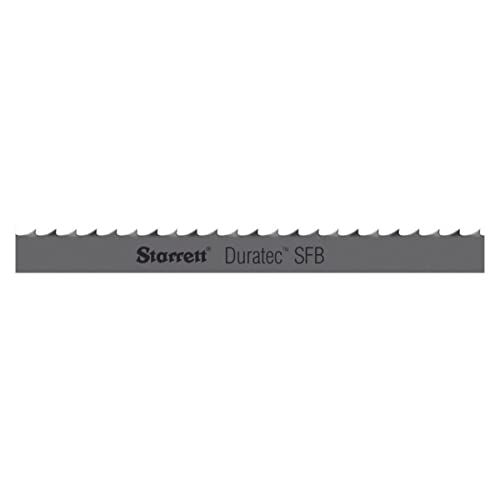
Starrett’s Duratec SFB is a carbon steel blade that bridges wood and metal cutting without compromising on sharpness. The regular tooth geometry with raker set provides aggressive cutting action, and the narrow kerf reduces material waste. It is an economical choice that holds an edge noticeably longer than generic store-brand blades, especially when cutting hardwoods like mahogany and cedar for instrument-grade work.
Customers report that this blade blasts through oak planks with ease and delivers cuts that are straight enough to eliminate alignment problems on older saws. One user cut 3.5-inch chrome moly tubing within 1/8 inch of square, a testament to the blade’s tracking stability. The flexible back design absorbs shock better than rigid blades, reducing the risk of cracking during aggressive feeds.
The 14 TPI count makes this blade more suitable for thinner hardwood stock and detailed curves rather than thick resawing. It excels as a general-purpose blade in a shop that cuts both hardwoods and non-ferrous metals. For users who want one blade for multiple materials without switching, this is a strong performer.
Why it’s great
- Cuts straight and tracks well on older or misaligned saws
- Sharp enough for fine woodworking and metal cutting
- Flex back design improves durability under heavy feeds
Good to know
- 14 TPI is not ideal for thick resaw operations
- Carbon steel dulls faster than bi-metal on abrasive woods
4. LENOX Portable 44-7/8″ x 1/2″ x 14 TPI 5-Pack

LENOX brings its Tuff Tooth design to this 5-pack of portable band saw blades, reinforcing the tooth face for longer life in demanding cuts. The bi-metal construction pairs a high-speed steel cutting edge with a flexible alloy steel back, allowing the blade to bend and resist breakage under the twisting forces common in handheld saw work. This is a serious upgrade for contractors cutting hardwood timbers on portable saws.
Users report that these blades cut straight even through 4-inch pressure-treated posts, and the multi-pack provides excellent value for professionals who go through blades quickly. The shatter-resistant design is a practical safety feature when cutting through material with hidden tension or embedded fasteners. The 14 TPI delivers a balance of speed and finish for general hardwood cutting on portable band saws.
While optimized for metal cutting, the high-speed steel teeth handle hardwood without excessive dulling. The pack is best suited for users who need a reliable stock of blades for on-site work. For stationary saw resaw applications, a wider blade with lower TPI will perform better.
Why it’s great
- Bi-metal construction resists breakage under twist loads
- Tuff Tooth design extends cutting life in abrasive woods
- 5-pack provides strong value for heavy-use users
Good to know
- Designed primarily for portable saws, not stationary resaw
- 14 TPI limits speed on very thick stock
5. Bosch CBS1418 3-Pack 28-7/8″ Portable Band Saw Blades

Bosch’s CBS1418 blades use advanced bonding technology to fuse the high-speed steel cutting edge to a durable backer, delivering up to three times the life of standard portable band saw blades. The optimized tooth geometry cuts through steel, iron, and aluminum efficiently, but the same engineering makes it effective on dense hardwoods in portable saw applications. It is a favorite among electricians and metalworkers who also cut wood.
Reviews from professionals highlight that these blades stay sharp through hundreds of conduit cuts without dulling, and the heat-resistant construction prevents premature failure. The 14-18 TPI variable pitch reduces vibration and produces a cleaner finish than single-pitch blades. For users who need one blade type for mixed-material jobsite cutting, this set is a reliable choice.
Some users report that the blades are prone to stress cracks if the tool twists during aggressive cuts, so proper technique is important. The 28-7/8-inch length fits common portable band saws. While not a dedicated hardwood resaw blade, it outperforms generic options in mixed-material settings.
Why it’s great
- Bi-metal construction delivers exceptional lifespan
- Variable tooth pitch reduces vibration in hard materials
- Heat-resistant build prevents dulling in heavy use
Good to know
- Can crack under twisting loads in the saw
- Short length only fits portable saws
6. POWERTEC 59-1/2″ 3PK Assortment for Small Band Saws

POWERTEC’s 3-blade assortment is tailored for smaller 9-inch band saws from Craftsman, Ryobi, Delta, and Skil. The set includes a 1/8-inch 14 TPI blade for fine curve cutting, a 3/8-inch 6 TPI blade for scroll work, and a 1/4-inch 6 TPI blade for general wood cutting. The high-grade carbon steel construction and optimal tooth geometry provide clean cuts through hard and soft woods as well as non-ferrous metals.
Users report that the blades run cool, track straight, and produce no noticeable vibration despite the visible weld. The 1/4-inch and 3/8-inch widths are well-suited for cutting hardwood boards up to 2 inches thick on these smaller saws. The set is a practical solution for hobbyists who switch between detail work and straight cuts without changing blades frequently.
One limitation is that the blades are thicker than some saw models can tension properly, specifically the Skil BW9501 and WEN 3959. Buyers should verify gauge compatibility before ordering. For saws that accept this thickness, the set offers good value and performance for small-shop hardwood cutting.
Why it’s great
- Three blades cover curve cutting, scrolling, and general work
- Runs cool and tracks straight with minimal vibration
- Good value for hobbyists with small band saws
Good to know
- Blade thickness may be incompatible with some saw models
- Not designed for thick resaw applications above 2 inches
7. AYAO Hardened Teeth 93-1/2″ 2-Pack, 4 TPI

AYAO’s 2-pack offers a wallet-friendly entry into hardwood cutting without sacrificing essential features. The hardened teeth and raker set arrangement provide consistent chip clearance and straight tracking on 14-inch saws from Delta, Jet, Rikon, and Ridgid. The 0.02-inch thickness keeps kerf waste low while maintaining enough beam strength for moderate resaw tasks.
Customer feedback indicates these blades cut noticeably straighter than generic store-brand blades, with sharp edges out of the box. They handle live-edge wood with embedded grit better than expected, though they dull faster than premium silicon or bi-metal alternatives. For users who cut hardwood occasionally and want a functional blade without a premium investment, this set delivers reliable performance.
The 4 TPI pitch is appropriate for resawing thick hardwood boards, and the two-blade pack provides a backup. Durability is not on par with premium blades, but the cost per blade is low enough to treat them as consumables. They are a solid choice for budget-conscious woodworkers or as emergency spares.
Why it’s great
- Hardened teeth provide acceptable sharpness for the price
- Two blades included offer good value for occasional users
- 4 TPI suitable for resawing thick hardwood
Good to know
- Less durable than premium alloy or bi-metal blades
- Carbon steel dulls faster on abrasive exotic hardwoods
FAQ
What is the best TPI for cutting thick hardwood on a band saw?
Can I use a metal-cutting band saw blade on hardwood?
How do I know if a blade is too thick for my band saw?
Final Thoughts: The Verdict
For most users, the best band saw blade for hardwood winner is the Timber Wolf 1/2″ x 80″, 3 TPI because it combines thin kerf efficiency with silicon-steel heat resistance for fast, straight resaw cuts on thick stock. If you want a wider induction-hardened blade for larger saws, grab the Timber Wolf 3423VPC 93.5″. And for budget-conscious occasional hardwood cutting, nothing beats the value of the AYAO 93-1/2″ 2-Pack.