
Our readers keep the lights on and the weekend projects moving. As an Amazon Associate, I earn from qualifying purchases.
A gas water heater rated for a 75-gallon tank or the equivalent tankless flow needed to serve a large household represents a decade-long commitment to your home’s comfort. The wrong choice means cold showers during back-to-back morning routines, surprise repair bills, or a unit that struggles to keep up with your family’s peak demand. The right choice delivers endless, stable hot water without a second thought.
I’m Rikta — the co-founder and writer behind FitlyFast. I’ve spent years analyzing water heater specifications, real-world flow rate data, and customer durability reports to separate marketing claims from real-world performance.
After reviewing the top contenders on the market, the most reliable options balance a burner output of at least 180,000 BTU with a flow rate above 8 GPM to handle simultaneous showers, laundry, and dishwashing. This guide breaks down the best 75 gallon gas water heater choices for every budget and home layout.
How To Choose The Best 75 Gallon Gas Water Heater
The traditional 75-gallon tank is a storage-type unit, but for this performance class, the market has largely shifted to high-output tankless systems that deliver the same or better continuous flow. Selecting the right one requires matching your home’s peak demand with the unit’s technical specifications.
Evaluate Peak Flow Demand (GPM)
A 75-gallon gas water heater legacy unit delivers around 6-7 gallons per minute under ideal conditions. For a tankless equivalent, you want a model rated for at least 8.0 gallons per minute (GPM) to comfortably run two showers, a dishwasher, and a washing machine at the same time. Undersizing here leads to noticeable temperature drops during concurrent use.
BTU Output and Temperature Rise
BTU (British Thermal Units) determines how fast the unit can raise incoming cold water to your desired set point. A 180,000 to 199,000 BTU burner is standard for this capacity class. If you live in a northern climate where incoming ground water is below 50°F, a higher BTU output is critical to avoid flow-rate throttling during winter months. Always check the temperature rise chart in the manual for your region’s groundwater temperature.
Condensing vs. Non-Condensing Design
Non-condensing units are simpler, less expensive, and require standard stainless steel venting, but they waste heat through exhaust gas and achieve lower Uniform Energy Factors (UEF around 0.81-0.85). Condensing models recover additional heat by capturing exhaust moisture, pushing UEF to 0.95 or higher. The trade-off is a higher upfront cost and more complex venting (often PVC), but the annual gas savings can offset the price difference within a few years for a high-use household.
Venting and Location Constraints
Outdoor-rated units eliminate venting complexity entirely and are ideal for warm climates or open-wall installations. Indoor units require either direct vent (two-pipe concentric system) or power vent (dedicated PVC sidewall venting). If you are converting from a tank-type water heater, verify that your existing vent pathways can handle the new unit’s exhaust temperature and pressure requirements. Some high-efficiency indoor models require condensation drain lines and a condensate pump if installed below grade.
Quick Comparison
On smaller screens, swipe sideways to see the full table.
| Model | Category | Best For | Key Spec | Amazon |
|---|---|---|---|---|
| Rinnai RU199iN | Condensing | High-demand, efficiency-focused homes | 199,000 BTU, 11 GPM, UEF 0.96 | Amazon |
| Rheem Prestige RTGH-84DVLN-2 | Condensing | Indoor installs needing leak detection | 180,000 BTU, 8.4 GPM, condensing | Amazon |
| Rinnai CX199iN | Commercial Condensing | Large families, multi-unit dwellings | 199,000 BTU, 11.1 GPM, 97% efficiency | Amazon |
| Rinnai RX199iN | Condensing Smart Sense | Versatile indoor/outdoor install | 199,000 BTU, 11.1 GPM, UEF 0.98 | Amazon |
| A. O. Smith ATI-310CX3 | Non-Condensing | Scale-prone hard water areas | 190,000 BTU, 8 GPM, X3 scale prevention | Amazon |
| Rheem RTG-84XLN-3 | Non-Condensing | Outdoor install, 2-3 bathroom homes | 180,000 BTU, 8.4 GPM, outdoor | Amazon |
| Westinghouse Smart Outdoor LP | Non-Condensing | Propane-powered outdoor installations | 180,000 BTU, 8.1 GPM, ±1°F stability | Amazon |
| Westinghouse Smart Indoor NG | Non-Condensing | Indoor natural gas with WiFi control | 180,000 BTU, 7.9 GPM, WiFi app | Amazon |
| FOGATTI 180S NG | Non-Condensing | Outdoor natural gas, multi-fixture homes | 180,000 BTU, 8.1 GPM, outdoor | Amazon |
| FOGATTI 170S LP | Non-Condensing | Indoor propane, tight spaces | 170,000 BTU, 7.5 GPM, CSA certified | Amazon |
| MIZUDO 180K BTU NG | Non-Condensing | Outdoor NG, stable temperature | 180,000 BTU, 8.1 GPM, ±1°F | Amazon |
| MIZUDO 120K LP | Convertible | Indoor/outdoor propane, whole-house | 120,000 BTU, 5.1 GPM, WiFi | Amazon |
| APUS 190K BTU LP | Non-Condensing | Budget-friendly outdoor propane | 190,000 BTU, 8.1 GPM, WiFi controlled | Amazon |
In‑Depth Reviews
1. Rinnai RU199iN Condensing Tankless Water Heater

The Rinnai RU199iN is a condensing tankless unit that sets the benchmark for this class with an 11 GPM flow rate and a 199,000 BTU burner. Its UEF of 0.96 means it captures far more heat from combustion than non-condensing rivals, translating to noticeably lower monthly gas bills for households that run hot water heavily. The Circ-Logic feature allows pairing with an external recirculation pump for near-instant hot water at the tap, reducing the typical tankless delay.
Long-term owners consistently report flawless operation for six months to several years, with one reviewer noting a 50% reduction in gas usage compared to their previous tank-style heater. The unit is remarkably quiet during operation and maintains a stable temperature across multiple simultaneous draws. The 15-year heat exchanger warranty underscores the build quality Rinnai brings to this tier.
Installation is best left to a licensed plumber due to the condensing venting requirements and the need to correctly size the gas supply line. Some buyers have noted that Amazon’s installation services may refuse tankless units, so sourcing a local pro is wise. The RU199iN is strictly for indoor use, so plan for a dedicated PVC vent pathway and a condensate drain.
Why it’s great
- Exceptional 11 GPM flow handles seven fixtures simultaneously
- Condensing design delivers UEF 0.96 for real energy savings
- 15-year heat exchanger warranty reflects long-term reliability
Good to know
- Indoor installation only with PVC venting required
- Professional installation strongly recommended for optimal performance
2. Rheem RTG-84XLN-3 Non-Condensing Outdoor
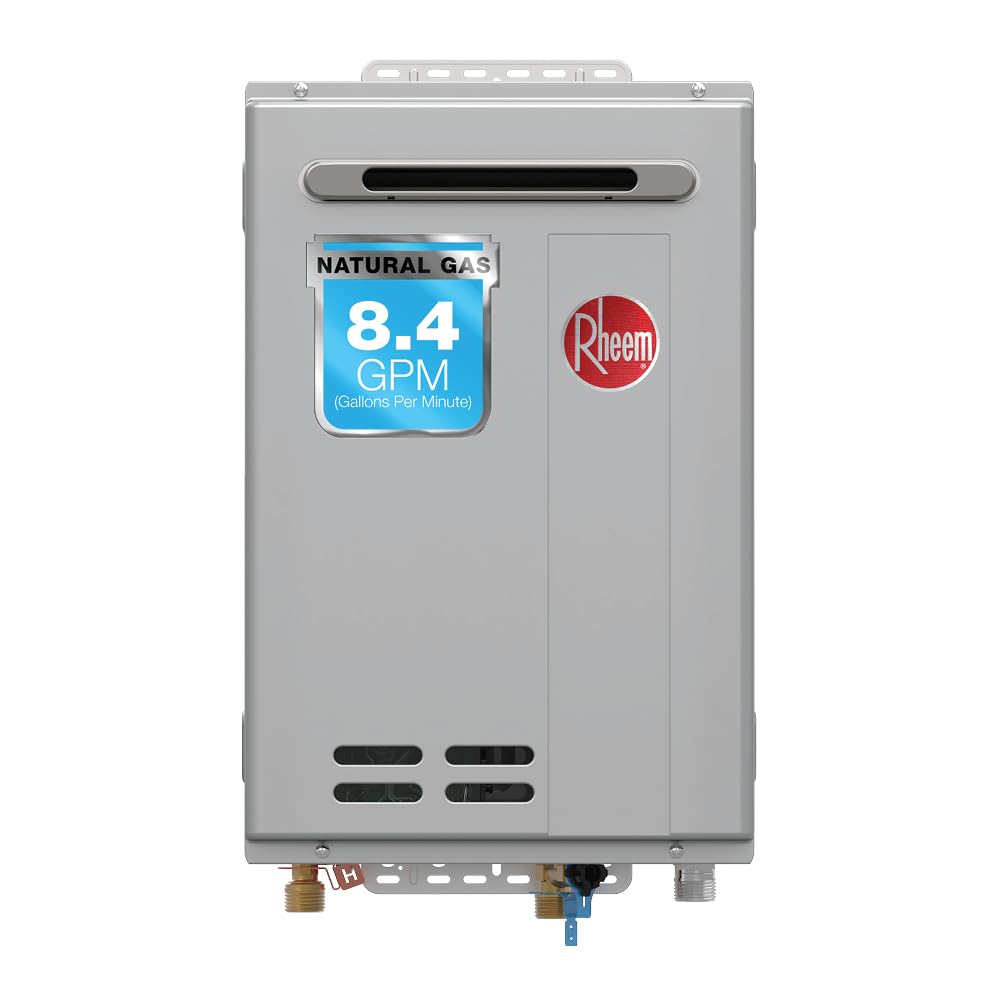
Rheem’s RTG-84XLN-3 is a workhorse outdoor unit built for homes where indoor venting is impractical or too expensive. It delivers 8.4 GPM from a 180,000 BTU burner, which is enough to handle two simultaneous showers plus a dishwasher without noticeable drop-off. The Hot-Start programming eliminates the cold water burst that plagues many tankless heaters when you turn a faucet back on within a few minutes of the last use.
Customer feedback over a year of ownership highlights the unit’s energy and space savings compared to a traditional 75-gallon tank. The compact metal cabinet is corrosion-resistant and designed for wall mounting in a protected outdoor location. Several long-term reviews note flawless operation with no error codes or freeze-related failures when properly installed with freeze protection measures.
The non-condensing design means this unit vents directly through the cabinet and doesn’t require a second vent pipe, simplifying the install. However, it is less efficient than condensing counterparts—UEF is around 0.81—so expect higher standby losses in cooler climates. Professional installation is recommended to ensure the gas line meets the BTU draw and that the outdoor location stays above freezing or is equipped with a heating element.
Why it’s great
- Rugged outdoor design eliminates venting complexity
- Hot-Start programming prevents cold water bursts
- Reliable performance for 2-3 bathroom homes
Good to know
- Non-condensing design yields lower UEF (0.81)
- Requires active freeze protection in sub-5°F climates
3. Rheem Prestige RTGH-84DVLN-2 Condensing Indoor

The Rheem Prestige RTGH-84DVLN-2 brings a condensing heat exchanger into an indoor package that fits in roughly the same footprint as a residential storage tank. Its 8.4 GPM flow rate at 180,000 BTU ensures your whole home never runs out of hot water, and owners report unit still delivering steady 120°F water after 50-minute showers. The built-in water and gas leak detection system adds a layer of safety that shuts the unit down and displays an error code before a small leak becomes a flood.
Long-term reliability data from owners shows the unit saves significant money on gas bills compared to tank-style heaters. However, the packaging has been widely criticized as inadequate for a unit of this weight (77.9 pounds), with several reviews reporting cosmetic damage upon delivery. The condensation drain line must be routed properly, and in sub-freezing crawlspaces, the line can freeze without insulation—a common complaint from users in cold climates.
Professional installation is mandatory for warranty coverage and safe operation. The 2-stage combustion system and variable-speed fan keep the noise level low, making it suitable for installation in garages or basements near living spaces. If you want a condensing unit with integrated leak detection and are prepared to handle the condensate routing, this Rheem is a compelling premium pick.
Why it’s great
- Built-in gas and water leak detection prevents damage
- Condensing design with high efficiency
- Quiet operation suitable for indoor near living areas
Good to know
- Packaging is inadequate for safe shipping
- Condensate line can freeze in very cold crawlspaces
4. Rinnai CX199iN Condensing Commercial

The Rinnai CX199iN is the commercial-tier sibling of the RU199iN, built with a 97% thermal efficiency rating and a 11.1 GPM flow cap that comfortably serves homes with six to eight occupants and two or more full bathrooms. The Smart Sense gas control automatically adjusts between natural gas and propane without a conversion kit, which simplifies inventory for installers. Professional users report the unit’s build quality is visibly superior to mid-range brands, with heavier-gauge cabinet steel and a more robust heat exchanger assembly.
Owners upgrading from 18-year-old Rinnai units note the CX199iN delivers notably faster hot water to remote faucets and saves roughly 360 kWh per month compared to older heat pump hybrids. The unit’s Bluetooth-based Smart Connect allows full control via the Rinnai Central App, including diagnostics and usage tracking. Even in 8-person households, the CX199iN runs multiple showers and appliances simultaneously without detectable temperature swings.
The higher upfront cost reflects the 97% efficiency and extended warranty (5-year heat exchanger, 1-year labor). Installation is more complex than a standard non-condensing unit due to the condensing vent pathway and the weight (60 pounds). Verify your gas line size supports the full 199,000 BTU draw, as undersized pipes will throttle performance. For large families committed to a 10+ year water heater lifespan, the CX199iN is a top-tier investment.
Why it’s great
- Industry-leading 97% thermal efficiency
- Smart Sense gas control works with NG or LP
- App-based control for monitoring and diagnostics
Good to know
- Heavier and larger than standard residential units
- Requires professional sizing of gas and vent lines
5. Rinnai RX199iN Condensing Smart Sense

The Rinnai RX199iN is the most versatile condensing unit in this roundup because it can be installed indoors OR outdoors thanks to the Versa Vent system, which uses a single vent cap for outdoor setups. This flexibility is a game-changer for homeowners who want the efficiency of a condensing unit but don’t have a clear indoor PVC vent pathway. The UEF of 0.98 is the highest in this list, putting it squarely in ENERGY Star Most Efficient territory.
Families of five using this unit for six months report flawless performance across three bathrooms, with zero pressure or temperature drop when multiple showers run simultaneously. The Smart Sense gas control means the unit automatically detects whether it’s connected to natural gas or propane, eliminating the need for a conversion kit or technician adjustment. The integrated Quick Flush feature simplifies annual maintenance, reducing the risk of scale buildup over time.
The RX199iN requires the RX-OVC vent cap for outdoor installations, which is sold separately. Even though the unit is rated for outdoor use, it should be placed under a covered overhang if installed in regions with heavy precipitation. As with all Rinnai condensing models, professional installation ensures the gas line diameter, vent run length, and condensate drain are correctly configured. For buyers who value flexibility above all else, this is the ultimate choice.
Why it’s great
- Indoor/outdoor installation with Versa Vent system
- Highest UEF 0.98 for maximum energy savings
- Auto-sensing gas type (NG or LP)
Good to know
- Outdoor vent cap (RX-OVC) sold separately
- Requires covered install in wet climates
6. A. O. Smith ATI-310CX3 ProLine XE
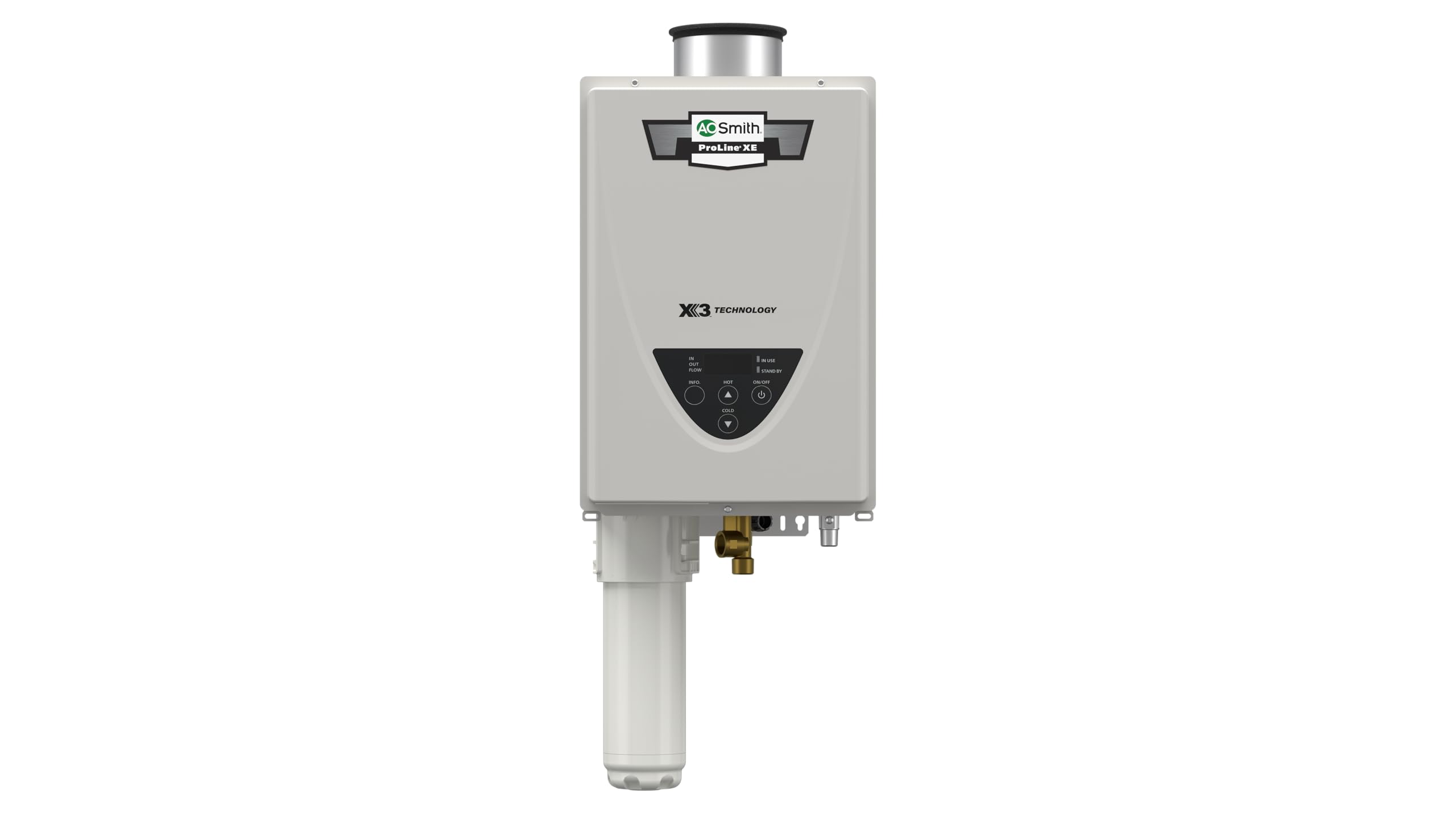
The A. O. Smith ATI-310CX3 is the only unit in this list that integrates X3 Scale Prevention Technology directly into the heat exchanger, eliminating the need for annual descaling and isolation valves. This makes it uniquely suited for homes with hard water, where scale buildup can destroy a standard tankless heater within three years. The commercial-grade copper heat exchanger provides 25 times better heat transfer compared to steel, ensuring consistent 8 GPM flow even after years of use.
Buyers report the unit maintains a steady 115°F output across multiple fixtures with no fluctuations, and the integrated air-fuel ratio (AFR) sensor compensates for variable gas pressure. The 15-year limited heat exchanger warranty (in residential applications) is among the best in the industry, reflecting confidence in the X3 technology. The unit also includes a propane conversion kit in the box, so you can switch fuel types without buying additional parts.
Non-condensing design keeps the upfront cost lower than equivalent condensing models, but the UEF of 0.81 means it’s less efficient. Professional installation is strongly recommended because the concentric vent system (direct vent) requires precise alignment for proper exhaust scavenging. If hard water is a concern in your area, the A. O. Smith’s scale prevention feature alone justifies the investment by eliminating annual maintenance labor.
Why it’s great
- Integrated X3 scale prevention eliminates descaling
- Commercial-grade copper heat exchanger
- 15-year residential heat exchanger warranty
Good to know
- Non-condensing with lower UEF (0.81)
- Concentric vent requires careful professional alignment
7. Westinghouse Smart Outdoor Propane 8.1 GPM
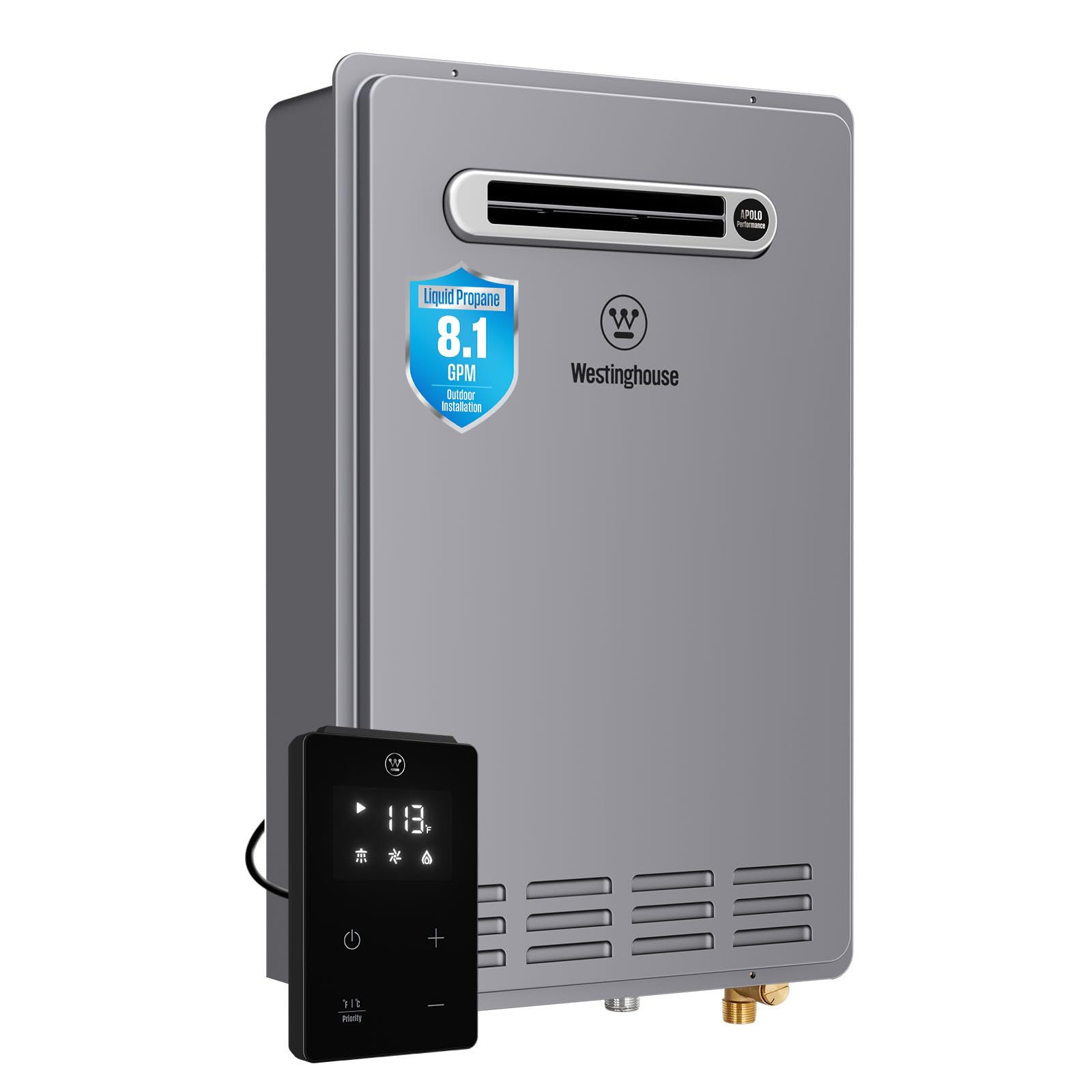
Westinghouse’s outdoor propane model (HS180A0G-LP) solves the problem of indoor venting by mounting on an exterior wall and drawing from a propane tank. Its 180,000 BTU burner produces 8.1 GPM, which is enough for three to five simultaneous fixtures. The included indoor remote control panel lets you adjust temperature and monitor status without walking outside—a real convenience in winter. The self-modulating technology holds water temperature within ±1°F, which is critical when you open a second shower.
Owners mention very easy installation when following the manual’s start-up sequence, and the freeze protection system is effective down to 5°F as long as the unit is properly drained during prolonged non-use. The 3/4″ NPT water connections match standard residential plumbing, so no special adapters are needed for the inlet and outlet. The exterior cabinet is weather-resistant, but direct rain exposure should be avoided with a small awning or overhang.
Non-condensing design keeps the price accessible, but the UEF is lower than what condensing rivals offer. The propane fuel path means you must confirm your gas tank is sized to handle the 180,000 BTU draw; a standard 100-pound tank may require upgrading to a larger one for continuous use. For homeowners with existing propane infrastructure who need a straightforward outdoor install, this Westinghouse delivers reliable performance without the complexity of indoor venting.
Why it’s great
- Outdoor mount eliminates indoor venting entirely
- Wireless remote control for convenient temperature adjustment
- ±1°F temperature stability across multiple fixtures
Good to know
- Requires adequate propane gas line sizing
- Non-condensing design has lower efficiency
8. Westinghouse Smart Indoor Natural Gas 7.9 GPM
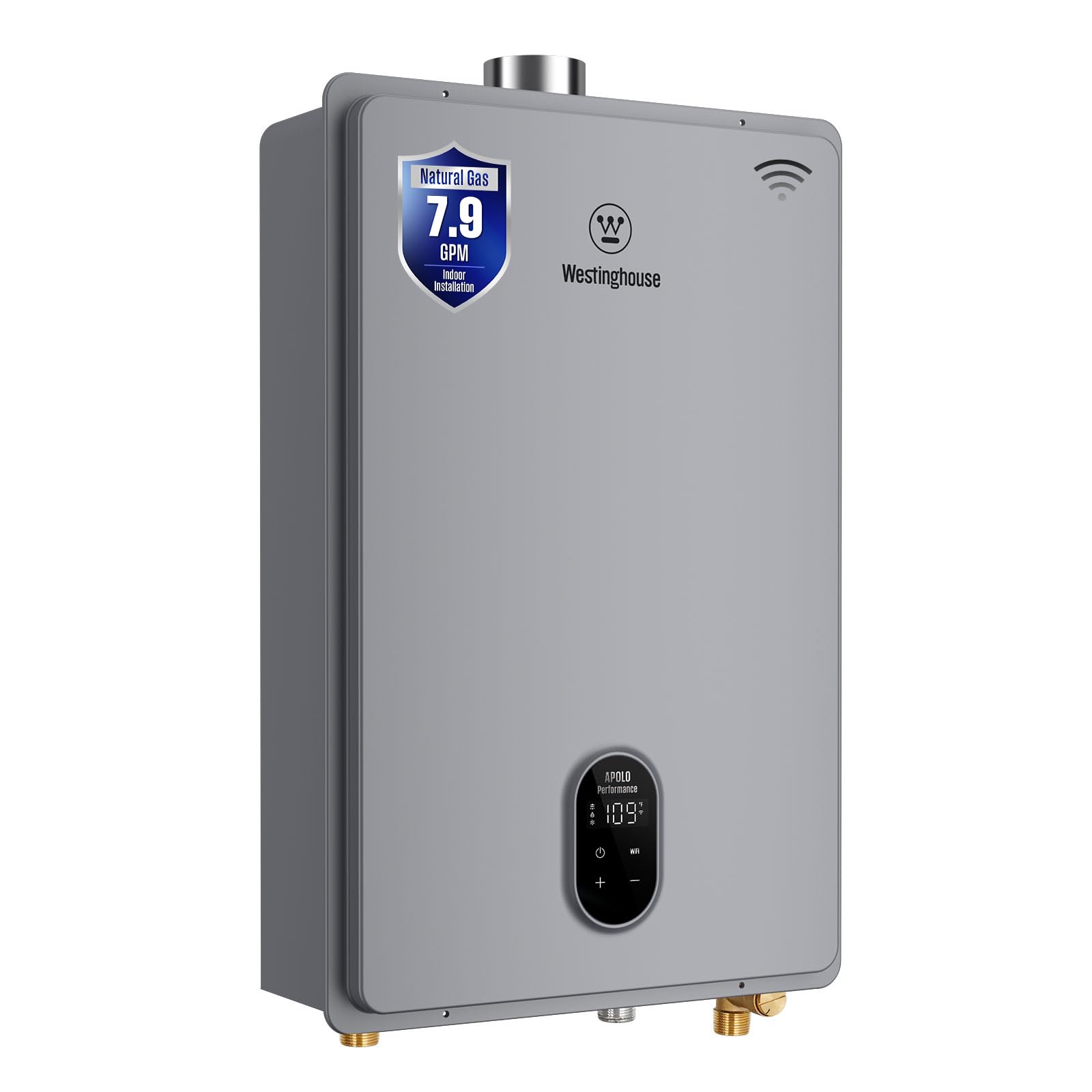
The Westinghouse HW180A0G-NG is an indoor natural gas unit that brings WiFi app control to the mid-range price tier without sacrificing build quality. Its 7.9 GPM flow and 180,000 BTU burner handle three to five fixtures simultaneously, and the self-modulating technology holds temperature within ±1°F. The smartphone app allows you to adjust the water temperature and monitor operating status from anywhere in the house—useful for checking energy usage or preheating before a shower.
Long-term owners report easy step-by-step installation with clear instructions, and several verified buyers highlight the unit’s quiet operation and stable 116°F output once set. The CSA certification and freeze protection give confidence in colder climates, though indoor installation is required. The compact 17.1″ x 26.2″ wall mount frees up floor space that would be occupied by a traditional 75-gallon tank.
Non-condensing design means it vents through standard stainless steel pipe, not PVC, which can simplify retrofitting into homes with existing gas water heater venting. The 150 PSI maximum pressure is standard, but low water pressure areas (15-30 PSI) should be tested to ensure the unit activates at the minimum flow rate. For buyers seeking a smart-enabled, indoor natural gas unit with an accessible price tag and strong brand support, this is the best balanced option.
Why it’s great
- WiFi app control for temperature and status monitoring
- ±1°F precise temperature stability
- Compact wall mount saves floor space
Good to know
- Non-condensing with lower efficiency
- Indoor installation only with standard venting required
9. FOGATTI Natural Gas Outdoor 8.1 GPM
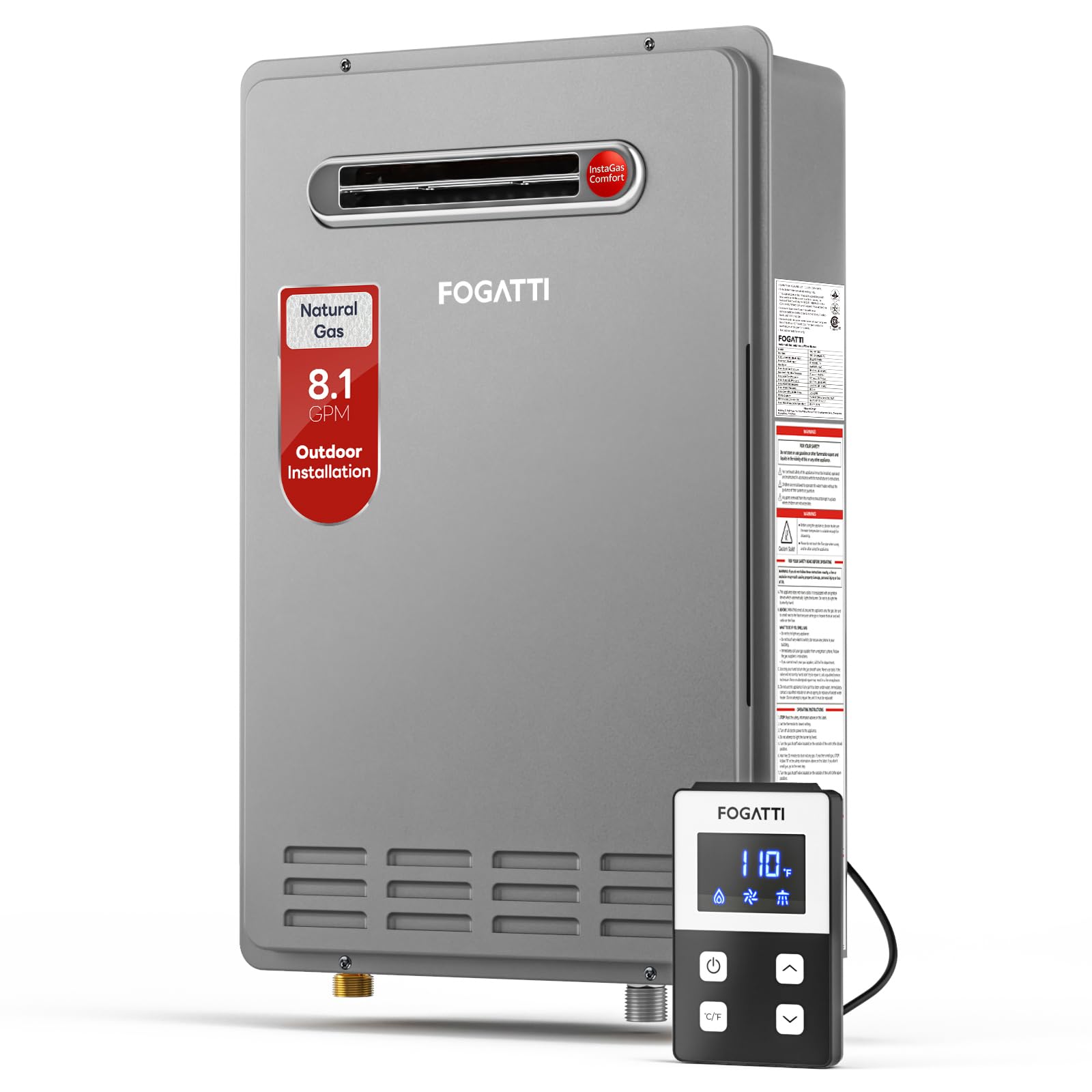
FOGATTI’s 180S series outdoor natural gas unit delivers 8.1 GPM from a 180,000 BTU burner, with a bottom-mounted fan that prevents exhaust backflow and stabilizes combustion—a critical design detail for outdoor installations in windy areas. The included remote control panel mounts indoors, so you can adjust the temperature without stepping outside. The 304 stainless steel burner combined with an oxygen-free copper heat exchanger is a premium materials pairing that resists corrosion in humid outdoor environments.
Owners describe the installation as straightforward for a qualified plumber, and the unit operates reliably in central Florida heat and cold snaps alike. The freeze protection system provides active heating down to 5°F, but users in extreme northern climates should still plan to drain the unit if temperatures drop below that threshold for extended periods. The water servo technology delivers ±1°F temperature stability, and the four-stage combustion system ensures consistent heating even when outdoor temperatures fluctuate.
Non-condensing design means standard venting through the cabinet, but the unit still meets industry certifications (CSA) for safety. The altitude restriction of 2,000 feet means homes at higher elevations may experience reduced performance unless derating calculations are performed. At this mid-range price point, the FOGATTI balances premium materials with a cost-effective non-condensing design, making it a strong choice for homeowners in milder climates.
Why it’s great
- Bottom-mounted fan prevents wind-induced exhaust backflow
- Premium materials: 304SS burner and oxygen-free copper
- ±1°F temperature stability with water servo technology
Good to know
- Non-condensing lower efficiency
- Altitude restriction of 2,000 feet
10. FOGATTI Propane Indoor 7.5 GPM
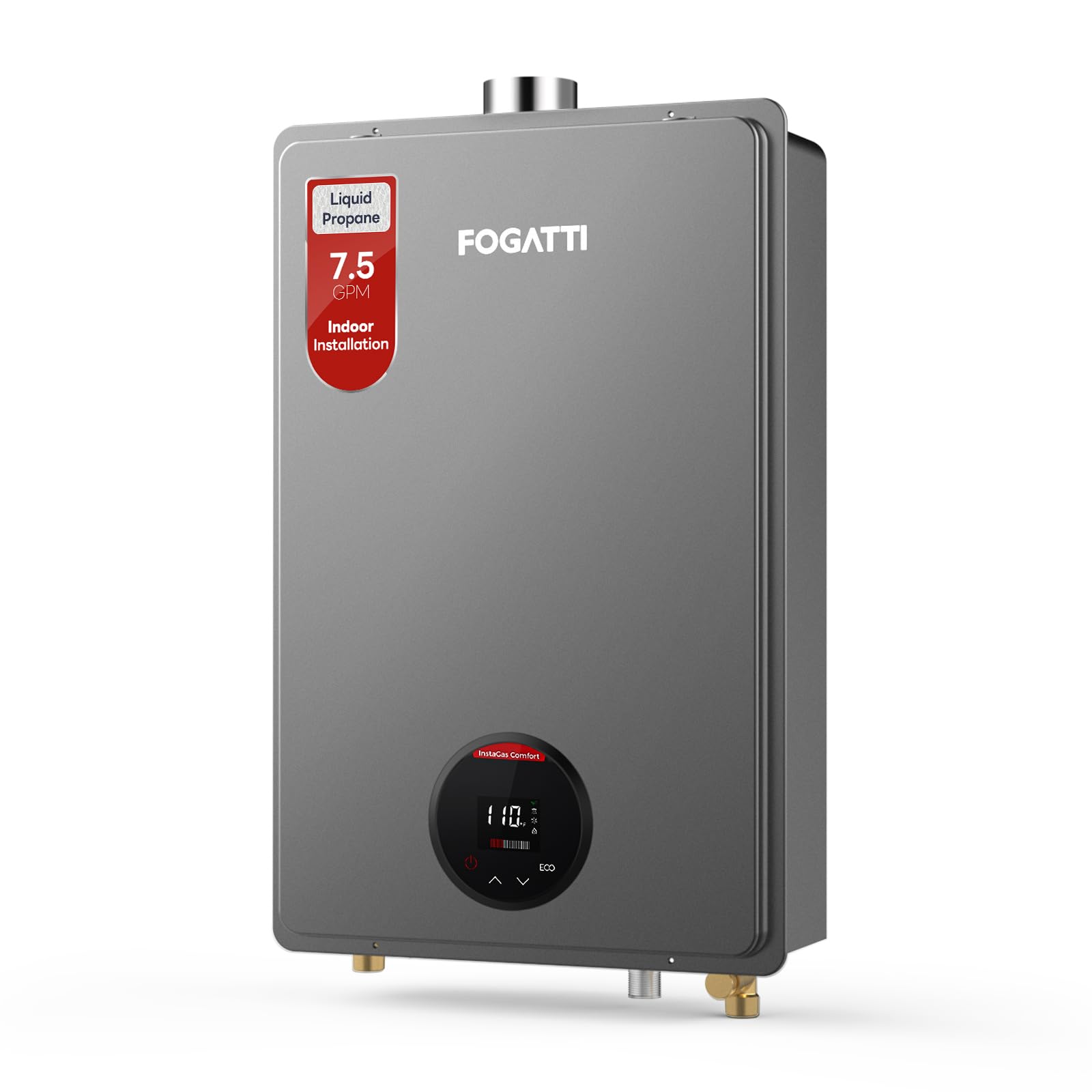
For homes with propane supply and limited indoor wall space, the FOGATTI 170S series indoor unit (7.5 GPM, 170,000 BTU) is a compact solution that fits in a footprint roughly one-third the size of a 75-gallon tank. Its key differentiator is compatibility with low water pressure as low as 15 PSI, making it an excellent choice for rural homes on well systems or properties with weak municipal supply. The water servo technology adjusts flow and gas intake to maintain ±1°F stability even at minimal inlet pressure.
Buyers converting from an old tank-style water heater report that the install was manageable for an experienced DIYer with knowledge of gas line sizing, but professional help is still recommended for the propane gas line connection. The unit’s copper heat exchanger and 304 stainless steel burner promise durability, and the CSA certification ensures it meets U.S. safety standards. End users note the immediate hot water response and the ability to run three to four outlets simultaneously without performance loss.
As a non-condensing unit, it vents through standard Category III stainless steel pipe, which must be correctly sized to prevent condensation from damaging the heater. The altitude limit of 2,000 feet also applies here, so high-elevation buyers should consider derating. If indoor propane is your fuel of choice and you need a compact unit that handles low incoming water pressure, this FOGATTI delivers consistent results without the premium price tag of condensing models.
Why it’s great
- Operates reliably at low inlet water pressure (15 PSI)
- Compact dimensions for tight installation spaces
- Integrated water servo for ±1°F temperature precision
Good to know
- Non-condensing lower efficiency
- Propane gas line sizing must match 170,000 BTU draw
11. MIZUDO Natural Gas Outdoor 8.1 GPM
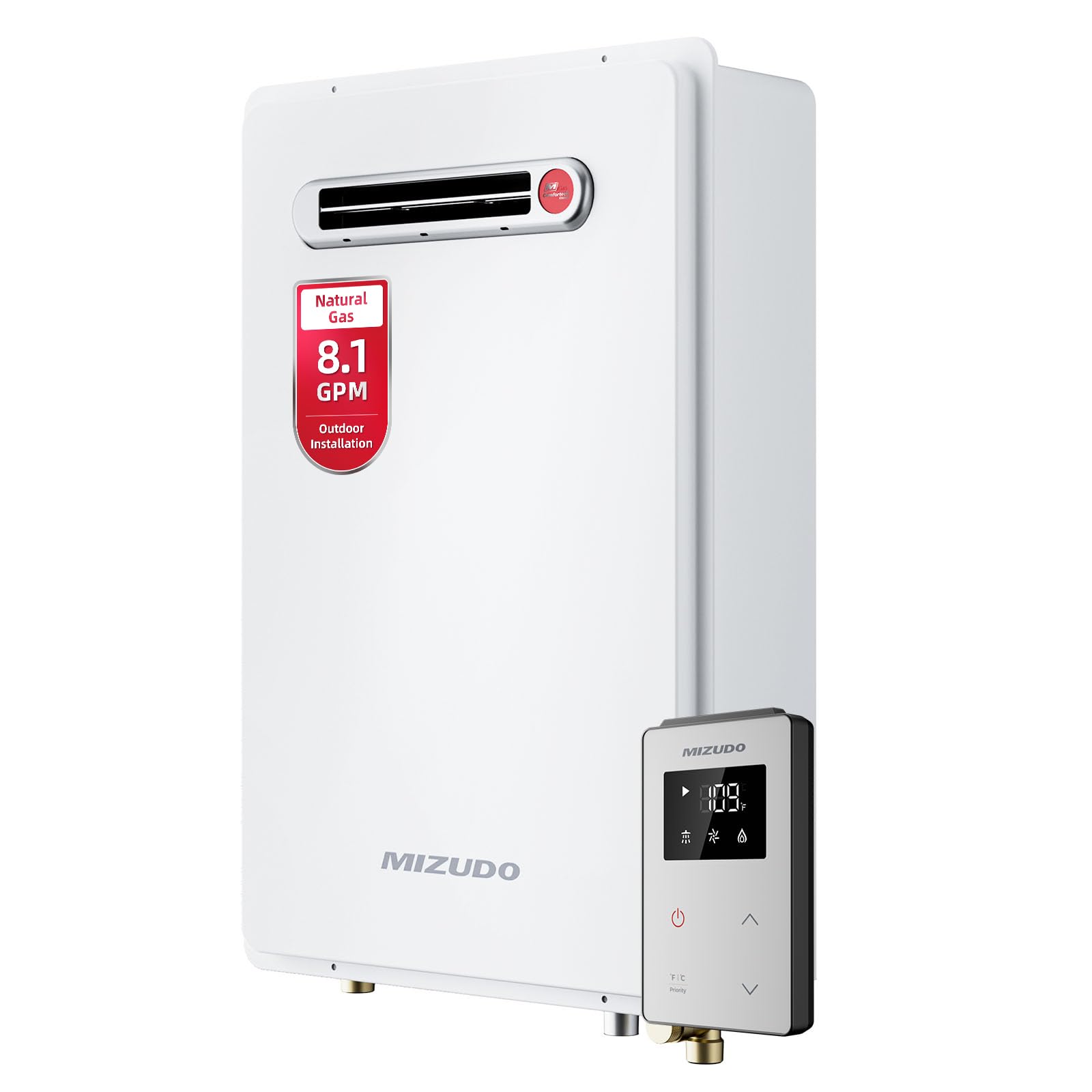
MIZUDO’s 8.1 GPM natural gas outdoor unit brings a 6-stage combustion system that delivers 180,000 BTU with ±1°F stability, supported by water servo technology. The bottom-mounted fan prevents exhaust backflow and is protected by an IMD (in-mold decoration) surface on the LED display that resists UV fading. The CSA certification ensures compliance with safety standards, and the 5-year heat exchanger warranty demonstrates confidence in the build.
Owners note the unit is surprisingly quiet for its output, with water heating up within 35-40 seconds even when lines are long. The install is straightforward for gas-rated plumbers, but some buyers report the supplied gas fitting is not a standard 1/2″ MIP, requiring an adapter from a local hardware store. The 2-year full unit warranty and responsive customer support have received positive feedback from early adopters.
The non-condensing design keeps the price accessible, but the unit is outdoor-only—there is no indoor convertible version. The freeze protection is active heating down to 5°F, but the manual recommends fully draining the system if temperatures drop below that threshold or during extended non-use. For buyers who want a reliable outdoor natural gas unit with a robust burner system and strong warranty coverage, MIZUDO offers excellent value at this mid-range price point.
Why it’s great
- 6-stage combustion for precise temperature control
- IMD LED display resists UV degradation outdoors
- 5-year heat exchanger warranty for peace of mind
Good to know
- Outdoor installation only (no indoor conversion)
- Gas fitting requires adapter for standard 1/2″ MIP
12. MIZUDO Propane 5.1 GPM Indoor/Outdoor
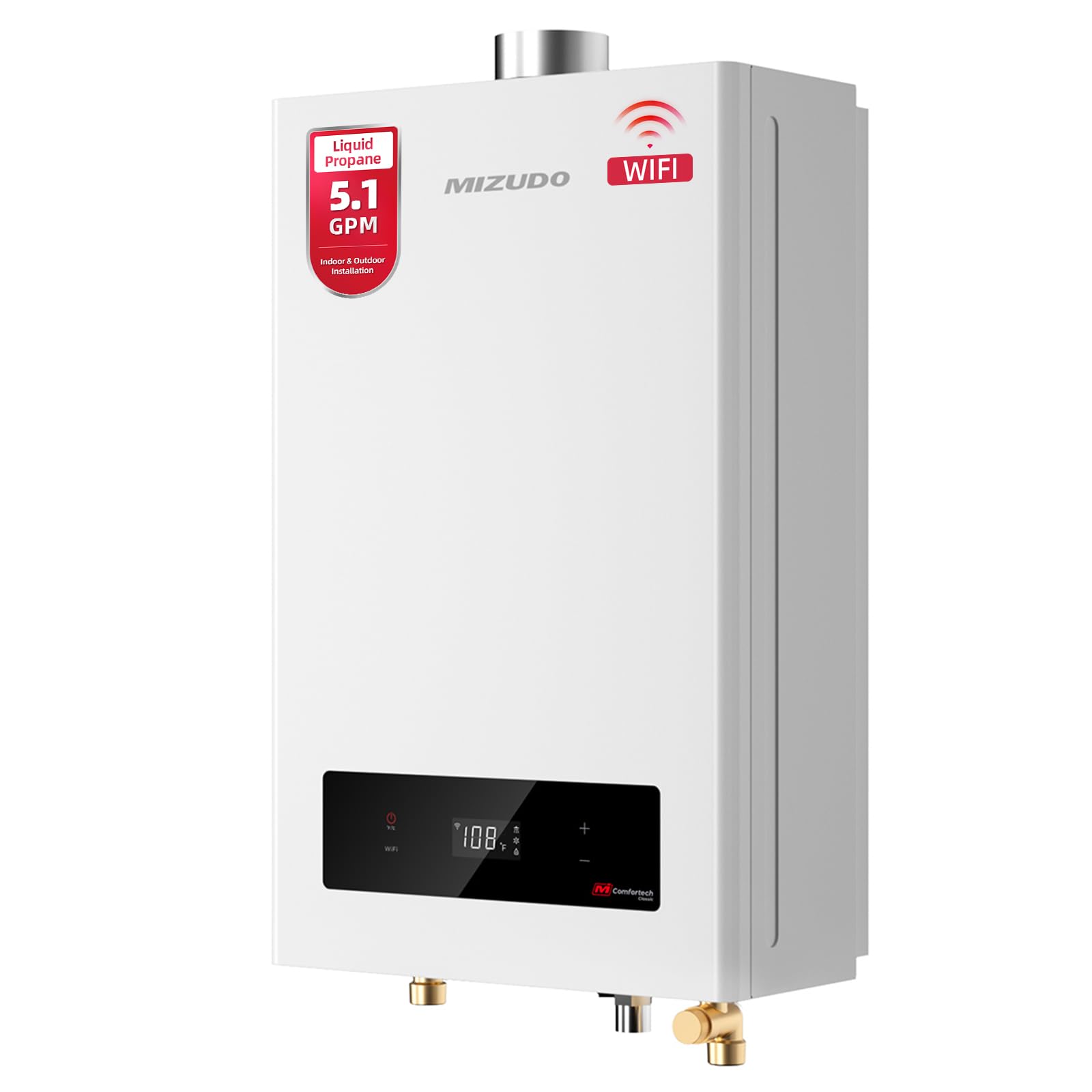
The MIZUDO 5.1 GPM propane unit offers convertible indoor/outdoor installation via accessory kits, making it uniquely flexible for homes that may relocate the water heater in the future. Its 120,000 BTU output is lower than competitors in this list, but 5.1 GPM is still sufficient for houses with two simultaneous showers and a kitchen faucet. WiFi and app control provide convenience for temperature adjustments and usage monitoring, a feature rarely seen at this flow rate tier.
Owners confirm the unit heats water quickly with stable temperature output, and the install process is described as surprisingly simple for a gas appliance. The phosphorous-deoxidized copper heat exchanger resists corrosion better than standard copper, while the 304 stainless steel combustion chamber handles the thermal stress of propane combustion. The CSA certification and integrated safety systems (freeze protection, flame failure detection) instill confidence in homes with young children or elderly residents.
The 5.1 GPM flow is the limiting factor here—households with large soaking tubs or simultaneous three-shower demands will notice the drop in flow. The kit for conversion between indoor and outdoor use requires separate purchase (vent pipe for indoor, vent cap for outdoor). For smaller households or vacation properties where propane is the fuel source and the ability to switch installation location is valuable, this MIZUDO offers a unique combination of flexibility and smart features.
Why it’s great
- Indoor/outdoor convertible with accessory kits
- WiFi and app control for remote temperature management
- Corrosion-resistant phosphorous-deoxidized copper heat exchanger
Good to know
- Lower flow rate (5.1 GPM) limits simultaneous use
- Conversion kits sold separately
13. APUS Outdoor Propane 8.1 GPM
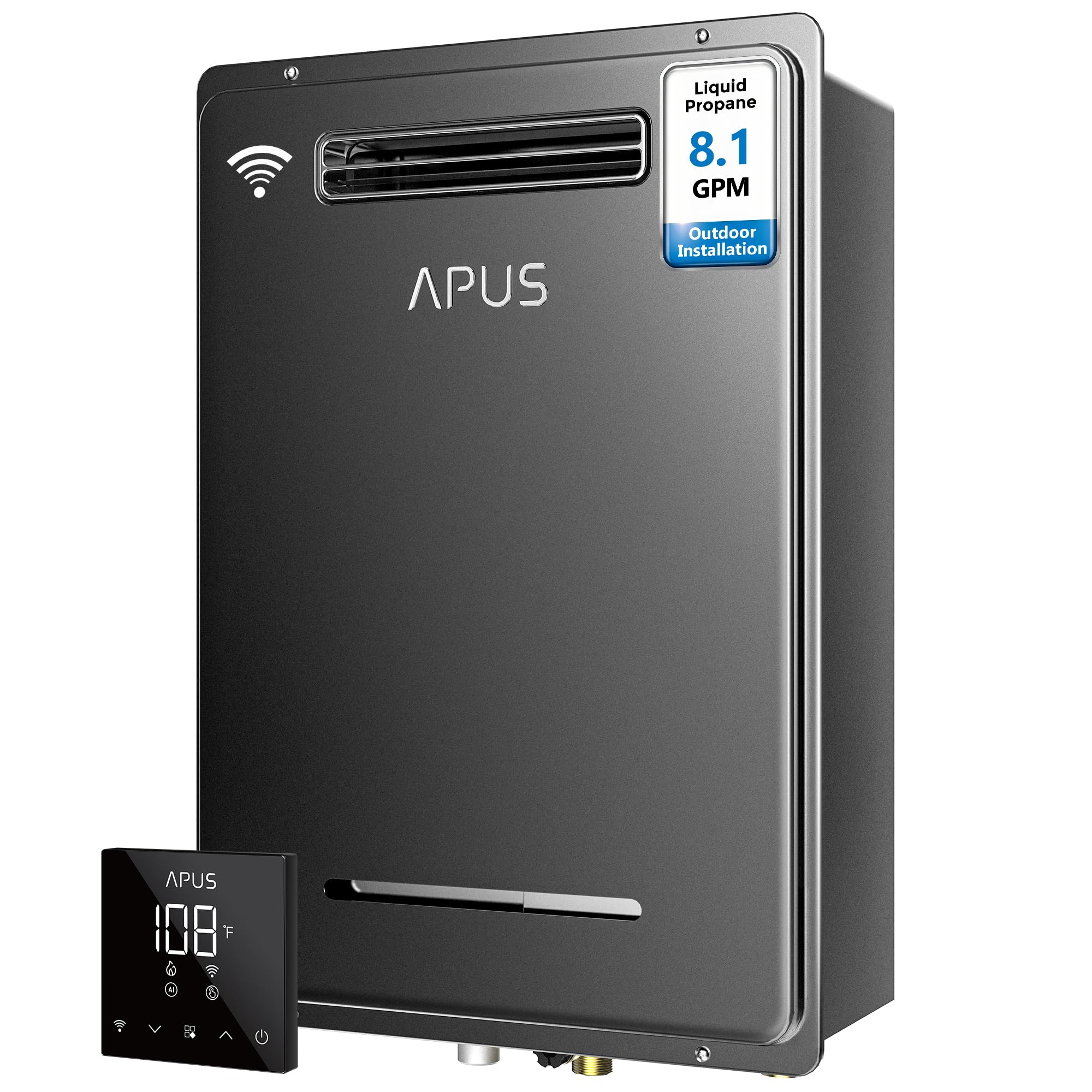
The APUS 190,000 BTU outdoor propane unit enters this list as the most budget-friendly option, yet it still delivers a 8.1 GPM flow rate that rivals mid-range models. The 100% oxygen-free copper heat exchanger is 30% more efficient than conventional copper, according to the manufacturer, and the intelligent staged combustion claims 20% energy savings over standard gas water heaters. The WiFi control via the Tuya app allows bathers to set the temperature between 95°F and 149°F from anywhere.
Buyers in cold climates report the unit has not frozen during winter use, thanks to the wind-resistant design (rated to 10-level wind) and electric anti-freeze protection. Reviewers mention the install was easy for those comfortable drilling holes for water lines, though some had to purchase additional valve bodies locally. The 0.79 GPM minimum flow rate means even weak well pressure systems can trigger the heater reliably, a distinct advantage over many low-cost units that require higher flow to activate.
Non-condensing design and the lower price point means the UEF will be around 0.81. The 2-year full warranty is standard for this tier. Some owners note that the unit requires a 120V AC power source, which means a nearby electrical outlet must be available at the outdoor installation location. For buyers on a tight budget who need genuine 8.1 GPM performance and are willing to handle a DIY-install-friendly outdoor unit, the APUS delivers the highest flow per dollar spent.
Why it’s great
- 100% oxygen-free copper heat exchanger for efficiency
- 0.79 GPM min activation works with low water pressure
- WiFi control via Tuya app for remote temperature adjustment
Good to know
- Non-condensing design with lower efficiency
- Requires nearby 120V AC outlet for operation
FAQ
Can a tankless water heater replace a 75 gallon tank without changing gas line size?
What is the difference between condensing and non-condensing for a 75 gallon gas water heater?
How do I prevent my outdoor gas water heater from freezing in winter?
Final Thoughts: The Verdict
For most users, the 75 gallon gas water heater winner is the Rinnai RU199iN because its condensing design, 11 GPM flow, and 15-year heat exchanger warranty deliver the best balance of efficiency and capacity for a large household. If you need an outdoor unit with minimal complexity, grab the Rheem RTG-84XLN-3. And for budget-conscious buyers who still demand 8.1 GPM performance, nothing beats the APUS Outdoor Propane.