
Our readers keep the lights on and the weekend projects moving. As an Amazon Associate, I earn from qualifying purchases.
You can’t see dust, CO₂ buildup, or volatile organic compounds, but your body sure feels them—brain fog, restless sleep, scratchy throat, low energy. An air monitor puts hard numbers on the invisible air you live in, showing you exactly when to crack a window or run a purifier. Without one, you are literally guessing at half the environment your lungs inhabit every night and every workday.
I’m Rikta — the co-founder and writer behind FitlyFast. I’ve spent years studying sensor technologies like NDIR CO₂ detection, laser particle counters, and photoionization VOC meters to distinguish dependable hardware from marketing fluff.
After comparing sensor accuracy, battery life, connectivity, and real-world usefulness across seven models, I built this guide to help you pick the best air monitor for your home, office, or workshop based on what actually matters for your specific space.
How To Choose The Best Air Monitor
Not all air monitors measure the same things. Some track only PM2.5 and temperature, while others give you a full panel of CO₂, VOCs, formaldehyde, and even radon. Picking the right one comes down to knowing what pollutants actually matter in your space and how you plan to use the data.
Match the Sensor Suite to Your Environment
For most homes, CO₂ is the single biggest invisible factor that affects focus and sleep—above 1000 ppm you’ll feel drowsy, above 2000 ppm headaches set in. If you live near a busy road or have pets, PM2.5 sensitivity matters because fine particles carry allergens and combustion byproducts. Workshops using paint, resin, or laser cutters need VOC and formaldehyde detection. Basements and ground-floor rooms benefit most from radon monitoring, which requires a completely different sensor technology (alpha spectrometry).
Prioritize Refresh Rate and Battery Life
A monitor that samples air every 2 seconds vs every 5 minutes makes a massive difference when you’re trying to see if opening a window actually helped. Fast refresh rates are essential for real-time feedback. At the same time, battery life determines whether you’ll actually move the device room to room or just leave it plugged into one wall. E-ink displays and interval-sampling modes can stretch battery life from two days to over two months, which is critical for bedrooms where you don’t want bright lights or constant fan noise from a powered sensor.
Check Connectivity and Data Export
Bluetooth and WiFi connectivity let you check readings from your phone, but more importantly, they enable data logging over weeks or months. Seeing that your CO₂ spikes every night at 3 AM tells you far more than a single snapshot. Some monitors offer 2-year data export for trend analysis, while others only show current values. If you plan to use the monitor to inform decisions about ventilation, purifier placement, or HVAC schedules, prioritize models that store and share historical data.
Quick Comparison
On smaller screens, swipe sideways to see the full table.
| Model | Category | Best For | Key Spec | Amazon |
|---|---|---|---|---|
| Temtop M10+ | 6-in-1 Premium | Family Bedrooms & Basements | 60-day battery (E-ink) | Amazon |
| BREATHE Airmonitor Plus | Professional Grade | Office & Allergy Tracking | PM1/2.5/10 + VOC + HCHO | Amazon |
| Temtop M10+ (Entry Level) | Budget Combo | Value-focused homes | Cost-effective 2-pack | |
| Airthings Corentium Home 2 | Radon Specialist | Basement & Ground Floor | Alpha spectrometry | Amazon |
| KDWKD Multi-Sensor | Comprehensive | Workshop & Renovation | 9-hour battery, color screen | Amazon |
| GoveeLife H5106 | Smart Home Hub | Smart Home Integration | WiFi, 2s refresh | Amazon |
| Temtop S1 (2-Pack) | Dual-Zone Value | Multi-Room Monitoring | 12 days battery (Smart mode) | Amazon |
| Temtop C1 | CO₂ Focused | Office & Nursery | 70-day battery, NDIR | Amazon |
In‑Depth Reviews
1. Temtop M10+

The Temtop M10+ strikes the best balance between sensor depth and practical daily use. It measures CO₂, PM2.5, VOC, temperature, and humidity on a crisp e-ink display that stays readable in direct sunlight and emits zero light pollution at night. The energy-efficient algorithm paired with that e-ink panel delivers up to 60 days of battery life—far beyond anything else in this roundup—making it a set-and-forget solution for bedrooms or nurseries.
Through the Temtop app, you get real-time data, historical trend analysis, and OTA firmware updates that keep the device relevant as the software improves. The Bluetooth connection stays stable, and the ability to mute the buzzer alarm means no startled awakenings when CO₂ creeps up overnight. Users consistently report readings that match their lived experience—waking up groggy with a 1200 ppm CO₂ spike, then watching it drop to 500 ppm after opening a door.
The tradeoff is that the 6-in-1 sensor set does not include PM10 or formaldehyde, which are useful for workshop or renovation environments. The app interface, while functional, lacks the polish of bigger smart-home ecosystems. Still, for the combination of sensor breadth, battery endurance, and silent operation, the M10+ is the most versatile air monitor a typical home can buy.
Why it’s great
- Up to 60 days of battery life eliminates the need to hunt for outlets.
- E-ink display is completely silent and doesn’t disturb sleep.
- Covers the four most important residential pollutants (CO₂, PM2.5, VOC, temp/humidity).
Good to know
- No PM10 or formaldehyde detection for heavier workshop particles.
- App is functional but not as polished as Govee’s ecosystem.
- No WiFi—requires Bluetooth proximity for remote viewing.
2. BREATHE Airmonitor Plus
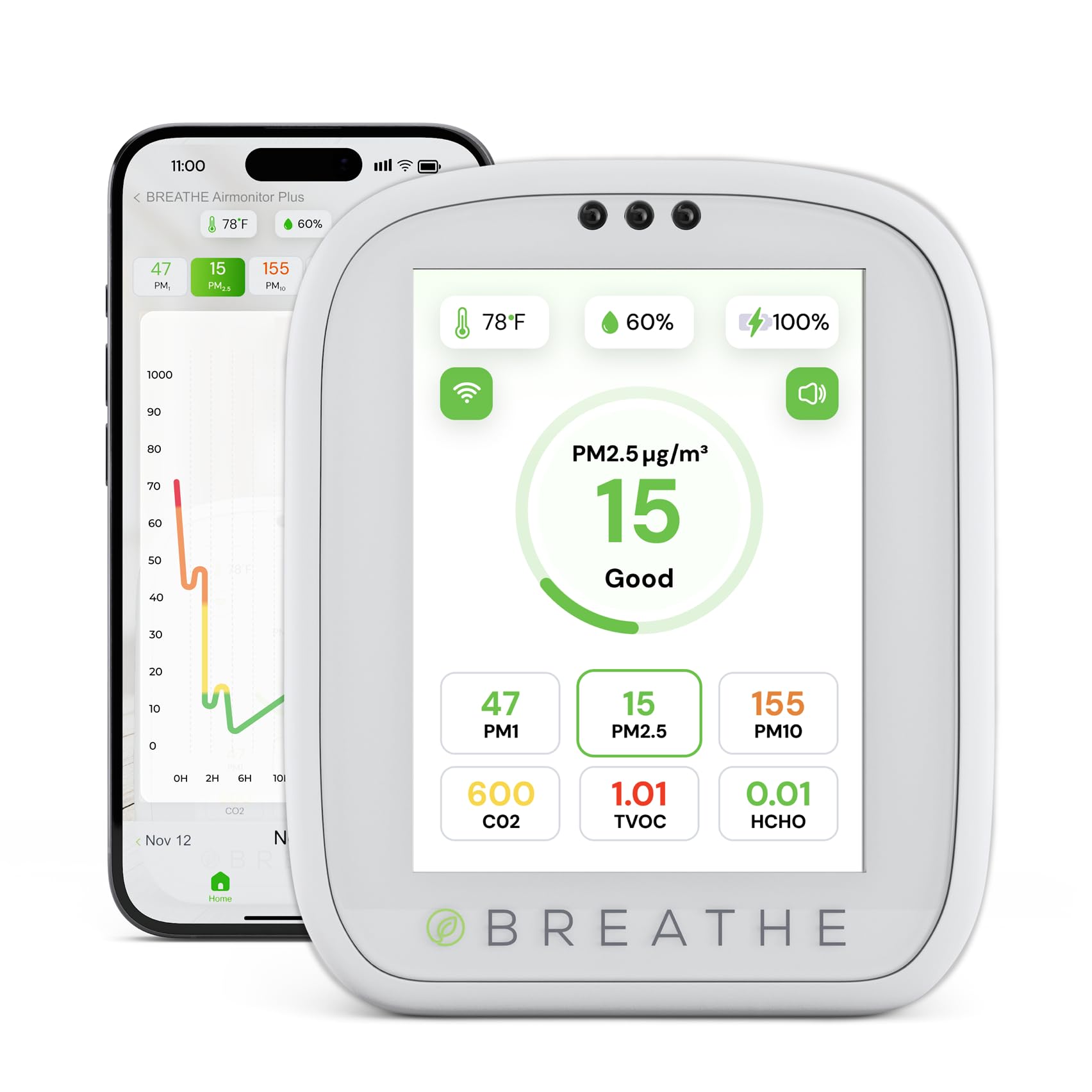
The BREATHE Airmonitor Plus is the most sensor-comprehensive unit in this lineup, tracking CO₂, PM1, PM2.5, PM10, TVOC, formaldehyde (HCHO), temperature, and humidity. This depth matters if you’re managing allergies, living near construction zones, or trying to pinpoint the source of recurrent headaches that might come from a mix of particles and gasses. The NDIR CO₂ sensor and laser particle counter deliver readings that users successfully cross-verified against professional-grade reference devices.
Setup takes under 30 seconds via the Breathe Tech app, which gives you remote monitoring, real-time alerts, and a 30-day data history to track trends. The modern, compact design fits neatly on a desk or nightstand without screaming “lab equipment,” and the quick calibration tools for CO₂, VOC, and HCHO ensure you can trust the baseline values. One reviewer noted it detected a CO₂ spike to 4500 ppm in a closed room—a clear ventilation warning that prompted immediate action.
Potential downsides include a display that some users find too bright even at the lowest setting, and a battery life measured in hours rather than days when unplugged. The ABC (Automatic Background Calibration) system for CO₂ can drift low in consistently high-CO₂ environments, so users in tightly sealed homes may need to manually recalibrate. For dedicated air quality analysts who want the deepest pollutant profile, this is the most capable option available.
Why it’s great
- Measures PM1, PM2.5, and PM10—essential for fine and coarse particle tracking.
- Formaldehyde sensor is rare at this price tier and critical for new furniture or renovations.
- App provides 30-day history with clear trend graphs.
Good to know
- Must remain plugged in for continuous monitoring; internal battery is short.
- ABC algorithm can under-report CO₂ in high-CO₂ homes without manual recalibration.
- Display brightness cannot be fully dimmed for sensitive sleepers.
3. Airthings Corentium Home 2
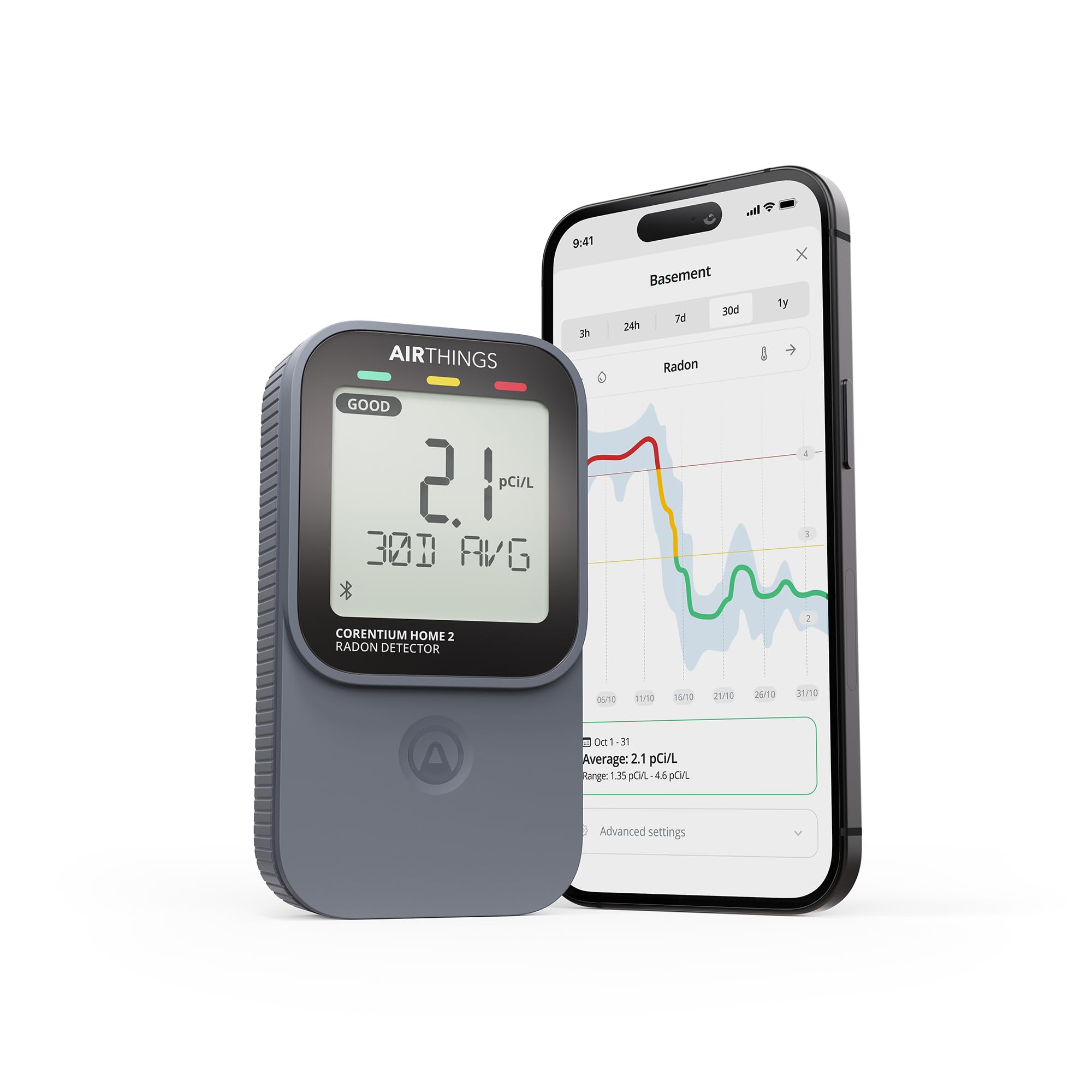
The Airthings Corentium Home 2 sits in a unique position because it addresses a pollutant no other monitor on this list can detect: radon gas. Radon is the second leading cause of lung cancer after smoking, and it’s invisible, odorless, and tasteless—you cannot know it’s there without an alpha spectrometry sensor. This updated version of the best-selling original adds Bluetooth connectivity, bonus temperature and humidity sensors, and a redesigned display that shows short and long-term averages with simple Good/Fair/Poor indicators.
Professional radon mitigators and home inspectors trust Airthings’ patented sensing technology, and users who cross-checked against short-term test kits confirm the readings are accurate. The device runs on two AA batteries for years of continuous monitoring, requires zero installation, and can be placed anywhere—including basements where radon levels are typically highest. The app graphs show how radon levels fluctuate with weather, ventilation, and HVAC cycles, enabling you to take targeted actions like opening basement windows or running a mitigation fan.
This is not a general-purpose air monitor; it tracks radon first and foremost, with temperature and humidity as bonus data. If radon is your primary concern—and every homeowner with a basement should consider it—this is the definitive choice. The higher investment reflects the specialized sensor technology and the peace of mind that comes from knowing you’re not breathing a carcinogen in your sleep.
Why it’s great
- Professional-grade alpha spectrometry for accurate radon detection.
- Runs for years on two AA batteries with no wiring or charging needed.
- App shows long-term trends and provides personalized mitigation advice.
Good to know
- Does not measure CO₂, PM2.5, VOCs, or formaldehyde.
- Higher price reflects the specialized radon sensor, not general air quality.
- Bluetooth only—requires separate Hub for remote WiFi access.
4. KDWKD Multi-Sensor
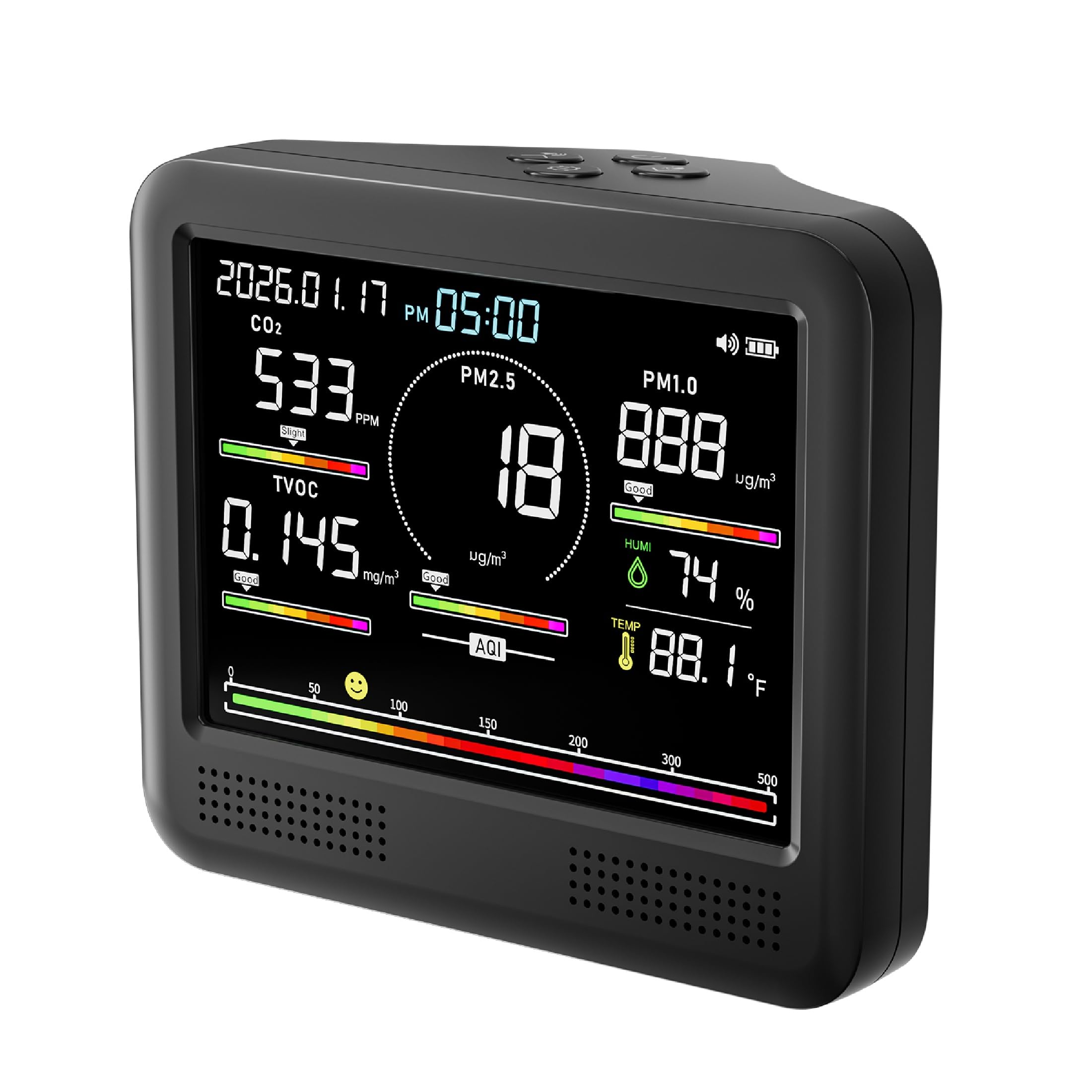
The KDWKD Multi-Sensor is the widest particle-range detector on this list, tracking PM0.3, PM0.5, PM1.0, PM5.0, and PM10 alongside CO₂, formaldehyde (HCHO), TVOC, temperature, and humidity. That means it can differentiate between the ultrafine particles from cooking smoke and the heavier dust from construction, giving you an unusually granular view of what’s actually floating in your air. The 7-level AQI display with color coding makes interpretation immediate—green to red tells you at a glance whether it’s time to ventilate.
Its built-in rechargeable battery lasts up to 9 hours, which is enough for a full workday of spot-checking around the house or taking it into a hotel room. The large color screen is easy to read from across a desk, and the audible alerts provide an extra safety net if you’re focused on a task like laser engraving or painting. Reviewers who bought it for workshop use confirm it responds instantly to fumes from paint, resin, and even scented oils, flagging VOC spikes that other monitors might miss.
The downside is that 9-hour battery life means you’ll need to charge it daily if you want round-the-clock monitoring—it’s more of an active diagnostic tool than a passive set-and-forget device. The brand (KDWKD) is less established than Temtop or Airthings, and some users reported the app connection was finicky during initial setup. For anyone who needs to survey particle sizes from ultrafine to coarse, this is the most complete spec sheet available at this price.
Why it’s great
- Measures particles down to PM0.3 and up to PM10—best range in class.
- Formaldehyde sensor is critical for detecting off-gassing from new furniture.
- Color screen with 7-level AQI is intuitive and fast to read.
Good to know
- 9-hour battery requires daily charging for continuous use.
- Brand is relatively new with limited long-term reliability data.
- App connection can be inconsistent on first pairing.
5. GoveeLife H5106

The GoveeLife H5106 is designed for the smart home enthusiast who wants sensors to talk to each other. It measures PM2.5, temperature, and humidity with a 2-second refresh rate—the fastest sampling in this roundup—and connects over 2.4 GHz WiFi to allow remote monitoring from anywhere via the GoveeHome app. The real killer feature is IFTTT-like automation: you can set it to trigger a Govee air purifier, humidifier, or space heater when PM2.5 or humidity crosses a threshold, creating a closed-loop air quality system.
Users consistently praise the app for its clean design, 2-year data storage and export capability, and hassle-free pairing with other Govee devices. The H5106 can also display the time and includes a bright LED indicator that shows 4 air quality levels—green, yellow, orange, red—so you get instant visual feedback even from across the room. Reviewers confirmed the PM2.5 sensor accurately detected dust spikes during vacuuming and sawdust during woodworking, matching readings from the company’s own purifiers.
The major limitation is that the H5106 has no internal battery—it must remain plugged into USB-C power at all times, which restricts placement to near an outlet. It also lacks CO₂ and VOC sensors, focusing purely on particles and climate. If you’ve already invested in the Govee ecosystem and want a responsive PM2.5 trigger for your purifier, this is the most seamless integration you can buy. For standalone monitoring, the cord dependency makes it less flexible than battery-powered alternatives.
Why it’s great
- 2-second sample rate is the fastest refresh for detecting real-time changes.
- WiFi enables remote monitoring and 2-year data export.
- Automates Govee purifiers, humidifiers, and heaters based on air quality.
Good to know
- Requires constant USB-C power—not portable.
- No CO₂ or VOC sensor, limited to PM2.5 and climate.
- Some users report occasional 30% failure rate for automated purifier triggers.
6. Temtop S1 (2-Pack)
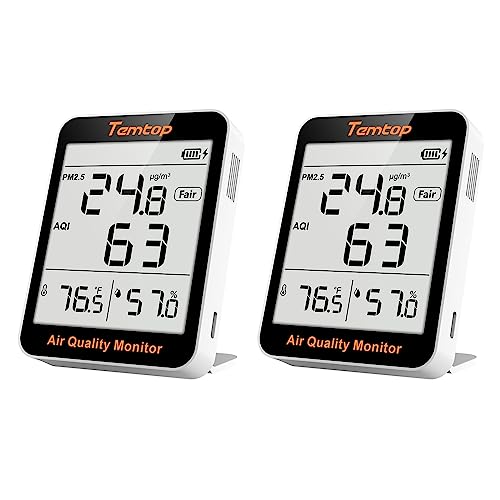
The Temtop S1 2-Pack is the only multi-unit bundle in this list, giving you two portable PM2.5/AQI/temperature/humidity monitors for the price of one premium device. That makes it ideal for monitoring two different rooms—say, a baby’s nursery and your home office—or keeping one upstairs and one downstairs to compare airflow patterns. Each unit features a 3.3-inch LCD screen with large digits, a magnetic back for easy attachment to metal surfaces, and a built-in fan that pulls ambient air past a laser particle sensor for real-time measurement.
Four smart modes let you dial in battery life from 12 hours (real-time mode) up to 25 days (power-saving mode), so you can run it continuously on a nightstand without recharging every other day. Users with sinus issues and allergies have used the S1 to confirm their indoor air stays clean even during high-pollen seasons, which helps with peace of mind. The interface is dead simple—no app, no Bluetooth pairing, just a screen that shows AQI, PM2.5, temperature, and humidity in clear numbers.
The lack of any wireless connectivity means you cannot view historical data or receive alerts on your phone—this is purely a real-time display device. It also omits CO₂ and VOC detection, so it won’t tell you anything about gas buildup from people breathing or off-gassing from paint. For the budget-conscious household that wants to keep an eye on particulate levels in two rooms without any smart-home complexity, this pack delivers excellent value.
Why it’s great
- Two monitors in one package allow multi-room comparison.
- Magnetic back makes placement on fridge or metal shelf effortless.
- Up to 25 days of battery life in power-saving interval mode.
Good to know
- No WiFi, Bluetooth, or app connectivity—data stays on the screen.
- No CO₂ or VOC sensors, limited to PM2.5 particulate only.
- Laser sensor is accurate but slower to respond than NDIR-based units.
7. Temtop C1

The Temtop C1 is a focused CO₂ monitor that prioritizes accuracy and battery endurance above all else. Its Swiss-engineered NDIR sensor delivers ±40 ppm +5% accuracy within the critical 400–2500 ppm range, with a 5-second refresh rate and 1 ppm resolution. That level of precision matters when you’re trying to differentiate between a comfortable 800 ppm room and a headache-inducing 1400 ppm space. It also tracks temperature and humidity, rounding out the three environmental factors that most directly affect comfort during sleep and work.
The newest version of the C1 uses a photoacoustic CO₂ sensor that achieves up to 70 days of battery life in dual detection modes, making it the longest-running monitor in this roundup. The slim, portable design includes mounting options and a bracket, so you can attach it to a wall or stand it on a desk without it taking up much space. Users consistently report that the C1 revealed startling overnight CO₂ readings (1100–1200 ppm) that prompted simple ventilation changes, cutting the levels in half within minutes of opening a door.
The C1 cannot measure PM2.5, VOCs, formaldehyde, or radon—it is exclusively a CO₂/climate device. The buzzer alarm is described as quiet by some, and the display lacks a backlight, which means you cannot read it at night without an external light source. If your primary concern is understanding how occupancy and ventilation affect CO₂—which is the most common invisible air problem in homes and offices—this is the most accurate and longest-running sensor available.
Why it’s great
- NDIR sensor delivers ±40 ppm accuracy in the most critical range.
- 70-day battery life sets the endurance standard for portable monitors.
- Alarm and display can be fully silenced for uninterrupted sleep.
Good to know
- No PM2.5, VOC, formaldehyde, or radon detection.
- No backlight makes nighttime reading difficult.
- Buzzer alarm is too quiet for some users to hear from adjacent rooms.
FAQ
What CO₂ level should I worry about in my bedroom?
Why do some air monitors need to stay plugged in while others run for months?
Can an air monitor detect mold?
Do I need a separate radon detector or will a general air monitor work?
Final Thoughts: The Verdict
For most users, the best air monitor winner is the Temtop M10+ because it combines the widest practical sensor set (CO₂, PM2.5, VOC, temp, humidity) with a 60-day e-ink battery life that lets you place it anywhere and forget about it. If you want professional-grade depth with PM1/PM10 and formaldehyde tracking, grab the BREATHE Airmonitor Plus. And for radon detection—a completely different threat—nothing beats the Airthings Corentium Home 2.