
Our readers keep the lights on and the weekend projects moving. As an Amazon Associate, I earn from qualifying purchases.
Securing a reliable AED for your church is a vital step in protecting your congregation until emergency services arrive, but the market is flooded with professional training kits and single-unit defibrillators, making it hard to distinguish what you actually need for your sanctuary space.
I’m Rikta — the co-founder and writer behind FitlyFast. I’ve spent years analyzing emergency medical equipment categories and advising community spaces on how to select life-safety hardware that balances cost, ease of use, and long-term maintenance needs.
After combing through specs, warranties, and real-user reports on seven leading models, I’ve narrowed down the critical factors that define the best aed for church use, focusing on self-testing capabilities, voice-guidance clarity, and pad cartridge longevity to ensure you spend budget wisely and keep your device ready at all times.
How To Choose The Best AED For Church
Selecting an AED for a church environment involves balancing the need for a simple, self-maintaining device with the reality that many church settings double as training centers for CPR-certified volunteers. The right choice depends on voice prompt clarity, pad replacement intervals, battery life, and whether your team will train on the same hardware.
Automatic Self-Testing and Maintenance-Free Design
In a church, the AED will likely be wall-mounted in a cabinet or stored in a sacristy closet for months without human attention. The single most important feature for this use case is a device that performs daily, weekly, and monthly self-tests—verifying battery charge, pad cartridge integrity, and internal electronics—so you never have to manually check it. The Philips HeartStart OnSite series excels here, eliminating the risk of finding a dead battery on the day of an emergency. For training kits, you accept manual pre-session checks, but the storage unit defibrillator should require zero human maintenance.
Voice Prompt Clarity and Step-by-Step Guidance
When a cardiac emergency occurs in a pew or fellowship hall, the person using the AED may be a panicked volunteer who has never touched a defibrillator. The device must talk them through each step—from placing pads to delivering a shock—using clear, loud, slow voice instructions. The Philips HeartStart OnSite and Prestan UltraTrainer AED units both provide this level of guidance, but the Philips is production-ready while the Prestan trainers are designed for practice. For a church, the production AED must have field-tested voice prompts that don’t rely on reading a screen or remembering training from years ago.
Pad Cartridge and Battery Longevity
Church AEDs typically sit idle for years. The SMART Pads Cartridge on the Philips HeartStart OnSite lasts up to two years before needing replacement, and the battery offers a four-year standby life. This means your church will only need to budget for replacement consumables every two to four years—a predictable, low-maintenance cycle. Competing units with shorter pad lifespans or non-rechargeable batteries that require annual replacement can drive up long-term cost and risk expiration without notice. Check the pad expiration date stamped on each cartridge at purchase and set a calendar reminder for replacement.
Training vs. Operational Hardware
Several products in this roundup—like the Prestan Take2 and Diversity Kits—are CPR training manikin setups that include AED simulator trainers, not live defibrillators. If your church runs its own CPR classes for staff, ushers, or daycare workers, a training kit is a separate purchase from the wall-mounted life-saving device. Don’t confuse a training AED trainer (which provides realistic practice without shocks) with a real AED that delivers a jolt during sudden cardiac arrest. For a church, you need both: a live Philips HeartStart for emergencies and, optionally, a Prestan training kit for compliance courses.
Quick Comparison
On smaller screens, swipe sideways to see the full table.
| Model | Category | Best For | Key Spec | Amazon |
|---|---|---|---|---|
| Philips HeartStart OnSite M5066A-C02 | Live Defibrillator | Wall-mounted emergency use | Daily/weekly/monthly self-test routine | Amazon |
| Philips HeartStart OnSite M5066A-C01 | Live Defibrillator | Emergency use with spare storage | 8‑year AED warranty, extra pad space | Amazon |
| Prestan Take2 CPR Kit (PP-FM-600M-MS) | Training Kit | CPR/AED certification classes | 2 adult + 2 infant manikins + 2 AED trainers | Amazon |
| MCR Medical Prestan Kit (K202M-MS) | Training Kit | Instructor mobile classroom | Includes kneeling mats and ManiVests | Amazon |
| MCR Medical Diversity Adult 4‑Pack (K400M-CA) | Training Kit | Large group adult training | 4 adult manikins + 4 AED trainers + wheeled bag | Amazon |
| Prestan Combo Diversity Kit (K404M-MSDS) | Training Kit | Adult & infant full‑class training | 4 adult + 4 infant manikins + 4 AED trainers | Amazon |
| MCR Medical Diversity Kit (K404M-MSDS-CA) | Training Kit | Ultimate mobile training center | 8 manikins total, wheeled carryall, accessories | Amazon |
In‑Depth Reviews
1. Philips HeartStart OnSite AED Defibrillator, Slim Carry Case M5066A-C02
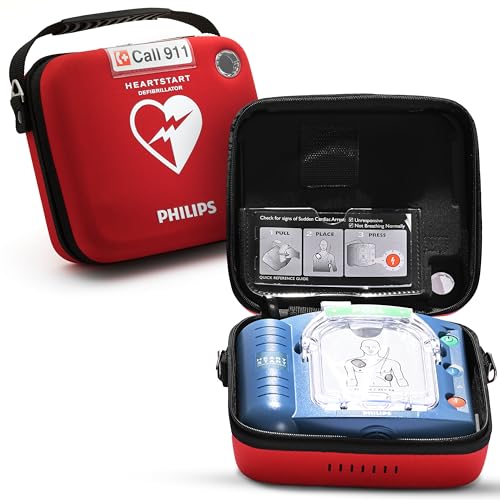
The Philips HeartStart OnSite is the only true live defibrillator in this roundup that is purpose-built for low-traffic public spaces like a church sanctuary. It runs a daily, weekly, and monthly automatic self-test cycle, so you never need to open the cabinet to confirm battery charge or pad integrity—critical for units that sit untouched for months. The SMART Pad Cartridge has a two-year shelf life, and the lithium battery lasts four years on standby, meaning your church can set a biannual calendar alarm and forget about maintenance in between.
The voice prompts are clear, slow, and step-by-step, covering pad placement, shock delivery, and post-shock CPR guidance. The device weighs just 5.34 pounds with the slim carry case, making it easy to grab and bring to a fellowship hall or outdoor church event. The Quick Shock feature delivers a shock within eight seconds of rhythm analysis, and the SMART Analysis algorithm ensures the device only shocks when a shockable rhythm is detected—no risk of accidental discharge on a conscious person.
Real buyers report the setup is straightforward and that the device provides genuine peace of mind, especially in rural areas where EMS response times exceed twenty minutes. A few note the English-only voice prompts could be a limitation in multilingual congregations, but the visual diagrams on the pads compensate. The 8-year warranty on the AED unit itself is industry-leading and covers the long service interval churches demand.
Why it’s great
- Fully automatic self-testing eliminates manual checks
- 8-year warranty covers the infrequent-use church scenario
- SMART Pad Cartridge lasts 2 years; battery lasts 4 years on standby
- Clear voice guidance requires no prior training to operate
Good to know
- Voice prompts are English-only; no multilingual option
- SMART Pads Cartridge and battery are proprietary replacements
- Does not include a training mode—requires separate trainer kit for classes
2. Philips HeartStart OnSite AED Defibrillator, Standard Carry Case M5066A-C01
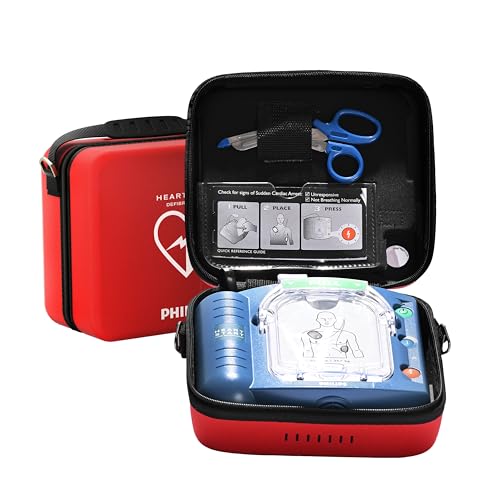
The M5066A-C01 is nearly identical to the C02 but ships with a standard carry case that includes extra internal space for a spare battery and a spare pads cartridge. For a church with a larger congregation or multiple buildings, this backup storage eliminates the need to run to a storage closet mid-emergency if the pre-installed cartridge is expired. The unit itself shares the exact same daily self-test cycle, SMART Analysis algorithm, and Quick Shock capability as the C02, so clinical performance is identical.
The 8-year AED warranty and 4-year battery standby remain unchanged, and the device weighs just 5.6 pounds with the standard case. The larger case footprint means it occupies slightly more wall cabinet space, but the benefit of having spares on hand—especially if your church budget only allows buying pads every two years—is significant. Real users emphasize that the straightforward setup and intuitive voice prompts make it easy to deploy quickly, even for someone who has never seen the unit before.
One difference buyers note is that the standard carry case is slightly less sleek than the slim version, but for a mounted cabinet scenario, aesthetics are secondary to functionality. Some users wish the device offered a child/infant mode without a separate infant pads cartridge purchase, but the adult-only pad set covers the majority of church cardiac arrest victims, who are typically older adults. The English-only interface is consistent across both OnSite models, so congregations with largely non-English-speaking attendees should plan to train bilingual staff on the commands.
Why it’s great
- Standard case holds spare battery and pads cartridge for backup
- Same self-test and Quick Shock features as the slim case variant
- 8-year unit warranty covers long-term installation
- Step-by-step voice guidance suitable for untrained users
Good to know
- Slightly larger case than the slim Carry version
- Voice prompts are English-only
- Infant/child use requires separate SMART Pads Cartridge
3. Prestan Take2 CPR Manikin Trainer Kit with Feedback (2-Adult, 2-Infant, & 2-UltraTrainers)

The Prestan Take2 kit is a purpose-built training solution, not a live defibrillator. It includes two adult manikins, two infant manikins, and two Prestan AED UltraTrainers—non-shocking simulators that replicate the look, feel, and voice prompts of real AEDs. This kit is ideal for a church that wants to run certification courses for ushers, nursery volunteers, and staff without needing to rent training equipment or travel to an external provider.
The manikins feature feedback lights that indicate correct compression depth and rate, a crucial feature for effective CPR skill development. The AED UltraTrainers are preprogrammed with five English/Spanish scenarios and can be updated if resuscitation standards change. The whole package arrives in a large blue carry bag, which is sturdy but lacks wheels, so transporting it across a church campus or to off-site training requires carrying by hand. Real-world users consistently praise the build quality, noting that Prestan is the most widely used brand by professional CPR instructors due to the reliability of the manikins’ chest springs and airway systems.
The 3-year warranty covers the plastic components, and replacement lung bags and face shields are readily available. While this kit is not meant to save a life directly, it serves the critical supporting role of ensuring that every volunteer in your church knows how to respond to a cardiac arrest with both CPR and an AED. For a church already investing in a live Philips HeartStart, this training kit is the perfect companion to ensure your congregation’s safety plan is complete.
Why it’s great
- Includes feedback lights for compression depth and rate
- AED trainers mimic real device voice prompts for realistic drills
- Adult and infant manikins cover full certification range
- AHA compliant and used by professional CPR instructors
Good to know
- Training kit only—not a live defibrillator
- Carry bag lacks wheels; heavy for long hauls
- Batteries for AED trainers not included
4. MCR Medical Prestan Take2 CPR Manikin & UltraTrainer Kit with Feedback (2-Adult, 2-Infant, & 2-UltraTrainers) and Accessories
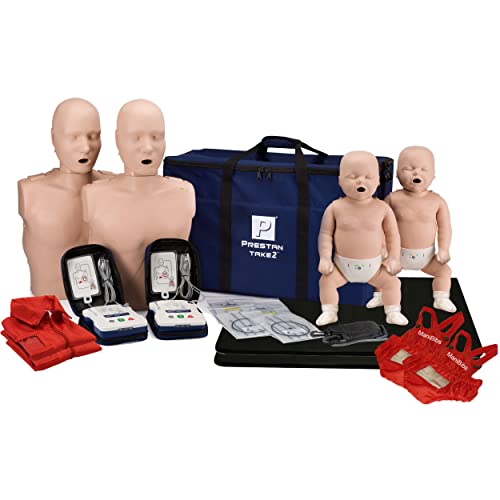
This MCR Medical version of the Prestan Take2 kit adds several accessories that make classroom management easier: kneeling mats to protect floors and knees, ManiVests for easier torso positioning during practice, and ManiBibs for hygiene. For a church that hosts CPR classes in a fellowship hall with hardwood or tile floors, the kneeling mats prevent slipping and add comfort during extended practice sessions. The kit also includes additional face shields and lung bags beyond what the base Prestan kit provides.
Real buyers—many of them working CPR instructors—report that the manikins feel identical to the units used by the American Red Cross, making this kit a drop-in replacement for any standardized course. The AED UltraTrainers are noted as being significantly more realistic than the toy-like trainers supplied with other kits, featuring genuine voice prompts and scenario switching that helps students stay engaged. One review mentions the kit is well-suited for classes of up to four students, making it perfect for small-group training sessions common in church settings.
The primary trade-off is that the added accessories increase the overall storage footprint and cost compared to the base Prestan Take2. The carry bag is still not wheeled, so transporting the full accessory package requires lifting roughly 25–30 pounds. However, the convenience of having everything you need in one organized bag—including the kneeling mats and vests—saves significant prep time before each class, which is valuable for volunteer instructors who may not have extensive setup experience.
Why it’s great
- Includes kneeling mats, ManiVests, and ManiBibs for classroom comfort
- Manikins match Red Cross standard equipment
- AED UltraTrainers are realistic with English/Spanish scenarios
- 3-year warranty covers the complete kit
Good to know
- Bag lacks wheels; heavy when fully loaded
- Added accessories increase cost vs. base Prestan Take2 kit
- Not a live defibrillator—purely for training
5. MCR Medical Prestan CPR Adult Manikin Diversity Kit Pack of 4 with Feedback, AED UltraTrainers, Carry Bag with Wheels
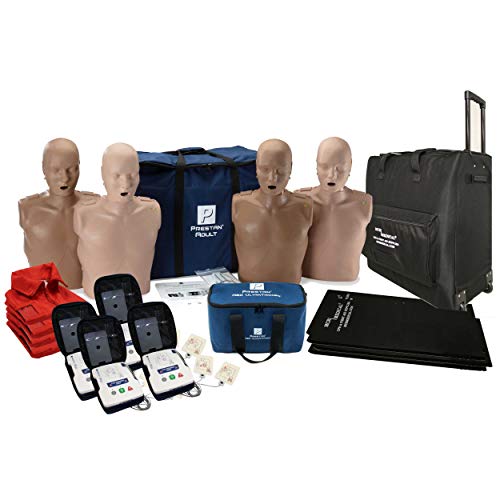
This diversity-focused kit from MCR Medical includes four adult manikins (two medium tone, two dark tone) and four Prestan AED UltraTrainers, all packed into a carry bag that finally includes wheels. For a church training coordinator who transports equipment between classrooms, a gymnasium, or off-site community centers, the wheeled bag is a genuine time-saver that reduces physical strain. The diversity skin tones are a thoughtful inclusion that helps all students see themselves represented during training, which can improve engagement and retention.
The manikins include the same clicker-style feedback system as the smaller Prestan kits, giving audible and visual confirmation of correct compression depth and rate. The AED UltraTrainers are pre-programmed with the same five scenarios (English/Spanish) and are upgradable if guidelines change, ensuring the kit remains current for years. Real buyers report that the manikins work great for large classes, but note that the kit is heavy at 39.3 pounds even with the wheels, so lifting it into a vehicle still requires two hands and some strength.
One customer initially thought face masks were missing but later realized the face mask and lung bag are a single integrated piece. This design reduces the number of small parts that can be lost between classes, but instructors should be aware of the single-piece construction when ordering replacement supplies. The 3-year warranty offers solid coverage for a kit that will likely see frequent use during quarterly certification courses.
Why it’s great
- Wheeled carry bag makes transport much easier
- Diversity skin tones improve training inclusivity
- Includes four AED UltraTrainers for large-group practice
- Feedback system confirms CPR quality in real time
Good to know
- Heavy even with wheels—just under 40 pounds
- Face mask and lung bag are a single integrated unit
- Training kit only; does not replace a live AED
6. Prestan CPR Manikin Diversity Kit, 4-Pack Adult and 4-Pack Infant w. Feedback, AED UltraTrainers, and MCR Accessories (K404M-MSDS)
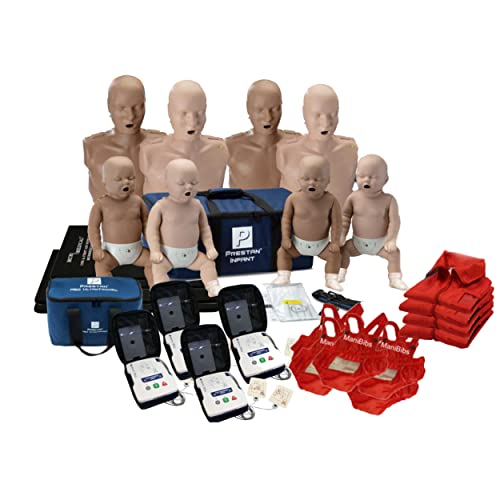
This is the most comprehensive training kit in the roundup: four adult manikins (two medium tone, two dark tone) plus four infant manikins, plus four AED UltraTrainers, plus the full range of MCR accessories (kneeling mats, ManiVests, ManiBibs, face shields/lung bags). For a church with a large volunteer base that needs to certify staff working across multiple age groups—from the nursery to the senior center—this kit covers every scenario in one order.
The infant manikins are particularly valuable for church daycare and children’s ministry staff, who need pediatric CPR training specific to small airways and lower compression forces. Real-world feedback is mostly positive, with users praising the value and ease of use, though one review noted quality issues: two adult manikins developed shoulder pin problems that caused the chest to open during rescue breaths, and the AED trainer cables were reported to deteriorate over time. The infant manikins performed well across all reviews, suggesting the adult manikins may have batch variability.
The 3-year warranty covers manufacturing defects, and MCR Medical has a reputation for responsive customer service and replacement parts. The kit does not include a wheeled bag—despite the large number of components—so transporting eight manikins plus accessories requires multiple trips or a separate rolling cart. For a church that only certifies a few times a year, this kit is likely overkill unless you regularly train twenty or more students per session.
Why it’s great
- Covers both adult and infant CPR/AED training with eight manikins
- Diversity skin tones for inclusivity
- Four AED UltraTrainers allow simultaneous practice
- Includes kneeling mats and vests for classroom setup
Good to know
- Some adult manikins reported shoulder pin issues
- No wheeled bag; moving the full kit is cumbersome
- Not a live defibrillator; training use only
7. MCR Medical Prestan’s Diversity Adult Manikin 4-Pack w. Feedback, Infant Manikin 4-Pack w. Feedback, AED UltraTrainers, Wheeled Carryall (K404M-MSDS-CA)
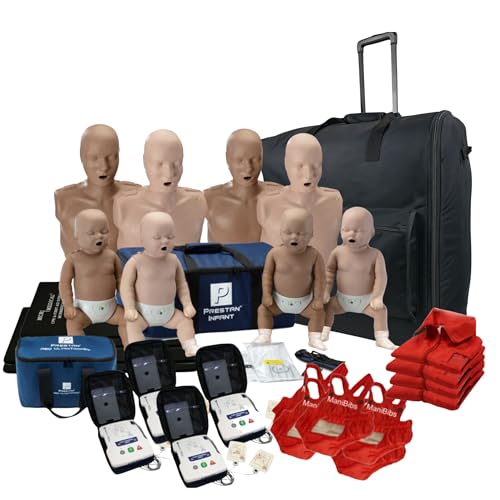
This version of the large diversity kit adds the critical upgrade that the base K404M-MSDS lacks: a wheeled carryall bag. At 42.5 pounds with all eight manikins, four AED trainers, and the full accessory set, the wheels make the difference between a single-person transport and a two-person struggle. For a church training coordinator who often sets up classes in different rooms or even different buildings on a church campus, this wheeled bag is the practical choice.
The kit includes the same four adult manikins (two medium tone, two dark tone) and four infant manikins, all with feedback, plus four AED UltraTrainers. Real customer reviews are overwhelmingly positive, with users calling it “outstanding value” and noting that teaching CPR became significantly easier with all the equipment in one organized, rolling case. One reviewer did report that one of the four AED trainers arrived non-functional, but MCR Medical quickly sent a replacement—demonstrating solid customer support for a purchase of this scale.
The 3-year warranty covers all components, and the Prestan brand reliability ensures the manikins will survive years of practice compressions and cleaning. The wheeled carryall has a large footprint, so storing it in a church office or closet requires dedicated floor space. For churches that only run one or two training sessions annually, the smaller wheeled kit (Product 5) may be a more manageable investment, but if your church runs quarterly open-to-the-community CPR classes, the capacity and mobility of this ultimate kit justify the decision.
Why it’s great
- Wheeled carryall solves the weight problem of the non-wheeled kit
- Eight manikins + four AED trainers support large classes
- Diversity skin tones for inclusive training
- MCR Medical customer service responds quickly to defects
Good to know
- Large storage footprint in church office/closet
- One reviewer reported a defective AED trainer (replaced)
- Overkill for churches with only a few annual training sessions
FAQ
Does my church need a live defibrillator or a training manikin kit?
How often do I need to replace the pads and battery on a Philips HeartStart OnSite?
Can I use a Prestan AED UltraTrainer as a real defibrillator in an emergency?
Final Thoughts: The Verdict
For most churches, the aed for church winner is the Philips HeartStart OnSite M5066A-C02 because it requires zero daily maintenance through its automatic self-tests, provides clear voice guidance for untrained bystanders, and offers an 8-year warranty that fits the slow-rotation purchasing cycle of a congregation. If your church runs its own CPR certification classes and wants to train volunteers on the same voice prompts they’ll hear in an emergency, grab the Prestan Take2 CPR Kit as a companion training tool. And for a church that needs to certify large groups with both adult and infant manikins across multiple seasons, nothing beats the mobility and capacity of the MCR Medical Diversity Kit with Wheeled Carryall.