
Our readers keep the lights on and the weekend projects moving. As an Amazon Associate, I earn from qualifying purchases.
Starting your piano journey with the right instrument is the single most important gear choice you will make. An electric piano with poorly weighted keys or a restrictive number of them can stall progress and deaden motivation before you even finish your first scale.
I’m Rikta — the co-founder and writer behind FitlyFast. My market research focuses on matching hardware specifications, from hammer-action resistance to polyphony limits, with real-world beginner scenarios to ensure smart, long-term investments.
After analyzing nine distinct electric pianos across multiple price tiers, I have built a focused guide to help you find the right beginner electric piano that balances realistic feel, a sufficient number of keys, and intuitive features to support practical learning at home.
How To Choose The Best Beginner Electric Piano
Selecting your first electric piano requires more than just picking a brand you recognize. The goal is to find an instrument that will not hinder your technique as you progress from single notes to complex chords.
Weighted vs. Semi-Weighted vs. Unweighted Keys
The resistance you feel when pressing a key is the most critical factor for a beginner. Fully weighted keys simulate the heavier, graduated feel of an acoustic piano, building proper finger strength. Semi-weighted keys offer resistance but with a lighter, spring-loaded feel, often found in portable models. Unweighted keys offer no resistance and are generally unsuitable for developing good technique on a serious practice instrument.
Key Count: Why 88 Keys Matter
While 61-key and 76-key models are smaller and cheaper, they lack the full range required for two-handed repertoire found in most method books and graded examinations. An 88-key piano ensures you will not outgrow it after a few months of lessons and provides the complete piano experience from the start.
Touch Sensitivity and Polyphony
Touch sensitivity allows the instrument to play louder when you strike a key harder, enabling expressive, dynamic playing. Polyphony, the number of notes the piano can produce simultaneously, should ideally be at least 64 to avoid notes dropping out during complex passages with pedal use.
Quick Comparison
On smaller screens, swipe sideways to see the full table.
| Model | Category | Best For | Key Spec | Amazon |
|---|---|---|---|---|
| Donner DDP-90 Pro | Premium | Long-term home practice | Hammer action + triple pedal | Amazon |
| YAMAHA P71 | Premium | Realistic feel on a budget | 88 weighted action keys | Amazon |
| STRICH SDP-120 | Mid-Range | All-in-one learning package | Hammer action + 200 tones | Amazon |
| AODSK B-83S | Mid-Range | Furniture-style home use | Wooden case + triple pedals | Amazon |
| Donner DEP-08 | Mid-Range | Compact living spaces | Velocity-sensitive + 380 tones | Amazon |
| Best Choice Products 88-Key | Mid-Range | Complete bundle value | Weighted keys + U-stand + stool | Amazon |
| Yamaha PSR-E383 | Budget | Portable learning for kids | 61 touch-sensitive keys | Amazon |
| FingerBallet BX20 | Budget | Travel practice companion | Folding semi-weighted keys | Amazon |
| Liquid Stands Kit | Accessory | Adding stand + bench to keyboard | Heavy-duty adjustable stand | Amazon |
In‑Depth Reviews
1. Donner DDP-90 Pro Digital Piano
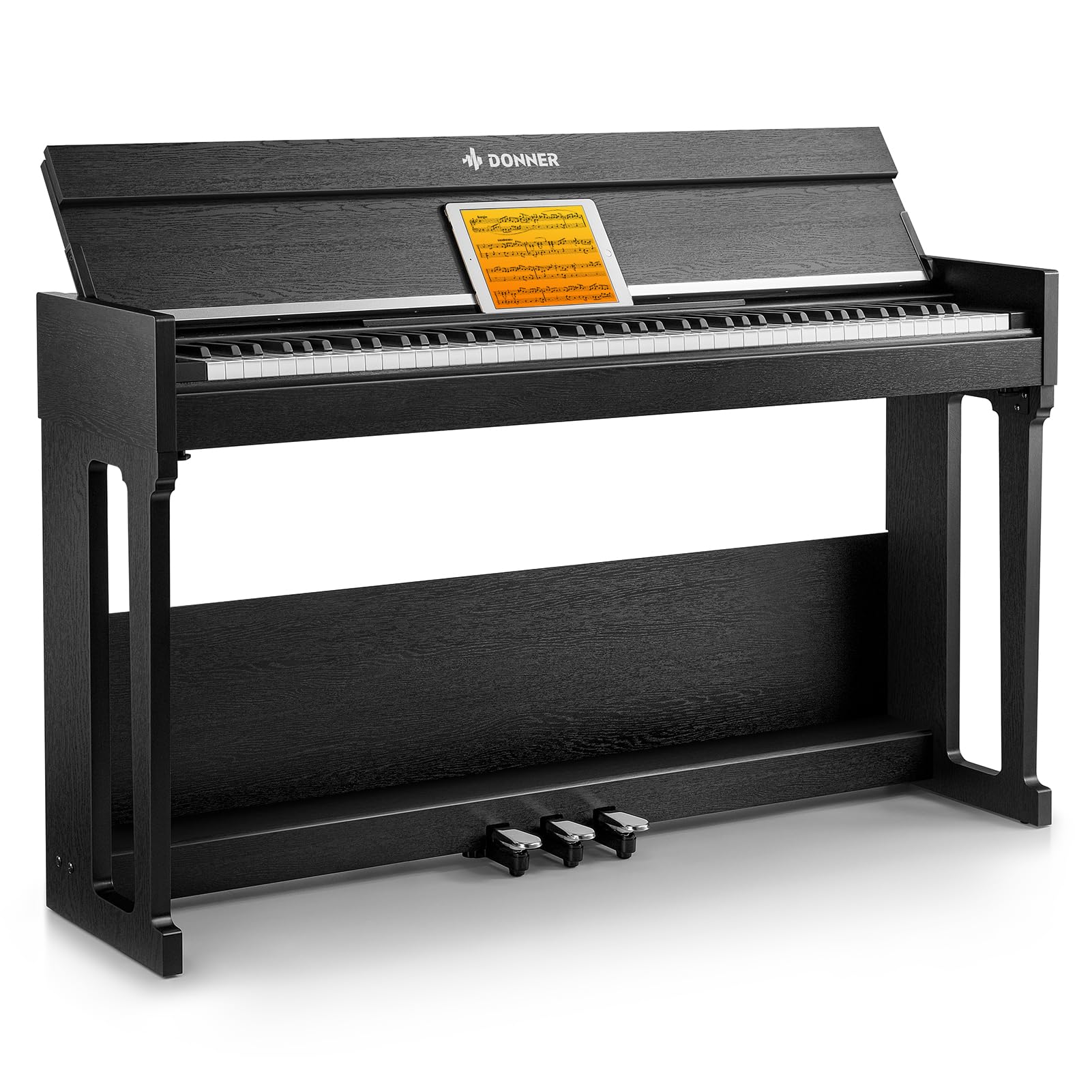
The Donner DDP-90 Pro is the clear winner for anyone serious about learning correctly from day one. Its hammer-action weighted keys, combined with an ivory-feel texture, closely mimic the resistance and feel of an upright acoustic piano, which is crucial for developing proper finger technique.
With 238 tones, 200 rhythms, and 100 demo songs, this instrument offers immense creative room for a student to explore beyond standard piano sounds. The thoughtful flip cover with a slow-close function adds a layer of safety and quality that parents will appreciate in a busy home environment.
The inclusion of a full metal triple-pedal system and support for USB-MP3 playback, plus connectivity to tablets and computers for learning apps, makes this a future-proof investment. It is heavier than some portable options, but the build quality and expansive feature set justify it for dedicated home practice.
Why it’s great
- Authentic hammer-action weighted keys for proper technique
- Full triple-pedal unit with sustain, soft, and sostenuto
- Expansive 238 tones and 128-note polyphony
Good to know
- Heavier construction (75 pounds) makes it less portable
- Assembly can be confusing with preinstalled screws
2. YAMAHA P71 88-Key Weighted Action Digital Piano

The YAMAHA P71 is a benchmark entry-level model because it delivers the most critical beginner requirement—a graded, weighted action—without unnecessary frills. The touch-sensitive keys allow you to play with genuine dynamic control, making it an excellent tool for developing a nuanced touch from the start.
Despite having only ten voices, the grand piano sample is rich and full, with deep bass that many competitors in this tier lack. The simple one-button interface keeps you focused on playing rather than navigating menus, and the Dual Mode lets you layer piano with strings for an inspiring sound.
The 25-pound weight makes it one of the lightest weighted 88-key options available, easily transportable for lessons or moving between rooms. The included sustain pedal is basic and tends to slide, but upgrading to a better pedal is a simple and affordable fix. This piano is a proven, durable choice for learners who prioritize feel over features.
Why it’s great
- Graded, weighted action that feels like an acoustic piano
- High-quality grand piano voice with rich bass
- Lightweight and portable (25 pounds) for its class
Good to know
- Only 10 instrument voices
- Basic sustain pedal included is prone to sliding
3. STRICH SDP-120 Digital Piano

The STRICH SDP-120 stands out as a complete learning suite for the modern beginner. Its fully weighted keys offer a professional-level feel, while the dual 15-watt speakers deliver clear, room-filling sound that surpasses what you typically find at this price, making lessons more engaging.
With 200 tones, 700 rhythms, and 110 demo songs, the creative variety is staggering for a mid-range instrument. The wireless MIDI feature is a standout, allowing you to connect effortlessly to tablets and phones for use with interactive learning apps or music production software.
The package includes a sturdy, solid stand and a quality sustain pedal right out of the box, meaning you don’t need to spend extra just to set it up properly. The LCD display and intuitive controls make navigation straightforward, and the lacquered black finish looks surprisingly elegant in a living room. A practical and inspiring choice for the motivated beginner.
Why it’s great
- Fully weighted keys with an authentic grand piano feel
- Wireless MIDI connectivity for apps and recording
- Powerful 2x15W speakers with clear sound projection
Good to know
- Manual lacks clear guidance for layering tones
- Power switch placement can be awkwardly blocked by music stand
4. AODSK B-83S Digital Piano
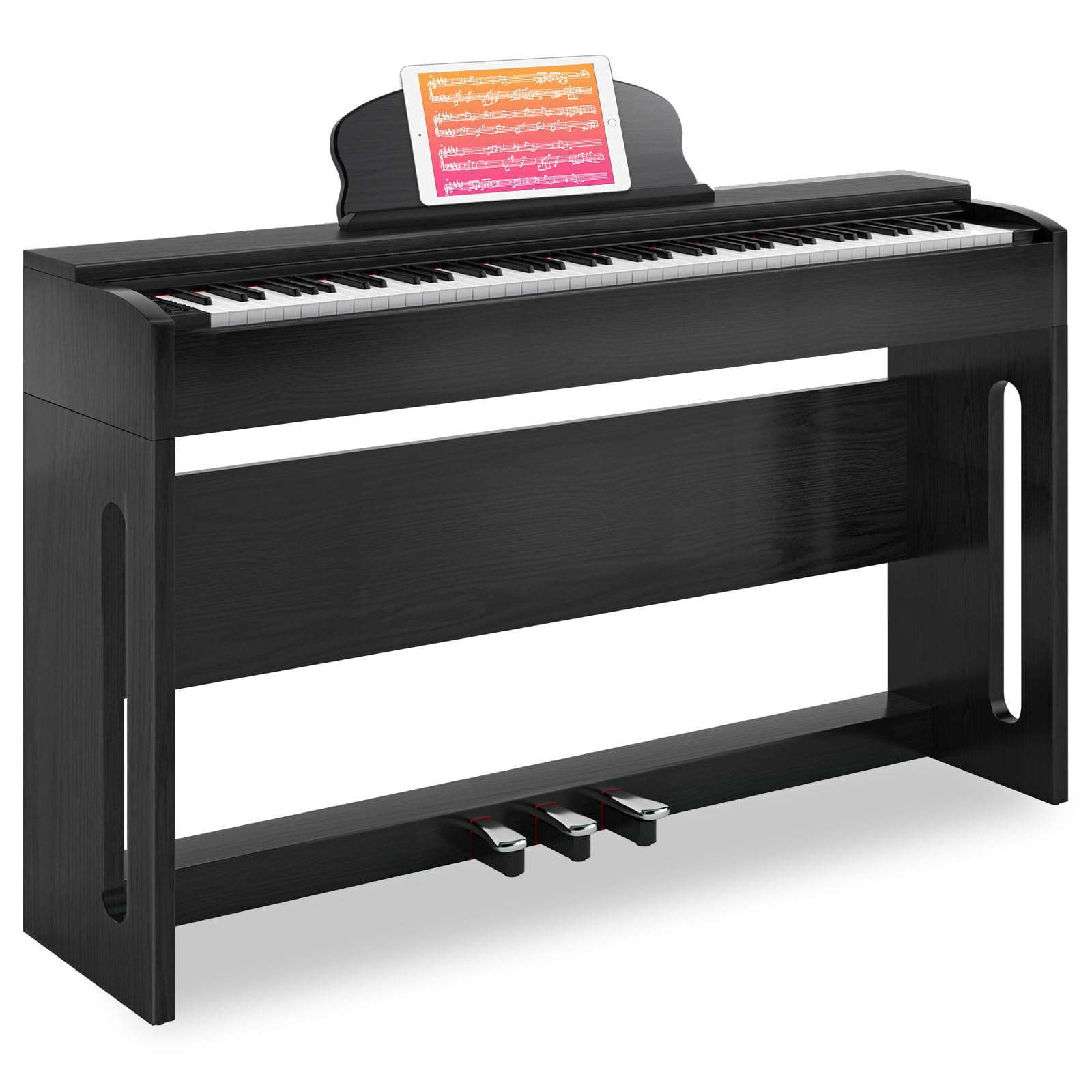
The AODSK B-83S is designed for learners who want their piano to feel like a permanent piece of furniture. The full wooden cabinet houses a fully weighted keyboard that provides smooth, high-response playing, closely mirroring the action of a real acoustic upright.
It includes a complete triple-pedal system (soft, sustain, and sostenuto), which is rare at this price point and essential for playing intermediate repertoire correctly. The 128-note polyphony and 128 timbres provide plenty of headroom for complex pieces, and it supports two headphone jacks for silent teacher-student practice.
Assembly is required, and the process can be frustrating due to vague instructions, but the end result is a stable, elegant instrument. The adjustable volume and headphone jack allow for late-night practice without disturbing the household. It is heavy (71 pounds), but the included hand holds make it easier to move than its weight suggests.
Why it’s great
- Realistic fully weighted keys in a wooden cabinet
- Full triple-pedal unit for advanced technique
- Two headphone jacks for duet or silent lessons
Good to know
- Assembly instructions can be confusing and time-consuming
- Key action feels slightly light for advanced players
5. Donner DEP-08 Digital Piano

The Donner DEP-08 is the best option for beginners with limited space, such as those living in dorm rooms or apartments. Its slim and lightweight design, paired with a removable stand, allows it to fit into tight corners where a full console would never go.
It features velocity-sensitive keys that respond well to different playing dynamics, and the 380 tones and 128 rhythms provide a huge palette for musical exploration. The teaching mode, which splits the keyboard into two equal zones with different sounds, is a fantastic tool for duet learning and creative practice sessions.
The built-in recording function lets students capture their practice sessions to track progress, and the headphone mode ensures silent practice. Some users note that the key bed feels slightly narrower than standard and the sound can feel slightly hollow, but for focused daily practice in a compact setting, this is an excellent ergonomic choice.
Why it’s great
- Slim, lightweight design ideal for small apartments
- Split teaching mode for duet practice and exploration
- Very high number of tones (380) for creative variety
Good to know
- Key width is slightly narrower than a standard acoustic piano
- Sound quality can feel hollow at higher volumes
6. Best Choice Products 88-Key Digital Piano Set

The Best Choice Products 88-Key set is the ultimate grab-and-go package for the parent or student who does not want to piece together accessories. It comes with a U-stand, an adjustable stool, a music rest, and a three-pedal unit, hitting the ground running from the first day of lessons.
The 88 fully weighted, hammer-action keys provide the necessary resistance for building finger strength, and the 140 timbres and 128 rhythms offer ample diversity to keep practice interesting. The two headphone jacks are a thoughtful addition for shared lessons or silent practice between siblings.
However, the build quality of the stand and stool is the main trade-off. Some users report the keyboard tray tilts slightly backward, and the stool’s seat can feel less stable over time. For a learner focused primarily on getting started with a complete weighted-key setup, the convenience of this bundle is hard to beat.
Why it’s great
- Complete set includes U-stand, stool, and triple pedal
- Fully weighted keys with hammer-action feel
- Dual headphone jacks for shared or silent practice
Good to know
- Keyboard tilt can require a simple DIY fix for leveling
- Stool and stand build quality are entry-level
7. Yamaha PSR-E383 Portable Keyboard

The Yamaha PSR-E383 is a fantastic budget-friendly entry point for a very young child or a casual learner who is not yet ready for a full 88-key commitment. Its 61 touch-sensitive keys allow for dynamic expression, a crucial feature often missing from the cheapest keyboards.
Yamaha’s sound quality is immediately noticeable here, with realistic acoustic and electric piano voices that sound far more mature than the price suggests. The built-in learning suite, including “Keys to Success,” step-by-step song lessons, and Smart Chord functionality, actively guides a beginner through their first songs without frustration.
The lightweight design (9.7 pounds) makes it easy for a child to carry to a lesson, and it runs on an included power adapter. The main limitation is the 61 keys, which will restrict two-handed playing as the student progresses. Consider this a first instrument, not a final one, for the developing pianist.
Why it’s great
- Touch-sensitive keys respond to playing dynamics
- Excellent Yamaha sound quality and instrument voices
- Built-in learning features guide beginners through songs
Good to know
- Only 61 keys, limiting two-handed repertoire
- Keys are unweighted, lacking resistance for finger strength
8. FingerBallet BX20 Folding Digital Piano

The FingerBallet BX20 solves a very specific problem: how to practice piano on an 88-key instrument while traveling. Its folding design halves its footprint, and the included carrying bag makes it genuinely easy to pack for a trip or move between rooms.
The semi-weighted keys are velocity-sensitive, offering some dynamic control, and the 128 tones and rhythms provide decent variety. Bluetooth MIDI connectivity is a strong feature for this price, allowing the piano to function as a wireless controller for music production apps on a phone or tablet.
The critical weakness is the sound quality of the built-in speakers, which multiple users describe as tinny or muffled, making headphones a near-necessity for an enjoyable playing experience. The key feel is also noticeably springy rather than weighted. This is a niche tool for maintaining practice on the road, not a primary home instrument.
Why it’s great
- Unique folding design for maximum portability
- Bluetooth MIDI for wireless connection to apps
- Semi-weighted, velocity-sensitive keys for dynamic control
Good to know
- Built-in speakers are very poor, requiring headphones
- Key feel is springy, not a realistic weighted action
9. Liquid Stands Keyboard Stand and Bench Set

The Liquid Stands set is not a piano, but it is an essential accessory tier item that many beginners overlook. This Z-style stand and adjustable bench converts a portable keyboard into a stable, ergonomically correct practice station, which is vital for preventing poor posture.
The stand is fully adjustable in height and width, accommodating everything from 54-key to 88-key instruments. The Z-style design is significantly more stable and less prone to wobbling than cheap X-style stands, with a 250-pound weight limit that comfortably supports any keyboard on the market.
The padded bench is adjustable and lightweight at 9 pounds, and the set includes anchoring straps and a headphone hook. This is a practical, affordable add-on for any beginner who already owns a keyboard body but lacks a proper setup. It ensures the instrument is played at the correct height, making practice more comfortable and effective.
Why it’s great
- Very stable Z-style design, far better than X-stands
- Height and width adjustable for any keyboard size
- Includes padded bench, straps, and headphone hook
Good to know
- Does not include a keyboard, only the stand and bench
- Bench padding is thin; may need extra cushion for long sessions
FAQ
Should a beginner start with a 61-key or 88-key electric piano?
Is a digital piano with weighted keys necessary for a complete beginner?
What is the minimum polyphony I should look for in a beginner electric piano?
Final Thoughts: The Verdict
For most users, the beginner electric piano winner is the Donner DDP-90 Pro because it combines authentic hammer-action keys with a professional-grade triple-pedal system and a rich sound library in a single, well-built package. If you want a reliable, lightweight workhorse with an unmatched feel from a trusted brand, grab the YAMAHA P71. And for a modern learner who values connectivity, wireless features, and excellent speakers right out of the box, nothing beats the STRICH SDP-120.