
Our readers keep the lights on and the weekend projects moving. As an Amazon Associate, I earn from qualifying purchases.
The hunt for an activity center often stalls between two worries: the flimsy plastic frame that tips with a determined toddler, and the overpriced unit your child outgrows before the packaging hits the recycling bin. The right choice delivers a secure, stimulating environment where a baby can practice standing, swivel for a toy, and pivot to a play table that survives the preschool years—a single piece of gear that prevents you from buying three separate products over eighteen months.
I’m Rikta — the co-founder and writer behind FitlyFast. I spend my days dissecting baby gear specifications, comparing seat rotation mechanics, toy density, material safety, and stage-conversion engineering across dozens of activity centers to find the ones that actually deliver on their promise.
I’ve sifted through safety reports and parent feedback to build a guide that highlights the most durable, engaging, and long-lasting options for your growing family. This article will help you identify the best activity center for baby that fits your space, budget, and developmental needs.
How To Choose The Best Activity Center For Baby
An activity center is not a bouncer. The real-world difference is that a stationary activity center allows a baby to practice standing, squatting, and transferring weight from foot to foot—movement patterns that build the core stability needed for independent walking. Jumpers and bouncers, by contrast, suspend the baby in a fixed position, which can encourage toe-walking and delay proper gait development. Always look for a center where the baby’s feet can rest flat on the base or floor support panel, not just dangle.
Stage Conversion Engineering
The most expensive mistake in this category is buying an activity center that stops being useful the moment your child walks. A well-designed multi-stage center converts into a toddler play table with minimal steps—usually by swapping the seat for a flat panel or bead bar insert. Check whether the conversion requires tools, whether the resulting table height matches a standard toddler chair (about 12 to 14 inches), and whether the table surface is large enough for crayons, snacks, or a single puzzle. Centers that convert into a table with a stool or bench provide a longer useful life than those that convert into a table alone.
Seat Rotation and Toy Density
A seat that rotates a full 360 degrees changes how a baby interacts with the environment. Instead of being locked into facing one direction, a baby can swivel to reach a toy, look at a sibling, or track movement across the room—activities that strengthen neck, trunk, and hip rotation. The number of toys matters less than how they are positioned. Look for activity centers with toys at different heights (low for grasping, mid-level for batting, high for reaching) and at least one toy that requires two hands or a cause-and-effect action, such as a piano that lights up when pressed or a bead maze. Avoid centers where all the toys cluster in a single plane—that configuration holds a baby’s attention for about four minutes.
Weight Capacity and Seat Height Range
Most activity centers claim a 25-pound maximum weight, but the seat height adjustability determines whether that weight limit is usable. A center with only two height settings may not accommodate a baby who is long-legged but light, or short-legged but heavy. Four or more height settings give you room to adjust as the baby grows and changes body proportions. The minimum age rating (usually 4 to 6 months) corresponds to the baby being able to hold their head upright unassisted—never place a baby who cannot yet sit with support into an activity center. The seat pad should be machine-washable, and the frame should have a wide enough base (at least 26 inches across) to resist tipping when a toddler leans to one side.
Quick Comparison
On smaller screens, swipe sideways to see the full table.
| Model | Category | Best For | Key Spec | Amazon |
|---|---|---|---|---|
| ORIBEL PortaPlay | Premium | Small-space living | Four height settings | Amazon |
| Skip Hop Explore & More | Premium | Longest usable life | 25+ activities, 3 stages | Amazon |
| Little Acorn 4-in-1 | Premium | Montessori-style design | 8 Montessori toys, piano | Amazon |
| Safety 1st Grow & Go | Mid-Range | Minimalist toy set | 4 modes, 7 interactive toys | Amazon |
| Fisher-Price 3-in-1 Hit Wonder | Mid-Range | Music-loving families | Removable piano, 3 modes | Amazon |
| Baby Einstein SuperSeat | Mid-Range | Seat-to-booster transition | Detachable piano, 4 languages | Amazon |
| FOPNETS Wooden Cube | Budget | Eco-conscious families | 7-in-1 wooden design | Amazon |
In‑Depth Reviews
1. ORIBEL PortaPlay Convertible 3-in-1
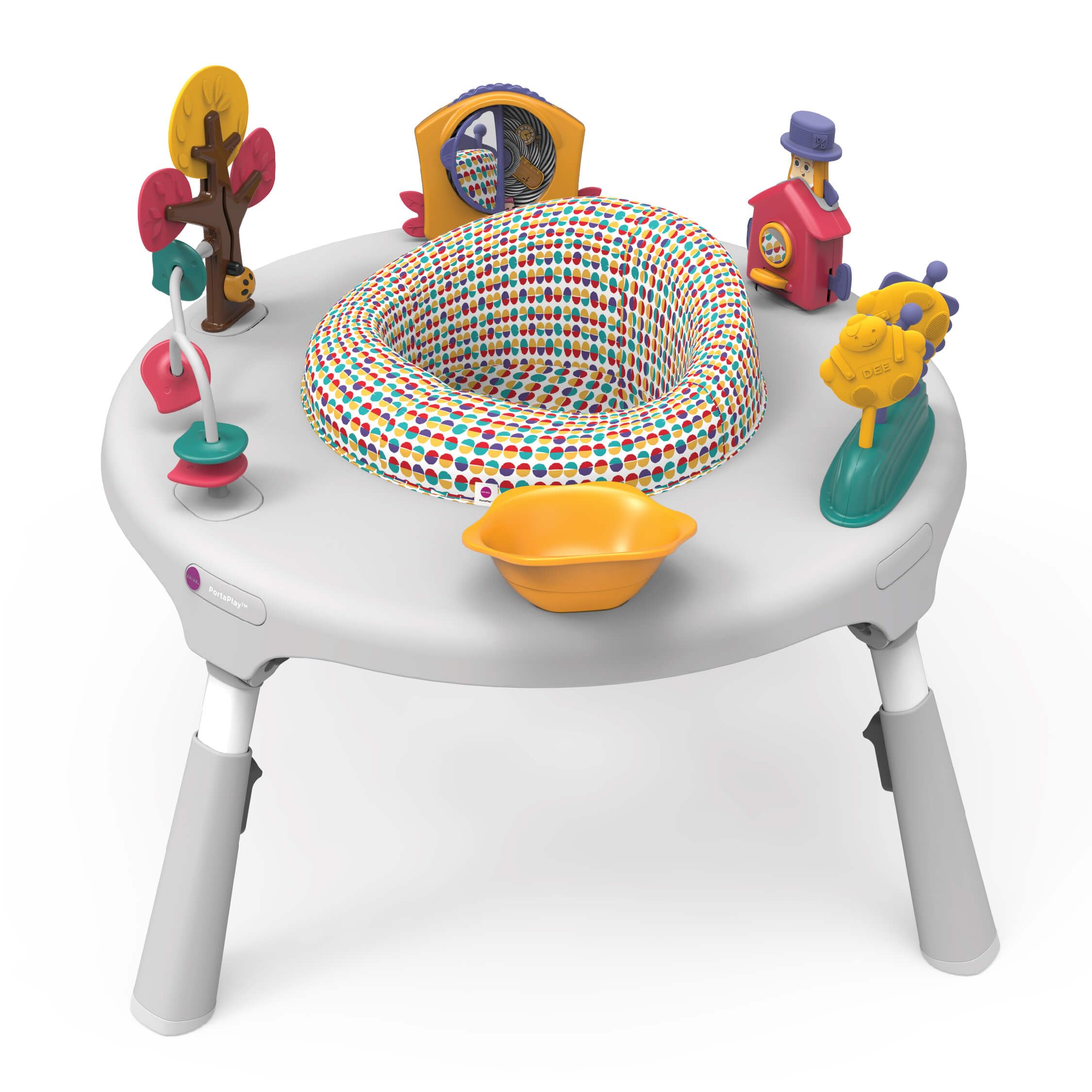
The ORIBEL PortaPlay is a premium activity center designed for parents who value clean aesthetics and a compact footprint. Its patented 360-degree elastic-band seat allows the baby to bounce, rotate, and explore while keeping the feet firmly planted on the base, which supports confident weight shifting. With four adjustable height settings, this center adapts to a baby’s growth more precisely than the standard two or three settings found on most competitors.
The development-focused toy set is intentionally minimal—fewer pieces than the Skip Hop or Fisher-Price, but each toy targets a specific skill: reaching, grasping, and cause-and-effect interaction. The seat converts to a toddler play table by swapping in a flat top, and the legs fold with a button press for storage or travel. Parents consistently praise the non-bulky footprint; the base measures 26.8 inches across, which fits into tight living room corners without dominating the space.
The tradeoff is the lack of a true bounce mechanism. The elastic seat allows gentle bouncing but not a vigorous jump, so babies who crave active bouncing may prefer a different style. The seat cover is wipeable but not machine-washable, which matters if you use it for snack time. Overall, the PortaPlay is the best choice for families who need an activity center that blends into the home décor and stores easily between uses.
Why it’s great
- Compact folding legs for easy storage and travel
- Patent-pending seat design supports natural foot placement and confidence
Good to know
- Toys are limited compared to premium models with 20+ activities
- Seat pad is not machine-washable; spot cleaning required
2. Skip Hop Baby Activity Center: Explore & More
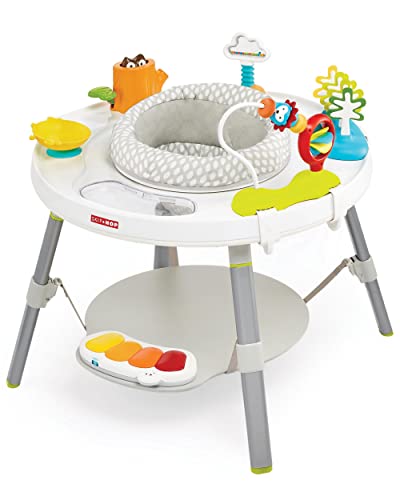
The Skip Hop Explore & More sets the standard for this category, and for good reason. Developed in collaboration with a pediatrician, it transitions through three distinct stages: a sit-in activity center with a 360-degree rotating seat, a cruise-and-interact station for babies learning to stand, and finally a toddler activity table with a built-in chalkboard surface. The 25-plus toys include a musical light-up piano with three play modes, a peek-a-boo owl, a spring cloud with beads, and a dishwasher-safe suction bee snack bowl.
The rotating seat glides smoothly, and the adjustable foot support platform ensures the baby’s feet are always planted, not dangling. The toy placement is well-thought-out: high for reaching, mid-level for batting, and low for grasping. The piano has a motion sensor mode that turns the music on when the baby kicks or moves, reinforcing cause-and-effect learning. The seat cover is machine-washable, and the steel-and-ABS frame resists tipping even when a 25-pound toddler throws weight to one side.
The biggest knock is the price—this is a premium product, and it shows in the build quality. The piano requires AAA batteries, and while the battery life is rated at about 2 hours of continuous use, it does drain faster than expected with the motion sensor mode active. The conversion to a table is straightforward but requires you to store the seat separately. For families who want a single piece of gear that lasts from 4 months to preschool, this is the definitive pick.
Why it’s great
- Pediatrician-designed three-stage system extends usable life through toddler years
- Machine-washable seat and dishwasher-safe snack bowl simplify cleanup
Good to know
- Requires AAA batteries for piano; motion sensor mode drains them relatively quickly
- Seat conversion parts need separate storage when using table mode
3. Little Acorn 4-in-1 Baby Activity Center
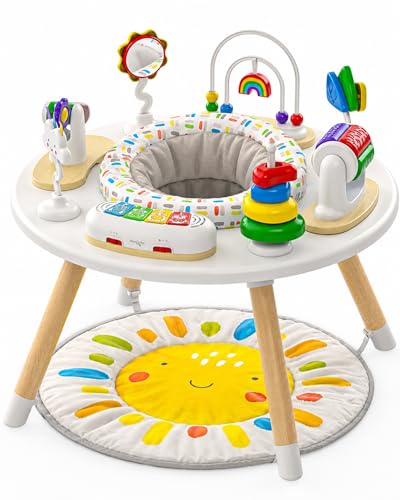
The Little Acorn 4-in-1 distinguishes itself with a Montessori-inspired approach that includes a dedicated tummy time mat alongside the standard activity center and toddler table functions. The eight included toys are designed to nurture motor control, tactile exploration, and self-awareness—think wooden spinning beads, a textured star rattle, and a baby-safe mirror. The interactive piano features over 30 phrases, sounds, and songs covering ABCs, numbers, and colors, and comes with batteries included so the toy works out of the box.
The sustainably sourced wooden legs give the frame a modern, furniture-like appearance that fits well in a living room or nursery. The fabric seat and tummy time mat are both machine-washable, and the plastic toys wipe clean with a damp cloth. Assembly takes about five minutes with the included tools. Parents consistently report that the activity center holds a 6-month-old’s attention for 15+ minutes per session, which is noteworthy for this age group.
The main issue reported is that a toy anchor cracked under the tray on one unit, and the customer support process was frustrating. Also, the seat does not adjust in height, so smaller babies may need a towel or pad under their feet to reach the floor properly. The weight limit is 25 pounds, and the conversion to a toddler table requires removing the seat—similar to the Skip Hop system. For families who prioritize eco-friendly materials and a calm, non-electronic toy set (with one electronic exception), the Little Acorn delivers excellent quality.
Why it’s great
- Machine-washable fabric seat and tummy time mat for easy maintenance
- Sustainably sourced wooden legs blend into home décor
Good to know
- Seat height is not adjustable; shorter babies may need a foot support pad
- One report of a broken toy anchor; customer support response was inconsistent
4. Safety 1st Grow and Go 4-in-1

The Safety 1st Grow and Go 4-in-1 is the no-fuss entry point for parents who want a reliable activity center without the electronic bells and whistles. Its four modes progress from an infant activity center to a balance board, a toddler play table, and a child activity table with a stool. The center features seven interactive toys, including a large busy bead toy bar and a spinning ice-cream cone, and the 360-degree rotating seat is sturdy and smooth. The seat fabric is machine-washable, and the plastic frame wipes clean easily.
The standout feature is the balance board mode: the seat and toy bar can be removed to leave a standing board that a toddler can wobble on for balance practice. This is a unique transitional function that no other center in this lineup offers. The conversion to a play table is straightforward and results in a surface about 20 inches tall, which is a good height for a standard toddler stool. Parents praise the compact footprint—about 27 inches across—and the fact that no batteries are required, so there is no sound fatigue.
The downsides are that some toy pieces and the crossbar detach a bit too easily for younger babies, and the spinning toy is not engaging enough for most children. The table attachment point can trap crumbs, making thorough cleaning a bit tedious. At 14.37 pounds, it is lighter than the Skip Hop and ORIBEL units, but the base is wide enough that tipping is not a concern. For a parent who wants a simple, no-battery center with a clever balance board transition, this is an excellent choice.
Why it’s great
- Unique balance board mode helps develop standing and wobble control
- Machine-washable seat and no batteries required for low-maintenance use
Good to know
- Toy pieces and crossbar can detach easily for younger babies (under 6 months)
- Table attachment point can trap crumbs and requires careful wiping
5. Fisher-Price Baby to Toddler Toy 3-in-1 Hit Wonder

The Fisher-Price 3-in-1 Hit Wonder is built around a music theme that appeals to babies who respond to rhythm and lights. The removable toy piano plays up to 20 minutes of music and lights, and it can be detached for on-the-go play. The center includes a microphone teether, jingle maraca, teeter-totter bongos, tambourine with mirror, crinkle song book, three shaker shapes to sort, a rollerball guitar, and a bead bar. The seat spins 360 degrees and is comfortable for babies with chunky legs.
The three modes are a sit-in entertainer, a toddler play table (by swapping the seat for the bead bar insert), and a take-along toy set. The conversion is simpler than the Skip Hop system—just lift out the seat and drop in the bead bar. The piano has three learning levels (numbers, colors, and music) and is one of the few in this category that actually teaches content in an engaging way. Parents report that babies as young as 4 months (with head control) enjoy the music, and older toddlers use the table mode for standing and cruising.
Some parents note that the piano volume is fixed and relatively loud, which can be fatiguing during extended play. The seat cover is not machine-washable; it requires spot cleaning. The base is 26 inches across, which is comparable to the Safety 1st and Skip Hop units, but the overall build feels slightly less sturdy than the Skip Hop. For a family that values musical stimulation and wants a center that transitions easily between seat and table, the Hit Wonder delivers solid value.
Why it’s great
- Removable piano with 20-minute music and lights extends play value beyond the center
- Simple seat-to-table conversion requires no tools and takes seconds
Good to know
- Piano volume is fixed and can be loud for sensitive babies (and parents)
- Seat cover requires spot cleaning; not machine-washable
6. Baby Einstein SuperSeat Touch of Tunes 3-in-1

Baby Einstein’s SuperSeat functions as an activity seat, a supportive floor seat for snacking, and a booster seat that attaches to most dining chairs. The detachable Cal the Caterpillar piano plays melodies and teaches numbers and colors in four languages—English, Spanish, French, and German—a feature that appeals to bilingual families. The activity tray includes a bubble popper, spinning gears, and dangling toys, and the toy bar can be removed to reduce stimulation during quiet time.
The seat is designed for babies 6 months to 3 years with a 33-pound max weight, which is higher than most activity centers. The 360-degree tray rotates and has two built-in compartments for snacks. The EVA foam insert can be removed for cleaning, and the BPA-free snack tray is dishwasher safe. Parents appreciate that the seat grows with the child: the insert works for smaller babies, and the full seat is roomy enough for a 1-year-old. The piano’s four-language feature is genuinely educational and not just a gimmick.
The biggest complaint is that the tray is difficult to attach and remove, even when using the handle. The initial snap on the surround is very stiff and takes about 10 uses to loosen up. The overhead bar can obstruct a baby’s arm movement if they are reaching for toys above their head. It is also not a true “center” in the sense that the baby is seated rather than standing, so it does not provide the same leg-strengthening benefit as a standing activity center. For families who want a combined seat-and-activity solution that transitions to a booster, this is a solid mid-range option.
Why it’s great
- Four-language piano introduces multilingual learning during everyday play
- Converts to a booster seat for dining; rated up to 33 pounds for extended use
Good to know
- Tray attachment and removal require significant force, especially when new
- Seated design does not provide the same leg-strengthening benefits as standing centers
7. FOPNETS Wooden Activity Cube 7-in-1

FOPNETS’ Wooden Activity Cube is a different take on the activity center concept—it is a stationary cube and push-along walker rather than a seat-based center. The 7-in-1 design includes a bead maze on top, four animal matching mazes, colorful gears, a number board, a carrot harvest game, and a lid that doubles as a storage box for small toys. It is designed for babies 12 months and older, and it doubles as a push toy with wheels and an adjustable handle.
The construction is solid wood with smooth, water-based paint, and the edges are rounded to prevent splinters. The cube measures 13 x 6.7 x 10.4 inches, which is compact enough for a small play area. The bead maze on top is a classic fine-motor activity, the gears teach cause-and-effect, and the carrot harvest game (where the child pulls wooden carrots from holes) builds hand strength. The walker mode has an adjustable handle that can rise as the child grows, and the storage box inside is deep enough for other toys.
The main limitation is that this is not a traditional seat-in activity center—it is a floor toy for crawling and newly walking babies. It does not provide a secure seated position, so it cannot replace an exersaucer or stationary center for younger babies. One review reported a piece broken during assembly (the sheepdog bottom), and the walker wheels work well on carpet but may tip on hard floors. For eco-conscious families who want a non-plastic, non-electronic activity toy that promotes standing and walking, the FOPNETS cube is a budget-friendly choice.
Why it’s great
- Solid wood construction with water-based paint, free of harmful chemicals
- Push-along walker mode with adjustable handle encourages early walking practice
Good to know
- Designed for 12 months+; not suitable as a seated activity center for younger babies
- Walker may tip on hard floors; best used on carpet for stability
FAQ
What is the difference between a stationary activity center and a jumper?
At what age should I introduce an activity center?
How long can a baby safely stay in an activity center?
Can an activity center help my baby learn to walk?
How do I clean an activity center?
Final Thoughts: The Verdict
For most users, the activity center for baby winner is the Skip Hop Explore & More because it combines a 360-degree rotating seat, 25+ developmental activities, and a three-stage grow-with-me system that extends through the toddler years without feeling cheap. If you want a compact, furniture-grade center that folds for storage, grab the ORIBEL PortaPlay. And for the most eco-conscious choice with a wooden build and push-along walker, nothing beats the FOPNETS Wooden Activity Cube.