
Our readers keep the lights on and the weekend projects moving. As an Amazon Associate, I earn from qualifying purchases.
Every microphone and instrument generates an analog signal that must be digitized for your computer, and the circuit that performs that conversion defines the ceiling of your recording quality. A weak converter introduces noise, reduces clarity, and clips your best takes before you ever hit the record button.
I’m Rikta — the co-founder and writer behind FitlyFast. My research focuses on identifying which AD/DA converter topologies and driver architectures deliver measurable audio transparency versus which ones merely look the part on paper.
After cross-referencing bit depth, sample rate ceilings, preamp noise floors, and real-world driver stability, this roundup cuts through the marketing noise to show you the most reliable best a/d converter options for home studios, streaming rigs, and broadcast environments.
How To Choose The Best A/D Converter
Choosing an A/D converter comes down to three non-negotiable factors: resolution, connectivity, and preamp quality. The converter’s bit depth and sample rate determine how much headroom and frequency detail you capture, while the connectivity protocol (USB, ADAT, Dante, or AES67) dictates how the unit fits into your existing signal chain. The preamp stage matters enormously — a transparent converter paired with a noisy preamp still produces a noisy recording. For home studio use, 24-bit/96 kHz is the practical sweet spot; demanding high-sample-rate sessions may benefit from 24-bit/192 kHz or even 32-bit converters, but only if your microphone and room actually justify the bandwidth.
Bit Depth, Sample Rate, and Dynamic Range
Bit depth governs the dynamic range — how quiet a sound you can capture below the loudest peak without noise floor intrusion. A 24-bit converter offers roughly 144 dB of theoretical dynamic range, which is enough for most spoken word and music applications. Sample rate defines the upper frequency limit of your recording; 44.1 kHz covers the audible spectrum with some headroom, while 96 kHz and above preserve ultrasonic overtones that some producers use for pitch-shifting and time-stretching. The key spec to check is the converter’s actual dynamic range at the driver level, not just the theoretical maximum of the chip. Mid-range converters like the Focusrite Scarlett and SSL 2 MKII deliver measured dynamic ranges above 110 dB, which is transparent enough for professional use.
Input Channels and Expandability
Your choice of converter also determines how many microphones or line-level sources you can record simultaneously. A two-input interface suits solo podcasters, vocalists, and single-instrument recording. If you plan to record drum kits, multiple vocalists, or live ensemble sessions, look for units with ADAT optical I/O. ADAT lets you chain additional 8-channel converters to your main interface, scaling your input count without upgrading the entire system. The Behringer ADA8200 is a classic expansion unit that adds eight Midas preamps via a single optical cable. For larger studio or live sound environments, Dante Audio over IP converters like the Audinate Dante AVIO offer flexible routing across a network.
Preamp Quality and Phantom Power
Clean preamps deliver the full resolution of your microphone to the converter stage. Check the maximum gain in dB — at least 55-60 dB is ideal for dynamic microphones like the Shure SM7B which require significant makeup gain. Phantom power at 48 volts is standard and necessary for condenser microphones. Some interfaces, like the Universal Audio Volt 1, include analog circuit emulation; the Legacy 4K button on the SSL 2 MKII adds high-frequency presence. For voice-over and critical listening, a low-noise preamp with under -129 dB EIN (Equivalent Input Noise) ensures your recordings stay free of hiss. The Neumann MT 48 represents the top tier with its class-leading 136 dB dynamic range and DSP-driven preamp processing.
Quick Comparison
On smaller screens, swipe sideways to see the full table.
| Model | Category | Best For | Key Spec | Amazon |
|---|---|---|---|---|
| Neumann MT 48 | Premium | Reference monitoring | 136 dB dynamic range, 1.54 MHz | Amazon |
| SSL 2 MKII | Mid-Range | Home studio/streaming | 32-bit/192 kHz AD/DA | Amazon |
| Focusrite Scarlett Solo 3rd Gen | Mid-Range | Guitar/vocal recording | 24-bit/192 kHz converters | Amazon |
| Universal Audio Volt 1 | Mid-Range | Mobile/podcast recording | 24-bit/192 kHz, Vintage mode | Amazon |
| Audient EVO 4 | Mid-Range | Quick single-mic setup | 96 kHz AKM converters | Amazon |
| Shure MVX2U | Mid-Range | XLR mic streaming | 48 kHz, 60 dB gain | Amazon |
| Behringer UMC1820 | Mid-Range | Multi-channel recording | 18×20, 96 kHz ADAT I/O | Amazon |
| Behringer ADA8200 | Expansion | ADAT channel expansion | 8 Midas preamps, 48 kHz | Amazon |
| Audinate Dante AVIO | Network | Dante network audio | 2-channel Dante analog out | Amazon |
In‑Depth Reviews
1. Neumann MT 48
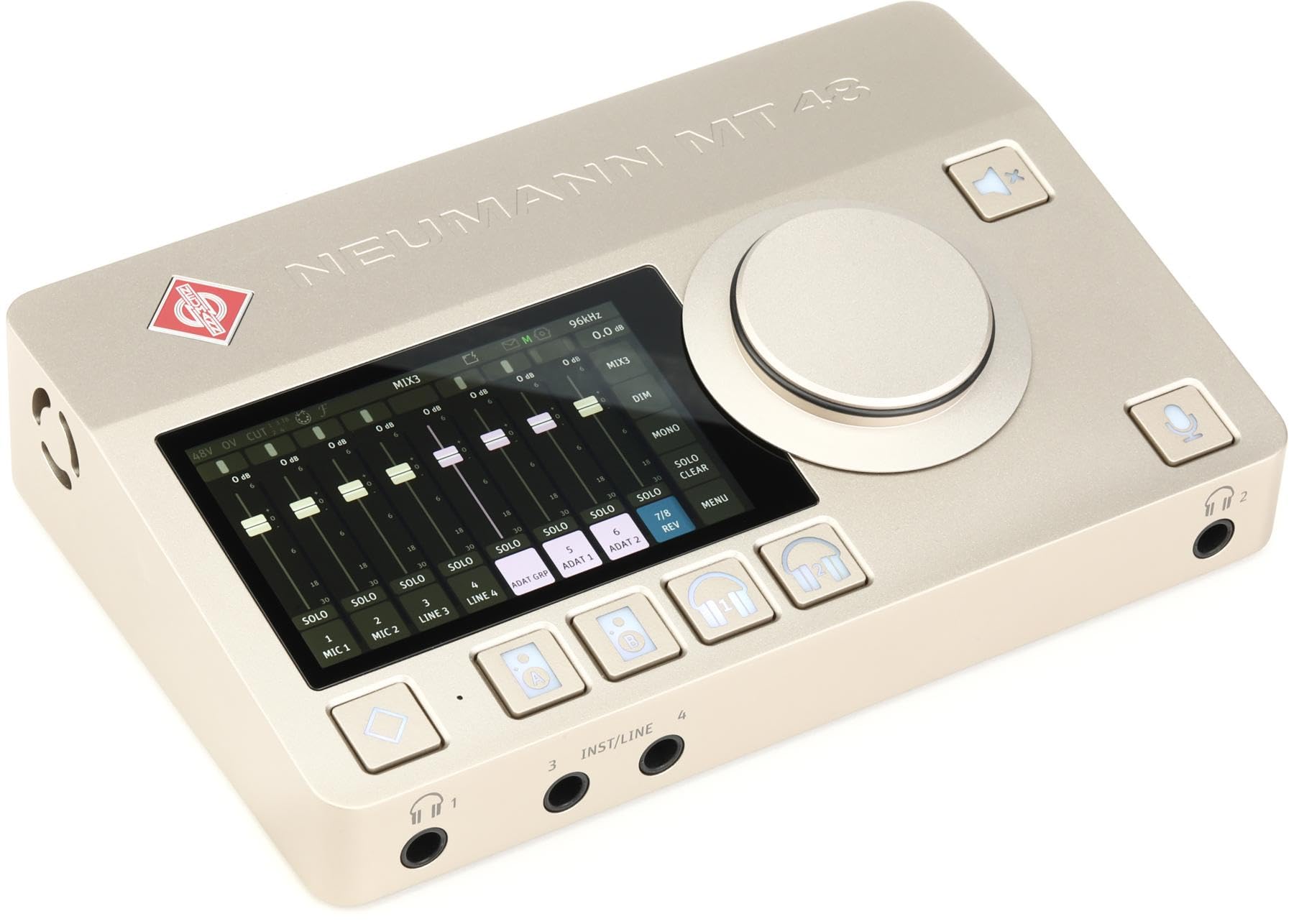
The Neumann MT 48 sits at the absolute top of the consumer-pro converter market, offering a dynamic range of 136 dB — meaning its noise floor is practically silent even with high-gain dynamic mics. The USB-C interface supports sample rates up to 1.54 MHz, which is overkill for most applications but provides headroom for future-proof archiving and pitch-manipulation workflows. It also includes ADAT and AES67 expansion, allowing it to slot into Dante or SoundGrid environments.
The built-in DSP engine handles EQ, compression, reverb, and talkback without taxing your computer’s CPU, and the touchscreen control surface makes routing adjustments quick. The two XLR/line combi inputs and two line/instrument inputs cover most home studio and broadcast scenarios. Phantom power and low-noise preamps are excellent, and the headphone outputs deliver clean drive even for high-impedance monitors. For voice-over artists and mix engineers who demand absolute transparency, this is the ceiling.
Setup is not completely plug-and-play; the advanced routing matrix requires some learning, and some units have shipped with unsealed boxes suggesting prior returns. The price is the highest in this roundup by a wide margin, but the measured performance justifies the investment for users who rely on every dB of dynamic range.
Why it’s great
- Class-leading 136 dB AD dynamic range
- DSP processing with zero-latency monitoring
- ADAT and AES67 expandability
Good to know
- Setup requires some routing configuration
- Premium investment for high-end studios
2. Solid State Logic SSL 2 MKII

The SSL 2 MKII brings the legendary British console sound to a desktop footprint, with two XLR/line combi inputs featuring the Legacy 4K analog enhancement switch that adds a high-frequency shelf and subtle harmonic distortion for character. The 32-bit D/A converter stage delivers clean monitoring, though the AD conversion is 24-bit — still more than enough for transparent recording. Sample rate tops out at 192 kHz, and the preamps offer a low noise floor with 62 dB of gain.
Build quality is excellent: the chassis is steel with smooth, weighted knobs that resist accidental bumps. The headphone amp is notably strong, driving 250-ohm cans with ease and no audible noise floor. Zero-latency monitoring, stereo loopback for streaming, and MIDI I/O add to the versatility. The included SSL Production Pack software bundle gives you competent plugins to start mixing immediately.
Some users note the unit is slightly larger and heavier than competing two-input interfaces, and the 32-bit label applies only to the D/A conversion — not the recording path. It also requires a firmware update out of the box for Windows driver stability, which is a minor inconvenience. For the sound quality per dollar, it remains the top mid-range contender.
Why it’s great
- Legacy 4K analog enhancement for character
- Strong headphone amp for high-impedance cans
- Rock-solid metal build with smooth controls
Good to know
- 32-bit spec applies only to D/A path
- Requires firmware update for Windows
3. Focusrite Scarlett Solo 3rd Gen

The Scarlett Solo 3rd Gen has been the entry-level benchmark for years, and the third generation refined the preamps with a higher headroom ceiling and switchable Air mode that emulates the high-frequency lift of the original Focusrite console. It records at up to 24-bit/192 kHz, which covers everything from vocal takes to detailed instrument capture. The single XLR input and one instrument input suit a solo performer or podcaster perfectly.
The Gain Halo rings provide a visual level indicator that changes color when clipping, making it easy to dial in clean levels without guessing. The two balanced outputs deliver clean monitoring, and the headphone output is adequate for standard 32-ohm headphones. The included software bundle — Pro Tools Intro, Ableton Live Lite, and Hitmaker Expansion — gives you a complete starter recording suite without additional cost.
Phantom power is reliable and switches cleanly. The chassis is lightweight and compact, ideal for travel. The main drawbacks are the single XLR input and no ADAT expandability, which limits you to one mic at a time. The preamps are clean but not as neutral as the SSL 2 MKII or Audient EVO 4. For a budget-conscious single-source recording chain, this remains a solid purchase.
Why it’s great
- Air mode enhances vocal clarity
- Gain Halo prevents clipping visually
- Includes Pro Tools and Ableton Lite
Good to know
- Limited to one microphone input
- No ADAT expansion option
4. Universal Audio Volt 1

The Universal Audio Volt 1 leverages UA’s famous 610 tube preamp circuit in a compact bus-powered interface. Vintage mode engages a tube-emulation stage that adds warmth and subtle compression to vocals and acoustic instruments, making it a favorite for singer-songwriters and voice-over artists looking for pre-mixed character. The converters handle 24-bit/192 kHz with clarity, and the single XLR/instrument input covers most mono recording scenarios.
The unit features a separate USB-C port for power (required when using with iPads/iPhone via the Camera Adapter), giving you mobile recording capability. It includes an integrated headphone output and MIDI I/O, which is unusual at this size. The included LUNA DAW, Ableton Live Lite, Melodyne, and a suite of UAD plugins add significant value for producers who want to stick within the UA ecosystem.
Some users report that the maximum gain is slightly lower than competing interfaces, requiring a clean preamp or boost for very quiet dynamic mics. The lack of dedicated software control for mixing/routing is a minor nuisance for advanced users. For those who want a colored, musical preamp tone baked into the signal path, the Volt 1 delivers a distinctive sound that few competitor units offer.
Why it’s great
- Vintage 610 tube emulation adds warmth
- Mobile recording with iPad/iPhone
- Includes LUNA and UAD plugins
Good to know
- Lower gain than some competing interfaces
- No software mixer for routing
5. Audient EVO 4

The Audient EVO 4 stands out with its Smartgain feature, which analyzes your incoming signal for a few seconds and automatically sets the input level to a clean sweet spot. This is a genuine timesaver for podcasters, streamers, and vocalists who do not want to fiddle with knobs mid-session. The two XLR inputs share a single gain stage, which means both microphones are matched in level — ideal for co-host setups but limiting if you need independent gain control.
Its predecessor, the EVO 4, uses AKM converters for the AD/DA path, delivering a flat response with low noise. The JFET instrument input replicates the impedance behavior of a tube amplifier, preserving the natural attack of electric guitar and bass. The loopback feature allows you to blend computer audio with microphone input, essential for podcast streaming and software tutorials.
The plastic chassis feels durable but less premium than the metal bodies of competitors, and the lack of independent left/right gain on the mic inputs may frustrate engineers who need to balance two different voice levels. The maximum sample rate is 96 kHz, which is sufficient for most productions but lower than the 192 kHz ceiling of some rivals. For quick, reliable, and idiot-proof level setting, this is the most intuitive interface on this list.
Why it’s great
- Smartgain sets optimal levels automatically
- Clean AKM converters with flat response
- JFET input for natural guitar tone
Good to know
- Shared gain for both mic inputs
- Plastic housing feels less robust
6. Shure MVX2U

The Shure MVX2U is not a full interface but a dedicated XLR-to-USB converter that turns any dynamic or condenser microphone into a plug-and-play USB device. It delivers up to 60 dB of clean gain, enough to power a Shure SM7B without an additional inline booster, and provides 48V phantom power for condenser mics. The Auto Level Mode dynamically adjusts gain to prevent clipping in live streaming scenarios where you cannot adjust settings mid-show.
The unit is tiny and weighs only 100 grams, with dual mounting options that let you attach it directly to a mic stand or use it inline with an XLR cable. Zero-latency headphone monitoring via the 3.5mm jack ensures you hear your voice in real time. The accompanying ShurePlus app provides onboard EQ, limiter, and compression controls that are stored on the device, so your settings persist even without a computer connection.
The maximum sample rate is 48 kHz, which is adequate for spoken word and most music applications but lower than the 96 kHz or 192 kHz options of dedicated interfaces. It also has no expandability or line outputs — it is strictly a single-mic input with headphone monitor. For streamers and podcasters who already own a quality XLR microphone, the MVX2U is a purpose-built upgrade over a traditional USB microphone.
Why it’s great
- 60 dB gain drives dynamic mics cleanly
- Auto Level Mode prevents clipping
- Onboard DSP saves settings without a computer
Good to know
- Maximum 48 kHz sample rate
- Single input with no expandability
7. Behringer UMC1820

The Behringer UMC1820 is an 18-input, 20-output USB 2.0 audio interface that serves as the backbone of a multi-channel home studio. Its eight Midas-designed mic preamps deliver clean gain up to 60 dB with +48V phantom power per channel, and the ADAT optical I/O lets you expand to 16 inputs by chaining an additional converter like the ADA8200. The unit records at 24-bit/96 kHz via Burr-Brown converters, which is transparent enough for professional recording sessions.
The rack-mountable chassis includes MIDI I/O, word clock output, and two balanced monitor outputs with independent level control. Setup is straightforward on both Mac and Windows, and the unit is class-compliant on macOS — no driver installation needed. The headphone output has its own dedicated mix, allowing separate monitoring from the main stereo out, which is a crucial feature for tracking musicians.
The preamps are clean but not as neutral as Focusrite or Audient preamps; some users note a very slight mid-range coloration. The plastic knobs feel less durable than the metal alternatives, and the unit lacks a dedicated power switch (you must unplug the USB to power off). For the channel count and ADAT expandability at this level, the UMC1820 is the most cost-effective way to build a multi-input recording rig.
Why it’s great
- 8 Midas preamps with 60 dB gain each
- ADAT I/O for 16-input expansion
- Independent monitor and headphone mixes
Good to know
- Knobs feel cheaper than the chassis
- No dedicated power switch
8. Behringer ADA8200

The Behringer ADA8200 is an 8-channel ADAT expander, not a standalone USB interface. It connects to your main interface via a single Toslink optical cable, adding eight Midas-designed mic preamps with +48V phantom power to your existing setup. The AD/DA conversion operates at 24-bit/48 kHz, which is the ADAT standard for 8-channel transmission over one cable. The preamps provide up to 60 dB of gain, and the front-panel controls include a high-pass filter to reduce low-frequency rumble.
The unit is rack-mountable and self-contained, requiring a power cable (no bus power). The analog outputs come from the ADAT input, not from the onboard preamps, which means the ADA8200 cannot function as a standalone analog preamp without a digital loopback setup. For users pairing it with the UMC1820, the combination yields 16 simultaneous inputs via ADAT, perfect for drum kits or multi-mic acoustic ensembles.
The maximum sample rate of 48 kHz is a limitation for high-resolution recording; the ADA8200 will not do 96 kHz over standard ADAT (which requires SMUX and reduced channel count). The front-mounted inputs mean cable management can be messy, and the knobs are average quality. For sheer value per channel — eight quality preamps with ADAT output — there is no cheaper alternative.
Why it’s great
- 8 Midas preamps via single ADAT cable
- High-pass filter on each channel
- Rack-mountable and reliable
Good to know
- Maximum 48 kHz sample rate
- Analog outs require ADAT loopback
9. Audinate Dante AVIO

The Audinate Dante AVIO Analogue Output Adapter serves a different purpose than a traditional USB interface: it converts digital Dante network audio into two balanced analog line-level outputs. This is essential for integrating Dante-equipped digital mixing consoles or computer networks into analog speaker systems, IEM feeds, or recording gear. It supports up to 24-bit/96 kHz audio over standard Ethernet, with extremely low latency thanks to Dante’s networked clock sync.
The device is compact (2 x 4 x 8 inches) and bus-powered via Power over Ethernet (PoE), requiring no separate power supply if your network switch supports PoE. Configuration is handled via the free Dante Controller software, where you can route any channel from any Dante transmitter on the network to the AVIO’s two outputs. It also includes a secondary RJ45 port for daisy-chaining additional Dante devices, reducing switch port consumption.
This is not a recording interface for a home studio — it is a utility adapter for live sound, installed sound, and networked audio distribution. It must be reset before events to maintain correct startup handshake. The cost reflects the Dante licensing rather than audio specs. For any workflow that involves Dante, the AVIO is an indispensable bridge to legacy analog gear.
Why it’s great
- Integrates Dante network with analog gear
- PoE bus power, no separate supply needed
- Daisy-chainable for multi-channel setups
Good to know
- May need power reset before use
- Niche use case for Dante systems only
FAQ
What sample rate should I use for podcasting?
Can I use a budget A/D converter with a professional microphone?
What is ADAT and why would I need it?
Does phantom power damage dynamic microphones?
Final Thoughts: The Verdict
For most users, the best a/d converter winner is the Solid State Logic SSL 2 MKII because it balances converter transparency, robust preamp quality, and the Legacy 4K character switch at a price that outperforms everything in its class. If you want multi-channel recording capability, grab the Behringer UMC1820 for its eight preamps and ADAT expandability. And for a single-mic streaming setup where plug-and-play simplicity matters most, nothing beats the Shure MVX2U.