
Our readers keep the lights on and the weekend projects moving. As an Amazon Associate, I earn from qualifying purchases.
Finding an adhesive that locks foam board cleanly onto wood without melting the foam or losing grip under stress is a narrower hunt than most DIYers expect. The wrong formula either dissolves the board’s surface or fails to create a lasting mechanical bond with the wood grain.
I’m Rikta — the co-founder and writer behind FitlyFast. I spend my days cross-referencing chemical formulations, bond shear ratings, and real-world cure times to find which adhesives actually solve the material mismatch between porous wood and closed-cell foam.
Whether you are mounting insulation panels or fabricating props, the winning adhesive for foam board to wood must deliver aggressive tack without chemical melt, and stay flexible enough to handle seasonal expansion and contraction.
How To Choose The Best Adhesive For Foam Board To Wood
The chemical composition is the first gatekeeper. Solvent-based aerosol adhesives often eat through EPS and XPS foam within seconds, leaving a pitted surface that never bonds. You need a formula explicitly labeled foam-safe or one that uses water-based or low-solvent carriers. The second factor is tack strength and open time — how long the glue stays workable before setting. Wood is porous and uneven, so you want an adhesive that can fill tiny gaps and still grab hard. Finally, consider the application method: spray cans give large coverage but less precision, while brush-on bottles let you keep the glue exactly where the foam meets the wood.
Foam-Safe Chemistry Is Non-Negotiable
Standard contact cement and superglue contain solvents that chemically dissolve expanded polystyrene foam board on contact. Look for adhesives that explicitly list EPS, EPP, or EPO foam as compatible materials. Water-based formulas are typically safe, as are certain solvent blends designed with low aromatic content. If the label says “foam-safe,” it has been formulated to avoid the melting reaction that destroys the board’s cellular structure.
Open Time And Tack Balance
Open time refers to how long the adhesive remains tacky after application before it skins over. For foam board to wood, you want enough open time — typically 1 to 5 minutes — to align the board perfectly, but not so long that you are holding it in place for minutes. Spray adhesives with a web pattern offer a middle ground: they flash off solvent quickly, so you must mate the surfaces within seconds. Brush-on formulas cure slower but allow repositioning.
Application Format And Control
For large flat panels, a spray adhesive with an adjustable nozzle saves time and ensures even coverage without puddles. For small crafts or tight corners, a bottle with a brush cap gives you millimeter precision. Dry time also varies: aerosol contact adhesives can set in 2 minutes, while bottle-applied foams may need up to 24 hours for full cure. Match the format to the scale of your project and the patience you have for clamping.
Quick Comparison
On smaller screens, swipe sideways to see the full table.
| Model | Category | Best For | Key Spec | Amazon |
|---|---|---|---|---|
| 3M Hi-Strength 94 | Heavy-Duty Spray | Large panels & insulation | 60-min bonding range | Amazon |
| Gorilla Ultimate Spray | Multi-Purpose Spray | Versatile indoor/outdoor use | 2-minute full cure time | Amazon |
| Beacon Foam-Tac | Bottle with Applicator | Precision RC foam repair | UV blockers in formula | Amazon |
| Hot Wire StyroGoo | Squeeze Bottle | Scenery & craft assembly | Solvent-free instant tack | Amazon |
| Tuck Multi-Purpose | Clear Web Spray | Clean transparent bonding | 41 PSI shear strength | Amazon |
| Ceoighe Foam Glue | Brush-Cap Bottle | RC airplane model assembly | Flexible vibration-absorbing bond | Amazon |
| 3M Scotch Spray Mount | Repositionable Spray | Light mounting & posters | Repositionable for 15 min | Amazon |
In‑Depth Reviews
1. 3M Hi-Strength 94 Spray Adhesive
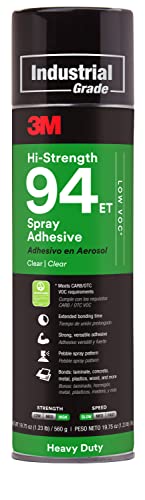
This is the industrial-grade answer for bonding thick XPS foam boards to plywood or lumber under demanding conditions. The 94 ET formula delivers an aggressive tack that locks foam in place within seconds, yet its 60-minute bonding range allows you to shift large panels if you misalign them. It carries GREENGUARD certification and low-VOC compliance, so it is a strong choice for interior foam insulation projects where air quality matters.
The spray pattern is wide and consistent, covering a 4×8 sheet of foam quickly without oversaturating. Users report that the bond holds up against freezing temperatures and moisture, making it suitable for basement subfloor or garage wall setups. The 19.75-ounce can covers a substantial surface area per application, which keeps costs predictable on larger builds.
On the downside, the initial solvent smell is potent — you need ventilation. Full cure takes 24 hours, and the bond is permanent once set, so there is zero forgiveness for mistakes after the open window closes. It also costs more per can than commodity spray glues, but the holding power justifies the premium when the foam-to-wood bond must survive long-term stress.
Why it’s great
- Aggressive foam-safe tack that does not dissolve EPS or XPS
- 60-minute bonding window allows panel repositioning
- Low-VOC and GREENGUARD certified for indoor use
Good to know
- Strong solvent odor requires ventilation
- 24-hour cure time before full bond strength
- Premium tier pricing for high-performance spray
2. Gorilla Ultimate Spray Adhesive
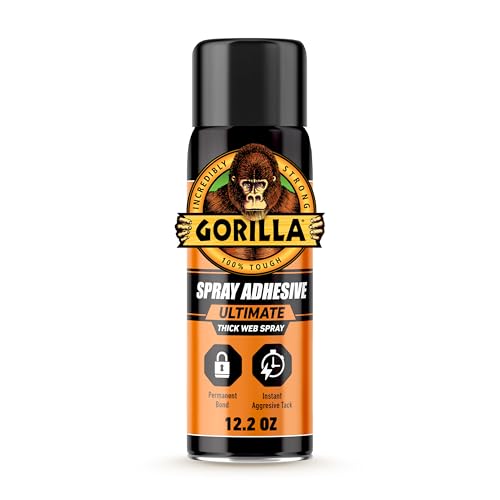
Gorilla’s entry into spray contact cement brings the aggressive tack the brand is known for, but in a foam-safe package that bonds wood, metal, and plastic equally well. The web spray formula creates a net-like dispersion that coats the foam board without pooling, and the three-way adjustable nozzle lets you switch from a narrow stream to a broad fan based on the panel size.
The adhesive resists heat and moisture after curing, so it works for outdoor signage or foam board overlays on exterior wood structures. Users note that the full cure happens in about 2 minutes — lightning fast for a contact adhesive — but that speed means you must align the foam board perfectly on the first attempt. Repositioning is nearly impossible once the two surfaces touch.
The Low-VOC formulation meets California CARB requirements, but the solvent base still produces a noticeable smell during application. For large coverage areas, the 12.2-ounce can runs out faster than you might expect, so plan for multiple cans if you are bonding a full 4×8 sheet. It is a mid-range option that delivers near-premium grip without the premium price tag.
Why it’s great
- Aggressive instant tack bonds foam to wood in seconds
- Resists heat and moisture for indoor/outdoor use
- Three-way adjustable nozzle for precise application
Good to know
- No repositioning after initial bond
- Can size may be small for large-scale projects
- Solvent odor present during spray application
3. Beacon Foam-Tac Glue
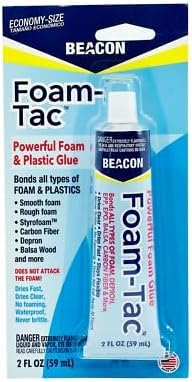
Foam-Tac is the standard for RC aircraft builders because it bonds EPP and Depron foam to balsa wood and carbon fiber without eating the foam. The formula is thick and snot-like by design — it stays in place on vertical surfaces and creates a flexible bond that absorbs vibration. That same flexibility helps when foam board meets wood in a project that experiences temperature swings or minor impacts.
The glue includes UV blockers that prevent yellowing and degradation over time, which matters if the adhesive line will be exposed to sunlight through a window or outdoor display. Users report that cleaning up excess is easier than with superglue, but the thick consistency takes some practice to apply cleanly. The bottle does not come with a nozzle, so you have to control the flow manually or use a separate applicator.
Full cure takes 24 hours, but the glue sets within minutes, giving you a short window to fine-tune positioning. It works best for small-to-medium sized bonds where precision matters more than speed. For large-scale foam-to-wood paneling, the cost and application method make it less efficient than a spray alternative.
Why it’s great
- Flexible bond absorbs vibration without cracking
- UV blockers prevent yellowing and degradation
- Foam-safe for EPP, EPO, Depron, and balsa wood
Good to know
- Thick consistency makes clean application tricky
- 24-hour full cure time
- Best for small-area precision, not large panels
4. Tuck Multi-Purpose Spray Adhesive
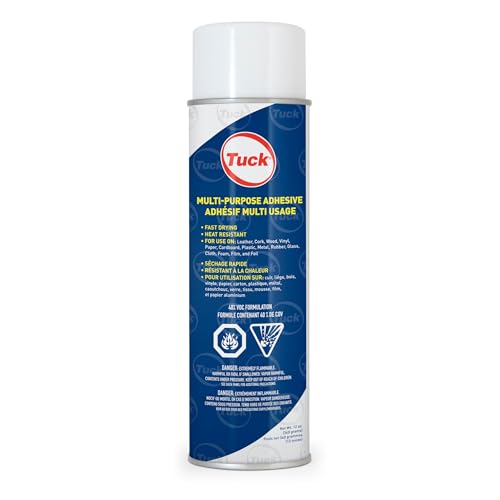
Tuck’s multi-purpose spray bridges the gap between a disposable craft glue and a heavy-duty contact cement. It sprays clear, dries in about 15 minutes, and delivers a 41 PSI shear strength that holds foam board to wood firmly under normal household conditions. The three-way nozzle gives you control over the web pattern, so you can keep the adhesive off surrounding surfaces.
Users have successfully bonded Dacron fabric to foam and bubble insulation to wood window frames, which shows the formula’s versatility across porous and semi-porous materials. The reduced-emission formula is designed for indoor use, so the smell is less overpowering than industrial spray adhesives. It also wipes off easily with mineral spirits before it cures fully.
On the performance front, it does not match the sheer holding power of a dedicated construction-grade spray like the 3M 94. For heavy foam board installations where the wood substrate is rough or the panel is thick, you might need to apply multiple coats or clamp the pieces while curing. It sits at the budget-friendly end of the spectrum, making it a good starter option for hobbyists.
Why it’s great
- Dries clear with a clean, professional finish
- 41 PSI shear strength holds foam to wood reliably
- Reduced-emission formula for comfortable indoor use
Good to know
- May require clamping for heavy panels
- Not as strong as industrial-grade contact spray
- 15-minute tack time feels slow for impatient users
5. Hot Wire Foam Factory StyroGoo
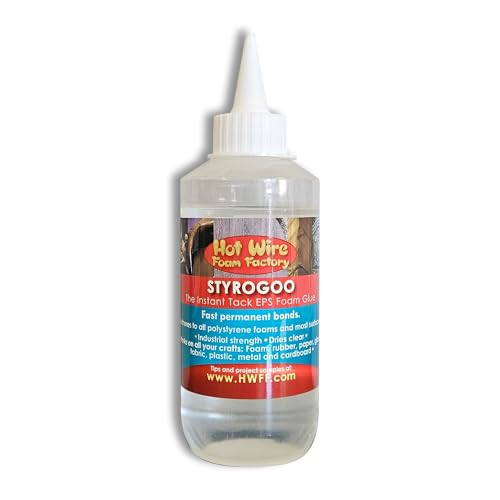
StyroGoo is purpose-built for foam crafters who need a fast-curing, solvent-free adhesive that does not melt polystyrene. The squeeze bottle design lets you place a bead exactly along the foam board edge before pressing it against wood. The instant tack grabs immediately, so you can skip clamping for most lightweight projects like holiday village scenery or architectural models.
The formula goes on clear and stays clear, which keeps the bond line invisible on finished pieces. Users praise its strength on Styrofoam bases for dioramas, and it also bonds well to wood, fabric, and glass without degrading. The full cure time of 12 hours is faster than many bottle adhesives, and the hold is permanent once set.
The main limitation is scale. For large foam board panels or structural bonds where shear load is high, the thin liquid consistency may not fill gaps as well as a thicker contact adhesive. It also requires clean surfaces to achieve maximum bond strength. Stick to smaller craft assemblies where precision and foam safety are the top priorities.
Why it’s great
- Instant tack with no clamping needed for small projects
- Solvent-free formula is safe for EPS and XPS foam
- Dries clear for invisible bond lines
Good to know
- Thin consistency may not fill surface gaps
- Best suited for small craft or scenery applications
- Requires clean, dust-free surfaces for optimal bond
6. Ceoighe Foam Glue with Brush Cap
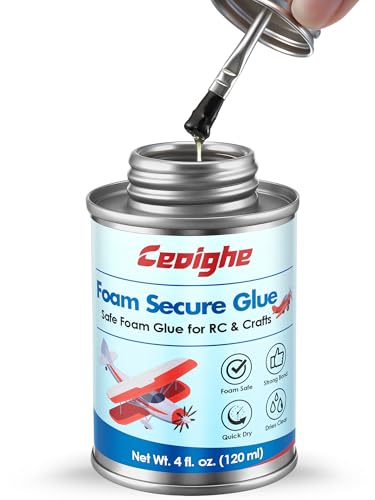
This glue targets the RC airplane crowd with a brush-cap bottle that puts the adhesive exactly where you need it. The formula is safe for EPP, EPO, and EPS foam, and it stays flexible after curing to absorb the vibration and shock of flight landings. When applied between foam board and balsa wood, the bond resists impact without shattering.
The built-in brush eliminates the need for separate tools, and it spreads the glue evenly over small strips without staining your hands. The initial set happens in minutes, but the full 24-hour cure delivers a waterproof and UV-resistant result. Users report that the glue holds well on plastic parts too, making it useful for mixed-material repairs.
On the downside, the glue appears dark yellow in the bottle, not clear, which can show through thin foam edges if over-applied. The bottle is also not filled to the top — a deliberate design choice to leave room for safe use — but it feels smaller than expected. The odor during application is noticeable, though it disappears once the adhesive cures fully.
Why it’s great
- Brush cap allows precise, targeted application
- Flexible bond absorbs vibration without cracking
- Waterproof and UV-resistant after full cure
Good to know
- Dark yellow color may show through thin foam
- Bottle appears partially empty due to design
- Odor present during application, requires ventilation
7. 3M Scotch Spray Mount

Scotch Spray Mount is the lightest adhesive in this lineup, designed for poster mounting, stencil work, and light craft projects rather than structural foam-to-wood bonding. It sprays on clear and stays repositionable for several minutes, which is perfect when you need to align a foam board graphic onto a wood backing without committing to a permanent bond immediately.
The formula does not wrinkle paper or thin foam sheets, and it holds well enough for vertical displays. Users have used it to mount appliqué shapes for sewing and to fix poster backings inside frames. The low-VOC formulation is comfortable for indoor use, and the 10.25-ounce can is easy to store.
The critical limitation is holding power. For any application where the foam board is thick, heavy, or exposed to stress and temperature changes, this adhesive will not deliver the grip required. It is strictly a light-duty mounting tool. If your project involves insulation panels, heavy craft foam, or outdoor wood surfaces, you need a stronger option from the premium or mid-range tiers above.
Why it’s great
- Repositionable bond allows alignment adjustments
- Non-wrinkling even on thin foam and paper
- Low-VOC for comfortable indoor craft use
Good to know
- Not strong enough for heavy foam board or insulation
- Best for light mounting and temporary projects
- May not hold in high-temperature or humid conditions
FAQ
Will standard spray adhesive melt my foam board?
Can I use construction adhesive like Liquid Nails for foam board to wood?
Do I need to rough up the wood surface before applying adhesive?
Final Thoughts: The Verdict
For most users, the adhesive for foam board to wood winner is the 3M Hi-Strength 94 because it offers the most reliable balance of aggressive foam-safe tack, long open time for alignment, and GREENGUARD certification for indoor use. If you want fast-drying versatility with a three-way nozzle, grab the Gorilla Ultimate Spray Adhesive. And for precision craft work where flexibility and UV resistance matter, nothing beats the Beacon Foam-Tac.