
Our readers keep the lights on and the weekend projects moving. As an Amazon Associate, I earn from qualifying purchases.
The right game can turn a quiet evening into a battle of wits, a fit of giggles, or a shared mission to save a space station. For kids ages six to eight, the board game aisle is a minefield of overly complex rules, short attention spans, and components that simply don’t hold up. The trick is finding options that are challenging enough to engage without causing frustration, and durable enough to survive enthusiastic play. This guide cuts through the clutter to deliver only the titles that hit that sweet spot for this specific age group.
I’m Rikta — the co-founder and writer behind FitlyFast. I analyze dozens of kid-focused board games each season, breaking down the mechanics, component quality, and real-world durability to identify the top performers.
Whether you need a fast-paced strategy game or a tool for developing emotional intelligence, this guide provides clear recommendations for the best board games for 6-8 year olds that will earn a permanent spot on your shelf.
How To Choose The Best Board Games For 6-8 Year Olds
A six-year-old and an eight-year-old are at very different developmental stages. The key is finding games that offer adjustable difficulty or are designed to be enjoyable across that two-year gap. Prioritize options with clear iconography, minimal reading requirements, and a playtime under 45 minutes to keep attention spans engaged.
Rule Complexity and Setup Time
The best games for this age group can be taught in under two minutes and played immediately. Complicated rulebooks lead to confusion and frustration. Look for games that use visual cues, simple turn structures, and offer a “first game” variant to ease kids into the flow.
Component Quality and Safety
Expect enthusiastic handling. The game board, cards, and pieces need to withstand drops and spills. Check for smooth edges, non-toxic materials, and components that are too large to be a choking hazard. A sturdy box that keeps everything organized is a major bonus for parents.
Educational and Social Value
The best games at this age teach without feeling like a lesson. Look for titles that encourage counting, reading basic words, strategic thinking, or turn-taking. Cooperative games, where players work together against the game, are fantastic for building teamwork and emotional regulation, as they remove the sting of losing.
Quick Comparison
On smaller screens, swipe sideways to see the full table.
| Model | Category | Best For | Key Spec | Amazon |
|---|---|---|---|---|
| Space Escape | Cooperative | Teamwork & Strategy | Playtime: 20 Min | Amazon |
| Monkey Palace | Creative Strategy | LEGO Fans & Builders | Playtime: 45 Min | Amazon |
| Breaking Barriers Down | Emotional Learning | Social-Emotional Skills | 208 Questions Included | Amazon |
| Dino-Opoly | Property Trading | Dinosaur Enthusiasts | Playtime: 60 Min | Amazon |
| Mini Foosball Table | Dexterity | Active Play & Sports Fans | Includes Scoreboard & Bell | Amazon |
| Magnet Chess Game | Push-Your-Luck | Quick, Laugh-Filled Rounds | Playtime: 10 Min | Amazon |
| Tetris: The Board Game | Strategy | Puzzle Lovers & Problem Solvers | Playtime: 20 Min | Amazon |
In‑Depth Reviews
1. Peaceable Kingdom Space Escape

Space Escape is a masterpiece of cooperative game design for young strategists. Designed by the inventor of Pandemic, this title tasks players with guiding a team of Mole Rats to their escape pod while a band of snakes slithers through the space station. Every player works together, discussing moves and making shared decisions to avoid the snakes and collect necessary equipment. The rising tension as the board fills with snakes is palpable, and the victory—when it comes—is a genuinely shared triumph.
The component quality is outstanding, with a thick game board, durable cards, and chunky plastic mole rat movers that are easy for small hands to grasp. The game’s “challenge” variant adds unlockable cards that increase difficulty and replayability, a smart touch that keeps the game fresh even after multiple plays. With a brisk playtime of about 20 minutes, it fits perfectly into an evening routine without dragging on.
This game excels at teaching communication and strategic planning without feeling like a lesson. Younger players learn to analyze the consequences of their moves, while older ones practice patience and teamwork. It’s a rare game where the whole family can play on equal footing, making it the top recommendation for this age group.
Why it’s great
- True cooperative play – everyone wins or loses together.
- Excellent component quality for the price point.
- Unlockable challenge cards add significant replay value.
Good to know
- Requires no reading, making it accessible for younger players.
- Best with 3-4 players; the two-player game is less dynamic.
2. Monkey Palace – LEGO Board Game

Monkey Palace brilliantly merges the tactile joy of LEGO brick construction with a competitive board game strategy. Players build towers on a shared LEGO base plate, placing their monkey figures to claim territory and score points. The twist: as towers grow taller, they become unstable and may collapse, sending bricks and monkeys tumbling. This chaotic element is the source of most of the game’s laughter and surprises.
The 231 included LEGO elements are of the standard high quality, and the game board is a 32×32 stud plate, offering a vast and flexible playing field. The rulebook is initially dense, but after a single playthrough, the mechanics become intuitive. The game teaches resource management and spatial reasoning, as players must decide whether to build tall for points or wide for stability.
While the box says ages 10+, many families with 7-8 year olds report great success, especially if the child is already a confident LEGO builder. The main downside is the setup and cleanup time, as sorting the large number of bricks can be tedious. However, for families who already love LEGO, this is a near-perfect addition to game night that offers a unique and deeply engaging experience.
Why it’s great
- Unique hybrid of LEGO building and board game strategy.
- Tower collapses create memorable, laugh-out-loud moments.
- High-quality components that are infinitely reusable.
Good to know
- Setup and cleanup are time-consuming due to many small pieces.
- May require additional LEGO for 4-player games after many rounds.
3. Breaking Barriers Down – Social Skills Game
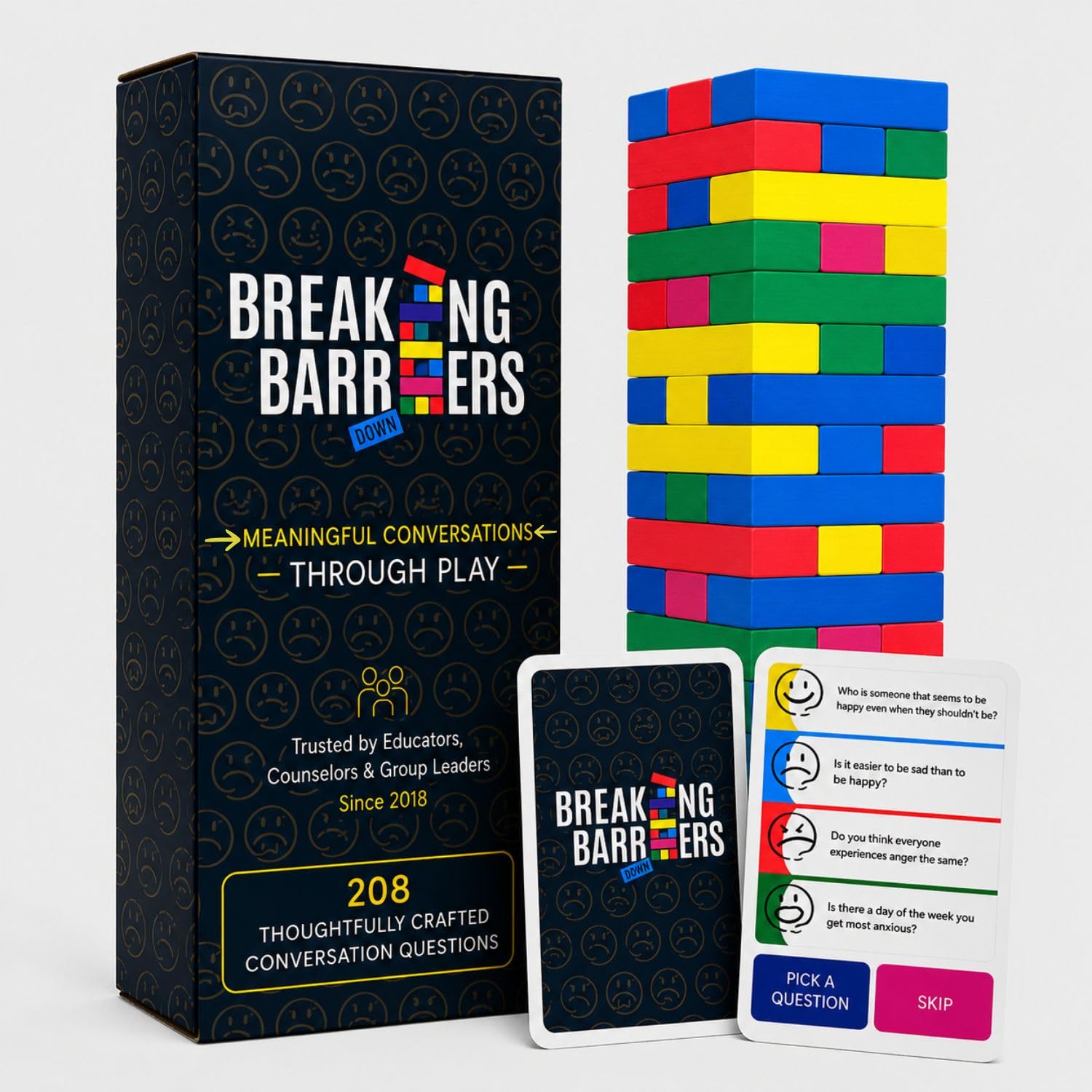
Breaking Barriers Down is a targeted tool for developing emotional intelligence, cleverly disguised as a block-stacking game. Using a Jenga-style tower of plastic blocks, players pull a block and answer a question that corresponds to that color, exploring feelings related to anger, sadness, fear, and joy. The 208 questions are thoughtfully crafted to open up conversations that children might otherwise avoid.
This game is a staple for therapists and school counselors for good reason. It creates a safe, structured environment where kids feel comfortable talking about big feelings. The physical act of pulling a block adds a layer of focus and playfulness, reducing the pressure of a direct conversation. The kit includes a compact storage bag, making it easy to bring to sessions or on trips.
The quality of the plastic blocks is a point of consideration; they are less durable than a traditional wooden Jenga set and have been noted to have slight inconsistencies in size. However, the game’s true value is in the content, not the blocks. For any parent or professional looking to strengthen a child’s emotional vocabulary and regulation skills, this is an invaluable resource that serves a unique purpose on this list.
Why it’s great
- Professionally designed questions that genuinely engage children.
- Versatile for home, classroom, and therapy settings.
- Portable and easy to store in the included bag.
Good to know
- Plastic blocks are less sturdy than traditional wooden alternatives.
- Best used as a facilitated activity, not a purely competitive game.
4. Late for the Sky Dino-Opoly
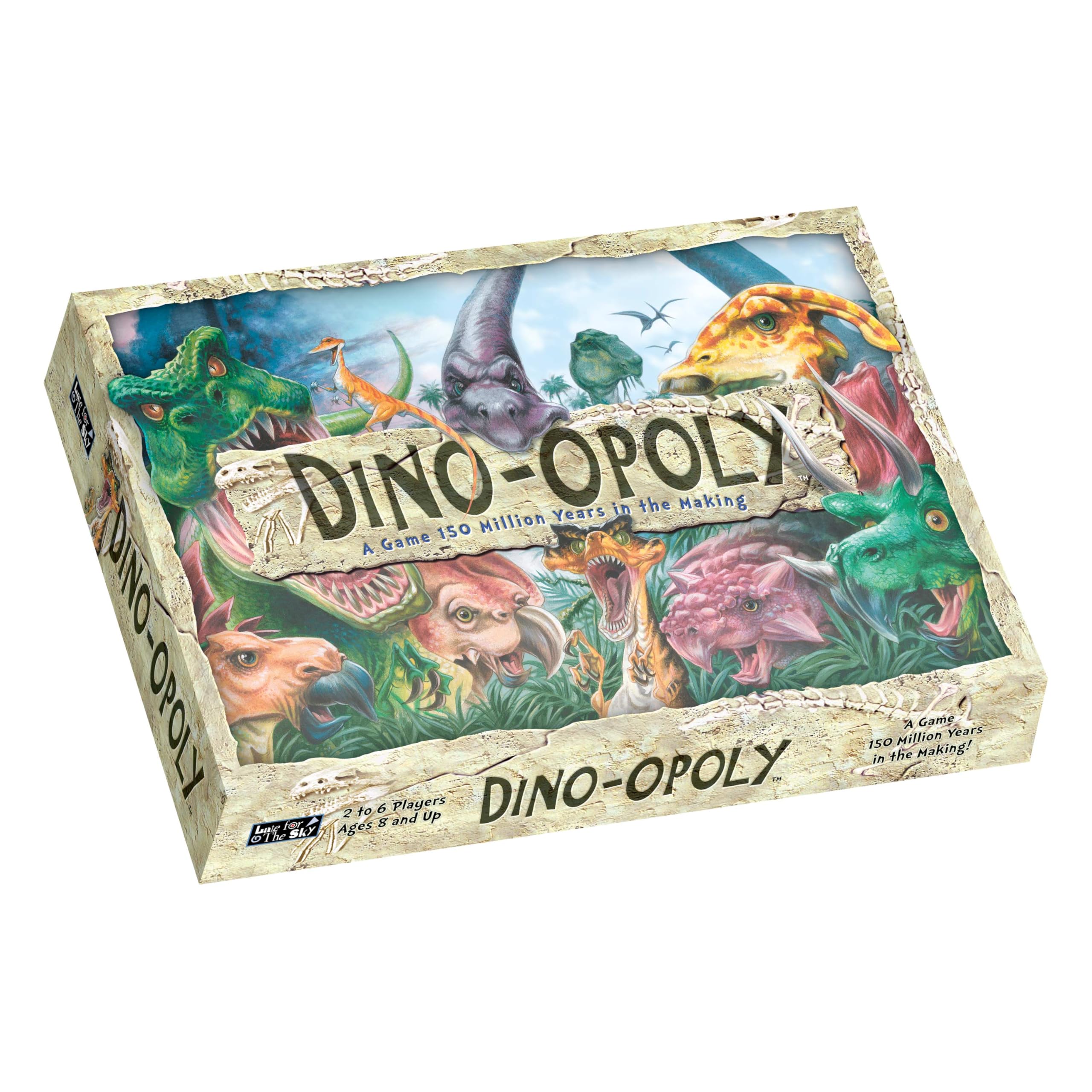
Dino-Opoly takes the familiar Monopoly framework and gives it a prehistoric makeover that is deeply appealing to young dinosaur fans. Instead of buying properties, players collect dino deeds, build bones (houses) and museums (hotels), and learn fun facts about each dinosaur on the deed cards. The board is colorful and engaging, featuring custom artwork rather than the standard real estate map.
The game is significantly shorter and simpler than traditional Monopoly, with streamlined rules that are easier for young minds to grasp. The use of dinosaur trivia cards adds an educational layer that feels natural and fun. Players will learn pronunciation and basic facts about species like the Triceratops and Pteranodon without realizing they are being taught.
The component quality is solid, with a sturdy board and thick cardstock. However, the player tokens are basic and could be more thematic. The “Chance” and “Opportunity” card actions are also less varied than in the original game, which can make the mid-game feel a bit repetitive. For a dinosaur-obsessed child, however, these are minor quibbles against a game that will likely become a fast favorite.
Why it’s great
- Excellent theming with educational dinosaur facts on every card.
- Shorter, kid-friendly rules compared to classic Monopoly.
- Teaches basic money management and counting.
Good to know
- Gameplay can feel repetitive after multiple plays.
- Player tokens are simple and lack detail.
5. COUOMOXA Soccer Board Game (Mini Foosball)

This mini foosball table from COUOMOXA brings the energy of the soccer pitch to the living room floor. Unlike traditional foosball, this table uses a “flipper drive” mechanism—buttons on the handles control moving flippers to kick the ball, allowing for passing, dribbling, and powerful shots. The 20×11.8 inch playing field is compact but spacious enough for genuine play.
Construction is from durable ABS plastic with smooth, rounded edges. The scoring system includes a ringing goal bell and a built-in slider scoreboard, adding to the authentic match-day feel. Assembly is straightforward and takes about ten minutes. The game folds flat for storage and includes a dedicated ball storage space to prevent lost balls.
This is a pure dexterity game that improves hand-eye coordination and reaction speed. It’s also a fantastic tool for teaching good sportsmanship, as players must learn to win and lose gracefully. The main limitation is that it is strictly a two-player game, and the sloped field design can cause the ball to roll in a predictable pattern. For screen-free, active fun that will have both kids and adults on their feet, this is a fantastic option.
Why it’s great
- Engaging physical gameplay that gets players moving.
- Durable, safe materials with smooth edges.
- Goal bell and scoreboard add to the excitement.
Good to know
- Limited to 2 players only.
- Sloped field may lead to predictable ball movement over time.
6. Hcusus Magnet Game (Magnet Chess)

The Hcusus Magnet Game is a masterclass in simple, addictive fun. Players take turns placing magnetic stones onto a shared board, trying to avoid having their stones snap together. When magnets connect, the player who placed the last stone must collect the entire cluster, increasing their piece count. The first player to get rid of all their magnets wins.
The rules can be learned in under 30 seconds, making it perfect for players of all ages, including younger siblings. The strong magnets create a satisfying click when they snap together, which leads to squeals and laughter every time. The game is fast, with rounds often lasting under ten minutes, allowing for multiple plays in a single session. The included travel bag makes it easy to bring to restaurants or on trips.
The primary concern is build quality. The plastic playing pieces feel thin and somewhat cheap, and the board is a simple foldable sheet. While the magnets themselves are strong, the components may not survive years of heavy play. However, at its price point, this game delivers an exceptional amount of joy and strategic depth per minute, making it a fantastic choice for quick, high-energy family fun.
Why it’s great
- Extremely simple rules—teachable in seconds.
- Fast, exciting gameplay with loud, satisfying magnetic snaps.
- Portable with a convenient storage bag.
Good to know
- Plastic components feel less durable than premium games.
- Game board is a thin, foldable sheet, not a rigid board.
7. Spin Master Games Tetris: The Board Game
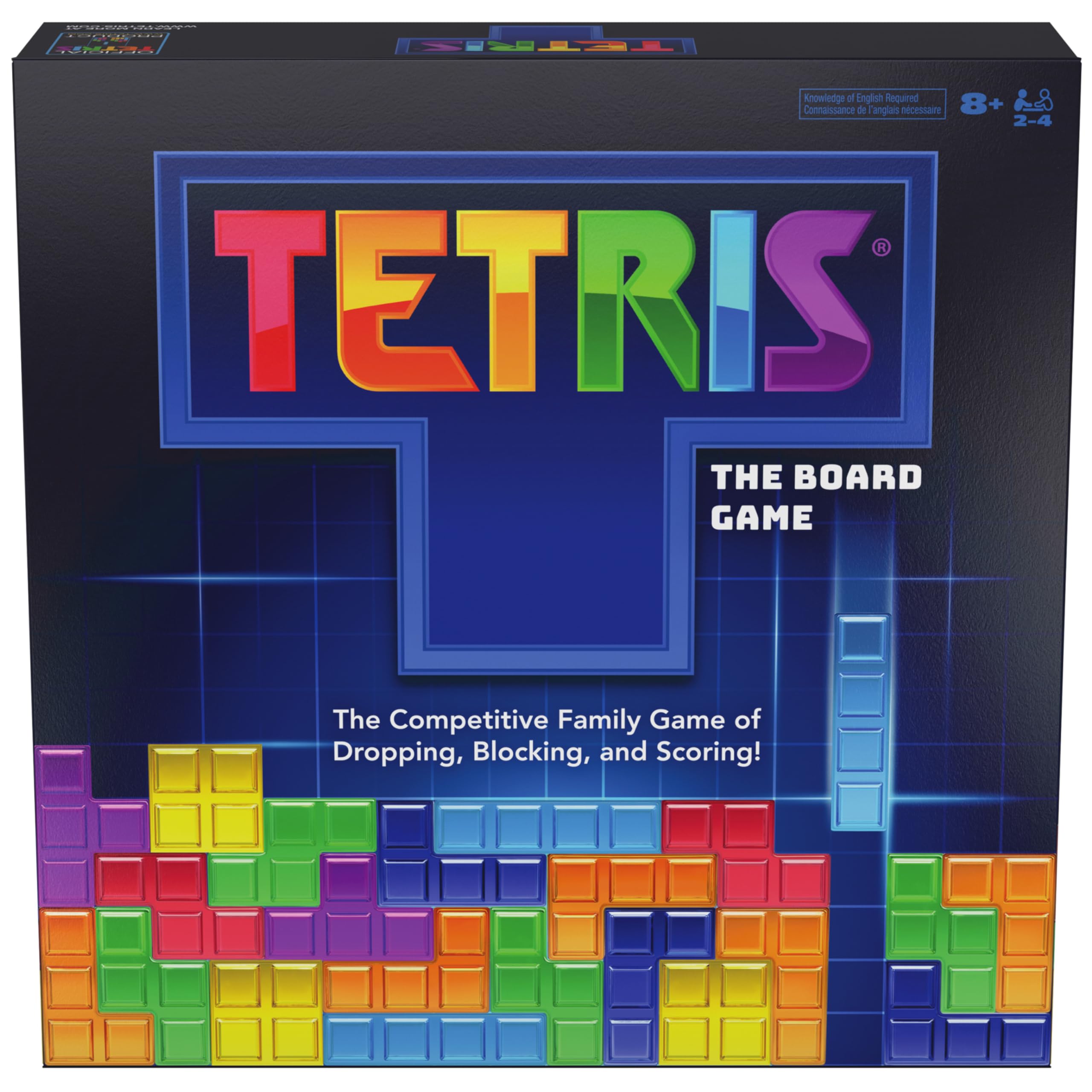
Spin Master’s Tetris: The Board Game successfully translates the iconic video game logic into a physical, head-to-head competition. Each player manages their own grid, drawing and placing semi-translucent Tetrimino pieces to complete lines. A competitive twist is introduced via “Garbage Drop” icons: placing a Tetrimino over one lets you add a piece to an opponent’s grid, blocking their progress and creating a satisfying back-and-forth battle.
The components are a standout feature. The Tetriminos are made of a high-quality, semi-translucent plastic that looks fantastic on the player grids. The four individual grids, base, and player cards are all well-made and designed to withstand repeated play. The game plays in about 20 minutes, which keeps the tension high without overstaying its welcome. It requires spatial reasoning and forward planning, which is excellent cognitive exercise.
The one caveat is the listed age range of 8+. Some of the strategic nuances, particularly the decision of when to use Garbage Drop tokens, may be challenging for a typical six-year-old. For an eight-year-old with good puzzle-solving skills, it’s perfect. It’s a great option for kids who enjoy video games but need a screen-free alternative that still feels modern and fast-paced.
Why it’s great
- Faithful and clever adaptation of a classic video game.
- Beautiful, high-quality translucent Tetrimino pieces.
- Fast-paced, competitive gameplay with a great balance of strategy and luck.
Good to know
- Strategic complexity may be advanced for younger 6-year-olds.
- Best as a head-to-head 2-player game; 3-4 player variants are less smooth.
FAQ
Are these games safe for a 6 to 8 year old child?
What is the difference between a cooperative and a competitive game for kids?
My child struggles with reading. Are there good board games for them?
Final Thoughts: The Verdict
For most users, the board games for 6-8 year olds winner is the Peaceable Kingdom Space Escape because it masterfully combines cooperative strategy with high-quality components and genuine replay value. If you want a creative, physically engaging experience, grab the Monkey Palace LEGO Board Game. And for addressing social-emotional learning in a fun, non-threatening way, nothing beats the Breaking Barriers Down Social Skills Game.