
Our readers keep the lights on and the weekend projects moving. As an Amazon Associate, I earn from qualifying purchases.
Walking a quarter-mile perimeter with a leaf blower that stalls every time you angle the nozzle is a unique frustration. The constant pull-start battle, the lingering smell of premixed fuel, and the sudden engine cough when you tilt it to clear a gutter—these are the daily realities that push property owners away from traditional 2-stroke blowers. Choosing the right engine platform eliminates these headaches before they start.
I’m Rikta — the co-founder and writer behind FitlyFast. I’ve spent years analyzing small-engine power equipment, digging into displacement specs, CFM-to-MPH ratios, and the mechanical differences between 2-cycle and 4-cycle designs that determine real-world usability.
No matter the size of your property, finding the best 4 stroke leaf blower means targeting a machine that runs on straight pump gas, starts reliably, and keeps running at any angle without oil mix anxiety.
How To Choose The Best 4 Stroke Leaf Blower
Selecting a 4-stroke leaf blower isn’t as simple as grabbing the highest CFM number. The engine platform itself dictates fuel type, weight distribution, noise output, and maintenance intervals. Understanding the trade-offs between handheld maneuverability and backpack endurance, and between raw airspeed and usable torque, will guide you to the right match for your property.
Engine Displacement and Power Output
Displacement, measured in cubic centimeters (cc), directly correlates to the engine’s ability to sustain airflow under load. A 26.5cc 4-stroke engine is sufficient for driveways and small lawns, while larger 49cc to 209cc engines generate the torque needed to move wet leaves and debris on multi-acre properties. Unlike 2-stroke engines, 4-stroke designs produce peak torque at lower RPMs, which translates to sustained blowing force without constant high-revving.
Airflow vs. Airspeed: CFM and MPH
Cubic feet per minute (CFM) measures the volume of air moved, while miles per hour (MPH) measures the speed of that air. For leaf blowing, CFM is the more critical number because high volume moves large piles of leaves efficiently. MPH matters for dislodging wet, stuck debris from mulch beds or tight corners. A balanced blower in the 500-600 CFM range with 180-200 MPH is the sweet spot for most residential properties.
Handheld vs. Backpack: Ergonomics and Endurance
Handheld 4-stroke blowers are lighter—typically 9-10 pounds—and are ideal for quick cleanups, sidewalks, and car drying. However, the weight of a 4-stroke engine (due to the oil reservoir and additional engine components) can cause fatigue during extended sessions. Backpack models distribute that weight across your shoulders and hips, making one-hour plus jobs far more manageable. If your property requires more than 30 minutes of continuous blowing, a backpack 4-stroke is the correct choice.
Quick Comparison
On smaller screens, swipe sideways to see the full table.
| Model | Category | Best For | Key Spec | Amazon |
|---|---|---|---|---|
| SENIX 49cc Backpack | 4-Stroke Backpack | Mid-sized yards, all-day comfort | 600 CFM, 200 MPH, 18N Force | Amazon |
| SuperHandy Walk Behind | Walk-Behind | Large properties, heavy debris | 1270 CFM, 150 MPH, 209cc | Amazon |
| Landworks Walk Behind | Walk-Behind | Heavy-duty commercial clearing | 2000 CFM, 200 MPH, 212cc | Amazon |
| SENIX 26.5cc Handheld | 4-Stroke Handheld | Light cleanup, small lots | 410 CFM, 125 MPH, 9.5 lbs | Amazon |
| Yardmax Walk Behind | Walk-Behind | Large lawns, flat terrain | 1200 CFM, 150 MPH, 209cc | Amazon |
| HTK 63cc Backpack | 2-Stroke Backpack | High power, budget conscious | 665 CFM, 205 MPH, 21 lbs | Amazon |
| Thalorus 52cc Backpack | 2-Stroke Backpack | Lightweight power, comfort | 550 CFM, 230 MPH, 13.6 lbs | Amazon |
| JUBATEC 65cc Backpack | 2-Stroke Backpack | High CFM for large debris | 884 CFM, 3.8 HP, 24.3 lbs | Amazon |
| Elementool 66cc Backpack | 2-Stroke Backpack | High speed, wet leaves | 880 CFM, 320 MPH, 25.1 lbs | Amazon |
In‑Depth Reviews
1. SENIX 49cc Backpack Leaf Blower
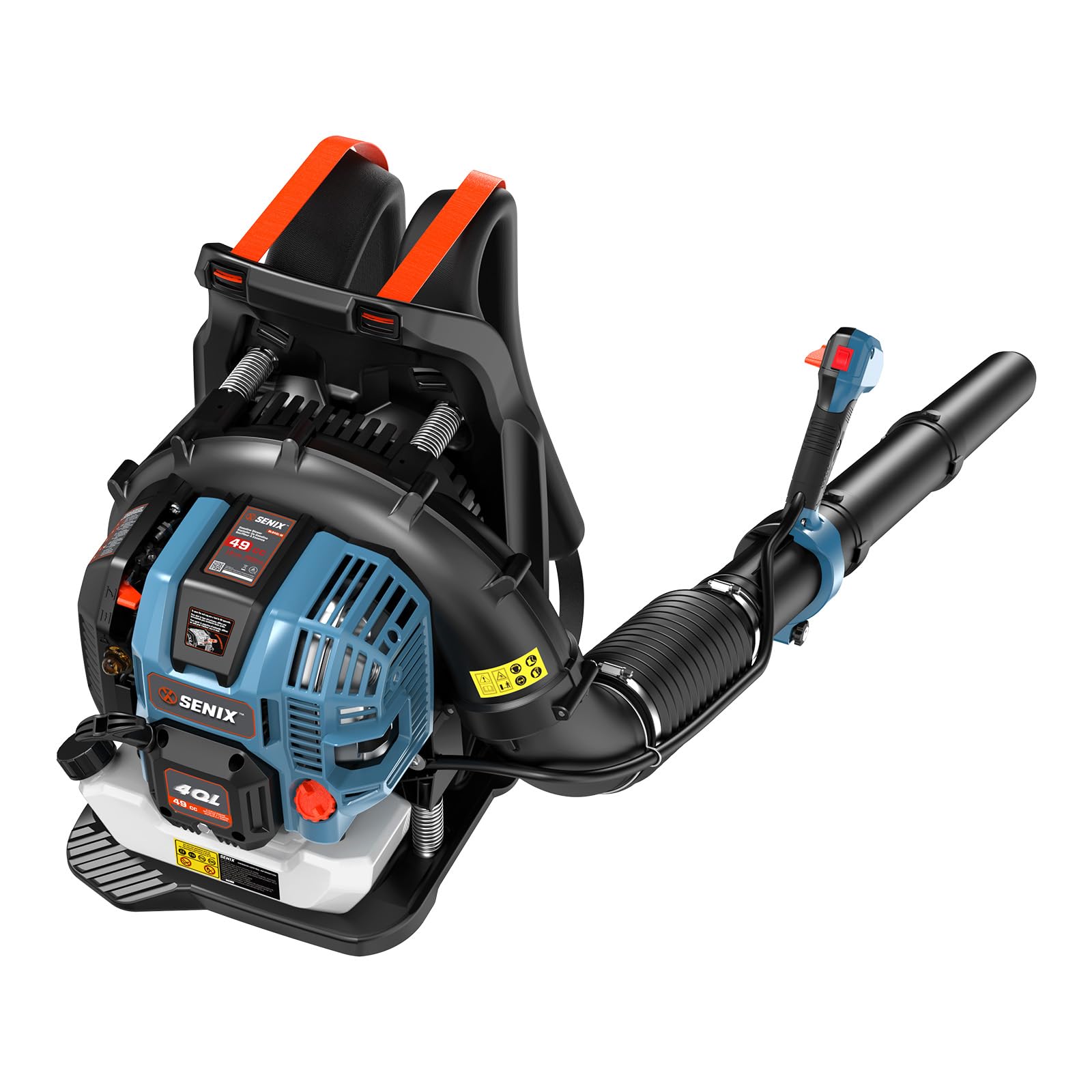
The SENIX 49cc backpack blower is the gold standard for a reason: it marries the convenience of 4-stroke fueling with the serious power of a 49cc full-crank engine. Delivering 600 CFM at 200 MPH with an 18N blowing force, this unit handles wet fall leaves and deep driveway clippings without bogging down. The 4QL technology engine is designed for all-directional use, meaning you can tilt the blower to clear gutters or reach under bushes without worrying about oil starvation—a genuine advantage over 2-stroke designs that often stall when angled.
What sets this model apart from handheld 4-strokes is the ergonomic backpack frame. Padded shoulder straps and a balanced frame structure distribute the engine weight across your back, allowing for sustained one-hour plus operation without forearm fatigue. The variable-speed throttle with cruise control locks in a consistent RPM, so you don’t have to hold the trigger during long straight-line passes. Real-world users report starting on the 5th pull and remark on the fuel efficiency and low vibration that make it feel quieter than similarly sized 2-stroke backpacks.
The only recurring concern involves quality control on certain units—a few owners experienced gas line seepage or rough idle after the break-in period. However, the 3-year limited warranty and generally positive long-term reviews suggest that initial issues are isolated. For anyone looking for a true “set it and forget it” 4-stroke backpack that runs on straight pump gas, this is the most balanced choice on the market.
Why it’s great
- 600 CFM airflow with 18N force moves large piles quickly
- No oil mixing—use standard unleaded gasoline
- All-directional lubrication prevents stalling when tilted
Good to know
- Some units have reported fuel line issues
- Plastic frame components feel less robust than pro-grade metal
2. SuperHandy Walk Behind Leaf Blower

When you have an acre or more of mature trees, a handheld or even backpack blower becomes a slow, exhausting tool. The SuperHandy walk-behind blower solves that with a 7HP 209cc 4-stroke engine that generates 1270 CFM at 150 MPH—enough volume to push wet oak leaves across a football field in minutes. The manual-propelled design uses 12-inch rear wheels and an 8-inch swivel front wheel, allowing you to navigate turf and uneven ground without the vibration fatigue that comes from carrying a motor on your back.
The 4-stroke engine here is a significant advantage over the 2-stroke walk-behinds in the same price tier. You fill the tank with standard unleaded gasoline (87 octane, less than 10% ethanol recommended), add the included 5W-30 oil to the crankcase, and you’re done. No mixing ratios, no smoky exhaust, and no carburetor gumming from old premix fuel. The adjustable airflow angle lets you direct the blast horizontally for sweeping or upward for moving leaves out of flower beds, and the throttle control varies the RPM continuously rather than at fixed settings.
The biggest trade-off is build quality consistency. The handlebar bolts can crack the powder coating if overtightened, and the front wheel bracket has been a failure point for some users. Several owners noted that the included instructions are minimal, but assembly is straightforward with basic tools. For the raw CFM-to-dollar ratio and the sheer labor savings on large properties, this machine is a clear winner for anyone who values speed over finesse.
Why it’s great
- 1270 CFM clears large areas in a fraction of the time
- 4-stroke engine runs on pump gas with no mixing
- Large wheels handle uneven terrain well
Good to know
- Front wheel bracket can fail; replacement bracket is available
- Manual-propelled design requires effort on inclines
3. Landworks Walk Behind Leaf Blower

The Landworks walk-behind blower sits at the top of the 4-stroke food chain with a 212cc 7HP engine that pushes up to 2000 CFM at 200 MPH. That is industrial-grade airflow—enough to move not just leaves but small sticks, gravel, and light snow in a single pass. The 13.5-inch metal impeller inside the housing is a major differentiator from plastic-impeller competitors; it handles debris impacts without cracking and maintains consistent airflow even when the intake pulls in wet, heavy material.
This is a machine for serious property management. The 0.7-gallon fuel tank provides enough runtime to cover several acres, and the 90-degree adjustable flow angle lets you switch between side discharge and front discharge to match the wind direction or clearing pattern. The EPA and CARB certification means it complies with California emissions standards without sacrificing power. Owners with one-acre-plus properties consistently report reducing cleanup time from hours to under 30 minutes compared to using a backpack blower.
The durability concern is real: the front wheel bracket has been a known failure point, though the manufacturer has since shipped redesigned, sturdier brackets to affected customers. Assembly requires some patience—the manual is sparse—and the unit is heavy enough that you’ll want a garage or shed for storage. For commercial-scale leaf clearing on flat terrain, this is the most powerful 4-stroke blower you can buy without stepping into a tow-behind PTO unit.
Why it’s great
- 2000 CFM maximum airflow handles commercial-scale debris
- Metal impeller is durable against impacts
- EPA and CARB compliant for California use
Good to know
- Front wheel bracket may need reinforcement
- Heavy unit requires dedicated storage space
4. SENIX 26.5cc Handheld Leaf Blower
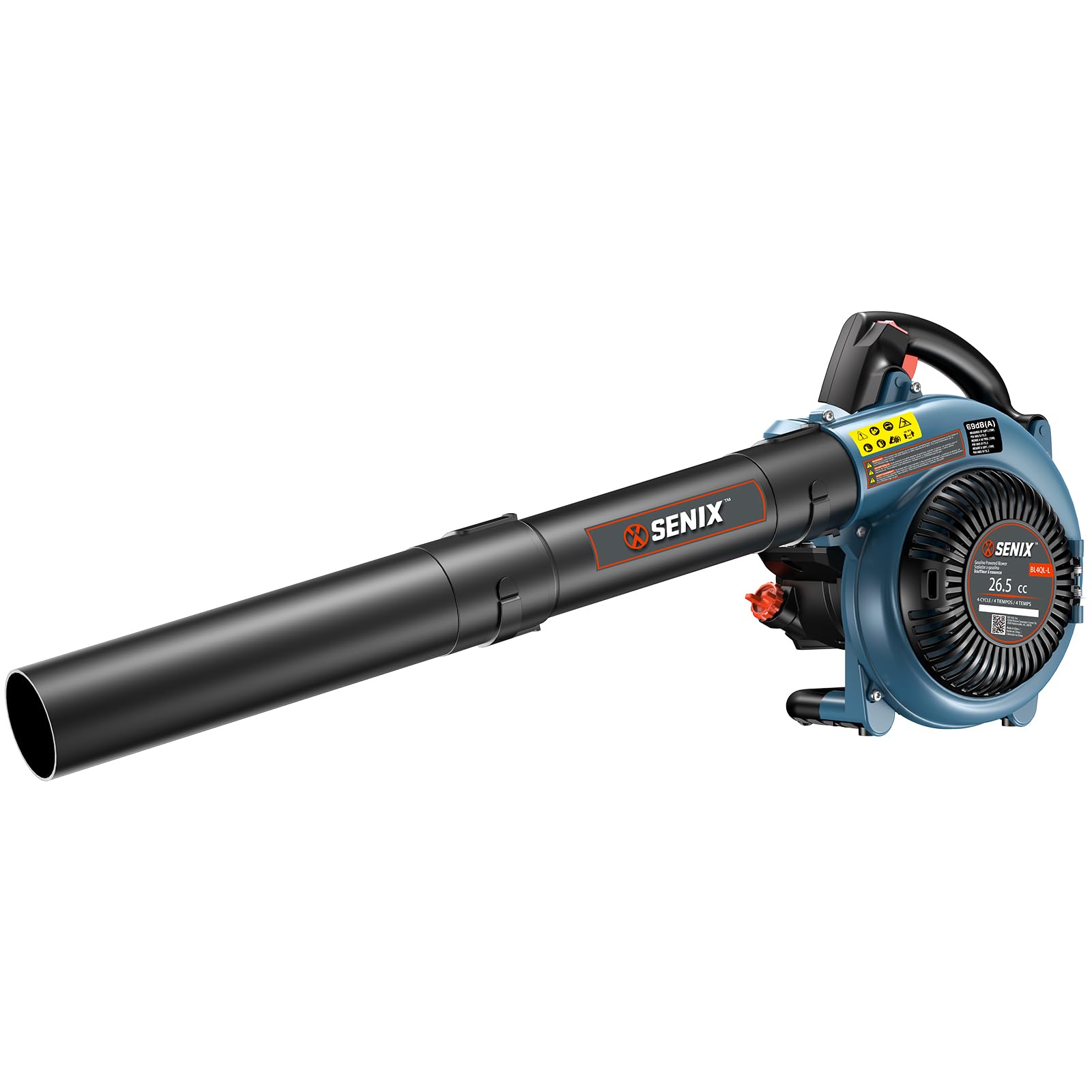
The SENIX 26.5cc handheld is the entry point into 4-stroke blowing without the premium price. At 9.5 pounds with a dual-grip handle, it strikes a balance between portability and usable power—410 CFM at 125 MPH is enough for sidewalks, driveways, and small lawns, though it will struggle against thick wet piles. The 4QL technology engine is the same all-directional design found in the larger backpack model, so you can tilt the blower for gutter cleaning or under-deck debris without the engine starving for oil.
What makes this a standout for budget-conscious buyers is the ease of use. The automatic compression release reduces pull-start effort significantly, and the metal washable air filter means you don’t have to buy disposable replacements. The fuel economy is excellent; users report running for weeks on a single tank for routine cleanups. The no-mix fueling is the feature that converts 2-stroke holdouts—just pour straight gas and go, with none of the blue smoke or carburetor cleaning that plagues premix engines.
The biggest drawback is a lack of throttle lock. You must hold the trigger continuously, which leads to hand fatigue during jobs longer than 15-20 minutes. Some users also note that the left-side air intake can be partially blocked by a right-handed user’s leg, reducing airflow. For quick daily cleanups and car drying, this is the lightest and most reliable 4-stroke handheld available, but it’s not designed for marathon sessions.
Why it’s great
- Lightweight 9.5-pound design for easy one-handed use
- All-directional lubrication allows tilting without stalling
- Washable metal air filter reduces maintenance costs
Good to know
- No throttle lock—must hold trigger continuously
- Airflow (410 CFM) is lower than 2-stroke alternatives
5. Yardmax Walk Behind Leaf Blower

The Yardmax YF1565 walk-behind blower fills the gap between entry-level handhelds and the heavy-duty Landworks units. Its 209cc 2-stroke engine (note: this is a 2-stroke, not 4-stroke) delivers 1200 CFM at 150 MPH, which is more than enough for most residential properties under an acre. The 7-position side handle allows you to adjust the airflow angle horizontally, upward, or downward, giving you precise control over where the debris goes—critical for avoiding blowing leaves into flower beds or onto the neighbor’s driveway.
The wheel setup is where Yardmax differentiates itself. Ball-bearing swivel casters on the 8-inch front wheel and 12-inch rear wheels provide smooth turning on flat lawns, and the removable discharge chute lets you redirect airflow forward or to the side. Assembly is straightforward, and the included funnel and oil get you started immediately. Owners with flat, open lawns report that this blower cuts cleanup time by roughly 50% compared to backpack units.
The trade-off is that this is a 2-stroke engine, not a 4-stroke, so you must mix oil into the fuel. Additionally, some owners report that the throttle cable can break after limited use and that the true pushing power is lower than expected for a 209cc engine. The 9-day commercial warranty is also a red flag for anyone expecting heavy daily use. For occasional weekend leaf duty on flat terrain, it’s a solid value, but serious 4-stroke advocates should look at the SuperHandy or Landworks alternatives.
Why it’s great
- 1200 CFM volume handles large leaf piles effectively
- 7-position adjustable airflow provides precise control
- Large wheels roll smoothly over turf
Good to know
- 2-stroke engine requires premixing oil and gas
- Build quality concerns with throttle cable durability
6. HTK 63cc Backpack Leaf Blower
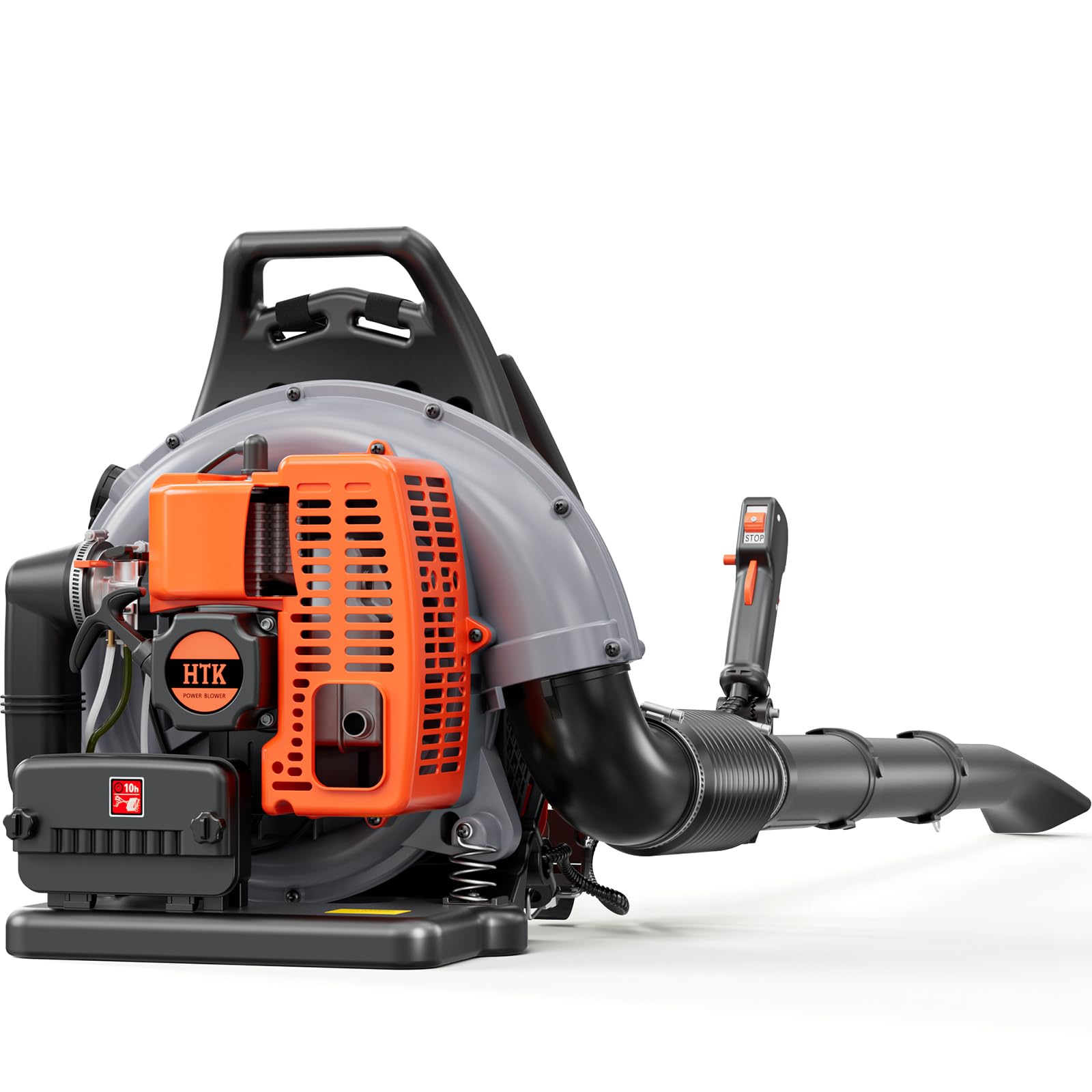
If raw CFM and MPH are your priority and you don’t mind mixing gasoline, the HTK 63cc backpack blower delivers serious numbers—665 CFM at 205 MPH—at a price that undercuts many mid-range 4-stroke backpacks. The 63cc 2-stroke engine is built for heavy lifting: wet leaves, deep snow, and stubborn gravel all get pushed aside with authority. The air purge system simplifies starting, and the padded backpack harness distributes the 21-pound weight across your shoulders for extended use.
This unit excels in pure power-to-weight ratio. The 1.7-liter fuel tank gives extended runtime, and the cruise control locks the throttle at a consistent speed to reduce finger fatigue. Owners report that it starts on the first or second pull after priming, which is impressive for a 63cc engine. For homeowners with large properties or light commercial use, this blower cuts through jobs that would overwhelm a 26cc handheld 4-stroke.
The obvious downside is the 2-stroke nature: you must mix 50:1 fuel, the exhaust is loud (hearing protection is mandatory), and the smoke and smell are more pronounced than any 4-stroke. Some users also note that the trigger must be held continuously—there is no reliable lock-on mechanism. For buyers who prioritize absolute blowing force over fuel convenience and noise, this is a strong contender, but it doesn’t fit the 4-stroke “no-mix” promise that many property owners seek.
Why it’s great
- 665 CFM and 205 MPH for heavy debris clearing
- Air purge system for easy starting
- Large 1.7L tank for extended runtime
Good to know
- 2-stroke engine requires oil mixing
- Very loud; hearing protection is essential
7. Thalorus 52cc Backpack Leaf Blower
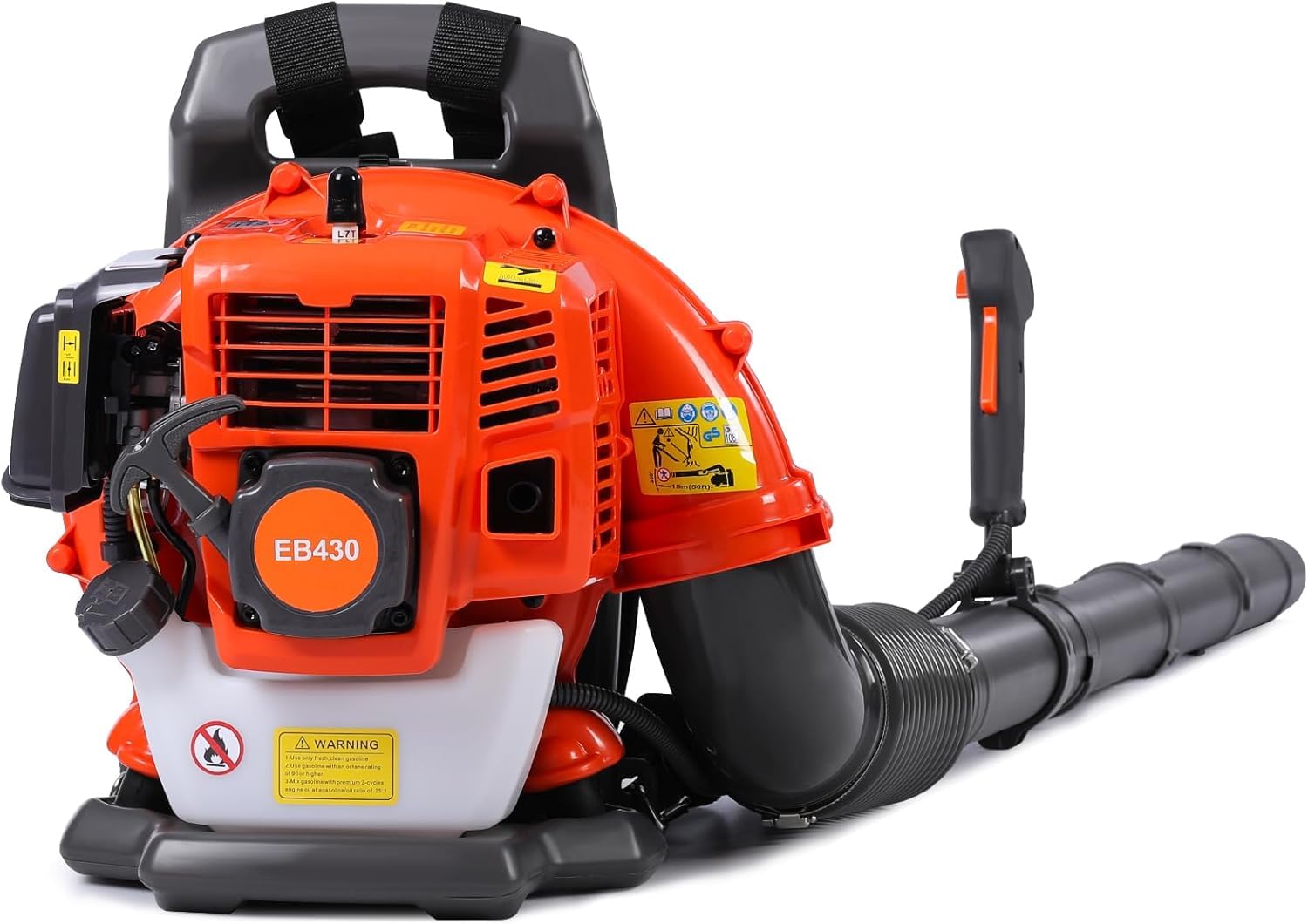
The Thalorus 52cc backpack blower is remarkably light for its displacement class—just 13.6 pounds—making it a strong choice for users who need backpack-level power without the bulk of a full-size machine. The 52cc 2-stroke engine produces 550 CFM at 230 MPH, which is a high airspeed combination ideal for dislodging wet leaves stuck to mulch or grass. The low-vibration harness and cushioned backplate reduce operator fatigue noticeably, especially on medium-sized properties.
The 1-liter fuel tank provides up to 45 minutes of runtime, which is enough for most residential lots. The thumb throttle and cruise control work well together to maintain consistent power without holding the trigger, though some users report that the trigger screw can work loose over time. Assembly is quick, and the engine starts within 2-3 pulls when cold. For its price, the Thalorus offers a compelling combination of low weight and high airspeed that makes it competitive with more expensive models.
The trade-offs are typical of 2-stroke backpack blowers: you must mix oil and gas, the noise level requires ear protection, and the build quality (plastic housing, screw retention) doesn’t match pro-grade Stihl or Echo units. Some users found the shoulder straps too short when wearing thick winter coats. For buyers who need to cover a moderate-sized property quickly and don’t want the weight of a 4-stroke, this is a fine choice, but it doesn’t deliver the no-mix convenience that defines the 4-stroke category.
Why it’s great
- Only 13.6 pounds for a 52cc backpack platform
- 230 MPH airspeed is excellent for wet debris
- Low-vibration harness with cushioned backplate
Good to know
- 2-stroke engine requires fuel mixing
- Trigger screw can loosen; may need thread locker
8. JUBATEC 65cc Backpack Leaf Blower
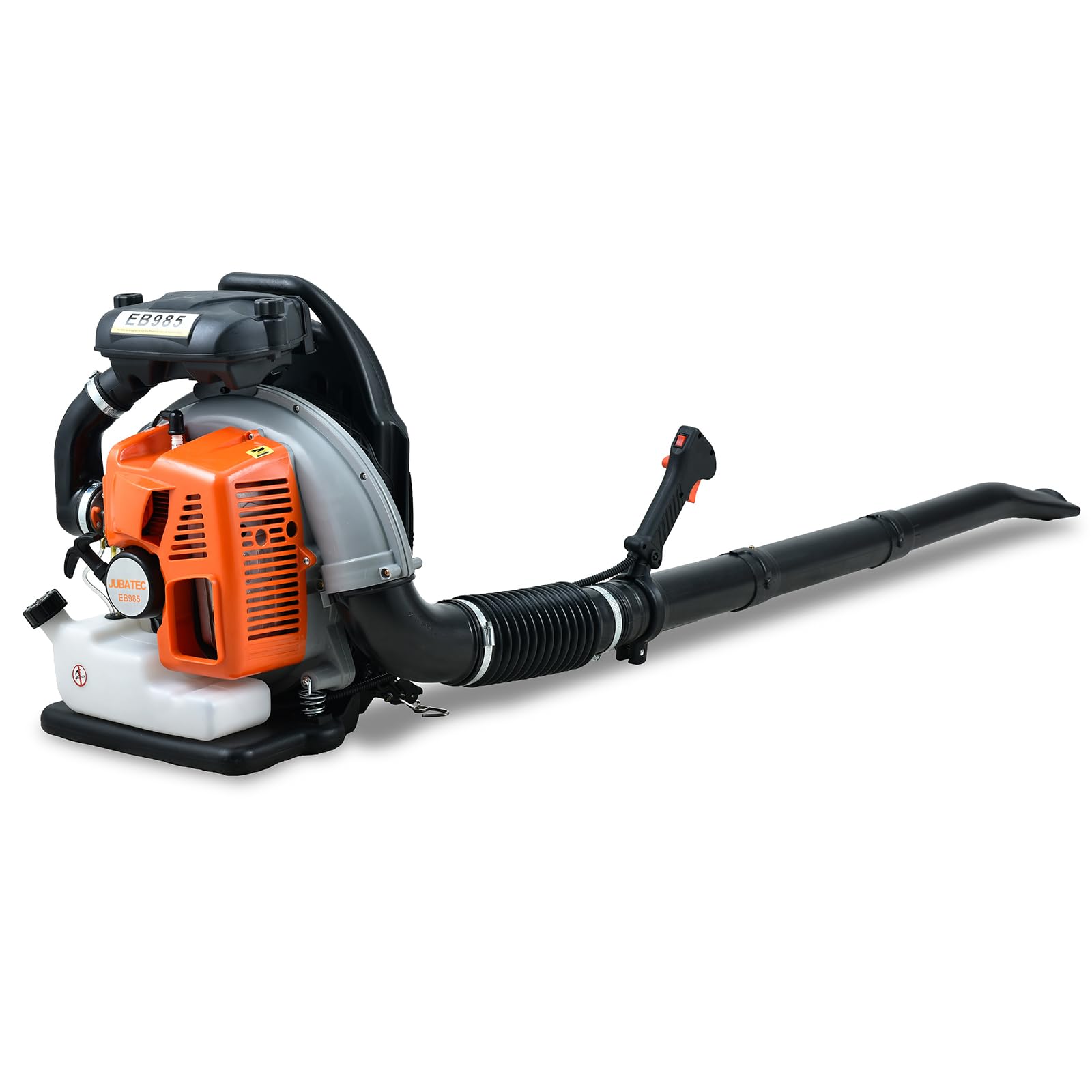
When massive air volume is the primary requirement, the JUBATEC 65cc backpack blower delivers a staggering 884 CFM at 3.8 HP—numbers that typically belong to commercial-grade machines costing significantly more. The 65cc 2-stroke engine revs to 8790 RPM, generating enough force to move heavy gravel, wet leaves, and even light snow within a wide 120-degree adjustable nozzle range. The 1.6-liter tank keeps you running for extended periods without refueling.
The harness system is padded and weight-balanced, making the 24.3-pound unit feel manageable during use. The flame-retardant outlet and 120-degree vertical plus 135-degree horizontal adjustment give you excellent control over debris direction. For users who need to clear large commercial or agricultural properties, the CFM-to-cost ratio here is extremely competitive. Owners consistently praise the starting reliability and the raw clearing power.
The downsides are significant: this is a loud machine (ear protection is mandatory), the 2-stroke exhaust can cling to clothes, and some users report that the nozzle can pop off if the lock lugs are not fully engaged. The 25:1 fuel mix ratio (during break-in) is richer than standard 50:1, which means more oil consumption initially. For pure volume clearing where noise and fuel mixing are acceptable trade-offs, this is a power bargain, but it doesn’t align with the “no mix, low noise” ethos of 4-stroke buyers.
Why it’s great
- 884 CFM airflow at an aggressive price point
- Wide 120-degree adjustable nozzle for versatile direction
- 3.8 HP engine handles heavy debris with ease
Good to know
- 2-stroke engine; 25:1 mix during break-in
- Very loud; hearing protection is required
9. Elementool 66cc Backpack Leaf Blower
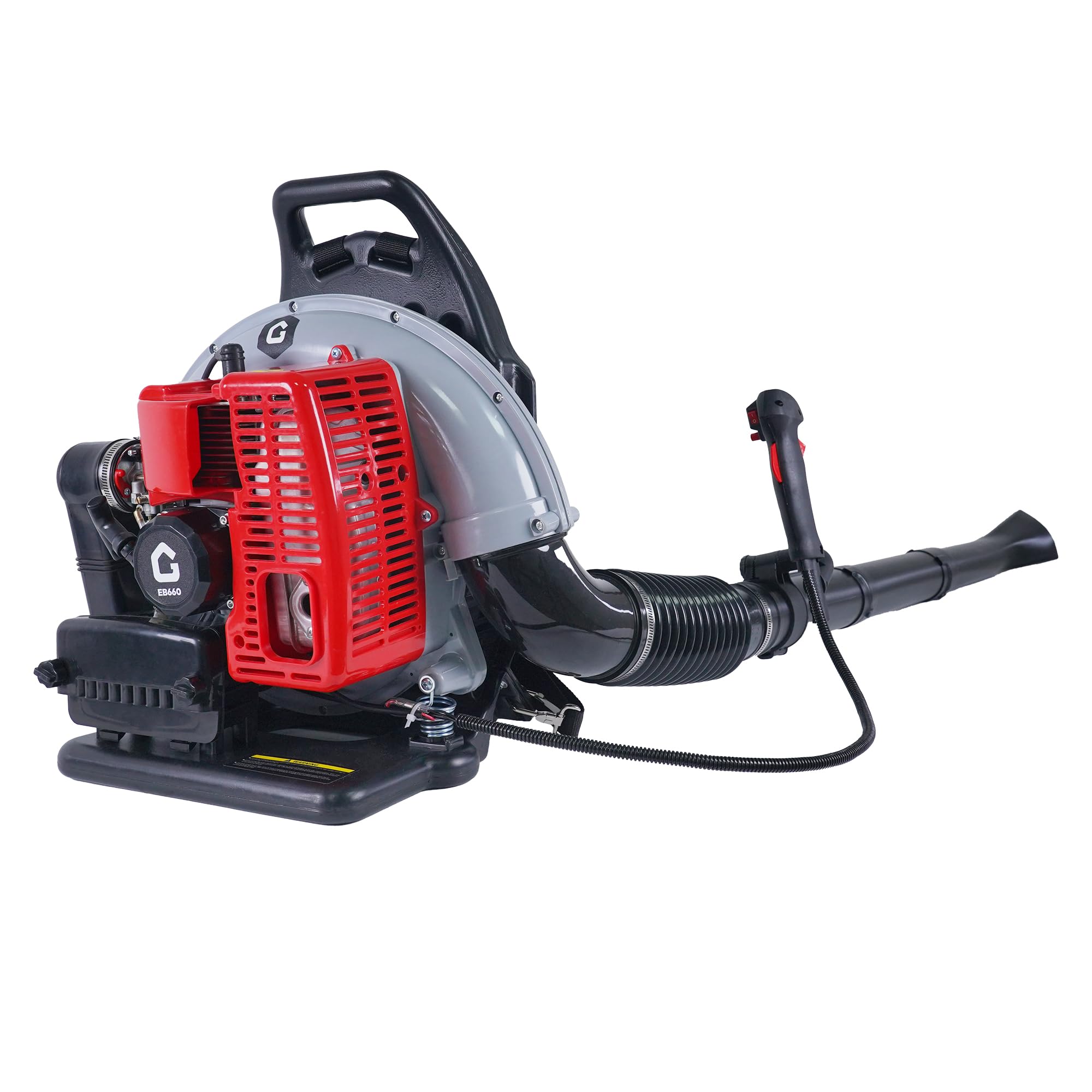
The Elementool 66cc backpack blower delivers the highest airspeed in this lineup at 320 MPH, combined with 880 CFM of volume from a 4 HP 2-stroke engine. This is a machine built for speed—perfect for blasting wet leaves out of dense shrubs, clearing construction dust from hard surfaces, or moving heavy snow from walkways. The quick-start recoil mechanism and 1.8-liter fuel tank (rated for up to 180 minutes of runtime) make it suitable for all-day landscaping work.
The ergonomic harness includes padded straps, ventilated back support, and shock-absorbing components that reduce fatigue during prolonged use. The cruise control throttle lock is a welcome feature for maintaining constant speed without trigger strain. Owners with large properties report clearing their entire yard in under two hours, a task that would take half a day with a handheld unit. The 4 HP output gives it noticeable grunt when pushing wet, heavy debris.
The weak points are the typical 2-stroke trade-offs: you must premix fuel, the instructions are poorly translated and nearly useless, and the plastic construction of the blower tube means it can break under heavy use—some owners report tube failure within days of commercial use. For a weekend homeowner looking for maximum airspeed at an entry-level price, this is a solid performer, but it’s not built for daily commercial abuse, and it lacks the no-mix convenience of a 4-stroke engine.
Why it’s great
- 320 MPH airspeed is class-leading for tough debris
- 4 HP engine provides strong low-end torque
- 1.8L tank and cruise control for extended work
Good to know
- 2-stroke engine requires fuel mixing
- Plastic tube and build quality are not commercial-grade
FAQ
Can I use a 4 stroke leaf blower at any angle?
How often do I need to change the oil in a 4 stroke leaf blower?
Is a 4 stroke or 2 stroke leaf blower better for my lawn?
Can I leave gasoline in my 4 stroke leaf blower over winter?
Why is my 4 stroke leaf blower hard to start?
Final Thoughts: The Verdict
For most users, the best 4 stroke leaf blower winner is the SENIX 49cc Backpack Leaf Blower because it delivers the ideal combination of 600 CFM power, no-mix fueling, all-directional lubrication, and backpack ergonomics for sustained use. If you want a walk-behind option for larger properties, grab the SuperHandy Walk Behind Blower for its 1270 CFM clearing capacity and pump-gas convenience. And for the tightest budget and lightest weight, nothing beats the SENIX 26.5cc Handheld Blower for quick daily cleanups that never require mixing oil.