
Our readers keep the lights on and the weekend projects moving. As an Amazon Associate, I earn from qualifying purchases.
Fighting peeling paint on a laminate cabinet or trying to get epoxy to stick to a slick tile backsplash? Standard primers just bead up and fail on non-porous surfaces like glossy tile, Formica, metal, and glass. A true bonding primer chemically grips these slick substrates, giving your topcoat a fighting chance to last for years, not weeks.
I’m Rikta — the co-founder and writer behind FitlyFast. I’ve spent years digging into paint chemistry to separate the gimmicks from the genuine adhesion solutions for tricky home and auto projects.
Whether you’re prepping a countertop for an epoxy pour or painting over aged cabinet laminate, the right best bonding primer is your only defense against chipping, peeling, and costly do-overs that ruin a finished project.
How To Choose The Best Bonding Primer
A bonding primer differs from a general-purpose sealer because of a simple engineering fact: it must form a mechanical and chemical lock to a non-porous surface that naturally repels liquid. Choosing the wrong type means you will be sanding and re-priming within months.
Match the Substrate to the Chemistry
Surfaces like glossy laminate, glazed tile, and powder-coated metal require a urethane-modified acrylic or straight epoxy primer. Plain acrylic stain-blockers lack the wetting agents needed to grip these slick surfaces. For bare, unpainted metal auto body panels, a 2K epoxy or self-etching primer that chemically bites into the metal provides the strongest foundation.
Check the Cure and Recoat Window
Many bonding primers dry to the touch in under an hour but require a full cure cycle (12-24 hours) before a topcoat can bond without lifting. If you plan to apply multiple primer layers, check whether the product allows recoating within a specific window — some epoxies become glass-hard and need sanding to accept a second coat after 24 hours.
Prioritize Low Odor and Low VOC for Indoor Use
Waterborne bonding primers with VOC levels below 25 grams per liter are safe for indoor use without requiring a respirator. Solvent-based self-etching primers and 2K epoxies produce strong fumes and demand excellent ventilation. Always match the primer’s VOC rating to your working environment.
Quick Comparison
On smaller screens, swipe sideways to see the full table.
| Model | Category | Best For | Key Spec | Amazon |
|---|---|---|---|---|
| Stone Coat Countertops Bonding Primer | Urethane Modified Acrylic | Laminate & countertop epoxy | Translucent white, 30-40 sqft/qt (2 coats) | Amazon |
| INSL-X STIX Waterborne Bonding Primer | Waterborne Acrylic | Glass, tile, and glossy cabinets | Semi-gloss finish, washable shell | Amazon |
| SprayMax 2K Epoxy Primer | 2K Epoxy Aerosol | Automotive bare metal & restorations | Dust-dry in 15 minutes | Amazon |
| SEM Self Etching Primer | Self-Etching Aerosol | Bare metal automotive panels | Corrosion-inhibiting grey coating | Amazon |
| XIM UMA Acrylic Bonder | Urethane Modified Acrylic | Laminate, Formica & glossy enamel | Excellent wet adhesion rating | Amazon |
| Roman PRO-999 Rx-35 Primer | Water-based Clear Sealer | Wallpaper adhesion on drywall | Clear matte finish, residual tack | Amazon |
| INSL-X Aqua Lock Plus | 100% Acrylic Sealer | Stain blocking on drywall & wood | Quick dry: 30 min tack-free | Amazon |
In‑Depth Reviews
1. Stone Coat Countertops Bonding Primer & Sealer

This urethane-modified acrylic primer was formulated specifically to solve the problem of epoxy peeling off slick countertop surfaces. Its translucent white color provides visual guidance during application while keeping the substrate visible underneath — useful for confirming full coverage on laminate, tile, and cultured marble.
The low-odor, low-VOC formula allows comfortable indoor use without masking off the entire kitchen. The manufacturer recommends two coats with a light sanding between layers, and reviewers consistently report zero bleed-through on dark laminate patterns. It bridges the gap between a general-purpose sealer and a full epoxy system.
It serves as the direct replacement for the previous XIM UMA primer formulation, incorporating an upgraded binder that improves wet-out on glossy surfaces. Expect to cover about 30 to 40 square feet per quart with the two-coat regimen recommended by Stone Coat.
Why it’s great
- Specifically engineered for epoxy countertop adhesion on slick substrates
- Very low odor makes indoor kitchen use practical
- Translucent white lets you see coverage gaps
Good to know
- Requires light sanding between coats for maximum bond
- Small quart size only; large countertops need multiple units
2. INSL-X STIX Waterborne Bonding Primer

INSL-X STIX is the primer professional painters reach for when faced with glossy, non-porous surfaces that reject standard latex. It bonds aggressively to glass, glazed ceramic tile, engineered wood, and even smooth metal without requiring aggressive sanding. The semi-gloss white finish provides a smooth surface for topcoat application.
The waterborne formula cleans up with soap and water, a major convenience compared to solvent-based alternatives. Many reviews specifically mention using it on ceramic tile backsplashes and painted laminate cabinets where every other primer failed the fingernail scratch test after drying. The thin consistency requires careful brushing to avoid drips on vertical surfaces.
One notable user report describes a three-coat system (two coats STIX, two coats paint, three coats polyurethane) on glass with no lifting after years of use. That level of adhesion is uncommon for a waterborne product and earns STIX a reputation as a true all-purpose bonding primer for tough household surfaces.
Why it’s great
- Works on glass, metal, and glazed tile without sanding
- Water clean-up with strong adhesion performance
- Effective on engineered wood where other primers fail
Good to know
- Thin consistency may run on vertical surfaces
- Full cure takes up to 36 hours per coat in some projects
3. SprayMax 2K Epoxy Primer Black
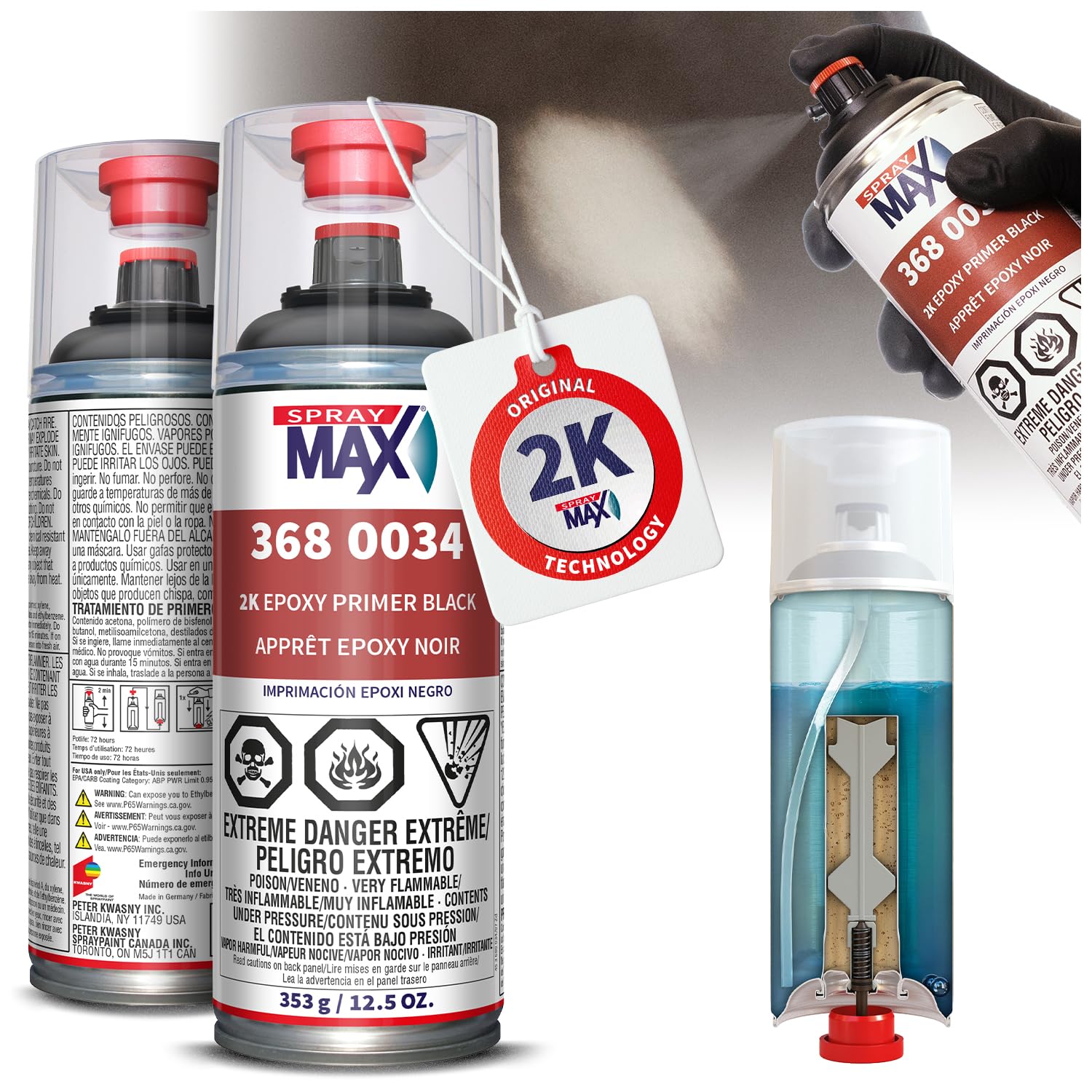
SprayMax 2K Epoxy Primer is the professional-grade choice for automotive metal, offering true two-component epoxy chemistry in a convenient aerosol can. The internal activator is released when you pierce the bottom seal, delivering a fresh epoxy mixture that provides superior chemical resistance and mechanical adhesion compared to single-component rattle cans.
The variable nozzle allows fine control over spray pattern, laying down a smooth, even coat without runs. It dries dust-free in 15 minutes and becomes sandable within a few hours, enabling fast workflow during panel repair and refinishing. The black color provides a uniform base for dark topcoats and metallic finishes.
User reports confirm its reliability on motorcycle tanks, fenders, and fiberglass hood undersides. The corrosion resistance on bare steel and aluminum is a key differentiator — standard aerosol primers lack the anti-rust package built into this 2K formula. One can covers roughly a door and rocker panel, making it ideal for small to medium repair sections.
Why it’s great
- True 2K epoxy chemistry in a portable aerosol format
- Dust-dry in 15 minutes for rapid recoating
- Superior corrosion resistance on bare metal
Good to know
- Strong fumes require good ventilation or respirator
- Coverage is modest per can; larger jobs need multiple cans
4. SEM Self Etching Primer Grey

SEM 39683 Self Etching Primer uses a phosphoric acid compound that chemically etches into bare metal, creating a mechanical anchor that paint particles can lock onto. This process also deposits a corrosion-inhibiting layer that prevents rust formation beneath the paint film — critical for auto body work on bare steel and aluminum.
The aerosol format sprays evenly with no runs and dries quickly to a flat grey finish that accepts most topcoat paints easily. User feedback highlights its performance on outboard lower units after skeg welding, with the primer bonding securely over JB Weld filler and providing a deep, glossy final paint finish after topcoating.
Coverage from the 15.5 oz can is generous for small to medium panels, though larger truck hoods or full body panels will require multiple cans. The self-etching action means it should only be applied to bare, clean metal — not over existing paint layers, where the etching chemistry cannot reach the surface.
Why it’s great
- Chemically etches into bare metal for superior adhesion
- Corrosion-inhibiting layer protects against rust
- Dries quickly with a smooth, run-free finish
Good to know
- Only effective on bare metal; not for painted surfaces
- Solvent-based fumes require adequate ventilation
5. XIM UMA Acrylic Bonder & Primer Sealer

XIM UMA has been a staple among countertop fabricators and cabinet painters for years due to its ability to bond aggressively to glossy finishes without sanding. The urethane-modified acrylic formula delivers wet adhesion properties that keep the primer locked onto laminate and Formica even when moisture intrudes the paint system later.
User reports consistently note its performance on surfaces that were degreased and lightly abraded but not fully sanded. One detailed review describes painting over laminate countertops — the primer passed the fingernail scratch test after curing, providing enough confidence for a durable epoxy pour. The low-odor formula is manageable indoors.
The primer applies streak-free with a roller and dries fast enough to recoat within one hour. Despite its effectiveness on slick surfaces, it is not designed for direct metal adhesion like the self-etching products — its strength lies in painted, laminated, and previously coated substrates where paint needs a second chance at sticking.
Why it’s great
- Bonds aggressively to glossy laminate and Formica
- Low odor and streak-free application
- Wet adhesion properties resist moisture damage
Good to know
- Not ideal for bare metal substrates
- Requires thin multiple coats for best results
6. Roman PRO-999 Rx-35 Wallpaper Primer & Sealer

Roman Rx-35 is a wallpaper-specific bonding primer that dries with a controlled residual tack — just enough grip to hold wallpaper in place while allowing repositioning. The clear matte finish disappears on the wall, meaning you can apply patterned paper without white primer showing through gaps in the design.
The low-VOC, water-based formula produces minimal odor, making it suitable for bedrooms and living areas where wallpaper installation happens. Coverage is generous at 400 to 450 square feet per gallon, and the product seals torn drywall paper, spackled patches, and joint compound to create a uniform surface for paper hanging.
Reviewers highlight the forgiving working time: the primer stays tacky long enough to slide heavy wallpaper into position before locking it down. It also helps seams stay closed during humidity changes, reducing the risk of gap lines appearing months after installation. Made in the USA with VOC under 25 grams per liter.
Why it’s great
- Residual tack allows wallpaper repositioning during hanging
- Clear matte finish hides behind any paper pattern
- Very low odor and high coverage per gallon
Good to know
- Not designed for bonding to glossy paint or metal
- Full cure takes 12 hours for best adhesion
7. INSL-X Aqua Lock Plus Acrylic Primer Sealer

Aqua Lock Plus is a straightforward 100% acrylic primer-sealer built for stain blocking and surface sealing on walls, new drywall, and previously painted surfaces. It is not a specialty bonding primer for slick substrates, but its drying speed and low odor make it a practical entry-level choice for general interior prep work.
The formula dries tack-free in 30 minutes and accepts a topcoat in as little as one hour, making it possible to complete a room in a single day. Reviewers note excellent coverage on new sheetrock and plaster, with good stain blocking over light water marks and smoke residue. The flat finish provides a uniform base for flat and eggshell paints.
Coverage is rated at 75 to 100 square feet per quart, which translates to roughly 300 to 400 square feet per gallon. It is not waterproof and should not be used in high-moisture areas like shower enclosures. For bonding to glossy surfaces, one of the urethane-modified options above will serve you much better.
Why it’s great
- Fast-drying allows same-day paint application
- Good stain blocking on drywall and plaster
- Low odor and water cleanup
Good to know
- Not formulated for bonding to glossy or slick surfaces
- Not waterproof; avoid in wet areas
FAQ
Can I use a bonding primer over existing paint without sanding?
How many coats of bonding primer do I need for laminate countertops?
Does a bonding primer prevent rust on bare metal?
What does “recoat window” mean for 2K epoxy primers?
Final Thoughts: The Verdict
For most users tackling a kitchen countertop or backsplash upgrade, the best bonding primer winner is the Stone Coat Countertops Bonding Primer because its urethane-modified acrylic formula directly addresses the adhesion challenge of epoxy on slick surfaces with low odor and easy cleanup. If you need to paint over glossy cabinets, tile, or glass, grab the INSL-X STIX Waterborne Bonding Primer for its proven grip on the toughest indoor surfaces. And for automotive bare metal or corrosion-sensitive repairs, nothing beats the SprayMax 2K Epoxy Primer for professional-grade chemical resistance and fast drying.