
Our readers keep the lights on and the weekend projects moving. As an Amazon Associate, I earn from qualifying purchases.
Choosing a generator that handles your whole home, an RV, or a job site means looking past the peak wattage number on the box. For a machine in this class, the real separator is fuel flexibility, runtime stability under continuous load, and the type of power sent to your sensitive electronics.
I’m Rikta — the co-founder and writer behind FitlyFast. I specialize in analyzing hardware specifications and market data for categories where a single bad purchase can leave you in the dark or worse, stranded.
This guide breaks down the top-rated models to help you sort through noise and pinpoint the best 7500 watt generator for your specific backup, travel, or jobsite demands.
How To Choose The Best 7500 Watt Generator
Not all generators in this power class are created equal. The differences show up when you look at fuel type, the quality of the electrical output, and how long the unit runs before needing a refill. Here are the core factors to evaluate.
Fuel Type: Dual Fuel vs. Tri-Fuel vs. Single Fuel
A dual-fuel generator runs on gasoline and propane. A tri-fuel unit adds natural gas, which is ideal for permanent home standby because you never need to store or refill a tank. Gasoline delivers the highest surge power but has shelf-life and gumming issues. Propane burns cleaner and stores indefinitely, though you lose about 10-15% of peak wattage. Natural gas is the most convenient for fixed installations but typically drops wattage further.
Total Harmonic Distortion (THD) and Electronics Safety
Standard generators often produce a THD above 6%, which can damage laptops, phone chargers, and medical devices over time. Inverter generators produce clean power with THD under 3%, making them safe for sensitive electronics. If you plan to power computers, a variable-speed fridge, or a TV, prioritize an inverter model even if it costs more.
Continuous Runtime and Fuel Tank Capacity
Running wattage matters more than peak wattage for sustained use. Look at the manufacturer’s runtime at 50% load to understand how long the generator will power your refrigerator, lights, and a window AC before you have to refuel. A 4-gallon tank on an efficient inverter can run 10-14 hours at partial load, while an open-frame unit may burn through fuel twice as fast.
Noise Level and Portability
Decibel ratings are measured differently by each brand, but a difference of 10 dB sounds twice as loud to human ears. Inverter units with enclosed frames typically hover in the low 60s dBA, while open-frame traditional machines can reach 75-80 dBA. Also check wheel size and handle type — never-flat wheels and a telescoping handle make moving a 130-pound generator much easier.
Safety Features: CO Sensing and Shutoffs
Carbon monoxide monitoring is now standard on many modern generators and is a crucial safety layer. Combined with low-oil shutoff and overload protection, these systems prevent engine damage and safeguard anyone near the running unit. Always confirm the unit has a certified CO sensor if you operate the generator near living spaces.
Quick Comparison
On smaller screens, swipe sideways to see the full table.
| Model | Category | Best For | Key Spec | Amazon |
|---|---|---|---|---|
| Westinghouse iGen8200TFc | Inverter / Tri-Fuel | Whole-home backup with sensitive electronics | 8200W peak / 6600W running (gas) | Amazon |
| A-iPower SUA7600iED | Inverter / Dual Fuel | Home & RV with clean power priority | 7600W peak / 6100W running (gas) | Amazon |
| Westinghouse WGen6000DFc EFI | Open-Frame / Dual Fuel | High-runtime home backup with EFI | 7500W peak / 6000W running (gas) | Amazon |
| Pulsar 7,250-Watt Inverter | Inverter / Dual Fuel | Quiet remote-started RV power | 7250W peak / 6000W running (gas) | Amazon |
| Champion Power Equipment Tri-Fuel | Open-Frame / Tri-Fuel | Natural gas home standby | 8125W peak / 6500W running (gas) | Amazon |
| AIVOLT 8000W Inverter | Inverter / Dual Fuel | Ultra-quiet RV and campsite power | 8000W peak / 6100W running (gas) | Amazon |
| Generac GP9500 Tri-Fuel | Open-Frame / Tri-Fuel | High-starting-wattage job site power | 12500W peak / 9500W running (gas) | Amazon |
| WEN DF680iX | Inverter / Dual Fuel | EV Level 2 backup and cabin power | 6800W peak / 5100W running (gas) | Amazon |
| PowerSmart 7000W Inverter | Inverter / Single Fuel | Job site and RV with clean power | 7000W peak / 6000W running (gas) | Amazon |
| AIVOLT 7500W Dual Fuel | Open-Frame / Dual Fuel | Budget-friendly home and RV backup | 7500W peak / 6300W running (gas) | Amazon |
| Generac GP3600 | Open-Frame / Single Fuel | Entry-level job site and tailgating | 4500W peak / 3600W running (gas) | Amazon |
In‑Depth Reviews
1. Westinghouse iGen8200TFc
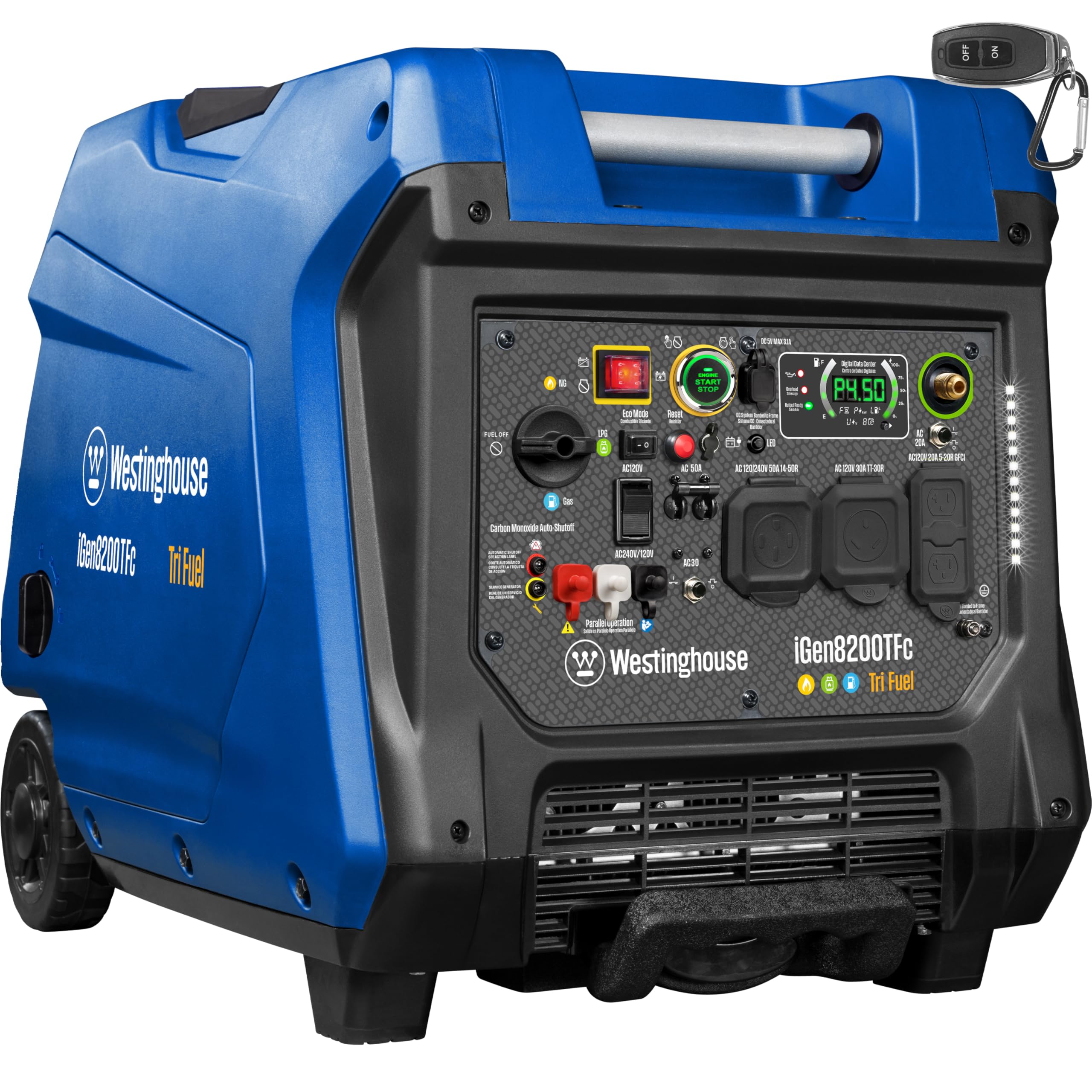
This is the most versatile generator in this review. It runs on gasoline, propane, or natural gas, and the inverter technology keeps THD below 3%, so you can safely power a laptop, TV, or furnace control board. The 298cc engine with a cast iron sleeve delivers 8200 peak watts on gas and a solid 6600 running watts—enough for a refrigerator, well pump, and a few lights simultaneously.
The fully enclosed design keeps noise around 60 dBA at 25% load, which is quiet enough for neighborhood-friendly overnight use. A built-in battery maintainer and tool-less access panel simplify maintenance, and the 50A outlet connects directly to a transfer switch or interlock kit. The 3.9-gallon tank provides up to 17 hours of runtime at partial load, meaning fewer interruptions for refueling during a long outage.
Remote key fob, electric start, and recoil backup give three ways to fire it up. Some owners note the battery arrives discharged and needs charging before first use. The natural gas output is naturally lower than gasoline, so confirm your load demands if you plan to run exclusively on NG.
Why it’s great
- Tri-fuel flexibility with an inverter for clean power
- Quiet enough for overnight residential use
- 50A outlet for direct transfer switch connection
Good to know
- Battery may need charging before first use
- Natural gas mode reduces peak wattage
2. A-iPower SUA7600iED

The SUA7600iED packs a 322cc OHV engine into a lightweight, telescoping-handle frame that comes in at 130 pounds. It produces 7600 peak watts and 6100 running watts on gasoline, with a step down to 6900 peak and 5500 running on propane. The low idle technology helps it run up to 10 hours on a 3.6-gallon tank at 25% load.
Fuel Sense technology automatically switches from propane to gasoline, giving a combined runtime of over 21 hours without a manual changeover. The THD stays under 3%, making it safe for charging laptops, running a TV, or powering a CPAP machine. Sound levels measure around 62 dBA, which is ideal for both campsites and neighborhoods with noise restrictions.
Setup takes about 15-20 minutes, and the unit arrives with oil, a funnel, a charged battery, and a propane hose. One caveat is that the recoil rope may not fully retract on some units, and the engine sometimes requires the choke to start even when warm.
Why it’s great
- Fuel Sense auto-switches from propane to gas
- Very quiet at 62 dBA for its power class
- Compact and maneuverable with telescoping handle
Good to know
- Recoil rope may not fully retract on some units
- Requires choke for warm restarts on some units
3. Westinghouse WGen6000DFc EFI
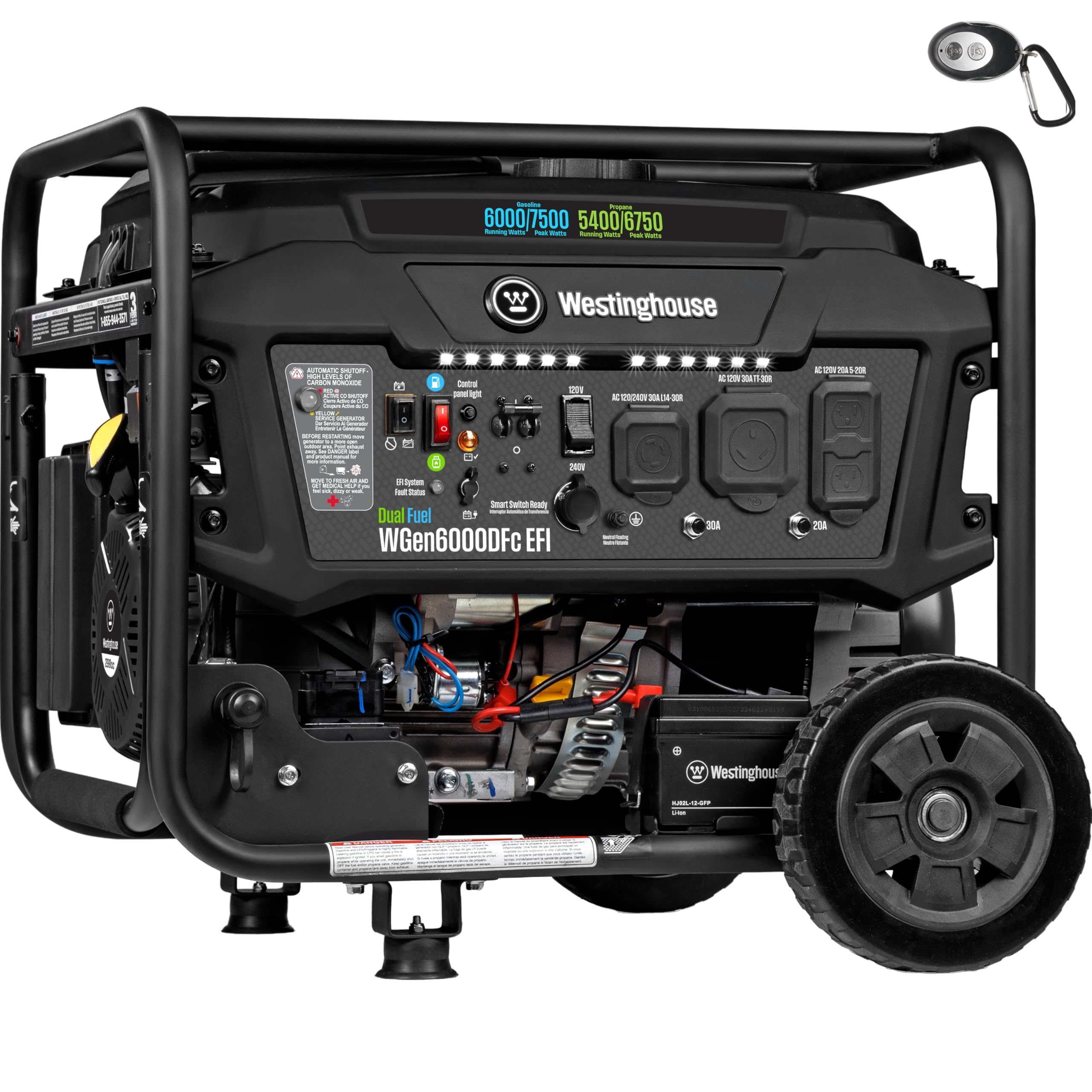
Electronic Fuel Injection (EFI) is rare in this power class, and it eliminates choke and carburetor issues entirely. The 298cc Westinghouse engine starts like a modern car — turn the key or hit the remote fob and it fires up regardless of temperature. Gasoline output is 7500 peak and 6000 running watts, while propane delivers 6750 peak and 5400 running watts.
The 4.75-gallon tank runs up to 14 hours at 25% load, and the fuel gauge makes check-ins quick. The control panel includes a 50A L14-30R twist lock for transfer switches, a TT-30R for RV hookups, and a duplex 5-20R for general use. The CO sensor, automatic low-oil shutdown, and rubber outlet covers add safety layers.
Assembly takes about 20 minutes. A few owners have noted that the neutral is unbonded from the factory, so you must verify grounding for the outlet adapters you use. The first start-up sometimes requires letting gasoline sit in the tank for a day to clear carburetor residue from manufacturing.
Why it’s great
- EFI eliminates choke and carburetor starting issues
- Up to 14-hour runtime on a single tank
- Remote key fob start included
Good to know
- First start may require gasoline sit-time to clear residue
- Neutral is unbonded from factory
4. Pulsar 7,250-Watt Inverter

The Pulsar uses a 312cc OHV 4-stroke engine in an enclosed frame that keeps noise down while still delivering 7250 peak watts on gasoline and 6500 on propane. The inverter technology keeps THD low for electronics, and the digital control center displays hours, voltage, load, and frequency in real time. Parallel capability lets you chain a second Pulsar unit to double your power output.
Start options include a remote key fob, push-button electric start, and a recoil backup. The control panel includes one USB-A and one USB-C port, two GFCI 120V outlets, an L14-30R twist lock, and a TT-30R RV outlet. The built-in CO sensor and low-oil shutdown provide essential safety coverage. Rated noise stays acceptably low thanks to the fully enclosed design.
Owners report excellent power stability for RVs, with the unit running AC, microwave, and lights without issue. A few units have experienced push-button or remote start failure within the first few days. The starter battery is a LIFEPO4 chemistry pack, which is lighter than lead-acid but requires a compatible charger.
Why it’s great
- Remote start with durable LIFEPO4 battery
- Real-time digital display for load management
- Parallel capable for double the power
Good to know
- Remote and push-button start can fail early
- Wheels reported as flimsy by some users
5. Champion Power Equipment 8125-Watt Tri-Fuel

This is a tri-fuel open-frame generator with a massive 389cc engine and a steel cradle frame. Gasoline output is 8125 starting and 6500 running watts. Propane drops slightly to 7500 starting and 6000 running, and natural gas delivers 6875 starting and 5500 running. Both propane and natural gas hoses are included in the box, so you can run it on any fuel immediately.
The rocker switch electric start fires the engine reliably, and the digital display tracks voltage, frequency, and run time for maintenance scheduling. The CO Shield auto-shutoff system meets safety standards, and the 3-year warranty with free lifetime tech support is one of the best in the industry. The wheel kit makes the 197-pound unit manageable on pavement.
One owner ran this unit for 155 hours straight during Hurricane Helene without a breakdown. The natural gas option eliminates fuel storage worries entirely. It is an open-frame design, so expect operational noise comparable to a lawn mower rather than an enclosed inverter.
Why it’s great
- True tri-fuel with all hoses included in the box
- Massive 389cc engine for heavy continuous loads
- 3-year warranty with free lifetime support
Good to know
- Heavy at 197 pounds
- Open-frame design means higher noise levels
6. AIVOLT 8000W Inverter

The AIVOLT inverter generator leans into quiet operation with a rated 62 dBA at 23 feet, which is whisper-soft for an 8000-watt machine. The 322cc copper-winding engine delivers 8000 starting and 6100 running watts on gasoline, and automatic fuel-switching technology allows swapping between gas and propane without manual adjustment. The eco switch extends runtime beyond 10 hours at partial load on a full tank.
The control panel is versatile: two 120V 20A GFCI outlets, one 240V 30A twist lock, one 120V 50A industrial outlet, and a 12V DC port with a dual USB adapter. The 5-in-1 LCD display tracks fuel consumption, output, voltage, frequency, and runtime. CO Alert technology and overload protection add safety on all fuel types.
Setup is straightforward, and the telescopic rod with 7-inch never-flat wheels makes transport easy. Some owners note that the unit is louder under heavy load than the 57 dBA some marketing material suggests. There is also a documented cooling delay: if you shut it off while hot, it may take up to an hour to restart.
Why it’s great
- Very quiet at 62 dBA for an 8000W machine
- Automatic fuel switching between gas and propane
- Copper windings for better heat dissipation
Good to know
- Cool-down restart delay of up to one hour
- Noise increases noticeably under heavy load
7. Generac GP9500 Tri-Fuel
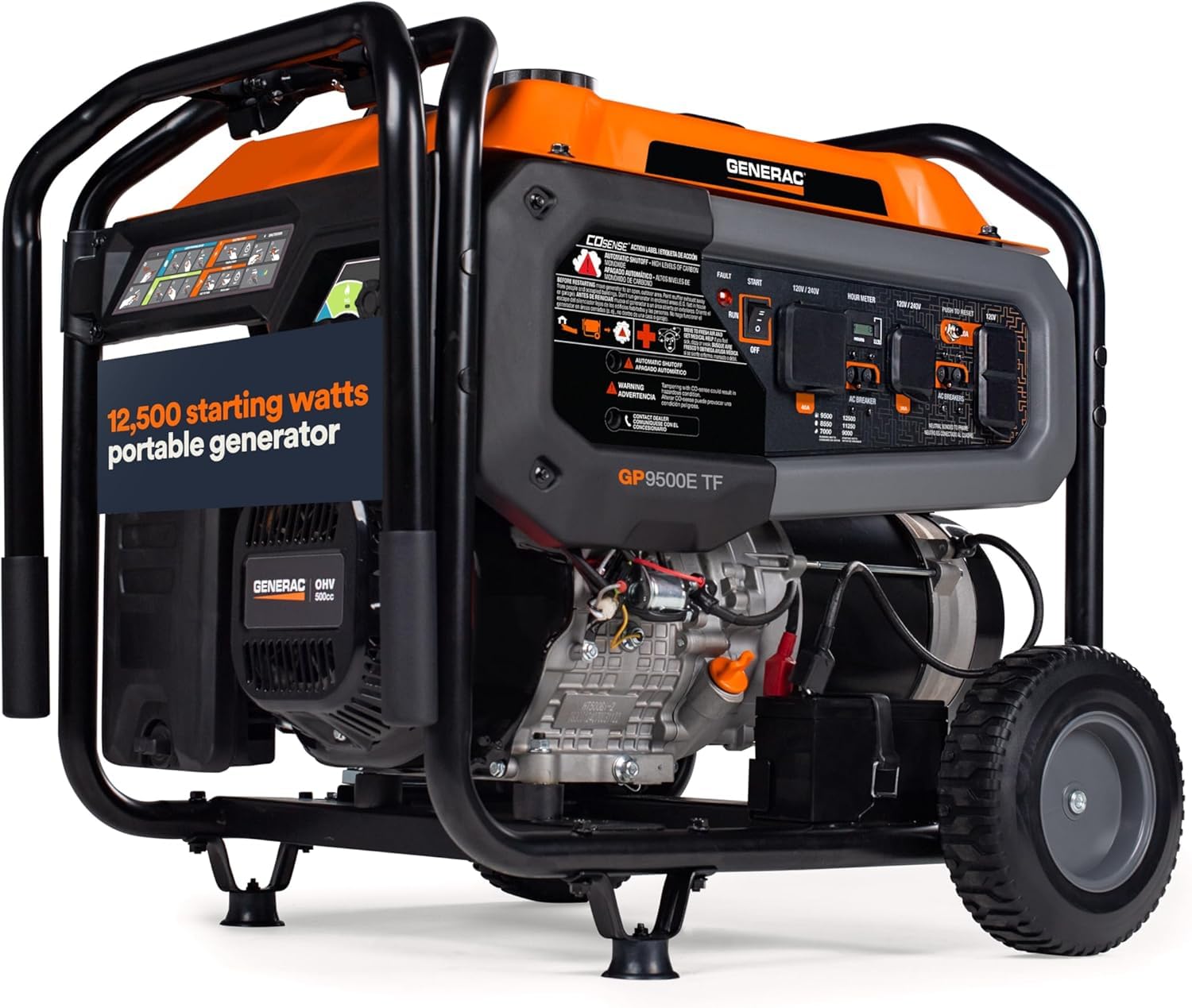
The GP9500 packs a 500cc Generac OHV engine and delivers 12,500 starting watts and 9,500 running watts on gasoline. That is a massive capacity that can handle central AC units, well pumps, and electric ranges simultaneously. It also runs on propane and natural gas via a simple fuel selector dial. The 7.5-gallon steel fuel tank provides up to 9.5 hours of runtime at 50% load on gasoline.
Push-button electric start with a rechargeable battery eliminates pull-cord hassle. The heavy-duty never-flat wheels and fold-down handle make the 219-pound unit transportable across rough terrain. The COsense carbon monoxide detection system automatically shuts the engine down and alerts the user if CO levels become dangerous.
Owner feedback highlights smooth operation and quiet running compared to other high-output Generac machines. A few buyers report that the natural gas conversion kit includes parts requiring a certified plumber to install. Others note that after one month of use, some units develop running issues, which the 3-year warranty covers.
Why it’s great
- 500cc engine with 12,500 starting watts for heavy loads
- Tri-fuel flexibility with simple dial selector
- Long 9.5-hour runtime on gasoline
Good to know
- Very heavy at 219 pounds
- Natural gas hookup may need certified plumber
8. WEN DF680iX

The DF680iX is uniquely designed for electric vehicle backup. The bonded-neutral 240V configuration provides low-power Level 2 charging for battery and hybrid EVs, making it a rare tool in this category. Gasoline output is 6800 surge watts and 5100 rated watts, with propane delivering 6000 surge and 4500 rated watts. The 224cc engine keeps the weight at a manageable 99.2 pounds.
The inverter technology provides clean power, and the fuel shutoff lets you run the carburetor dry to prevent gumming during storage. The Watchdog CO sensor auto-shuts the unit if dangerous CO levels are detected. Outlets include an L14-30R receptacle, two three-prong 120V outlets, a TT-30R RV plug, a 12V DC outlet, and two 5V USB ports.
Owners using it for off-grid cabins and fifth wheels appreciate the low fuel consumption on propane and the quiet eco mode operation. Some mention that the 240V mode disables the 120V outlets, so you cannot simultaneously run both voltage types. A few units have had premature failure on gasoline due to a faulty fuel solenoid.
Why it’s great
- 240V bonded-neutral for Level 2 EV charging
- Very light at 99.2 pounds for its class
- Fuel shutoff for clean storage
Good to know
- 240V mode disables all 120V outlets
- Gasoline fuel solenoid can fail early on some units
9. PowerSmart 7000W Inverter
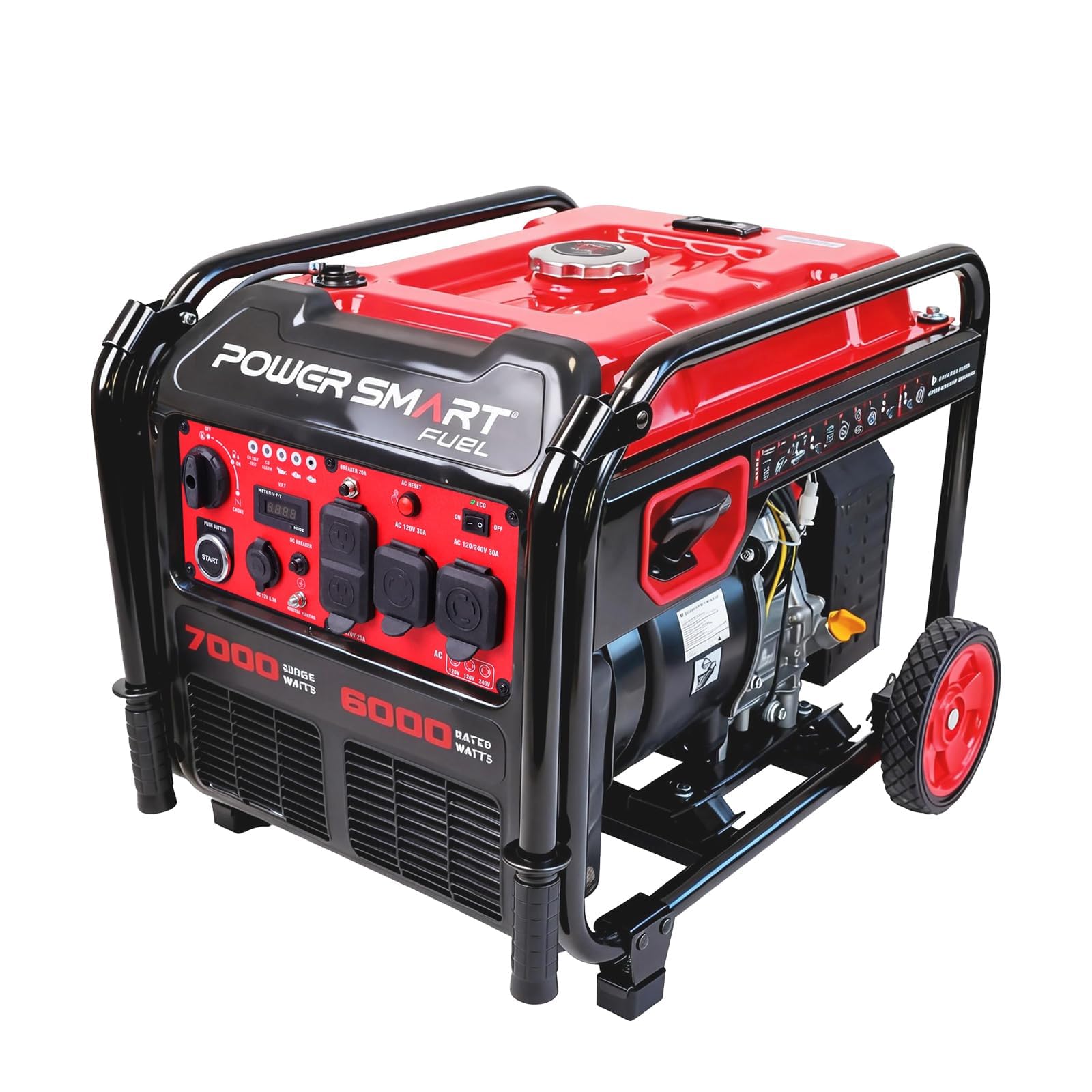
This inverter generator punches above its price point with 6000 rated watts and clean sine wave output under 3% THD. The 322cc OHV engine uses an open-frame inverter design that balances heat dissipation with quiet operation at 70 dBA. The electric push-button start with battery is standard, and a recoil backup gives you a manual option. Runtime on a 3.2-gallon tank is approximately 6 hours at 50% load.
The dual-voltage selector switch allows switching between 120V and 240V, making it ready for a transfer switch or a 50A RV service. The panel includes a 120V 30A twist lock and standard 120V 20A outlets. Low-oil shutoff and overload protection keep the unit safe during extended runs.
Owners report strong performance powering planers, refrigerators, and window AC units. Some note that the unit is louder than enclosed inverter models but quieter than traditional open-frame generators. A few units arrived with minor oil residue from factory testing, which is normal.
Why it’s great
- Clean sine wave inverter at an accessible price point
- Dual voltage 120V/240V with transfer switch capability
- Reliable electric start with recoil backup
Good to know
- Single fuel only (gasoline)
- Shorter runtime than larger tank competitors
10. AIVOLT 7500W Dual Fuel
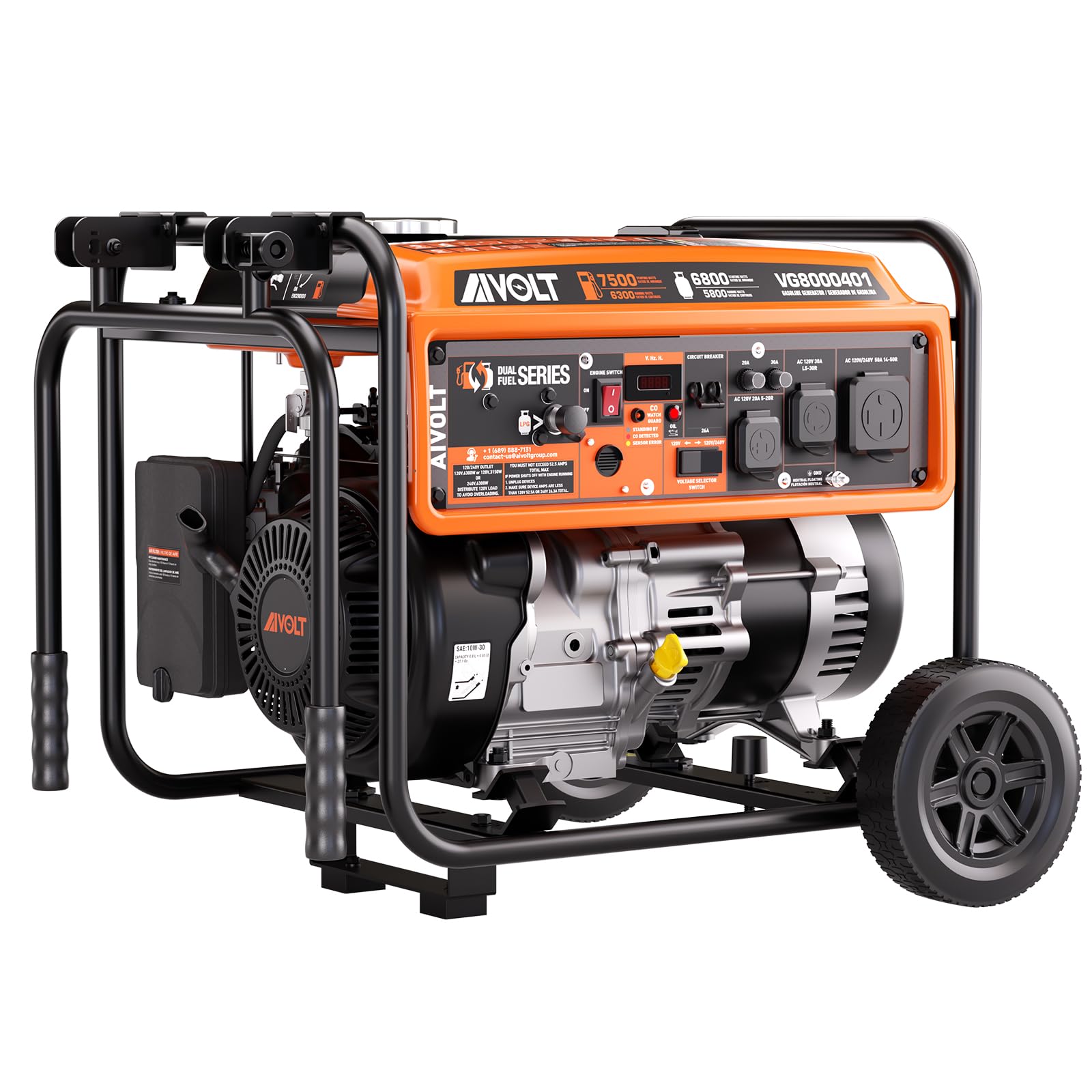
The AIVOLT 7500W dual fuel generator is a compact open-frame machine with a 322cc cast iron sleeve engine. It delivers 7500 peak and 6300 running watts on gasoline, with 6800 peak and 5800 running on propane. The digital data center displays voltage, frequency, and runtime for easy load monitoring.
The control panel features a NEMA 14-50R 50A outlet for RVs and home transfer switches, a twist-lock 30A outlet, and standard 120V household outlets. The CO Watch-Guard system uses visual red/yellow alerts and auto-shutdown to prevent carbon monoxide hazards. A low-oil shutoff and multi-circuit breakers add extra safety. The never-flat wheels and supportive frame make the 128-pound unit portable.
Owners say it powers travel trailer AC, microwave, and fridge simultaneously without issue. A few reviewers report that the CO sensor can fail after a few weeks, causing random shutdowns. The company offers a two-year warranty and lifetime technical support, but some users found the support unresponsive to early failures.
Why it’s great
- Compact form factor with cast iron sleeve engine
- Full 50A RV outlet and digital display
- Two-year warranty and lifetime support
Good to know
- CO sensor can fail prematurely on some units
- Customer support responsiveness inconsistent
11. Generac GP3600
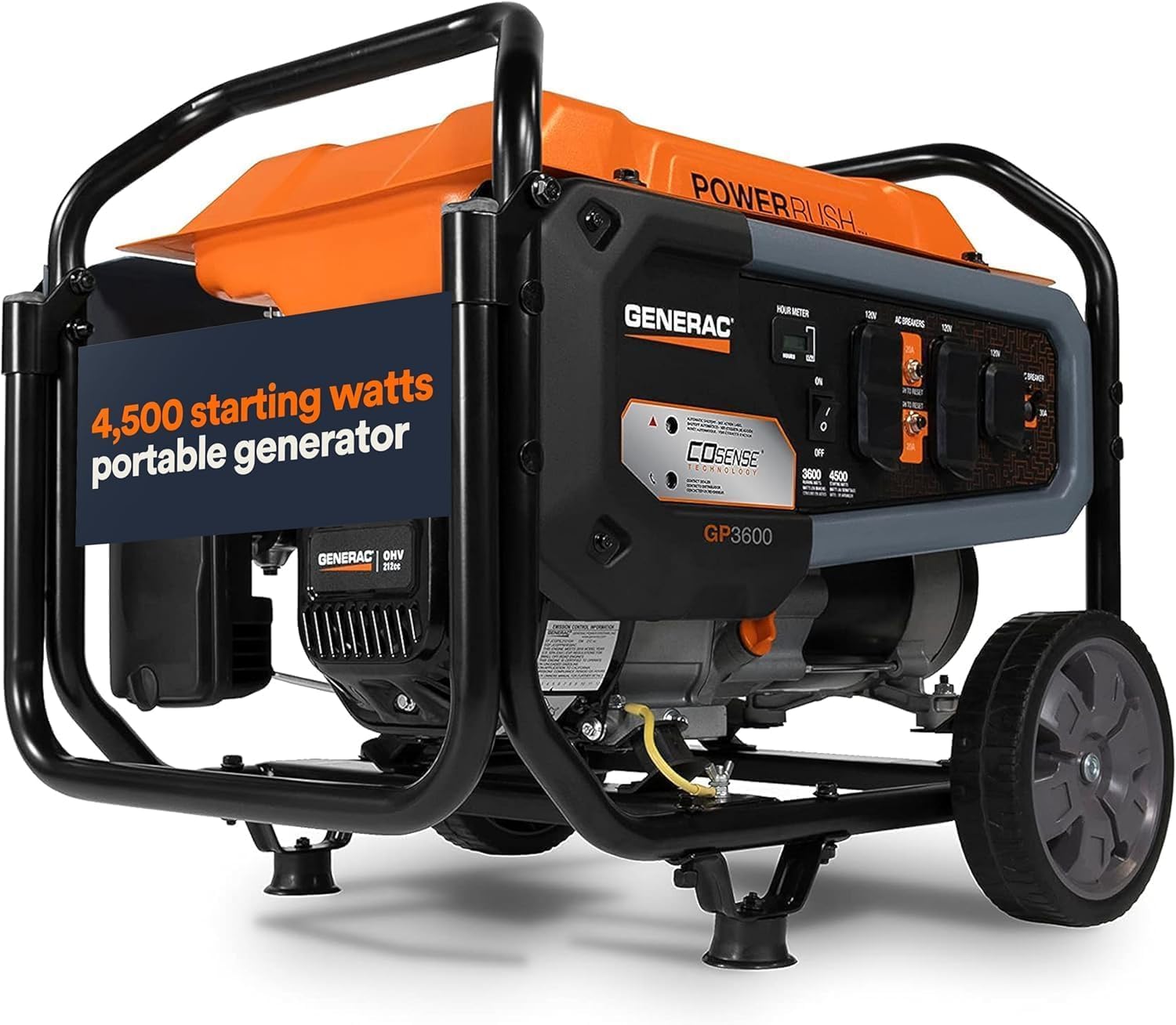
The GP3600 is a compact, single-fuel (gasoline) generator with 3600 running watts and 4500 starting watts thanks to PowerRush technology. The 212cc OHV engine gives it a 40% starting capacity boost over standard generators of similar displacement. The heavy-duty 1.25-inch steel tube frame and never-flat wheels with fold-down handle make it highly portable at 105 pounds.
The COsense technology continuously monitors carbon monoxide levels and auto-shuts the unit if a hazard is detected. An hour meter tracks maintenance intervals, and low-oil shutdown protects the engine. The covered outlet panel adds weather protection during outdoor use. Assembly is minimal, and the controls are intuitive with a fuel gauge and easy-to-read switches.
Owners find it smooth-running and quieter than older comparably sized generators. Some report that after a month of ownership, some units develop running issues. It is not rated for whole-home backup but works well for power tools, lights, and refrigerators during short outages.
Why it’s great
- PowerRush gives 40% more starting capacity
- Compact, lightweight, and easy to move
- COsense auto shutoff for safety
Good to know
- Single fuel (gasoline) only
- Some units develop running issues within a month
FAQ
How many watts do I actually need from a 7500-class generator?
Is an inverter generator worth the extra cost over an open-frame model?
Can a 7500-watt generator run an entire house?
How often should I change the oil in a generator during a long outage?
What does a CO sensor actually do on a generator?
Final Thoughts: The Verdict
For most users, the 7500 watt generator winner is the Westinghouse iGen8200TFc because it combines tri-fuel flexibility with inverter clean power and a noise level that works for residential neighborhoods. If you want fuel savings and automatic propane-to-gas switching, grab the A-iPower SUA7600iED. And for heavy-duty natural gas home standby without the hassle of gasoline storage, nothing beats the Champion Power Equipment Tri-Fuel.