
Our readers keep the lights on and the weekend projects moving. As an Amazon Associate, I earn from qualifying purchases.
Nothing tests a DIYer’s patience more than drilling into glazed tile only to have the anchor twist uselessly in the hole, refusing to bite. Tile requires a specific balance of grip and expansion that standard drywall anchors simply cannot deliver.
I’m Rikta — the co-founder and writer behind FitlyFast. After poring over thousands of customer reviews and analyzing the expansion mechanisms, material compositions, and load specs of the most common tile-compatible anchors on the market, I’ve narrowed down the ones that actually work on ceramic, porcelain, and stone.
Whether you are mounting a towel bar in a bathroom or a shelf in a backsplash, this guide to the anchors for tile will spare you the frustration of a stripped hole and a broken drill bit.
How To Choose The Best Anchors For Tile
Tile is brittle and slick, so the wrong anchor choice leads to cracked tile or an anchor that spins freely. You need an anchor that expands evenly without exerting too much radial pressure, and one that grips the substrate behind the tile—not just the tile itself.
Expansion Mechanism Matters Most
Look for anchors that elongate or open “jaws” as the screw drives in. Standard conical plastic anchors force outward pressure against the walls of the hole, which can crack porcelain. Multi-purpose plugs with folding wings (like the fischer DuoPower) distribute force more safely.
Substrate Behind the Tile
Knowing what is behind your tile—drywall, cement board, concrete, or a stud—is critical. Hollow walls need toggle-style or collapsible anchors that grip the back surface. Solid substrates (brick, concrete) can use expanding nylon or self-tapping masonry screws.
Quick Comparison
On smaller screens, swipe sideways to see the full table.
| Model | Category | Best For | Key Spec | Amazon |
|---|---|---|---|---|
| TOGGLER Alligator AF6 | Premium | Tile over drywall & concrete | 675 lb in concrete / 69 lb in drywall | Amazon |
| fischer DuoPower | Premium | Universal solid & hollow | Folding / expanding / knotting action | Amazon |
| Hard-to-Find Fastener Expandet | Mid-Range | Concrete & brick tile | Fluted vinyl, 9/32″ drill size | Amazon |
| LineShading 200 Pcs Plastic | Mid-Range | General tile & masonry | PE material, 1/4″ hole | Amazon |
| PRLF Heavy-Duty Steel | Mid-Range | Hollow wall behind tile | 270 lb per anchor in 1/2″ drywall | Amazon |
| FixMaster Hex Head Screws | Budget-Friendly | Solid tile & concrete only | Self-tapping, 3/16″ diameter | Amazon |
| BUSY-CORNER 228 Pcs Kit | Budget-Friendly | Light tile mounting jobs | Includes 3 drill bits | Amazon |
In‑Depth Reviews
5. TOGGLER Alligator AF6 Flanged Polypropylene Anchors

The TOGGLER Alligator is the smartest choice for tile work because it works equally well in hollow drywall and solid concrete behind the tile. The flanged head keeps it from sinking into the hole, and the polypropylene material expands and elongates in solid substrates while opening “jaws” behind hollow surfaces—exactly what you need when you aren’t sure what’s below the tile.
Rated up to 675 lb in 3,500 psi concrete and 69 lb in 1/2″ drywall, this anchor packs serious holding power into a small 1/4″ hole. Professional installers praise its reliability in plaster walls, and the corrosion-resistant construction means it won’t degrade in damp bathroom environments.
The only catch is that screws are not included, so you will need to pair it with #6–#12 sheet metal or wood screws. For most tile-mounting scenarios, the added cost is justified by the peace of mind that the anchor will not spin or pull out.
Why it’s great
- Works in both solid and hollow substrates behind tile
- Extremely high load rating for a plastic anchor
- Flanged head prevents sinking into the hole
Good to know
- Screws sold separately
- Slightly more expensive than basic nylon anchors
6. fischer DuoPower Universal Wall Anchors
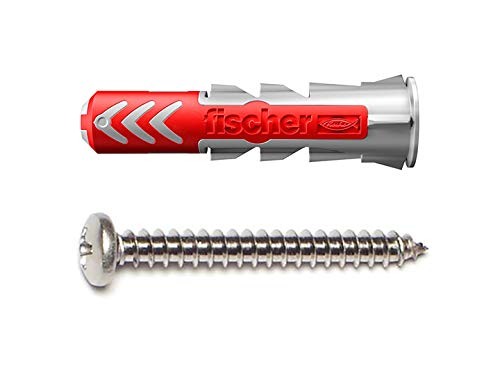
The fischer DuoPower is a two-component nylon anchor that automatically adapts its behavior to the substrate: it folds, expands, or knots depending on whether it is in concrete, brick, drywall, or wood. For tile applications, this means the anchor will find the right grip without you having to guess what is behind the surface.
Red expansion wings prevent rotation in the drill hole, and the narrow rim stops the plug from slipping in—a common problem when drilling into slick glazed tile. The compact 1-1/4″ length means you need a shorter screw, reducing the risk of hitting pipes or wires.
Users report these anchors survived a 3.5 magnitude earthquake while holding a heavy guitar rail system. The only compromise is the 50-piece count at a mid-range price point, but the engineering justifies the investment for serious tile projects.
Why it’s great
- Self-adapts to solid, perforated, or hollow walls
- Anti-rotation feature prevents spinning in tile
- Requires less drilling depth than standard anchors
Good to know
- Fewer pieces per pack compared to budget options
- Best performance with screws 0.12–0.16 inch diameter
3. Hard-to-Find Fastener Expandet Screw Anchors

These Danish-made Expandet anchors have been trusted since the 1960s for masonry and concrete applications. The fluted vinyl design provides traction along the full length of the anchor, preventing it from spinning in the hole—a critical feature when driving screws into tile over concrete.
The 1/4″ diameter requires a 9/32″ drill bit, and users report they hold exceptionally well in brick, concrete slab, and humid outdoor environments. The anchors can be cut shorter if needed, giving you flexibility for varying tile thicknesses.
One experienced user noted that #10 screws fit perfectly, while #12 screws are too tight. The 100-count pack is solid value for finishing a whole room of tile work. The only downside is the glossy white finish, which is cosmetic and doesn’t affect performance.
Why it’s great
- End-to-end flutes prevent spinning in tile holes
- Can be cut to custom length
- Proven track record in concrete for decades
Good to know
- Not ideal for hollow walls behind tile
- Requires precise 9/32″ drill bit
1. LineShading 200 Pcs Expanding Plastic Screw Anchors
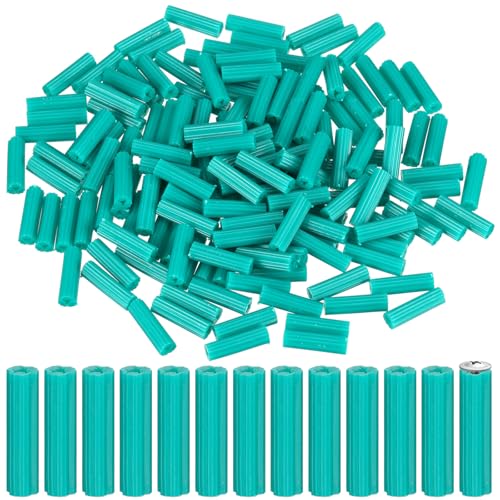
When you need a massive quantity of reliable plastic anchors for a large tile project, this 200-piece set from LineShading delivers. The PE material is stiffer than standard nylon, making it better at hammering into concrete block walls without deforming.
These anchors come in four length options (1″, 1-1/4″, 1-1/2″, 2″) all sharing a 1/4″ hole diameter, so you can match the length to your tile and substrate thickness. Users confirm they work well in concrete and tile when used with #10–#12 screws, though the hole must be drilled to the exact diameter to prevent spinning.
One trade-off is that these are primarily masonry anchors—they are not suited for drywall-only applications. For tile mounted over solid backing, however, the price per anchor is hard to beat, and the bulk quantity covers multiple jobs.
Why it’s great
- Excellent value for high-volume tile projects
- Stiff PE material holds up in concrete and brick
- Multiple length options included
Good to know
- Not designed for hollow drywall behind tile
- Some anchors may have slight burrs from manufacturing
4. PRLF Heavy-Duty Hollow Drywall Anchors with Bolts

For tile installations where the backing material is hollow drywall or metal studs, these steel toggle-style anchors from PRLF are the answer. Each anchor can hold up to 270 lb in 1/2″ drywall, making them ideal for mounting heavy bathroom mirrors, shelves, or even a TV above a tiled fireplace.
The kit includes 12 complete sets with pre-assembled 1/4″-20 bolts, so you don’t need to buy separate fasteners. Installation requires a 1/2″ hole and a minimum 1-7/8″ clearance behind the wall for the toggle to open.
Users report these anchors easily supported a 55″ TV bracket mounted on metal studs. However, some buyers caution that the thin metal tabs can break if overtightened or if the anchor is forced into a slightly undersized hole.
Why it’s great
- Extremely high load rating for hollow wall tile mounts
- Includes matching bolts, no extra hardware needed
- Reusable—can be removed and reinstalled
Good to know
- Requires 1/2″ hole—larger than typical tile anchors
- Thin metal tabs can break if overtightened
2. FixMaster 3/16″ Hex Head Blue Concrete Screw Anchors

If you are drilling directly into tile that is backed by solid concrete or brick, these self-tapping masonry screws eliminate the need for a separate anchor. The diamond-point tip threads directly into the base material, and the blue epoxy coating provides 1,000 hours of corrosion resistance—valuable in humid bathrooms.
The high-low thread design cuts quickly, and the included screwdriver bit and drill bit give you a ready-to-go kit. Users emphasize that the included drill bit is low quality and suggest using a dedicated masonry bit instead. The screws themselves, however, are comparable to name-brand Tapcons.
Note that these are designed for solid substrates only—they will not hold in hollow walls. Also, the fixture hole must be 1/4″ even though the screw diameter is 3/16″, so pre-drill accordingly to avoid stress on the tile.
Why it’s great
- Self-tapping design removes the need for separate expansion anchors
- Corrosion-resistant coating is ideal for bathrooms
- Complete kit with bits included
Good to know
- Only works in solid backing, not drywall
- Included drill bit is dull—buy a separate masonry bit
7. BUSY-CORNER 228 Pcs Conical Concrete Wall Anchors Kit

The BUSY-CORNER kit offers the widest variety of conical wall anchors in one bundle, making it a convenient starting point for homeowners who need to tackle multiple small tile mounting jobs. The 114 anchors and 114 screws are organized by size in a transparent compartmented box.
These are traditional conical PE anchors that work best in solid masonry, concrete, and brick behind tile. The inclusion of three drill bits means you can start drilling immediately, though the bits are basic and may not last through dense porcelain tile.
User feedback indicates the anchors perform adequately for light-duty tasks like curtain rods, small mirrors, and picture frames on brick or concrete walls. For heavier loads on tile, some users found they needed to step up to a more robust anchor like the TOGGLER.
Why it’s great
- Everything you need in one organized box
- Four size options for different tile depths
- Very affordable for the total piece count
Good to know
- Conical shape can crack tile if overtightened
- Not recommended for hollow wall applications
FAQ
Can I use regular plastic anchors in ceramic tile?
What drill bit type should I use for drilling into tile for anchors?
How do I prevent an anchor from spinning in a tile hole?
Final Thoughts: The Verdict
For most users, the anchors for tile winner is the TOGGLER Alligator AF6 because it grips both hollow and solid substrates without spinning, and its load rating leaves room for heavy towel bars, shelves, and cabinets. If you want a universal anchor that auto-adapts to whatever is behind the tile, grab the fischer DuoPower. And for budget-conscious bulk installations on solid concrete backing, nothing beats the LineShading 200-piece set.