
Our readers keep the lights on and the weekend projects moving. As an Amazon Associate, I earn from qualifying purchases.
A muscle knot in your lower back that won’t release, a sciatica flare-up that radiates down your leg, or a shoulder locked up from desk work — an at-home TENS unit delivers electrical pulses through electrode pads to block pain signals and trigger endorphins without a prescription pad or a co-pay.
I’m Rikta — the co-founder and writer behind FitlyFast. I have spent months analyzing the spec sheets, customer durability reports, and clinical-grade output ranges of these devices to isolate the models that actually deliver measurable pain relief rather than just a buzzing sensation on the skin.
This guide ranks the top contenders by channel count, intensity granularity, and electrode pad quality so you can confidently select the best at home tens unit that matches your specific pain points.
How To Choose The Best At Home TENS Unit
Selecting an at-home TENS unit requires more than sorting by price. You have to weigh channel count, mode flexibility, electrode quality, and battery life against your specific pain pattern — chronic lower back, acute muscle strain, or neuropathic sciatica. The wrong unit leaves you with a weak pulse that barely penetrates the muscle layer.
Channel Count: 2 Outputs vs 4 Outputs
A dual‑channel unit (two output ports, supporting up to four pads) covers one primary pain area such as the lower back or a single knee. A four‑output unit expands coverage to four pads per channel, letting you treat both shoulders and both hips simultaneously or share the device with a partner. If your pain is isolated to one zone, two channels suffice; if you manage multiple trigger points, invest in four.
Intensity Levels and Mode Variety
The therapeutic range of a TENS unit is defined by how many intensity steps and mode patterns it offers. Budget units typically cap out at 20 levels with 8 modes. Mid-range and premium models push beyond 40 levels and 24 modes, allowing you to dial in exactly the pulse rate (Hz) and pulse width (μs) that matches your nerve response without overshooting into discomfort. Experienced users with chronic pain tend to prefer units with 40+ levels for gradual ramp‑up control.
Electrode Pad Quality and Adhesion
All TENS units use gel pads, but not all gel is equal. American‑sourced medical‑grade gel typically lasts 30–45 uses before losing stickiness, while lower‑quality pads degrade after 5–10 uses. Look for units that ship with a starter pack of at least eight pads in two sizes (square for small joints, rectangular for broad muscle groups). Aftermarket pad availability matters — standard 2mm connector pads are easiest to replace.
Quick Comparison
On smaller screens, swipe sideways to see the full table.
| Model | Category | Best For | Key Spec | Amazon |
|---|---|---|---|---|
| Therapist’s Choice TENS | Premium | Prescription‑strength parameters | Burst / Modulated / Constant modes + 9V | Amazon |
| AUVON PT1+Pro | Mid-Range | Customizable pulse width & frequency | 600 mAh battery, 60 hrs continuous | Amazon |
| TENS 7000 | Mid-Range | Medical pro standard since 2008 | 9V battery, hard carry case included | Amazon |
| AUVON 3‑in‑1 | Value | Gradual ramp‑up with 40 intensity levels | Aluminum alloy body, 24 modes | Amazon |
| AUVON 4 Outputs | Value | Multi‑area treatment for 4 body parts | 4 output ports, 300 mAh battery | Amazon |
| CESLIFF Dual Channel | Value | Independent channel customization | 36 modes + 20 levels per channel | Amazon |
| EMS MASTER 48‑Mode | Value | 48 modes + DIY program | 4 outputs / 16 included pads | Amazon |
In‑Depth Reviews
1. Therapist’s Choice TENS Unit
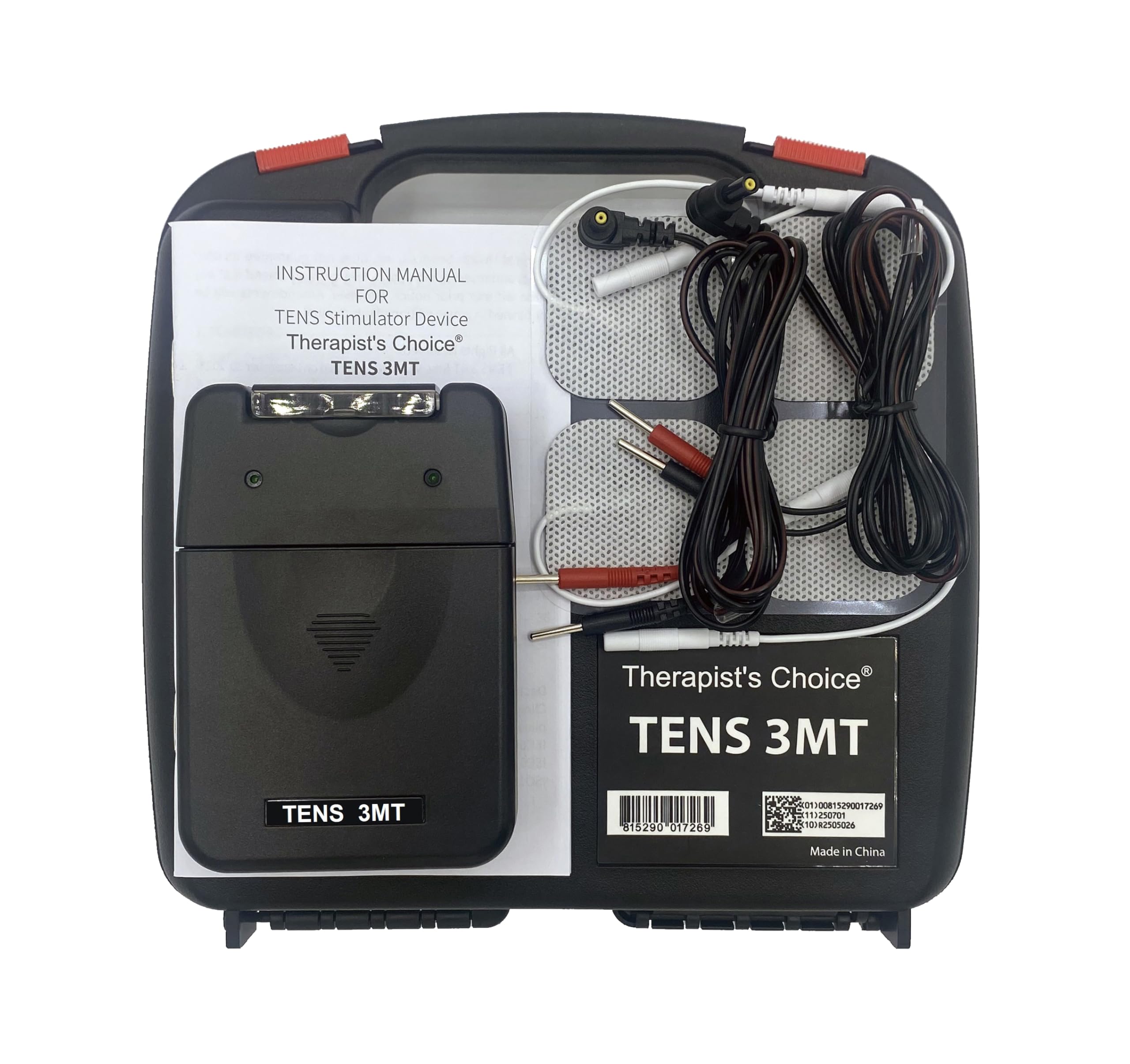
The Therapist’s Choice TENS is the physical therapist’s gold standard for a reason — it offers Burst, Modulated, and Constant stimulation modes that mimic the parameter flexibility of clinical units that cost ten times as much. Rather than relying on a digital menu, you adjust pulse rate, pulse width, and amplitude via physical dials for tactile, real-time control that doesn’t require scrolling through menus. The 9V battery platform delivers consistent, high-amplitude output that many rechargeable units cannot sustain, making this a trusted choice for users who need reliable current penetration through deep muscle tissue.
The included hard carrying case and belt clip turn this into a wear-and-go system for chronic pain sufferers who need therapy during commutes or work hours. Starter pads are standard size, and the industry-standard 2mm connector pins mean replacement leads and electrodes are available at any pharmacy without brand-lock. The unit’s small footprint — roughly the size of a deck of cards — clips onto a waistband without sagging.
Customer reviews highlight battery endurance exceeding 24 hours of continuous use, with many users reporting the same unit lasting years of daily treatment. A physical therapy clinic owner confirmed that the device’s simplicity eliminates patient confusion during in-clinic instruction. The trade-off is a slightly steeper learning curve for those who prefer pre-programmed mode names like “knead” or “tap” rather than adjusting Hz and pulse width manually.
Why it’s great
- Analog-digital hybrid gives you clinical-level control over pulse parameters
- Exceptional battery stamina with a standard 9V cell
- Compact enough to wear under clothing with belt clip
Good to know
- No pre-programmed body-part modes — requires manual Hz/width adjustment
- No rechargeable battery; ongoing 9V purchasing needed
2. AUVON PT1+Pro Rechargeable TENS Unit

The AUVON PT1+Pro bridges the gap between a basic multi-mode device and clinical-level adjustability. Instead of locking you into 24 fixed programs, it offers eight modes with fully adjustable frequency and pulse width — meaning you can replicate the exact Hz/μs settings a physical therapist prescribes. The 40 intensity levels are divided per channel (CH1 and CH2), so you can run a gentle pulse on a cervical trigger point while delivering stronger current to lumbar knots.
Battery life here is class-leading: a 600 mAh cell delivers up to 60 hours of continuous therapy on a single charge. The unit ships with twelve premium electrode pads made from low-impedance solid gel that maintain stickiness for roughly 45 uses per pad — nearly double the lifespan of standard pads. The flip-cover interface prevents accidental button presses when stored in a bag, and the included carry case keeps everything organized.
Reviews consistently note that the PT1+Pro matches the output quality of chiropractic-office units, with several users reporting two months of daily use without needing to recharge. The trade-off is that the mode customization takes a few sessions to dial in perfectly — beginners may prefer a unit with more presets. Physical therapists have recommended AUVON units in Forbes and Medical News Today reviews.
Why it’s great
- Adjustable pulse width and frequency for PT-prescribed protocols
- Massive 60-hour battery endurance
- 12 long-life gel pads with low-impedance adhesive
Good to know
- Learning curve to set custom parameters
- Replacement pads sold separately; look for AUVON-branded ones for best adhesion
3. TENS 7000 Digital TENS Unit

The TENS 7000 has been a fixture in physical therapy clinics since 2008, with over three million units sold, and its longevity is not based on marketing hype. The dual-channel device runs on a 9V battery (included) that delivers a consistently strong, deep pulse that rechargeable units tend to lose as the battery depletes. The digital screen shows treatment time, pulse rate, and pulse width in real time, and four preset modes (C, B, M, N) cover the most common therapeutic patterns for acute and chronic pain.
The kit arrives with a hard carrying case, two lead wires, four reusable electrode pads, and a belt clip — everything needed to begin therapy immediately. The 45-inch lead wire length is sufficient for seated or reclined use, though some users with back issues note that pad placement on the mid-spine can be awkward solo. The device is FDA-cleared as an OTC TENS unit and is HSA/FSA eligible.
Customer reviews from users with herniated discs and sciatica frequently describe the 7000 as “more powerful than expected,” with pulse amplitude ratings that effectively penetrate deep gluteal and lumbar muscle layers. The consistent complaint is that the included pads are only 6 inches apart on the wire, which limits simultaneous coverage for broad areas like the full lower back without buying an extension cable.
Why it’s great
- Proven clinical track record with decade-plus durability
- Strong, stable output from fresh 9V battery
- Hard case keeps unit secure for travel
Good to know
- Pad spacing on leads is fixed at 6 inches
- Short lead wires limit placement flexibility for back
4. AUVON 3-in-1 TENS Unit Muscle Stimulator

The AUVON 3-in-1 combines TENS, EMS, and a Relax mode into an aluminum-alloy chassis that is remarkably thin and portable. With 40 current levels and 24 pre-programmed modes, it offers the broadest ready-to-use mode library at this tier — perfect for users who want a “set and forget” device without manually adjusting pulse parameters. The A/B dual channel allows independent operation of two or four pads, making it easy to treat one area with a steady TENS pulse while using EMS on another muscle group.
The electrode pad quality stands out: American-sourced adhesive gel that holds through 45+ uses and cleans easily with water. The kit is generous — eight square 2-inch pads and four large rectangular 2×4-inch pads — giving you enough inventory to rotate pads as they dry out. The Type-C charging port is a practical upgrade over older micro-USB units, and the 90-minute continuous timer accommodates long therapy sessions without manual restarts.
Veterans and physical therapy patients praise the 3-in-1 for providing relief comparable to clinical units at a fraction of the cost. A 30-year PT veteran specifically noted the compact rechargeable design replaces bulky battery-powered devices. The only shortcoming is that the instruction manual is somewhat generic, and users need to experiment across the 24 modes to find their optimal setting.
Why it’s great
- Aluminum alloy body is ultra-portable yet durable
- 40 levels + 24 modes provide wide prescriptive range
- 12 high-adhesion pads included with long gel life
Good to know
- Manual does not detail each mode’s Hz/width parameters
- Some trial and error required to match mode to pain type
5. AUVON 4 Outputs TENS Unit

The AUVON 4 Outputs TENS Unit solves a specific pain-point problem: treating multiple body areas simultaneously. With four independent output ports (supporting up to eight electrode pads), you can cover your lower back, both shoulders, and a knee all in one session — or share the device with a partner. The enlarged LCD screen includes a body contour map with dedicated body-part buttons, so selecting “neck” or “back” automatically suggests relevant mode patterns without manual mode-hunting.
The therapeutic options are split between TENS for pain blocking and EMS for muscle performance, with a Relax mode for post-workout recovery. The 300 mAh battery offers roughly 40 hours of standby time, and the Type-C charging port works with any wall adapter or laptop. The kit includes ten electrode pads in two sizes — 2×2-inch squares for cervical or joint use, and 2×4-inch rectangles for broad muscle coverage.
Users who suffer from multiple pain locations (such as chronic neck tension combined with sciatica) find the four-port design cuts therapy time in half. The intuitive body-part navigation is especially helpful for older users or those new to TENS therapy.
Why it’s great
- Treats up to four areas simultaneously with independent controls
- Body-map interface makes navigation intuitive for beginners
- FSA/HSA eligible for pre-tax purchase
Good to know
- 300 mAh battery charges more often than 600 mAh rivals
- Fewer mode variations than the 24‑mode AUVON sibling
6. CESLIFF Dual Channel TENS Unit
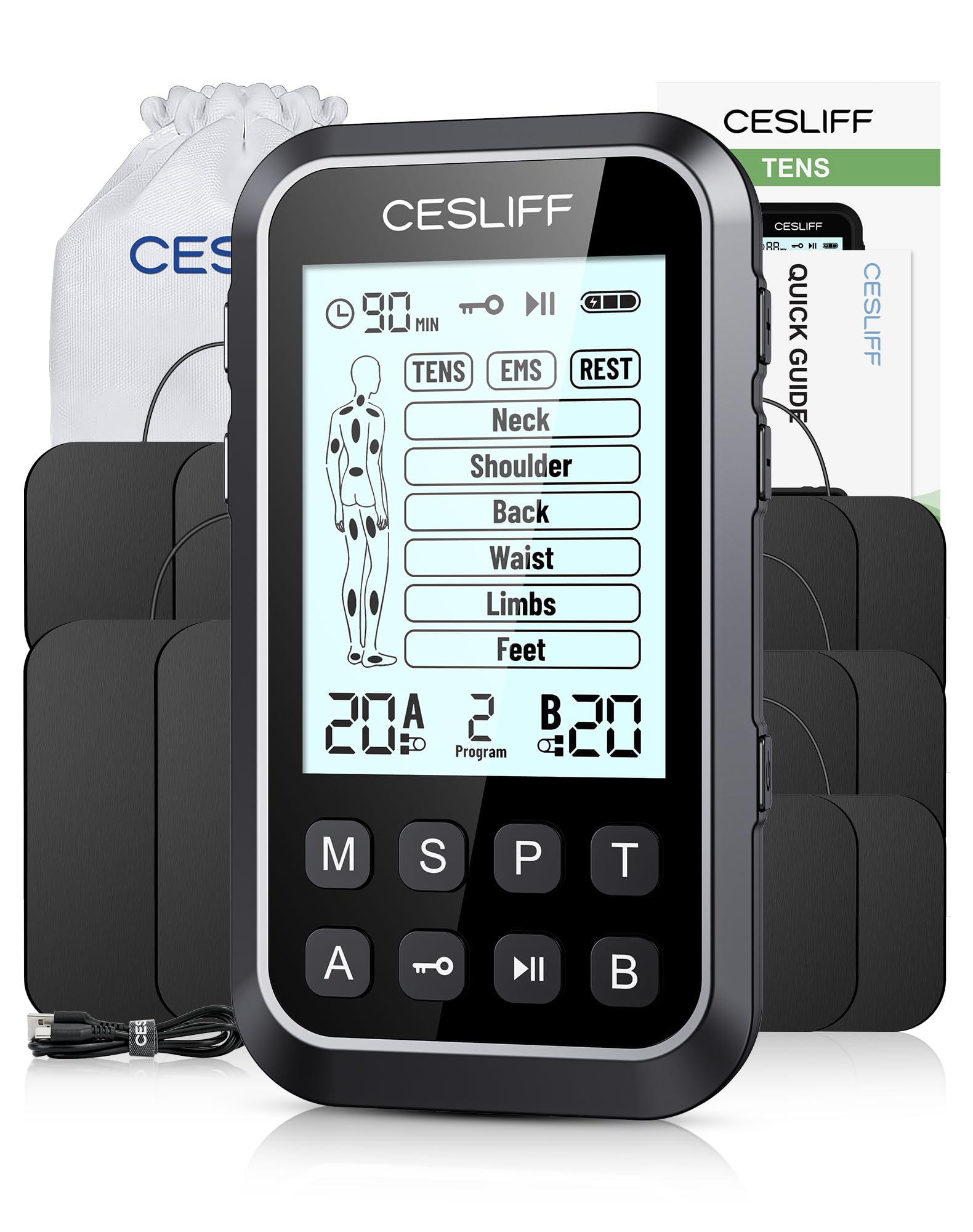
The CESLIFF unit distinguishes itself by allowing completely independent mode and intensity selection on each of its two channels. You can run a TENS program on Channel A for neck tension at intensity level 4 while Channel B delivers an EMS program to your quads at intensity level 12 — and neither setting interferes with the other. This granularity is rare in the sub- range, making the CESLIFF a strong option for users with multiple pain profiles that demand different stimulation patterns.
The device is slim and lightweight at just under 12 ounces, with a built-in rechargeable battery that supports quick charging. An auto memory function recalls your last mode and intensity on startup, eliminating the need to reprogram settings between sessions. The kit includes eight reusable gel pads (two large 2×4-inch and six medium 2×2-inch) plus a convenient carrying bag for storage.
Customer feedback highlights the mode depth — 36 programs per channel — as a major advantage for those who want to fine-tune therapy without upgrading to a medical-grade device. Users with long-standing back and neck pain report that the independent channel control allowed them to treat a pinched nerve in the neck with a gentle TENS pulse while simultaneously targeting a separate lumbar knot with higher intensity. The only drawback is that the included pads are not as durable as American-gel alternatives, typically lasting 25–30 uses before needing replacement.
Why it’s great
- True independent channel control for dual‑zone custom therapy
- 36 modes per channel provide extensive program variety
- Auto memory saves time on repeat sessions
Good to know
- Gel pads wear out faster than premium American‑gel alternatives
- No hard carrying case — soft bag only
7. EMS MASTER 48-Mode TENS Unit
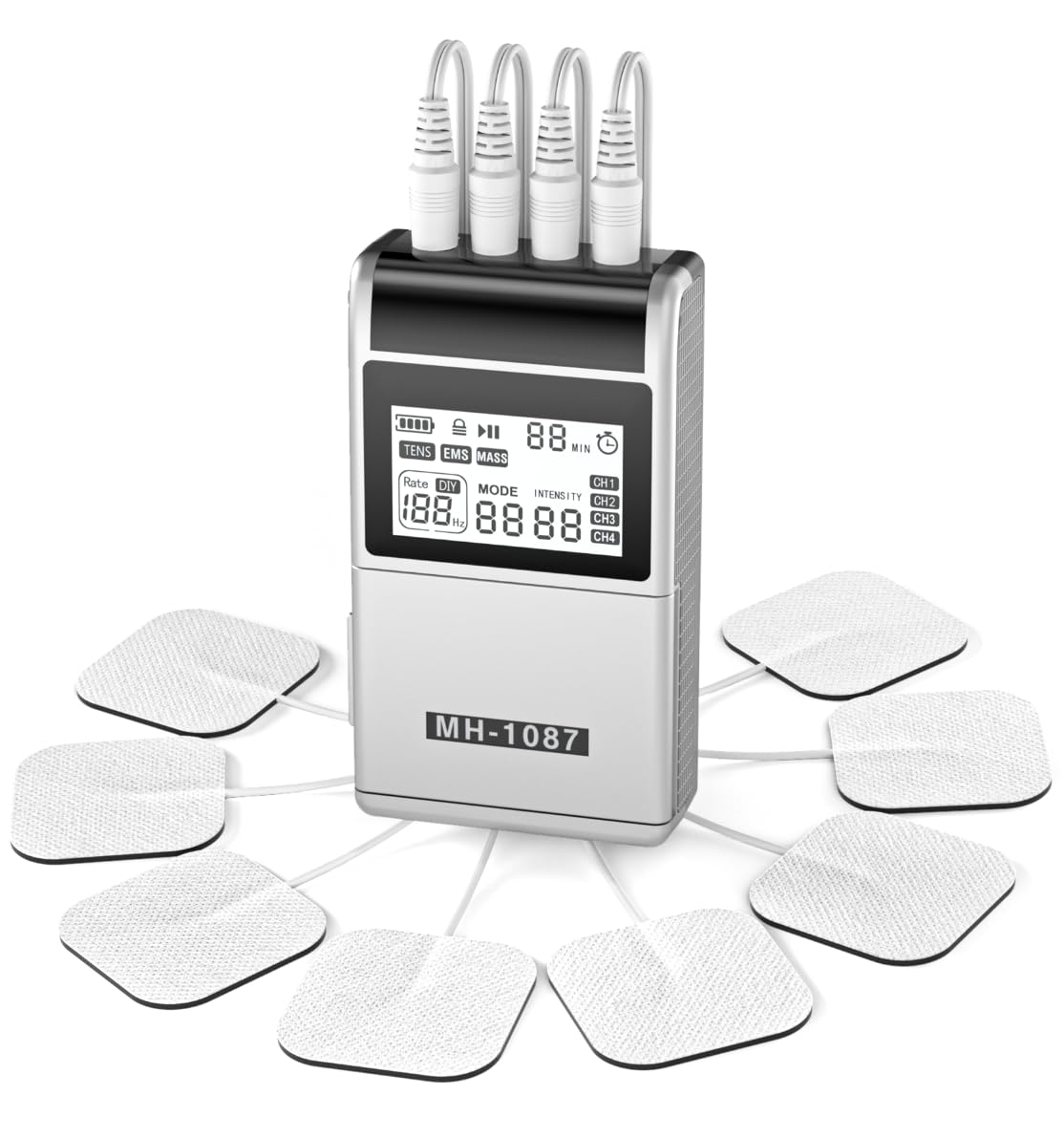
The EMS MASTER 48-Mode unit offers the highest mode count in this line-up, splitting its library into TENS modes (01–16), EMS modes (17–32), massage modes (33–47), and a DIY mode (48) that lets you save a custom pulse pattern. With four output ports arranged as C1/C2 and C3/C4 independent channels, you can run two different mode-and-intensity combos simultaneously across four body zones. The 20 levels per mode provide a smooth gradation from a barely-there tingle to a deep, muscle-contracting pulse.
This unit is also the most generous in terms of included accessories: 16 premium electrode pads, 4 lead wires, and a Type-C charging cable. The device dimensions are compact at 4.33 x 2.36 x 0.79 inches, fitting easily into a pocket or gym bag. The rechargeable lithium-ion battery eliminates the ongoing cost of 9V batteries, though some users note that intensity resets when switching modes.
Real-world feedback underscores its effectiveness for post-accident muscle spasms — one car-accident patient rated the TENS and massage mode combination as equal to physical therapy sessions. The sheer volume of pads means you can treat multiple areas without reusing the same electrodes. The drawback is that the device lacks a hard carrying case, and users must be careful not to lose the four small lead wires between sessions.
Why it’s great
- 48‑mode library with a customizable DIY program
- 16 included pads support multi‑area or shared use
- Compact form with four independent output ports
Good to know
- Intensity resets each time you change modes
- No storage case included for the unit and accessories
FAQ
How many intensity levels do I need for effective at-home TENS therapy?
Can I use an at-home TENS unit on my neck or head?
Why do my electrode pads stop sticking after a few uses?
Final Thoughts: The Verdict
For most users, the best at home tens unit winner is the AUVON 3-in-1 TENS Unit because it balances 40 intensity levels, 24 pre-programmed modes, and 12 long-lasting gel pads in a sleek, rechargeable aluminum chassis that covers both beginners and experienced users. If you want independent channel customization for distinct pain profiles on two body areas, grab the CESLIFF Dual Channel TENS Unit. And for clinical-level parameter control with Burst/Modulated/Constant modes, nothing beats the Therapist’s Choice TENS Unit.