
Our readers keep the lights on and the weekend projects moving. As an Amazon Associate, I earn from qualifying purchases.
Distributing a single 4K or 1080p HDMI source to every TV in a building over existing coax used to mean grainy analog or expensive proprietary systems. A dedicated 4K RF modulator changes that, encoding and modulating HD video into a clean, digital multichannel QAM or ATSC signal that any modern television can tune into. This is the core technology behind in-house TV distribution for hotels, sports bars, hospitals, RVs, and commercial A/V systems.
I’m Rikta — the co-founder and writer behind FitlyFast. I’ve spent years analyzing broadcast distribution hardware, cross-referencing standardized specs like QAM modulation depth, ATSC bitrates, and Dolby Audio encoding latency to separate professional-grade gear from consumer-level compromises.
Whether you’re running a multi-tenant property or a mobile command center, the right 4k rf modulator multichannel qam atsc blade must deliver reliable, low-latency HD distribution over your existing coax backbone without signal degradation or audio sync issues.
How To Choose The Best 4K RF Modulator Multichannel QAM ATSC Blade
Selecting the right RF modulator involves more than just matching HDMI inputs. You must consider your signal distribution environment — is it a residential coax network, a commercial headend with mixed QAM/ATSC channels, or a live production setup with strict latency requirements? The modulation standard (QAM vs ATSC), output power adjustability, and encoding quality are the three pillars that determine whether your distributed video looks clean or falls apart at the last TV in the chain.
Modulation Standard: QAM J.83B vs ATSC
Commercial cable systems almost exclusively use QAM (J.83B) modulation, which allows for dense channel packing and is the standard for hospitality, healthcare, and multi-tenant distribution. ATSC is the over-the-air broadcast standard used for antenna-based TV systems. Some modulators support both, letting you mix a modulated channel alongside an existing OTA antenna feed. If you’re injecting into a legacy cable plant, QAM-only units are fine. For general consumer TVs in an RV or home, ATSC is read by every modern digital tuner without a cable box.
Output Power and Signal Amplification
Measured in dBuV, adjustable output power lets you compensate for long coax runs, splitter loss, and poor cabling. Entry-level modulators typically output a fixed 70-80 dBuV, which works for short runs. Premium units allow adjustment from 70 to over 100 dBuV, giving you the headroom to drive a signal through a 200-foot line with multiple splits. Too much gain can overload nearby tuners, so fine control is a sign of professional-grade design.
Encoding Quality and Latency
All digital RF modulators encode HDMI video into an MPEG-2 transport stream. The quality of this encoder directly determines picture sharpness, motion handling, and color accuracy across your distributed TVs. High-end modulators offer AC3 (Dolby Digital) audio encoding for clear multi-channel sound. Latency is a hidden factor — budget units can introduce 600ms+ of delay, making them unsuitable for live camera feeds or interactive kiosks. Professional broadcast switchers and cross-converters keep latency under 100ms.
Quick Comparison
On smaller screens, swipe sideways to see the full table.
| Model | Category | Best For | Key Spec | Amazon |
|---|---|---|---|---|
| SatLink ST-7000 | Mid-Range | Single source 1080p distribution | Adjustable 70-100 dBuV output | Amazon |
| Thor Broadcast Petit | Mid-Range | Motorhome and small building | AC3 Dolby Audio encoding | Amazon |
| Vecoax MINIMOD 2 | Mid-Range | RV and small commercial | OLED display with channel naming | Amazon |
| Decimator 12G-CROSS | Premium | 4K cross-conversion with scaling | 12G-SDI/HDMI with frame-rate conversion | Amazon |
| OREI 8K 4×4 Matrix | Premium | Multi-source 4K switching and routing | 4×4 HDMI 2.1 with EDID management | Amazon |
| Blackmagic UltraStudio 4K Mini | Premium | Professional capture and playback | Thunderbolt 3 40Gb/s capture interface | Amazon |
| Blackmagic ATEM 1 M/E 4K | Premium | Live switching with 4K multiview | 10-input 12G-SDI/HDMI live switcher | Amazon |
In‑Depth Reviews
1. SatLink ST-7000 HDMI to RF Digital Modulator

The SatLink ST-7000 hits the sweet spot for most distribution needs, offering a single-channel HDMI-to-coax modulator that encodes up to 1080p with adjustable RF output power from 70 to 100 dBuV. This adjustability is critical for tuning signal strength across long coax runs without overdriving nearby tuners. Users consistently report that setup via IP configuration is straightforward and that picture quality is excellent when the signal is properly leveled — grainy results almost always trace back to a weak cable plant.
The unit supports both HDMI and analog RCA inputs, making it backward-compatible with legacy security cameras or older source equipment. It modulates to either ATSC or QAM (J.83B), so it integrates cleanly with both consumer TV tuners and commercial cable headends. Several pro installers noted the lack of an overscan adjustment, meaning the HDMI input may crop a few pixels at the edges of the frame — typically fixable in the TV’s service menu or by selecting a different source resolution.
Audio encoding has been a point of contention in user feedback. While the majority report clean stereo audio, a minority experienced audio distortion that made the unit unusable for their specific source gear. This appears to be a compatibility issue rather than a systemic flaw, but it’s worth verifying with your exact video source before committing to a multi-unit deployment. For a dedicated channel modulator at this price tier, the ST-7000 delivers reliable HD distribution with the most essential pro feature: output power control.
Why it’s great
- Adjustable RF output (70-100 dBuV) for variable cable distances
- Simple IP web-based configuration
- Excellent 1080p picture quality when signal is clean
- Supports both ATSC and QAM modulation
Good to know
- No overscan adjustment — may crop edge pixels
- Audio encoding can glitch with some HDMI sources
- Single-channel input only
- Initial setup requires network connection
2. Thor Broadcast HDMI to Coax Modulator Petit
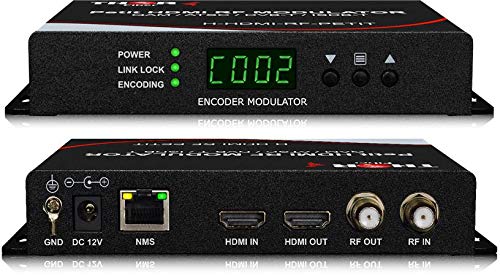
The Thor Broadcast H-HDMI-RF-PETIT is a purpose-built unit for mobile installations like motorhomes, boats, and small commercial buildings. Its compact footprint (under 10 ounces and 4 inches wide) makes it easy to tuck into a cabinet or headend rack. The key differentiator here is AC3 Dolby Audio encoding — a feature often missing in budget modulators — which ensures clean, synchronized audio across every connected TV without the jumbled mess reported on some competitors.
Users praise the picture quality as excellent, with minimal video delay for a device at this level. The unit is frequency agile, supporting both ATSC and QAM output, and can be configured via the front panel buttons or through an Ethernet-based web GUI. Installers using it for security camera distribution (NVR HDMI to modulator) report clear image delivery across existing coax splitters, with enough signal integrity to maintain sharp 1080p on the furthest TV in the chain.
The trade-off is latency — roughly 600ms of encoding delay, which several users noted is noticeable for live camera feeds or interactive applications. If you need frame-accurate synchronization (e.g., lip-sync for live performance), this unit will not deliver. But for distributing a satellite receiver, streaming stick, or Blu-ray player to multiple rooms, the Thor Broadcast Petit is a reliable, cost-effective solution that gets the fundamentals right: clean encoding, broad compatibility, and easy setup.
Why it’s great
- AC3 Dolby Audio encoding for clear, synced sound
- Ultra-compact and lightweight for mobile installations
- Web GUI and front panel configuration options
- Supports both ATSC and QAM (J.83B) modulation
Good to know
- ~600ms latency noticeable for live interactive use
- Requires initial network connection for setup
- Moderate price relative to single-channel function
- No 4K passthrough — inputs capped at 1080p
3. Vecoax MINIMOD 2 HDMI to Coax Modulator

The Vecoax MINIMOD 2 is the enthusiast’s choice for RV and small commercial distribution, offering the unique ability to name your channel via an integrated OLED display — a rare convenience that saves scrolling through dozens of numbered channels during TV rescan. This unit combines HDMI encoding with adjustable RF output gain and slope compensation, letting you fine-tune the signal for OTA antenna passthrough and cable plant losses in a single pass.
RV users consistently highlight the MINIMOD 2’s ability to distribute a single HD satellite or streaming source to all onboard TVs simultaneously. The adjustable gain/slope is a pro-level feature that becomes critical when you need to merge the modulator’s channel with an existing OTA antenna feed — at each new campground, users rebalance the signal to compensate for local broadcast strength. The unit supports both ATSC and QAM output and offers Dolby audio passthrough, preserving surround sound from a Blu-ray or streaming source.
The main trade-off is picture quality under direct comparison. While vastly superior to analog RF modulators, users switching from a direct HDMI connection report slightly less crisp detail in shadows and edges, with visible compression artifacts on demanding content. HDMI over CAT6 remains the alternative for installations where every pixel matters. For its intended use — synchronized multi-TV playback across a building with minimal installation complexity — the MINIMOD 2 is a proven, reliable tool with robust tech support backing it up.
Why it’s great
- OLED display with customizable channel naming
- Adjustable gain and slope for antenna passthrough
- Simple front-panel setup without a network
- Dolby audio support for multi-channel sound
Good to know
- Picture quality slightly less sharp than direct HDMI
- Slight overscan may need TV-level correction
- Requires individual TV channel scan after setup
- Premium price for a single-channel modulator
4. Decimator 12G-CROSS 4K HDMI/SDI Cross Converter

The Decimator 12G-CROSS is a professional-grade cross-converter designed for live production, not traditional RF distribution. It converts between HDMI and 12G-SDI while performing high-quality scaling and frame rate conversion — a critical function when connecting mismatched video sources to a broadcast chain. Unlike dedicated RF modulators, this unit outputs SDI signals for routing through a production switcher or encoder, making it ideal for live streaming, concert video, and house-of-worship AV.
Users running gaming consoles (Xbox Series X, PS5 Pro) report flawless signal integrity with no perceptible added latency or image degradation. The unit automatically saves all settings to internal memory, even after being unplugged, which is a professional reliability feature that budget converters lack. It supports resolutions up to 4K at 60Hz with bidirectional conversion, meaning it can upscale or downscale between HDMI and SDI formats without adding artifacts.
This device does not modulate to QAM or ATSC — it is purely a cross-converter. For users needing to distribute a 4K source over RF coax, the Decimator would sit before an RF modulator or be used to feed multiple displays via SDI distribution. Given its premium price, it delivers exactly what broadcast engineers expect: zero-compromise signal handling with rock-solid EDID management and automatic configuration retention. If your workflow demands frame-accurate conversion between HDMI and SDI, this is the standard.
Why it’s great
- Bidirectional 12G-SDI and HDMI 2.0 conversion
- Professional scaling and frame rate conversion
- Automatic setting retention after power loss
- No perceptible latency for live gaming or production
Good to know
- Does not output RF or modulate to QAM/ATSC
- Premium price for a single-input converter
- Requires separate RF modulator for coax distribution
- Red housing may not match rack aesthetic
5. OREI 8K 4×4 HDMI Matrix Switch with Audio Extractor

The OREI BK-404 is an 8K-capable 4×4 HDMI matrix switcher that distributes four independent HDMI sources to four displays — not an RF modulator, but a critical component in any advanced distribution system. Its standout feature is advanced EDID management, allowing you to download an EDID file and apply it uniformly across all inputs. This eliminates the common headache of displays dropping sync or refusing to show the correct resolution when sources don’t agree on capabilities.
Supporting full HDMI 2.1 features — including 4K at 120Hz, VRR, ALLM, Dolby Vision, and HLG passthrough — this matrix is future-proofed for next-gen gaming consoles and high-end streaming devices. The IR remote, front panel buttons, and web GUI provide multiple control paths, making it adaptable for both simple home installations and complex commercial AV racks. Users report flawless switching performance with automatic EDID negotiation, and the 8K-to-4K downscaling per output port lets you connect a mix of 4K and 1080p displays without signal loss.
The primary drawback is fan noise. The built-in cooling fans run continuously and, according to multiple users, are very loud — some describe them as commercial-grade noise levels (30mm fans spinning at full speed). In a sealed rack or a room with ambient noise, this is acceptable, but in a quiet living room, the hum will be noticeable. Several users have replaced the fans with quieter Noctuas, which requires opening the chassis and voiding warranty. For the feature set, build quality, and remote management capabilities, this is the most capable HDMI matrix at its price tier — if you can manage the acoustics.
Why it’s great
- Advanced EDID download/apply for consistent handshaking
- Full HDMI 2.1 support with VRR, ALLM, Dolby Vision
- Web GUI, IR, and front panel control options
- 8K to 4K downscaling per output port
Good to know
- Built-in fans are very loud (commercial noise level)
- IR port uses non-standard +12V on ground pin
- Not in Harmony remote database (use Orei 8×8 profile)
- Heavy unit (6.1 lbs) — needs secure rack mounting
6. Blackmagic Design UltraStudio 4K Mini

The Blackmagic Design UltraStudio 4K Mini is a Thunderbolt 3 external capture and playback device that handles 12G-SDI and HDMI 2.0 signals up to 4K DCI resolution. It is not a standalone RF modulator — it connects to a computer (Mac, Windows, or Linux) and integrates with production software like DaVinci Resolve, Adobe Premiere, OBS, and Wirecast for recording, streaming, and monitoring. For users needing to capture 4K video from a broadcast feed or encoder, this is the gold standard.
Users in professional video production praise the uncompressed capture quality and low-latency performance. The device is recognized immediately by most capture software once a proper Thunderbolt cable (not a USB-C charging cable) is used — a common rookie mistake that has caused initial detection failures. The unit features multiple SDI and HDMI inputs with loop-through outputs, making it flexible for integrating into a larger broadcast chain alongside RF modulators and switchers.
Quality control has been inconsistent. Multiple reports of dead-on-arrival units (no power, no signal detection) and a delivery of an empty box suggest that packaging and manufacturing oversight have room for improvement. Additionally, the audio input is weak and difficult to adjust, forcing some users to invest in separate audio interface gear for clean production-level sound. If you get a fully functional unit, the performance is excellent — but the reliability risk means buying from a vendor with a strong return policy is advisable.
Why it’s great
- Uncompressed DCI 4K capture over Thunderbolt 3
- 12G-SDI and HDMI 2.0 input support
- Compatible with all major NLE and streaming software
- Loop-through outputs for live monitoring
Good to know
- Some units arrive dead on arrival or with missing contents
- Weak audio input requires extra gear for clean sound
- Must use Thunderbolt cable, not USB-C
- No video feedback until capture application is active
7. Blackmagic Design ATEM 1 M/E Constellation 4K

The Blackmagic ATEM 1 M/E Constellation 4K is a full-scale live production switcher designed for concerts, sports, houses of worship, and professional streaming. It features 10 standard-converted 12G-SDI inputs (plus one HDMI reference input), 6 dedicated 12G-SDI outputs, a 16-way multiview SDI output, and a USB-C webcam output that replaces the need for a separate capture device. This is a complete production hub, not an RF modulator, but it integrates directly with RF distribution systems by feeding its program output into an encoder or modulator.
The standout feature is the standards conversion on every SDI input, which allows mixing cameras of different resolutions (e.g., 1080i alongside 1080p) without external scalers — a significant cost and complexity saving. The built-in 28-channel digital audio mixer, talkback system, and media players make it a self-contained production station. Users upgrading from older ATEM models report vastly improved reliability and feature density for the price.
Potential issues include Ethernet port reliability — one user reported a hardware defect that prevented network control — and the removal of the dedicated aux button on the front panel, requiring menu navigation or software for aux routing. The audio channel limitation (max two channels passed via SDI despite the 28-channel mixer) has also been flagged by advanced users. For live production that needs to output a clean program feed for RF modulation or streaming, the ATEM 1 M/E Constellation 4K delivers broadcast-quality switching with the flexibility to scale from church streaming to multi-camera arena events.
Why it’s great
- Standards conversion on all 10 inputs — no scalers needed
- Built-in 28-channel audio mixer and talkback
- USB-C webcam output for direct streaming
- 16-way multiview for comprehensive monitoring
Good to know
- Ethernet port can be unreliable on some units
- No dedicated aux button on front panel
- Audio channel pass-through limited to 2 channels
- Premium price appropriate for professional broadcast use
FAQ
What is the difference between QAM and ATSC modulation for an RF modulator?
How do I choose the right output power (dBuV) for my coax network?
Can I combine an RF modulator channel with my existing antenna signal?
Final Thoughts: The Verdict
For most users, the 4k rf modulator multichannel qam atsc blade winner is the SatLink ST-7000 because it combines the essential pro feature — adjustable dBuV output power — with reliable 1080p encoding and support for both QAM and ATSC modulation at a price that makes sense for both single-install and multi-unit deployments. If you need Dolby Audio encoding and ultra-compact size for a motorhome or boat, grab the Thor Broadcast Petit. And for full live production switching with built-in standards conversion and USB-C streaming output, nothing beats the Blackmagic ATEM 1 M/E Constellation 4K.