
Staring at a chewed-up piece of trim after a fresh crosscut is the woodworker’s equivalent of a flat tire. You spend hours on layout, measure twice, and then your miter saw blade leaves a fuzzy, splintered edge that sanding can’t fully save. That jagged line isn’t a tool problem — it’s a blade selection problem. Choosing the right 12-inch blade for your miter saw means the difference between a joint that fits tight and one you hope the caulk will hide.
I’m Rikta — the co-founder and writer behind FitlyFast. I’ve spent years analyzing the mechanical specs, carbide grades, and hook angles that turn an average cut into a glass-smooth finish, so you don’t have to test a dozen blades to find the one.
Every serious trim carpenter or weekend workshop owner needs a reliable 12 inch miter saw blade that resists deflection, holds its edge, and produces zero-tear-out crosscuts on hardwoods and plywood alike.
How To Choose The Best 12 Inch Miter Saw Blade
The difference between a sloppy cut and a glass-smooth one lives in three variables: tooth count, carbide quality, and kerf thickness. Miter saws are inherently side-loading tools, so a blade that flexes under pressure will walk off the line. Here is what you need to know before swiping a credit card.
Tooth Count and Alternate Top Bevel (ATB) Geometry
For a 12-inch miter saw, 32 to 40 teeth are general-purpose ripping tools. They clear waste fast but leave a rough face. For crosscuts on trim work, cabinetry, and molding, look for 60 to 80 teeth with an Alternate Top Bevel (ATB) grind. The angled tooth tips shear the wood fiber rather than grinding through it, producing a finish that often eliminates the need for sanding. The CMT Orange Tools 96-tooth blade pushes this further with a Hi-ATB grind for ultra-fine results on veneered plywood and melamine.
Kerf Width and Steady Feeding
Kerf is the width of the cut. Standard full kerf blades (0.098 to 0.125 inches) are rigid and track straight through dense hardwood. Thin kerf blades (around 0.071 inches) reduce motor drag and waste less material, but they flex more during aggressive crosscuts on sliding miter saws. If your saw is a 12-inch slider doing heavy beam work, a full kerf blade like the Diablo D1040W provides the lateral stiffness needed to avoid blade wander.
Arbor Size and Blade Body Quality
All 12-inch blades here use a 1-inch arbor, but some models include a 5/8-inch diamond knockout for wormdrive saw compatibility. Check your miter saw’s arbor before ordering. Beyond the hole, a laser-cut steel body with heat expansion slots (as seen on the CMT and WEN models) reduces thermal warping during extended cuts. Polymer-filled sound dampening slots, featured on the premium CMT blade, dramatically lower the whistle and vibration that fatigues your ears and hands over a long trim day.
Quick Comparison
On smaller screens, swipe sideways to see the full table.
| Model | Category | Best For | Key Spec | Amazon |
|---|---|---|---|---|
| CMT Orange Tools 255.096.12 | Ultra Fine | Flawless crosscuts on melamine and veneer | 96 teeth, Hi-ATB, polymer sound slots | Amazon |
| DEWALT DWA11260 | Finish | Clean trim and finish cuts on hardwood | 60 teeth, low-vibration slot design | Amazon |
| DEWALT DWA11280 | Fine Finish | Extended use fine trim work | 80 teeth, up to 3X edge life | Amazon |
| BOSCH DCB1244 | General Purpose | Versatile rips and crosscuts | 44 teeth, C3/C4 Brute carbide | Amazon |
| WEN BL1200 | Ultra Fine | Budget-friendly finish cuts | 100 teeth, 2.8mm kerf | Amazon |
| WEN BL1232-2 | Two-Pack | Swapping between ripping and finishing | 32 + 80 teeth set | Amazon |
| Diablo D1040W | Beam/Ripping | Thick headers, 4X posts, heavy framing | 40 teeth, 0.063″ kerf, Perma-SHIELD | Amazon |
In‑Depth Reviews
1. CMT Orange Tools 255.096.12
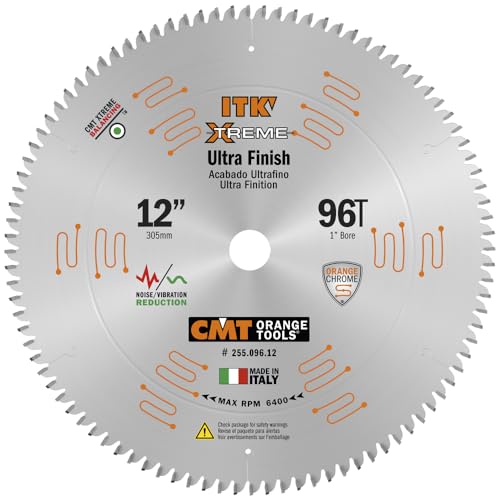
The CMT 255.096.12 is the quietest, smoothest cutting 12-inch blade I have evaluated in this category. Its 96 teeth use a Hi-ATB grind that shears through hard maple and MDF with zero tear-out, leaving a surface so clean you can glue it directly. The laser-cut steel body features polymer-filled sound dampening slots that kill the ringing vibration most high-tooth-count blades produce, making long trim sessions noticeably less fatiguing.
Industrial chrome carbide holds the edge far longer than standard C4 carbide, and the tri-metal brazing ensures the tips do not pop off when you hit a knot in oak. The hook angle is a conservative -5 degrees, which reduces the blade’s tendency to self-feed — a real safety advantage on a sliding miter saw.
This is not the blade for framing or ripping pressure-treated 4x4s. It is an ultra-fine finishing tool, and it owns that job completely. If your daily work is crown molding, picture frames, or custom cabinetry, this is the best 12-inch blade for the task.
Why it’s great
- Near-silent operation thanks to polymer-filled slots
- Zero tear-out on veneered plywood and melamine
- Chrome carbide holds edge twice as long as standard carbide
Good to know
- Premium price point — not a budget option
- Too many teeth for general ripping
2. DEWALT DWA11260
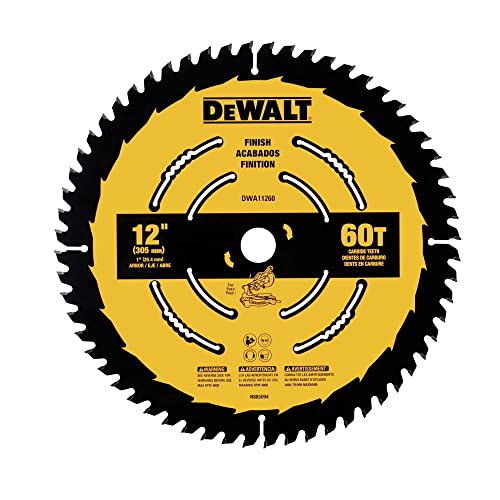
The DEWALT DWA11260 strikes the ideal balance between cut speed and finish quality for a 12-inch miter saw. The 60-tooth ATB pattern produces smooth crosscuts on hardwoods and plywood while still clearing chips fast enough for moderate ripping. DEWALT’s patented body slot design lowers vibration noticeably compared to their older blade generations.
The ultra-sharp carbide formulation delivers a clean cut out of the box with no burning, even on dense cherry or white oak. The blade body is laser-cut from extra-hard steel that resists bending under side loads — a common failure point when cutting stacked trim on a slider. Users regularly report this blade lasting through entire whole-house trim packages before needing a touch-up.
This is DEWALT’s mid-range finish blade, sitting below their premium 80-tooth model. For the woodworker who does a mix of crosscuts and some light ripping without changing blades, this 60-tooth configuration is the most versatile single option.
Why it’s great
- Smooth cuts on hardwoods with minimal burn
- Very low vibration for reduced fatigue
- Durable carbide holds edge for extended trim runs
Good to know
- Not ideal for ultra-fine melamine work
- Mid-range price may push budget shoppers away
3. DEWALT DWA11280

The DEWALT DWA11280 is an 80-tooth finish blade that delivers near-premium cut quality at a mid-range price. Optimized tooth geometry reduces deflection during crosscuts, and the patented body slot design keeps vibration low. The ultra-sharp carbide is formulated for extended edge life — DEWALT claims up to three times longer than their standard finish blades.
Users consistently report clean, tear-free cuts on both softwoods and hardwoods, with a noticeable improvement over saw stock blades. The thin kerf reduces motor load on smaller miter saws, making this a good match for 12-inch sliders with limited torque. The finish on cedar and poplar is particularly good, with no fuzzy edges. A number of users mention it running true on Dewalt DW780 and Bosch gliding saws without any blade wobble.
If you need a reliable 80-tooth blade for finishing work but are not ready to spend the premium for boutique European steel, this is the blade to beat. It sits at a sweet spot between performance and cost.
Why it’s great
- Excellent finish on hardwoods and softwoods
- Extended carbide life for heavy use
- Low vibration design runs true on most miter saws
Good to know
- Thin kerf may deflect under aggressive feed
- Not suited for ripping thick stock
4. BOSCH DCB1244

The BOSCH DCB1244 Daredevil is a general-purpose workhorse with a 44-tooth ATB grind that handles crosscuts, cutoff, and trim work without changing blades. The Brute Carbide formulation uses an upgraded C3/C4 micro-grain structure that resists chipping when you accidentally hit a nail or embedded grit — a common hazard for framers and remodelers.
The Speed Coat anti-friction finish reduces heat buildup during long cuts, preventing the resin from gumming up the carbide tips. The thinner kerf delivers faster cuts with less waste, making it a good upgrade for compact miter saws where every amp matters. Users report it cuts far cleaner than typical stock blades, with smooth finishes on plywood and construction lumber.
This is not a finishing blade for furniture-grade work. The 44-tooth count leaves a slightly rougher edge than a 60-tooth blade, but for framing, decking, and general construction cutting, the DCB1244 is tough, fast, and priced right for daily abuse.
Why it’s great
- Tough C3/C4 carbide resists chipping
- Anti-friction coating prevents gumming
- Fast cuts with less motor load
Good to know
- Not a finish-grade blade
- 44 teeth may leave slight fuzz on veneers
5. WEN BL1200

The WEN BL1200 packs 100 carbide-tipped teeth into a 12-inch blade at an entry-level price that redefines value. The ultra-thin kerf of 2.8 mm (0.110 inches) reduces waste and makes the blade easy on smaller motors, while the C4-grade carbide reliably cuts pine, walnut, and plywood with no splintering. Heat expansion slots help the blade stay flat during extended use.
Users consistently praise the cut quality, noting it rivals much more expensive finish blades for clean crosscuts on baseboards and crown molding. The blade is compatible with most 12-inch miter saws, jobsite saws, and table saws using a standard 1-inch arbor. Several long-term users report it still holds a usable edge after three years of moderate use.
The trade-off is edge longevity. Some users note the blade wears faster than premium competitors, especially when cutting dense hardwoods or engineered LVP flooring. For the price, it is an excellent entry point for the budget-conscious woodworker who needs finish-grade cuts.
Why it’s great
- Remarkably smooth cuts for the price
- High tooth count for fine finishing
- Works on miter saws, table saws, and jobsite saws
Good to know
- Wears faster than premium carbide blades
- Thin kerf can deflect under aggressive feeding
6. WEN BL1232-2

The WEN BL1232-2 delivers the best value for woodworkers who need both a ripping blade and a finish blade without buying them separately. The set includes a 32-tooth general-purpose blade for fast ripping through framing lumber and a 80-tooth fine-finish blade for clean crosscuts on trim and plywood. Both use a 2.6 mm ultra-thin kerf that reduces waste and motor load.
Users report that the 80-tooth blade produces very clean cuts, with minimal tear-out even after more than 100 cuts on cedar and pine. The 32-tooth blade clears chips aggressively, making it effective for dimensional lumber and quick job site work. Both blades fit the standard 1-inch arbor and are rated up to 6000 RPM.
The trade-off is that thin-kerf blades are more prone to deflection in heavy cuts. For a home shop that does mixed work — rough framing one weekend and trim the next — this set eliminates the hassle of swapping a single blade back and forth between tasks.
Why it’s great
- Two blades cover ripping and finishing
- Very clean cuts from the 80-tooth blade
- Affordable for the value received
Good to know
- Thin kerf may wander in dense hardwood
- Not designed for heavy production work
7. Diablo D1040W
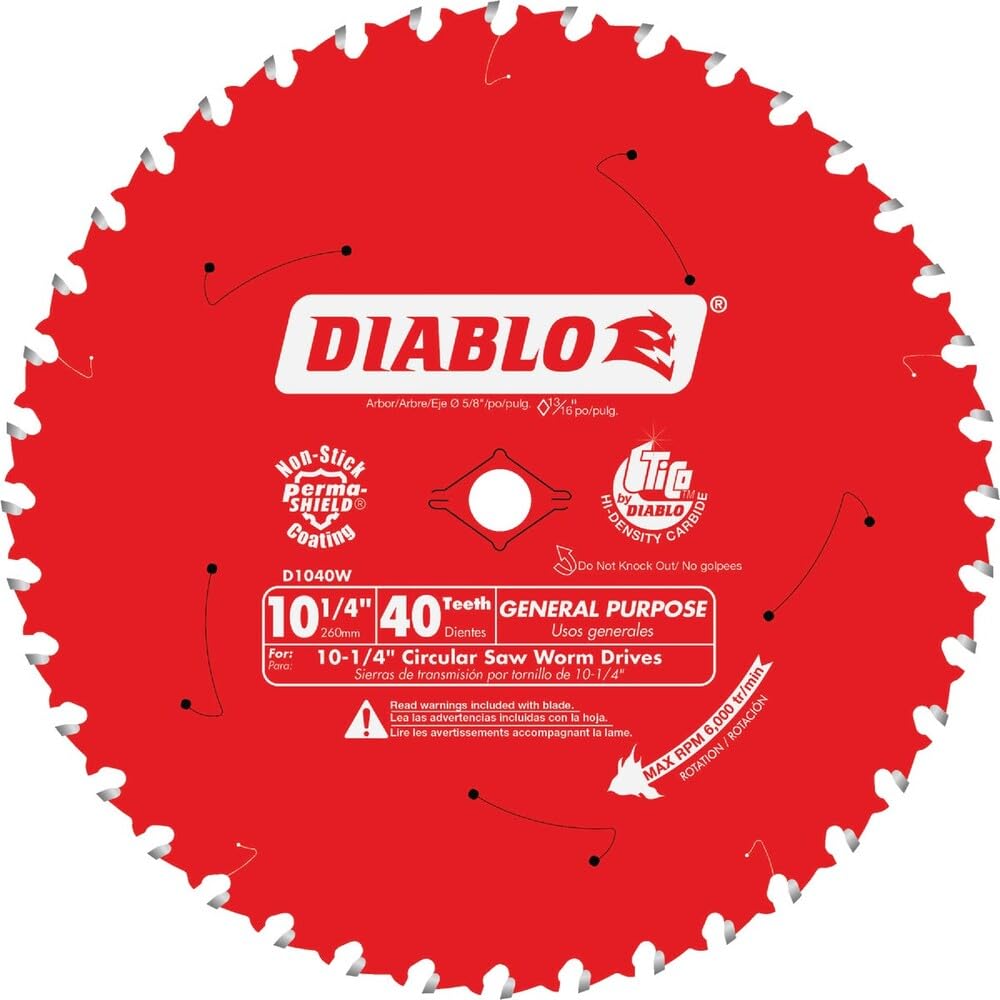
The Diablo D1040W is purpose-built for the heavy side of the 12-inch blade world: cutting 4X headers, fence posts, sandwiched beams, and exposed rafters. The 40-tooth ATB design with TiCo Hi-Density carbide is engineered to withstand the extreme impact of wormdrive saws and heavy miter saws. The Perma-SHIELD non-stick coating protects against heat and gumming when cutting pressure-treated lumber.
The ultra-thin kerf (0.063 inches) and plate (0.039 inches) conserve material and reduce motor drag significantly. Users report it rips faster than many 24-tooth blades while leaving a smoother edge. The tri-metal shock-resistant brazing keeps the carbide tips attached through the kind of abuse that chips cheaper blades. The 5/8-inch diamond knockout arbor makes it compatible with wormdrive saws as well as standard miter saws.
This is not a finishing blade. The thin kerf will deflect if you use it for precision crosscuts on expensive hardwood. But for beam work, decking, and heavy construction, the Diablo D1040W is tough, fast, and durable.
Why it’s great
- Built for extreme impact on beam work
- Ultra-thin kerf reduces waste
- Non-stick coating prevents gumming
Good to know
- Thin plate, not for precision finishing
- Requires careful feed to avoid deflection
FAQ
How many teeth do I need on a 12-inch miter saw blade for finish trim work?
Why does my 12-inch miter saw blade make a loud ringing or whistling noise?
What arbor size do I need for a 12-inch miter saw blade?
Can I use a thin kerf blade on a sliding miter saw?
Final Thoughts: The Verdict
For most users, the best 12 inch miter saw blade winner is the DEWALT DWA11260 because its 60-tooth ATB design perfectly balances finish quality and cut speed for the widest range of woodworking tasks. If you want a near-silent, glass-smooth finish on melamine and hardwood, grab the CMT Orange Tools 255.096.12. And for heavy beam cutting and construction abuse, nothing beats the Diablo D1040W.