
Over-torquing a wheel lug or under-torquing a suspension bolt can turn a routine job into a costly repair. A 1/2 inch torque wrench is the final authority on every fastener that holds your vehicle together, delivering a precise break-loose point that a standard ratchet simply cannot guarantee. The market is crowded with micrometer-click, split-beam, and digital models, each promising exact repeatability for axle nuts, control arms, and engine components that demand 40 to 250 foot-pounds.
I’m Rikta — the co-founder and writer behind FitlyFast. I’ve spent years dissecting the calibration standards, ratchet mechanisms, and real-world durability data behind the torque wrenches that professional mechanics and serious DIYers trust for critical chassis and powertrain work.
Whether you are seating a cylinder head or torquing a crankshaft pulley bolt, choosing the right tool means understanding drive size, accuracy tolerances, and reset protocols. This guide breaks down the seven most capable models on the market to help you find the best 1/2 inch torque wrench for your specific automotive or truck application.
How To Choose The Best 1/2 Inch Torque Wrench
Selecting the right 1/2 inch torque wrench goes beyond grabbing the cheapest clicker on the shelf. You need to match the torque range, accuracy tolerance, and internal mechanism to the fastener family you work on most — from motorcycle engine bolts to heavy-duty truck lug nuts.
Micrometer‑Click vs. Split‑Beam: The Core Trade‑Off
Micrometer-click wrenches must be dialed down to their lowest setting before storage or their internal spring loses calibration over time. Split-beam wrenches eliminate this step entirely because the load is carried by a separate flexing beam — you can store them at any setting and they stay accurate. Split-beam models also let you set torque without fighting the locking collar, making them faster to adjust on the fly. If you use the wrench daily or leave it set overnight regularly, a split-beam design from a brand like TEKTON is the smarter long-term investment.
Accuracy Grade and Real-World Range
Most 1/2 inch torque wrenches claim ±3% or ±4% accuracy in the clockwise direction. What manufacturers rarely advertise is that this tolerance applies only between 20% and 100% of the wrench’s full scale. A 250 ft-lb wrench, for instance, is only guaranteed to hit its rated accuracy above 50 ft-lb. For sub-50 ft-lb work, a smaller 3/8 drive unit is a better fit. Stick with wrenches that are serialized and ship with a certificate of calibration traceable to N.I.S.T. if you rebuild engines or perform suspension work where every foot-pound counts.
Ratcheting Head and Handle Length
A 72-tooth ratcheting head provides a 5-degree swing arc, which is essential when you are working in tight wheel wells or around suspension A-arms. Longer handles — 24 inches and above — give you mechanical leverage at the high end of the torque range, but they also mean the wrench may not fit between the frame rail and a lower control arm. If your work involves tight engine bays, prioritize a compact head with a quick-release button and a knurled, non-slip grip that stays secure even with oily hands.
Quick Comparison
On smaller screens, swipe sideways to see the full table.
| Model | Category | Best For | Key Spec | Amazon |
|---|---|---|---|---|
| CDI 2503MFRMH | Premium Click | Professional shop & high‑leverage use | ±4% CW / ±6% CCW | Amazon |
| TEKTON TRQ62203 | Split‑Beam | Daily work & long‑term calibration stability | 40‑250 ft‑lb, 22.8 in | Amazon |
| GEARWRENCH 85066 | Micrometer Click | Heavy‑duty truck & high‑torque fasteners | ±3% CW / 30‑250 ft‑lb | Amazon |
| CRAFTSMAN CMMT99436 | Digital | Angle‑degree & multi‑unit conversions | Digital readout ±2% | Amazon |
| Park Tool TW‑5.2 | Bicycle Click | Low‑torque precision (18‑124 in‑lb) | 2‑14 Nm / 3/8 in drive | Amazon |
| EPAuto ST‑10A‑3 | Value Click | Budget‑friendly home garage duty | 10‑150 ft‑lb, Cr‑V steel | Amazon |
| UYECOVE Purple | Entry Click | Entry‑level automotive & light truck | 72‑tooth, ±3% accuracy | Amazon |
In‑Depth Reviews
1. CDI 2503MFRMH

The CDI 2503MFRMH carries the DNA of Snap‑on’s torque division — it is built in California, serialized, and ships with an individual N.I.S.T.‑traceable calibration certificate. The dual‑scale micrometer head reads 30‑250 ft‑lb / 47‑332 Nm, and the laser‑etched markings remain legible even after years of shop solvent exposure. The pull‑down lock ring positively prevents accidental setting changes during a hard pull, a detail missing from many lower‑tier competitors.
The ratcheting head offers three positions (tighten, loosen, and locked) with a quick‑release button that works smoothly even with heavy work gloves. At 24.4 inches long, it provides ample leverage for stubborn truck and SUV fasteners, though the length can feel cumbersome inside a tight engine bay. Users consistently confirm the wrench holds calibration within 2 ft‑lb of the set value at mid‑range torque, making it a reliable choice for engine internals and wheel assemblies.
Storage is straightforward — CDI explicitly recommends returning the dial to 30 ft‑lb before putting it in the blow‑molded case. The knurled handle stays grippy when wet, and the compact head width (1.43 in) fits behind brake calipers better than most bulkier designs. If you demand “Buy Once, Cry Once” performance and want a wrench that will survive heavy daily use without drift, this is the professional‑tier standard.
Why it’s great
- Made in USA with N.I.S.T. certificate
- Consistent ±4% accuracy across wide range
- Positive lock ring prevents accidental changes
Good to know
- Must be reset to lowest setting for storage
- Laser scale can be hard to read in direct sunlight
2. TEKTON TRQ62203

The TEKTON TRQ62203 changes the game with a split‑beam design that never needs to be dialed down after use. Unlike every micrometer‑click wrench on this list, you can store it at 250 ft‑lb without stressing the internal spring. This alone saves minutes on every job — you pull it out, set the thumbscrew, lock the flip‑up cover over the teeth, and start torquing immediately.
Accuracy is rated at ±4% across the full ASME B107.300‑2010 range, and each unit ships with a serial‑matched calibration report. The 22.8‑inch handle delivers the leverage needed for lug nuts and axle nuts without being as unwieldy as some 26‑inch wrenches. The smooth‑turning thumbscrew makes micro‑adjustments intuitive, and the clear scale on the body includes a foot‑pound to newton‑meter conversion table directly printed on the shaft.
User reports confirm it has survived being dropped, run over by a shop truck, and exposed to rain over three years with zero drift. TEKTON’s no‑fuss lifetime warranty — processed without a receipt or original owner requirement — adds a safety net that budget brands simply do not match. The one trade‑off is the non‑ratcheting head, but the clean click feedback more than compensates when you need confidence on a critical fastener.
Why it’s great
- No reset needed after use — storage‑ready at any setting
- Lifetime warranty with hassle‑free processing
- Smooth thumbscrew adjustment with locking cover
Good to know
- Non‑ratcheting head slows repetitive work
- Case quality is basic compared to premium brands
3. GEARWRENCH 85066

GEARWRENCH engineered the 85066 for a specific job — hitting high torque values quickly and repeatably. The 26.75‑inch handle is the longest in this comparison, giving you the mechanical advantage to reach 250 ft‑lb without leaning your full body weight on the tool. The engraved numbers on the micrometer barrel are laser‑etched rather than painted, so they will not wear off or fade after repeated solvent cleaning.
The pull‑adjustment collar allows single‑handed torque changes — twist the knurled ring while pulling the collar down, and you are set. The teardrop‑style ratcheting head features a lever cam that switches direction positively, and the compact head profile fits between tight suspension brackets better than slab‑sided designs. Accuracy tests from independent users show it lands within 2 ft‑lb of the target at 150 ft‑lb on a calibrated gauge.
Storage requires returning the dial to 30 ft‑lb, but the included plastic case has dedicated cutouts that hold the wrench securely. The knurled grip stays in your hand even when covered in gear oil, and the overall build quality — despite being made in China — rivals tools costing significantly more. If your primary work involves heavy trucks, motor home lugs, or agricultural equipment, this is the leverage champion.
Why it’s great
- Longest handle for maximum leverage at high torque
- Engraved, never‑fade marking
- Teardrop ratchet head fits tight clearance spots
Good to know
- Slip‑collar lock can be bumped loose in a crowded toolbox
- Handle padding is minimal for extended use
4. CRAFTSMAN CMMT99436

For jobs that require more than just a click — angle‑degree torque‑to‑yield sequences, unit conversion on the fly, or logging peak torque — the CRAFTSMAN CMMT99436 brings digital precision to the 1/2‑inch drive category. The backlit LED screen shows readings in foot‑pounds, inch‑pounds, or newton‑meters at the push of a button, and the built‑in beeper and LED alert ensure you never miss the target even when wearing ear protection.
The 5‑pound, 29.6‑inch body is heavy and long, which helps dampen vibration during high‑torque pulls but can be tiring over a long session. Users confirm the digital readout is accurate within a fairly tight tolerance and works flawlessly on everything from car lug nuts to TTY head bolts on small engines. The ergonomic rubberized grip provides sure hold even with sweaty or greasy palms.
Battery life is solid under intermittent use, and the auto‑off feature prevents drain when you forget to switch it off. The one catch is the learning curve — the mode‑selection button sequence requires reading the manual, and the screen can be hard to see in bright outdoor light despite the backlight. For engine builders who need angle measurement or quick unit switching, this is the most versatile electronic option in the lineup.
Why it’s great
- Switchable ft‑lb, in‑lb, and Nm on‑screen
- Angle‑degree mode for torque‑to‑yield fasteners
- Backlit display with beeper alert
Good to know
- Heavy and long — fatiguing for extended overhead work
- Display can be hard to read in direct sunlight
5. Park Tool TW‑5.2

The Park Tool TW‑5.2 is the outlier here — it occupies the bicycle and low‑torque precision niche rather than the automotive high‑torque space. With a range of 2–14 Nm (18–124 in‑lb), it is purpose‑built for carbon‑fiber bike frames, delicate motorcycle fasteners, and small‑engine work where over‑torquing means cracked composites or stripped threads. The 3/8‑inch drive is a deliberate design choice that prevents accidental cross‑use on high‑torque lug nuts.
The dial‑adjust system lets you set the desired torque in 0.4 Nm increments, and the ratcheting head registers both left and right‑hand threading, making it suitable for both pedals and derailleur bolts. Users praise the smooth, tight ratchet action and the easy‑to‑read scale printed on the tool body. The 9‑inch handle fits comfortably in a bike‑repair stand environment where leverage needs are minimal.
Calibration is rated at ±4%, and the included conversion sticker on the case helps translate between newton‑meters and inch‑pounds. The main limitation is the price relative to its torque ceiling — you are paying for bicycle‑specific precision, not automotive capacity. If your daily work revolves around bicycles, motorcycle engines, or small carbon assemblies, this is the right tool. For general car repair, you will need a separate 1/2‑inch unit.
Why it’s great
- Fine 0.4 Nm increments for low‑torque precision
- Ratcheting head handles left‑hand threads
- Trusted brand in bicycle maintenance circles
Good to know
- Narrow 2‑14 Nm range — not for automotive fasteners
- Ratcheting head is large for tight bike frame clearance
6. EPAuto ST‑10A‑3

The EPAuto ST‑10A‑3 proves that a budget‑tier torque wrench does not have to feel cheap. The head is forged from hardened chrome‑vanadium steel with a satin finish that resists surface rust, and the knurled handle provides a secure grip even when your hands are slick with oil. The 10–150 ft‑lb range covers most passenger‑car work — lug nuts, suspension bolts, brake calipers — while the included 5‑inch extension bar and 1/2‑to‑3/8 reducer add versatility right out of the box.
The click mechanism is audible and tactile, with a clear demarcation point that even first‑time users can feel. Calibration is rated at ±4%, and independent reviews confirm it holds up well after being accidentally dropped and left out in light rain. The storage case is sturdy with positive‑latch closures that keep everything organized in a packed garage drawer.
The main compromises are the 150 ft‑lb ceiling — it cannot handle heavy truck or SUV axle nuts that require 200+ ft‑lb — and the need to dial it back to its lowest setting after each use. For the home mechanic doing routine maintenance on a sedan or crossover, the EPAuto delivers accuracy and durability at a fraction of the premium brand cost. It is the ideal entry‑level companion for a well‑equipped weekend tool kit.
Why it’s great
- Chrome‑vanadium head with corrosion‑resistant satin finish
- Includes extension bar and reducer for added reach
- Audible click clear enough for beginners
Good to know
- 150 ft‑lb max — not enough for heavy‑duty truck work
- Must be reset to lowest value after every use
7. UYECOVE 10‑170 ft‑lb Purple
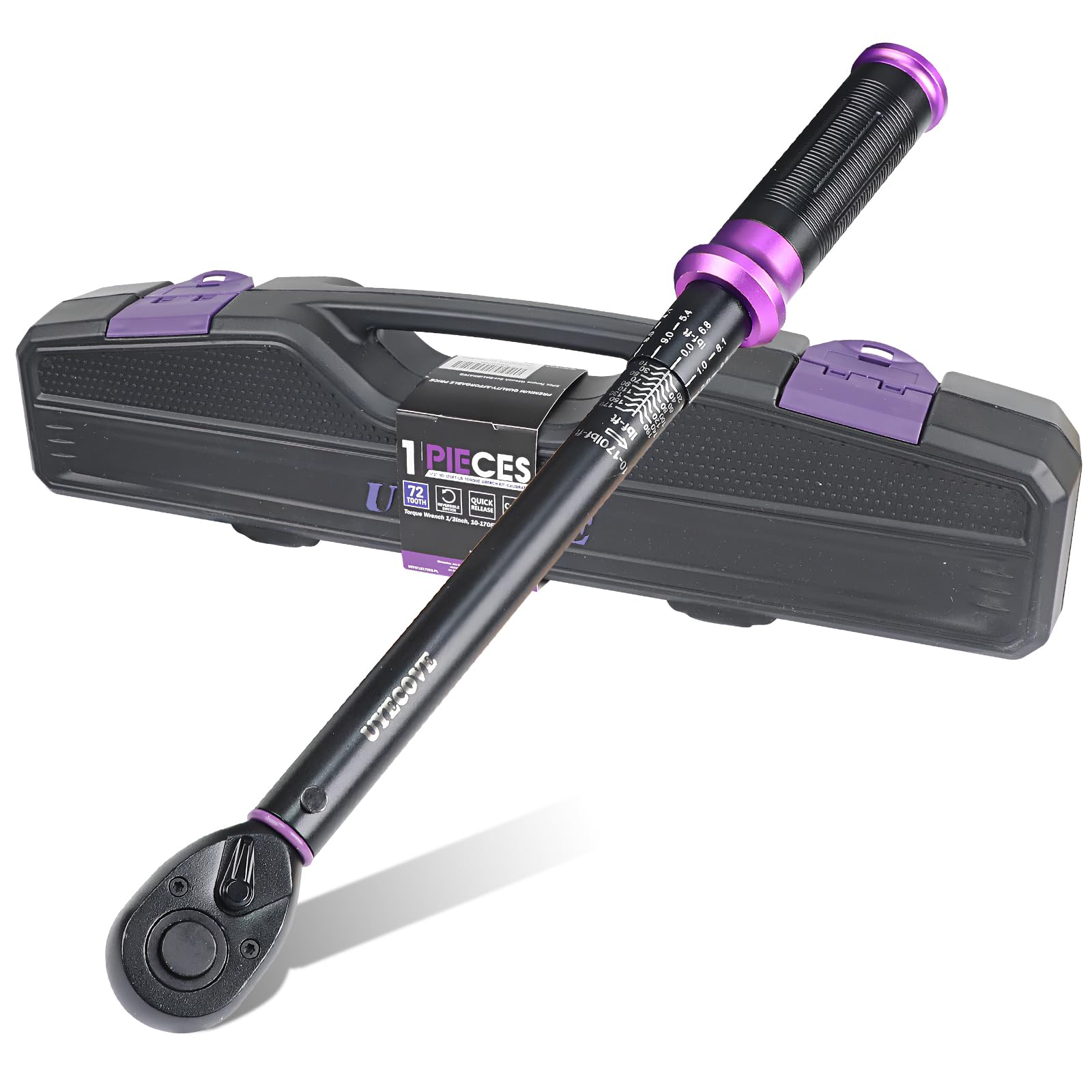
The UYECOVE purple torque wrench stands out for two reasons — its 72‑tooth ratcheting head that requires only a 5‑degree swing arc, and its sub‑4‑lb weight that makes it the most maneuverable option in this list for tight engine bays. The 10–170 ft‑lb range covers the vast majority of automotive fasteners on passenger cars and light trucks, and the ±3% accuracy rating is competitive with wrenches costing multiple times more.
The CR‑MO head is paired with an aluminum handle that resists rust and corrosion, and the quick‑release button makes socket swaps fast. The dual‑range scale is graduated in both foot‑pounds and newton‑meters, and the included calibration certificate adds a layer of accountability at this price tier. Users have successfully used it for suspension rebuilds, engine work, and even precision rifle assembly with consistent results.
The locking collar is the unit’s weakest point — several users note that it unlocks more easily than expected, allowing the head to pivot freely when the wrench is not in use. This is more of a nuisance than a calibration threat, but it does require you to double‑check the lock before each pull. The included plastic case is adequate for drawer storage. If you need a lightweight, accurate click‑type wrench for occasional work and value the 5‑degree swing arc for confined spaces, this purple tool is a compelling budget‑friendly entry.
Why it’s great
- 72‑tooth ratchet with 5° swing for tight access
- Lightweight aluminum handle resists corrosion
- ±3% accuracy with factory calibration certificate
Good to know
- Locking collar unlocks easily, allowing free head movement
- Must be reset to lowest value after use for calibration
FAQ
Do I need to reset a 1/2‑inch torque wrench after every use?
What torque range should I get for home automotive work?
Can I use a 1/2‑inch torque wrench for low‑torque bicycle or motorcycle fasteners?
What does ASME B107.300 certification mean for a torque wrench?
Final Thoughts: The Verdict
For most users, the best 1/2 inch torque wrench winner is the TEKTON TRQ62203 because it eliminates the reset‑after‑use requirement with its split‑beam design, holds calibration reliably, and backs everything with a lifetime warranty that trusts the user. If you want maximum leverage for heavy‑duty truck and SUV fasteners without breaking the bank, grab the GEARWRENCH 85066. And for the pro who needs N.I.S.T.‑traceable accuracy and USA‑made construction, nothing beats the CDI 2503MFRMH.