
A miter saw is only as good as the blade spinning on its arbor. Stock blades often burn, vibrate, or tear out the wood fibers you need clean. Choosing a replacement 10-inch blade means balancing tooth count, kerf thickness, and carbide quality against the materials you cut most—from pressure-treated framing lumber to fragile plywood veneers.
I’m Rikta — the co-founder and writer behind FitlyFast. I spend my days analyzing manufacturer specs, customer durability reports, and real-world cut tests to separate blades that degrade fast from those that hold their edge through hundreds of crosscuts.
Use this guide to compare teeth, coatings, and anti-vibration features so you can confidently buy the 10 inch blade for miter saw that matches how you work—whether that is weekend DIY remodeling or professional cabinet installs.
How To Choose The Best 10 Inch Blade For Miter Saw
Picking the right blade comes down to matching the tooth geometry and kerf width to the material you cut most. A 24-tooth ripping blade leaves rough edges on plywood, while an 80-tooth fine-finish blade can burn through a stack of 2x4s because the gullets fill too fast. Understand your primary cut type first, then filter by build quality and coating.
Tooth Count And Geometry
Fewer teeth (24T) clear waste fast—ideal for framing and rough dimensioning. A 40-tooth Alternate Top Bevel (ATB) blade is the general-purpose sweet spot that crosscuts and rips cleanly on solid lumber and sheet goods. 60-tooth and 80-tooth blades with Hi-ATB grind produce near-splinter-free edges on melamine, veneered plywood, and hardwoods, but require slower feed rates to avoid overheating.
Kerf Width And Arbor Fit
Thin kerf blades (around 0.071 inches) remove less material per cut, which reduces strain on the miter saw motor and extends battery runtime on cordless models. The trade-off is reduced lateral stiffness—you may notice blade wobble during heavy ripping. Standard 5/8-inch arbor is universal for 10-inch blades; always confirm your saw’s arbor size before purchasing.
Carbide Grade And Anti-Friction Coatings
TiCo-infused carbide holds an edge longer than standard high-speed steel. A non-stick Perma-SHIELD or Speed Coat layer prevents pitch buildup and reduces heat friction during long cuts. Anti-vibration slots (laser-cut into the steel body) damp harmonics that cause burn marks and chattering—critical for clean finishes on dense hardwoods.
Quick Comparison
On smaller screens, swipe sideways to see the full table.
| Model | Category | Best For | Key Spec | Amazon |
|---|---|---|---|---|
| Freud P410 Premier Fusion | General Purpose | Zero-tear-out crosscuts on solid wood & melamine | 40T Hi-ATB, Anti-Vibration Polymer | Amazon |
| Freud LU79R010 | Finish / Plywood | Splinter-free plywood & melamine thin-kerf cuts | 80T Hi-ATB, Perma-SHIELD, Laser Slots | Amazon |
| Bosch DCB1080 | Extra-Fine Finish | Chipper-free cuts on finished plywood & melamine | 80T ATB, Brute Carbide, Speed Coat | Amazon |
| Makita B-66977 Max Efficiency | Miter Saw / Cordless | Hardwood crosscuts with minimal drag on battery saws | 80T ATAFR, Thin Kerf, Low-Drag | Amazon |
| Bosch DCB1060 Daredevil | Fine Finish | Fast crosscuts on wood & plywood without burning | 60T ATB, Brute Carbide, Speed Coat | Amazon |
| Diablo D1040X | General Purpose | Clean, quiet cuts on framing lumber & plywood | 40T ATB, TiCo Carbide, Perma-SHIELD | Amazon |
| DEWALT DW3112 | Ripping / Framing | Fast cuts on pressure-treated 4×4 & engineered wood | 24T ATB, Thin Kerf, Wedge Shoulder | Amazon |
In‑Depth Reviews
1. Freud P410 Premier Fusion 10″ 40T Hi-ATB

The Freud P410 is the goldilocks blade for woodworkers who need one blade to do everything well. Its exclusive Fusion tooth geometry combines a high alternate top bevel with anti-vibration polymer slots that damp harmonics so effectively that crosscuts on cherry, oak, and birch plywood come out with zero visible tear-out on the top face. The 40-tooth count gives you fast feed rates on solid lumber while still producing glue-ready edges on veneered panels.
Field reports confirm that the TiCo carbide holds its grind through dozens of sheets of double-sided melamine without chipping or burning. The blade weighs about 2 pounds and uses a standard 5/8-inch arbor, fitting most 10-inch sliding and compound miter saws. Ripping performance on stock thicker than 1.5 inches degrades slightly compared to a dedicated ripping blade, but the smooth, quiet cut quality compensates for most general-purpose tasks.
One note: the red Perma-SHIELD coating can leave light transfer marks on dense exotic woods like padauk or bloodwood. If you work exclusively with hard oily species, you may prefer a bare-carbide alternative. For everyone else—cabinet builders, trim carpenters, and serious hobbyists—the P410 is the finish-grade upgrade that transforms a miter saw into a precision crosscut station.
Why it’s great
- Zero tear-out crosscuts on hardwoods and melamine
- Anti-vibration polymer slots make cuts noticeably quieter
Good to know
- Coating can streak on dense oily species
- Not recommended for dado stacks or heavy ripping over 1.5 inches
2. Freud LU79R010 10″ 80T Thin Kerf Plywood/Melamine Blade
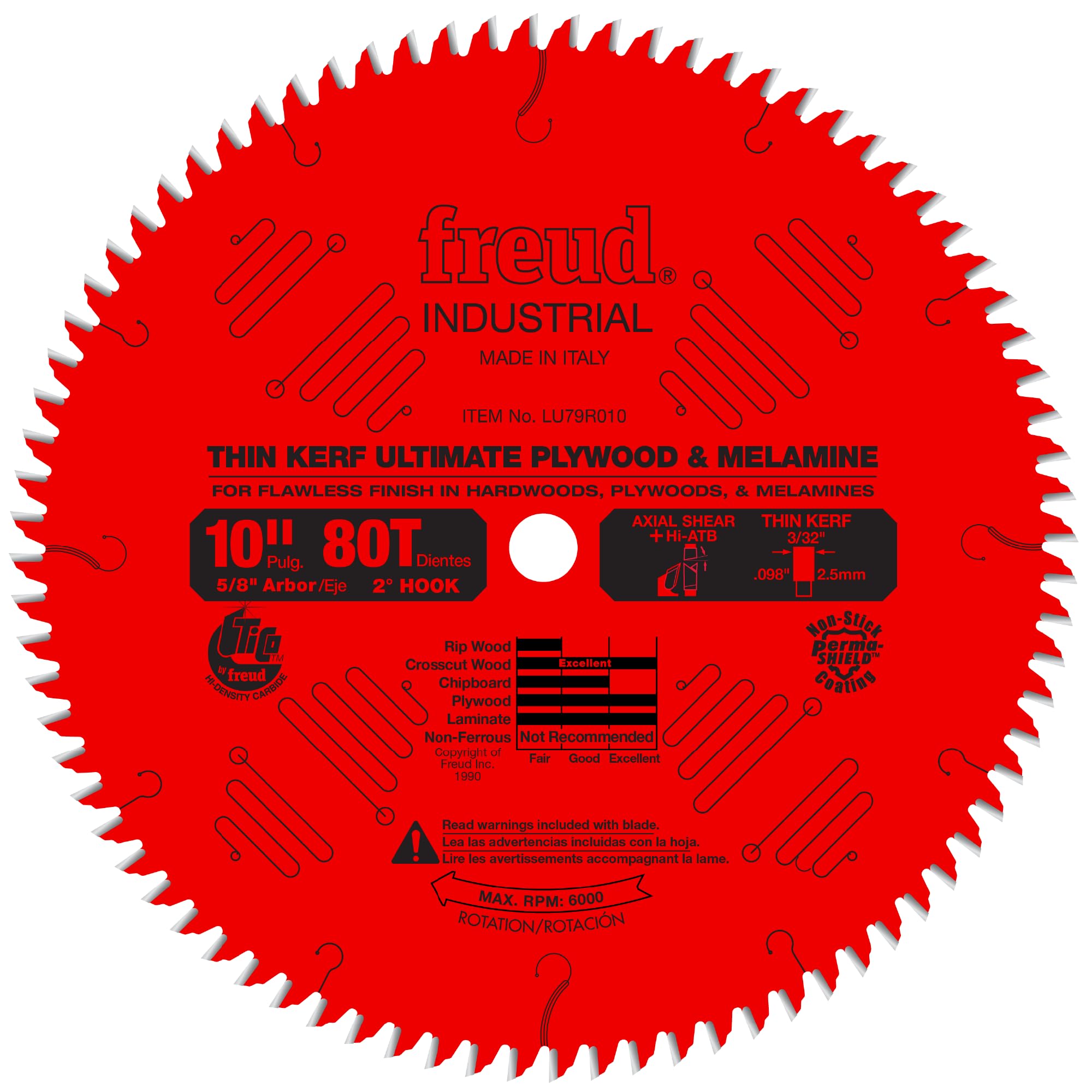
The LU79R010 is purpose-built for one job: slicing plywood and melamine without splintering the show face. Its 80-tooth Hi-ATB grind shears through veneer layers rather than tearing them, and the laser-cut anti-vibration slots keep the blade stable even when feeding sheets of 3/4-inch birch ply. The thin kerf (about 0.071 inches) reduces material waste and eases the load on the saw motor, making this a top pick for cordless miter saw users who want finish-grade results.
User data from cabinet installations shows the blade maintaining clean A-side cuts after breaking down 18 sheets of cherry plywood plus 10 sheets of 1/4-inch ply without measurable dulling. The TiCo carbide tips are brazed with a tri-metal shock-resistant bond that withstands occasional encounters with hidden nails better than standard carbide. The Perma-SHIELD non-stick coating prevents resin buildup during long rip sessions on pine and fir.
The trade-off is that thin kerf blades flex more under heavy side load. Aggressive feeds on dense 8/4 hard maple can cause the blade to deflect slightly, producing a cut that is not perfectly square. For dedicated plywood and melamine work—especially on sliding compound miter saws—this blade is hard to beat. It also sharpens well; local sharpening services return it to near-factory performance.
Why it’s great
- Near-perfect splinter-free cuts on plywood and melamine
- Thin kerf reduces motor strain on battery saws
Good to know
- Thin kerf can deflect on heavy ripping of thick hardwoods
- Not ideal as a single general-purpose blade for framing lumber
3. Bosch DCB1080 10″ 80T Extra-Fine Finish Blade

The Bosch DCB1080 is engineered for woodworkers who demand polished crosscuts on finished plywood, melamine, and hardwood moldings. The 80-tooth ATB geometry with Brute C3/C4 micrograin carbide delivers improved impact resistance compared to standard carbide—meaning the tips stay intact even when cutting materials with the occasional embedded staple. The Speed Coat anti-friction finish prevents pitch and tar buildup, so cuts remain clean and burn-free through extended use.
Field tests on sliding miter saws show that the DCB1080 produces edges that require minimal sanding on maple and oak trim stock. The thinner kerf reduces waste and helps battery-powered miter saws achieve more cuts per charge. The extra-hard steel body resists bending and deflection, maintaining true cuts even when the blade is pushed at moderate feed rates.
Where this blade stands out is on melamine and pre-finished panels—the Hi-ATB tooth grind leaves a chip-free surface on both the top and bottom edges when paired with a zero-clearance insert. The blue Speed Coat does not transfer onto the workpiece, which is a plus for light-colored woods. The main consideration is that 80-tooth blades require slower feed speeds on thick stock to avoid burning the cut face.
Why it’s great
- Brute carbide handles impact from staples and debris
- Speed Coat prevents gumming on resinous woods
Good to know
- Slow feed required on thick hardwoods to avoid burn marks
- Not designed for heavy framing or ripping work
4. Makita B-66977 10″ 80T Max Efficiency Miter Saw Blade
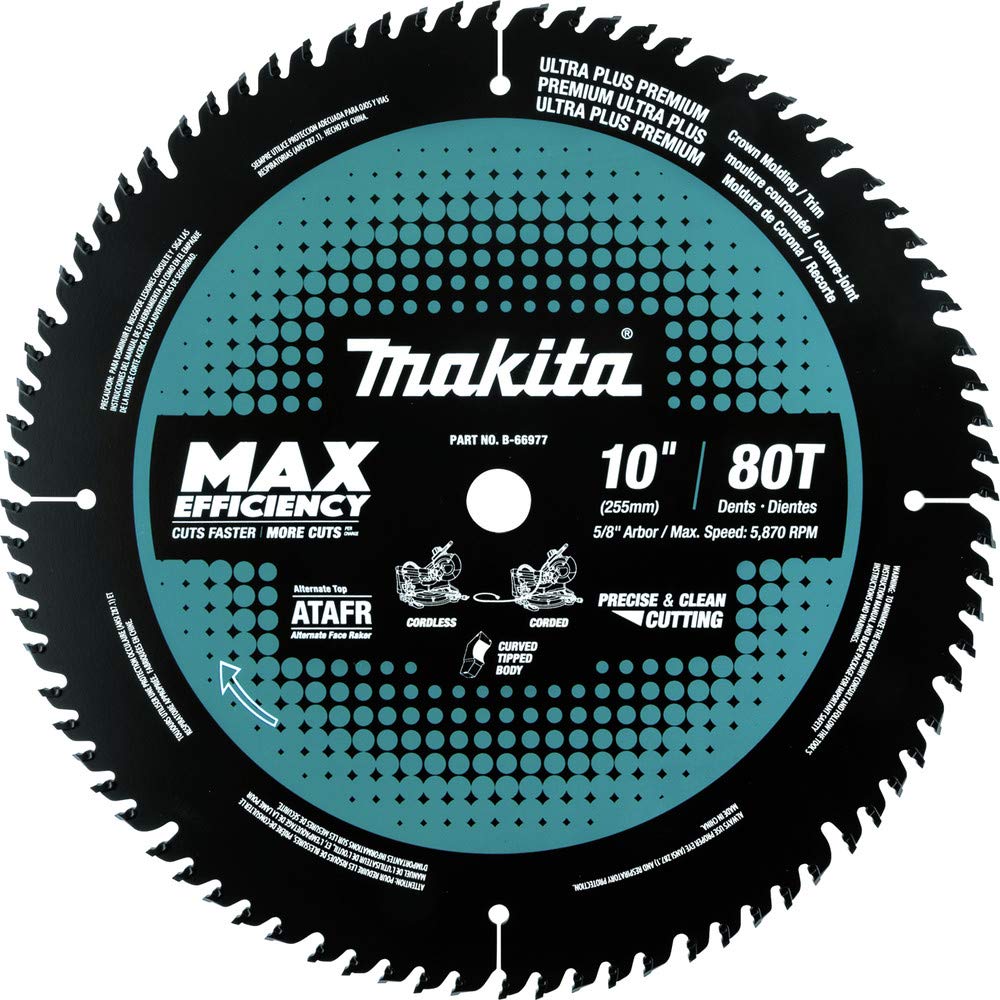
Makita designed the B-66977 specifically for miter saws, with an ATAFR (Alternate Top Alternate Face with Raker) tooth geometry that reduces cutting resistance and motor draw. This translates to faster crosscuts on 8/4 cherry and butcher block with noticeably less drag, which is a measurable advantage on cordless saws where every amp-hour counts. The thin kerf further minimizes waste and feed effort.
Professional cabinet installers report that this 80-tooth blade outperforms similar-count blades from other brands on hard maple, producing cuts that look polished with no detectable blade marks. The carbide tips are engineered to reduce gumming—a common issue with standard 90-tooth blades on resinous woods. The blade also delivers chip-free crosscuts on plywood veneers, eliminating the need for painter’s tape on the cut line.
The B-66977 is a dedicated crosscut blade; its performance on ripping operations is limited. Using it for heavy ripping on thick lumber will accelerate wear on the thin kerf edges. For miter saw users who primarily crosscut hardwood, plywood, and trim—especially with battery-powered saws—this blade provides the best balance of speed, finish, and runtime extension.
Why it’s great
- Low-drag ATAFR grind cuts hard maple smoothly
- Up to 30% more cuts per charge on cordless saws
Good to know
- Crosscut-only blade; not for heavy ripping
- Thin kerf may deflect on deep cuts in dense stock
5. Bosch DCB1060 Daredevil 10″ 60T Fine Finish Blade

The DCB1060 Daredevil sits between a general-purpose 40-tooth and a dedicated finish 80-tooth. Its 60-tooth ATB grind is fast enough for crosscuts on construction lumber yet fine enough to produce smooth edges on plywood without tear-out. The Brute C3/C4 carbide formulation gives the tips durability similar to the premium DCB1080, while the Speed Coat keeps the blade cool during extended cutting sessions on pressure-treated wood.
Users consistently report that this blade cuts so smoothly they thought something was wrong the first time—the reduced vibration and lower noise compared to stock blades are immediately noticeable. On a 7-1/4-inch cordless miter saw, the DCB1060 produces cleaner cuts than the factory blade without draining the battery noticeably faster. The thinner kerf also helps smaller motors maintain cut speed.
Where the 60-tooth count fits best is for DIYers who cut a mix of dimensional lumber, hardwood trim, and plywood on the same day. It is not finish-grade enough for polished melamine work, and it is not fast enough for production ripping of thick rough stock, but as a single-blade solution for the home shop, it outperforms most saws’ included blade by a wide margin.
Why it’s great
- Quiet, low-vibration cuts right out of the box
- Good balance of speed and finish for mixed materials
Good to know
- Not fine enough for perfect melamine cuts
- 60T will burn if forced through thick oak too fast
6. Diablo D1040X 10″ 40T ATB General Purpose Blade

The Diablo D1040X has earned a reputation as the upgrade every miter saw owner should make. Its 40-tooth ATB grind with TiCo carbide tips produces cuts that feel sanded to 180 grit on solid wood, and the Perma-SHIELD non-stick coating resists gumming even after hundreds of cuts through pressure-treated lumber. The tri-metal shock-resistant brazing keeps carbide tips attached during demanding demolition cuts.
Real-world durability data shows the D1040X holding its edge through 192 pressure-treated dock boards plus additional dimension lumber with no measurable drop in cut quality. The super-thin laser-cut kerf (0.071 inches) reduces feed effort and helps cordless miter saws run cooler. Users report that the blade runs noticeably quieter than stock 24-tooth blades, with much less vibration transmitted through the saw handle.
The main limitation is that a 40-tooth ATB blade will produce some tear-out on melamine and pre-finished plywood—for those materials you need an 80-tooth Hi-ATB blade. For general remodeling, framing, and trim work, this is the best value-per-dollar blade in the category. It also sharpens well when the edge eventually dulls.
Why it’s great
- Remarkably smooth cuts for a 40T general-purpose blade
- Durable TiCo carbide holds through hundreds of pressure-treated cuts
Good to know
- 40T will chip melamine and thin veneers
- Red coating may transfer to wood on very dense species
7. DEWALT DW3112 10″ 24T Thin Kerf Miter/Table Saw Blade

The DEWALT DW3112 is a straightforward ripping blade designed to chew through dimensional lumber and engineered wood quickly. Its 24-tooth ATB grind with thin kerf geometry clears waste fast, making it ideal for framing, deck building, and cutting pressure-treated 4×4 posts. The exclusive wedge shoulder design puts more steel behind each carbide tip, reducing breakage during tough crosscuts on nail-embedded wood.
User reports confirm the blade cuts 2x4s, treated 4x4s, and hardboard with speed and minimal burning. One reviewer noted excellent performance on Brazilian walnut with no vibration—comparable to premium Freud blades in that specific test. At a weight of 1.7 pounds, the blade is well-balanced and fits standard 5/8-inch arbors on both miter and table saws.
The trade-off is cut finish. A 24-tooth blade leaves a rough, splintered edge that requires sanding or jointing for visible joinery. It also lacks any anti-vibration slots or non-stick coating, so pitch buildup will occur faster than on coated blades. For homeowners who need a fast, durable blade for rough construction and occasional miter cuts, the DW3112 delivers reliable performance at a entry-level investment.
Why it’s great
- Fast, aggressive cuts on framing lumber and 4x4s
- Wedge shoulder adds tip durability against hidden nails
Good to know
- Rough finish requires sanding for visible joints
- No non-stick coating—pitch builds up quickly
FAQ
Can I use a 10-inch table saw blade in my miter saw?
How do I know when a 10-inch miter saw blade needs sharpening?
Is a thin kerf blade better for a cordless miter saw?
Final Thoughts: The Verdict
For most users, the 10 inch blade for miter saw winner is the Freud P410 Premier Fusion because its 40-tooth Hi-ATB grind with anti-vibration polymer delivers pro-grade crosscuts on solid wood, plywood, and melamine without needing a second blade. If you want a dedicated plywood and melamine blade, grab the Freud LU79R010—its 80-tooth thin kerf design produces near-zero splintering on finished panels. And for a budget-friendly framing and rough-cut blade, nothing beats the DEWALT DW3112 for fast, durable cuts on pressure-treated lumber and engineered wood.