
Your television’s built-in speakers are a compromise of thin cabinets and downward-firing drivers that turn explosions into muffled noise and dialogue into a guessing game. A dedicated soundbar or speaker system bypasses that limitation entirely, delivering clear vocals, punchy bass, and a soundstage that actually matches the visuals on your screen. The shift from tiny TV drivers to proper audio hardware is the single most impactful upgrade you can make to your home entertainment setup.
I’m Rikta — the co-founder and writer behind FitlyFast. I’ve spent years analyzing audio hardware specifications, from driver dimensions and Bluetooth codecs to DAC quality and frequency response curves, across hundreds of home theater products.
This guide breaks down the best options for upgrading your television audio, from compact detachable soundbars to full 5.1 and 7.1 channel systems. Read on to find the right bluetooth tv speakers for your room size, listening habits, and budget.
How To Choose The Best Bluetooth TV Speakers
Finding the right audio solution for your television depends on understanding three core factors: the physical size of your room, the type of content you watch most, and your tolerance for cable management. A small bedroom setup needs a different approach than a dedicated living room home theater.
Channel Configuration: Stereo vs. Virtual Surround vs. True Multi-Channel
A 2.0 or 2.1 setup (soundbar plus optional subwoofer) is the simplest upgrade for dialogue clarity and fuller sound. Virtual surround systems use digital signal processing to simulate rear channels from fewer speakers, which is effective for smaller rooms and avoids cabling rear satellites. A true 5.1 or 7.1 system with physical rear speakers delivers the most convincing immersion but requires more space and wire routing.
Connectivity and Audio Lag
HDMI ARC (Audio Return Channel) is the gold standard for modern televisions because it carries uncompressed audio and remote control commands over a single cable. Optical (TOSLINK) works with older TVs but cannot transmit high-bitrate formats like Dolby Atmos. Bluetooth is the most convenient for streaming from your phone but introduces unavoidable latency that can cause lip-sync issues; for TV use, a wired connection is strongly preferred.
Driver Design and Cabinet Size
Full-range oval or multi-driver arrays (with separate tweeters and woofers) produce better frequency separation than single-driver designs. The cabinet volume and internal bracing determine how much bass a soundbar can generate without distortion. A separate subwoofer, even a small one, relieves the main bar from trying to reproduce low frequencies, which dramatically cleans up midrange clarity and vocal intelligibility.
Quick Comparison
On smaller screens, swipe sideways to see the full table.
| Model | Category | Best For | Key Spec | Amazon |
|---|---|---|---|---|
| Bose Smart Dolby Atmos Soundbar | All-in-One Soundbar | Premium all-in-one cinematic immersion | TrueSpace Atmos upmixing, 5 transducers | Amazon |
| JBL Bar 2.1 Deep Bass (MK2) | 2.1 Soundbar | Deep bass with a dedicated 6.5″ subwoofer | 300W peak, 6.5″ wireless subwoofer | Amazon |
| ULTIMEA Aura A40 7.1ch | 7.1 Virtual Surround | Full surround with 4 satellite speakers | 330W peak, 4 surround speakers, 13 levels | Amazon |
| ULTIMEA Poseidon D50 5.1 | 5.1 Channel System | Value 5.1 system with HDMI ARC | 320W peak, HDMI ARC, app EQ | Amazon |
| Bose SoundLink Plus | Portable Speaker | Portable TV audio for multiple rooms | IP67, 20hr battery, SimpleSync | Amazon |
| MZEIBO 80W Detachable Soundbar | Detachable Soundbar | Budget detachable stereo setup | 80W, 4 full-range drivers, detachable | Amazon |
| Saiyin Sound Bar | Detachable Soundbar | Ultra-budget detachable tower setup | 98dB, BT 5.3, oval drivers, 2-in-1 | Amazon |
In‑Depth Reviews
1. Bose Smart Dolby Atmos Soundbar

The Bose Smart Soundbar packs five transducers—including two upward-firing drivers—into a surprisingly compact chassis that fits under most televisions. Its TrueSpace technology intelligently upmixes stereo and 5.1 content into a convincing Atmos-like bubble, so non-Atmos broadcasts still benefit from height cues. The A.I. Dialogue Mode uses real-time analysis to keep vocals crisp without muddying the soundtrack, which is a genuine relief for news, documentaries, and dialogue-heavy dramas.
Connectivity is comprehensive: Bluetooth, Apple AirPlay 2, Spotify Connect, and Chromecast built-in mean you can stream from any device without switching inputs. Amazon Alexa with Voice4Video lets you control both the soundbar and your TV source hands-free. The initial setup requires the Bose app and a network connection, but once configured, the soundbar remembers your EQ presets and source preferences.
This is an all-in-one solution that delivers theater-like immersion from a single unit. It cannot reproduce the physical rumble of a dedicated subwoofer without the separate Bose Bass Module, but for clarity, soundstage width, and vocal intelligibility in a mid-sized living room, it sets the standard. The absence of a display panel is a minor frustration, but the app-based control more than compensates.
Why it’s great
- Exceptional virtual height channel via TrueSpace upmixing
- A.I. Dialogue Mode keeps voices ultra-crisp in complex mixes
- Headphone-free rear surround via Bose Ultra Open Earbuds pairing
Good to know
- No onboard display for input or EQ mode
- Requires phone app for full setup and firmware updates
2. JBL Bar 2.1 Deep Bass (MK2)

JBL’s Bar 2.1 Deep Bass (MK2) is a straightforward 2.1 channel system built around a single compelling feature: a 6.5-inch wireless subwoofer that delivers genuinely room-shaking low-end. The main soundbar handles mids and highs cleanly, with three adjustable bass levels (Low, Mid, High) that let you tune the subwoofer’s output to your tolerance. At 300W peak power, this system can fill a large living room without distortion, making it ideal for action movies and bass-heavy music.
Setup is genuinely plug-and-play: HDMI or optical cable connection, and the subwoofer pairs wirelessly out of the box. Bluetooth streaming from a phone is included for music playback, and the JBL Surround Sound processing adds a modest virtual width to the stereo field. The remote control is basic but functional, with direct access to volume, source, and bass level.
The trade-off for that bass power is the lack of rear satellite speakers or virtual height channels. This is a front-stage-only system, so you won’t get rear effects or overhead cues. Some users have reported intermittent static requiring a power cycle, but repeat units seem to resolve this. For pure bass depth and simplicity, this is the premium pick for subwoofer-focused buyers.
Why it’s great
- Powerful, impactful bass from a large 6.5″ wireless subwoofer
- Clean mids and highs with three adjustable bass levels
- Immediate setup with HDMI ARC or optical cables
Good to know
- No rear or height speakers for true surround effects
- Occasional static issue reported by some users
3. ULTIMEA Aura A40 7.1ch

The ULTIMEA Aura A40 is a 7.1-channel virtual surround system that includes four physical satellite speakers—two wired front surrounds and two wireless rear surrounds—plus a wired subwoofer. This is not simulated surround from a single bar; you get actual speaker placement around the listening position. SurroundX technology analyzes incoming audio and distributes it across all channels to create a convincing spatial bubble, with 13 adjustable surround levels for fine-tuning.
The Ultimea Home app is the control center, offering 121 preset equalizer matrices across four styles (Bass, Pop, Classical, Rock) plus six dedicated EQ modes for Movie, Music, Voice, Sport, Game, and Night. A 10-band custom equalizer is also available for precision tuning. The system supports Bluetooth 5.3, optical, AUX, and USB inputs, though it lacks HDMI ARC—worth noting if your TV relies on ARC for audio return.
For a mid-range price point, getting four physical surrounds plus a subwoofer is exceptional value. The rear speakers connect wirelessly to the main bar, reducing cable clutter. Dialogue clarity is good thanks to the separate center channel handling vocals. The subwoofer could use more low-end extension for dedicated bass heads, and occasional Bluetooth dropouts have been noted. Still, for immersive movie nights in a medium room, this system outperforms its price tier convincingly.
Why it’s great
- Four physical satellite speakers provide genuine surround placement
- Deep app-based EQ with 121 presets and 10-band customizer
- 13 adjustable surround levels for precise spatial tuning
Good to know
- No HDMI ARC input, limiting audio return channel options
- Subwoofer bass extension is adequate but not chest-thumping
4. ULTIMEA Poseidon D50 5.1

The Poseidon D50 is a 5.1-channel system that includes a soundbar, two wired rear speakers, and a wireless subwoofer, all connected via HDMI ARC for single-cable audio return and TV remote control. The 320W peak power rating translates to clean, distortion-free output at high volumes, and the BASSMX Technology on the subwoofer provides a satisfying low-end punch for explosions and game soundtracks. The rear speakers come with a 19.6-foot cable, giving you flexibility in placement without needing extension cables.
The Ultimea app mirrors the A40’s powerful EQ suite: 121 preset matrices, six optimized modes, and a 10-band customizable equalizer. Switching between Movie, Music, Voice, Game, and Night modes is responsive via remote or app. The system also supports Bluetooth, optical, and AUX inputs, making it compatible with older TVs and projectors. Setup is straightforward, with clear channel labeling on cables.
The primary advantage over the A40 is the inclusion of HDMI ARC, which simplifies integration with modern televisions. The rear speakers are wired rather than wireless, which is more reliable for signal stability but requires cable routing. Dialogue clarity is excellent for a budget 5.1 system, and the subwoofer integrates well without overwhelming the mids. For a affordable 5.1 setup with app control, this is the strongest contender.
Why it’s great
- HDMI ARC for single-cable audio return and remote control
- Massive EQ flexibility via app with 121 presets
- Excellent dialogue clarity and balanced sound signature
Good to know
- Rear speakers are wired, requiring cable management
- Not compatible with external remotes like Nvidia Shield
5. Bose SoundLink Plus

The Bose SoundLink Plus is a premium portable Bluetooth speaker that doubles as a secondary audio solution for your TV via Bose SimpleSync. The IP67 dust and waterproof rating means it can accompany you to the patio, garage, or backyard without concern, and the 20-hour battery ensures all-day playback. Its audio signature is balanced with clear highs, a present midrange, and surprisingly deep bass for its compact size—thanks to the passive radiator design and optimized enclosure.
SimpleSync technology lets you pair the SoundLink Plus with a compatible Bose smart soundbar or speaker, so you can use it as a rear channel for a fuller surround experience or simply sync audio between rooms. The Bose app provides access to a multi-band EQ for sound customization, battery monitoring, and device management. USB-C charge-out lets you top off your phone from the speaker’s 4500mAh battery.
This is not a dedicated TV soundbar replacement—it lacks HDMI, optical, and AUX inputs for low-latency TV audio. Bluetooth latency can create lip-sync issues with video. Its best use case is as a portable companion for an existing Bose soundbar or as a standalone speaker for casual TV viewing in secondary rooms. The build quality is exceptional, and the sound quality justifies the premium positioning.
Why it’s great
- Rugged IP67 build survives outdoor environments and spills
- SimpleSync pairs with Bose soundbars for expanded audio
- 20-hour battery life with USB-C charge-out for devices
Good to know
- Bluetooth-only connection introduces potential lip-sync delay
- No wired audio inputs for direct TV connection
6. MZEIBO 80W Detachable Soundbar

The MZEIBO 80W Soundbar delivers a surprising amount of flexibility for its price tier. Its detachable design allows the single bar to split into two separate tower speakers, widening the stereo soundstage significantly compared to a monolithic bar. Four full-range drivers handle the audio duties, and the large internal cavity adds depth to the low-end response without a separate subwoofer. The matte black finish and compact profile (2.36 inches tall) let it sit in front of most TV stands without blocking the IR sensor.
Connectivity covers Bluetooth, AUX, optical, and HDMI ARC, which is an unusually complete set for this price bracket. Three preset EQ modes (Movie, Music, News) let you switch between sound signatures for different content. The included remote control provides volume, input, and EQ adjustments, and setup is genuinely simple with the included cables—optical cable included in the box.
The main compromise is in absolute loudness and bass depth compared to systems with dedicated subwoofers. At higher volumes, the drivers can show strain, and the lack of a separate sub means you won’t feel explosions in your chest. The detachable design requires two power outlets when separated, which may be inconvenient. For a small bedroom or office setup where space is tight, this is a capable and cleverly designed entry-level option.
Why it’s great
- Detachable design widens stereo separation significantly
- Full connectivity set including HDMI ARC and optical
- Very compact footprint for tight TV stands
Good to know
- Lacks a dedicated subwoofer for deep bass extension
- Detached towers require separate power outlets
7. Saiyin Sound Bar
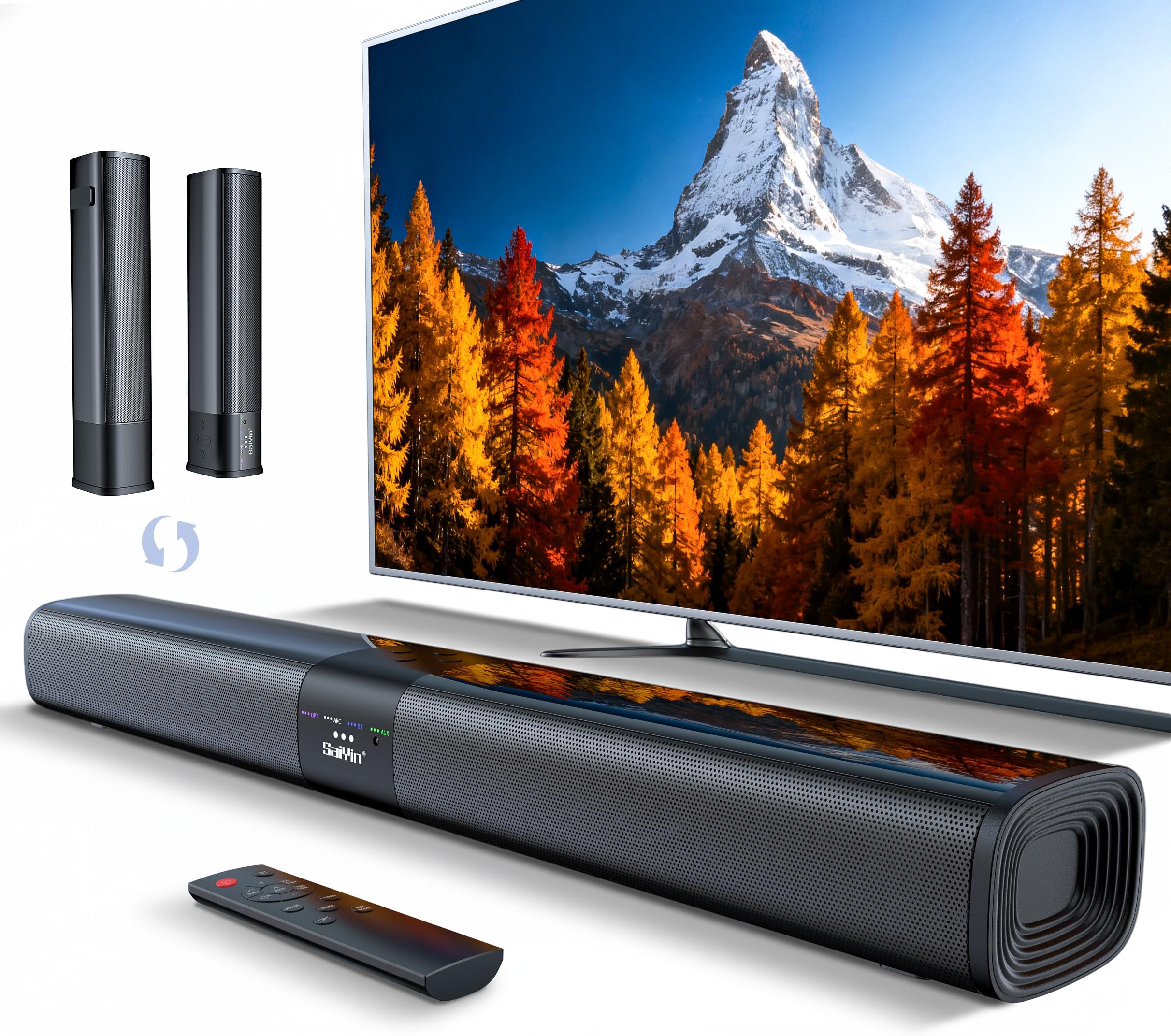
The Saiyin Sound Bar offers a 2-in-1 detachable design where the main soundbar splits into two tower speakers via an included base. This is the same concept as the MZEIBO but at a lower price point, making it the absolute entry-level champion for stereo width. The two 3.9 x 2.1 inch oval full-range drivers provide a larger diaphragm surface than traditional circular drivers of the same height, which translates to better efficiency and higher output—the system reaches 98dB, enough to fill a medium living room.
Bluetooth 5.3 provides stable wireless streaming from any device, and the optical input connects directly to your TV’s SPDIF port for instant audio. The soundbar also supports ARC and AUX inputs, ensuring compatibility with virtually any television. TV remote control via ARC simplifies daily use, and the soundbar works with Fire TV, Google Chromecast, and Apple TV remotes. The rounded corners and black finish blend with most home decor.
At this price point, the audio quality is surprisingly competent for dialogue and moderate music, but the bass is naturally limited by the lack of a subwoofer. The 98dB peak output is loud enough for typical viewing, but distortion creeps in near maximum volume. Setup requires switching your TV’s audio output to PCM and disabling Dolby/DTS processing to avoid crackling noise, which is a common requirement for budget optical soundbars. For the absolute lowest cost of entry to improved TV audio, this is a solid starting point.
Why it’s great
- Detachable tower design widens soundstage dramatically
- High 98dB output for a compact budget soundbar
- Bluetooth 5.3 with TV remote control via ARC
Good to know
- No subwoofer included, limiting low-end presence
- Requires PCM audio setting on TV to avoid crackling noise
FAQ
Will Bluetooth TV speakers cause lip-sync delay?
Can I use a portable Bluetooth speaker as my main TV speaker?
What is the difference between optical and HDMI ARC for TV soundbars?
Do I need a subwoofer for good TV audio?
Can I add rear speakers to a basic 2.1 soundbar later?
Final Thoughts: The Verdict
For most users, the bluetooth tv speakers winner is the Bose Smart Dolby Atmos Soundbar because it delivers the best balance of cinematic immersion, dialogue clarity, and wireless streaming flexibility from a single unit. If you want deep, physical bass for action movies and games, grab the JBL Bar 2.1 Deep Bass (MK2). And for a complete-surround experience without the premium price, nothing beats the ULTIMEA Aura A40 7.1ch system with its four physical satellite speakers and app-based tuning.