
A home blackout doesn’t just mean inconvenience—it can spoil your refrigerator, halt your work, and leave you powerless for days. A 10000 watt generator is the line between chaos and control, delivering enough surge capacity to kick-start a central air conditioner, deep-well pump, and an entire kitchen of appliances simultaneously.
I’m Rikta — the co-founder and writer behind FitlyFast. I’ve spent over a year analyzing the generator market, cross-referencing real owner experiences, noise levels, and fuel-efficiency metrics to separate the units that just look good on paper from the ones that actually perform when the grid goes dark.
After digging through thousands of verified buyer reports and comparing build quality across thirteen distinct models, this guide helps you pinpoint the 10000 watt generator that matches your home’s actual power appetite without burning through your budget on overkill.
How To Choose The Best 10000 Watt Generator
A 10kW-class generator is a serious investment in your home’s resilience. The wrong choice—too few outlets, too loud for your neighborhood, or too finicky on fuel—can turn storm prep into a costly headache. Focus on three pillars: the engine’s displacement and build, the fuel flexibility that matches your supply chain, and the outlet configuration that fits your transfer switch.
Fuel Type and Your Long-Term Readiness
Gasoline is the most energy-dense option per gallon, but it degrades in storage and requires regular carburetor maintenance. Propane stores indefinitely and burns cleaner, though it delivers about 10-12% less peak wattage. Natural gas gives you unlimited runtime if you have a household line, but it ties you to the same grid that might fail during a quake or hurricane. Tri-fuel units offer the ultimate flexibility, letting you switch sources without shutting down the engine.
Engine Build and Cast Iron Durability
Look for a cast-iron cylinder sleeve—this single component determines whether your generator dies after two hurricane seasons or runs reliably for a decade. Engines in the 439cc to 459cc range are the workhorses of the 10kW class. A larger 717cc V-twin, like the one found in premium tri-fuel models, provides smoother power delivery and longer service intervals, but it also adds significant weight.
Outlets, Connectivity, and THD
If you plan to run sensitive electronics—a computer, a modem, a smart TV—you need a generator with total harmonic distortion (THD) under 5%, and ideally under 3%. Inverter generators deliver the cleanest power, but they come at a premium. On the outlet front, confirm your unit has a 50A NEMA 14-50R for RV or transfer-switch hookup, plus a 30A L14-30R for standard backup panels. GFCI-protected 120V duplexes are a must for outdoor use in wet conditions.
Quick Comparison
On smaller screens, swipe sideways to see the full table.
| Model | Category | Best For | Key Spec | Amazon |
|---|---|---|---|---|
| Westinghouse WGen12500DF | Dual Fuel | Whole-home backup via remote start | 457cc OHV cast-iron sleeve | Amazon |
| Champion 201161 15000W | Tri Fuel | Whole-house with central AC | 717cc V-Twin engine | Amazon |
| Generac GP9500 Tri-Fuel | Tri Fuel | Gas, propane, or natural gas | 12,500 starting watts | Amazon |
| Gidrox GNV 11000W | Tri-Fuel Inverter | Sensitive electronics + whole home | <3% THD inverter | Amazon |
| AIVOLT VS12000411 | Dual Fuel Inverter | Quiet sites, RV, food trucks | 65dB noise level | Amazon |
| DuroMax XP10000E | Gasoline | Worksite and heavy-tool power | 439cc OHV DuroMax engine | Amazon |
| Jackery 5000 Plus | Solar Generator | Clean, silent home backup | 5040Wh LiFePO4 battery | Amazon |
| EcoFlow DELTA Pro | Solar Generator | Expandable whole-home battery | 3600Wh base, expandable to 25kWh | Amazon |
| EcoFlow DELTA 2 Max | Solar Generator | Mid-capacity silent power | 2048Wh LFP battery | Amazon |
| WEN DF1100X | Dual Fuel | Emergency backup on a budget | 457cc 4-stroke OHV | Amazon |
| A-iPower AP10700E | Gasoline/Propane | High-output for job site or home | 459cc cast-iron sleeve | Amazon |
| Champion 4000-Watt Inverter | Dual Fuel Inverter | RV and sensitive electronics | 64 dBA quiet operation | Amazon |
| Generac GB1000 Power Station | Battery Power Station | Indoor, emission-free backup | 1086Wh lithium-ion | Amazon |
In‑Depth Reviews
1. Westinghouse WGen12500DF

The Westinghouse WGen12500DF delivers 12,500 peak watts (9,500 running) on gasoline and 11,200 peak watts on propane, putting it squarely in the sweet spot for whole-home backup without stepping into commercial price territory. Its 457cc OHV engine features a cast-iron sleeve that dissipates heat efficiently and resists wear over years of intermittent storm-season use—the same foundational durability that earned it a top recommendation from consumer testing bodies.
What sets this unit apart is the three-way starting system: you get a key fob remote start for convenience from inside the house, a traditional electric push-button, and a recoil backup for when the battery is dead. Owners consistently report assembly under five minutes, with the wheel kit, battery charger, and oil funnel included in the box. The six-gallon fuel tank provides up to 12 hours of runtime at half load, which gets you through a full overnight outage without a refueling trip.
For safety, the integrated CO sensor and automatic low-oil shutdown protect both you and the engine. The dual GFCI-protected 120V outlets, a 30A L14-30R twist lock, and a 50A 14-50R receptacle cover every common transfer switch configuration. The only consistent complaint is the manual’s omission of an Eco switch that doesn’t exist on this model—minor documentation confusion, but the hardware itself is rock solid.
Why it’s great
- Remote key fob start adds real convenience in emergencies
- Cast-iron sleeve engine promises long service life
- Full outlet suite handles any transfer switch or RV plug
Good to know
- Loses efficiency above 2,000 ft elevation; a high-altitude kit is required
- Heavy at 212 pounds—plan for two-person unloading
2. Champion 201161 15,000-Watt Tri-Fuel

The Champion 201161 steps up to a 717cc Milwaukee Series V-Twin engine—a significant displacement advantage over the typical 450cc-class single-cylinder units in this category. This engine architecture delivers smoother power delivery and dramatically reduces vibration at the frame, making the generator feel more stable during sustained operation. With 15,000 starting watts and 12,000 running watts on gasoline, it has the headroom to handle a 5-ton central air conditioner alongside a refrigerator and well pump without voltage sag.
True tri-fuel capability means you can run on natural gas, propane, or gasoline, and Champion ships both an LPG hose and a natural gas hose with NPT adapter right in the box. Hurricane Beryl survivors report running their entire house for seven consecutive days on natural gas, with the V-Twin maintaining stable output even in 90°F+ conditions. The Intelligauge keeps you informed of voltage, hertz, and runtime hours, which simplifies maintenance scheduling.
The noise level registers 78 dBA from 23 feet—louder than an inverter unit but typical for an open-frame workhorse of this output class. The CO Shield auto shutoff system adds an important safety layer, though some owners find the CO sensor too sensitive, tripping after 1.5-2 hours of outdoor operation. Despite a 331-pound curb weight, the wheel kit makes positioning manageable for two people.
Why it’s great
- V-Twin engine provides exceptional smoothness and torque
- True tri-fuel with hoses included—no extra purchase needed
- Whole-house capacity verified by owners during multi-day outages
Good to know
- CO sensor can trigger prematurely in certain outdoor placements
- Extremely heavy; requires a dedicated spot or strong dolly
3. Generac GP9500 Tri-Fuel
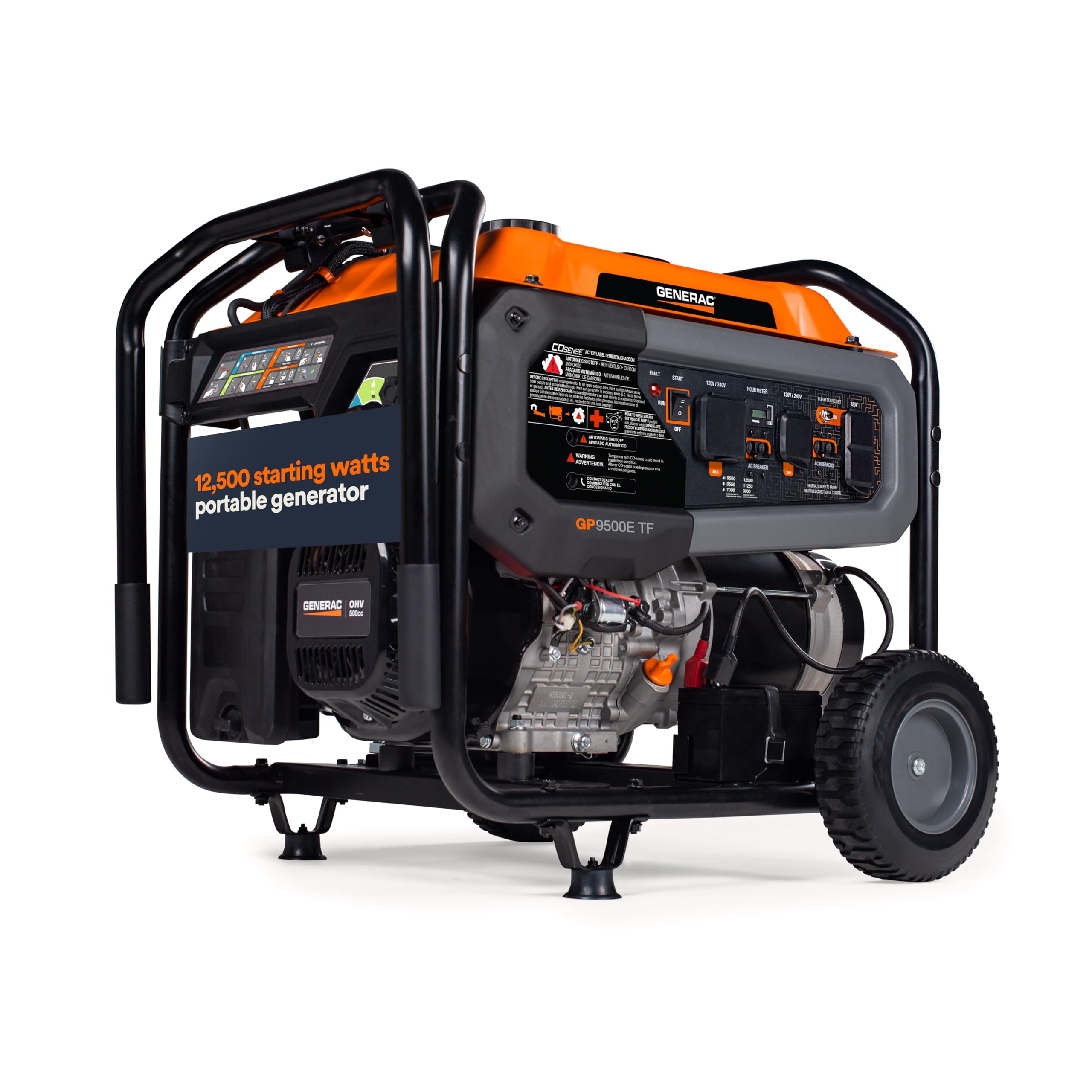
The Generac GP9500 delivers 12,500 starting watts and runs on gasoline, propane, or natural gas via a straightforward fuel selector dial. This is the same brand trusted for automatic standby systems nationwide, and the portable version inherits that engineering DNA: a rugged steel-tube cradle protects the frame from jobsite abuse, and the covered outlets are sealed against moisture and debris. The engine is designed for extended runtime, offering up to 10.5 hours on gasoline at 50% load from its large-capacity steel tank with a built-in gauge.
Electric start with an included battery eliminates the struggle of pull-cords during a stressful outage, and the COsense technology automatically shuts the unit down if exhaust accumulates in an enclosed space. Owners praise the build quality, describing it as “heavy but that’s why it’s such high quality.” The 227-pound weight is about average for this class, and the never-flat wheels roll smoothly over gravel and pavement.
One limitation is the current rating listed at 9,500 amps (a spec likely referencing the L14-30R outlet capacity rather than engine output). The 50-state compliant emissions rating means you can purchase it in California without special handling. A small number of buyers reported receiving damaged units in shipping, but Generac’s customer service generally resolved those cases quickly.
Why it’s great
- Seamless fuel switching between gas, propane, and natural gas
- COsense auto shutoff for critical safety
- Covered outlets add weather and debris protection
Good to know
- Heavier than some competitors at 227 pounds
- Occasional shipping damage reported due to packaging
4. Gidrox GNV 11,000W Tri-Fuel Inverter

The Gidrox GNV is one of the few tri-fuel inverter generators in the 11kW class, which means it delivers clean sine wave power with less than 3% total harmonic distortion—safe for running a gaming computer, a CPAP machine, or a home theater setup without risking internal damage. The inverter also enables ECO mode, which adjusts engine speed to match the load, reducing fuel consumption and noise to a whisper-quiet 65 dB under light loads.
With an 8.7-gallon fuel tank, runtime stretches up to 21 hours at 25% load on gas—enough to sleep through the night without a refill. The unit includes both NG and LPG hoses out of the box, plus an ATS port for connecting an automatic transfer switch, making it a true whole-home solution. Remote start via key fob, push-button electric start, and a recoil backup give you triple redundancy for startup.
Early owners report that the build quality feels premium, with well-placed components like an oil drain tube and a carburetor bowl drain for easy maintenance. The 258-pound weight requires planning, but the wheel kit eases movement on flat surfaces. A minority of buyers experienced a manual-start handle detachment issue on the first pull, but the electric start works flawlessly as the primary method.
Why it’s great
- Inverter technology delivers clean power for sensitive devices
- Tri-fuel with ATS port for whole-home automation
- Whisper-quiet 65 dB in ECO mode
Good to know
- Very heavy at 258 pounds
- Some early units had minor recoil start assembly issues
5. AIVOLT VS12000411 11,250W Dual Fuel Inverter
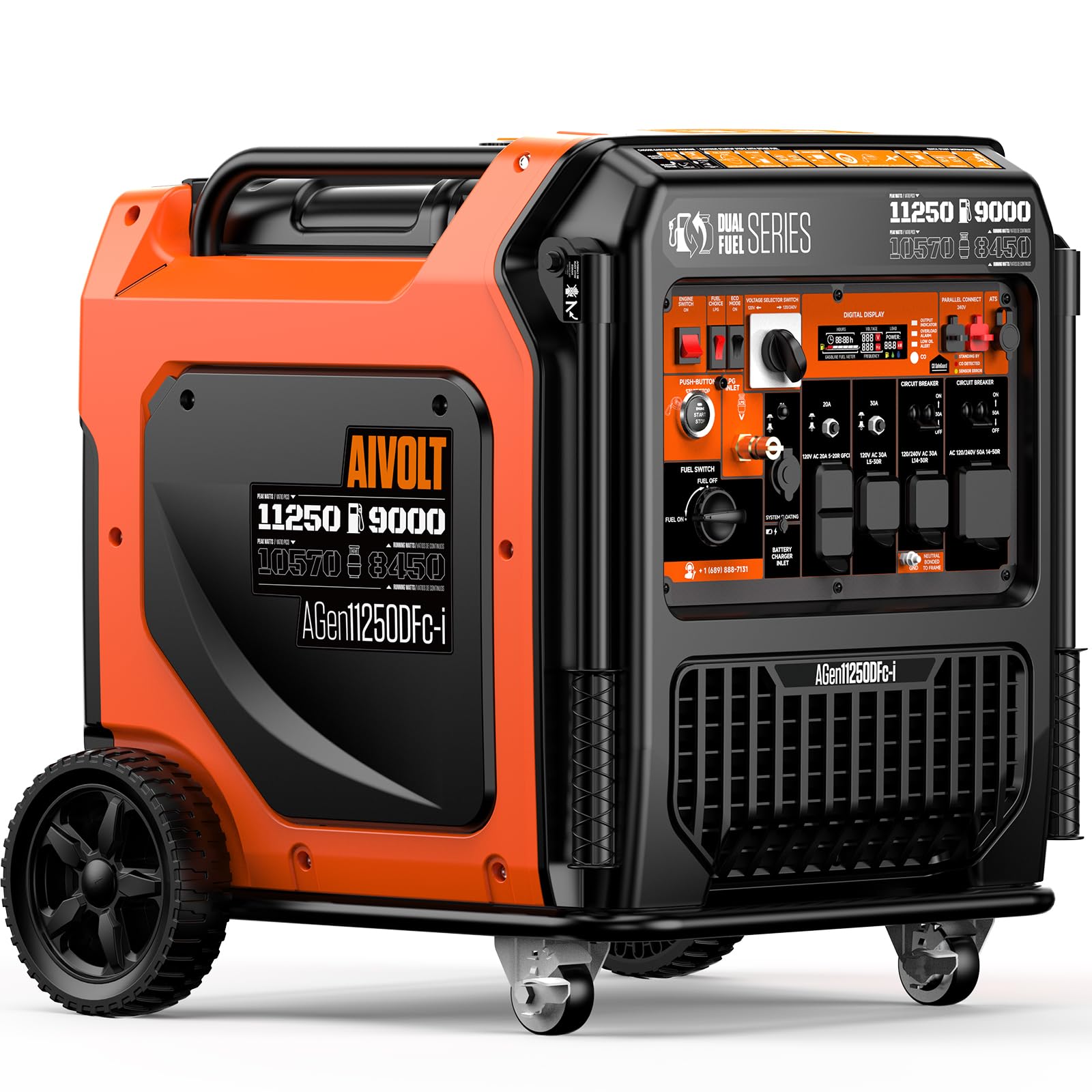
The AIVOLT VS12000411 combines an inverter’s low THD with a 50A RV outlet, making it a top choice for RVers and food truck operators who need both clean power and high capacity. Noise output measures around 72-73 dB at five feet—about as loud as a household vacuum cleaner—which is noticeably quieter than comparable open-frame non-inverter generators. The dual-fuel capability lets you switch between gasoline (11,250W peak/9,000W running) and propane (10,570W peak/8,540W running) without shutting down.
Eco mode optimizes fuel consumption at lighter loads, stretching runtime past 19 hours on a full tank. The digital display gives you fuel level, voltage, and runtime at a glance, and the 50A 14-50R outlet makes it a direct plug-and-play for most large RVs. Owners running portable air conditioners in hot tents report eight hours of continuous operation with no issues, and the remote start key fob is a welcome touch for not having to walk out in the rain to fire it up.
The unit is CARB-compliant and legal in all 50 states, including California. A small number of owners experienced a safety-mode lockout after hot shutdown—the generator needs to cool completely before restarting, which can take up to an hour. One verified buyer reported a catastrophic failure after just one hour of use, though the majority of reviews are overwhelmingly positive.
Why it’s great
- Quiet inverter operation ideal for campgrounds and neighborhoods
- 50A RV-ready outlet for direct coach hookup
- Remote start and ECO mode for convenience and efficiency
Good to know
- Hot restart requires full cooldown period
- Occasional reliability concerns reported
6. DuroMax XP10000E

The DuroMax XP10000E is powered by a 439cc OHV engine with DuroMax’s MX2 technology, which lets you switch between 120V-only mode for maximum amperage on each receptacle and standard 120/240V mode for full-house use. This is a pure gasoline unit, which simplifies the fueling process if you already have ethanol-free gas on hand. With 10,000 starting watts and 8,000 running watts, it has enough punch for a central AC unit, a well pump, and the kitchen circuit simultaneously.
Durability is the headline here: owners who used the XP10000E during Hurricane Irma ran it for 77 continuous hours, powering their entire home including central air and multiple appliances, with no mechanical issues. The engine features an automatic idle control that reduces noise and fuel consumption when loads are light, and the voltage meter gives you visual confirmation of stable output. The break-in procedure—four hours with no load, then four hours with light load, followed by an oil change—is straightforward and well-documented.
At 210 pounds, it’s lighter than most tri-fuel competitors, and the included wheel kit makes it manageable for one person on level ground. The inclusion of a 50-amp twist-lock plug is a nice touch, though some owners note the generator lacks a matching 50A receptacle and requires a small wiring adjustment. The key can fall out in the off position, so a tie-wrap is a smart preventive measure.
Why it’s great
- MX2 technology gives full 120V power per outlet
- Automatic idle control reduces noise and fuel use
- Proven reliability during multi-day hurricane runs
Good to know
- Gasoline-only limits fuel flexibility during supply shortages
- No 50A receptacle included; minor rewiring needed
7. Jackery 5000 Plus Solar Generator

AC output reaches 7,200W (14,400W surge), and the unit supports both 120V and 240V via its dual voltage design, which means it can handle a 5-ton AC unit or an electric water heater without breaking a sweat.
Charging is where this system shines: with up to 4,000W solar input, you can recharge the battery in about two hours on a sunny day using the included 500W (85W x 6) solar panel array. The ChargeShield 2.0 battery management system extends cycle life to approximately 11 years of daily use, making this a long-term investment rather than seasonal gear. The lack of fumes, noise, and moving parts means you can run it indoors safely—a major advantage over gasoline generators during a wildfire smoke event or in an apartment setting.
The Jackery 60A Smart Transfer Switch pairs with the unit to power up to 12 circuits at 120V or six at 240V, creating a seamless backup system. Some owners experienced an F6 error code during pass-through charging with a 30A outlet, which was resolved via a firmware update. The 190-pound weight is considerable, but it’s much lighter than a comparable gas generator with the same output capacity.
Why it’s great
- Zero-emission, silent operation suitable for indoor use
- Expandable capacity up to 60kWh for multi-day backup
- Ultra-fast solar recharge in ~2 hours
Good to know
- Premium price reflects the advanced battery and solar technology
- Firmware update needed for pass-through charging on some units
8. EcoFlow DELTA Pro
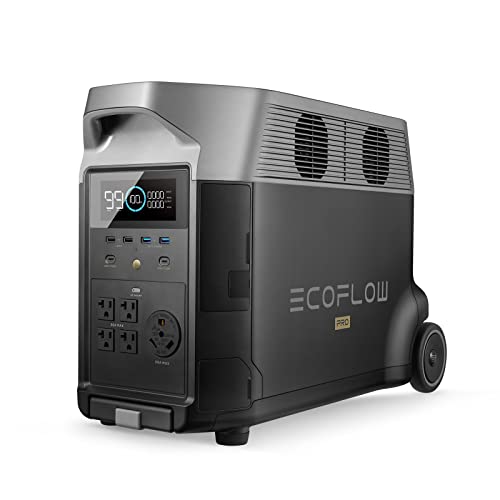
The EcoFlow DELTA Pro starts with a 3,600Wh LiFePO4 battery (expandable to 25kWh with extra batteries or the Smart Generator) and delivers 3,600W of continuous AC output, boosted to 4,500W via X-Boost technology. If you need even more, you can pair two units together for 7,200W of output. This modular approach lets you scale your backup power incrementally as your needs grow, rather than buying a single massive unit all at once.
X-Stream fast charging replenishes the battery from a wall outlet in 1.8 hours with 240V or 2.7 hours with 1800W. Solar charging is equally impressive: with four 400W panels, you can fully recharge in about 2.8 hours thanks to the industry-leading 23% solar conversion efficiency. The unit has 15 output methods including five 120V AC outlets, two USB-C 100W ports, and an Anderson port for high-current DC devices.
Smart app control via Wi-Fi or Bluetooth lets you monitor charge level, temperature, and customize input/output settings. Owners running vendor markets praise its ability to power a heat press continuously without voltage drops, while home users appreciate the pass-through mode that automatically switches to battery during outages. At 99 pounds, it’s significantly lighter than a gas generator of similar output, but it remains heavy enough to need two hands for carrying.
Why it’s great
- Modular expandability from 3.6kWh to 25kWh
- Ultra-fast charging—80% in 43 minutes (AC + solar)
- App-controlled customization for energy habits
Good to know
- Base 3.6kWh capacity may be insufficient for whole-home use without expansion
- Heavy at 99 pounds for its power class
9. EcoFlow DELTA 2 Max

The EcoFlow DELTA 2 Max packs a 2,048Wh LiFePO4 battery into a portable 51-pound package, making it the most travel-friendly solar generator in this roundup. Its 2,400W AC output (3,400W with X-Boost) is enough to run a refrigerator, a TV, a fan, and a modem simultaneously for 12+ hours during an outage. The LFP battery chemistry offers 3,000 full charge cycles before degrading to 80% capacity—roughly six times the lifespan of older NMC batteries.
Dual charging technology combines AC and solar input for a total of 2,400W, achieving 0-80% charge in just 43 minutes. An included 400W solar panel with IP68 weatherproof rating lets you recharge on sunny days in about 5.1 hours, or 2.6 hours with a second panel. Owners report using it as a daily solar battery to offset kitchen and laundry loads, effectively reducing their electric bill by over half while staying fully charged for emergencies.
Fifteen outlets cover every common device, including two USB-C 100W ports for laptops. The smart app lets you prioritize solar input or schedule charging during off-peak hours. A minor complaint is that the solar panel’s carrying case feels flimsy when used as a stand, but the panel itself is robust and folds compactly.
Why it’s great
- Portable 51-pound design with high capacity
- LFP battery lasts 10+ years with daily use
- Dual charging hits 80% in 43 minutes
Good to know
- Solar panel case is somewhat flimsy for stand use
- 2kWh base may not cover central AC without extra batteries
10. WEN DF1100X Dual Fuel

The WEN DF1100X delivers 11,000 surge watts (8,300 running) on gasoline and 9,500 surge (7,500 running) on propane, putting it in the same performance class as units costing significantly more. Its 457cc 4-stroke OHV engine features a cast-iron sleeve for durability, and the dual-fuel selector dial lets you switch between gas and LPG without stopping the engine. The 6.6-gallon tank provides about 8.5 hours of runtime at half load on gasoline.
Electric start with a key gets the engine running quickly, and the included wheel kit makes the 214-pound unit mobile. The CO Watchdog shutdown sensor provides automatic shutoff if carbon monoxide accumulates, which is a critical safety feature when operating near the home. The outlet selection is generous: four GFCI-protected 120V 5-20R duplexes, one 120V L5-30R twist lock, and one 120/240V 50A NEMA 14-50R—covering standard transfer switches and RV hookups.
Owners praise its reliability during hurricane season, with one reviewer reporting it ran their elderly father’s entire house during a major storm without any issues. Setup takes about 20 minutes, though some units arrive with carburetor varnish from the factory test run—a quick drain and spray cleaner resolves it. A consistent maintenance note is to use ethanol-free gas and run the unit under a 1,500W load for 30 minutes every other month to keep the carburetor clean.
Why it’s great
- Dual fuel with simple dial switching
- CO Watchdog auto shutoff enhances safety
- Budget-friendly without sacrificing core features
Good to know
- Assembly required—remove red engine mounts before adding oil
- Carburetor may need initial cleaning from factory test residue
11. A-iPower AP10700E
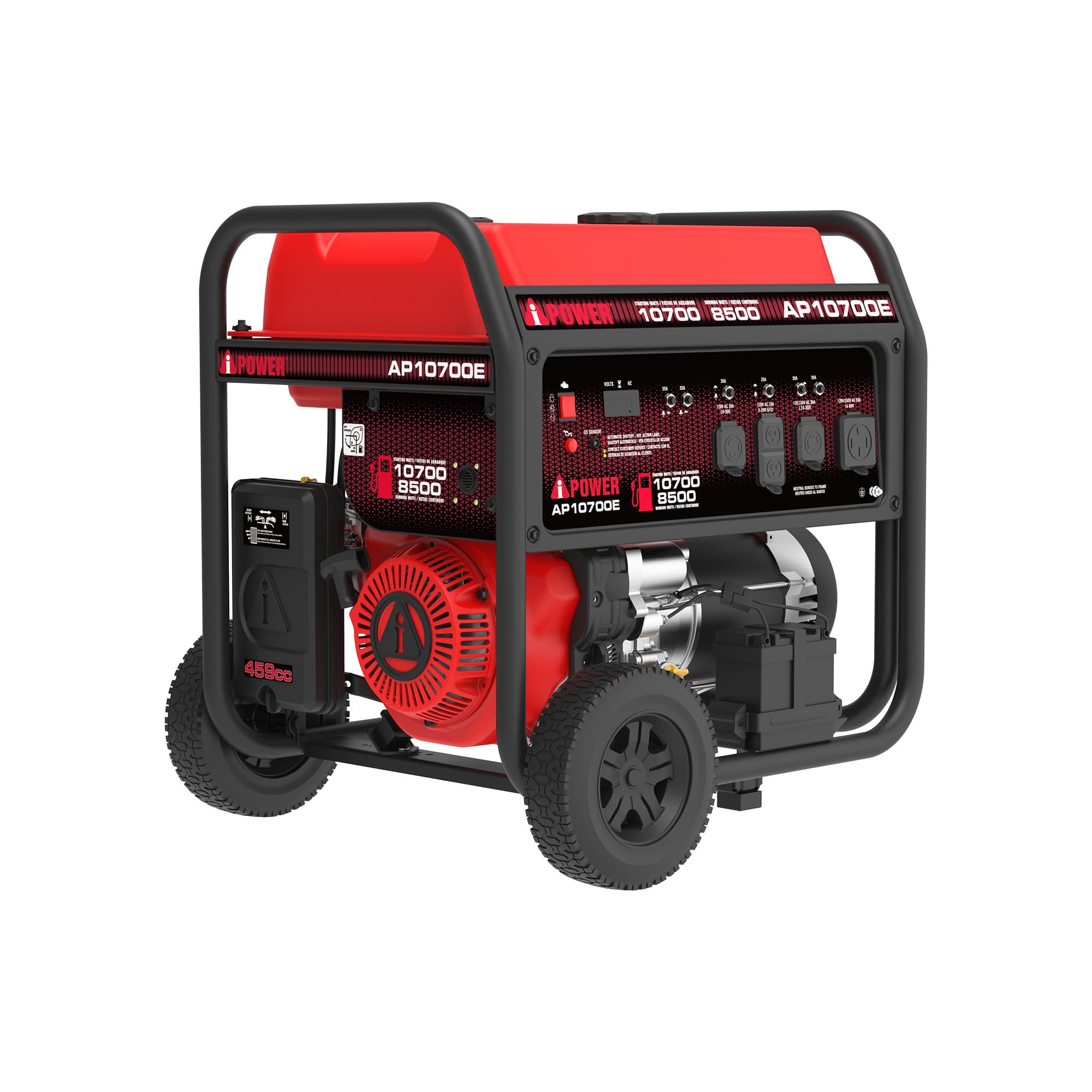
The A-iPower AP10700E runs on gasoline or propane and produces 10,700 starting watts with 8,500 running watts on gas. Its 459cc OHV engine uses a cast-iron sleeve, which provides excellent heat dissipation and long-term wear resistance—the same metallurgy found in premium commercial-grade engines. The three-start system includes electric push-button, recoil backup, and a winter-friendly electric start, ensuring you can fire it up in any weather condition.
Owners report that the unit handles challenging starting loads like a 3.5-ton AC compressor and a 2HP well pump simultaneously, with only a brief voltage sag before stabilizing. Voltage output measures 119-121V on the 120V leg and frequency stays between 60.5-62.5 Hz, which is within acceptable range for most appliances. One reviewer ran it for 80 continuous hours during Hurricane Irma, powering a fridge, 12K BTU AC, TV, and gaming consoles without any struggle.
The control panel includes a CO sensor indicator, digital data center, and multiple outlets: two 20A GFCI 120V duplexes, an L5-30R 30A 120V, an L14-30R 30A 120/240V, and a 14-50R 50A 120/240V—one of the most complete outlet arrays in this class. The 220-pound weight is about average, and the wheel kit helps with positioning. Some owners received units with shipping damage (cracked battery, dents), but A-iPower’s 2-year warranty covers replacement parts.
Why it’s great
- Cast-iron sleeve engine for long life and heat dissipation
- Complete outlet selection covers every common plug type
- Proven ability to start heavy AC and well pump loads
Good to know
- Missing load metering display for precise power tracking
- Some units arrive with shipping damage
12. Champion 4000-Watt Dual Fuel Inverter

The Champion 4000-watt inverter generator is a dual-fuel portable unit perfect as a companion to a larger home backup or as a standalone for RV trips and sensitive electronics. Its 64 dBA noise level from 23 feet is quieter than a normal conversation, making it welcome in campgrounds and residential neighborhoods. With 4,000 starting watts (3,000 running on gas, 2,700 on propane), it handles a small RV air conditioner, a refrigerator, and device charging simultaneously.
The clean electricity output (less than 3% THD) is safe for laptops, CPAP machines, and modern televisions. A parallel kit (sold separately) lets you connect two Champion inverters for double the output—or pair it with a compatible power station for hybrid operation. The 149cc engine delivers up to 10 hours on gasoline and an impressive 25 hours on a 20-pound propane tank at light loads, which is ideal for weekend trips without refueling.
Dual-fuel switching is straightforward, and the CO Shield carbon monoxide auto shutoff system provides a critical safety layer. At about 53 pounds, it’s easy for one person to load into an SUV. Reviewers love the runtime on propane—one owner ran two refrigerators and a freezer for 6-12 hours without finishing a single 20-pound tank, with no carburetor maintenance needed.
Why it’s great
- Ultra-quiet 64 dBA operation ideal for camping
- Excellent propane runtime—up to 25 hours on 20 lbs
- Clean <3% THD safe for sensitive electronics
Good to know
- Lower wattage limits whole-home backup use
- Parallel kit required for higher output—sold separately
13. Generac GB1000 Power Station

The Generac GB1000 is a 1,086Wh lithium-ion power station designed for clean, emission-free power indoors. It’s not a direct replacement for a 10kW generator, but it serves as an essential companion for running lights, a modem, a TV, and phone charging during short outages, or as a silent power source for camping and tailgating. The rechargeable battery eliminates all exhaust concerns, fuel storage, and noise.
Charging is versatile: AC wall outlet achieves 0-80% in 2.1 hours, and you can also use solar panels, a car outlet, or another generator as input. The built-in 15W wireless charging pad is convenient for phones and earbuds, and the large 4.7-inch color display shows battery level, remaining runtime, and input/output rates at a glance. Owners successfully powered their TV, internet router, phones, and small kitchen appliances through a 12-hour outage while using only 77% of the battery.
At just 29 pounds, the GB1000 is easy to carry anywhere. The compact footprint (14.1 x 10.2 x 12 inches) means it fits under a desk or in a car trunk easily. Durability is solid—multiple owners reported surviving multi-day outages and powering neighbor’s fridges alongside their own. A small number of units have arrived defective, and Generac’s support has been less responsive in those cases, so testing the unit immediately upon arrival is recommended.
Why it’s great
- Indoor-safe with no fumes or noise
- Fast dual-input charging for quick top-ups
- Lightweight and compact for easy transport
Good to know
- 1,086Wh capacity insufficient for high-wattage appliances
- Quality control and support issues noted for some units
FAQ
Can a 10000 watt generator run my whole house?
What is the difference between dual fuel and tri fuel generators?
How long can a 10000 watt generator run continuously?
Is a 10000 watt generator loud enough to disturb my neighbors?
Final Thoughts: The Verdict
For most users, the 10000 watt generator winner is the Westinghouse WGen12500DF because it combines a durable cast-iron sleeve engine, remote start convenience, and dual-fuel flexibility at a price that doesn’t break the bank. If you want enough power to run your entire home including central air on natural gas, grab the Champion 201161 Tri-Fuel. And for zero-emission, silent backup that runs indoors, nothing beats the Jackery 5000 Plus.