
A good amplifier is the quiet engine of a great stereo system. It sits between your turntable, TV, or phone and your passive speakers, doing the essential work of turning a weak signal into music that fills the room. But the market is flooded with wattage claims, tube gimmicks, and confusing chipset names that make a simple decision feel like a research project.
I’m Rikta — the co-founder and writer behind FitlyFast. I’ve spent years analyzing amplifier circuit designs, decoding power supply specs, and comparing real-world listening results across Class D, Class A/B, and tube topologies to help buyers separate genuine performance from marketing noise.
Reviews often focus on raw peak numbers, but the best amplifier for your system depends on your speaker sensitivity, preferred source inputs, and room size. That is exactly what this guide delivers as we break down the best audio amplifier for different setups and budgets.
How To Choose The Best Audio Amplifier
Buying an amplifier is about matching the right topology and power to your speakers, room, and listening habits. Start with these three filters.
Power Output and Speaker Sensitivity
An amplifier’s rated wattage means little without knowing your speaker’s sensitivity, measured in decibels (dB) at one meter with one watt. Speakers rated at 88dB or higher will reach satisfying volume levels with as little as 20–30 clean watts. Low-sensitivity speakers (84dB or below) need power reserves of 100 watts or more to avoid distortion during dynamic peaks. Always compare continuous RMS power per channel at a given impedance (4 ohms or 8 ohms) rather than peak burst numbers.
Amplifier Topology: Class D, Class A/B, and Hybrid Tube
Class D amplifiers are compact and efficient, using switching technology to produce high power with minimal heat. They are ideal for bookshelf setups and near-field listening where space is tight. Class A/B amplifiers run warmer and weigh more but often deliver a richer harmonic texture, especially in the midrange. Hybrid tube amplifiers use a vacuum tube preamp stage paired with a solid-state output section, aiming to blend the warmth of tube coloration with the power and reliability of Class A/B or Class D circuitry.
Input Connectivity and DAC Integration
A modern amplifier should match your source devices. HDMI ARC is essential if connecting to a TV for simplified control. USB and optical inputs with a built-in DAC allow high-resolution streaming from a computer or console. A phono input eliminates the need for an external preamp if you own a turntable. Bluetooth 5.0 or higher with LDAC or aptX support ensures wire-free listening without sacrificing too much fidelity.
Quick Comparison
On smaller screens, swipe sideways to see the full table.
| Model | Category | Best For | Key Spec | Amazon |
|---|---|---|---|---|
| Denon PMA-600NE | Premium Integrated | Analog purists with turntables | 70W/ch (4 ohms) with Analog Mode | Amazon |
| Cambridge Audio AXA35 | Premium Integrated | Vinyl lovers seeking analog warmth | 35W/ch (8 ohms) with built-in phono stage | Amazon |
| WiiM Amp | Streaming Amplifier | Multiroom streaming and TV setups | 60W/ch (8 ohms) with HDMI ARC | Amazon |
| Dayton Audio HTA200 | Hybrid Tube | Warm tube sound with modern features | 100W RMS/ch (8 ohms) with phono and DAC | Amazon |
| AIYIMA A80 | Compact Class D | Near-field listening with digital sources | 300W x 2 (peak) with ES9038Q2M DAC | Amazon |
| YAMAHA R-S202BL | Traditional Stereo | Simple radio and Bluetooth listening | 100W/ch with built-in AM/FM tuner | Amazon |
| Fosi Audio MC351 | Budget 2.1 System | Small 2.1 setups with subwoofer | 165W x 2 + 350W (peak) with VU meter | Amazon |
| AMPAPA D1 | Compact 2.1 Amp | Near-field 2.1 with balanced inputs | 300W x 2 (peak) with TRS balanced input | Amazon |
| REISONG A10 | Pure Tube | High-efficiency bookshelf speakers | 12W single-ended Class A with EL34 tubes | Amazon |
In‑Depth Reviews
1. Denon PMA-600NE

The Denon PMA-600NE is a full-featured integrated amplifier that bridges classic analog design with modern convenience. Its Advanced High Current (AHC) power section delivers 70 watts per channel into 4 ohms, providing ample headroom for a wide range of bookshelf and floorstanding speakers. The built-in DAC handles optical and coaxial digital inputs, while the dedicated phono stage supports moving magnet turntables directly without an external preamp. The Analog Mode disconnects the digital input circuitry entirely, allowing a completely analog signal path when listening to vinyl or other line-level sources.
Listening tests reveal a warm but detailed sound signature with a slightly forward midrange that pairs well with neutral speakers. The tone controls and Source Direct bypass give you flexibility to shape the sound without degrading signal purity. The headphone output is capable, driving low-impedance headphones cleanly. The build quality is solid with a vibration-resistant chassis and relay-based input switching that avoids mechanical noise.
The remote control is basic and the volume adjustment is stepped rather than smooth, which some users find less precise. The power consumption is higher than a typical Class D amp due to the linear power supply, but it contributes to the robust dynamics and bass control that sets this amp apart. For anyone building a versatile system with vinyl, digital, and Bluetooth sources, this is a strong anchor component.
Why it’s great
- Analog Mode for pure signal path with turntables
- Robust power supply delivers consistent 70W/ch into 4 ohms
- Built-in DAC and phono stage reduce external boxes
Good to know
- Remote volume control uses coarse stepped adjustment
- Higher heat output than Class D alternatives
2. Cambridge Audio AXA35

The Cambridge Audio AXA35 is a purist’s integrated amplifier that focuses entirely on analog signal integrity. Rated at 35 watts per channel into 8 ohms, it is not about brute force. Instead, it delivers a clean, controlled sound with a tactile midrange presence that makes acoustic instruments and vocals sound natural. The front-mounted 3.5mm auxiliary input is a thoughtful touch for quick connections to portable devices, while the rear panel offers four RCA line-level inputs plus a moving magnet phono stage.
When paired with speakers above 88dB sensitivity, the AXA35 sounds more powerful than its rating suggests. The class A/B topology runs warm but maintains stable performance during extended listening sessions. The internal design uses a toroidal transformer and carefully selected capacitors to minimize noise floor, which is audible as a black background between notes. The headphone output is surprisingly capable, driving both low and moderate impedance headphones with clarity.
The omission of any digital inputs or Bluetooth is a deliberate trade-off. You will need an external DAC or streamer for digital sources. The speaker terminals are basic spring clips rather than binding posts, which may frustrate users with thicker speaker cable. For those committed to analog sources — especially vinyl — and who value simplicity and musicality over feature counts, this amplifier punches well above its weight.
Why it’s great
- Low noise floor with toroidal transformer design
- Excellent phono stage for moving magnet cartridges
- Clean, musical sound character that favors vocals
Good to know
- No digital inputs, Bluetooth, or built-in DAC
- Speaker terminals are basic spring clips
3. WiiM Amp

The WiiM Amp redefines convenience by combining a Class D amplifier, streaming module, and DAC into a compact chassis that fits in any entertainment center. With 60 watts per channel into 8 ohms and 120 watts into 4 ohms, it drives most bookshelf and floorstanding speakers with ease. The HDMI ARC input allows seamless integration with a TV, automatically powering on and switching inputs when the television is turned on. The built-in Wi-Fi and Bluetooth 5.0 support multiroom audio via AirPlay 2, Google Cast, and the WiiM Home app.
The sound quality is surprisingly refined for its size. The TI TPA3255 chipset, combined with a 32-bit/192kHz DAC, delivers a clean and dynamic presentation with good imaging. The app-based parametric EQ with room correction is a genuine asset for tuning the system to your space without additional hardware. The subwoofer output includes adjustable crossover and phase control, making it easy to integrate with a powered sub for a 2.1 setup. The included voice remote with Alexa support adds hands-free control flexibility.
The USB port on the back serves only for service and power, not as a USB DAC input. There is no headphone jack or phono input, so turntable users will need an external preamp. The reliance on the app for full functionality means initial setup requires a smartphone. For anyone building a modern, music-streaming-centric system that also serves as a TV sound upgrade, this is a streamlined solution.
Why it’s great
- HDMI ARC with CEC for seamless TV integration
- Built-in streaming with AirPlay 2, Google Cast, and Alexa
- Parametric EQ and room correction via the app
Good to know
- No USB DAC input or headphone jack
- Full setup requires the WiiM Home app
4. Dayton Audio HTA200

The Dayton Audio HTA200 is a hybrid tube amplifier that marries the visual appeal of glowing vacuum tubes with the practicality of a Class A/B output stage. The preamp section uses a pair of 12AX7 tubes to impart subtle harmonic richness, while the power section delivers 100 watts RMS per channel into 8 ohms. The front panel features illuminated VU meters that respond to output level, adding a vintage aesthetic that will draw attention in any room. The motorized volume knob can be controlled via the included remote.
Connectivity is comprehensive for a hybrid design. In addition to RCA line inputs, the HTA200 includes a built-in phono preamp for turntables, optical and USB DAC inputs for digital sources, and Bluetooth 5.0 for wireless streaming. Sound quality leans toward the warm and relaxed side of neutral, with a slightly rolled-off top end that reduces listening fatigue over long sessions. The soundstage is wide but not as precisely layered as a pure Class A/B design at the same price point.
The included remote control is cheap and unresponsive compared to the rest of the build quality. The amplifier runs hot during extended use, which is typical for a Class A/B output stage but worth noting if ventilation is limited. The tube preamp section can be rolled for different tonal characteristics, a feature that tube enthusiasts will appreciate. For listeners who want the visual romance of tubes with the power to drive large speakers, the HTA200 offers a compelling package.
Why it’s great
- Hybrid design blends tube warmth with 100W RMS power
- Built-in phono, DAC, and Bluetooth inputs
- VU meters and motorized volume knob add visual appeal
Good to know
- Remote control is low quality and unresponsive
- Runs hot due to Class A/B output section
5. AIYIMA A80
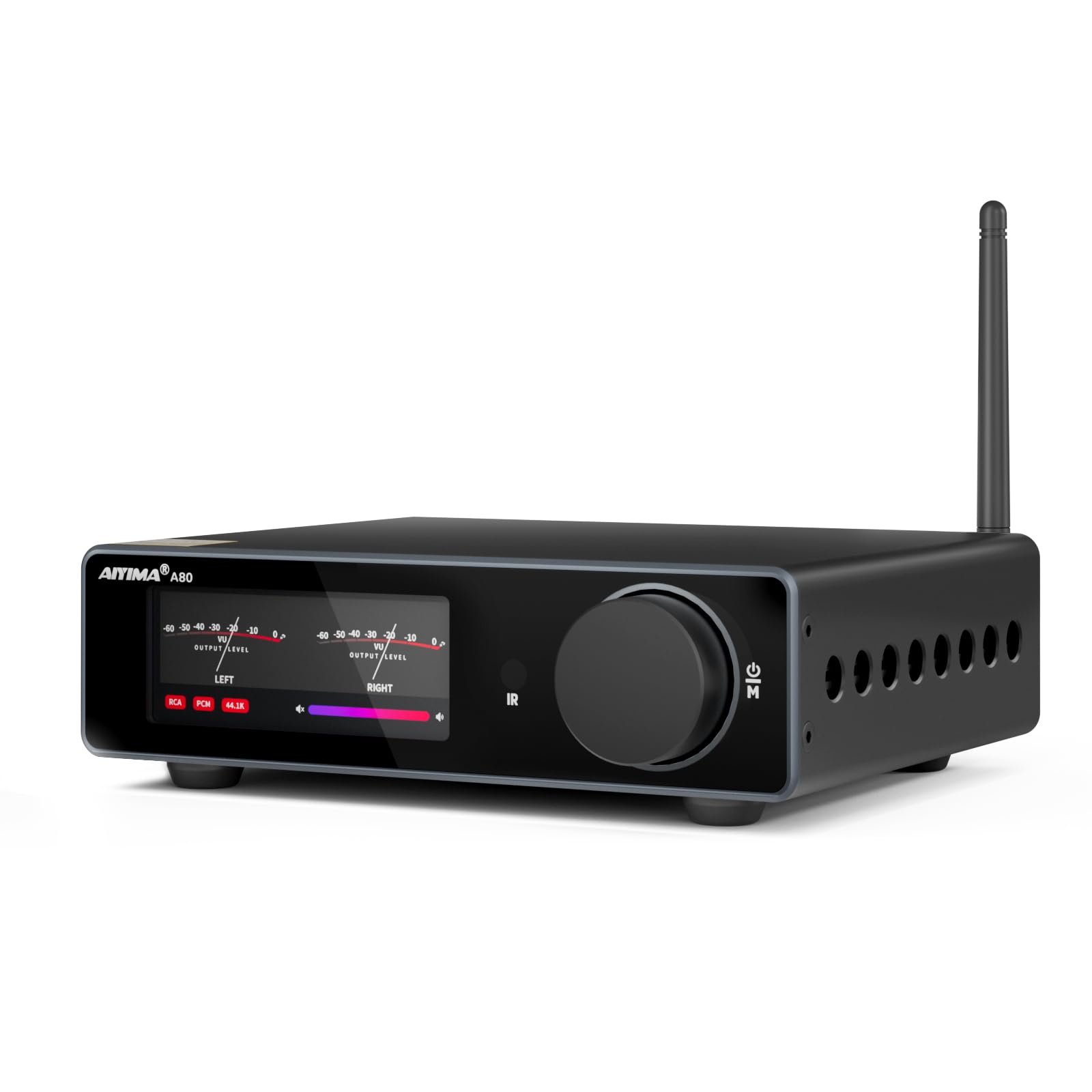
The AIYIMA A80 is a compact Class D amplifier that packs serious digital audio capability into a chassis that barely covers a hand. At its core is the ES9038Q2M DAC chip, a popular choice in the audiophile community for its low distortion and high dynamic range, paired with the TPA3255 amplifier chipset. The combination supports PCM up to 32-bit/768kHz and DSD512, making it future-proof for high-resolution music files. The digital VU meter on the front panel offers several display modes including a spectrum analyzer that dances to the music.
Input selection is generous for a unit this size: Bluetooth 5.0, USB, optical, coaxial, and TRS balanced inputs cover nearly every source scenario. The 48V GaN power adapter drives the amplifier to a rated 300 watts per channel (peak), though real-world continuous output into 8 ohms is lower. In practice, it drives moderately sensitive bookshelf speakers to satisfying room-filling levels without audible distortion. The PFFB (Post Filter Feedback) technology helps maintain consistent frequency response across different speaker loads.
The unit runs warm even at moderate volumes, and the GaN power adapter can get hot. The glass top panel that exposes the socketed op-amps is a nice touch for tinkerers, but it can become loose over time. The bass and treble tone controls with center detent are useful for tuning room acoustics. For a desktop system or small room setup where a separate DAC is not desirable, the A80 delivers remarkable value.
Why it’s great
- High-performance ES9038Q2M DAC with DSD512 support
- Multiple inputs including TRS balanced and USB
- Customizable VU meter display adds visual feedback
Good to know
- Real-world continuous power lower than peak rating
- Runs warm; GaN adapter can get hot
6. YAMAHA R-S202BL

The YAMAHA R-S202BL is a straightforward stereo receiver that prioritizes simplicity and reliability. Rated at 100 watts per channel into 8 ohms, it offers enough headroom to drive most passive speakers to high volumes without strain. The built-in AM/FM tuner with 40 station presets is a rare feature in modern amplifiers, catering to users who still enjoy terrestrial radio. Bluetooth 4.1 with EDR is included for streaming from smartphones, though it does not support high-resolution codecs like aptX or LDAC.
Sound quality is clean and neutral, with a slight emphasis on clarity in the upper frequencies. The amplifier handles dynamic peaks well for its price bracket, though the soundstage is not as wide as more refined designs. The brushed aluminum front panel gives a premium feel despite the budget positioning. The speaker selector switch allows connection of two separate speaker pairs, useful for multi-room setups controlled from a single source.
The lack of any digital inputs (optical, coaxial, HDMI) limits connectivity to analog RCA sources and Bluetooth. There is no subwoofer pre-out, so adding a powered sub requires speaker-level connection. The volume control uses a 0-99 digital display that only becomes audible above the mid-40s, which can feel sluggish. For a simple, no-fuss receiver to drive a pair of speakers in a living room or garage system, the R-S202BL is a reliable workhorse.
Why it’s great
- 100W per channel provides ample power for large rooms
- AM/FM tuner with 40 presets for radio listeners
- Two-speaker pair switching for multi-room setups
Good to know
- No optical, coaxial, or HDMI inputs
- No subwoofer pre-out for 2.1 systems
7. Fosi Audio MC351

The Fosi Audio MC351 is a 2.1 channel integrated amplifier built around two TPA3255 Class D chips, one for each stereo channel plus a dedicated subwoofer channel. The rated 165 watts per channel for the mains and 350 watts for the sub channel (peak) are generous on paper, though real-world continuous output into 8 ohms is lower. The round mini VU meter on the front adds a retro aesthetic that will appeal to those building a vintage-styled compact system. The aluminum chassis is CNC-machined with a sandblasted matte finish that feels more expensive than the price suggests.
The amplifier supports Bluetooth, USB, optical, and coaxial digital inputs in addition to analog RCA, making it versatile for TV, computer, and turntable setups. The bass and treble controls have a center detent that allows tone defeating when centered. In near-field listening, the amp delivers crisp highs and punchy lows with acceptable clarity at moderate volumes. The dual PCBA separated design helps reduce electrical interference between the input and output stages.
As volume increases, the MC351 can sound congested and the bass loses definition, particularly with complex musical passages. The VU meter needle movement is decorative rather than accurately calibrated. Bluetooth audio quality drops noticeably compared to wired connections. For a budget-conscious 2.1 system in a small room or office, this amp offers a solid feature set, but it is not designed for high-volume, high-fidelity listening sessions.
Why it’s great
- Dedicated subwoofer channel with 350W peak rating
- CNC aluminum chassis with premium matte finish
- Multiple digital inputs including USB and optical
Good to know
- Sound quality degrades at high volume levels
- VU meter is decorative, not accurately calibrated
8. AMPAPA D1
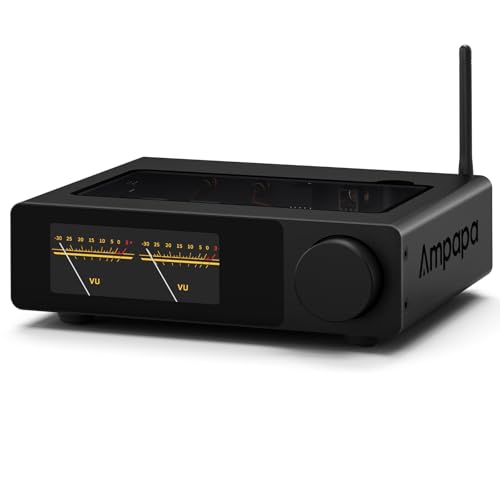
The AMPAPA D1 is a collaboration between Ampapa and Douk Audio, essentially an evolution of the well-regarded Douk Audio A5. The TPA3255 chipset is paired with a 48V GaN power supply to deliver 300 watts per channel peak, translating to roughly 80 clean watts per channel into 8 ohms in real-world use. The standout feature is the OLED digital VU meter with seven display styles in yellow, blue, or black color themes. The front glass panel provides access to the socketed NE5532 op-amps for users who enjoy rolling operational amplifiers for different sound signatures.
The D1 includes a TRS balanced input, a rarity at this price point, alongside standard RCA inputs and Bluetooth 5.2. The adjustable high-pass filter (30–200Hz) removes low frequencies from the main speaker output, allowing the use of smaller bookshelf speakers without distortion while a subwoofer handles the bass through the pre-out. The PFFB technology maintains a flat frequency response regardless of load impedance changes. Listening to Sony CSS 3-way speakers, the D1 produces clean and dynamic sound with good instrument separation.
The non-defeatable auto standby feature kicks in after five minutes of inactivity, which can be annoying during quiet passages. The glass top panel can fall out if the unit is moved quickly. The real-world wattage is lower than the marketing peak numbers, but the performance is still impressive for the size. For a desktop 2.1 setup where balanced inputs and adjustable HPF matter, the D1 is a clever choice.
Why it’s great
- TRS balanced input for professional audio sources
- Adjustable HPF from 30–200Hz for 2.1 setups
- Socketed op-amps for easy sound customization
Good to know
- Auto standby is not defeatable
- Glass top panel can come loose during transport
9. REISONG A10
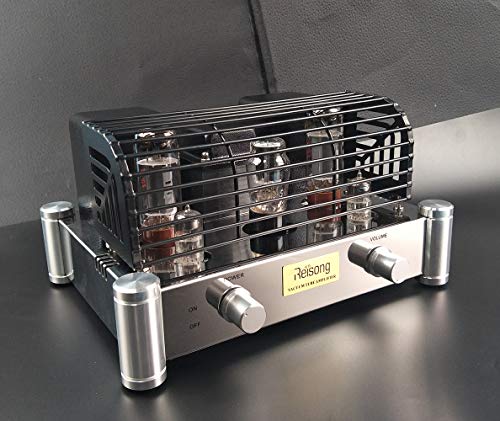
The REISONG A10 is a pure single-ended Class A tube amplifier that delivers 12 watts per channel into 8 ohms. This is not a mistake — it is a deliberate design choice for users with high-efficiency speakers (89dB or higher) who want the lush, three-dimensional presentation that only Class A operation can provide. The amplifier uses two EL34 output tubes, two 6N2J input tubes, and a 5Z4PJ rectifier tube, all visible through a protective cage. The chassis is finished in stainless steel and aluminum with hand-wired point-to-point construction that appeals to DIY-oriented audiophiles.
The sound character is warm and spacious with a midrange that makes voices and acoustic instruments feel present in the room. The high-frequency extension is relaxed rather than etched, making it forgiving of poor recordings. Tube rolling is straightforward: swapping the EL34s and input tubes can shift the tonal balance significantly. Users report excellent results with Gold Lion KT77 tubes and 12AX7 adapted tubes. The amplifier runs extremely hot as expected from a Class A design, requiring generous ventilation.
The power output limits speaker pairing strictly to high-sensitivity bookshelf models. Paired with Klipsch RP-600M speakers (93dB sensitivity), the A10 provides satisfying volume levels in a small to medium room. With low-sensitivity speakers, it will run out of headroom quickly. The build quality is good for the price, though some units have experienced reliability issues over extended use. For the enthusiast who values tube harmonics over wattage, the A10 offers an authentic single-ended experience.
Why it’s great
- Pure single-ended Class A circuit for authentic tube sound
- Point-to-point hand-wired construction for easy modding
- Warm, spacious soundstage ideal for acoustic music
Good to know
- Only 12W per channel requires high-sensitivity speakers
- Runs very hot and needs ventilation space
FAQ
What speaker sensitivity do I need for the REISONG A10?
Can I connect a turntable directly to the Denon PMA-600NE?
What is the advantage of HDMI ARC in an amplifier?
Why does the YAMAHA R-S202BL not have a subwoofer output?
Is the AIYIMA A80 suitable for low-sensitivity speakers like the KEF Q150?
Final Thoughts: The Verdict
For most users, the best audio amplifier winner is the Denon PMA-600NE because its combination of analog purity, digital inputs, phono stage, and robust power supply makes it a versatile anchor for any music or home theater system. If you want a compact streaming solution that integrates perfectly with a TV and multiroom audio, grab the WiiM Amp. And for pure tube warmth with high-efficiency bookshelf speakers, nothing beats the character of the Dayton Audio HTA200.