
Our readers keep the lights on and the weekend projects moving. As an Amazon Associate, I earn from qualifying purchases.
An 18350 battery is the compact powerhouse behind high-output flashlights and portable vaporizers, but its shorter runtime means you handle chargers and spares almost daily. Picking the wrong gear here can mean slow top-ups, safety risks, or a battery that won’t fit your device. This guide cuts through the compatibility noise to find the hardware that keeps your 18350 cells topped off and your gear running.
I’m Rikta — the co-founder and writer behind FitlyFast. I’ve spent hundreds of hours analyzing battery chemistry, charger circuit safety, and real-world user feedback to find the chargers and storage solutions that actually work for 18350 users.
Whether you need a travel-friendly single-slot unit, a multi-bay LCD monitor, or a rugged case for field carry, this breakdown of the best 18350 battery charging ecosystem will help you choose with confidence.
How To Choose The Best 18350 Battery Charger or Case
An 18350 cell is physically smaller than the common 18650, so not every universal charger handles the shorter length reliably. You need hardware that provides proper contact, safe charging rates, and protection against over-current or reverse polarity. Here are the key factors to evaluate.
Charge Current and Safety
An 18350 typically has a capacity between 700mAh and 1200mAh. A charge rate of 500mA to 1000mA is ideal — too high a current can stress the small cell and shorten its lifespan. Look for chargers that offer adjustable current or a fixed rate within that safe band. Safety protections like over-charge, short-circuit, and reverse polarity detection are non-negotiable with lithium-ion chemistry.
Compatibility and Fit
Not all battery slots are equal. The spring-loaded negative terminal must compress enough to grip a short 18350 while still accepting longer cells. Check the charger’s official compatibility list for 18350 and 16340 (RCR123) sizes. A charger that rattles or requires forceful insertion can damage the battery wrapper or the charger contacts over time.
Display and Intelligence
An LCD screen showing real-time voltage, charge current, and battery percentage is a major convenience for users who want to monitor cell health. Intelligent auto-detection of battery chemistry (Li-ion vs. NiMH) saves time and prevents incorrect charging. Manual mode selectors give you control if the auto-detection fails on a specific cell.
Quick Comparison
On smaller screens, swipe sideways to see the full table.
| Model | Category | Best For | Key Spec | Amazon |
|---|---|---|---|---|
| Nitecore D2 | Premium Charger | Comprehensive multi-chemistry charging at home | Auto-detect Li-ion/NiMH; 2 independent slots | Amazon |
| Thyrm CellVault-18 | Premium Case | Rugged field storage for 2x 18350 | IPX7 waterproof; holds 2x 18350 | Amazon |
| Tenergy TN471U | Mid-Range Charger | Smart LCD charging at a mid-range price | 1000mA charge current; LCD display | Amazon |
| Swanlake 2-Slot | Mid-Range Charger | Adjustable current and detailed LCD data | Variable 0.5A/1A/2A charge current | Amazon |
| Guard Dog Security | Budget Charger | Simple USB-C single-slot backup | USB-C input; 4.2V 0.6A output | Amazon |
| EBL Universal | Budget Charger | Budget dual-slot LCD without complexity | 1000mA charge current; LCD display | Amazon |
| Nitecore UI1 | Budget Charger | Ultra-compact travel single-slot charger | 800mA max; micro-USB input | Amazon |
In‑Depth Reviews
1. Nitecore D2 Smart Charger

The Nitecore D2 is a long-standing favorite among flashlight enthusiasts, and for good reason. It automatically detects battery chemistry — Li-ion, IMR, LiFePO4, or NiMH — and selects the correct charge mode without any guesswork. Its two independent slots charge an 18350 and a 26650 at the same time without cross-interference.
The LCD backlit display shows real-time voltage, charge current, and elapsed time, giving you full visibility into cell health. Included AC and 12V DC power cords mean you can charge at home or in the car, and the unit is compact enough for a go-bag. Charging is deliberate — around 500mA per slot — which keeps small 18350 cells cool during top-ups.
Long-term reliability is the D2’s strongest suit; users report years of daily use without failure. The trade-off is slower charge speeds compared to newer high-current chargers, but the gentle rate is actually safer for smaller batteries. If you want a charger that treats every 18350 cell with care and gives you data to monitor it, this is a top-tier choice.
Why it’s great
- Auto-detects Li-ion, NiMH, and LiFePO4 chemistry
- Independent slots with per-cell monitoring
- Includes both AC and 12V car power cords
- Proven long-term durability over many years
Good to know
- Charge rate is slower (500mA) than some newer chargers
- Buttons and screen are basic compared to premium models
2. Thyrm CellVault-18

The Thyrm CellVault-18 is not a charger — it’s a rugged, waterproof storage case for your 18350 batteries. When you’re carrying spare cells for a tactical flashlight or optic, you need protection from impact, moisture, and accidental short circuits. This case delivers that with an IPX7 rating, meaning it survives submersion to 2 meters for 30 minutes.
It holds one 18650, two 18350s, or two CR123s, held securely by a non-conductive silicone foam shock absorber that reduces rattle and noise. The folding latch attaches to MOLLE webbing, backpack straps, or a belt, and the clear polycarbonate windows let you verify contents without opening. The slim profile takes up less than one MOLLE column width.
The trade-off is that this is a storage-only solution — you still need a separate charger. But for anyone who carries spare 18350s in the field, the CellVault-18 eliminates the risk of crushed wrappers or dead cells from moisture exposure. It’s overbuilt for civilian use, but that’s exactly the point if your gear sees hard use.
Why it’s great
- IPX7 waterproof and crushproof construction
- Holds 2x 18350 securely with silicone foam
- MOLLE-compatible folding latch for gear carry
- Clear windows for visual battery check
Good to know
- Storage only — does not charge batteries
- Premium price for a case over a charger
3. Tenergy TN471U 2-Bay LCD Charger

The Tenergy TN471U brings a crisp LCD screen and a 1000mA charge rate to the mid-range price segment. It auto-detects Li-ion, IMR, LiFePO4, and NiMH chemistries, so you can drop in an 18350 without worrying about setting the correct voltage. The display shows charge time, voltage, and progress, which helps you spot a degrading cell before it fails.
Charging an 18350 at 1000mA is fast enough for a same-day turnaround without being aggressive. The USB-powered design means you can run it from a laptop, car adapter, or power bank, making it genuinely portable. Tenergy backs it with a one-year warranty and lifetime support from a US-based service team.
A few users note that the micro-USB port can feel delicate, so careful cable insertion is advised. The charger also tends to output a slightly warm charge current, which is normal but worth monitoring. For the balance of features, data visibility, and price, this is a strong contender for everyday bench use.
Why it’s great
- Auto-detects multiple lithium and NiMH chemistries
- LCD shows voltage, time, and charge progress
- Fast 1000mA charge speed for 18350 cells
- USB-powered for portable/vehicle use
Good to know
- Micro-USB port reported as delicate by some users
- Charger can run warm during operation
4. Swanlake 2-Slot LCD Charger
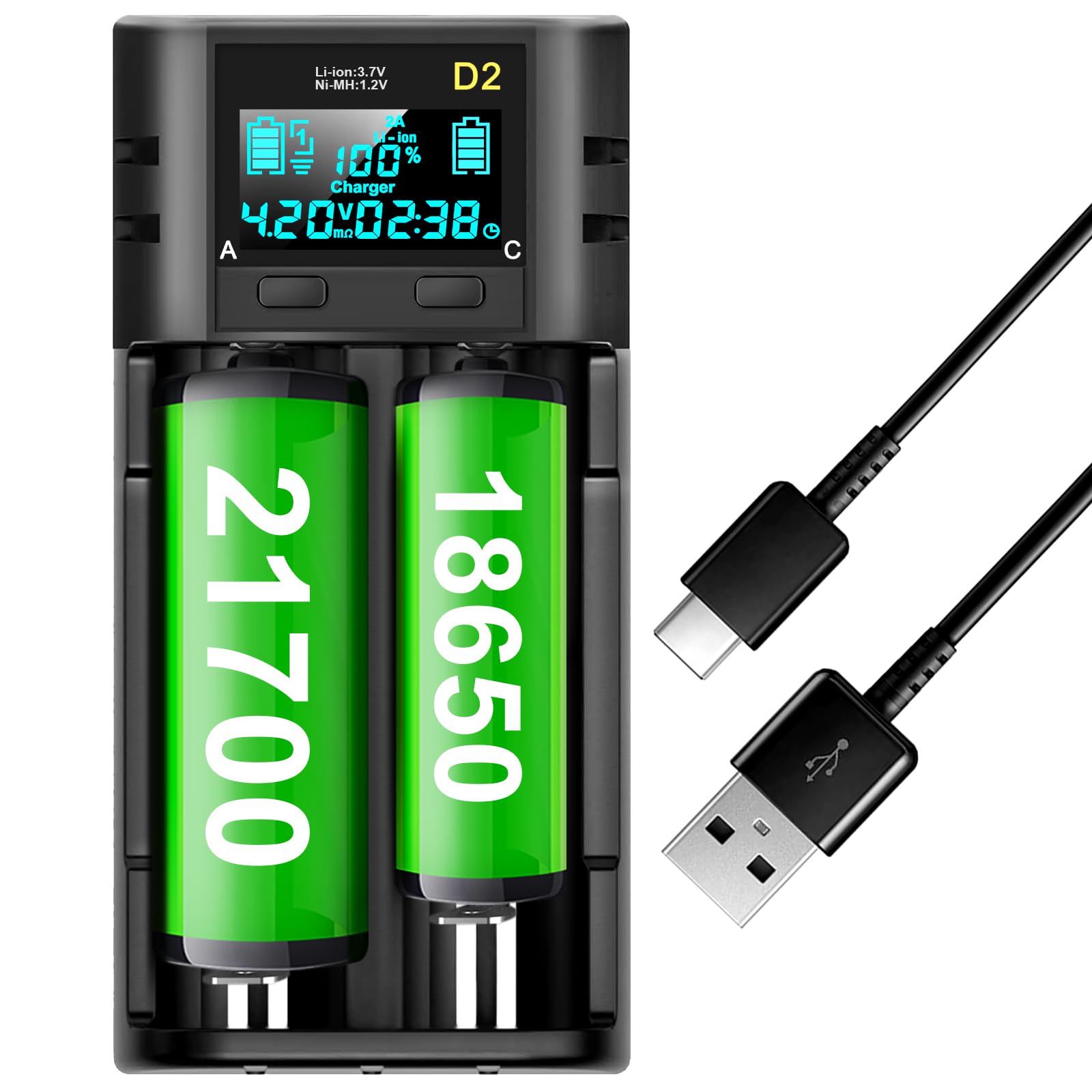
The Swanlake 2-Slot charger sets itself apart with user-selectable charge currents of 0.5A, 1A, or 2A. For a small 18350 cell, dropping to 0.5A is the safest option for long-term health, while 1A works for quicker top-ups when you’re in a hurry. This flexibility is rare in this price range and makes the unit suitable for both small-format and large-format lithium cells.
The large LCD display packs a lot of data: voltage, current, charge time, battery type, and percentage. Each slot operates independently, so you can charge an 18350 at 0.5A in one bay and a 21700 at 2A in the other. The housing uses PC+ABS material, which is heat-resistant and adds a layer of safety over basic plastic shells.
The charger requires a wall wart with a NEMA 1-15P plug; a USB cable alone won’t power it in most cars. Some users also mention that voltage and capacity readings can be approximate rather than laboratory-precise. Still, the combination of adjustable current and rich display data makes this a versatile tool for anyone managing multiple lithium cell sizes.
Why it’s great
- Adjustable current (0.5A/1A/2A) for different cell sizes
- Detailed LCD showing voltage, current, and battery type
- Independent slots for simultaneous charging
- Heat-resistant PC+ABS shell
Good to know
- Requires a wall adapter — not USB-powered
- Voltage/capacity readings may be approximate
5. Guard Dog Security Single-Slot Charger
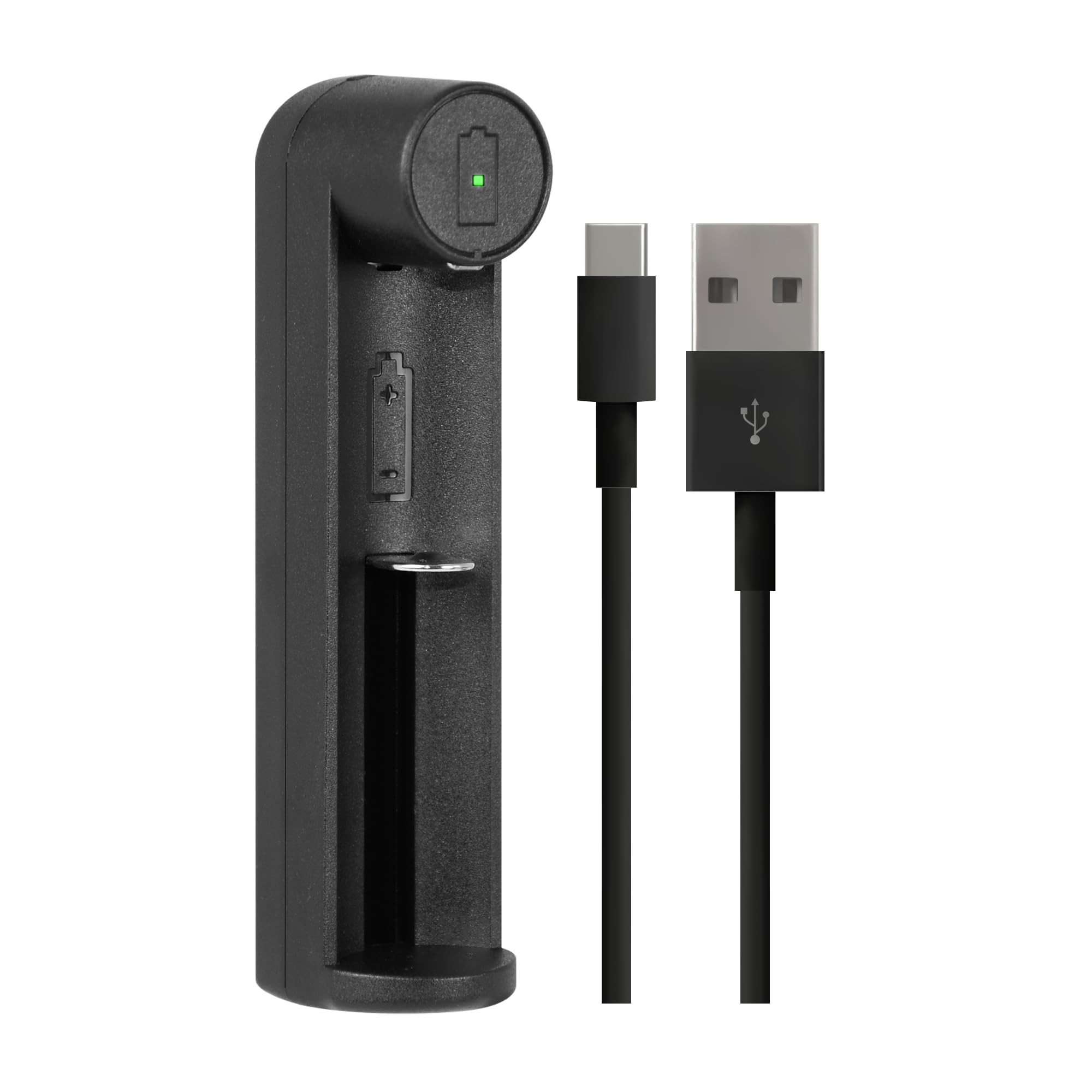
The Guard Dog Security charger is a bare-bones single-slot unit that prioritizes simplicity and USB-C convenience. With a 5V/2A input and a 4.2V/0.6A output, it charges an 18350 at a safe, low current that avoids overheating the small cell. The LED indicator glows red while charging and turns green when done — no display, no fuss.
Its compatibility list is wide, covering everything from 14500 to 26700, and the USB-C input means you can use the same cable as your phone for charging on the go. The compact dimensions (4 x 1 x 0.9 inches) make it easy to slip into a pocket or backpack pouch.
The spring-loaded battery holder is where corners were cut. Users report that the spring can pop the battery out if it’s not seated perfectly, and the output is slower than some alternatives. This charger works reliably once you get the cell positioned, but it lacks the polish of more expensive units. It’s an adequate emergency backup or travel charger for a single 18350 user.
Why it’s great
- USB-C input for modern cable compatibility
- Very compact and pocket-friendly
- Safe 0.6A charge rate for 18350 cells
- Wide battery size compatibility
Good to know
- Spring-loaded slot can launch the battery if not seated perfectly
- Slow charge speed compared to LCD models
6. EBL Universal 18650 Charger
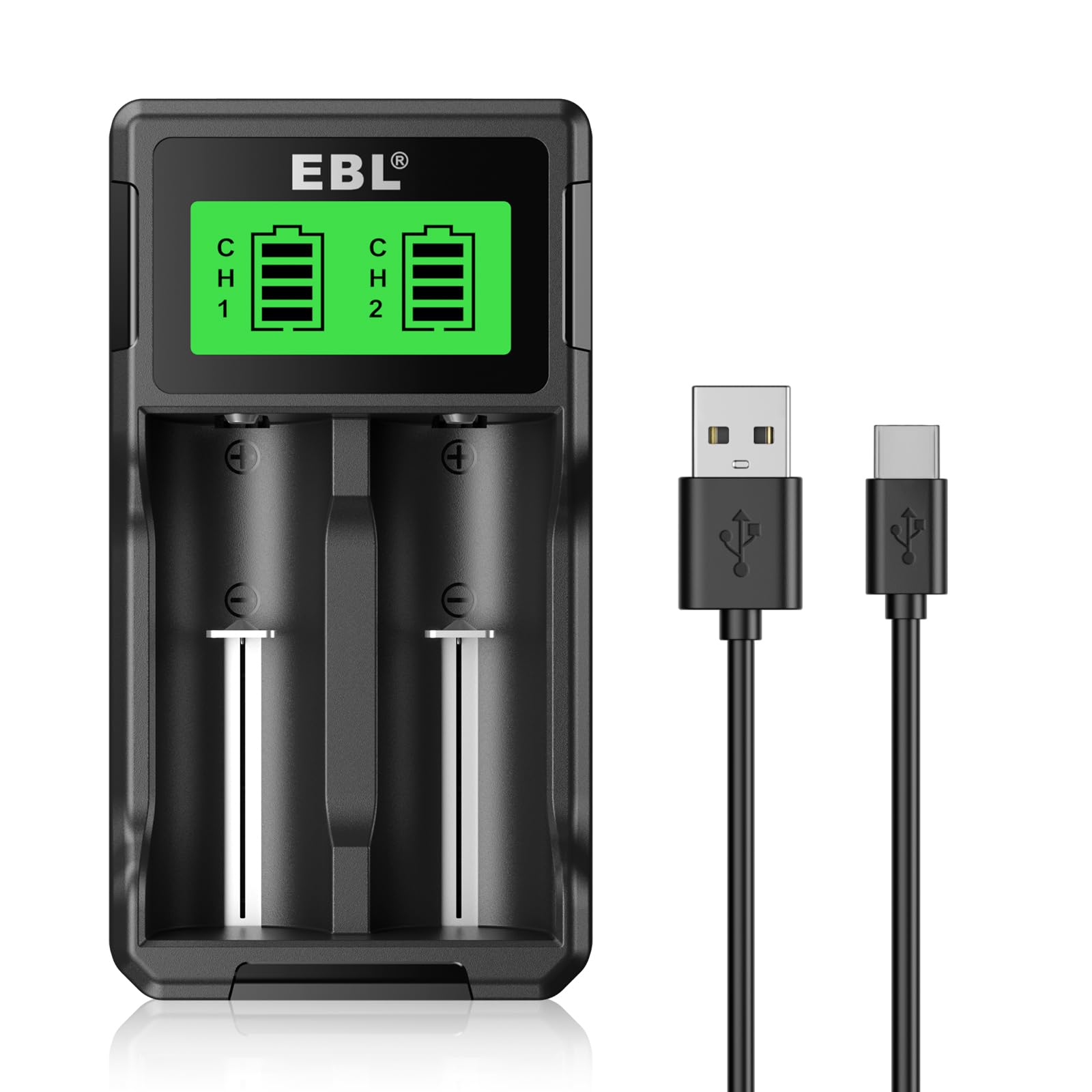
EBL’s universal charger offers two slots and a simple LCD screen at a budget-friendly price point. It charges 18350, 18650, and other 3.7V lithium cells at up to 1000mA, and also handles NiMH/Ni-CD sizes like AA and AAA at a lower 400mA rate. The LCD shows basic charge status information, which is more than many entry-level chargers provide.
The micro-USB input allows charging from standard power adapters, power banks, or car chargers. The unit is compact enough to fit in a console or backpack, and the included safety protections (over-voltage, short-circuit, and over-charge) meet RoHS, UL, and CE standards.
Some users note that the display doesn’t show real-time voltage or capacity data — it’s more of a progress bar than a diagnostic tool. The charger also lacks manual current adjustment, so the 1000mA rate is fixed, which is on the higher side for an 18350 cell. For casual users who want a cheap, dual-slot charger without complex controls, this gets the job done.
Why it’s great
- Affordable dual-slot design for lithium and NiMH cells
- 1000mA charge speed for decent turnaround
- Compact and travel-friendly with micro-USB power
- UL and CE safety certifications
Good to know
- No manual current adjustment — fixed 1000mA rate
- LCD shows progress, not detailed voltage or capacity
7. Nitecore UI1 Single-Slot Charger

The Nitecore UI1 is an ultra-compact single-slot charger designed for travelers who need to top off one cell at a time. It pushes up to 800mA to a single 18350 or 18650, which is a good balance of speed and safety for the small form factor. The unit itself weighs just 1.43 ounces and is less than 5 inches long.
Intelligent charging mode selection automatically picks the optimal current for the inserted battery, and the included battery/cable case keeps everything organized in your bag. The micro-USB input works with solar panels, wall adapters, and power banks, making it incredibly flexible for outdoor or emergency use.
With only one slot, this isn’t a charger for heavy users who rotate multiple cells. The 800mA rate is fast enough but not adjustable. However, for a minimalist who carries a single backup 18350 and wants the smallest possible charging solution, the UI1 is hard to beat. It’s a purpose-built travel companion, not a bench charger.
Why it’s great
- Extremely compact and lightweight for travel
- 800mA charge current is safe for 18350 cells
- Intelligent auto-selection of charge mode
- Includes storage case for charger and cable
Good to know
- Single slot only — not for multi-battery users
- Micro-USB input (no USB-C)
- No LCD display for monitoring
FAQ
Can I charge an 18350 in a standard 18650 charger?
What is the safest charge current for a 700mAh 18350?
What does the LCD display on a battery charger actually tell me?
Final Thoughts: The Verdict
For most users, the best 18350 battery charging ecosystem starts with the Nitecore D2 because its auto-detection, independent slots, and long-term reliability make it a set-and-forget workhorse. If you need rugged field storage for spare cells, grab the Thyrm CellVault-18. And for a budget-friendly dual-slot charger with an LCD, the Tenergy TN471U delivers the best blend of data visibility and price.