
Our readers keep the lights on and the weekend projects moving. As an Amazon Associate, I earn from qualifying purchases.
An untreated crack in your asphalt driveway is an open invitation for water to seep beneath the surface, accelerate freeze-thaw damage, and transform a simple hairline split into a costly crumbled section. The sealant you choose must bond aggressively, flex with seasonal ground movement, and block moisture without cracking off itself.
I’m Rikta — the co-founder and writer behind FitlyFast. I have spent years analyzing pavement repair formulations, comparing polymer and emulsion technologies, and reading thousands of verified buyer reports to separate products that deliver a lasting seal from those that wash away after one rain.
This guide evaluates the top formulas on the market, from self-leveling gels to heavy-duty emulsion and permanent cold-patch systems, to help you find the absolute best asphalt crack sealer for your specific driveway conditions and budget.
How To Choose The Best Asphalt Crack Sealer
Choosing the right sealer is not about picking a can off a shelf — it is about matching the sealant’s chemical family and physical properties to the width, depth, and location of your cracks. A one-size-fits-all approach leads to adhesion failure within a single winter cycle.
Sealant Chemistries: Emulsion vs. Urethane vs. Polymer vs. Cold Patch
Emulsion-based sealers (rubber- or polymer-modified) are the standard for hairline to medium cracks in residential driveways — they flow deep, self-level, and remain flexible. Urethane-boosted formulas add a harder, more durable finish that resists traffic tracking. Cementitious polymer sealants (silane-terminated) bond aggressively to concrete and masonry edges but cure with less flexibility. For potholes and deep divots, a permanent cold patch like Aquaphalt’s hybrid resin system provides structural fill without the need for hot-mix equipment.
Flexibility and Elastomeric Recovery
The single biggest predictor of long-term performance in variable climates is the sealer’s ability to stretch and contract with the asphalt as temperatures swing from freezing to scorching. Look for products described as “elastomeric” or those that list a high elongation percentage. A rigid sealer will shear away from the crack walls after the first hard frost, while a flexible formulation maintains a watertight bond through dozens of expansion-contraction cycles.
Cure Time and Traffic Windows
Fast-dry products that allow foot traffic in 60 minutes and vehicle traffic in 24 hours are ideal for driveways and paths that cannot stay blocked. Slower-curing emulsions (24-48 hour tack-free) often penetrate deeper and form a stronger initial bond on wider cracks. If rain is in the forecast, a quick-cure formulation is essential to prevent washout before the seal sets.
Quick Comparison
On smaller screens, swipe sideways to see the full table.
| Model | Category | Best For | Key Spec | Amazon |
|---|---|---|---|---|
| Black Jack Drive-Maxx 1000 | Urethane Gel | Heavy vehicle traffic | Urethane boosted, foot traffic in 60 min | Amazon |
| Henry Driveway Elastomeric | EPDM Emulsion | Freeze-thaw climates | Ethylene propylene diene monomer rubber | Amazon |
| Jetcoat Premium Elastomeric | Polymer Emulsion | Large surface coverage | Plasticizer-fortified, 1 gallon pot | Amazon |
| Aquaphalt 6.0 Permanent Repair | Cold Patch | Potholes and deep craters | 3-year warranty, open immediately | Amazon |
| E-SDS Self-Leveling Crack Filler | Silane Polymer | Concrete-to-asphalt transitions | Silane-terminated, 3-pack | Amazon |
| Magic Crack Filler | Granular Powder | Narrow hairline cracks | 22.4 oz, pour-and-spray application | Amazon |
| MuzeFansi Asphalt Crack Filler | Cement Gel | Small budget repairs | 2-pack, gel form, 2.2 lb total | Amazon |
In‑Depth Reviews
1. Black Jack Drive-Maxx 1000
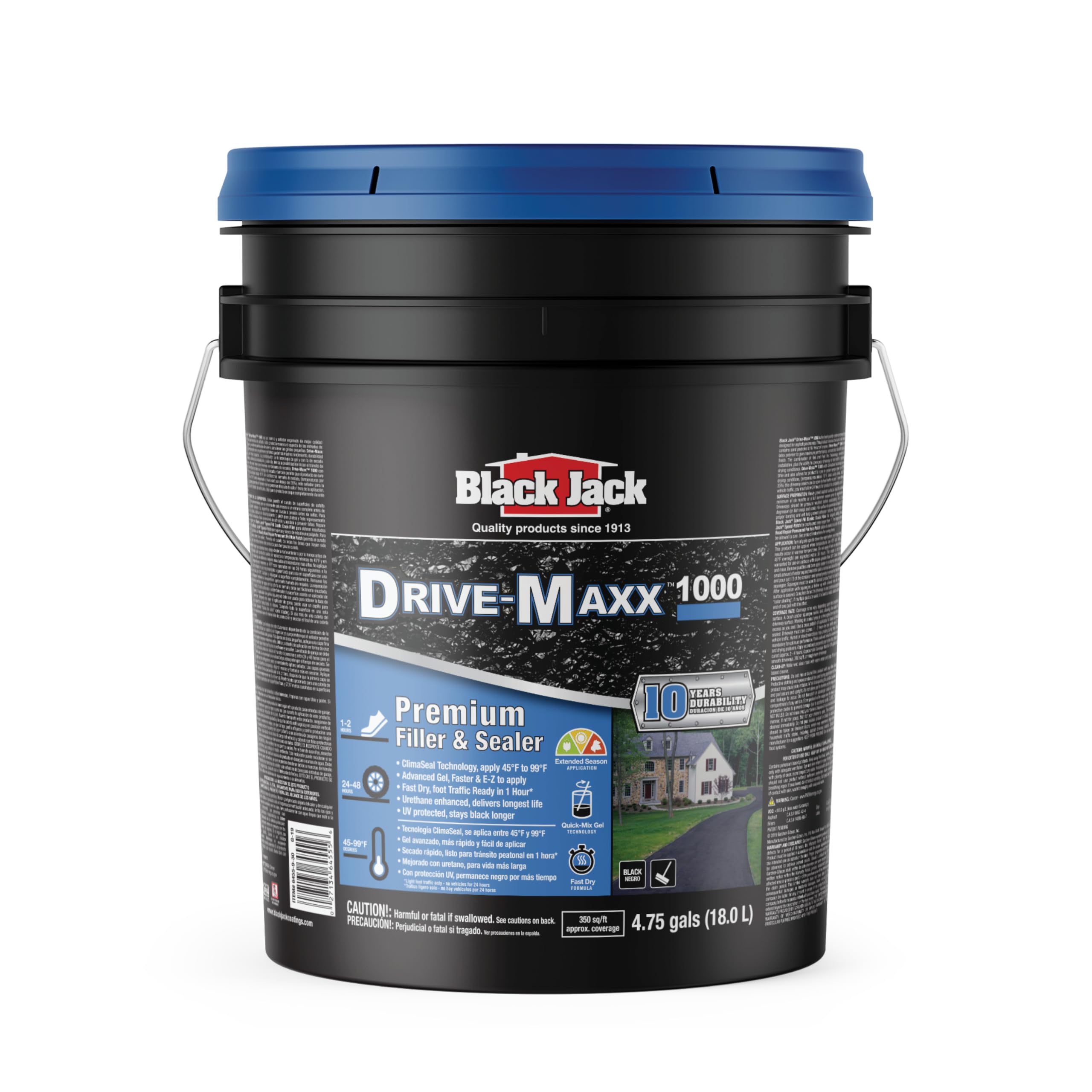
The Black Jack Drive-Maxx 1000 is a urethane-boosted gel that delivers the best balance of application ease, durability under heavy vehicles, and rapid return-to-service in the entire category. Its advanced gel formulation flows evenly into cracks without dripping excessively, and it cures to a tough, flexible seal that resists tracking even in hot weather. The 55-pound pail provides enough material to cover a standard two-car driveway with cracks of varying widths, making it a true value purchase for homeowners who want a single solution.
Field reports consistently highlight how well this product holds up to tractor, truck, and daily car traffic after a proper 24-48 hour cure. The 60-minute foot traffic window is a genuine advantage when you need to seal cracks in a high-use area over a weekend. Users also note the rich black color blends seamlessly into aged asphalt, avoiding the patchy grey look that some cementitious fillers leave behind. The advanced gel consistency means it stays in place on vertical crack walls without slumping.
The main consideration is that the pail is heavy at 55 pounds, and you need to turn it upside down 24 hours before opening to re-liquefy the material — a step that is easy to forget. Some users report the material is thicker than expected, requiring a strong stirring technique, but the superior finish and coverage density justify the extra effort.
Why it’s great
- Urethane boost provides exceptional durability against heavy vehicles
- Foot traffic ready in 60 minutes, vehicle-ready in 24 hours
- Thick gel resists tracking and stays black
Good to know
- Heavy pail requires pre-use inversion to re-liquefy
- Thicker consistency may need stronger mixing effort
2. Henry Driveway Elastomeric Emulsion Crack Filler

Henry’s formula is built around ethylene propylene diene monomer (EPDM) rubber — the same material used in roofing membranes — giving it exceptional cold-weather flexibility and resistance to thermal cycling. In regions where the ground freezes and thaws repeatedly through winter, this sealer stretches with the pavement instead of shearing off, slowing crack propagation significantly. Users in northeastern climates report that annual reapplication to new cracks keeps the driveway sealed without the need for expensive milling.
The application method is straightforward: pour the thin emulsion from the container into cracks using a cup or brush, and it dries to a flat black finish in roughly 10 minutes. The low viscosity allows deep penetration into narrow fissures, filling voids that thicker gels cannot reach. Many contractors choose this product for its ability to bond even on slightly damp surfaces (not standing water) and its rapid skin-over time that prevents rain from washing out the uncured sealer.
On the downside, the thin liquid consistency can require multiple applications for deeper cracks — users often need to return in summer to top off areas where the material settled. The container, at 8 pounds, is lightweight but the open bucket design makes it easy to spill during transport. Humidity also significantly extends drying time, so plan for a stretch of dry weather before applying.
Why it’s great
- EPDM rubber formulation handles freeze-thaw cycles exceptionally well
- Dries to a flat black finish in about 10 minutes
- Low viscosity penetrates deep into narrow cracks
Good to know
- Deep cracks may need multiple applications over the season
- Thin liquid can be messy if poured too quickly
3. Jetcoat Premium Elastomeric Asphalt Crack Filler

Jetcoat’s one-gallon emulsion is polymer-modified and fortified with plasticizers to provide a self-healing quality — the sealer can reseal minor separations in warmer weather without reapplication. For homeowners managing a long driveway with a dozen or more cracks, the large volume makes this an economical choice that avoids the per-unit cost of smaller tubes. The ready-to-use formula requires only stirring to a uniform consistency and pouring from the included spout.
The sealer is designed for use on all blacktop surfaces including driveways, parking lots, athletic courts, and playgrounds. Users frequently mention that professional contractors charge thousands for the same work, while a motivated homeowner can achieve comparable results with careful application over a weekend. The elastomeric properties mean the material can stretch with ground movement rather than cracking, and the fast-drying characteristics allow a second coat within 24 hours for deeper fissures.
The one-gallon jug is a bit cumbersome to handle when pouring into long, thin cracks, and the plasticizer additives do not fully prevent separation in severe freeze-thaw regions — some users in cold climates report that cracks reopen in the coldest weeks of winter, though the self-healing claim works well in temperate zones. The product also settles noticeably in storage, so vigorous stirring throughout the application is mandatory.
Why it’s great
- Large gallon volume covers extensive crack networks economically
- Plasticizer fortification promotes self-healing in warm weather
- Fast drying allows second coat within 24 hours
Good to know
- Large jug is awkward for precise crack pouring
- Not ideal for extreme freeze-thaw zones without annual touch-ups
4. Aquaphalt 6.0 Permanent Asphalt Repair

Aquaphalt 6.0 is not a crack filler in the traditional sense — it is a permanent cold-patch system backed by a 3-year warranty that fills potholes, deep divots, and crumbling edges with a material that sets with water and opens to traffic immediately. The formula contains no volatile organic compounds (VOCs), making it environmentally friendly and odorless during application. For homeowners dealing with areas where the asphalt has completely failed rather than just cracked, this is the only structural solution in this guide.
Application is refreshingly simple: shovel or pour the material into the void, spread it level, tamp it down, and apply water. The product cures through a chemical reaction with water, not by drying, so it hardens even in wet conditions and forms a durable surface that bonds to the edges of the hole. Users report that after 24 hours the repair is solid enough to handle daily car and truck traffic without shifting or cracking, and after a week it becomes nearly indistinguishable from the surrounding pavement.
The trade-off is price per square foot of repair — Aquaphalt is significantly more expensive than emulsion-based crack fillers, so it is only economical for structural repairs rather than routine crack maintenance. The 51-pound bucket is heavy and awkward to handle, and for very deep holes (over 3 inches) you may need multiple buckets to build up the fill layer. It is also worth noting that the material is softer than hot-mix asphalt immediately after application, so avoid sharp turning on the fresh patch for the first few hours.
Why it’s great
- Permanent structural repair with a 3-year warranty
- Traffic ready immediately — no waiting
- No VOCs, odorless, cures with water
Good to know
- Premium cost per repair — not for small cracks
- Heavy bucket and requires tamping for proper compaction
5. E-SDS Self-Leveling Crack Filler
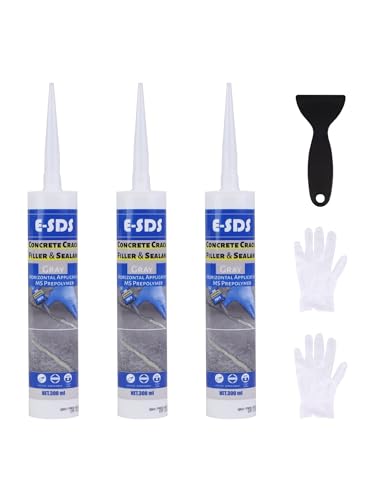
The E-SDS formulation uses a silane-terminated polymer (STP) chemistry that bonds aggressively to concrete, brick, stucco, and asphalt alike — making it ideal for transition cracks where asphalt meets a concrete garage floor or pool deck. The self-leveling behavior means you simply cut the nozzle, apply with a caulking gun, and the paste flows into the void without needing to be smoothed. It cures quickly within 24–48 hours into a waterproof, flexible seal that resists UV and temperature swings.
Users consistently praise the easy application and rapid cure time, noting that the dark grey color blends acceptably into both concrete and blacktop. The 3-pack provides enough material for multiple projects, and the STP chemistry means the sealant remains rubbery and flexible rather than becoming brittle over time. This product is particularly effective on narrow cracks (up to 1/4 inch wide) where a thick gel might bridge the surface without fully penetrating.
The primary limitation is color — the dark grey finish contrasts noticeably against lighter concrete surfaces, making repairs visible if blending is your priority. The tubes are relatively small (10.5 fl. oz each) compared to bulk options, so for a lengthy driveway with dozens of cracks you will need multiple packs. Some users also find that the material requires a temperature above 5°C (41°F) during application for optimal cure, limiting winter use in colder climates.
Why it’s great
- Silane polymer bonds to concrete, brick, and asphalt equally well
- Self-leveling paste requires no manual smoothing
- Quick cure at 24–48 hours with good flexibility
Good to know
- Dark grey color contrasts with light concrete surfaces
- Small tube size requires multiple packs for large driveways
6. Magic Crack Filler Bottle
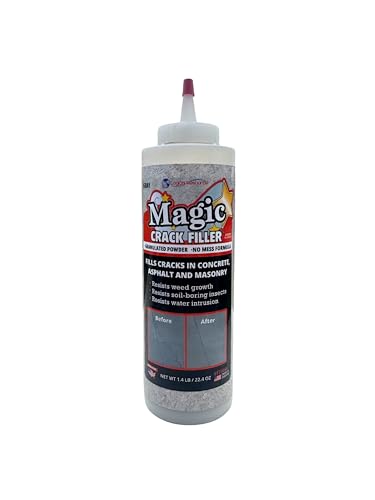
Magic Crack Filler takes a completely different approach to crack repair — it is a granulated powder that you pour dry into the crack, then spray with water to activate the cementitious bond. This pour-and-spray method eliminates the mess of liquid sealants and allows you to fill multiple narrow cracks quickly without tubes, guns, or cleanup. For thin hairline cracks where a gel would simply sit on top, the powder settles deep into the void and hardens into a solid fill that supports the crack walls.
Users report impressive results on stress cracks in new concrete and asphalt, noting that the material dries solid, holds up to weather cycles, and maintains its fill for months without shrinking. The veteran-owned company manufactures the product in the USA, and the gray color blends reasonably well into weathered asphalt and concrete surfaces. Simple application steps — pour, tap with a rubber mallet to settle, refill if needed, and spritz with water — make this an accessible option for first-time DIYers.
The powder method works best on cracks narrower than about 1/2 inch — wider gaps may require multiple applications or a different product entirely. Durability in freeze-thaw is decent but not at the level of elastomeric emulsions; some users note that after a harsh winter the powder fill can crack along the original fault line. Additionally, the 22.4-ounce bottle only covers a limited linear footage of cracks, so large network repairs will require multiple bottles.
Why it’s great
- Mess-free powder application — no caulking gun needed
- Settles deep into narrow cracks for a solid fill
- Made in the USA by a veteran-owned company
Good to know
- Best for cracks under 1/2 inch wide
- Limited coverage per bottle for large networks
7. MuzeFansi Asphalt Crack Filler
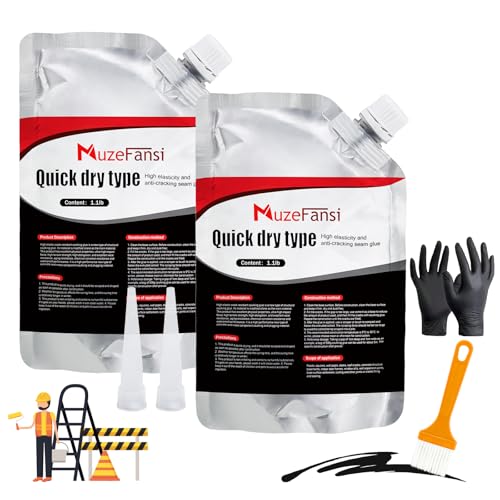
MuzeFansi packages its cement-gel crack filler as a 2-pack, giving you two tubes to split between different projects or test on a small section before committing to a full driveway repair. The gel formulation is designed for standard caulking guns and features a self-leveling finish that flows into cracks without requiring extensive tooling. When cured at 24–48 hours, the seal forms a waterproof barrier that withstands foot traffic and vehicle loads on moderate-width cracks.
The cement-based adhesive technology provides strong adhesion to concrete, brick, and masonry surfaces, making it suitable for transition cracks and edges where asphalt meets a garage slab. Users note that the material is thin compared to urethane gels, which helps it penetrate deeper into fissures, but it can be somewhat difficult to control flow rate. The black color blends well into asphalt, and the all-season durability claim holds up in moderate climates without extreme temperature swings.
The main drawback reported repeatedly is that each tube covers a relatively small area — the 2.2-pound total weight is enough for a handful of medium cracks but not a driveway-wide repair. Some users found the material to be cost-ineffective for large jobs compared to buying a single gallon of emulsion. The thin consistency also means deeper cracks may require two passes to fill flush to the surface, adding to the time investment.
Why it’s great
- Two-tube pack lets you test on small cracks before scaling up
- Cement-gel bonds well to concrete and masonry edges
- Self-leveling finish requires minimal tooling
Good to know
- Limited total coverage per 2-pack for larger repairs
- Thin gel may require two coats on deep cracks
FAQ
Can I apply asphalt crack sealer over a wet crack?
How long should I wait before driving on a freshly sealed crack?
Will crack filler work on concrete or only asphalt?
Why does my crack filler keep cracking again after winter?
Final Thoughts: The Verdict
For most users, the best asphalt crack sealer winner is the Black Jack Drive-Maxx 1000 because it delivers a urethane-boosted, tracking-resistant seal that withstands heavy vehicles and returns to service faster than any emulsion product. If you live in a climate with brutal freeze-thaw cycles, grab the Henry Driveway Elastomeric Emulsion for its EPDM rubber flexibility. And for potholes or structural asphalt damage, nothing beats the Aquaphalt 6.0 Permanent Asphalt Repair with its immediate drive-on capability and 3-year warranty.