
Our readers keep the lights on and the weekend projects moving. As an Amazon Associate, I earn from qualifying purchases.
Waking at the same brutal hour every morning just to shove a thermometer under your tongue is the single most disruptive ritual in the trying-to-conceive (TTC) journey. A dedicated basal body thermometer solves that — but the market now splits between basic digital sticks, Bluetooth-connected wands, and wearable armbands that track you while you sleep. The wrong choice means missed temperature shifts, lost data, and another cycle of guessing your fertile window.
I’m Rikta — the co-founder and writer behind FitlyFast. I’ve spent the last 15 years analyzing fertility tracking hardware, from commodity digital thermometers to algorithm-driven wearable sensors, to separate gimmicks from tools that actually confirm ovulation.
After cross-referencing accuracy specs, real-user retention rates, and app ecosystem maturity, I’ve narrowed the field to seven devices that represent real options. Whether you need hands-free sleep tracking or budget-conscious manual entry, this review of the best bbt tracker gives you a clear path to the right tool for your cycle.
How To Choose The Best BBT Tracker
Your BBT tracker is the cornerstone of fertility awareness. The choice between a manual digital thermometer and a wearable sensor dictates whether you stay in bed or disrupt your morning routine. Focus on three factors: measurement accuracy, data management workflow, and long-term algorithm depth.
Measurement Precision: The ±0.1°F Threshold
Standard fever thermometers round to 0.2°F, which is too coarse to detect the 0.4°F to 1.0°F thermal shift that confirms ovulation. A BBT tracker must read to 1/100th of a degree — look for ±0.09°F accuracy on the spec sheet. Without that granularity, you’ll miss the shift entirely and mistake noise for a pattern.
Data Entry Workflow: Manual vs. Bluetooth vs. Wearable
Manual-entry thermometers require you to wake at the same time daily, hold the probe still, and log the number. Bluetooth-sync models cut out the log step but still demand the same rigid morning ritual. Wearable sensors like Tempdrop and the femometer Ring measure continuously during sleep and auto-sync later — no 5 AM alarm needed. If your sleep schedule is erratic, a wearable is the only path to clean data.
Quick Comparison
On smaller screens, swipe sideways to see the full table.
| Model | Category | Best For | Key Spec | Amazon |
|---|---|---|---|---|
| Tempdrop | Wearable Sensor | Irregular sleep schedules | 98.6% fertile window accuracy | Amazon |
| Premom Smart Thermometer | BT Smart Wand | Hands-free oral measurement | 0.09°F accuracy, 60 memory | Amazon |
| femometer Ring Gen1 | Fingertip Wearable | Discreet all-day comfort | 2.7mm thickness, waterproof | Amazon |
| Daysy Fertility Tracker | Smart Thermometer | Algorithm-guided red/green light | 99.4% accuracy, Swiss design | Amazon |
| Femometer Smart BBT | Bluetooth Wand | App-centric tracking | 0.09°F accuracy, three probe modes | Amazon |
| Easy@Home BBT-013 | Basic Digital | Budget manual entry | ±0.10°F, 30 memory recall | Amazon |
| Easy@Home TTC Bundle | Strips + BBT Kit | Combined LH & BBT tracking | 50 OPK strips + BBT thermometer | Amazon |
In‑Depth Reviews
1. Tempdrop Wearable Ovulation Tracker
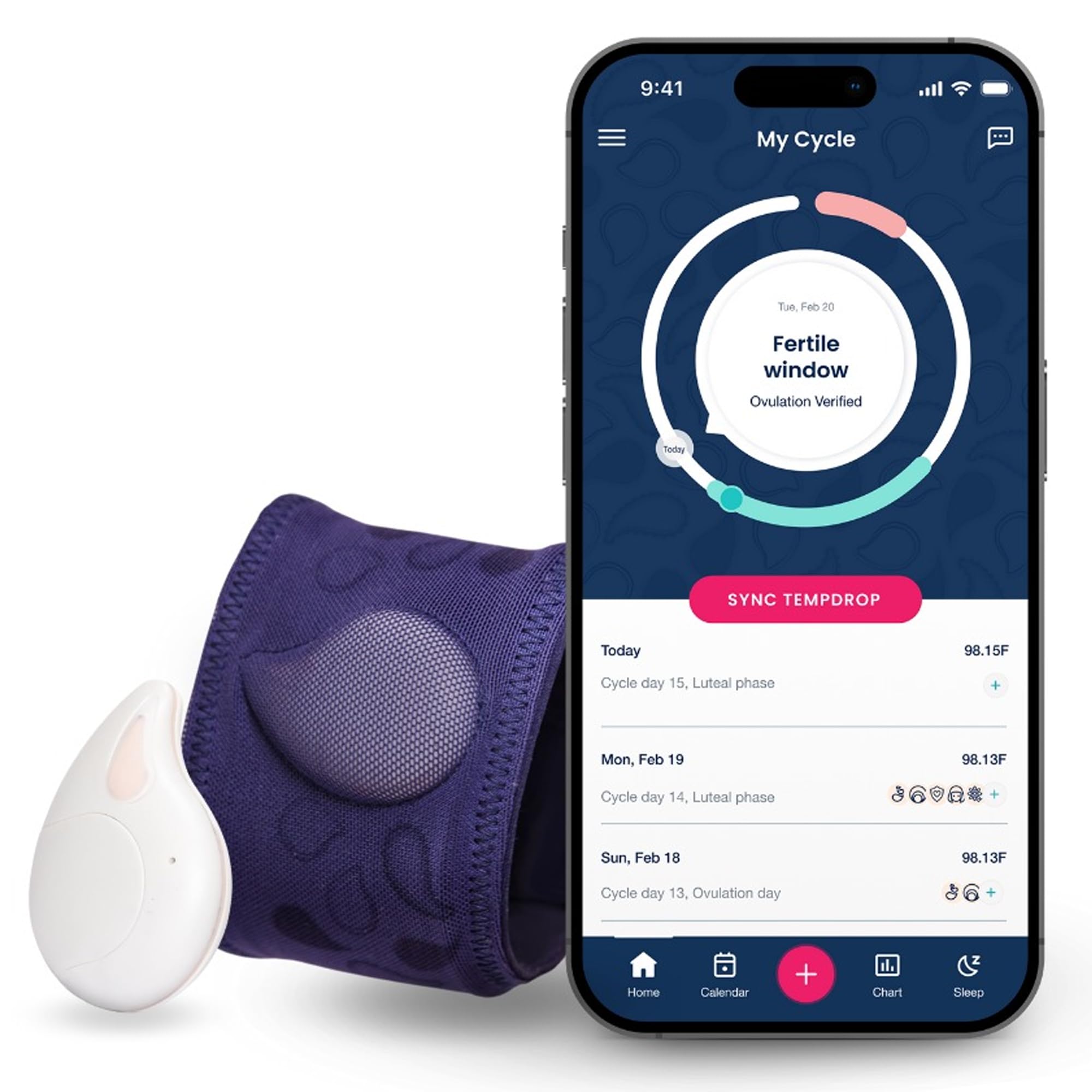
The Tempdrop is built for the exact pain point that drives women to this category: waking at 5 AM to take a resting temperature. Instead of a morning ritual, you wear the soft silicone sensor on your upper arm through the night. It measures your BBT every few seconds, then uses an algorithm to filter out motion artifacts. After syncing via Bluetooth, the app shows a clean chart without the gaps that come from off-time wakeups.
Clinical accuracy data backs the convenience. Tempdrop claims 98.6% accuracy for fertile window identification and 93.3% for ovulation day. The coin-cell battery lasts over six months, and the onboard memory stores up to 60 hours of data, so skipping a sync day isn’t catastrophic. Customer reviews from postpartum breastfeeding mothers confirm the algorithm correctly handles the hormonal noise that throws off oral thermometers.
The drawbacks are real but manageable. The armband can feel bulky for side-sleepers, and the Bluetooth sync is slower than a modern smartwatch. Some units have failed after two to three years due to fragile battery contacts. Tempdrop has also moved key analysis features behind a subscription, raising the long-term cost for users who rely on the app.
Why it’s great
- Eliminates the fixed 5 AM wake-up — tracks continuously during sleep
- Algorithm adapts to postpartum, breastfeeding, and irregular cycles
- Six-month battery life with 60-hour onboard storage
Good to know
- Armband can shift during sleep on side-sleepers
- Bluetooth sync is slower than competitors
- Subscription required for advanced chart analysis
2. Premom Smart Basal Body Thermometer
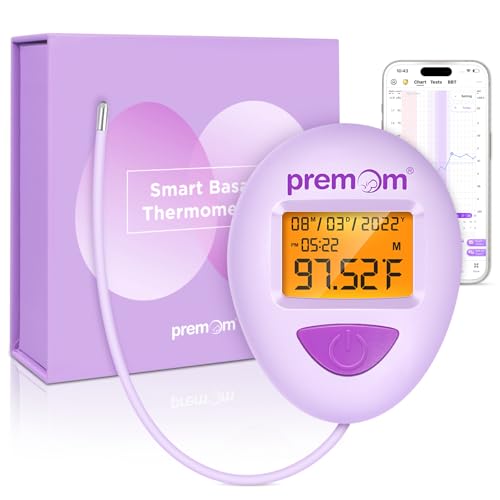
The Premom EBT-380 solves a subtle but impactful problem: micro-movements during oral measurement introduce temperature errors. Its breakthrough is a 9.8-inch long, fixed-position tip that lets you place the probe under your tongue and relax your arm completely — no reaching, no holding. This hands-free stance reduces the jitter that can blur the 0.1°F shift you’re looking for.
Accuracy is rated at ±0.09°F with 1/100th degree resolution. The backlit LCD is large enough to read without squinting, and the unit stores 60 measurements locally. Bluetooth syncs automatically to the Premom app, which overlays your BBT chart with LH test results and period data for a unified fertility picture. Users report the app integration works seamlessly for auto-charting.
Reliability complaints appear in the review stream. A small number of units stopped working after a month, and some users found the temperature readings inconsistent compared to a hospital-grade reference thermometer. The long probe length also makes it less portable than a standard pencil-style thermometer.
Why it’s great
- Long-tip design eliminates hand fatigue and micro-motion errors
- Auto-syncs to Premom app with LH and period data overlay
- 60-session onboard memory for catch-up syncing
Good to know
- A minority of units fail after a few weeks of use
- Long tip is bulky for travel or storage
- Some users report readings inconsistent with reference thermometers
3. femometer Ring Gen1

The femometer Ring Gen1 takes the wearable concept and shrinks it to a discreet 2.7mm-thick ring worn on your finger. Unlike armband sensors that can be felt all night, the ring is barely noticeable. It uses multiple temperature sensors to capture continuous BBT data while you sleep, then auto-syncs to the Femometer app each morning via Bluetooth. No alarms, no probes, no waking up.
The premium ceramic exterior with an aluminum core feels solid, and the ring is waterproof enough to handle hand washing and bathing. The app generates fertility charts, predicts ovulation windows, and provides sleep stage analysis — all without a subscription fee. Users on the TTC forums praise the comfort and the fact that the app caught ovulation even when LH strips gave ambiguous results.
Durability is the main concern. Customer reports of the ring cracking or delaminating within the first few weeks are not isolated. The seller offers replacements, but the defect rate suggests the Gen1 build quality isn’t where it needs to be for a device worn daily in varied conditions. Additionally, the ring has no display — all data flows through the phone, which can be annoying for quick checks.
Why it’s great
- Ultra-thin ring is comfortable for all-night wear
- Waterproof and durable ceramic/aluminum construction
- No subscription fee for full app features
Good to know
- Multiple reports of cracking or delamination within weeks
- No onboard display — full reliance on smartphone
- Sizing kit required before purchase to ensure fit
4. Daysy Fertility Tracker

Daysy takes a different approach than typical BBT trackers: instead of showing you a temperature number and letting you chart it, it processes the data through a proprietary algorithm and displays a simple red (fertile) or green (not fertile) light. The idea is to eliminate the cognitive load of interpreting charts — the device decides for you. It’s designed in Switzerland, built in Germany, and backed by 40 years of fertility research.
The stated 99.4% accuracy for identifying non-fertile days (its primary claim) is based on clinical validation studies. You take one oral temperature reading each morning and insert the device into the base station, which charges it and syncs data to the app. The algorithm adapts to your personal cycle over the first 60 days, learning irregular patterns. Customer reviews from women with PCOS and irregular cycles confirm it reliably detected fertile windows even when other methods failed.
The catch is the rigid measurement protocol. You must take your temperature at roughly the same time every morning — if your sleep schedule is erratic, Daysy will struggle to produce clean data. It also does not work as a wearable; it’s strictly a morning probe that you insert, hold, and return to the charging dock. At the premium end of the price spectrum, it offers less convenience than a wearable but more algorithmic depth than a basic digital thermometer.
Why it’s great
- 99.4% accuracy validated against clinical data
- Simple red/green light removes chart interpretation guesswork
- Algorithm adapts to irregular cycles with 60-day learning period
Good to know
- Requires same-time daily oral measurement — not wearable
- Premium entry price with no sensor alternative
- App syncing can be slow after initial setup
5. Femometer Smart Basal Body Thermometer

The Femometer Smart BBT thermometer prioritizes discretion and app integration. Its lipstick-shaped form factor hides the fact it’s a fertility tool — pull the lid up to power on, take the reading, and push the lid down to shut off. The yellow backlight is soft enough not to disturb a sleeping partner, and the beep volume is adjustable through the app, addressing a common complaint about loud thermometers.
Accuracy is rated at 0.09°F, and the device offers three measurement modes via the app: fast (30 seconds), normal (90 seconds), and mercury-like (up to 5 minutes) for users who prefer the traditional slow-rise method. Bluetooth syncs automatically to the Femometer app, which charts BBT data, predicts ovulation, and stores unlimited records in the cloud. The app is among the better-designed fertility trackers, with clear ovulation markers and period predictions.
Reliability is the weak spot. Multiple users report devices that stop working after one to two months — either refusing to power on or displaying an error message. Battery reseating sometimes helps, but the failure rate appears higher than the category average. The app integration, while excellent when it works, can lose pairing data after a phone reset, forcing users to start over.
Why it’s great
- Discreet lipstick design hides fertility tracking intent
- Three probe modes (fast/normal/mercury) for personal preference
- Adjustable beep volume avoids waking partner
Good to know
- Higher-than-average device failure rate after 1-2 months
- App pairing can break after phone OS update or reinstall
- Takes up to 3 minutes per reading in mercury mode
6. Easy@Home Basal Thermometer BBT-013
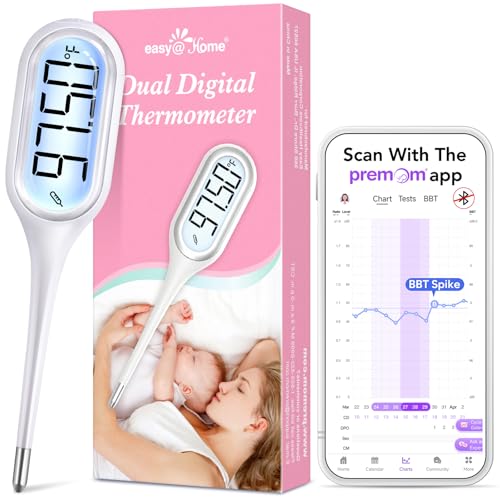
The Easy@Home BBT-013 is the no-frills workhorse of this category. It’s a rigid-tip digital thermometer with ±0.10°F accuracy, a large backlit LCD, and 30-session memory recall. No Bluetooth, no app, no algorithm. You take the reading, write it down or snap a photo for the Premom app’s OCR scan feature. It’s the same workflow as the original BD Basal Thermometer that many veterans consider the gold standard.
Accuracy holds up against professional reference thermometers — customer tests against a Welch Allyn hospital unit showed exact match on every reading. The 60-to-120-second basal mode is designed for the slower temperature stabilization that fertility tracking requires, while the 8-to-12-second fever mode is a bonus for illness monitoring. The rigid tip is easy to clean (wipe only, no submersion) and the secure case prevents tip damage.
The device has no smart features, which is either a pro or a con depending on your tolerance for manual logging. The beep is loud — one of the most common complaints — and can wake a partner. The 30-memory limit means frequent logging is needed if you skip days. But for under , this delivers clinical-grade consistency at a price that makes it easy to have a backup.
Why it’s great
- ±0.10°F accuracy matches hospital-grade reference thermometers
- Large backlit LCD readable in low light
- Removable 30-session memory for catch-up logging
Good to know
- Beep volume is loud and may disturb partner
- No Bluetooth or app connectivity — manual logging required
- Rigid tip is wipe-clean only, not waterproof
7. Easy@Home Ovulation Kit with BBT
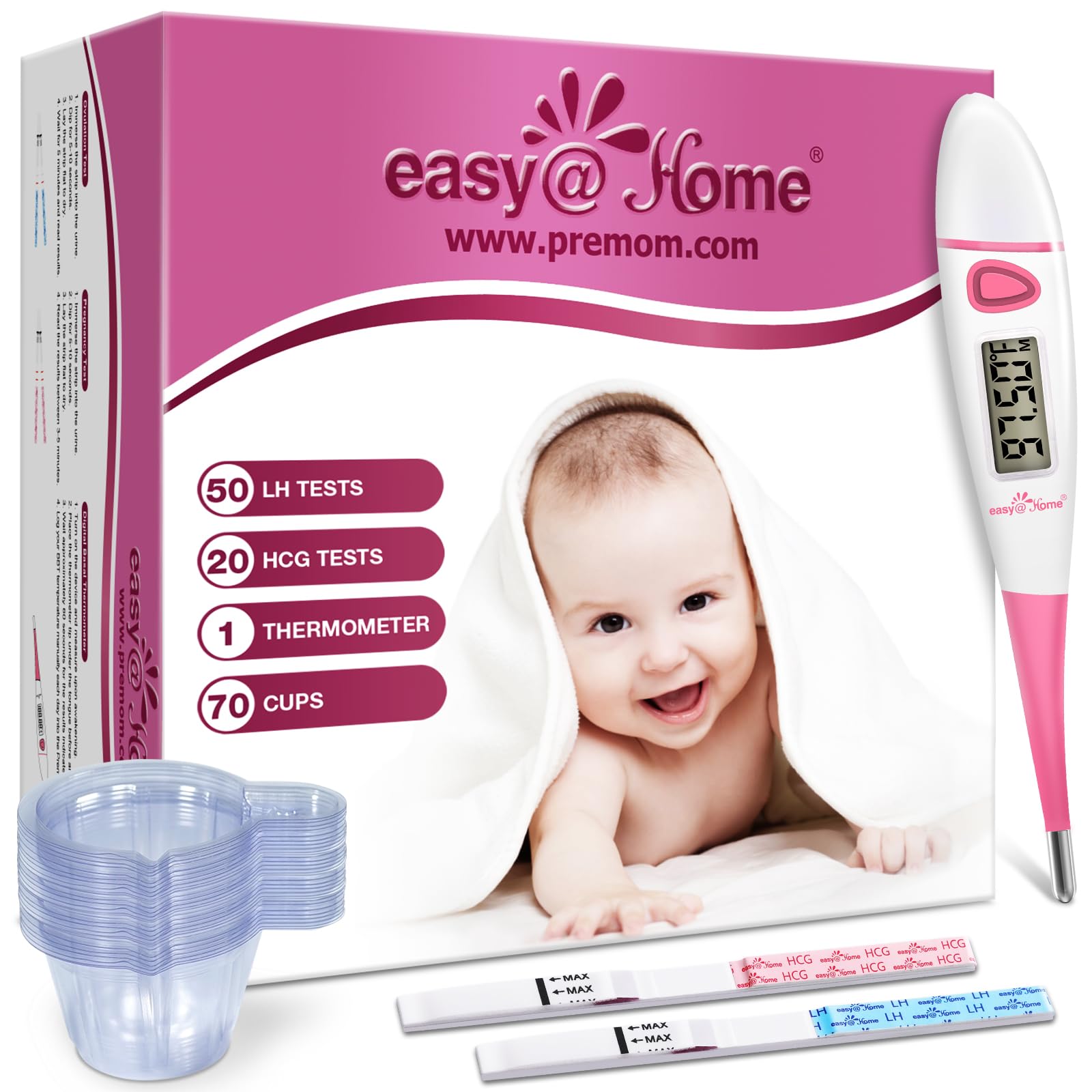
This is less a standalone BBT tracker and more of a complete TTC starting kit. The bundle includes 50 ovulation prediction strips (LH), 20 early pregnancy test strips (HCG), one digital basal thermometer, and 70 urine cups. The thermometer is the same basic dual-mode unit found in other Easy@Home packages — ±0.10°F accuracy, 60-to-120-second BBT mode, and reading in Fahrenheit or Celsius.
The value lies in having both LH surge prediction and BBT confirmation in one box. LH strips tell you ovulation is coming; the BBT thermometer confirms it happened. The Premom app supports OCR scanning of the thermometer display and photo-based analysis of the test strip intensity. Customer success stories on this bundle are striking — many users report pregnancy within the first or second cycle of use after months of failed tracking with calendar-based apps.
The thermometer itself is the weakest component. It has no memory recall, no backlight, and no Bluetooth — it’s a bare-bones digital stick. The strips, while sensitive and accurate at 10 mIU/mL for LH and 25 mIU/mL for HCG, require disciplined daily testing to catch the surge. You get many components, but the quality of each is entry-level. This is ideal for someone starting their TTC journey who wants both prediction and confirmation tools in one order.
Why it’s great
- Complete TTC toolkit: LH predictor, BBT confirmer, and HCG tester
- Strips are sensitive enough for early detection (25 mIU/mL HCG)
- Premom app supports photo-based strip analysis and temp OCR
Good to know
- Thermometer is basic — no memory recall or backlight
- Requires daily LH strip testing to catch the 24-hour surge window
- Bulk packaging vs. buying components separately
FAQ
Can I use a regular fever thermometer for BBT tracking?
What time should I take my BBT temperature?
How many cycles does a wearable BBT sensor take to learn my pattern?
Does Bluetooth sync matter for BBT tracking?
Final Thoughts: The Verdict
For most users, the best bbt tracker winner is the Tempdrop because it eliminates the rigid morning measurement protocol that causes the most data gaps and cycle errors. If you want the precision of a hands-free oral probe with automatic charting, grab the Premom Smart Thermometer. And for a budget-friendly manual entry option that delivers hospital-grade accuracy, nothing beats the Easy@Home BBT-013.