
Our readers keep the lights on and the weekend projects moving. As an Amazon Associate, I earn from qualifying purchases.
Radon is a radioactive gas that moves silently from the soil into your basement or ground-floor living space. Standard HEPA filters designed for dust and pollen are completely useless against it — radon atoms slip straight through micron-rated mesh. Tackling this threat means choosing a machine built around a massive activated carbon and zeolite bed that actually adsorbs the gas before it decays into lung-damaging progeny.
I’m Rikta — the co-founder and writer behind FitlyFast. I’ve spent years researching air filtration hardware, focusing specifically on how different media chemistries interact with gaseous contaminants like radon, VOCs, and chemical off-gassing.
After analyzing dozens of units, comparing carbon weights, airflow architecture, and real-world user results, I’ve narrowed the field to the nine machines that actually have a chance at reducing your radon exposure. This is the definitive guide to choosing an air purifier for radon.
How To Choose The Best Air Purifier For Radon
Selecting a radon-targeting purifier is different from any other air filter purchase. You need to ignore the pretty graphs for fine dust and focus on the one metric that counts: pounds of activated carbon and zeolite in the filter stack. Without enough adsorbent media, radon gas will flow right through the machine and back into your breathing zone.
Prioritize Carbon Bed Mass Over Everything Else
The only way to capture radon gas is through adsorption onto a high-surface-area material like activated carbon or zeolite. A unit with a thin, pleated carbon pre-filter — common in budget HEPA purifiers — has virtually no capacity for radon. Look for machines that list a specific weight of carbon (e.g., 15 lbs of activated carbon) rather than vague “carbon filter” claims.
Seal the Room and Maximize Dwell Time
Radon adsorption improves when the air stays in contact with the carbon bed longer. Units with lower CFM (cubic feet per minute) on low speeds actually perform better for gas removal because they increase dwell time. Avoid running a high-CADR unit on turbo if your goal is radon reduction — slower air movement through a thick carbon matrix produces better results.
Quick Comparison
On smaller screens, swipe sideways to see the full table.
| Model | Category | Best For | Key Spec | Amazon |
|---|---|---|---|---|
| Austin Air HealthMate Plus B450 | Premium | Maximum carbon bed for large basements | 15 lbs activated carbon & zeolite | Amazon |
| Austin Air HealthMate Standard B400 | Premium | Radon + VOC removal in medium rooms | 12 lbs carbon & zeolite blend | Amazon |
| Nuwave OxyPure Ultra | Premium | Zero filter replacement cost for 5 years | Washable Bio-Guard + HEPA/carbon combo | Amazon |
| AirDoctor AD3500 | Mid-Range | Ultra-fine particle capture + gas reduction | UltraHEPA (0.003 microns) + activated carbon | Amazon |
| Nuwave Forever Smart | Mid-Range | Washable filters with no ongoing media cost | 7-stage: stainless steel + Bio-Guard + ozone removal | Amazon |
| Medify MA-40 UV | Mid-Range | UV + H14 HEPA for microorganism control | H14 HEPA (99.99% at 0.1 microns) + UV light | Amazon |
| PuroAir 400 | Mid-Range | Smart sensor + auto mode for daily use | HEPA CarbonTech 3-layer filter | Amazon |
| SIESEAN AP-400 | Budget | Large coverage at an entry-level price | 235 CFM CADR, H13 True HEPA + carbon | Amazon |
| LEVOIT Vital 200S-P | Budget | Smart WiFi control with AHAM VERIFIDE stamp | 3-stage filter, 254 CFM CADR (dust) | Amazon |
In‑Depth Reviews
1. Austin Air HealthMate Plus B450

The HealthMate Plus B450 is the gold standard for radon gas adsorption. Its filter stack contains 15 pounds of activated carbon and zeolite — a media mass that dwarfs every other unit on this list. That thick carbon bed creates enough dwell time to capture radon atoms before they decay, and the 360-degree intake design pulls air from every direction in the room.
Users consistently report that this machine eliminates neighbor smoke and cooking odors that smaller purifiers couldn’t touch. The construction is rugged steel, and the filter lifespan stretches to 5 years under normal use. On the lowest fan setting the unit is whisper-quiet, making it suitable for a bedroom or basement installation.
The trade-offs are real: it’s heavy at 47 pounds, the highest fan speed is loud, and there are no smart features or WiFi controls. This is a purpose-built gas adsorber that prioritizes chemistry over convenience. If your primary concern is radon reduction in a large basement or open-concept space, nothing else in this price range delivers this much media.
Why it’s great
- 15 lbs of activated carbon/zeolite — best in class for gas adsorption
- 5-year filter life minimizes long-term maintenance
- Low EMF emission for health-conscious users
Good to know
- Loud on high fan speed (suitable as white noise only)
- No WiFi, app, or air quality display
- Heavy and bulky — difficult to move between rooms
2. Austin Air HealthMate Standard B400

The B400 is the smaller sibling of the B450 but still packs 12 pounds of carbon and zeolite — more than most mid-range competitors. It covers up to 700 square feet, making it the right fit for a single large room or a medium-sized basement where radon levels are a concern. The 4-stage filtration starts with a washable pre-filter, moves through the carbon/zeolite bed, and finishes with a HEPA-grade particulate filter.
Owners praise its ability to eliminate pet odors, cigarette smoke, and cooking fumes within hours. The rugged metal housing dampens vibration but amplifies mechanical noise on the higher settings. On low, it’s barely audible; on high, it’s comparable to a window fan running at full speed.
Filter replacements are expensive — roughly the same cost as the unit itself every 5 years — but that cost is reasonable when amortized over 60 months. Unlike many modern purifiers, the B400 has no ionizer, no UV light, and no ozone generation, which is a positive for anyone worried about secondary pollutants.
Why it’s great
- 12 lb carbon bed provides excellent radon adsorption capacity
- 5-year filter life keeps downtime minimal
- Zero ozone emission — safe for continuous use
Good to know
- Filter replacement cost is high when it’s due
- No air quality sensor or auto mode
- Short power cord limits placement options
3. Nuwave OxyPure Ultra

The Nuwave OxyPure Ultra takes a radically different approach: instead of disposable filter cartridges, it ships with stainless-steel pre-filters, a washable Bio-Guard filter, and four extra HEPA/carbon combo filters that eliminate replacement costs for the first 5 years. That’s a massive value proposition for anyone who plans to run the unit 24/7.
Its 5-stage system includes an ozone removal filter and a dedicated carbon layer, giving it respectable gas-adsorption capability for a non-Austin unit. The coverage rating of 2,934 square feet in one hour is the highest on this list, and the WiFi app enables remote monitoring of filter life and air quality. Owners also report accurate PM2.5 readings that respond quickly to cooking smoke and pet odors.
The downside: the HEPA/carbon combo filters, while long-lasting, don’t match the carbon mass of the Austin HealthMate series. For radon specifically, the OxyPure is a strong second-tier option — especially in spaces where the ceiling height or open floor plan demands massive air volume turnover.
Why it’s great
- Zero filter replacement cost for 5 years
- Massive coverage (2,934 sq ft) for open-concept homes
- WiFi app with real-time air quality tracking
Good to know
- Carbon mass is lower than dedicated gas-adsorption units
- Washable filters require 24-hour drying time after cleaning
- Heavy at 26 pounds
4. AirDoctor AD3500
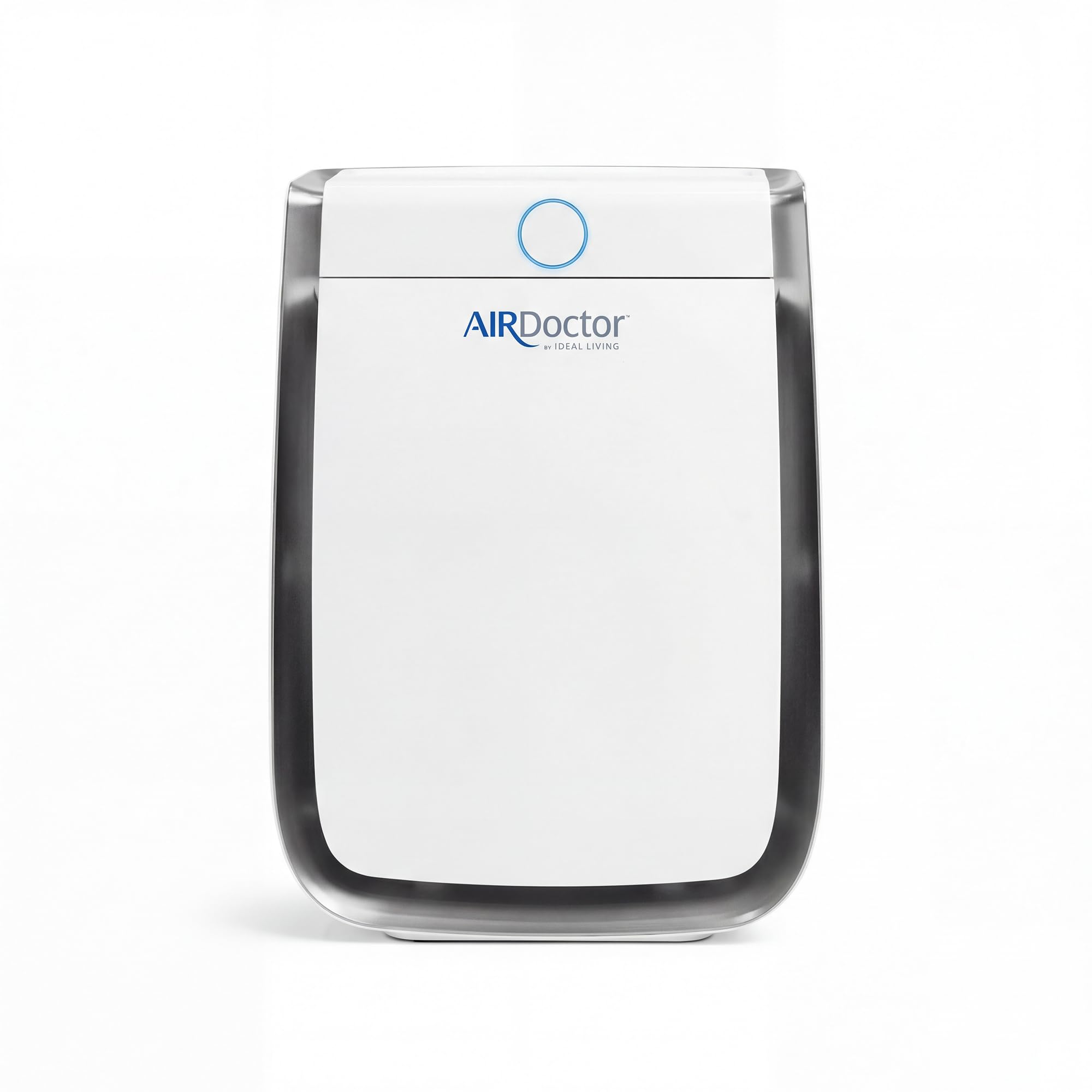
The AirDoctor AD3500 combines a hospital-grade UltraHEPA filter that captures particles down to 0.003 microns with a premium activated carbon filter treated with potassium permanganate. This chemical treatment allows the carbon to break down volatile organic compounds and gases more effectively than untreated carbon alone.
The 3-stage system includes a washable pre-filter, a thick carbon layer, and the UltraHEPA stage. The Halo air quality display shows real-time PM2.5 levels with color-coded feedback, and auto mode adjusts the fan speed as conditions change. Owners consistently note that the unit visibly improves air quality within minutes of turning it on, especially in rooms with cooking smoke or pet dander.
For radon specifically, the AD3500’s carbon bed is adequate for medium rooms but doesn’t match the mass of the Austin units. Replacement carbon filters are needed every 6 months, and replacement UltraHEPA filters every 12 months, which adds up over time. This is a balanced choice for someone who needs both particle removal and gas reduction.
Why it’s great
- UltraHEPA captures particles 100x smaller than HEPA standard
- Potassium permanganate-impregnated carbon enhances gas adsorption
- Auto mode with real-time PM2.5 display
Good to know
- Requires filter changes every 6-12 months
- Premium price point for ongoing filter costs
- Fan noise on high is noticeable
5. Nuwave Forever Smart

The Nuwave Forever Smart eliminates the recurring cost of replacement filters entirely. Its patented 7-stage system uses a stainless-steel pre-filter, a Bio-Guard 360 filter, and an ozone removal filter — all of which are washable and reusable. For radon, the key stages are the Bio-Guard filter (which captures micropollutants) and the ozone removal filter (which targets airborne chemicals).
Owners with multiple pets report dramatic reductions in wet-dog smell and dust accumulation. The unit’s auto mode uses a sensitive odor sensor that ramps fan speed when it detects cooking fumes or other airborne irritants. The WiFi app allows scheduling and remote monitoring, which is convenient for basement installations where you rarely walk down.
The downside: the washable filters require thorough drying (up to 24 hours) after cleaning, and the unit is louder above fan level 3. The carbon-equivalent mass is lower than the Austin units, so this is best suited as a supplementary purifier in a room where radon levels are already low-to-moderate.
Why it’s great
- Never buy another filter — all stages are washable
- Ozone removal filter targets airborne chemicals
- WiFi app with scheduling and remote control
Good to know
- Carbon-equivalent mass is lower than dedicated gas units
- Noisy above fan level 3
- Filters need 24-hour drying after washing
6. Medify MA-40 UV

The Medify MA-40 UV uses a HEPA H14 filter — a step above the more common H13 — to capture 99.99% of particles at 0.1 microns. The built-in UV light adds an extra layer of protection by neutralizing microorganisms trapped on the filter surface. While UV light doesn’t directly adsorb radon gas, the H14 filter and the activated carbon pre-layer provide moderate gas reduction.
Users highlight its quiet operation on the lowest fan speed (46 dB) and the sleep mode that dims all panel lights. The unit covers up to 1,793 square feet in one hour, making it suitable for large basements where radon is typically highest. The child lock and 8-hour timer add safety and convenience for family homes.
The carbon layer in the MA-40 is thin compared to dedicated gas adsorbers, meaning radon removal is secondary to particle filtration. It’s a strong choice for someone who wants UV sterilization and high-efficiency particle capture while getting some incidental gas reduction.
Why it’s great
- H14 HEPA filtration captures 99.99% of particles
- UV light neutralizes trapped microorganisms
- Quiet sleep mode with fully dimmable panel
Good to know
- Carbon layer is too thin for serious radon adsorption
- Replacement filters are pricey for the H14 media
- Coverage ratings assume high fan speed
7. PuroAir 400
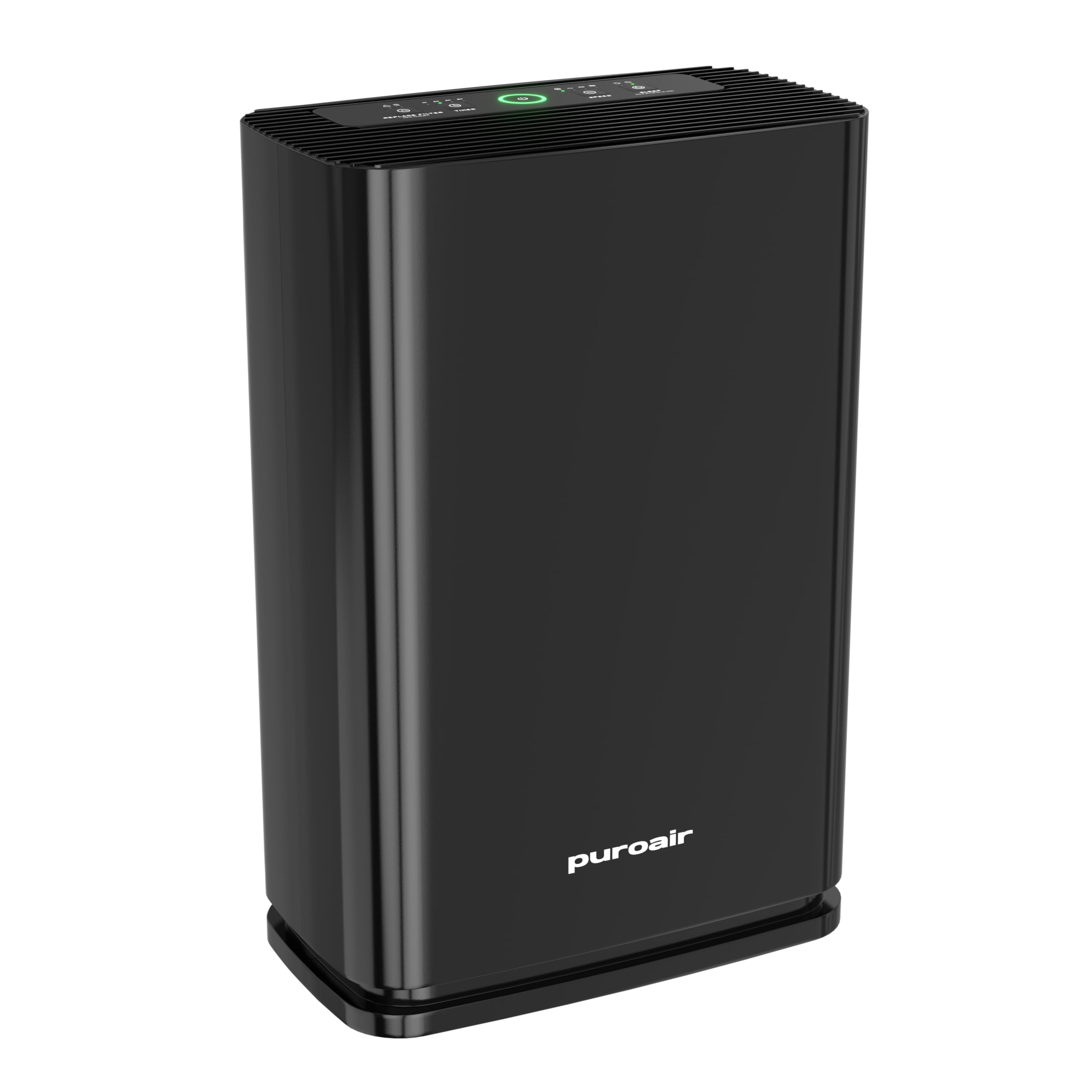
The PuroAir 400 uses a 3-layer HEPA CarbonTech filter that combines a pre-filter, a HEPA layer, and an activated carbon matrix. Its smart particle sensor monitors air quality continuously and adjusts fan speed automatically. The unit covers up to 2,000 square feet in one hour and operates at a whisper-quiet level on low settings.
Owners report significant reductions in dust accumulation and noticeable improvement in allergy symptoms within three weeks of continuous use. The carbon layer, while not as massive as the Austin units, does help with cooking odors, pet smells, and VOC reduction. The air quality display provides immediate visual feedback — users see the color shift from red to green as the unit cleans the room.
The PuroAir is backed by a 2-year risk-free warranty, which signals confidence in durability. For radon, its carbon mass is appropriate for small to medium rooms rather than large basements. It’s a solid entry point for someone who wants automated air quality management with decent gas adsorption.
Why it’s great
- Smart sensor with real-time auto mode adjustment
- Whisper-quiet operation on low fan speed
- 2-year risk-free warranty from a USA-based company
Good to know
- Carbon mass is moderate — best for smaller rooms
- Coverage may be overestimated for open floor plans
- Filter can be vacuumed but still needs periodic replacement
8. SIESEAN AP-400
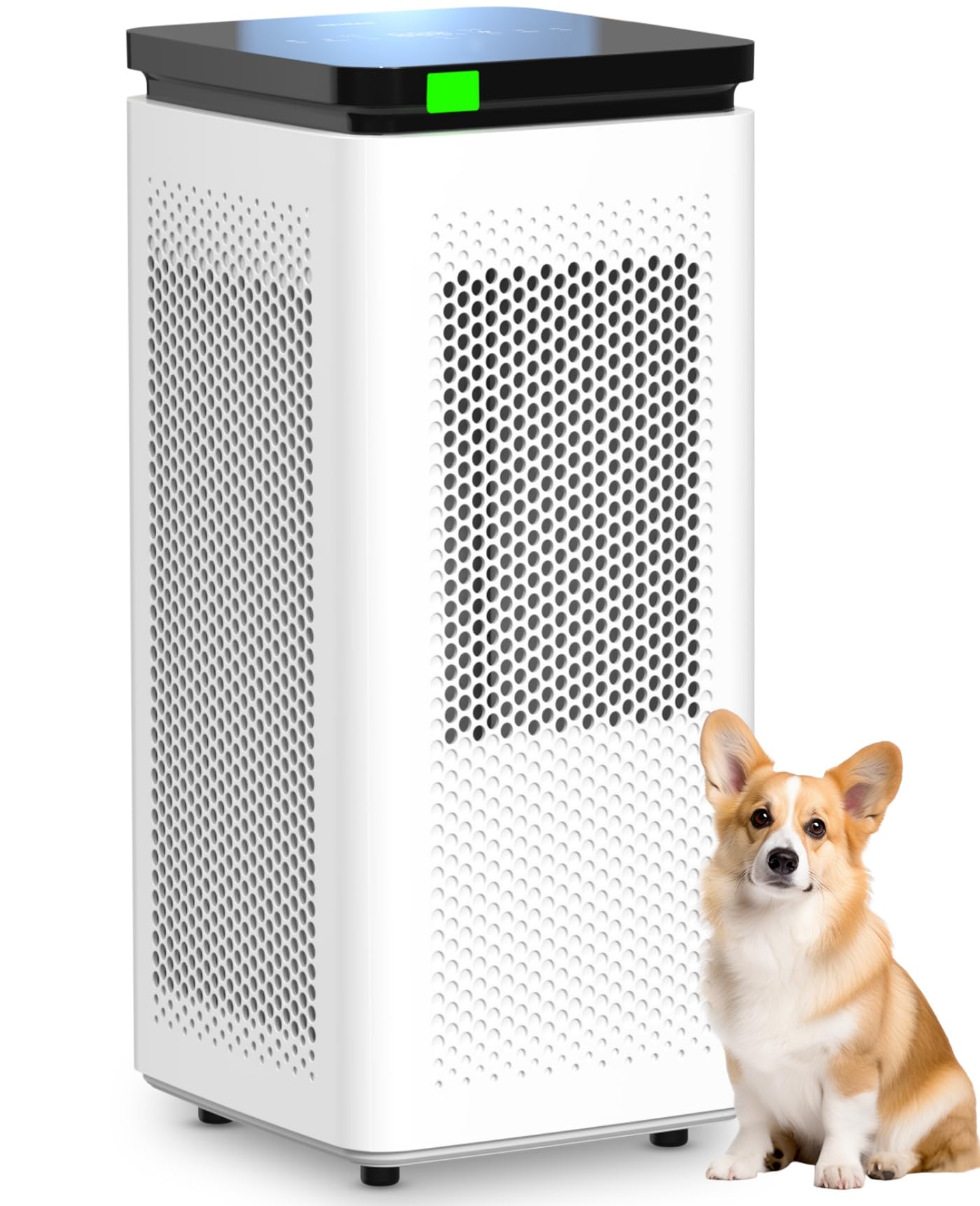
The SIESEAN AP-400 is an entry-level unit that punches above its price class with a 235 CFM CADR and dual-sided airflow design. It uses an H13 True HEPA filter plus an activated carbon filter to capture smoke, odors, VOCs, and everyday particulates. The unit can clean 500 square feet in just 15 minutes and claims coverage up to 3,500 square feet.
Owners note the real-time PM2.5 display and auto mode are responsive to cooking smoke and pet odors. Sleep mode drops the noise to 30 dB, making it one of the quietest options on this list at night. The child lock and timer are welcome safety features for family households with curious toddlers.
The activated carbon layer is relatively thin, so radon adsorption capacity is limited compared to the Austin or AirDoctor units. This unit is best used as a general-purpose air purifier in rooms where radon levels are already low and you want to maintain overall air quality.
Why it’s great
- High CADR (235 CFM) for rapid particle removal
- Sleep mode at 30 dB — among the quietest tested
- Real-time PM2.5 digital display with auto mode
Good to know
- Carbon layer is thin — limited radon gas capacity
- Dual-inlet design can pull in floor-level dust
- Filters need replacement every 3-4 months in heavy use
9. LEVOIT Vital 200S-P

The LEVOIT Vital 200S-P is a smart purifier with AHAM VERIFIDE certification, meaning its CADR ratings (Smoke: 250 CFM, Dust: 254 CFM, Pollen: 289 CFM) have been independently verified. It uses a 3-stage filter system with a washable pre-filter, an activated carbon layer, and an HEPA-grade main filter.
The VeSync app enables remote control, scheduling, and integration with third-party voice assistants. The light sensor automatically dims the display in a dark room, and the auto mode adjusts fan speed based on real-time air quality readings. Owners consistently praise its quiet operation on auto and the color-coded air quality ring that provides instant feedback.
For radon, the Vital 200S-P’s carbon layer is best suited for very low-level gas reduction. The unit excels at everyday particle removal and odor control but cannot match the carbon mass needed for significant radon adsorption. It is an excellent choice for bedrooms or living areas where general air quality is the primary concern.
Why it’s great
- AHAM VERIFIDE certification with independently tested CADR
- Smart WiFi control with VeSync app and scheduling
- Light sensor auto-dims display for undisturbed sleep
Good to know
- Carbon layer is thin — minimal radon adsorption capacity
- Filter replacement indicator doesn’t measure actual carbon saturation
- Best suited for general air quality, not heavy gas removal
FAQ
Can a HEPA filter capture radon gas?
How much activated carbon do I need for radon removal?
Should I place the purifier directly on the basement floor?
Will an air purifier eliminate the need for radon mitigation?
Final Thoughts: The Verdict
For most users, the air purifier for radon winner is the Austin Air HealthMate Plus B450 because its 15-pound activated carbon and zeolite filter provides unmatched gas adsorption capacity for large basements and open-concept spaces. If you want a zero-maintenance solution with no recurring filter costs, grab the Nuwave OxyPure Ultra. And for a balanced mid-range unit that handles both ultra-fine particles and gas reduction, nothing beats the AirDoctor AD3500.