
Our readers keep the lights on and the weekend projects moving. As an Amazon Associate, I earn from qualifying purchases.
A 3D pen for kids isn’t just a toy — it’s a bridge between a child’s imagination and a physical object they can hold. The challenge for a parent is finding a device that is genuinely safe at low temperatures, durable enough to survive a drop, and simple enough for small hands to master without constant frustration.
I’m Rikta — the co-founder and writer behind FitlyFast. I spend my time analyzing the hardware safety specs, nozzle materials, and filament compatibility of creative STEM tools so parents can skip the research and grab the right one.
After digging through dozens of models and real owner feedback, I’ve narrowed down the field to the seven safest and most reliable options to help you find the best 3d pen for kids that keeps the fun flowing without the burns or constant jams.
How To Choose The Best 3D Pen For Kids
Buying a 3D pen for a child means prioritizing different specs than you would for an adult hobbyist. You need to balance safety, ease of use, and creative potential without the pen turning into a frustrating paperweight. Here is what actually matters.
Filament Type and Nozzle Temperature
This is the single most important decision point. Standard PLA and ABS filaments require a nozzle temperature of 180-230°C — hot enough to cause a serious burn if a child touches the tip or the extruded plastic. Child-safe 3D pens use PCL (polycaprolactone) filament, which melts at around 70-80°C. PCL plastic is warm to the touch but will not blister skin. If you buy a pen that only works with PLA, you are signing up for constant supervision and a higher risk of injury. For a child under 10, a PCL-only pen is the safer path.
Nozzle Material and Clog Resistance
A ceramic nozzle is the gold standard in this category because it resists clogging better than basic metal tips. A clogged nozzle is the number one reason kids (and parents) give up on 3D pens. Look for models with anti-clog features or simple cleaning mechanisms. The frustration of a jammed pen is not worth the low price of a throwaway model — spend a few dollars more for a reliable extruder.
Included Accessories and Stencil Support
A bare pen and filament are nearly useless for a young beginner. The best kits include a heat-resistant silicone mat (to protect the table and release finished pieces easily), a stencil book with traceable templates, and finger protectors. These accessories remove the guesswork and let a child start creating a recognizable shape in their first session. A kit without stencils forces the child to learn freehand 3D drawing immediately, which is a steep and discouraging curve.
Quick Comparison
On smaller screens, swipe sideways to see the full table.
| Model | Category | Best For | Key Spec | Amazon |
|---|---|---|---|---|
| 3Doodler Start+ | PCL Pen Set | Child safety first | 70-80°C PCL-only nozzle | Amazon |
| MYNT3D Junior | PCL Pen Set | Budget-friendly safety | Battery powered, PCL-only | Amazon |
| SCRIB3D P1 | PLA/ABS Pen | Versatile beginner | Stepless speed slider | Amazon |
| LinkSpoX 07pro Kit | PLA/ABS Pen Kit | Complete beginner kit | 12-color filament & stencils | Amazon |
| 3Doodler Create+ | PLA/ABS/FLEXY | Older kids & teens | Dual-drive speed control | Amazon |
| 3Dmate Filament Kit | Refill Kit | Filament + accessories | 360 ft PLA refills | Amazon |
| Marvin’s Magic Pens | Color-Change Set | Pre-3D creative play | 30 color-change markers | Amazon |
In‑Depth Reviews
1. 3Doodler Start+ Essentials 3D Pen Set
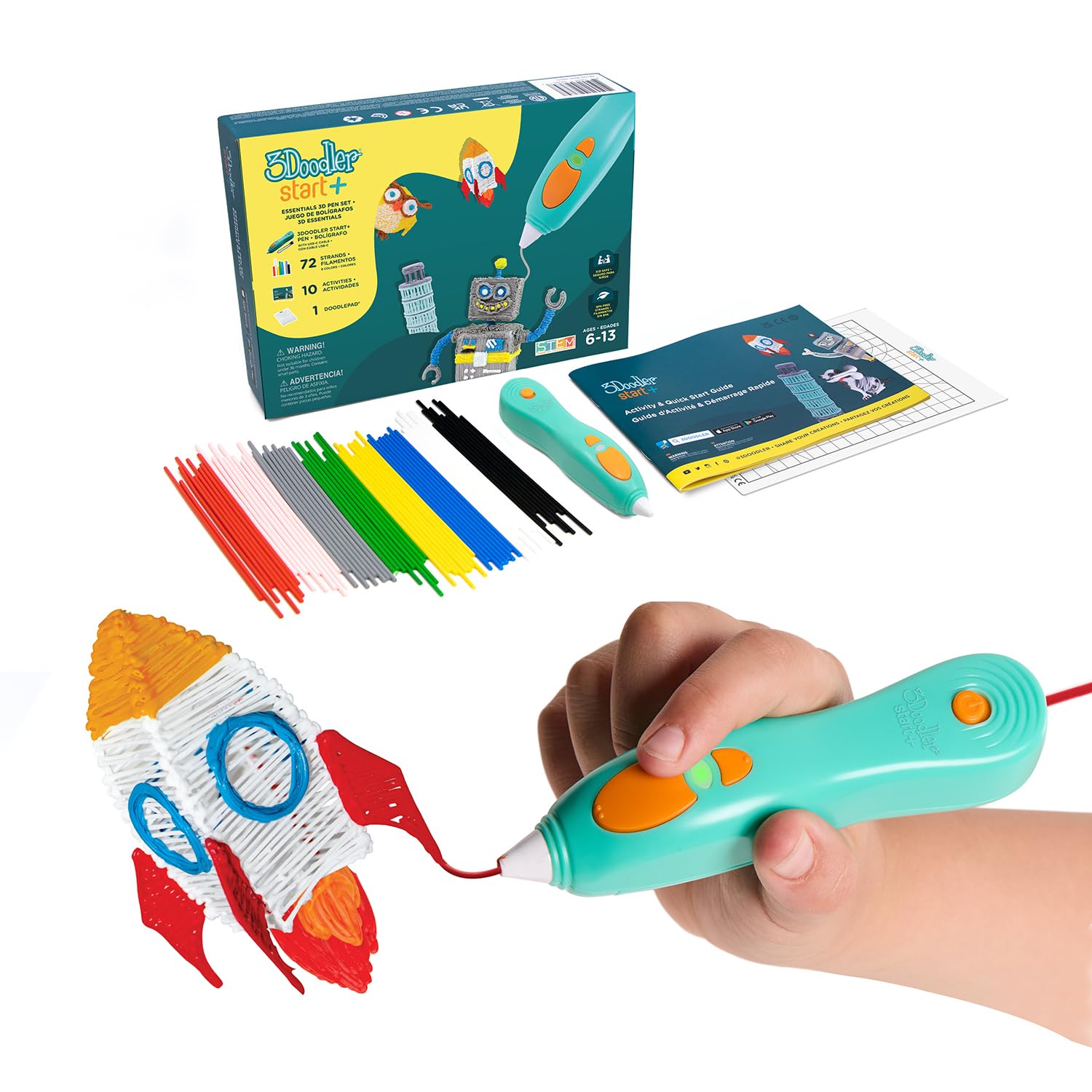
The 3Doodler Start+ is the only pen in this roundup that specifically guarantees a nozzle and plastic that can be touched without burn risk. It uses proprietary PCL filament that melts at low temperature (around 70-80°C), making it genuinely safe for kids aged 6 and up. The slimmer body than earlier models fits smaller hands better, and the USB-C charging cuts the downtime between creative sessions.
The kit includes 72 strands of mixed-color PCL plastic and a DoodlePad that lets the child trace stencils before building upward. The standby mode is a nice touch — after a few minutes of inactivity, the pen drops to a lower temperature to conserve plastic and reduce wear. Beginners report smoother extrusion than budget alternatives, with far fewer stringing issues out of the box.
Filament consumption is the main watch-out here — the included 72 strands look generous but get eaten up fast on larger projects. Expect to buy refill packs regularly once the enthusiasm kicks in. The customer support is responsive, with multiple reports of replacement pens shipped quickly when a unit failed after the initial charge cycle.
Why it’s great
- No-hot-parts safety design rated for ages 6+
- Better extrusion consistency than most entry-level pens
- Fast USB-C charging with a long run time
Good to know
- Filament runs out quickly on big projects
- Proprietary PCL refills cost more than generic filament
2. MYNT3D Junior 3D Pen for Kids

MYNT3D Junior is the budget-conscious entry into the child-safe PCL pen category. The low-temperature nozzle stays between 70-80°C, so parents of 4 and 5-year-olds can relax. The pen runs on battery power and charges via Micro USB, which is convenient for a car ride or a visit to grandparent’s house, but the battery life is short — expect to recharge after 30-40 minutes of steady use.
The ergonomic design is genuinely good for small hands: the body is curved and lightweight at 8.8 ounces. Included in the box are three starter rolls of PCL filament and a handful of basic stencils. The extrusion is a bit lumpy compared to premium models, which is why many reviewers note that this is best for freeform creative play rather than precise architectural builds.
Reliability is the main trade-off here. Multiple owners report the feeder mechanism jamming or failing completely after a few uses. The nozzle is a single piece that cannot be unclogged, so if the pen jams, it is often game over. For the price, it is a fine feeler gift for a young child, but do not expect longevity without some frustration.
Why it’s great
- Low-temp PCL nozzle is safe for preschoolers
- Lightweight and well-balanced for small hands
- Battery powered for portability
Good to know
- Nozzle is a one-piece design that can’t be unclogged
- Battery life is short and Micro USB only
3. SCRIB3D P1 3D Printing Pen

The SCRIB3D P1 is a dual-temperature pen that works with PLA (160-210°C) and ABS (210-235°C), which makes it a much more versatile tool for older kids or teens. It is not burn-safe — the nozzle reaches well over 200°C — so this is a parent-supervised pen for children aged 8 and up. The key feature is the stepless speed slider, which lets the user adjust extrusion rate from a slow trickle for detail work to a faster flow for filling large surfaces.
The ceramic nozzle resists clogging better than the metal-tip alternatives, and the 2-minute auto-sleep function prevents overheating if the pen is idle. The starter kit includes just three colors of PLA filament (30 feet total), which is a modest amount — you will need a refill pack quickly. The stencil guide book is helpful for early projects but assumes the child can already trace reasonably well.
Some users note the first batch of filament can pop and crackle at the default temperature setting. Dropping the temperature 10-15°C usually solves this. The pen body is comfortable and light (12.9 ounces), but the 2-3 minute warm-up time feels long for an impatient child. Replacement filament is cheap and widely available, which is a big plus for ongoing use.
Why it’s great
- Ceramic nozzle for better clog resistance
- Stepless speed slider for detail control
- Works with cheap, standard PLA filament
Good to know
- Nozzle temperature is not child-safe
- Included filament is a very small sample
4. LinkSpoX 3D Printing Pen Kit (07pro)
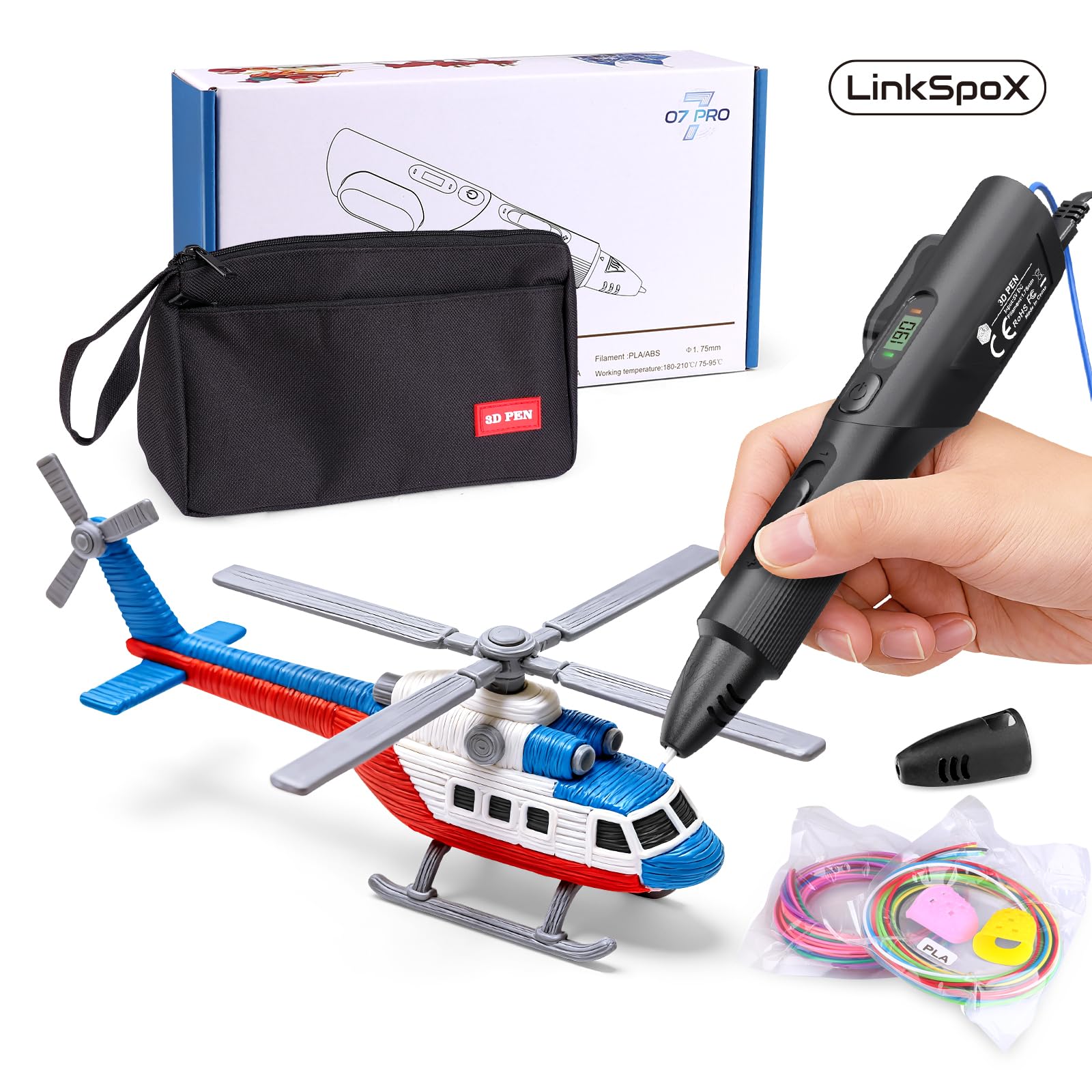
The LinkSpoX 07pro kit is the most inclusive starter set among the PLA-compatible pens. It comes with 12 colors of filament (80 feet total), a pack of reusable stencils, a pen stand, heat-resistant finger sleeves, and a storage bag. The pen itself features a ceramic nozzle, an LCD screen that shows the real-time temperature, and dual preset heat levels for switching between PLA and ABS.
At 7.8 ounces, it is one of the lightest pens on this list, which helps reduce hand fatigue during longer sessions. The USB power brick keeps the temperature stable, but the absence of a battery means it must be tethered to a wall outlet. The auto-standby function kicks in after 2-3 minutes of inactivity to conserve the nozzle and reduce power consumption.
The main limitation is the speed control, which some users describe as having too little variation between the low and high settings. Precise detail work is harder than with the SCRIB3D’s stepless slider. Customer support is responsive — a few owners received free replacements after early units failed. For a child who wants a splash of many colors from day one, this kit delivers the most creative variety out of the box.
Why it’s great
- 12 colors of filament included for variety
- Lightweight body at 7.8 ounces
- LCD screen for precise temperature monitoring
Good to know
- Speed control lacks fine variation
- Must be plugged into a wall outlet
5. 3Doodler Create+ (Juku Edition)

The 3Doodler Create+ is the high-temperature sibling of the Start+, designed for teens and older kids who have outgrown the PCL phase. It is compatible with PLA, ABS, and FLEXY filaments, giving the user the widest creative range — flexible designs, hard structural parts, and detailed models. The dual-drive technology lets you switch between a fast flow rate for filling large areas and a slow rate for precise detail work.
The kit includes two refill packs of 3mm ABS and PLA plastic (15 colors total) plus a power adapter. The pen body is slightly heavier at 1.3 pounds, so younger children may find it tiring to hold for long sessions. The Ultimate Guide to Doodling provides 5 starter projects that help the user build confidence before attempting freehand work.
Quality control is the biggest gamble here. Several buyers received units with rust on the metal components straight out of the box, and others reported devices that were dead on arrival. The extrusion is smooth when working, but the high nozzle temperature (up to 235°C) makes this unsuitable for any child under 12 without constant supervision. This is a tool for a serious young maker, not a casual plaything.
Why it’s great
- Works with PLA, ABS, and flexible filaments
- Dual-drive speed control for detail work
- Largest creative material range of any pen here
Good to know
- Inconsistent quality control out of the box
- Heavy 1.3-lb body fatigues small hands
6. 3Dmate Filament Kit with Silicone Mat

This 3Dmate kit is not a pen — it is a refill and accessory bundle designed for any 1.75mm PLA pen. If you already own a 3D pen for kids or are buying one separately, this kit provides 36 colors of filament (360 feet total), a 7×9 inch silicone starter mat with a smooth side and a grooved side, a stencil book with 11 templates, and 4 finger protectors. The filament is vacuum-sealed to prevent moisture damage.
The silicone mat is the highlight here: the grooved side helps the user control extrusion direction, and the mat’s flexibility makes it easy to peel off completed designs. The transparent mat allows you to place a stencil underneath and trace directly, which is a huge help for beginners who struggle with freehand 3D drawing. The finger protectors add an extra layer of safety for kids using high-temperature pens.
The filament is standard PLA — not PCL — so it requires a pen capable of reaching 180-230°C. Do not pair this with a MYNT3D Junior or 3Doodler Start+, as those pens only accept low-temp PCL. For a standard PLA pen like the SCRIB3D or LinkSpoX, this is an excellent expansion pack that keeps the creative pipeline full.
Why it’s great
- 36 colors offer huge variety for creative projects
- Silicone mat with grooved side improves precision
- Vacuum-sealed packaging prevents moisture damage
Good to know
- Not compatible with low-temp PCL pens
- No pen included in this kit
7. Marvin’s Magic 30 Color-Changing Pens

Marvin’s Magic is not a 3D pen — it is a 2D color-changing marker set that mimics the optical illusion of 3D lettering and secret hidden messages. This is the best stepping stone for a child who is not yet ready for a heated nozzle or filament refills. The set includes 30 markers plus 2 erasable pens. The trick: draw with a colored marker, then sweep the special white pen over the ink to reveal a different color or make the drawing vanish.
The 3D lettering effect is achieved by layering strokes and using the magic pen to pop certain areas forward visually. The softer barrel is comfortable for small hands aged 5+, and the ink flows with minimal pressure. The color-change reaction is instant and repeatable, so the child can perform the same trick again and again. It is a mess-free, non-toxic alternative that builds drawing confidence and hand-eye coordination.
The only downside is that the magic effect works best on the included smooth paper. On rougher or absorbent paper, the color-change reaction is less vivid and the 3D lettering effect looks muddy. If your child’s goal is to eventually graduate to a real 3D pen, this set is an excellent introductory creative tool that teaches layering and design without the heat or frustration of an extruder.
Why it’s great
- Zero heat or burn risk — safe for ages 5+
- Instant color-change effect is highly engaging
- 30 markers provide long-lasting creative variety
Good to know
- No actual 3D extrusion or printing
- Effect varies on different paper types
FAQ
At what age can a child use a 3D pen safely?
Can I use any 1.75mm filament in a kid’s 3D pen?
Why does my child’s 3D pen keep jamming?
Final Thoughts: The Verdict
For most users, the best 3d pen for kids winner is the 3Doodler Start+ Essentials because its no-hot-parts design gives parents genuine peace of mind while the PCL extrusion quality is the best in the child-safe category. If you want a budget-friendly PCL entry point for a very young child, grab the MYNT3D Junior. And for a creative prelude to 3D printing that involves zero heat and zero frustration, nothing beats the Marvin’s Magic color-changing pen set.