
Our readers keep the lights on and the weekend projects moving. As an Amazon Associate, I earn from qualifying purchases.
Dust, pollen, pet dander, and smoke can turn your bedroom into a sneezing zone. The right machine scrubs these particles from the air, letting you breathe easier without a distracting hum or a bulky tower dominating your nightstand.
I’m Rikta — the co-founder and writer behind FitlyFast. My guide ranks the top models by CADR, HEPA grade, noise floor, and real-world filtration speed, cutting through the marketing spin to find the ones that actually deliver measurable air changes per hour.
Whether you need a whisper-quiet unit for a nursery or a workhorse for an open living area, choosing the right air purifier under $200 comes down to matching CADR numbers and filter area to your room’s square footage without overspending on extras you won’t use.
How To Choose The Best Air Purifier Under $200
Sticking to a budget below $200 doesn’t mean sacrificing clean air, but it does force you to be strategic about which specs really matter. Big-box claims like “covers 3,000 sq ft” often come from a single air-change calculation at the lowest fan speed — you need to cross-check CADR numbers and filter quality to avoid a unit that’s merely noisy without being effective.
Match CADR to Your Room’s Volume
CADR (Clean Air Delivery Rate) measures cubic feet of air cleaned per minute. For a typical 200 sq ft bedroom with 8-ft ceilings, you want a smoke CADR of at least 120 CFM. Units in this price range vary from 100 to 250+ CFM — picking the lowest CADR for a large living space will result in slow air turnover and lingering odors.
Check the Filter Media, Not Just the Marketing
True HEPA must capture 99.97% of particles at 0.3 microns. Some units labeled “HEPA-type” or “HEPA-grade” use slightly less dense media that can release smaller particles back into the room. A washable pre-filter extends the main HEPA filter’s life by trapping larger hair and dust first, cutting annual replacement costs — a real advantage at the lower end of the price bracket.
Noise Floor and Sleep Mode Realities
A purifier on max speed will always be audible — the question is how quiet the lowest setting goes. Sleep mode targets 20-27 dB, roughly the level of a quiet library. Units from Levoit and Coway tend to lead here, while budget twin-packs often trade acoustic refinement for raw fan power at the highest speed.
Quick Comparison
On smaller screens, swipe sideways to see the full table.
| Model | Category | Best For | Key Spec | Amazon |
|---|---|---|---|---|
| Coway Airmega AP-1512HH | Premium | All-around performance | CADR Smoke 233 CFM | Amazon |
| WINIX 5520 | Premium | Large room + smart app | CADR up to 243 CFM | Amazon |
| HEARBOBO K06 | Premium | Dual-filter coverage | Double-sided H13 HEPA | Amazon |
| LEVOIT Core 300-P | Mid-Range | Bedroom allergen control | CADR 143 CFM | Amazon |
| LEVOIT Core 200S-P | Mid-Range | Smart compact bedroom unit | 24dB Sleep Mode | Amazon |
| GermGuardian AC4825E | Mid-Range | UV-C + HEPA combo | HEPA PURE 0.1 micron | Amazon |
| VEWIOR 2 Pack | Budget | Multi-room coverage on a budget | 15dB Sleep Mode | Amazon |
In‑Depth Reviews
1. Coway Airmega AP-1512HH(W)
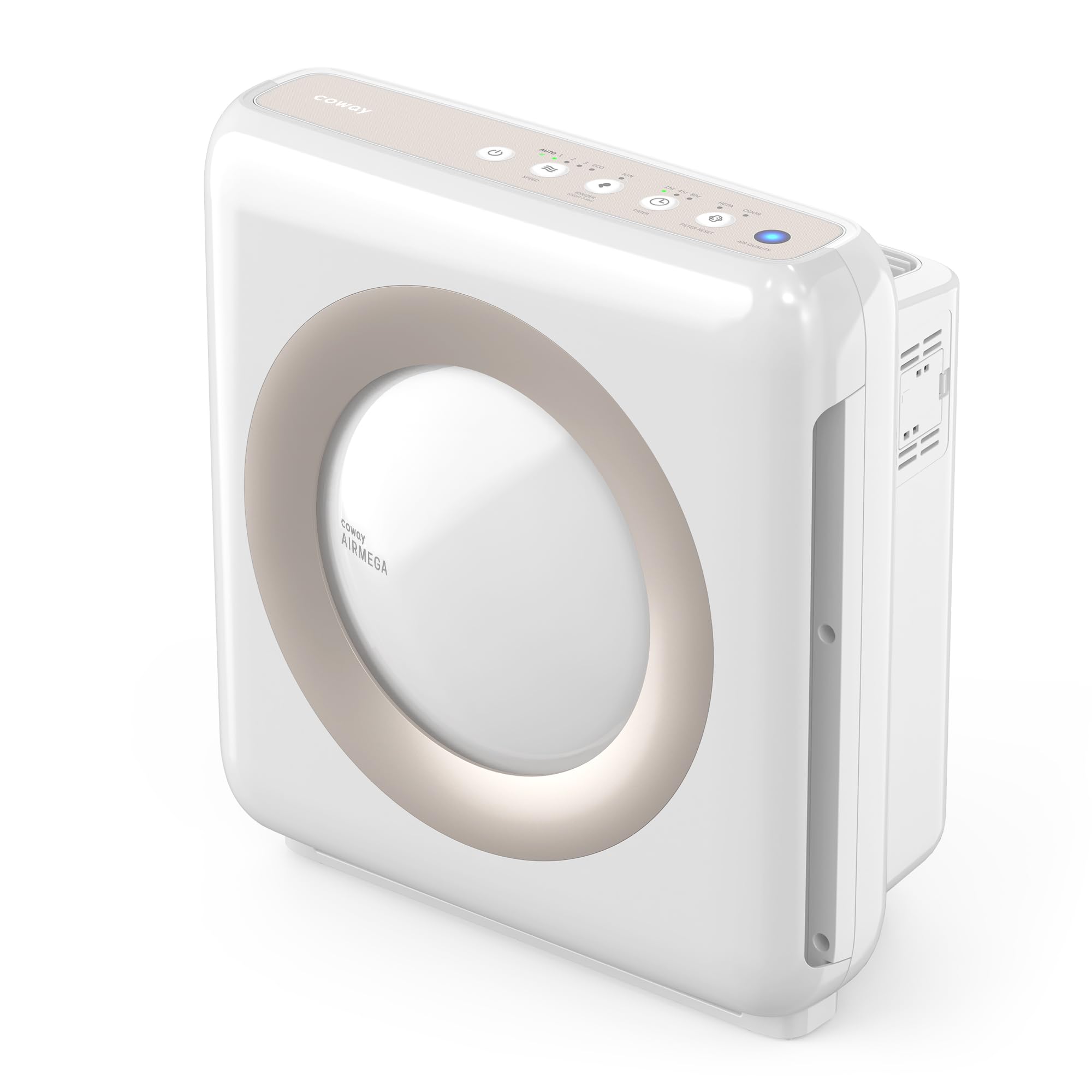
The Coway Airmega AP-1512HH delivers a smoke CADR of 233 CFM, making it one of the highest-performing units inside the $200 threshold. Its four-stage filtration — washable pre-filter, deodorization carbon layer, True HEPA, and Vital Ion — captures 99.97% of particles down to 0.3 microns. Real-world tests show it clearing heavy wildfire smoke from a 360 sq ft room within minutes, dropping the LED air quality indicator from red to blue faster than most competitors in this class.
The auto mode uses a pollution sensor to adjust fan speed between three levels, and the Eco mode shuts the fan off when no pollution is detected for 30 minutes — saving energy without sacrificing responsiveness. Noise ranges from 24.4 dB on low to 53.8 dB on high, which is quieter than mid-range units at equivalent fan speeds. Users specifically note the top-mounted air exhaust prevents cold drafts, a design detail that matters for overnight use in bedrooms.
Filter replacement is indicated separately for the pre-filter and HEPA, and replacement filters typically last 12 months, costing roughly annually. The lack of app or voice control is a deliberate trade-off — the unit relies on its own clear display showing PM 1.0, 2.5, and 10.0 readings. The main complaint is that auto mode can spike to high speed in response to moisture from a shower, which some find disruptive during sleep. However, manually selecting speed 1 or 2 bypasses this entirely.
Why it’s great
- Highest CADR in its price class at 233 CFM smoke
- Four-stage filtration with washable pre-filter extends HEPA life
- Ultra-quiet 24.4 dB low speed for undisturbed sleep
Good to know
- No Wi-Fi or app control
- Auto mode may overreact to humidity spikes
- Filter replacements cost roughly /year
2. WINIX 5520
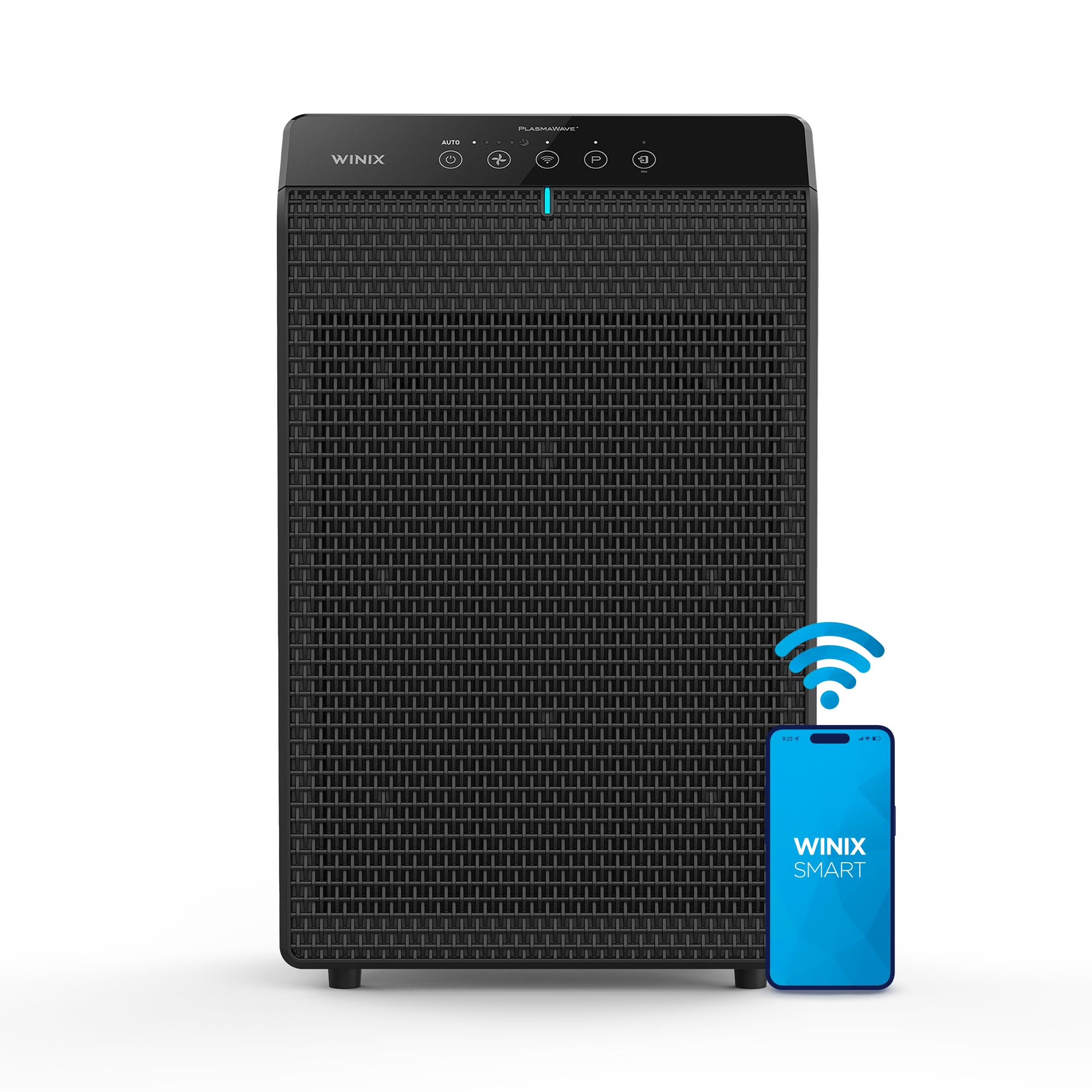
The WINIX 5520 is AHAM Verifide at 392 sq ft with a CADR rating that supports rooms up to 1,882 sq ft in one hour. That 4.8X air-change rate per hour makes it a legitimate choice for open-concept living spaces or large master bedrooms. The True HEPA filter captures 99.99% of particles as small as 0.01 microns, surpassing the standard 0.3-micron threshold by a wide margin.
WINIX includes a washable fine mesh pre-filter, an advanced odor control carbon filter, and PlasmaWave technology that can be toggled off if you prefer zero ionization. The built-in air quality sensor communicates real-time readings via color-coded LED (blue/orange/red), and the unit supports the Winix Smart App plus Alexa and Google Home voice control. Sleep mode automatically engages when the room darkens, dropping fan speed to a near-silent 23.5 dB.
Customers report that the 1-inch thick HEPA filter lasts a full 12 months, with total annual filter costs around — the lowest recurring expense of any model reviewed here. The primary downside is that at 75% speed or higher, the fan is noticeable; some users describe the airflow as less forceful than the previous generation unit they replaced. The PlasmaWave feature is controversial among ozone-sensitive buyers, but since it can be turned off independently, it doesn’t force a compromise on filtration performance.
Why it’s great
- Lowest annual filter cost at roughly per year
- Smart app, Alexa, and Google Home compatible
- Captures 99.99% of particles down to 0.01 microns
Good to know
- PlasmaWave ionization can be turned off if preferred
- High speed fan noise is noticeable at 75%+
- Wi-Fi connection draws standby power continuously
3. HEARBOBO K06
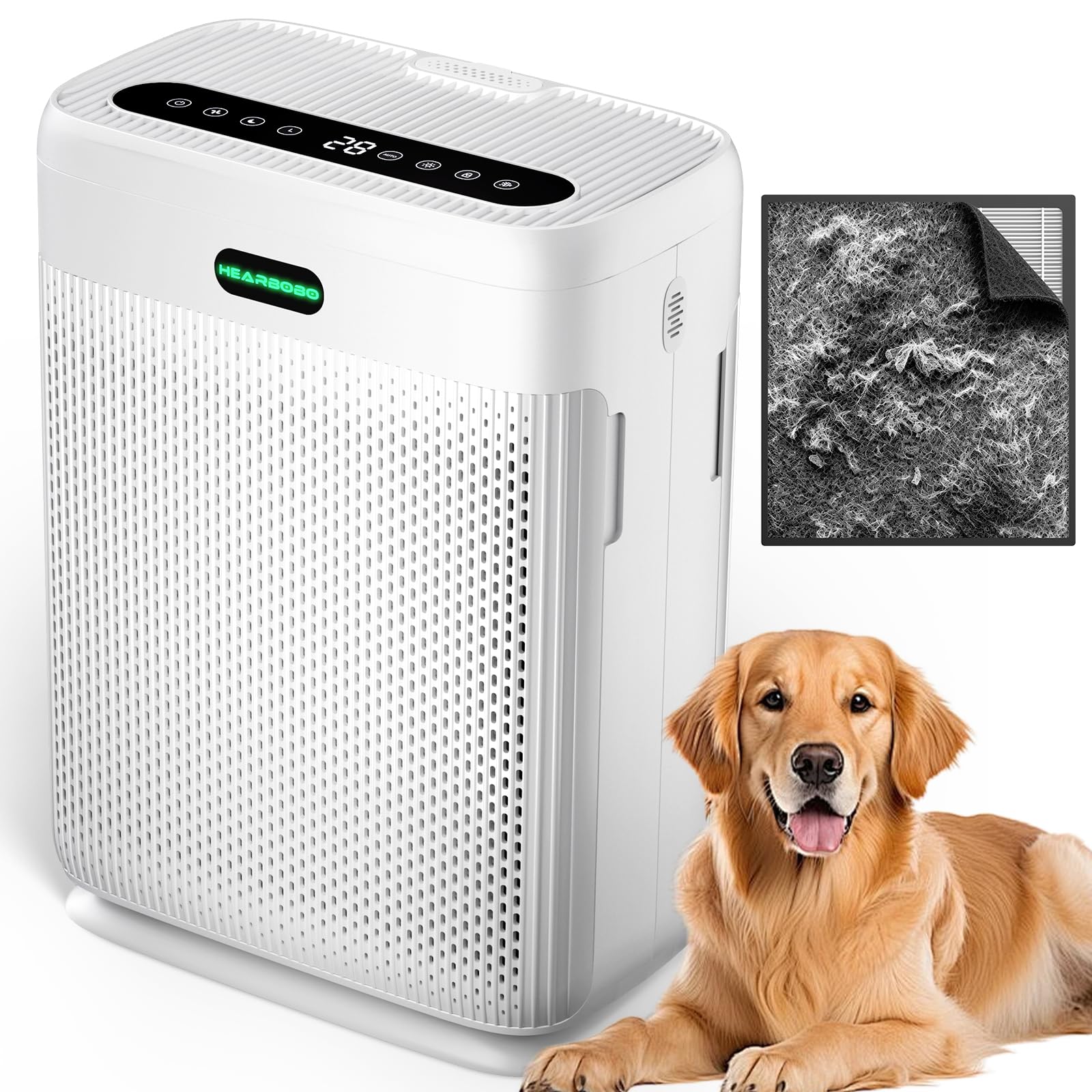
The HEARBOBO K06 uses a double-sided air intake design with two H13 HEPA filters, effectively pulling air from both sides simultaneously. This dual-fan system shortens purification time in rooms up to 3,000 sq ft — though real-world reviews peg its sweet spot at around 400 sq ft. The PM2.5 sensor displays real-time particle levels on the front panel and automatically adjusts fan speed between low, medium, and high based on readings.
The washable pre-filter can be vacuumed or rinsed, reducing the frequency of main filter replacements. Noise levels drop as low as 20 dB in sleep mode, which is virtually inaudible. The unit also includes a built-in aromatherapy diffuser pad and a dimmable night light with a breathing-light function, making it one of the few purifiers under $200 that doubles as a sensory sleep aid.
Certifications include CARB, FCC, ETL, and RoHS, ensuring compliance for California air quality standards. The replacement filter (B0F9NPZBGF) costs about and lasts 3–6 months depending on usage. The biggest critique is that the advertised 3,000 sq ft coverage requires the highest fan speed, which negates the quiet operation — keep expectations realistic for medium-sized rooms. Additionally, the washable layer is only the black cotton pre-filter; the main HEPA media cannot be washed.
Why it’s great
- Dual-sided air intake for faster room turnover
- 20 dB sleep mode and aromatherapy diffuser
- Real-time PM2.5 display with auto fan adjustment
Good to know
- 3,000 sq ft claim requires max fan speed
- Only the black cotton pre-filter is washable
- Filter replacements needed every 3–6 months
4. LEVOIT Core 300-P

The LEVOIT Core 300-P packs a 56W high-torque motor that delivers a CADR of 143 CFM for smoke, 153 CFM for dust, and 167 CFM for pollen. AHAM Verifide testing confirms it refreshes a 222 sq ft room 4.8 times per hour. The 3-in-1 filtration system includes a nylon pre-filter, high-efficiency activated carbon, and a HEPA-grade main filter that captures 99.97% of particles between 0.1 and 0.3 microns.
Sleep mode activates QuietKEAP Technology, dropping noise to just 24 dB — barely perceptible in a quiet bedroom. The display includes a timer for 2, 4, 6, or 8 hours and a check-filter indicator. Users consistently report noticeable reductions in dust accumulation and easier breathing for allergy sufferers within days. The Core 300-P also supports multiple Levoit replacement filter types — the Toxin Absorber for VOCs and the Smoke Remover for wildfire smoke — allowing you to customize filtration to your specific air quality problem.
The design is compact at 8.7 inches square and 14.2 inches tall, weighing 7.9 pounds, so it fits easily on a nightstand or desk. The main trade-off is that the 143 CFM CADR is lower than the Coway or WINIX options, making it better suited to smaller bedrooms or home offices rather than open living areas. Replacement filters run roughly – per year, and some users note that off-brand filters don’t fit as securely as the official Levoit replacements.
Why it’s great
- Compact footprint ideal for nightstands and desks
- Multiple specialized replacement filter options available
- Near-silent 24 dB sleep mode
Good to know
- Limited CADR for rooms above 250 sq ft
- Off-brand filters may not fit correctly
- No auto mode or air quality sensor
5. LEVOIT Core 200S-P

The LEVOIT Core 200S-P brings smart home integration to the budget end of the market. It supports Wi-Fi control via the Levoit app and is compatible with both Alexa and Google Assistant voice commands. The 360° air intake pulls from all sides, refreshing a 140 sq ft room 4.8 times per hour. The 3-in-1 filter captures 99.97% of dust, pollen, and dander down to 0.1 microns.
Noise levels bottom out at 27 dB in sleep mode — slightly louder than the Core 300-P but still well within whisper-quiet territory. The display-off button turns off all lights on the unit, which is a small but welcome detail for light-sensitive sleepers. The compact 8 x 5-inch footprint makes it the smallest unit in this review, fitting into cramped dorm rooms, nursery corners, or office bookshelves without dominating the space.
Users report effective smoke and odor filtration in rooms up to 200–300 sq ft, though the 140 sq ft CADR rating is conservative. The app provides filter life monitoring and timer scheduling. Some customers note a faint whine on the lowest fan setting, though this isn’t consistent across all units. The Core 200S-P lacks the higher-motor-power and multiple filter options of the Core 300-P, but for between and , the combination of smart controls and compact design is hard to beat in this price tier.
Why it’s great
- Wi-Fi, Alexa, and Google Assistant compatible
- Smallest footprint at 8 x 5 inches
- Display-off button for zero light disruption
Good to know
- CADR optimized for rooms under 150 sq ft
- Some units produce a faint whine on lowest speed
- No auto mode or air quality sensor
6. GermGuardian AC4825E

The GermGuardian AC4825E uses a True HEPA filter that captures 99.97% of particles as small as 0.1 microns, plus an optional UV-C light that further reduces airborne bacteria and viruses. Its 22-inch tower design circulates air through a 153 sq ft room every 12.5 minutes and a 743 sq ft space once per hour on high speed. The activated carbon filter addresses cooking and pet odors, and the washable pre-filter extends the life of the main HEPA.
Controls are refreshingly straightforward: a three-speed dial and a separate UV button. No Wi-Fi, no app — just a simple knob that lets you select low, medium, or high. The blue UV light is bright enough to be distracting at night; some users cover it with tape to darken the room.
Replacement filters (GermGuardian B) are widely available and typically last 6–8 months, costing about each. The unit has been on the market since 2011 with consistently positive reviews for reliability and ease of maintenance. The trade-offs are the absence of any smart features, a larger physical footprint (22 inches tall), and the lack of an auto mode — you have to adjust the speed manually based on perceived air quality. For buyers who want proven performance without digital extras, this is a solid, no-fuss option.
Why it’s great
- UV-C light adds germ reduction beyond HEPA filtration
- Simple dial controls with no app or Wi-Fi complexity
- Washable pre-filter reduces replacement frequency
Good to know
- Blue UV light is bright — may require covering at night
- High speed fan noise is louder than top-tier competitors
- No auto mode or air quality sensor
7. VEWIOR 2 Pack
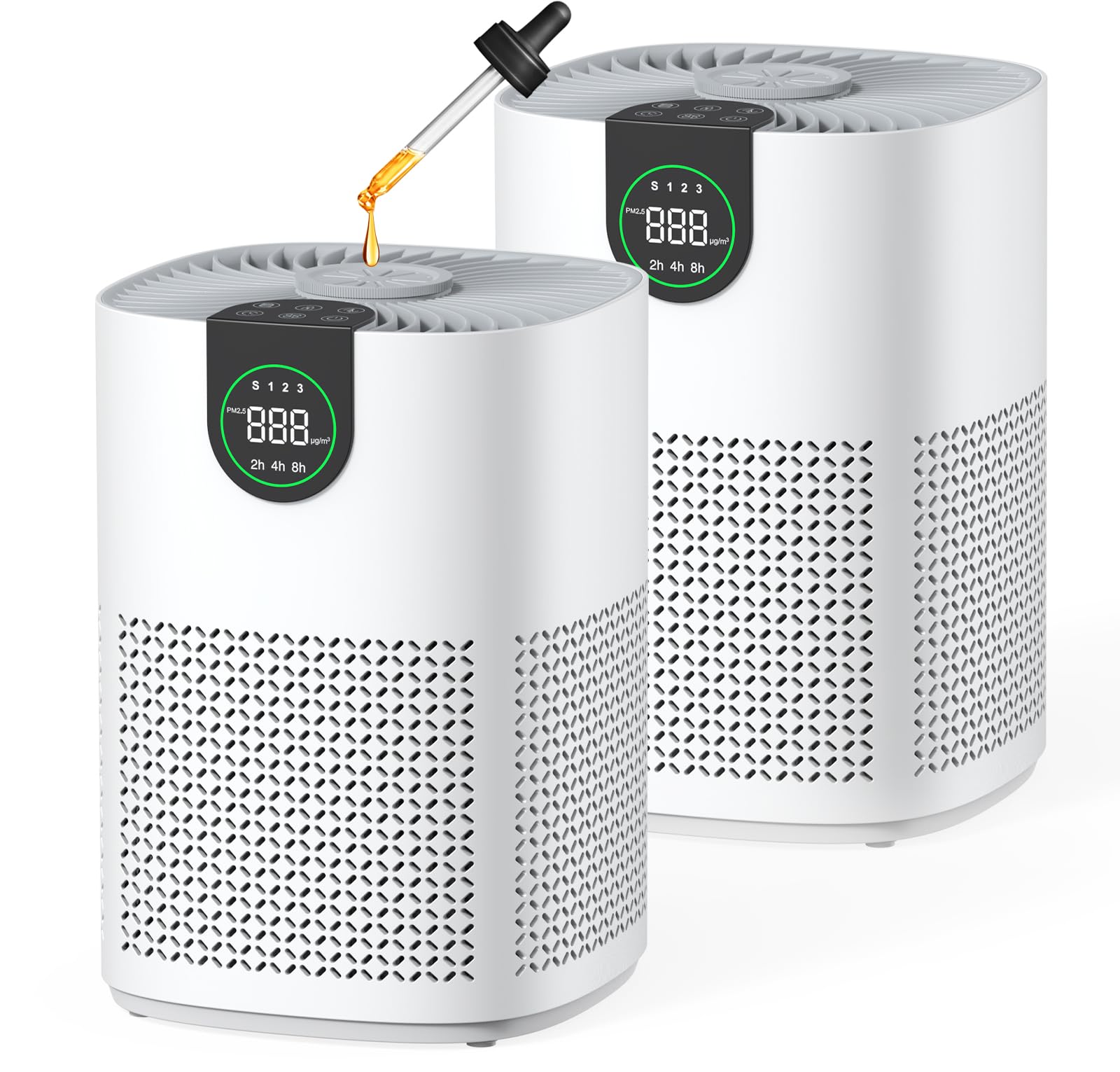
The VEWIOR 2 Pack delivers two H13 HEPA air purifiers for the price of a single mid-range unit, making it the most cost-effective entry point for multi-room coverage. Each unit uses a three-stage filtration system — washable pre-filter, HEPA, and activated carbon — and claims 360° air intake that refreshes a 1,200 sq ft room five times per hour. Real-world testing shows meaningful reductions in kitchen odors and visible dust in open-plan spaces of around 1,000 sq ft.
Each purifier includes a built-in PM2.5 sensor with real-time display and color-coded air quality light (red, yellow, green). Auto mode adjusts fan speed based on sensor readings, and sleep mode drops the noise to just 15 dB — the lowest claimed noise floor in this whole review. The aromatherapy pad on top lets you add essential oils for scent, and the child lock prevents accidental button presses from kids or pets.
The main caveat is that the HEPA filter itself is not washable — only the outer pre-filter can be cleaned via vacuum or rinse. The manual contains a typo suggesting “replace filter every 3-6 seconds,” which underscores a less polished documentation experience. On the highest of four speeds, the units produce noticeable fan noise, and there is no remote control. For buyers who need coverage in two separate rooms on a strict budget, this twin-pack offers respectable performance for the outlay, but it lacks the acoustic refinement and filter longevity of the single-unit premium picks above.
Why it’s great
- Two units for the price of one medium-range purifier
- 15 dB sleep mode — quieter than any single unit
- Built-in PM2.5 sensor with auto mode
Good to know
- HEPA filter itself is not washable — pre-filter only
- No remote control for adjusting settings from across the room
- High speed fan noise is louder than premium alternatives
FAQ
What size air purifier do I need for a 300 sq ft room?
Should I leave my air purifier on 24/7 or only when I’m in the room?
Does UV-C light in an air purifier actually kill viruses and bacteria?
How often should I replace the HEPA filter in a budget air purifier?
Final Thoughts: The Verdict
For most users, the air purifier under $200 winner is the Coway Airmega AP-1512HH because it combines the highest CADR in the class (233 CFM smoke) with a 24.4 dB sleep mode, washable pre-filter, and 12-month filter life — all at a price that leaves room in the budget for replacement filters. If you want smart home integration and the lowest recurring filter costs, grab the WINIX 5520. And for multi-room coverage on a strict budget, nothing beats the VEWIOR 2 Pack.