
Our readers keep the lights on and the weekend projects moving. As an Amazon Associate, I earn from qualifying purchases.
The leap from milk to solids marks a critical window for iron stores, gut adaptation, and oral motor development. At six months, a baby’s natural iron reserves begin to deplete, making iron-fortified cereal a nutritional priority, not just a texture experiment. The wrong choice — loaded with added sugars, rice-based heavy metals, or low bioavailability iron — can quietly undermine this transition.
I’m Rikta — the co-founder and writer behind FitlyFast. I have spent hundreds of hours cross-referencing ingredient labels, third-party purity certifications, and clinical feeding guidelines to isolate the formulas that actually support a six-month-old’s rapid growth phase without unnecessary fillers or marketing fluff.
This guide dissects seven contenders across iron levels, organic integrity, heavy metal testing, and texture adaptability so you can confidently select the right baby cereal for 6 month old without second-guessing the label.
How To Choose The Best Baby Cereal For 6 Month Old
Selecting a first cereal goes beyond flavor. You need to evaluate iron fortification levels, ingredient purity, texture flexibility, and third-party safety certifications. Below are the four factors that separate genuinely nutritious options from sugary impostors.
Iron Content & Bioavailability
At six months, a baby requires about 11 mg of iron daily. Look for cereals supplying at least 60% DV of iron per serving — this is the standard for brain development support. Avoid cereals that use reduced-iron blends or hide iron behind other fortifications.
Heavy Metal & Contaminant Testing
Rice-based cereals consistently test higher for arsenic, lead, and cadmium. Choose oat, barley, or multigrain bases that carry Clean Label Project Purity Awards or third-party heavy metal certifications. This single choice dramatically reduces cumulative toxin exposure during the first year.
Added Sugars & Artificial Ingredients
Many fruit-blend cereals sneak in added sugars, syrups, or concentrated fruit juices. The ideal cereal for a 6-month-old contains zero added sugar — sweetness should come only from whole fruit puree, if present. Check the ingredient list for anything ending in “-ose” or syrup.
Texture & Mixability
A six-month-old’s oral motor skills are still developing. The cereal should mix smoothly with breast milk, formula, or water to a thin, easy-to-swallow consistency. Avoid gritty or clumping textures that frustrate early spoon-feeding attempts.
Quick Comparison
On smaller screens, swipe sideways to see the full table.
| Model | Category | Best For | Key Spec | Amazon |
|---|---|---|---|---|
| Else Nutrition Super Cereal | Plant Protein | Heavy metal safety & complete protein | Clean Label Purity Award | Amazon |
| Earth’s Best Organic Banana Raspberry | Organic Grain Puree | Organic whole grain blend | Whole grain barley base | Amazon |
| Amara Oats & Berries | Freeze-Dried | Customizable texture on the go | Mix with breastmilk or formula | Amazon |
| Serenity Kids Meats & Herbs | Savory High Protein | 5g protein per pouch, no sugar | Veggie-first, meat puree | Amazon |
| Beech-Nut Variety Pack | Non-GMO Purees | Mixed fruit/veggie variety | Protein, iron & prebiotic fiber | Amazon |
| Gerber Apple Mango Oatmeal | Fruit-Oat Blend | High iron & vitamin C | 60% DV iron per tub | Amazon |
| Gerber Pear Cinnamon Oatmeal | Fruit-Oat Blend | No artificial flavors, baby-favorite taste | 8g whole grains per serving | Amazon |
In‑Depth Reviews
1. Else Nutrition Super Cereal (Banana-High Iron)
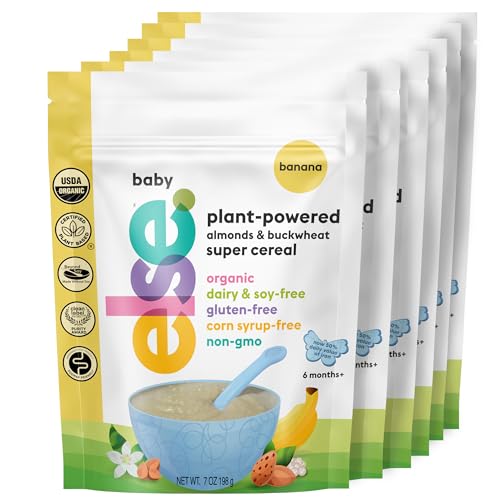
Else Super Cereal is the first US baby cereal to earn the Clean Label Project Purity Award, meaning it is rigorously tested for over 400 contaminants including heavy metals, pesticides, and BPA. This is non-negotiable for parents concerned about arsenic in rice-based cereals — Else uses an organic almond and buckwheat base, completely rice-free. Each serving delivers high iron plus all nine essential amino acids from plant protein, a rarity in the baby cereal aisle.
The banana flavor is mild, not artificially sweet. You can mix it with breast milk, formula, or water, and it dissolves into a silky, non-gritty texture that six-month-olds accept readily. Some reviewers noted that the fine powder can cause constipation if used more than twice daily, so start with one serving and monitor stool frequency.
At a premium tier, this is the gold standard for parents who prioritize purity certification and plant-based nutrition. The 6-pack format works well as a pantry staple, though the shorter 2-month shelf life after opening means you shouldn’t stockpile ahead of schedule.
Why it’s great
- Only US baby cereal with Clean Label Purity Award
- Rice-free, organic almond & buckwheat base
- High iron with complete plant protein
Good to know
- Premium price per serving
- Can cause constipation if overfed
- Shorter 2-month shelf life after opening
2. Earth’s Best Organic Banana Raspberry Whole Grain Barley
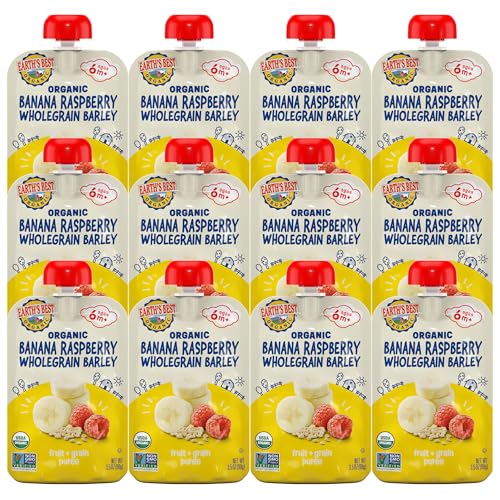
Earth’s Best strikes a reliable balance between organic certification, whole grain nutrition, and child-friendly flavor. The Banana Raspberry blend uses whole grain barley as its base, offering a lower heavy-metal risk profile compared to rice cereals. Each 3.5 oz pouch contains no added sugars or artificial preservatives, and the resealable cap makes it practical for staggered feeding sessions.
Parents report that the banana aroma is pronounced enough to entice even picky six-month-olds, and the texture is smooth without being watery. It mixes well when spoon-fed directly from the pouch or thinned with a splash of breast milk. The variety pack includes 12 pouches, making it a strong mid-range value proposition for daily use.
While it lacks the heavy metal certification of Else or Serenity Kids, the barley base and organic sourcing put it well ahead of conventional rice cereals. Some toddlers continue to enjoy these pouches well into their second year, extending its useful lifespan beyond the initial solids phase.
Why it’s great
- Organic whole grain barley – lower heavy metal risk
- No added sugars or artificial preservatives
- Resealable pouch for on-the-go feeding
Good to know
- No third-party heavy metal certification
- Some pouches can be thick for early eaters
3. Amara Organic Oats & Berries
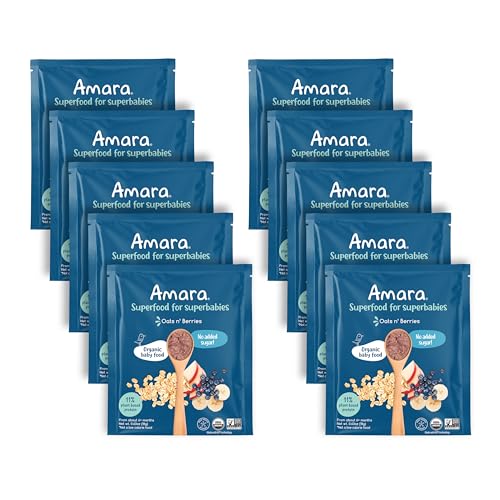
Amara uses a patented freeze-drying process that avoids the repeated high-heat treatment found in jarred and pouch baby foods. The result is a cereal that retains the fresh taste and nutrient density of whole organic oats, apple, banana, and blueberries — with no additives or preservatives. You control the texture by mixing with breast milk, formula, or water, making it ideal for babies who need a thinner or thicker consistency as they progress.
Each 10-pouch box is lightweight and shelf-stable, perfect for travel or diaper bag storage. Many parents noted that their babies initially paused at the unique texture compared to traditional purees, but quickly adapted within a few feedings. The unsweetened flavor profile is subtle, so expect less overt “sweetness” than Gerber fruit blends.
A standout advantage: Amara tests for heavy metals, giving it a safety edge over many mainstream options. The price per serving lands in the mid-range, but the ability to customize hydration makes it a versatile tool for transitioning from bottle to spoon.
Why it’s great
- Freeze-dried for better nutrient retention
- Customizable texture – mix with milk or water
- Lightweight & shelf-stable for travel
Good to know
- Unique texture may require adjustment period
- Mild flavor may not appeal to all babies
4. Serenity Kids Meats & Herbs Variety Pack
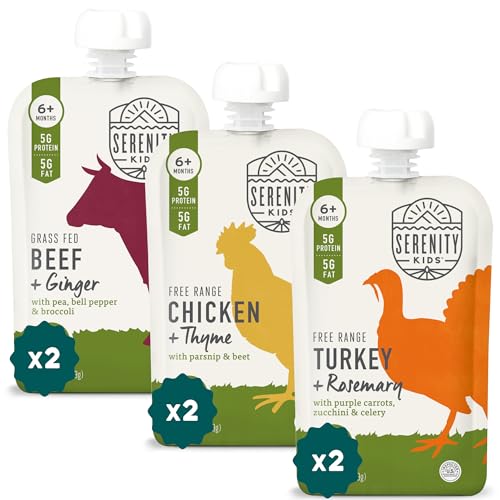
Serenity Kids flips the sweet-fruit-pouch script with a savory Meats & Herbs lineup that delivers 5g of quality protein per pouch — an outlier in the baby cereal and puree space. Each pouch leads with a vegetable (parsnip, carrot, or sweet potato) before adding organic meat like chicken or turkey, plus herbs. This profile mimics the macronutrient balance of breast milk far more closely than fruit-heavy blends.
The BPA-free packaging and organic, no-sugar formulation make it a smart choice for parents who want to introduce umami flavors early. Reviewers consistently highlight that even young six-month-olds eagerly accept the chicken with thyme and turkey with sage varieties. The consistency is smooth but not runny, and the portion size (3.5 oz) is appropriate for a single feeding.
At a premium per-pouch cost, Serenity Kids is best used as a protein-rich complement rather than a daily staple. The lack of grain-based carbs means you may want to pair it with a traditional oatmeal or barley cereal for a complete meal.
Why it’s great
- 5g protein per pouch – rare in baby food
- Savory, veggie-first ingredients – no added sugar
- BPA-free and organic meat sources
Good to know
- High per-pouch cost
- No grain or carb component for a full meal
5. Beech-Nut Variety Pack (Protein, Iron & Prebiotic Fiber)

Beech-Nut’s 18-count variety pack delivers three targeted nutrition lines — Protein & Fiber, Iron & Zinc, and Prebiotic Fiber — covering the diversity a six-month-old needs across fruit, vegetable, and yogurt blends. The pouches are free of artificial preservatives, colors, and flavors, and the ingredients are non-GMO with no nuts or soy, reducing allergy crossover risk.
The texture is consistently smooth, neither thick nor watery, and the flavor profiles (apple, yogurt, raspberry, purple carrot, blueberry, spinach, sweet potato) provide exposure to a range of tastes early on. Parents who started their babies on Beech-Nut at six months report high acceptance with minimal waste. The 18-count box offers strong per-pouch economics compared to the premium brands.
While Beech-Nut does not carry a Clean Label or heavy metal certification like Else or Amara, their ingredient transparency and absence of added sugars make them a solid mid-tier choice for budget-conscious families who still want clean nutrition.
Why it’s great
- 18 pouches across 3 targeted nutrition lines
- Non-GMO, no artificial preservatives
- Smooth texture with high baby acceptance
Good to know
- No third-party heavy metal certification
- Yogurt-based pouches may not suit all allergies
6. Gerber Apple Mango Oatmeal Cereal Puree Tubs
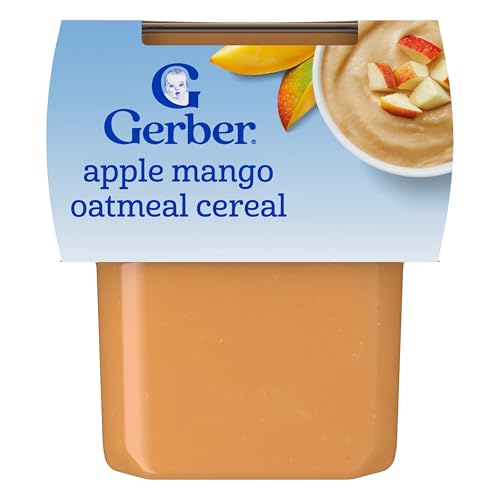
Gerber’s Apple Mango Oatmeal delivers 60% DV of iron per tub — meeting the benchmark for brain development support — plus 45% DV of vitamin C, which enhances iron absorption. The tub format (16-pack) is convenient for parents who want a pre-mixed, no-prep option. The flavor is naturally sweet from apple and mango, with no added sugars, though the oatmeal base does include some whole grains (8g per serving).
However, Gerber labels this Stage 2 food for 9+ months on the packaging despite the 6+ month usage in practice. The texture is thicker than Stage 1 purees, so some six-month-olds may need initial thinning with breast milk or formula. Many parents report high baby enthusiasm for the apple-mango combination, making it a reliable backup when a baby refuses blander cereals.
The main drawback is the absence of organic certification or heavy metal testing. For families prioritizing purity certification, the Gerber line falls short, but for iron fortification and convenience at a budget-friendly price, it performs well.
Why it’s great
- 60% DV iron per serving
- Vitamin C for enhanced iron absorption
- Convenient pre-mixed tubs
Good to know
- Labeled Stage 2 for 9+ months
- No organic or heavy metal certification
7. Gerber Pear Cinnamon Oatmeal Cereal Tubs
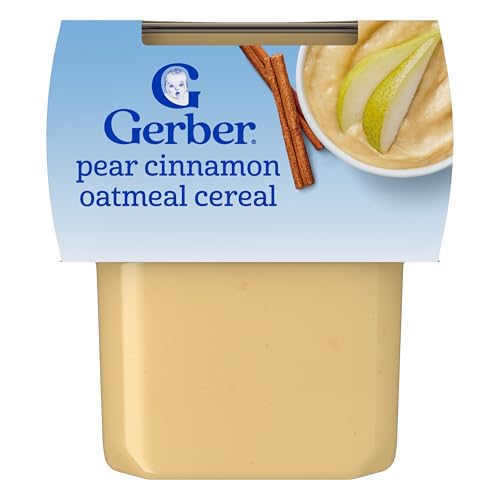
The Pear Cinnamon Oatmeal is one of the most consistently well-reviewed Gerber flavors, with multiple parents reporting that even picky toddlers who refuse other brands will accept this blend. It supplies 60% DV of iron, 8g whole grains, and 45% DV vitamin C per serving, plus zinc and B vitamins. The brand explicitly states no added sweeteners and no artificial flavors, keeping the ingredient list clean for a mainstream product.
The cinnamon note is subtle, not overpowering, and the pear base gives a gentle sweetness without resorting to fruit concentrates. Parents appreciate that the tub format (16-pack) is easy to portion and pack for daycare or trips. The primary drawback is again the lack of organic certification — families who want USDA Organic or Clean Label verification should look to Else, Amara, or Earth’s Best.
For parents on a tighter budget who still want iron-fortified, no-artificial-ingredient cereal, the Pear Cinnamon Oatmeal delivers consistent feeding success at a low cost per serving. Many reviewers note their babies continued eating these well into the second year.
Why it’s great
- Top-rated flavor among babies and toddlers
- 60% DV iron with 8g whole grains
- No artificial flavors or added sweeteners
Good to know
- Not organic or third-party tested for heavy metals
- Labeled 9+ months on packaging
FAQ
Can I mix baby cereal with breast milk or formula?
How do I know if my 6-month-old is ready for cereal?
Is rice cereal safe for a 6-month-old?
Why does my baby refuse the cereal I bought?
How much cereal should I feed my 6-month-old per day?
Final Thoughts: The Verdict
For most families, the baby cereal for 6 month old winner is the Earth’s Best Organic Banana Raspberry because it combines organic whole grain barley, no added sugars, and a resealable pouch format at a mid-range price that balances safety and value. If your priority is absolute heavy metal purity and plant-based protein, grab the Else Nutrition Super Cereal. And for parents who want a protein-rich, savory alternative to sweet fruit blends, nothing beats the Serenity Kids Meats & Herbs Pack.