
Our readers keep the lights on and the weekend projects moving. As an Amazon Associate, I earn from qualifying purchases.
You might not see it, but the air inside your home can be two to five times more polluted than the air outside. An AQI monitor translates invisible threats—from off-gassing furniture to the CO₂ cloud in your home office—into numbers you can actually act on.
I’m Rikta — the co-founder and writer behind FitlyFast. I’ve spent hundreds of hours analyzing the specifications, sensor types, and real-world testing patterns across the current market of indoor air quality detectors to separate the tools from the toys.
Whether you suffer from seasonal allergies, work in a home office, or simply want to sleep better, this guide walks through the measurement science and build quality you need to find the best aqi monitor for your specific living environment.
How To Choose The Best AQI Monitor
Not every monitor measures the same pollutants or uses the same sensor grade. Before you click “add to cart,” confirm the device targets the specific air quality hazards you face — stale CO₂ in a small office, dust particles from a pet, or chemical VOCs from a new paint job.
Sensor Technology: NDIR vs. Electrochemical vs. Laser
The sensor is the engine. For CO₂, a true NDIR (non-dispersive infrared) sensor is far more stable and long-lived than cheaper chemical-based alternatives. For particles, a laser-based sensor gives you PM1.0, PM2.5, and PM10 counts in real time. Electrochemical sensors handle formaldehyde (HCHO) and broader TVOC readings, but they drift faster and need periodic fresh-air calibration.
Display Readability and Alert Systems
A 2.8-inch screen might work for a nightstand, but a 7-inch color display lets you glance from across the room during a workday. Look for color-coded AQI scales (green to red), adjustable brightness for bedrooms, and an audible alert system that actually wakes you when CO₂ crosses 1000 ppm. A mute button for those alerts is non-negotiable for light sleepers.
Connectivity and Data History
Wi-Fi-enabled monitors like the GoveeLife allow you to track historical data through an app, export CSV reports for your doctor, or trigger smart fans when CO₂ spikes. If you value privacy or simplicity, a plug-and-play unit without an app eliminates the risk of connectivity drops. Battery life matters if you plan to move the monitor between rooms — anything under eight hours of cordless use limits real portability.
Quick Comparison
On smaller screens, swipe sideways to see the full table.
| Model | Category | Best For | Key Spec | Amazon |
|---|---|---|---|---|
| U UNNI 7.5″ Display | Mid-Range | Glanceable whole-room display | Sensirion Swiss sensor; ±5% CO₂ accuracy | Amazon |
| GoveeLife H5140 | Mid-Range | Smart home integration & app data | SCD4x NDIR sensor; 5-second refresh | Amazon |
| YNAK 16-in-1 (7″) | Mid-Range | Comprehensive pollutant detection | 0.001 accuracy external sensors | Amazon |
| EG Air Quality Monitor | Premium | Lab-grade HCHO & TVOC analysis | Electrochemical + laser sensor | Amazon |
| LifeBasis 11-in-1 | Budget-Friendly | Cost-effective multi-parameter starter | NDIR CO₂ + laser PM; 2500mAh battery | Amazon |
| KDWKD AK23CA | Budget-Friendly | Portable check for VOCs in new builds | 9-hour battery; HCHO + TVOC sensor | Amazon |
| Shenzhen Langtao 16-in-1 | Premium | All-day cordless whole-home tracking | 3500mAh battery; 12-hour runtime | Amazon |
In‑Depth Reviews
1. U UNNI 7.5″ Air Quality Monitor
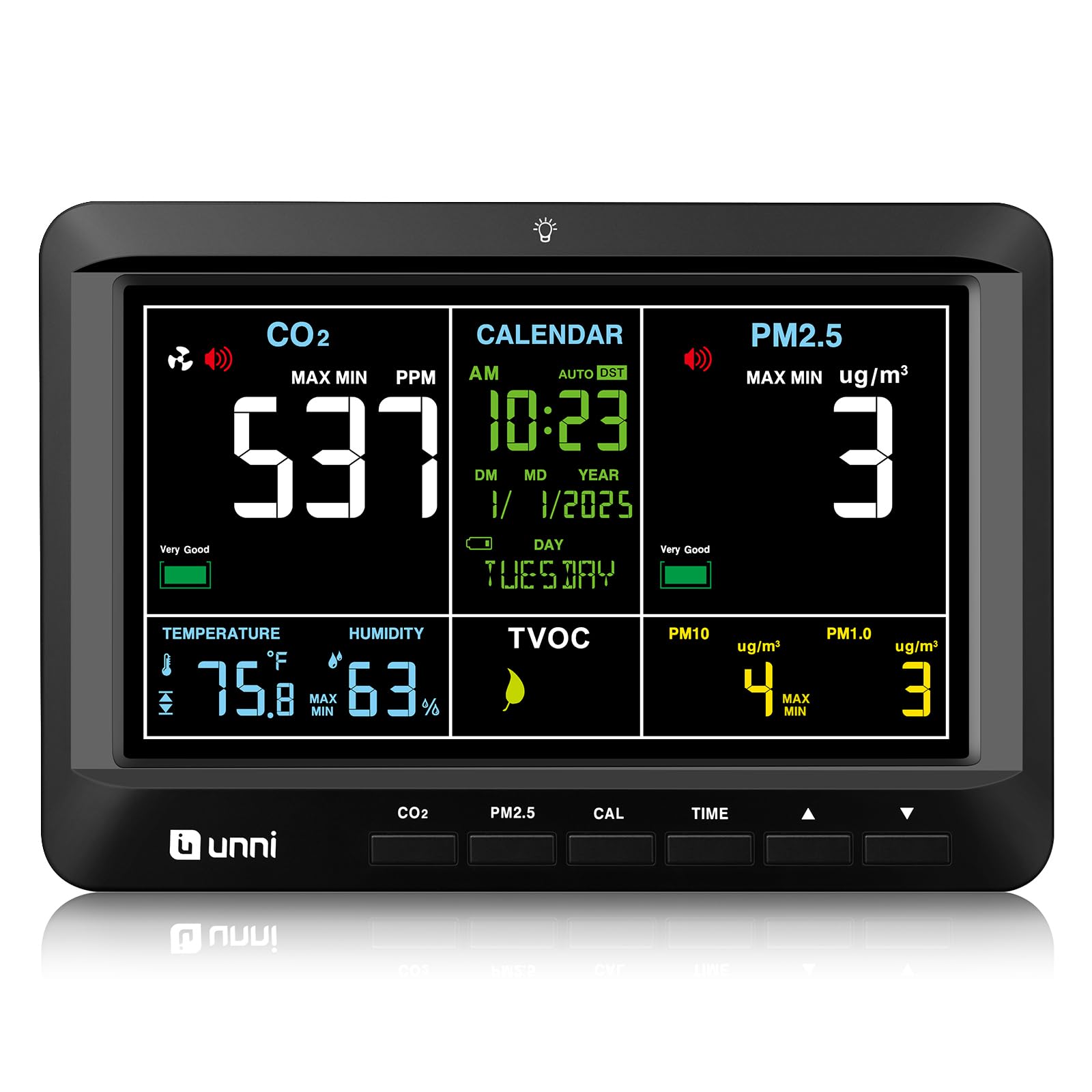
The U UNNI hits the sweet spot of screen size and sensor reputation. Its 7.5-inch color-coded display is large enough to read from across a living room, showing CO₂, PM2.5, PM10, TVOC, temperature, and humidity simultaneously with no menu scrolling. The Swiss-made Sensirion sensor delivers CO₂ readings within ±50 ppm +5%, which is the benchmark for home-grade accuracy.
Setup is genuinely plug-and-play — no Wi-Fi, no app, no account. The 180-second warm-up is standard, and the automatic calibration algorithm maintains accuracy over time without requiring you to take it outdoors. The three-level backlight brightness means the screen won’t disrupt a dark bedroom, and the mute button quiets alarms during a meeting or sleep.
Users consistently report that the monitor catches PM spikes from cooking and ventilation-driven CO₂ drops from 950 ppm to 500 ppm within minutes. The only ergonomic complaint is that the bottom bracket protrudes when wall-mounted, making it sit slightly off the wall. If you want a no-hassle glance-and-react monitor for the family room or office, this is the one.
Why it’s great
- Large, readable 7.5-inch display with intuitive color coding
- High-precision Sensirion sensor with auto-calibration
Good to know
- Wall mount leaves a visible gap at the bottom
- No Wi-Fi or historical data logging
2. GoveeLife Smart Air Quality Monitor H5140
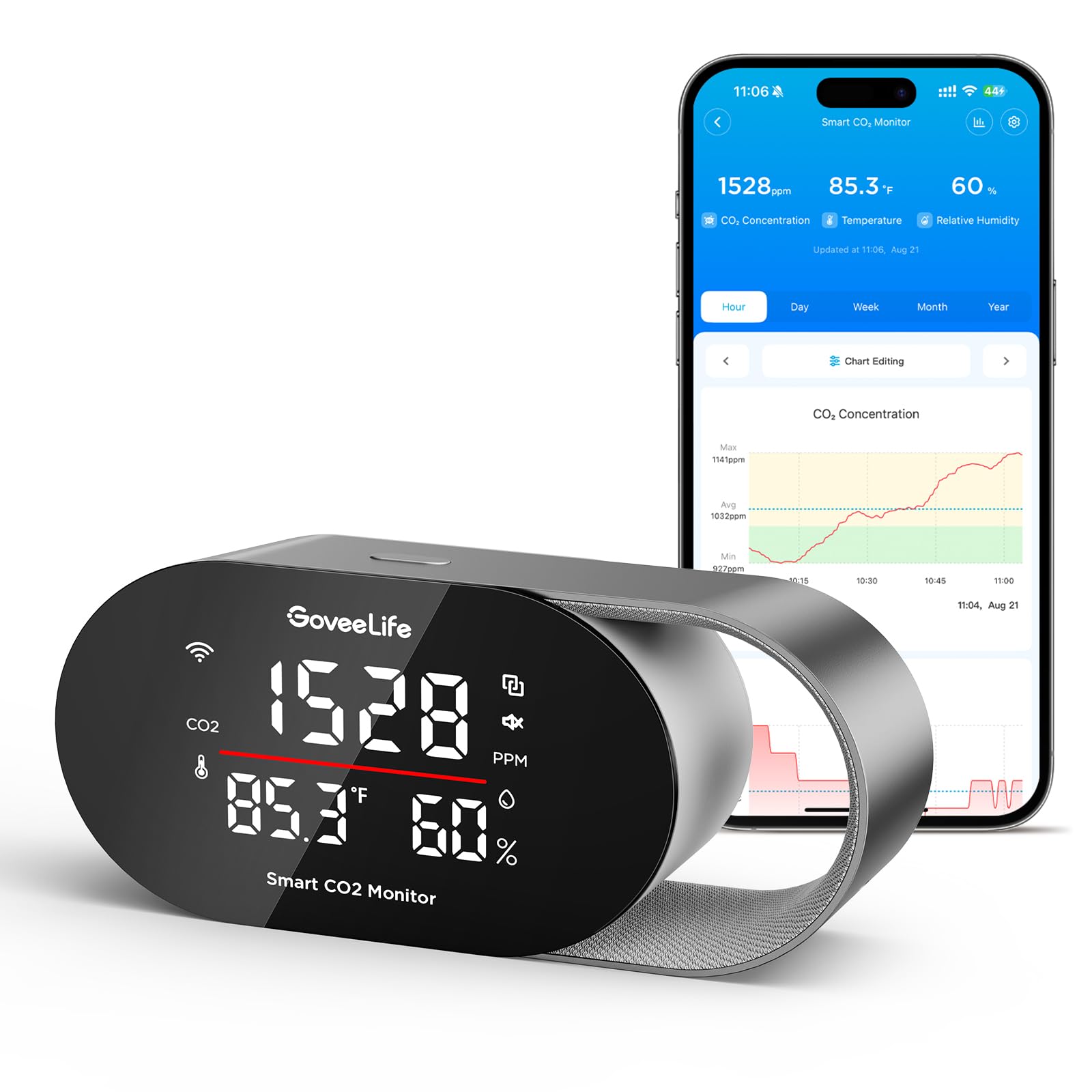
If you want data you can actually do something with, the GoveeLife is the most connected monitor here. It uses the SCD4x photoacoustic NDIR sensor — the same chip found in pro-level CO₂ meters — with a 5-second refresh rate and built-in pressure compensation for altitude. Accuracy is ±40 ppm +5%, making it the tightest CO₂ spec in this lineup.
The triple alert system (buzzer, app notification, email report) is a genuine differentiator for families with a baby or elderly member. The programmable LED bar and automatic day/night brightness schedule via the GoveeLife app eliminate light pollution in the nursery. You can also export two years of historical CSV data and link the monitor to Alexa or Google Assistant for voice queries and smart-fan triggers.
This unit does not measure PM2.5 — it is purpose-built for CO₂, temperature, and humidity. Users report that the Wi-Fi connection can be spotty if the monitor is placed far from the router, and the AC-only power (no battery) means you can’t easily move it room to room. For a dedicated desk or tabletop station, though, it’s the gold standard for evidence-based ventilation habits.
Why it’s great
- Top-tier SCD4x NDIR sensor with pressure compensation
- App-based data export, smart home linkage, and email alerts
Good to know
- No particulate measurement — CO₂ and humidity only
- Requires continuous AC power; no battery
3. YNAK 16-in-1 Air Quality Monitor (7″)
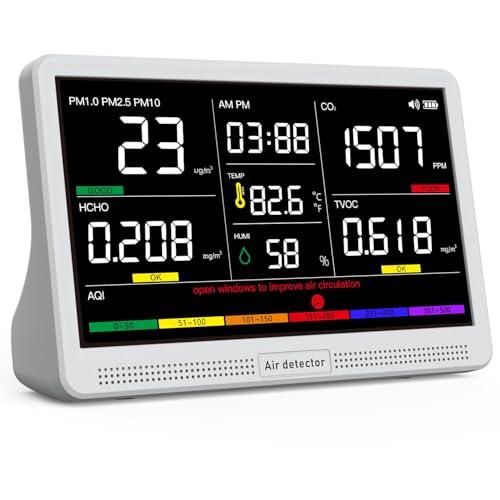
The YNAK packs 16 measurement functions into a single 7-inch LED display, covering CO₂, PM2.5, PM1.0, PM10, HCHO, TVOC, temperature, humidity, and AQI all at once. Its external high-precision sensors boast 0.001-unit resolution, which is unusual at this price tier and allows the monitor to catch subtle formaldehyde changes from cleaning products or new furniture.
The seven distinct AQI alert buzzers can be silenced with a mute button, and the three brightness settings keep the screen visible without glare. No app or Wi-Fi is required, appealing to users who want privacy and simplicity. The 2500mAh battery provides up to 8 hours of cordless use, so you can walk the monitor from the kitchen to a basement workshop to check for VOC spikes.
Reviewers confirm the monitor is sensitive enough to detect vape smoke and UV printer fumes within seconds, though a few experienced a delay with strong chemical cleaners initially showing green. The screen is bright enough to read in direct sunlight, and the AQI smiley-face indicator makes it dead-simple for any family member to interpret. The lack of Wi-Fi data export is the only real limitation for number-crunchers.
Why it’s great
- Broad 16-in-1 detection including HCHO, TVOC, and PM10
- Bright 7-inch LED readable in sunlight with battery portability
Good to know
- Can show delayed response to some chemical aerosols
- No app connectivity or data logging
4. EG Air Quality Monitor (EGVOC)

The EG monitor is the most science-forward unit in this roundup. It uses a dedicated electrochemical sensor for formaldehyde and TVOC plus a laser particle counter for PM2.5, and its built-in fan draws ambient air into the chamber for real-time sampling. The included 20-page eBook on gas hazards shows this is designed for users who want to understand the chemistry, not just glance at a color.
Outdoor calibration is essential before first use — a step many budget monitors skip. Once calibrated, the EG correctly identified high TVOC levels in a furniture warehouse and red-flagged HCHO in a new construction closet. The 2200mAh battery runs about two days of continuous monitoring, though heavy users report needing a charge after just a few hours of active sampling with the fan running.
The 2.8-inch color LCD is clear but small compared to the 7-inch displays in this list, and the plastic chassis feels noticeably lighter. A few units showed sensor drift after two to three months, though the manufacturer provided a full refund without pushback. This is a monitor for the curious investigator — not for passive wall mounting.
Why it’s great
- Separate electrochemical and laser sensors for accurate HCHO + TVOC readings
- Built-in fan draws air quickly for real-time sampling
Good to know
- Battery drains fast during continuous fan operation
- Small 2.8-inch screen requires closer viewing distance
5. LifeBasis 11-in-1 Air Quality Monitor

The LifeBasis proves that you don’t need to spend triple digits for legit multi-parameter detection. It combines an NDIR infrared CO₂ sensor, a laser particle sensor, a semiconductor sensor for TVOC, and a photoelectric sensor for HCHO — covering AQI, PM1.0, PM2.5, PM10, CO₂, TVOC, HCHO, temperature, and humidity. The 2500mAh battery delivers 11 to 12 hours of continuous use, making it genuinely portable for a full day of room-hopping.
Users praise the color-coded four-grade alert system (green to red) and the audible ticking alarm when any pollutant exceeds safe levels. One reviewer noted that PM2.5 readings closely matched a PurpleAir reference monitor, which is high praise for a budget device. The flat, pocketable design (6.3 inches tall, 6.1 ounces) fits in a jacket or bag for travel use.
Manual CO₂ calibration outdoors for 30 minutes is required for peak accuracy — a step some users skip. The monitor lacks Wi-Fi or Bluetooth, so there is no historical data or app support. The faint internal fan hum is noticeable in a quiet room but not disruptive. If you want maximum sensor coverage for the lowest entry cost, this is the pragmatic pick.
Why it’s great
- Four sensor types cover CO₂, PM, TVOC, and HCHO on a budget
- Excellent battery life for portable whole-home use
Good to know
- Requires outdoor manual calibration for best CO₂ accuracy
- No Wi-Fi, app, or data logging
6. KDWKD AK23CA Air Quality Monitor
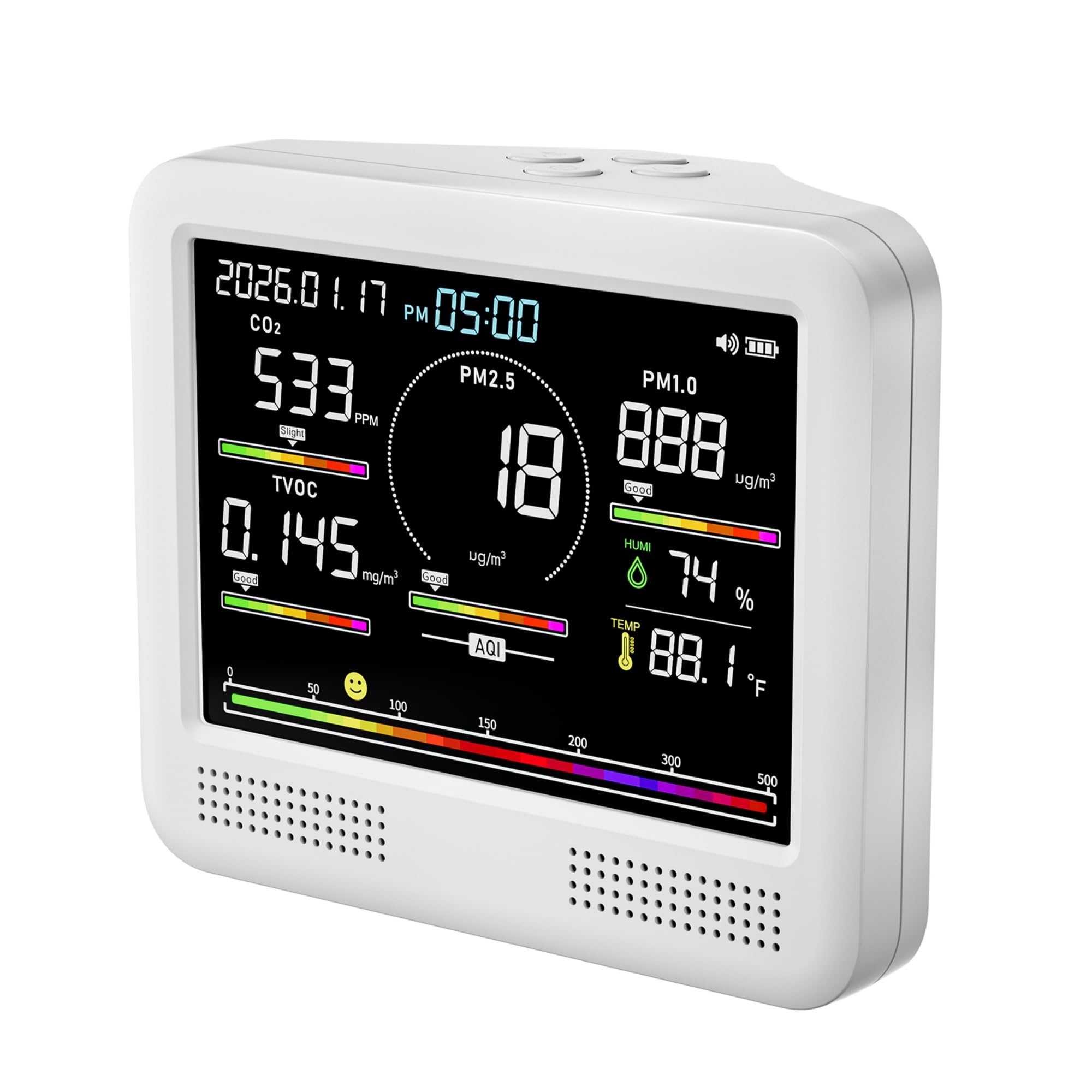
The KDWKD is purpose-built for the post-renovation or new-construction home where formaldehyde and TVOC off-gassing are the primary concerns. It tracks CO₂, PM0.3 through PM10, HCHO, TVOC, temperature, and humidity on a compact display, with a 9-hour rechargeable battery that lets you run a monitoring circuit from the nursery to the basement without hunting for an outlet.
Its electrochemical sensor is sensitive enough to flag VOCs from fresh paint and new flooring within minutes, and the audible alarm provides an immediate heads-up. The ABS enclosure is lightweight and the design is clean enough for a desk or countertop. Users moving into a newly built house have found it invaluable for deciding when to ventilate versus when to run an air purifier.
The build quality is solid for the price tier, though the user interface is basic — no color-coded AQI gradations, just numerical readouts. A few reviewers’ feedback was mixed due to lid fit issues on unrelated products, so be sure to buy directly from the KDWKD listing. For spot-checking VOCs during the critical off-gassing period, this monitor earns its carry.
Why it’s great
- Good HCHO and TVOC sensitivity for new-construction monitoring
- 9-hour battery allows portable room-to-room VOC sweeps
Good to know
- Basic numerical interface lacks color-coded AQI scales
- Mixed user reviews due to unrelated product confusion
7. Shenzhen Langtao 16-in-1 (3500mAh)
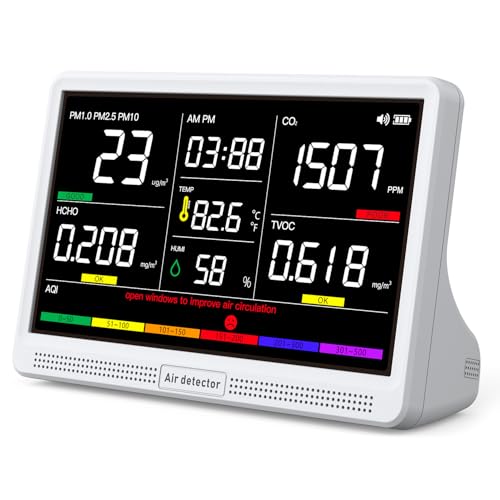
This Langtao unit is the direct upgrade of the YNAK monitor, sharing the same 16-in-1 detection profile (CO₂, PM2.5, PM1.0, PM10, HCHO, TVOC, temperature, humidity, AQI) but swapping the standard battery for a 3500mAh pack that extends cordless runtime to 12 hours. That extra capacity makes a real difference for users who want to leave the monitor running in a bedroom overnight and still have juice to move it to the living room the next morning.
The 7-inch LED screen is identical in layout and brightness to the YNAK, displaying all metrics on a single panel with three adjustable backlight levels. The external high-precision sensors with 0.001-unit resolution provide fine granularity for formaldehyde and TVOC detection. Seven distinct alert buzzers cover each measurement category, and the mute button silences the noise while keeping visual warnings active.
Reviewers confirm fast detection of vape smoke, cooking fumes, and UV printer off-gassing, with a delay of about 3 to 7 seconds compared to professional equipment. Like the YNAK, the non-app nature keeps things simple but limits data tracking. The weight increase (1.52 pounds) reflects the bigger battery. If you need a monitor that keeps running past the dinner rush, this extended-life variant is the clear answer.
Why it’s great
- 3500mAh battery delivers full 12-hour cordless monitoring
- High-resolution external sensors for HCHO and TVOC
Good to know
- Slightly heavier (1.52 lbs) than the standard 16-in-1
- No app or Wi-Fi for data export
FAQ
How often should I calibrate my AQI monitor?
What is a dangerous CO₂ level for a bedroom?
Can an AQI monitor detect mold?
Final Thoughts: The Verdict
For most users, the best aqi monitor winner is the U UNNI 7.5″ Display because it combines a Swiss-made Sensirion sensor with a large, glanceable screen and zero setup friction. If you want smart home connectivity and deep historical tracking, grab the GoveeLife H5140. And for comprehensive all-day portable detection at a steal, nothing beats the LifeBasis 11-in-1.