
Our readers keep the lights on and the weekend projects moving. As an Amazon Associate, I earn from qualifying purchases.
You’re paying for channels that are just floating through the air for free — every major network from ABC to Fox is beaming a signal straight to your roof, waiting for an antenna that can actually catch it. The difference between picking up a crisp 1080p picture or fighting pixelation is all about matching the right antenna to the specific broadcast frequencies your local towers use and the obstacles your home puts in their way.
I’m Rikta — the co-founder and writer behind FitlyFast. I’ve spent countless hours analyzing signal reception specs, real-world customer performance reports, and the construction quality of dozens of OTA antennas to find which ones truly deliver a stable, clear picture for local channels.
In this guide, I break down the top contenders based on range, build material, amplification, and real-world installation ease so you can find the perfect antenna for hdtv local channels.
How To Choose The Best Antenna For HDTV Local Channels
Not every antenna works the same way because broadcast signals travel at different frequencies and your home’s construction acts as a filter. Before clicking buy, you need to understand where your local towers are, what frequencies they use, and whether your roof or attic can give you a clear line of sight.
Know Your Broadcast Frequencies: VHF vs. UHF
Most local channels after the digital transition still broadcast on UHF (channels 14-51), but many major networks like ABC and NBC still use VHF (channels 2-13). A UHF-only antenna will miss VHF stations entirely, while a combined VHF/UHF design picks up both. Check your local station list at sites like RabbitEars.info before buying to see which frequencies matter in your area.
Range Claims vs. Reality
A manufacturer’s claimed range of 60 or 200 miles is measured under ideal open-air conditions with zero obstructions. Real-world reception is dominated by hills, trees, buildings, and the materials in your own walls and roof. A 60-mile rated antenna in a suburban area with moderate tree cover often performs like a 20-mile antenna. Buy based on the physical design (directional vs. multi-directional) and the quality of the amplifier rather than the big number on the box.
Amplification: When It Helps and When It Hurts
Amplifiers boost a weak signal, but if you’re within 15-20 miles of a tower, an amplifier can overload your TV tuner with too much signal, causing dropouts. In those cases, a passive (unamplified) antenna or one with a switchable amplifier like the Mohu Leaf’s Jolt Switch gives you control. In fringe areas 40+ miles out, a quality low-noise amplifier is essential to overcome cable run loss.
Quick Comparison
On smaller screens, swipe sideways to see the full table.
| Model | Category | Best For | Key Spec | Amazon |
|---|---|---|---|---|
| Antennas Direct ClearStream MAX-V | Multi-Directional | Overall Balance | 60+ mile range, UHF/VHF | Amazon |
| Antennas Direct Element | Directional | Weak Signal Areas | 60+ mile range, UHF/VHF | Amazon |
| Five Star 200 Mile | Multi-Directional | Extreme Range | 200 mile range, UHF/VHF | Amazon |
| Five Star Yagi | Directional | Focused Reception | 200 mile range, UHF/VHF | Amazon |
| Winegard Elite 7550 | Directional | Durability & Build | 70+ mile range, amplified | Amazon |
| Mohu Leaf Amplified | Indoor | Apartment & Renters | 60 mile range, UHF/VHF | Amazon |
| 1byone Outdoor 360° | Omni-Directional | Entry-Level Outdoor | 100+ mile range, VHF/UHF | Amazon |
In‑Depth Reviews
1. Antennas Direct ClearStream MAX-V
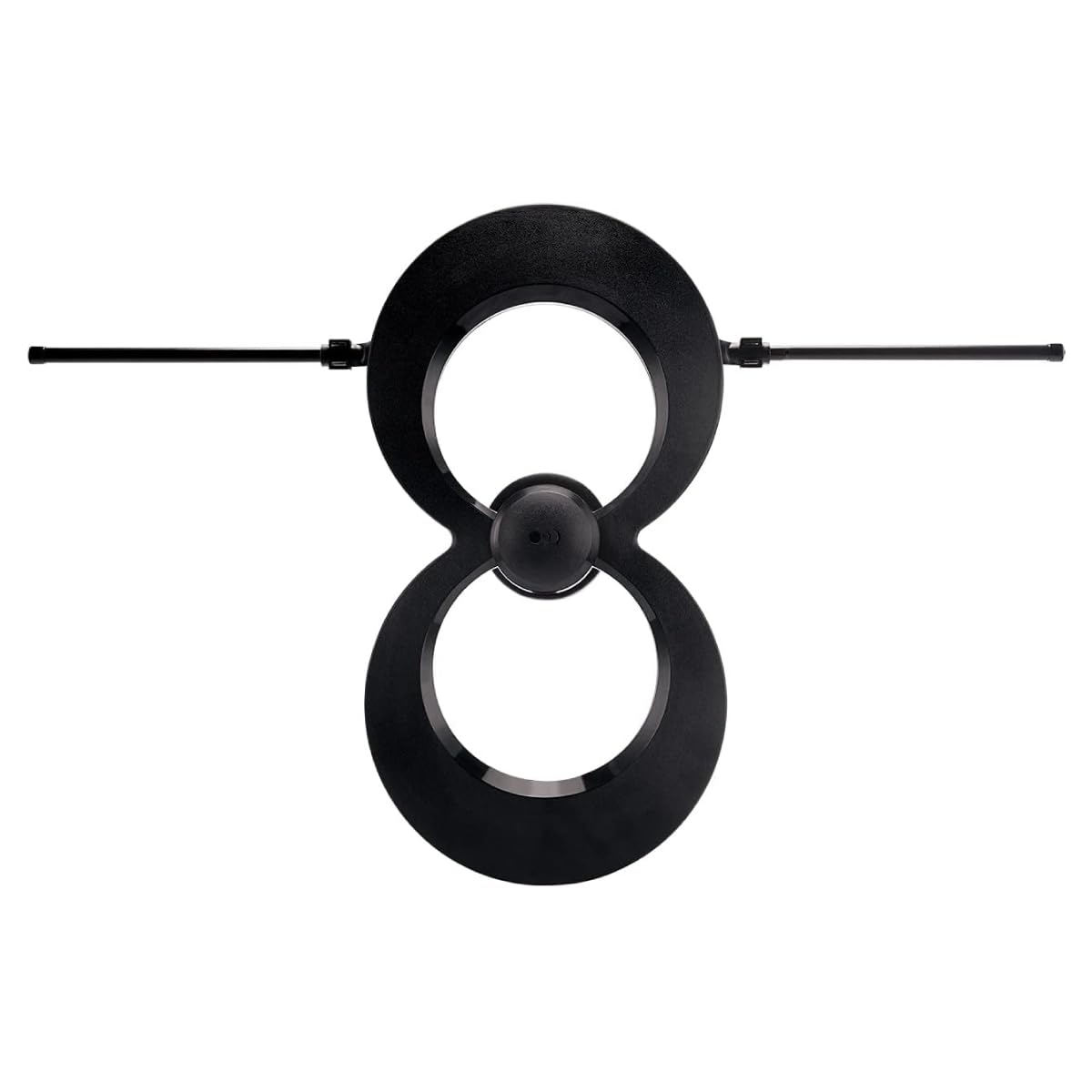
The ClearStream MAX-V strikes the hardest-to-find balance in the OTA antenna world: it offers a genuine 60+ mile range with both UHF and Hi-VHF elements in a compact, indoor-friendly form factor. Its double-loop design gives a 65-degree beam angle that pulls signals from multiple directions without needing a rotor, making it ideal for suburban homes where towers sit in different spots on the compass. In real-world tests, users wall-mounted it 28 miles from NYC and pulled 70 stations, while attic installations in rural areas consistently reported 60+ channels with the help of a separate amplifier.
The included steel wall bracket is a standout — it keeps the antenna flush against the wall, unlike models that require you to buy mounting hardware separately. The build uses premium materials that hold up outdoors, though most users find attic placement delivers the best balance of performance and weather protection. It’s fully compatible with 4K, 8K, and ATSC 3.0 NextGen TV broadcasts, future-proofing your setup.
The only real caveat is that it doesn’t include an amplifier in the box, so if you’re more than 40 miles from towers or splitting to multiple TVs, you’ll want to add an inline preamp. The assembly is minimal but not tool-free — you’ll need a screwdriver to secure the elements. Still, for the price, it outperforms nearly everything in its range class.
Why it’s great
- Exceptional multi-directional UHF/Hi-VHF reception in a compact package
- Lifetime manufacturer antenna warranty for long-term peace of mind
- Includes sturdy steel wall bracket for low-profile installation
Good to know
- No amplifier included; may need one for fringe-area reception
- Assembly requires a screwdriver — not completely tool-free
2. Antennas Direct Element Uni-Directional

When your local broadcast towers are clustered in one direction — common in rural areas where all the major networks sit on the same ridge — the Element’s uni-directional design is purpose-built to outperform any multi-directional antenna. It uses a stepped-up Yagi-inspired element layout that focuses energy forward, giving it the ability to punch through 60+ miles of terrain with remarkably low noise. Users 70-80 miles out in weak signal areas reported zero pixelation when paired with a low-noise amplifier, while suburban installations without amplification still picked up new channels 42 miles away.
The all-weather mounting hardware includes everything you need for an outdoor mast or attic install, and the snap-together assembly requires no tools — the elements click into place. At 44.5 inches wide with a 2.5-inch profile, it’s a substantial antenna but still manageable for a single person to mount. The wide 55-degree off-axis beam gives you some forgiveness in aiming, so you don’t need surgical precision to get stable reception.
The catch is that being directional, it won’t pull signals from behind it. If your local towers are spread across 180 degrees, this antenna will miss stations on the backside. It also ships without an amplifier, which is typical for this category but still worth noting for users at the far end of the range. Despite that, it’s the go-to choice for anyone living in a terrain-heavy area where signal reflection is the main enemy.
Why it’s great
- Superior weak-signal performance with excellent off-axis beam tolerance
- Tool-free snap-together assembly in minutes
- Premium weather-resistant construction for outdoor longevity
Good to know
- Directional design misses stations behind the antenna
- No amplifier included in the package
3. Five Star 200 Mile Long Range Outdoor Antenna

The Five Star 200 Mile antenna is the best option in the mid-range for anyone who lives in deep fringe territory — the kind of place where you can count the miles to the nearest tower on two hands. Its extended element design is physically larger than most competitors at 46 inches in length, giving it more surface area to capture weak signals. Users 45 miles away with a 2,500-foot mountain between them and the towers went from 26 channels on an indoor antenna to 60 solid channels after installing this one in the attic.
The package is generous: you get the antenna, a mounting bracket, a J-pole, and a TV splitter that supports up to four TVs. That last part is rare in this price tier — most antennas cap at one or two outputs. The ATSC 3.0 readiness means you’ll be able to receive NextGen TV broadcasts when they roll out in your area, and the VHF gain of 11dB helps lock in those finicky low-VHF stations that many newer antennas struggle with.
Assembly is mostly straightforward, though the VHF director alignment isn’t clearly illustrated in the instructions — some users noted the screw heads on the vibrator section must face the same direction to work properly. The included mount is functional but not the most robust; if you’re going on a roof, consider picking up a heavier-duty mount. For the price, it’s a lot of antenna for the money, especially if you need to feed multiple rooms.
Why it’s great
- Includes splitter to support up to 4 TVs out of the box
- Extended element design captures weak signals better than compact models
- ATSC 3.0 ready for future NextGen TV broadcasts
Good to know
- VHF director alignment not well-documented in instructions
- Mounting hardware is serviceable but not premium-grade for extreme weather
4. Five Star Yagi HDTV Outdoor Antenna
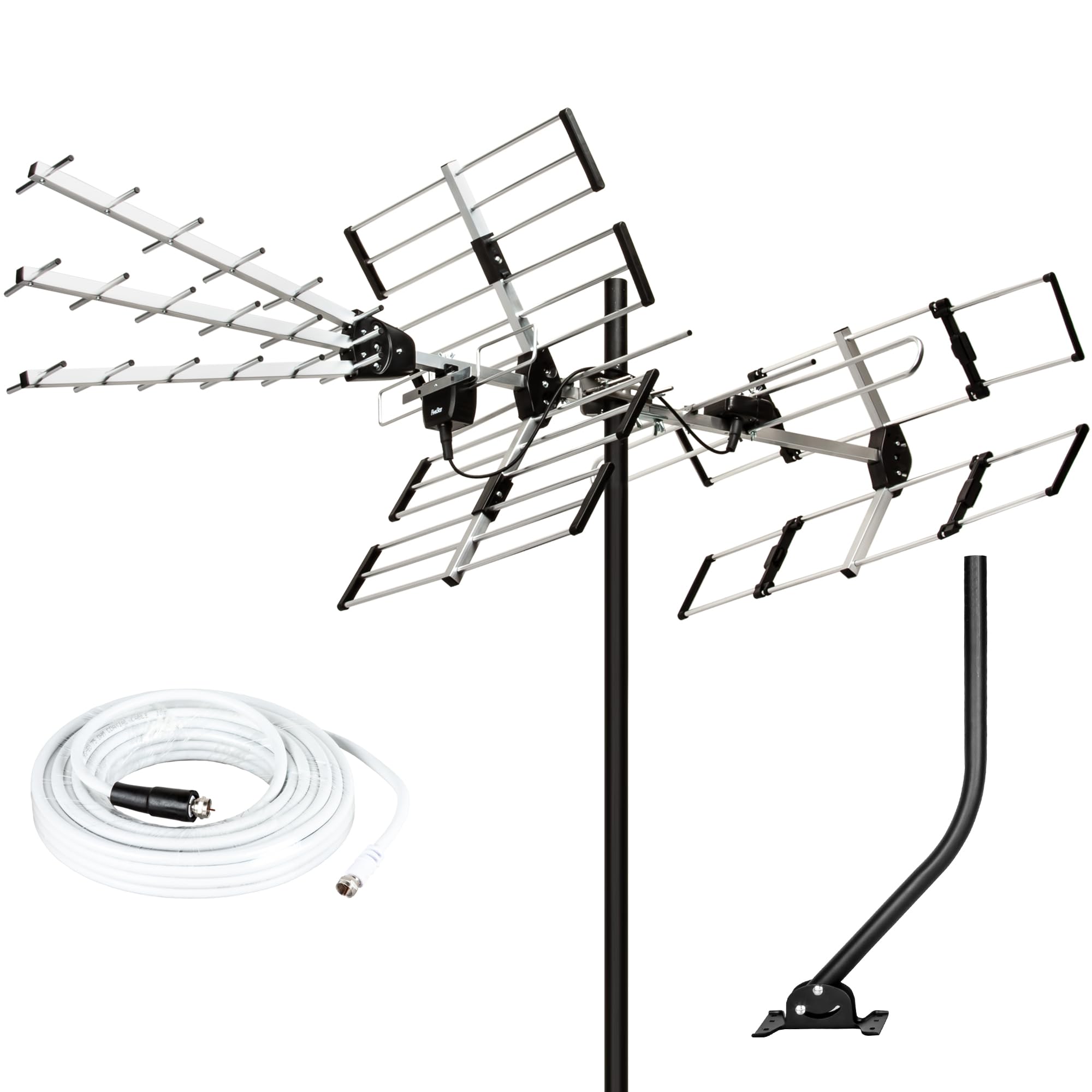
The Five Star Yagi takes the company’s proven platform and adds a directional focus that’s particularly effective when your towers are all in one narrow band on the horizon. Its Yagi-style design provides high gain in a single direction, and the innovative folding structure means the elements collapse for easy storage or transport — a unique feature if you plan to take the antenna to an RV or seasonal cabin. Users in St. Louis pulled 60+ channels with a preamp, and those in challenging terrain 30 miles from towers reported clean reception on every major network.
The assembly is the standout here: the click-and-lock design means absolutely zero tools are required — the elements snap into place and the whole thing takes about 15 minutes to set up. The included 21-inch J-mounting pole is longer than what most competitors include, giving you more flexibility to clear rooflines. The antenna itself is lightweight at around 10 pounds, making it manageable for a single person to install on a mast or eave.
One realistic limitation is that the 200-mile range claim is optimistic for most environments — expect reliable performance up to about 50-60 miles with a clear line of sight, which is still excellent for the category. The instructions also recommend a signal amplifier for any run beyond 20 miles, which is an honest admission that the passive design benefits from a boost in fringe conditions. Still, for the price and build quality, it’s a strong directional option.
Why it’s great
- Tool-free click-and-lock assembly, fastest in class
- Folding element design for easy storage and transport
- Longer 21-inch J-mounting pole included
Good to know
- 200-mile range is best-case; real-world performance tops out around 50-60 miles
- Signal amplifier recommended for runs longer than 20 miles
5. Winegard Elite 7550 Outdoor HDTV Antenna
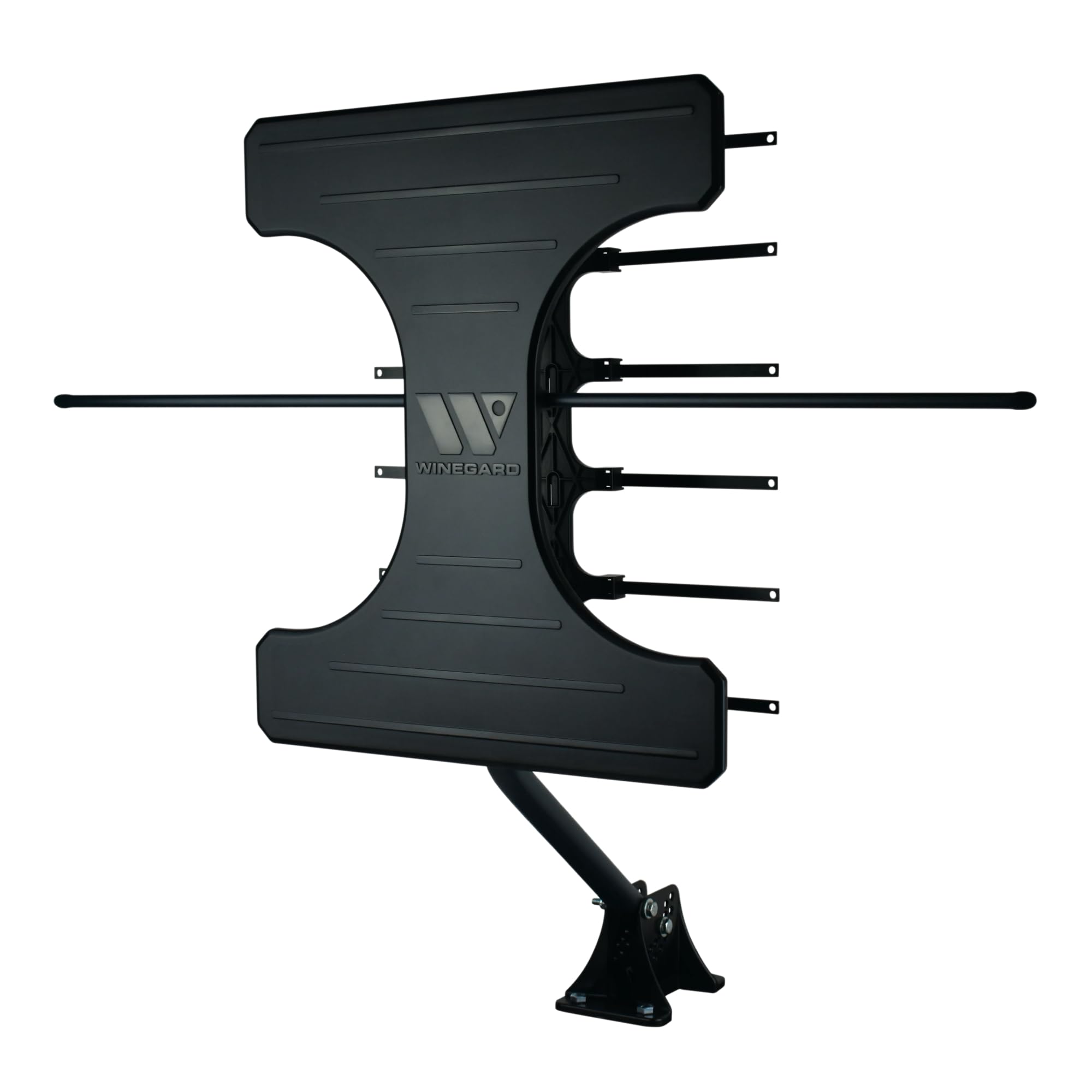
The Winegard Elite 7550 is the rare antenna that embeds its low-noise amplifier directly into the antenna housing, which means the signal gets boosted right at the source before any cable-run loss can degrade it. That 1dB ultra-low noise amplifier is the real differentiator — it amplifies the wanted signal without amplifying the noise floor, giving you a cleaner picture in marginal conditions. Users in rural areas 50+ miles from towers reported doubling their channel count after repositioning, and others in mountain valleys between two peaks still pulled 16 strong channels.
The build quality is solid but the construction is almost entirely plastic, which is a concern for long-term outdoor exposure in harsh sun or coastal salt air. The Clear Circuit Technology handles VHF and UHF equally well, but the antenna’s physical design is smaller and lighter than its range suggests. Assembly is straightforward with the included pipe foot and mounting hardware, and the inline 5V power inverter with LED indicator makes it easy to confirm the amplifier is powered.
The biggest complaints come from users expecting a full-metal build at this price point — the plastic housing and self-tapping screws can feel flimsy during assembly, and overtightening will strip the threads. However, the Winegard app helps you find the optimal aiming direction, and once dialed in, the reception quality is genuinely excellent for the 70-mile class. It’s best suited for buyers who want an all-in-one amplified solution without buying separate components.
Why it’s great
- Embedded ultra-low noise amplifier boosts signal at the source
- Clear Circuit Technology handles both VHF and UHF with low noise
- Winegard app assists with optimal aiming for maximum channels
Good to know
- Predominantly plastic construction feels less durable than competitors
- Self-tapping screws can strip if overtightened during assembly
6. Mohu Leaf Amplified Indoor TV Antenna

The Mohu Leaf Amplified is the best pick for renters or apartment dwellers who can’t mount anything on a roof. Its ultra-thin profile — just 0.04 inches thick — lets it sit flush on a window or wall without looking like a piece of industrial equipment. The included Jolt Switch amplifier lets you toggle the signal boost on and off in real time, which is critical if you’re close to the towers and the amplifier would otherwise overload your tuner. Users in Manhattan facing south picked up 60 channels including CBS, NBC, Fox, and PBS from a single window position.
The 12-foot coaxial cable is generous enough to reach most entertainment centers from a window mount, and the included hook-and-loop tabs and push pins make installation genuinely adhesive-free if you want to avoid wall damage. The multi-directional elements receive signals from both the front and back, so you don’t need to point it — just stick it on the window facing the general direction of the towers. It supports 4K UHD and ATSC 3.0 NextGen TV, so it’s not a temporary solution.
The trade-off is that an indoor antenna will always be at the mercy of your home’s construction — brick walls, metal roofs, and double-pane windows with low-E coatings can all block signals that an outdoor antenna would catch easily. Some users in dense suburban areas with heavy tree cover reported getting fewer channels than older passive antennas, which might mean the amplifier is too aggressive for their location. Still, for a clean, low-profile indoor solution, it’s the most refined option available.
Why it’s great
- Ultra-thin design blends into any room without visual clutter
- Jolt Switch lets you toggle amplification on/off to avoid signal overload
- Multi-directional — no precise aiming required
Good to know
- Indoor placement means reception is heavily impacted by wall materials
- Amplifier can overload tuner if you’re too close to broadcast towers
7. 1byone Outdoor TV Antenna 360° Omni-Directional

The 1byone Outdoor Antenna is the most cost-effective way to get into outdoor OTA reception without the complexity of directional aiming. Its 360-degree omni-directional design means you can install it once and it will pull signals from every compass direction simultaneously — no rotor, no repositioning, no missed channels when towers are scattered. The built-in pre-amplifier with 4GLTE filter actively rejects interference from nearby cell towers, a common problem in suburban areas where 4G and 5G signals can bleed into the UHF band.
The package includes a 32-foot RG6 coax cable, which is long enough to reach most attic or eave mounting spots without buying an extension. The weatherproof construction uses moisture-proof and flame-retardant materials, and the compact 11.8-inch form factor is small enough to fit in tight attic spaces or under eaves. Users in Manhattan reported pulling 60 channels after a 15-minute scan, while suburban installations consistently got between 50 and 70 channels with minimal pixelation.
However, the omni-directional design trades raw gain for convenience — in very weak signal areas, a directional antenna will outperform it by a significant margin. Some users reported water ingress after two years, specifically flooding the preamplifier and corroding the RF connector, which suggests the weather sealing could be better at the connection points. The two-year warranty covers defects, but if you live in a heavy rain or coastal environment, you may want to add dielectric grease to the connector. For the price, it’s an unbeatable entry point into outdoor TV reception.
Why it’s great
- True 360-degree reception with no aiming or rotor needed
- Built-in 4GLTE filter blocks cellular interference
- Includes 32-foot RG6 coax cable and two-year warranty
Good to know
- Omni-directional design has lower gain than directional alternatives
- Weather sealing could be improved at connection points for coastal climates
FAQ
Do I need a special TV to use an HDTV antenna?
What does ATSC 3.0 mean and do I need it?
Can I use an outdoor antenna indoors in my attic?
Final Thoughts: The Verdict
For most users, the antenna for hdtv local channels winner is the Antennas Direct ClearStream MAX-V because it balances multi-directional convenience with genuine VHF/UHF performance in a compact, mountable design backed by a lifetime warranty. If you live in a weak-signal area where towers are clustered in one direction, grab the Antennas Direct Element for its superior directional gain. And for apartment dwellers who need a zero-profile indoor solution, nothing beats the Mohu Leaf Amplified with its Jolt Switch amplifier that adapts to your signal environment.