
Our readers keep the lights on and the weekend projects moving. As an Amazon Associate, I earn from qualifying purchases.
A chef’s knife under fifty dollars should feel like an extension of your hand, not a compromise. Yet most options in this bracket arrive dull, chip within weeks, or fatigue your wrist after a single onion. The difference between a frustrating prep session and a fluid, joyful one comes down to three things: the steel’s hardness, the handle’s ergonomics, and the edge angle out of the box. This is the exact criteria I used to separate the real performers from the packaging.
I’m Rikta — the co-founder and writer behind FitlyFast. To build this guide, I cross-referenced hundreds of verified customer reviews with each knife’s hardness rating, blade material, handle construction, and edge retention reports to surface only the picks that actually deliver on their claims.
Whether you’re breaking down a brisket, mincing garlic for a weeknight sauce, or slicing ripe tomatoes for a salad, the right blade changes everything. After weeks of analysis, I’ve narrowed the field to the seven knives that define the $50 chef knife category — each one a legitimate workhorse that punches well above its price.
How To Choose The Best $50 Chef Knife
Within a fifty-dollar budget, manufacturers cut corners somewhere — either on steel grade, handle construction, or edge finishing. Knowing where to compromise and where to hold the line is the difference between a knife that lasts a decade and one that gets replaced in six months. These are the four decisions that matter most.
Steel Hardness and Edge Retention (HRC)
The Rockwell hardness scale tells you how well the blade holds its edge. For a chef knife under this price cap, aim for HRC 56-60. Steel rated below 56 will dull noticeably after a week of regular use. Steel above 58, like the German 1.4116 or VG-10 used in several picks here, stays sharp for months with proper care. Harder steel is also more brittle — avoid flexing the blade on bones or frozen items.
Edge Angle: 12 to 15 Degrees Per Side
Most factory edges in this price range arrive at 15 to 20 degrees per side. Knives hand-sharpened to 12-15 degrees per side deliver noticeably cleaner cuts through tomatoes, raw meat, and herbs without crushing or tearing. The trade-off: a thinner edge requires more careful maintenance and isn’t ideal for heavy chopping through bones or hard squash. Choose based on your primary prep volume.
Handle Material and Ergonomics
Santoprene, Fibrox, and textured G10 handles offer slip resistance even with wet or oily hands — critical for safety. Pakkawood handles look elegant but require hand washing and drying to prevent cracking or swelling. Full-tang construction (the steel runs through the entire handle) provides better balance and prevents the blade from snapping under lateral pressure. Always prioritize a non-slip profile if you prep for longer than 20 minutes at a time.
Construction: Forged vs. Stamped
A forged blade is shaped from a single piece of heated steel, then tempered — denser grain structure, better edge retention, heavier weight. Stamped blades are cut from a rolled sheet of steel, then heat-treated — lighter, thinner, and generally less expensive. Both can be excellent under $50, but forged knives typically offer superior balance and durability for heavy chopping tasks. Stamped knives like the Victorinox Fibrox excel when weight and fatigue reduction matter most.
Quick Comparison
On smaller screens, swipe sideways to see the full table.
| Model | Category | Best For | Key Spec | Amazon |
|---|---|---|---|---|
| imarku Chef Knife | Single-Bevel / Premium | Right-handed precision slicing | Single bevel, HRC 56-58 | Amazon |
| Victorinox Fibrox Pro | Stamped / Workhorse | High-volume daily prep | 7.9 in, 5.7 oz, TPE grip | Amazon |
| SAMCOOK Damascus | Japanese / VG-10 | Balance of edge and aesthetics | 67-layer VG-10, HRC 60 | Amazon |
| KEEMAKE Chef Knife | Forged / Mid-Range | Precision with Pakkawood comfort | 8°–12° edge, HRC 58 | Amazon |
| PAUDIN D1 Chef Knife | Forged / German Steel | Dishwasher-safe durability | 13° edge, HRC 58+, G10 | Amazon |
| Sunnecko 8-Inch Chef Knife | Japanese / Pakkawood | Edge sharpness and value | 12-15° edge, HRC 58+ | Amazon |
| Mercer Culinary Millennia | Stamped / Commercial | Budget-friendly line cook work | Hollow-ground, Santoprene | Amazon |
In‑Depth Reviews
1. imarku Chef Knife 8-Inch Pro (Single-Bevel)
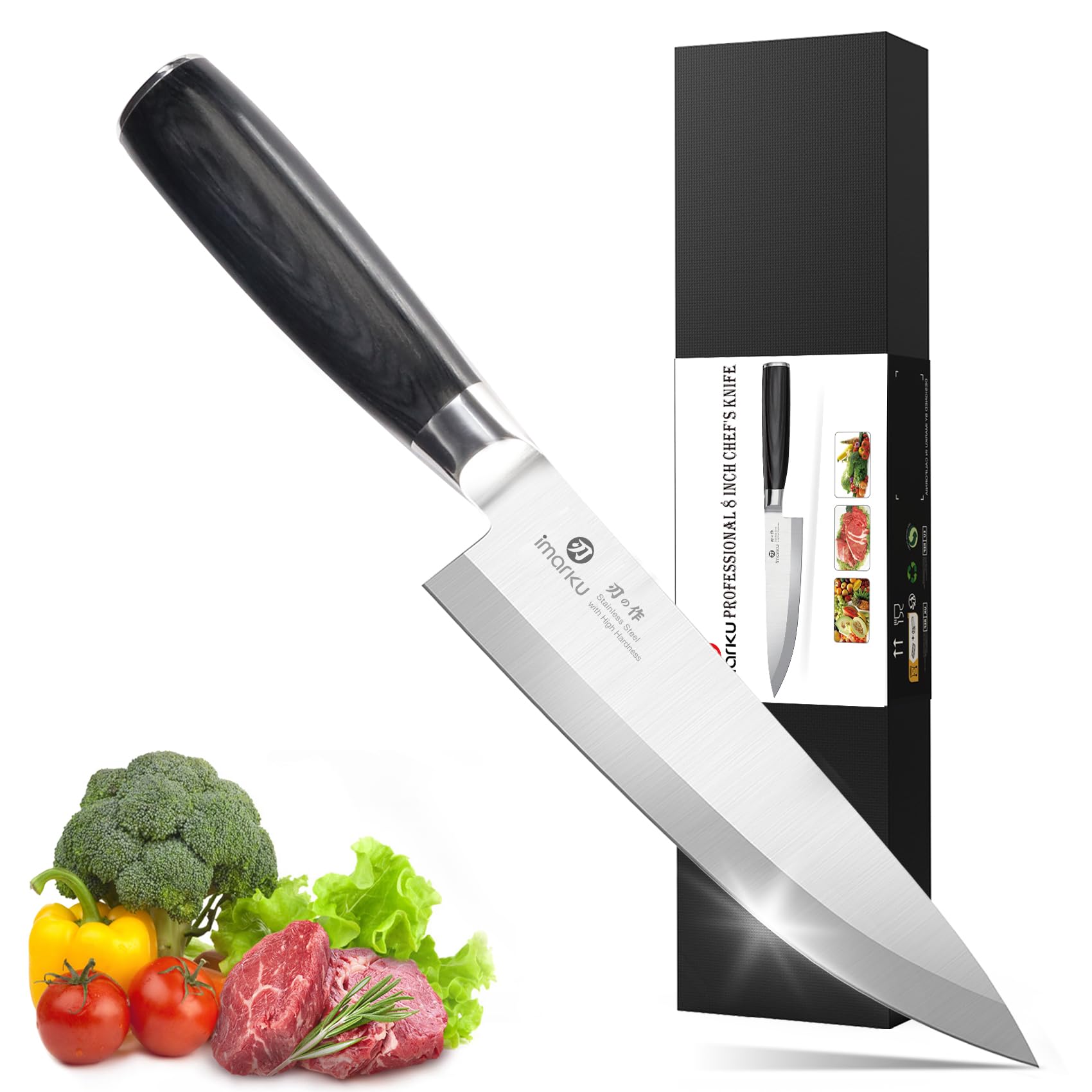
The imarku stands alone in this lineup for its single-bevel blade geometry — a design usually reserved for high-end Japanese sashimi knives. Hand-sharpened to a 13-degree angle on one side, this blade glides through fish fillets, raw beef, and ripe tomatoes with zero tearing. The asymmetrical edge produces a cleaner cut than any double-bevel knife at this price. Rated HRC 56-58, the high-carbon stainless steel offers enough hardness for prolonged edge retention while remaining tough enough to handle light chopping through chicken bones.
The Pakkawood handle is rounded specifically for users with larger hands, and the full-tang construction gives the knife a planted, balanced feel during extended prep. At 13 inches overall, it provides substantial knuckle clearance on a standard cutting board. A single-bevel knife requires a slightly different sharpening technique (right-handed users only — left-handed versions are not available in this model). The included gift box presentation is refined enough for a culinary student or home cook upgrading their kit.
Where the imarku truly shines is in applications that reward precision over brute force. Slicing raw salmon for sashimi, portioning duck breast, or finely chiffonading herbs — these tasks feel effortless because the single bevel reduces resistance. The trade-off is that heavy spatchcocking or butternut squash halving is better handled by a double-bevel workhorse. For the right-handed cook who prioritizes clean cuts above all else, this is the sharpest tool in the under-fifty bracket.
Why it’s great
- Single-bevel geometry delivers superior precision slicing
- Ergonomic Pakkawood handle reduces fatigue for larger hands
Good to know
- Right-handed only — no left-handed version
- Not recommended for heavy chopping through bones
2. Victorinox Fibrox Pro Chef’s Knife, 8 Inch
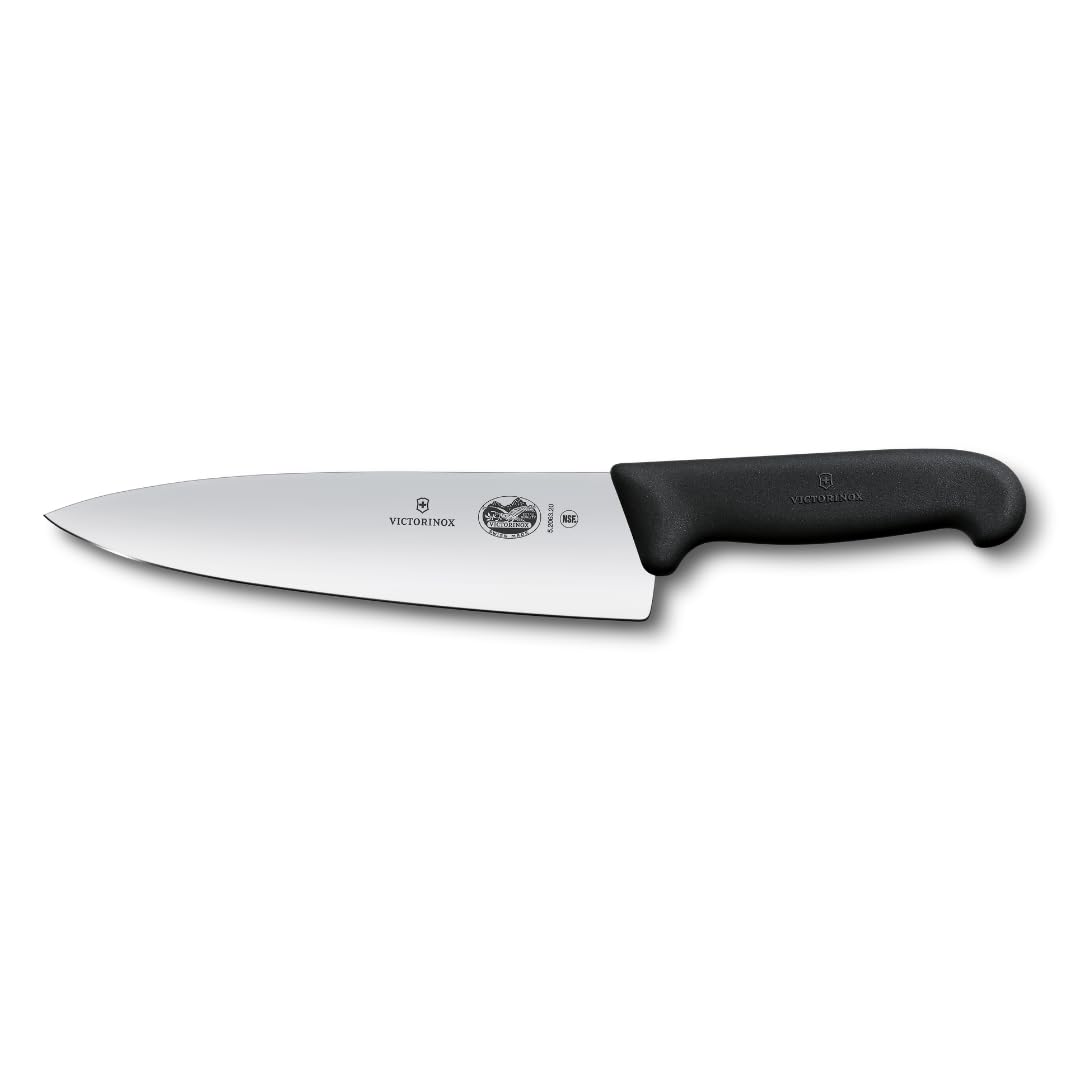
The Victorinox Fibrox Pro is the most recommended knife by culinary schools and America’s Test Kitchen for good reason. At 7.9 inches with a stamped stainless steel blade, it weighs only 5.7 ounces — noticeably lighter than forged alternatives. The thin spine (roughly 1/16 inch) reduces drag through dense ingredients, and the laser-tested edge arrives sharp enough to slice through ripe tomatoes using just the blade’s weight. The Fibrox handle uses thermoplastic elastomer (TPE) that provides exceptional grip even when slick with oil or water, and the finger guard adds a layer of safety for fast chopping.
This is not a knife that will turn heads on a magnetic strip, but it is a knife that will outwork almost anything in its price range. The chromium carbide stainless steel requires minimal maintenance — no oiling, no special drying — and the blade is dishwasher safe, though hand washing is recommended to preserve the edge. The edge geometry leans toward a steeper angle than European knives, meaning you’ll need an Asian-style sharpener (~20 degrees) to restore it properly.
Where the Fibrox excels is volume. If you’re dicing five pounds of onions, mincing a dozen cloves of garlic, and slicing bell peppers for a stir-fry — all in one session — the lightness and grip make it the least fatiguing option here. It is also the best entry-level knife for someone who has never owned a decent chef’s knife. The trade-offs are a stamped construction that won’t feel as premium as a forged blade, and a utilitarian aesthetic that some home cooks find uninspiring. But for pure performance-to-weight ratio under fifty dollars, this Swiss-made workhorse is unmatched.
Why it’s great
- Ultra-light design reduces fatigue during long prep sessions
- Non-slip TPE handle provides secure grip even when wet
Good to know
- Stamped blade feels less substantial than forged alternatives
- Steeper edge angle requires a dedicated sharpener for maintenance
3. SAMCOOK Damascus Chef Knife 8-Inch

The SAMCOOK Damascus brings 67 layers of VG-10 high-carbon stainless steel — a core steel known for its balance of hardness (HRC 60±2) and corrosion resistance — to a price that typically buys commodity knives. The layered Damascus pattern isn’t just decorative; the repeated forging and vacuum heat treatment produce a blade with exceptional hardness retention and a microstructure that resists micro-chipping. The edge is hand-finished to 10-15 degrees per side, giving it a razor feel out of the box that competes with knives costing three times as much.
The blue resin wood handle is the most visually striking in this lineup. The ergonomic contour fits both right and left hands comfortably, and the balance between the handle and the thin blade allows for relaxed pinch-grip control. At 0.46 kilograms, it’s lighter than most forged German knives but heavier than the Victorinox, occupying a sweet spot for cooks who want feedback from the blade without wrist strain. The included white gift box packaging elevates it to a legitimate gifting option for a cooking enthusiast.
Practical weaknesses: the blade is thin enough that lateral twisting or prying can risk fracture, so this is not a knife for opening shellfish or cutting through frozen blocks. Some users note that the Damascus pattern is aesthetic rather than functional on the edge itself. And while the manufacturer lists it as dishwasher safe, hand washing is strongly recommended to protect both the resin handle and the etched finish. For the home cook or enthusiast who wants a Japanese-style gyuto with genuine VG-10 performance at a fraction of the usual cost, the SAMCOOK delivers the most dramatic visual-performance combination in this guide.
Why it’s great
- Genuine VG-10 core with 67-layer Damascus cladding
- Stunning blue resin wood handle with ergonomic contour
Good to know
- Thin blade is vulnerable to damage from twisting or prying
- Damascus pattern is cosmetic, not structural on the edge
4. KEEMAKE Chef Knife 8-Inch
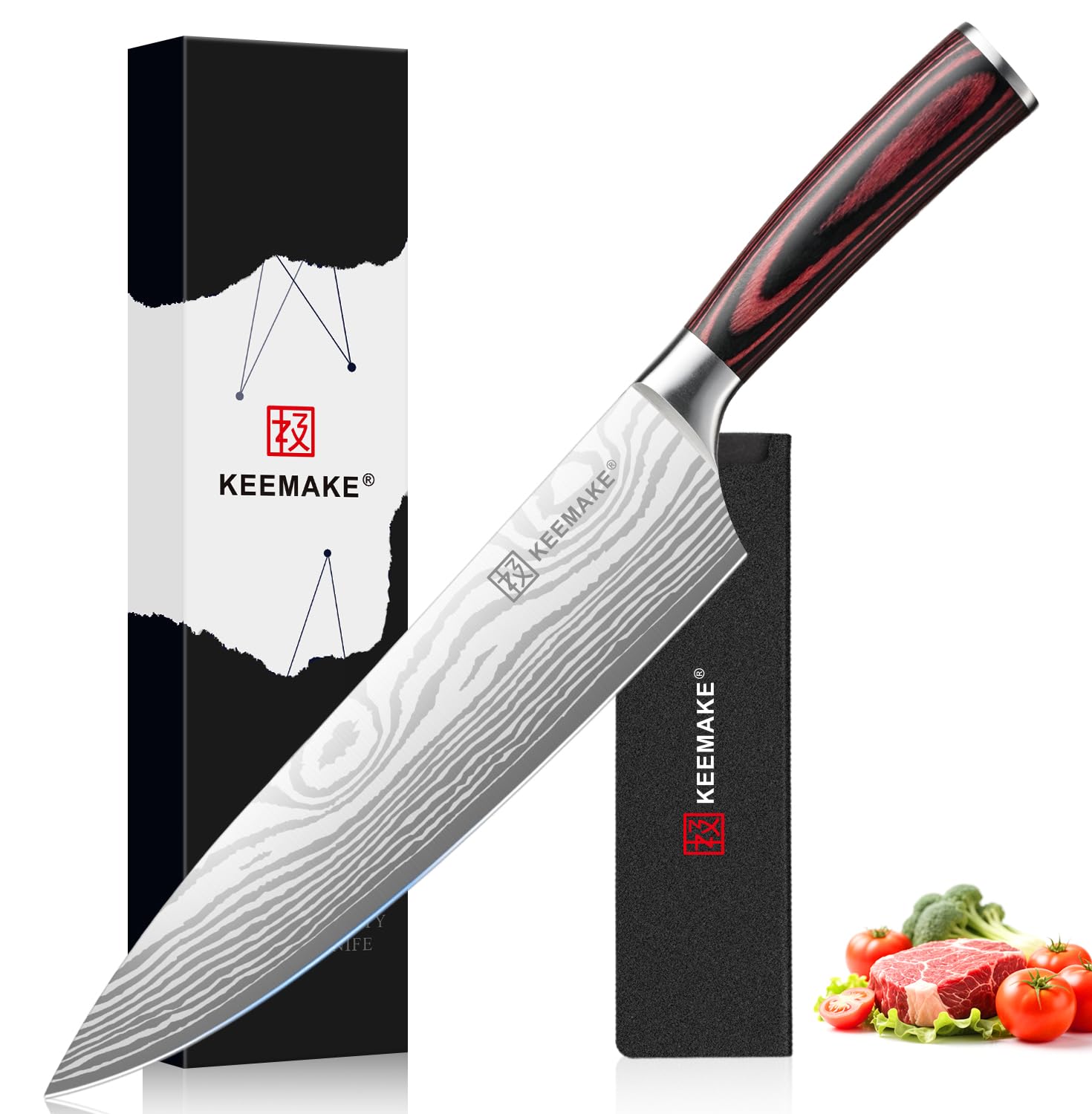
The KEEMAKE enters the conversation with the most aggressive edge angle in the lineup: hand-sharpened to 8-12 degrees per side. That’s significantly sharper than the 13-15 degree norms of most competitors, and it shows immediately in performance. The German 1.4116 high-carbon stainless steel (HRC 58±2) provides a sweet spot of hardness — hard enough to hold that thin edge for weeks, but not so hard that it becomes brittle. Reviews consistently note that this knife cuts through ripe tomatoes, raw chicken skin, and even slightly stale bread without crushing or tearing.
The Pakkawood handle uses a curved silhouette with a sloped bolster that naturally guides the user into a proper pinch grip. This is a genuine ergonomic improvement over many budget knives that rely on straight handles. At 0.53 pounds, the weight sits solidly in the hand without being heavy, and the full-tang construction gives the knife a reassuring stability during hard chopping through butternut squash or sweet potatoes. The included protective sheath is a simple PVC sleeve that keeps the blade safe in a drawer.
Several verified buyers mention that a professional sharpener friend of 30-plus years complimented the steel quality — an anecdotal but powerful signal in the budget category. The laser-etched Damascus pattern is cosmetic (not a true forged layer), but at this price point that expectation is reasonable. The knife is listed as dishwasher safe, but hand washing is advisable to protect both the edge and the wood handle. For the cook who wants the sharpest out-of-box blade and isn’t afraid of a thin edge, the KEEMAKE is a standout performer.
Why it’s great
- Aggressive 8-12 degree edge delivers unmatched OOTB sharpness
- Curved Pakkawood handle with sloped bolster promotes correct pinch grip
Good to know
- Cosmetic laser-etched pattern, not true Damascus forging
- Very thin edge requires careful maintenance to avoid micro-rolls
5. PAUDIN Chef Knife 8-Inch D1
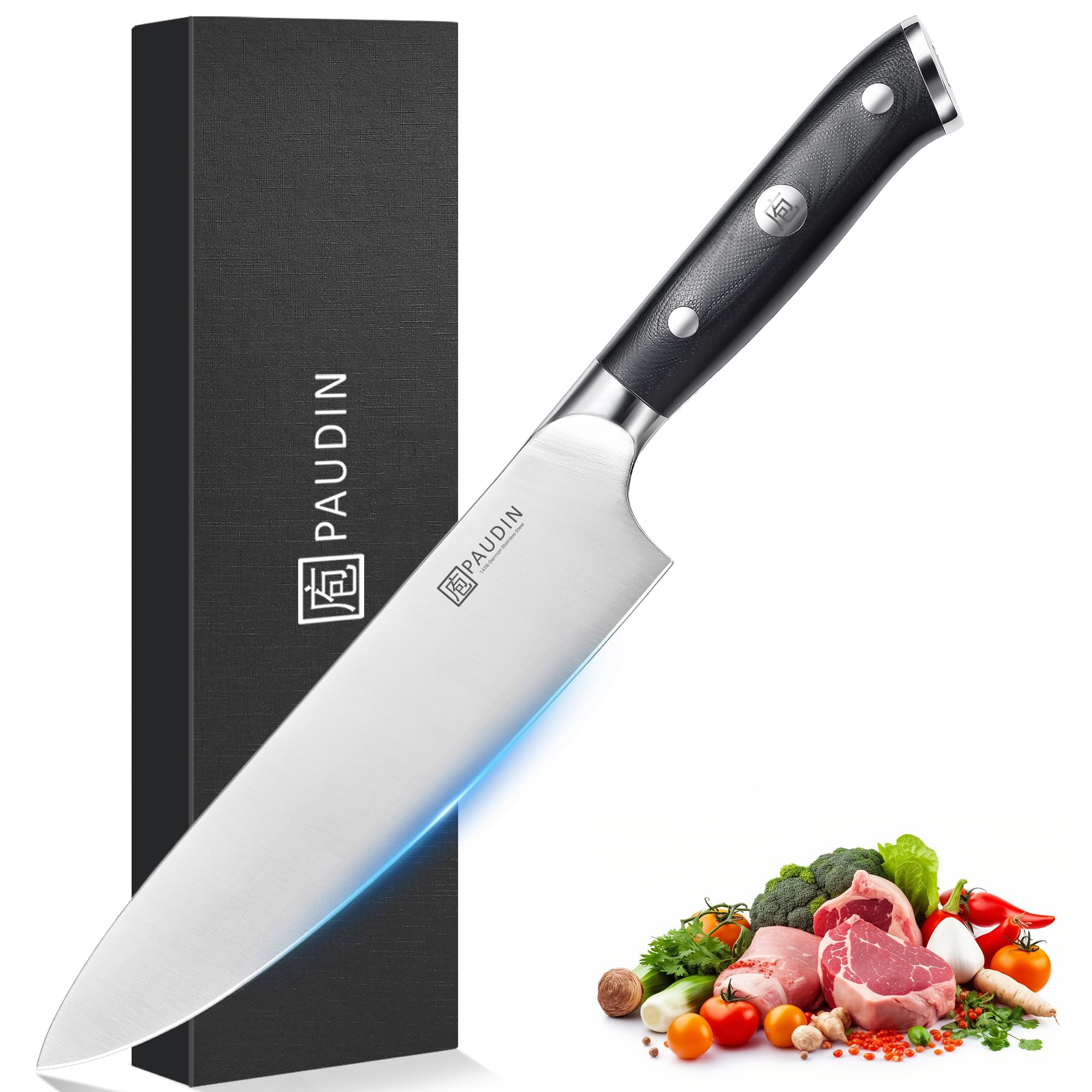
The PAUDIN D1 is the most balanced all-rounder in this guide — a forged German 1.4116 steel blade (HRC 58+) with a military-grade G10 glass fiber handle that is genuinely dishwasher safe. Many budget knives claim dishwasher compatibility, but the G10 handle on this model resists the heat and moisture that cause Pakkawood to crack or Santoprene to degrade. The blade’s 13-degree edge per side is sharp enough for delicate tomato work while retaining enough material to handle squash halving and onion dicing without edge roll. Verified reviews from commercial users report 6-7 years of daily use with proper maintenance.
Ergonomically, the PAUDIN scores high for its balance ratio. The 7.87-inch blade paired with a 4.92-inch handle creates a natural pivot point for rocking cuts, and the seamless bolster supports a pinch grip that minimizes wrist tension. The full-tang construction is triple-riveted into the G10, eliminating any handle separation concerns. At 8.96 ounces, it’s heavier than stamped options but distributed so evenly that it feels lighter than the number suggests. The Swedish-designed silhouette is clean and modern enough to live on a magnetic strip.
The only real drawback is cosmetic: some users report that the handle can discolor over time if exposed to acidic ingredients like lemon juice or tomato sauce. The manufacturer offers a no-questions replacement for such issues, which is rare at this price tier. For the home cook who wants one knife to handle 90% of kitchen tasks — from dicing onions to slicing brisket — and wants to be able to throw it in the dishwasher without anxiety, the PAUDIN D1 is the most versatile pick. It also comes in gift-ready packaging, making it a solid choice for housewarmings or holiday gifts.
Why it’s great
- Genuinely dishwasher safe thanks to G10 handle construction
- Excellent balance ratio for fluid rocking and push-cutting
Good to know
- Handle may discolor with prolonged exposure to acidic foods
- Heavier than stamped competitors — may fatigue smaller hands
6. Sunnecko 8 Inch Chef Knife

The Sunnecko is the knife that keeps appearing in reviews with the phrase “immediately sliced my finger while cleaning it” — which, while alarming, is proof that the hand-sharpened 12-15 degree edge per side is genuinely razor out of the box. The high-carbon stainless steel (HRC 58+) is forged construction, giving it the density and grain structure that stamped blades lack. The laser-etched pattern on the blade mimics traditional Japanese finishes and does serve as a functional aid — it reduces food sticking during slicing.
The Pakkawood handle is ergonomic and comfortable in both right and left hands, with a steel bolster that provides optimal weight distribution for pinch-grip users. At 0.2 kilograms, it’s noticeably lighter than the PAUDIN and KEEMAKE options, making it a strong choice for cooks with smaller hands or those who prefer a less substantial blade. The included PVC sheath is basic but effective, and the knife arrives in an attractive gift box that makes it a popular choice for Father’s Day or housewarming presents.
Where the Sunnecco falls slightly short is in long-term edge retention compared to the VG-10 or 1.4116 steel options. Multiple users note that while the initial sharpness is exceptional, the edge requires more frequent honing — every 2-3 weeks with regular use. The Pakkawood handle also demands hand washing and thorough drying to prevent cracking. For the budget-conscious cook who prioritizes out-of-box sharpness and aesthetic appeal over maximum edge durability, the Sunnecko is a compelling entry-level Japanese-style knife that punches above its weight in first impressions.
Why it’s great
- Exceptional OOTB sharpness with 12-15 degree edge
- Attractive laser-etched pattern reduces food sticking
Good to know
- Edge requires more frequent honing than VG-10 or German steel
- Pakkawood handle needs hand washing and thorough drying
7. Mercer Culinary M18000 Millennia 8-Inch

The Mercer Millennia is the entry-level standard in culinary schools across North America — and for good reason. The hollow-ground Japanese high-carbon steel blade arrives sharp enough to slice through salmon skin cleanly, and the Santoprene handle with textured finger points provides a non-slip grip even when covered in oil. The one-piece construction eliminates any joint weakness, and the protective finger guard adds a safety measure for novice cooks. At 0.29 pounds, it’s the lightest knife in this guide, which translates to minimal fatigue during extended prep.
Line cooks specifically praise this knife for its ability to maintain a working edge with just a ceramic rod — no dedicated sharpening system required for daily touch-ups. The blade’s hollow grind reduces friction during cutting, making it ideal for high-volume tasks like portioning chicken breasts or dicing onions for a service. Reviews consistently note that the knife “keeps a good edge and is easy to sharpen with little effort,” which is the hallmark of a good stamped steel formulation.
The trade-offs are clear: this is a stamped knife with a basic handle that will never feel premium. The paint on the “Mercer Culinary” stamp will gradually wear off with washing. The blade is thinner than forged options, meaning it’s not suitable for hard squash or bone-in tasks. And while the Santoprene handle is comfortable, it lacks the elegance of Pakkawood or G10. For the home cook or culinary student on a tight budget who needs a reliable, lightweight workhorse that sharpens easily and won’t cause hand fatigue, the Mercer Millennia is the most cost-effective entry into proper knife ownership.
Why it’s great
- Lightest blade in the guide — minimizes fatigue during extended use
- Hollow grind reduces friction for high-volume slicing tasks
Good to know
- Stamped construction feels less premium than forged alternatives
- Not suitable for heavy chopping through bones or hard squash
FAQ
Is a forged chef knife worth the extra cost over a stamped one in this budget?
Can a $50 chef knife really handle butternut squash and bones safely?
How often should I sharpen a $50 chef knife to keep it performing?
Final Thoughts: The Verdict
For most users, the $50 chef knife winner is the PAUDIN D1 because it combines forged German steel, a dishwasher-safe G10 handle, and balanced ergonomics into a single versatile package that handles 90% of kitchen tasks without compromise. If you want the lightest, least-fatiguing blade for high-volume prep, grab the Victorinox Fibrox Pro. And for precision slicing with a single-bevel edge that cuts cleaner than anything else in this bracket, nothing beats the imarku — provided you’re right-handed and ready to maintain a specialized edge.