
Our readers keep the lights on and the weekend projects moving. As an Amazon Associate, I earn from qualifying purchases.
A 2000-watt solar generator sits in the sweet spot between portable weekend backup and whole-home emergency power. It can run a refrigerator, a sump pump, lights, and a modem simultaneously — without the fumes, noise, or fuel logistics of a gas generator. The catch is that not all 2000-watt units store the same amount of energy or recharge at the same speed, and the wrong choice can leave you guessing whether your appliances will actually start.
I’m Rikta — the co-founder and writer behind FitlyFast. I’ve spent hundreds of hours analyzing inverter specs, battery chemistries, solar input voltages, and real-world runtime data to separate the units that deliver on their wattage claims from the ones that fall short when the grid goes down.
This guide breaks down the strongest options available today to help you find the right 2000 watt solar generator for your home, RV, or job site without overspending on capacity you do not need or undershooting on the power your essentials actually require.
How To Choose The Best 2000 Watt Solar Generator
Choosing a 2000-watt solar generator comes down to three interconnected factors: battery capacity measured in watt-hours, inverter type and surge capability, and solar recharge speed. A unit that delivers 2000 watts of continuous AC output but stores only 1000 watt-hours will run a large load for a very short time, while a high-capacity unit with a weak inverter might not start motor-driven appliances at all. You need the right balance for your specific load profile.
Battery Capacity (Watt-Hours) vs. Inverter Output (Watts)
Inverter output determines what you can power — a refrigerator compressor, a microwave, or a circular saw. Battery capacity determines how long you can power it. A 2000-watt inverter paired with a 2000Wh battery will run a 200-watt refrigerator for about 10 hours, but run a 1500-watt space heater for just over one hour. Always calculate your total daily load in watt-hours before picking a capacity tier, and leave a 20% buffer to avoid deep discharges that shorten battery life.
Battery Chemistry: LiFePO4 vs. NMC vs. Lead-Acid
Lithium iron phosphate (LiFePO4) is the standard for modern solar generators. It delivers 3000 to 6000 full charge cycles before degrading to 80% capacity, compared to roughly 500 cycles for older NMC lithium cells or 300 cycles for sealed lead-acid. LiFePO4 also handles higher operating temperatures more safely and does not require venting. If you plan to use the generator weekly or leave it plugged in as a UPS, LiFePO4 is the only chemistry that makes financial sense over a decade of use.
Solar Input Voltage and Maximum Amperage
The solar charge controller inside the generator has a maximum input voltage rating and a maximum input current rating. Exceeding the voltage limit can damage the unit; staying below the voltage window means the panels will never produce their rated wattage. For a 2000-watt generator, look for a solar input voltage range that matches common 36-cell or 72-cell panels (typically 18V to 150V open-circuit). Also verify the maximum input wattage — a generator that accepts only 400W of solar will recharge a large battery very slowly, even in full sun.
UPS Switching Speed and Pass-Through Charging
If the generator will serve as a home backup that stays plugged in, the transfer time from grid power to battery power matters. Units with less than 20-millisecond UPS switching will keep computers, routers, and medical devices running without a reboot. Units with slower switching may cause a momentary flicker or full restart. Pass-through charging — the ability to charge the battery from AC while simultaneously powering connected loads — is another convenience factor that eliminates the need to unplug devices during recharging.
Quick Comparison
On smaller screens, swipe sideways to see the full table.
| Model | Category | Best For | Key Spec | Amazon |
|---|---|---|---|---|
| Jackery Explorer 2000 v2 | Portable Station | Light & daily carry | 2042Wh LiFePO4, 39.5 lbs | Amazon |
| BLUETTI Apex 300 | Modular Station | 240V split phase | 2765Wh, 3840W output | Amazon |
| EF ECOFLOW Delta 3 Ultra | High-Power Station | 7200W surge capacity | 3072Wh, 3600W cont. | Amazon |
| Jackery HomePower 3000 | Home Backup | Whole-room essentials | 3072Wh, 3600W output | Amazon |
| Anker SOLIX C1000 Gen 2 | Compact Station | Fast wall recharge | 1024Wh, 2000W output | Amazon |
| AFERIY 3840Wh Station | Large Capacity | Long home backup | 3840Wh, 3600W output | Amazon |
| ABOK Ark3600 | Expandable Station | Scalable to 11.5kWh | 3840Wh, 3600W output | Amazon |
| OSCAL PowerMax 6000 (3 panels) | Split-Phase Kit | High solar harvest | 3600Wh, 6000W surge | Amazon |
| OSCAL PowerMax 6000 (4 panels) | Max Capacity | Off-grid extended stays | 7200Wh, 6000W surge | Amazon |
| DuroStar DS13000MX | Dual Fuel | Whole-house gas backup | 13000W peak, 500cc | Amazon |
| Generac iQ5200 | Inverter Gen | Quiet clean power | 5200W, 107 lbs | Amazon |
| DuroMax XP11000iH | Dual Fuel Inv | High-wattage job sites | 11000W peak, 216 lbs | Amazon |
| Westinghouse WGen14500TFc | Tri-Fuel | Natural gas home use | 18000W peak, 713cc | Amazon |
In‑Depth Reviews
1. Jackery Explorer 2000 v2 Portable Power Station with 2x200W Solar Panels
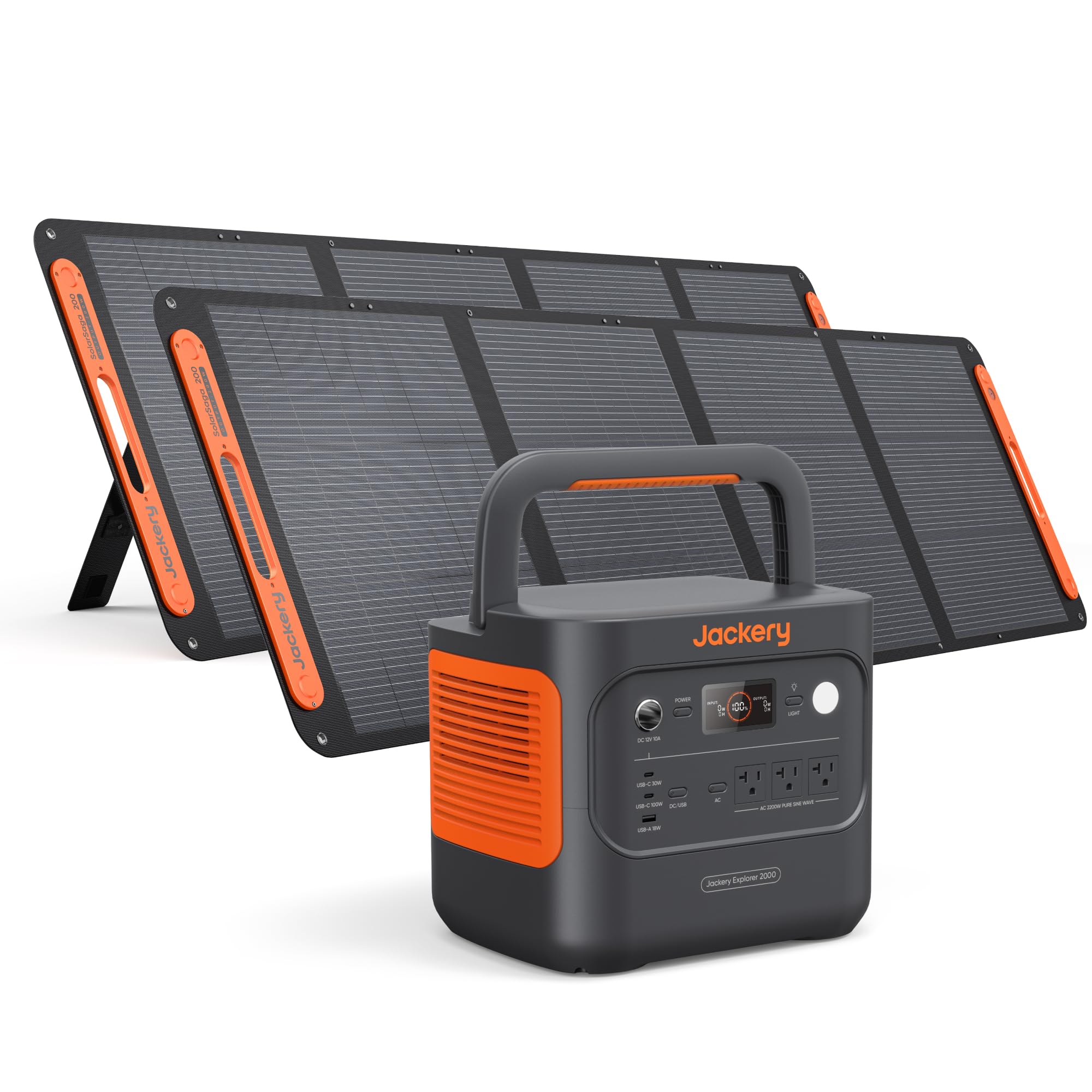
The Jackery Explorer 2000 v2 uses CTB (Cell-to-Body) architecture borrowed from EV manufacturing to shrink the footprint of a 2kWh station down to 39.5 pounds — 41% lighter than many competitors at the same capacity. Despite the weight savings, the inverter delivers a clean 2200W continuous output (4400W surge) from three AC ports, and the 2042Wh LiFePO4 battery is rated for 4000 cycles to 70% capacity.
Included in this kit are two 200W SolarSaga panels that, in full sun, can recharge the station from zero to full in about six hours. The UPS switchover is rated at 20 milliseconds, which is fast enough to keep a desktop computer or router running during a grid flicker. Owners report running window air conditioners for over three hours and powering two freezers plus a fridge simultaneously without tripping the inverter.
The app-activated Emergency Super Charging mode pushes AC recharge to 80% in 66 minutes, and a Silent Charging mode keeps fan noise at 30dB for overnight charging. The only practical limitation is that the unit cannot be expanded with external batteries — the 2042Wh is fixed, so if you need more runtime, you need a second station or a larger-capacity model.
Why it’s great
- Very light for a 2kWh station at under 40 lbs
- Fast AC recharge with app-controlled boost mode
- Clean sine wave output safe for sensitive electronics
Good to know
- Battery capacity is not expandable
- Solar panels shipped separately from the power station
2. BLUETTI Apex 300 Portable Power Station
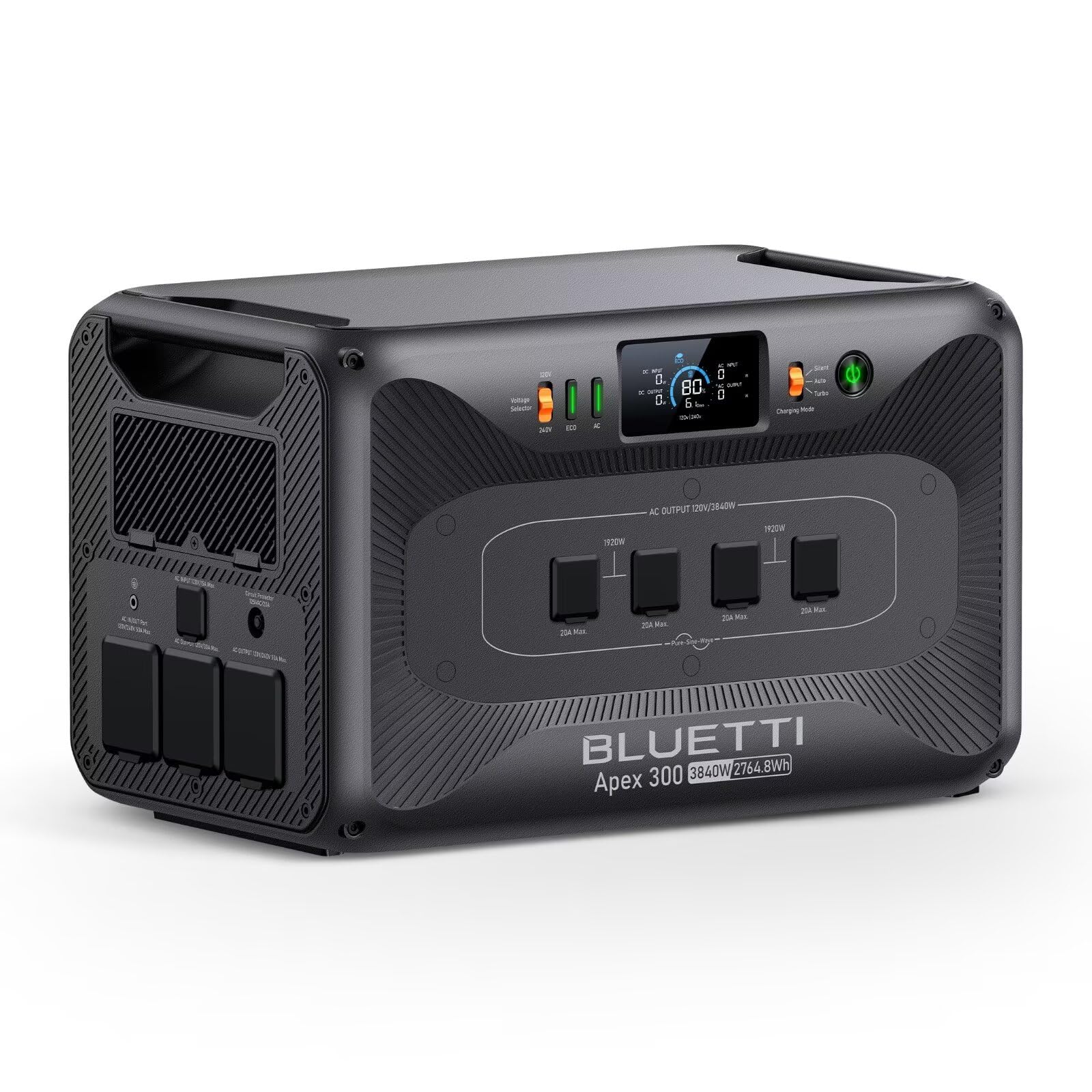
The BLUETTI Apex 300 is one of the few portable stations in this class that delivers native 120V/240V split-phase output from a single unit, which means it can directly feed a home transfer switch without requiring a separate transformer or stacking two units. The base model holds 2765Wh, expandable with B300K or B500K batteries, and the inverter peaks at 7680W surge from its 3840W continuous rating.
The unit weighs 66.1 pounds and includes a 0ms UPS for seamless grid-to-battery switching. Owners note that the 60Voc PV input limit is a meaningful constraint — 72-cell panels with Voc above 60V will not work, so you must build solar arrays that stay within that ceiling. Workarounds include charging via a 120V AC input from a smaller station that is itself replenished by solar.
Build quality is consistent with BLUETTI’s reputation for robust LiFePO4 packs and intelligent BMS. The Apex 300 supports BLUETTOPUS AI-BMS for active battery balancing, and the unit can be controlled remotely through the BLUETTI app. For users who need 240V backup without upgrading to a whole-house gas generator, this station offers a clean, expandable path.
Why it’s great
- Native 120V/240V split-phase output for transfer switch connection
- Expandable battery capacity up to 2765Wh base
- Zero-millisecond UPS for uninterrupted power
Good to know
- Solar input limited to 60Voc, excluding many 72-cell panels
- No DC ports included on the unit
3. EF ECOFLOW Delta 3 Ultra Portable Power Station with 400W Solar Panel
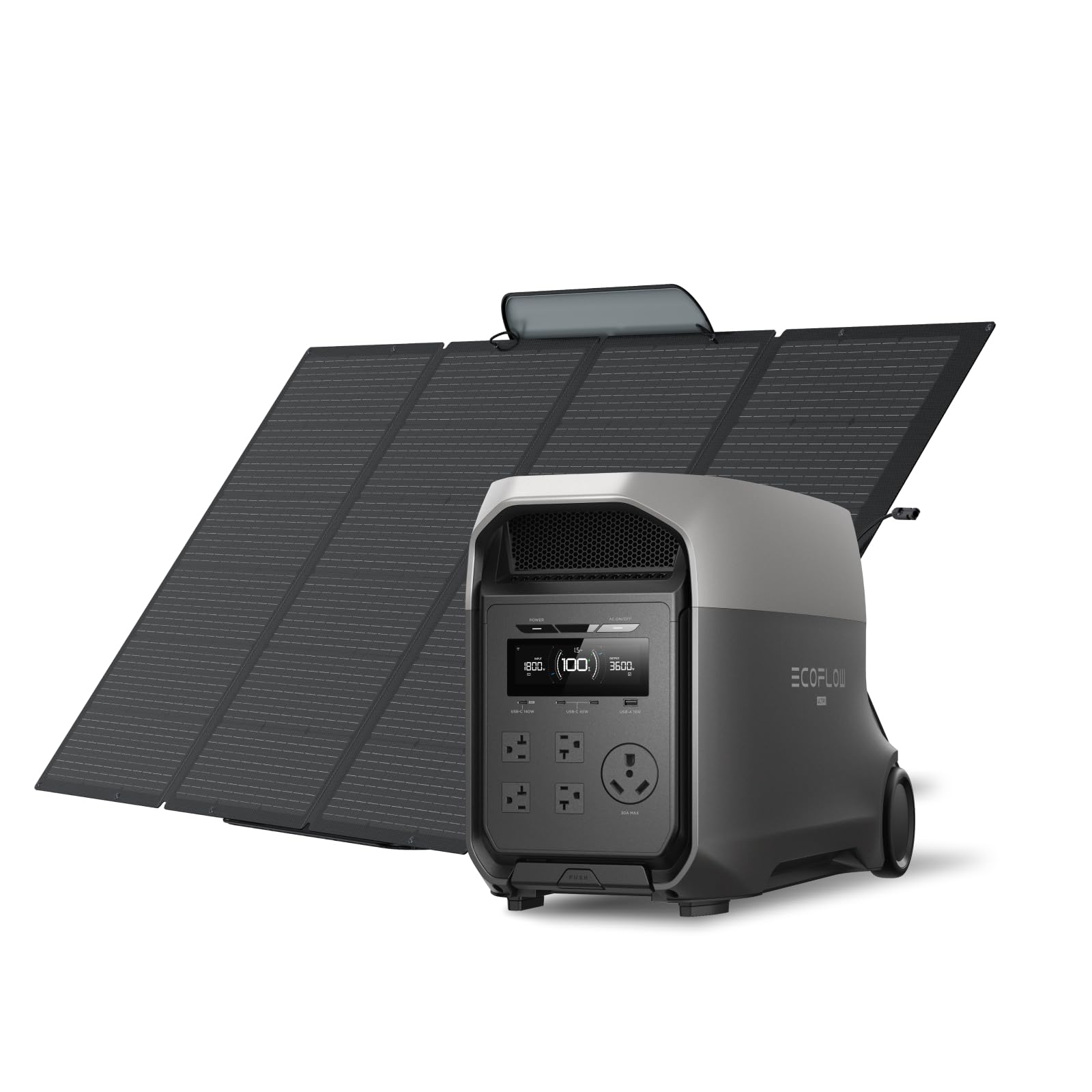
The Delta 3 Ultra from ECOFLOW pushes 3600W continuous output with a 7200W surge capability, which is unusually high for a portable station at this size. The 3072Wh LiFePO4 battery uses EV-grade CTC (Cell-to-Chassis) structure for thermal management, and the X-Quiet 3.0 cooling system keeps noise at 25dB under normal loads — quiet enough for use in a bedroom or RV overnight.
The included 400W solar panel charges the station at up to 400W input, and the unit supports X-Stream fast AC charging that can refill the battery from zero to 80% in under an hour. The UPS transfer time is under 10 milliseconds, which qualifies for sensitive electronics without requiring a separate UPS unit. Owners report running a fridge, lights, laptop, and tools simultaneously with no stability issues.
The trade-off is weight: at 74.3 pounds, the Delta 3 Ultra is not a grab-and-go unit, and the included 400W panel is large and heavy as well. The unit also cannot be expanded with extra batteries, so the 3072Wh capacity is final. For users who need massive surge capability for motor-starting loads like air conditioners or pumps, this station competes directly with gas inverter generators in power delivery without the fuel and maintenance.
Why it’s great
- 7200W surge handles motor-starting loads easily
- Quiet 25dB operation under load
- Very fast AC recharge with X-Stream technology
Good to know
- Heavy at 74.3 lbs, not truly portable for hiking
- Battery capacity is not expandable
4. Jackery HomePower 3000 Portable Power Station with 2x200W Solar Panels
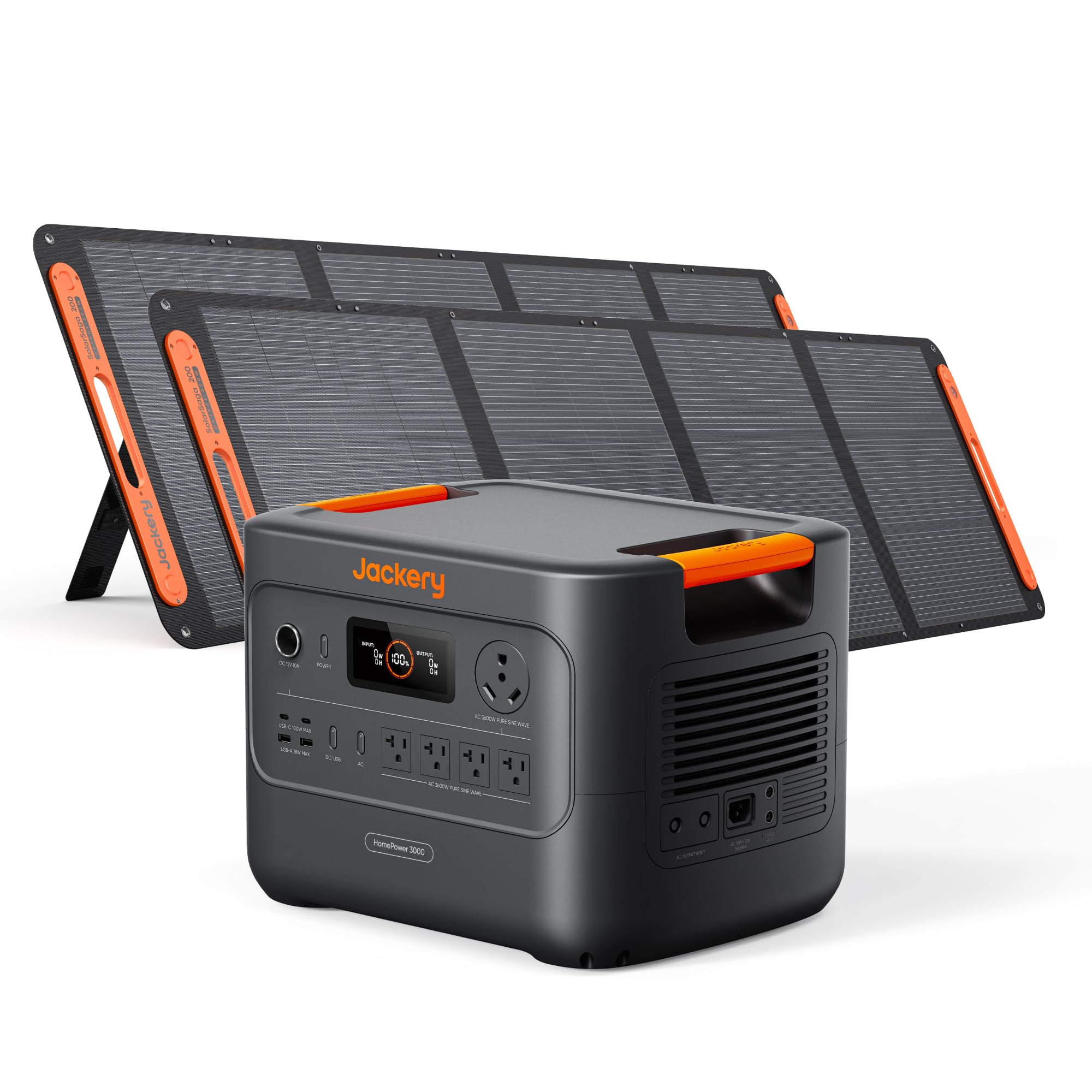
The Jackery HomePower 3000 delivers 3072Wh of LiFePO4 storage with a 3600W inverter (7200W surge) in a chassis that uses CTB technology to keep weight at 59.5 pounds — light for a 3kWh station. It includes two 200W SolarSaga panels that can recharge the battery in about 11 hours of full sun, and the AC charger refills completely in 2.2 hours via a standard wall outlet.
The unit has a built-in TT-30 RV port for direct connection to travel trailers, plus dual 100W USB-C PD ports for fast device charging. The ChargeShield 2.0 algorithm extends battery lifespan by optimizing charge curves, and the unit is rated for 4000 cycles to 70% capacity. Owners consistently report running a refrigerator for two full days or powering an RV (minus air conditioning) off-grid without issues.
The most common feedback is that the unit is heavy enough to need a wheel kit, which is sold separately, and that battery expansion is not supported — the 3072Wh is sealed. For home backup users who want a single-station solution with enough capacity to cover overnight outages, this Jackery hits a strong value point.
Why it’s great
- Excellent weight-to-capacity ratio at 59.5 lbs for 3kWh
- Integrated TT-30 port for RV hookup
- Dual 100W USB-C ports for fast device charging
Good to know
- Battery capacity is not expandable
- Wheel kit sold separately
5. Anker SOLIX C1000 Gen 2 Portable Power Station with 400W Solar Panel
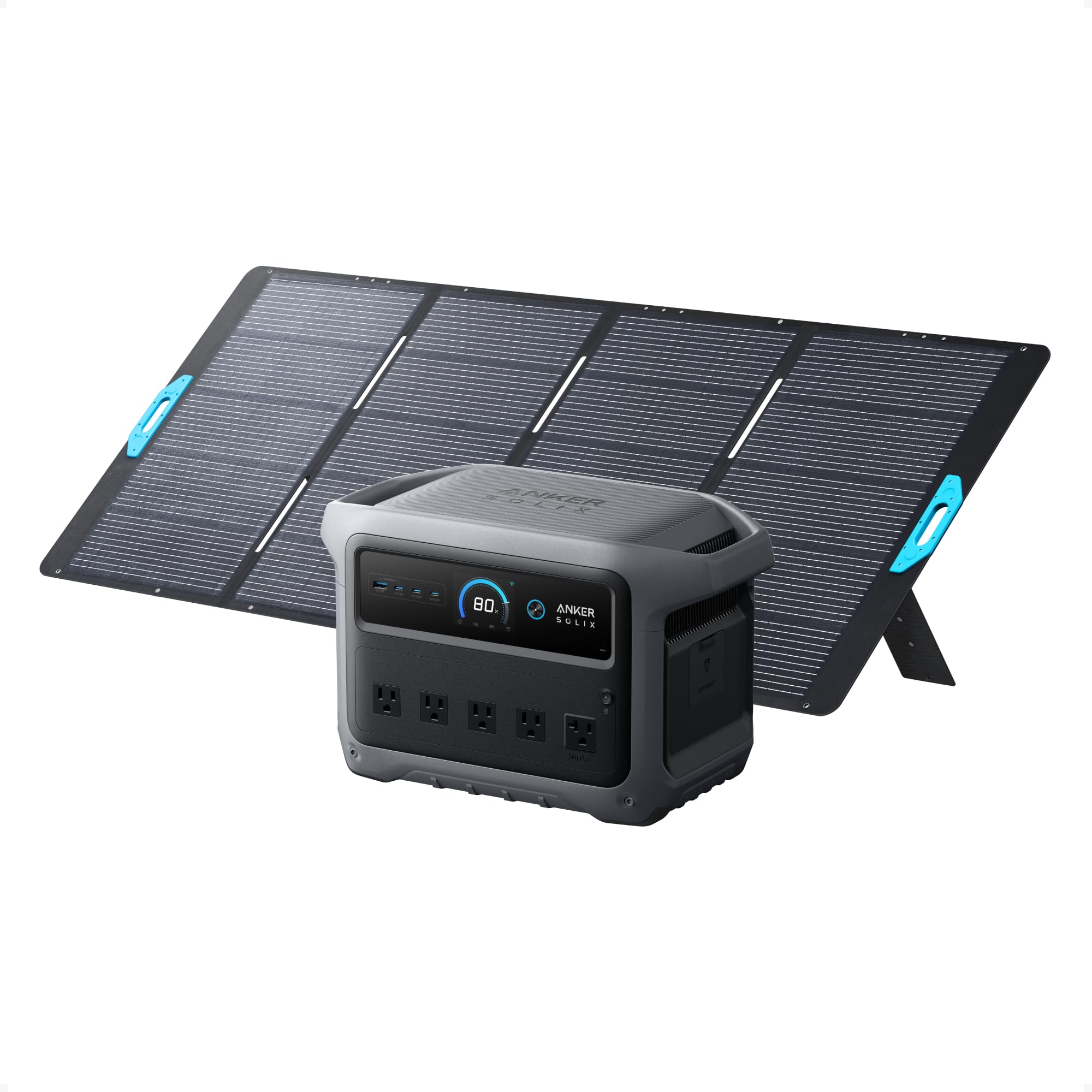
The Anker SOLIX C1000 Gen 2 offers the smallest footprint in this lineup — 15.1 x 8.2 x 9.6 inches — while still delivering a full 2000W of continuous output (3000W peak) from its 1024Wh LiFePO4 battery. The unit weighs about 25 pounds, making it genuinely portable for car camping or moving room to room during an outage. The included 400W PS400 solar panel has IP67 waterproofing and 23% conversion efficiency.
The standout feature is HyperFlash AC charging: the C1000 Gen 2 can recharge from zero to 100% in 49 minutes when plugged into a wall outlet, which is the fastest recharge time in this comparison. The unit supports 600W solar input (60V max), allowing a full solar recharge in about 1.8 hours in optimal conditions. Ten ports including three AC outlets cover the basics for a fridge, modem, and a few lights.
The 1024Wh capacity limits runtime on high-draw appliances — a 1500W space heater would drain the battery in roughly 40 minutes. This station is best suited for short outages, overnight CPAP use, or as a portable power pack for electronics and a mini-fridge rather than whole-home backup.
Why it’s great
- Fastest AC recharge at 49 minutes full
- Compact and light for true portability
- IP67 waterproof solar panel included
Good to know
- 1024Wh capacity limits runtime on high-wattage loads
- Solar panel and station ship separately
6. AFERIY 3840Wh Portable Power Station

The AFERIY 3840Wh station delivers 3.8kWh of storage from LiFePO4 cells and can be expanded to 11.5kWh with additional battery packs, making it one of the most scalable options in this review. The 3600W continuous inverter (7200W peak) supports 15 output ports, including five 120V AC outlets, USB-C with PD, DC5521, and a 12V car socket.
Recharge is fast: AC input can fill the battery in 1.5 hours, and combined AC plus solar charging can achieve the same in about 1.5 hours. The UPS transfer time is under 10 milliseconds, which is fast enough for computers and network gear. Owners consistently praise the build quality, noting the rugged wheels and telescoping handle make the 80.5-pound unit reasonably easy to move despite its size.
The integrated app provides remote monitoring and scheduling, and the unit is UL Listed for safety. Some users reported the LCD display had connection issues that resolved after repositioning the unit, and the fan noise is slightly higher than top-tier competitors. For the capacity-per-dollar ratio, this station offers strong value for extended home backup.
Why it’s great
- Expandable up to 11.5kWh for multi-day outages
- Fast 1.5-hour AC recharge time
- UL Listed with robust build quality
Good to know
- Fan noise is noticeable under load
- Some reports of display connection quirks
7. ABOK Ark3600 Portable Power Station
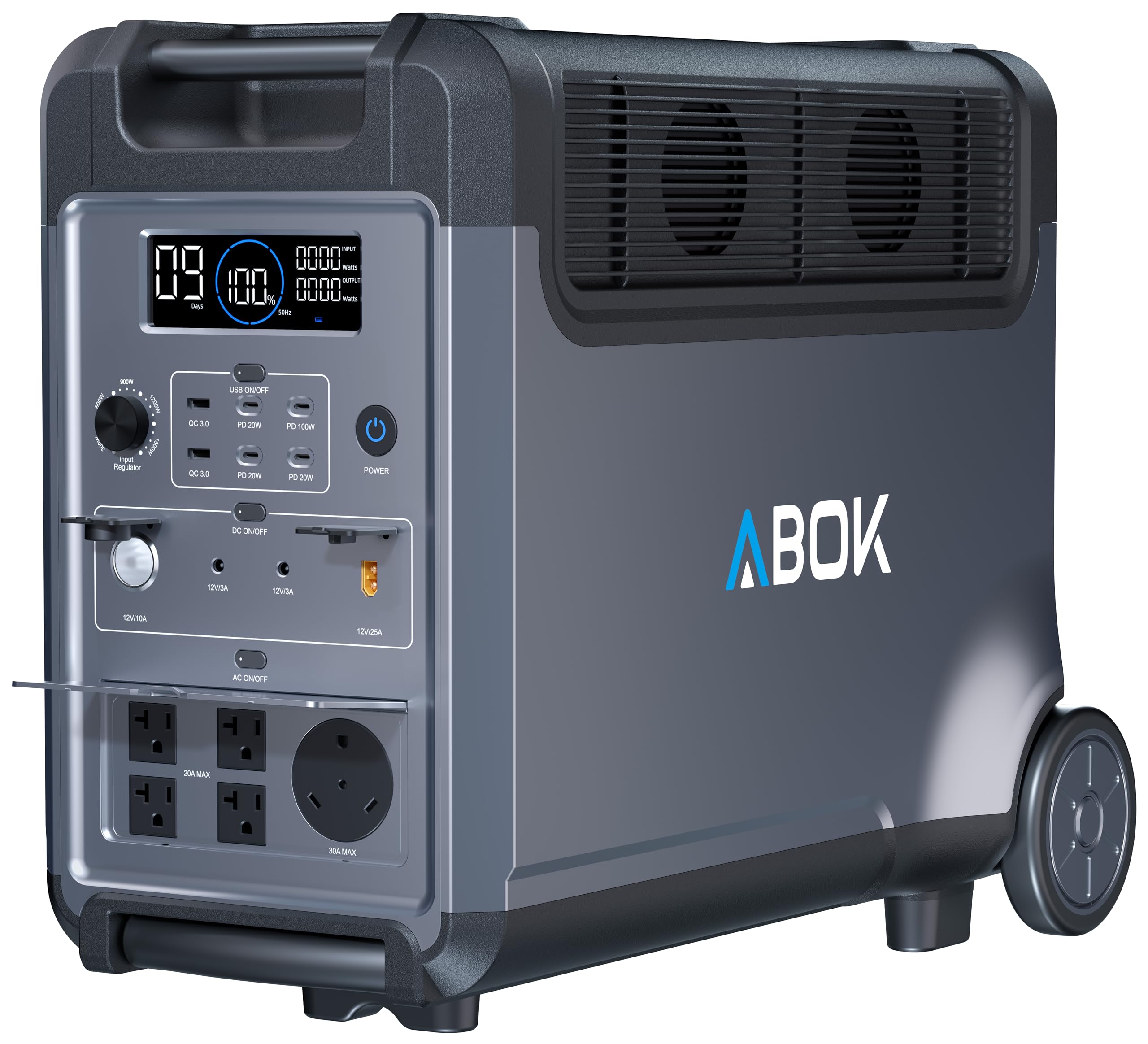
The ABOK Ark3600 packs 3840Wh of LiFePO4 storage and a 3600W inverter (4500W peak) in a wheeled chassis with a telescoping handle, weighing 92 pounds. It can be expanded to 11520Wh by connecting additional battery packs, which puts it in the same league as the AFERIY for large-scale home backup. The unit offers 15 output ports including a 30A AC outlet, USB-C 100W PD, and XT60 for DC loads.
AC charging refills the battery in three hours, and combined AC plus 2000W solar input can cut that to 1.3 hours. The UPS switchover is rated at 10 milliseconds, and the battery is rated for over 4000 cycles with a 10-year lifespan. Owners report running a wet vac, heat gun, and SDS-Max drill simultaneously on a job site and ending the day with 22% battery remaining.
The Bluetooth app allows remote monitoring and control, and the unit includes a cigarette lighter port for 12V accessories. Some users note the weight makes it difficult to move without the wheels, and the fan is audible during high-load discharge. For the price-to-capacity ratio, the Ark3600 is one of the more affordable ways to get a 3.8kWh base with expansion capability.
Why it’s great
- Expandable up to 11520Wh for whole-home backup
- 30A AC outlet supports high-draw appliances
- Competitive price for 3.8kWh base capacity
Good to know
- Heavy at 92 lbs, needs wheels for movement
- Fan noise is noticeable under sustained load
8. OSCAL PowerMax 6000 with 3x400W Solar Panel
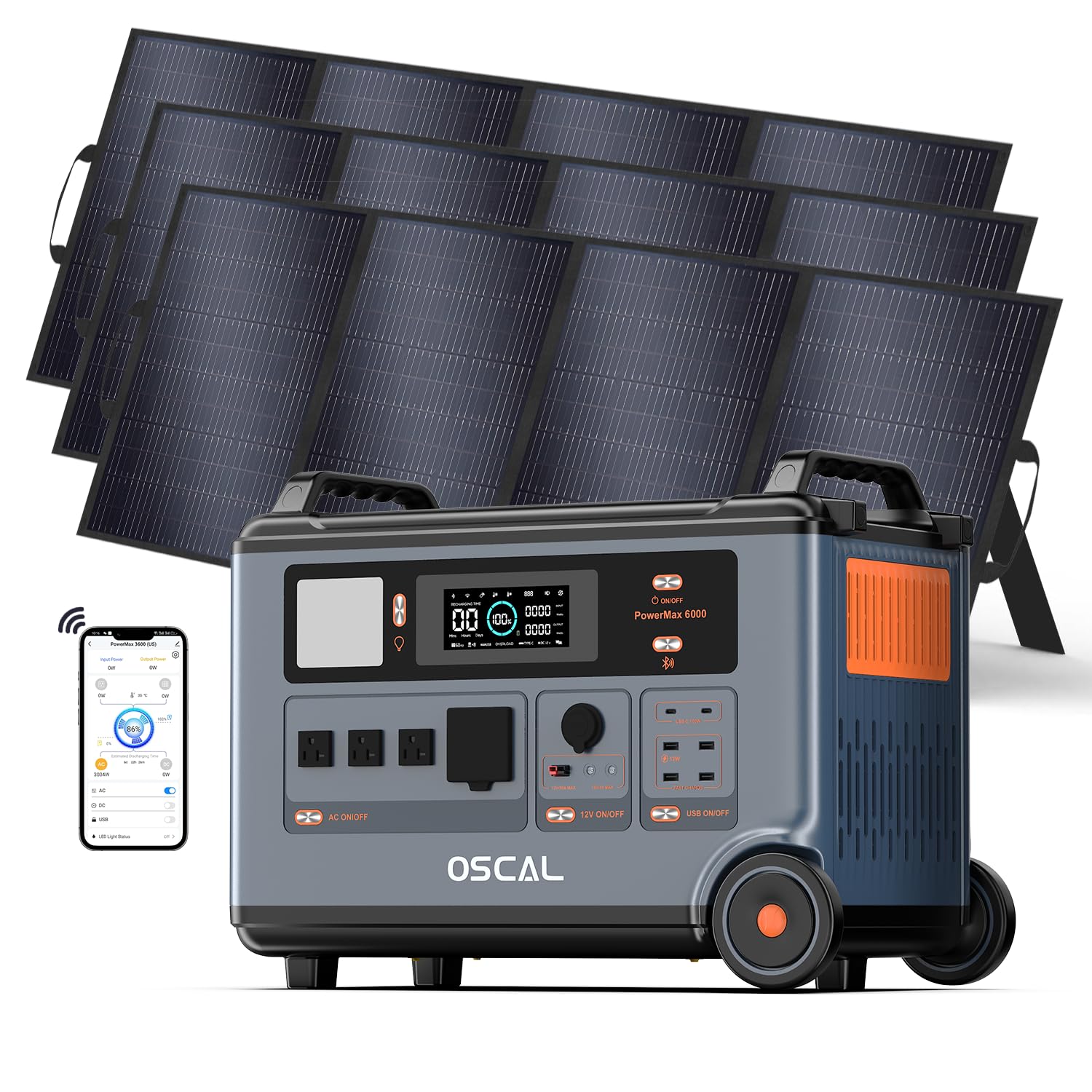
The OSCAL PowerMax 6000 is a 3600Wh system that outputs 6000W continuous (9000W surge) through four AC outlets and supports 120V/240V split-phase operation. The kit includes three 400W solar panels that together can deliver up to 1200W of solar input, and the 2200W bi-directional inverter allows AC charging from zero to full in 1.44 hours. The EPS switchover happens in 5 to 8 milliseconds.
The LiFePO4 battery is rated for 3500 cycles and includes an eight-layer BMS for overcharge, over-discharge, and temperature protection. The unit connects to the OSCAL app for remote monitoring. Owners note that the included charging cables are short and that the unit is heavy but manageable with the built-in handle and wheels.
Some users report that the battery drains faster than expected with very small loads, and the 6000W continuous rating may require careful balancing of high-draw appliances to avoid tripping the BMS. For users who need high-capacity solar harvesting in a single package with 240V output, this kit provides one of the highest panel-to-station ratios available.
Why it’s great
- Three 400W panels included for high solar harvest
- 120V/240V split-phase output
- Very fast 1.44-hour AC recharge
Good to know
- Some battery drain reported at very low loads
- Included charging cables are short
9. OSCAL 7200Wh Portable Power Station PowerMax 6000 with 4x500W Solar Panel
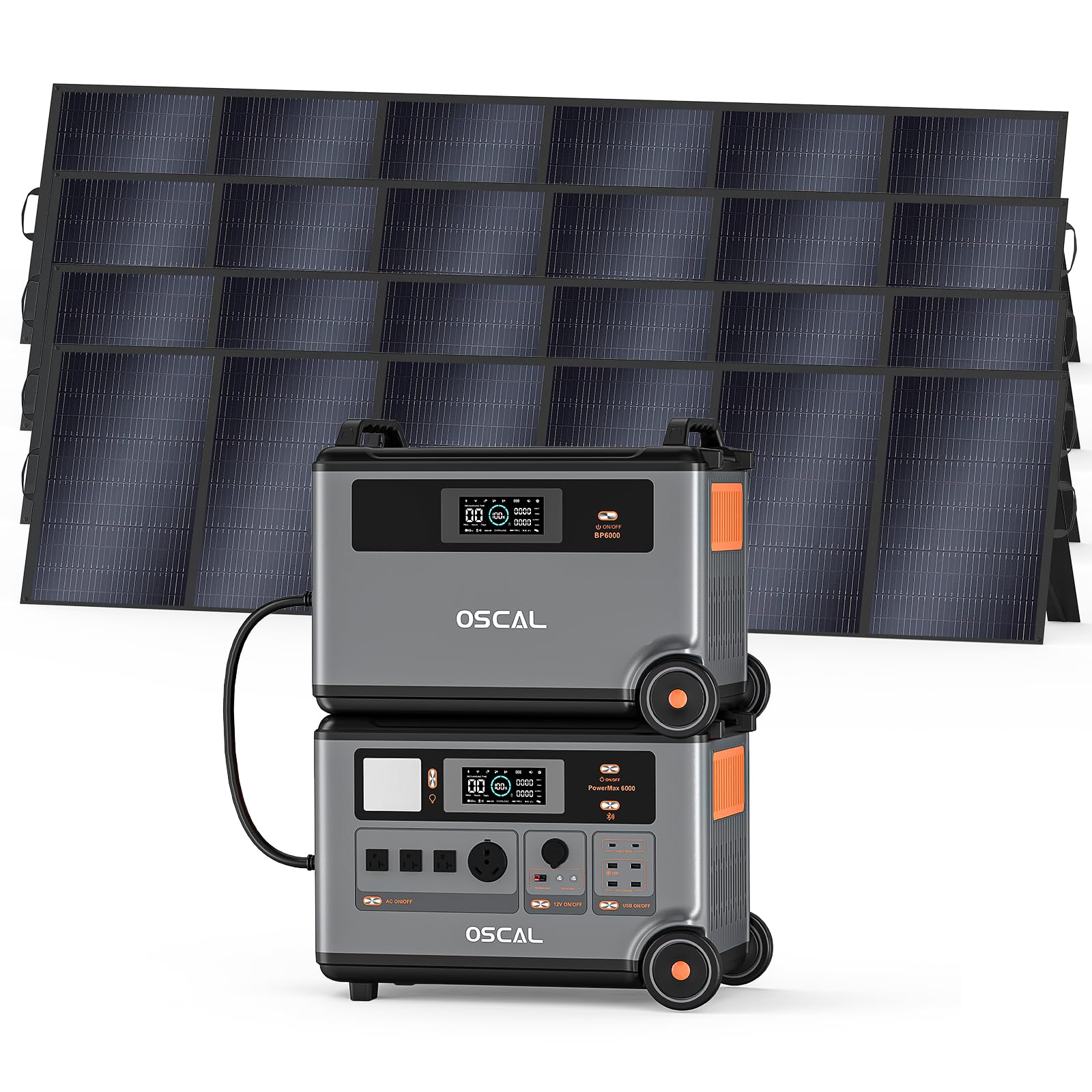
This OSCAL kit doubles the previous model’s storage to 7200Wh while maintaining the same 6000W continuous output (9000W surge) and 120V/240V split-phase capability. The four included 500W solar panels create a 2000W solar array that can recharge the battery in ideal sun conditions in a single day, and the AC charger refills from zero in 1.44 hours using the 2200W bi-directional inverter.
The LiFePO4 pack is rated for 3500 cycles to 80% capacity, and the eight-layer BMS provides comprehensive protection. The EPS switchover happens in 5 to 8 milliseconds, and the app allows remote control and monitoring. With 7200Wh of storage, this system can run a refrigerator for several days or power a workshop off-grid for extended periods.
The main concern from owners is that the 30A receptacle cannot handle the startup surge of motors larger than 3/4 HP, causing the BMS to shut down and require a hard reset. Customer support response times via email have been reported as slow. For users who need maximum capacity for low-surge loads like lighting, refrigeration, and electronics, this kit offers exceptional energy density.
Why it’s great
- Very large 7200Wh capacity for extended backup
- Four 500W panels provide massive solar input
- 120V/240V split-phase output
Good to know
- May struggle with startup surge from large motors
- Customer support response can be slow
10. DuroStar DS13000MX 13,000-Watt Dual Fuel Portable Generator

The DuroStar DS13000MX is a conventional dual-fuel generator, not a battery-based solar generator, but it is included here as a reference point for buyers comparing fuel-powered vs. solar options at a similar budget. It produces 13,000 peak watts (10,000 running watts) on gasoline or propane from a 500cc 4-stroke engine, with a 50-amp outlet that can connect directly to a home transfer switch.
The unit features push-button electric start, a CO sensor that automatically shuts down the engine if carbon monoxide reaches dangerous levels, and low-oil shutdown. It weighs 220 pounds and requires a wheel kit or hand truck to move. Owners report powering entire homes including AC units, refrigerators, and microwaves, and note that the propane option provides cleaner emissions and longer fuel storage life.
The trade-offs are the noise, ongoing fuel costs, and maintenance required for an internal combustion engine. Unlike a solar generator, this unit produces exhaust that must be vented outdoors, and it consumes fuel at a rate that makes extended runtime expensive. For buyers who need raw power output at the lowest upfront cost, this generator delivers, but the total cost of ownership over several years typically exceeds a solar generator.
Why it’s great
- Very high power output at a low upfront cost
- Dual fuel flexibility for fuel availability
- CO sensor for safety
Good to know
- Requires fuel, oil changes, and regular maintenance
- Loud operation compared to solar generators
- Produces exhaust, cannot be used indoors
11. Generac 5,200-Watt Dual-Fuel Portable Inverter Generator
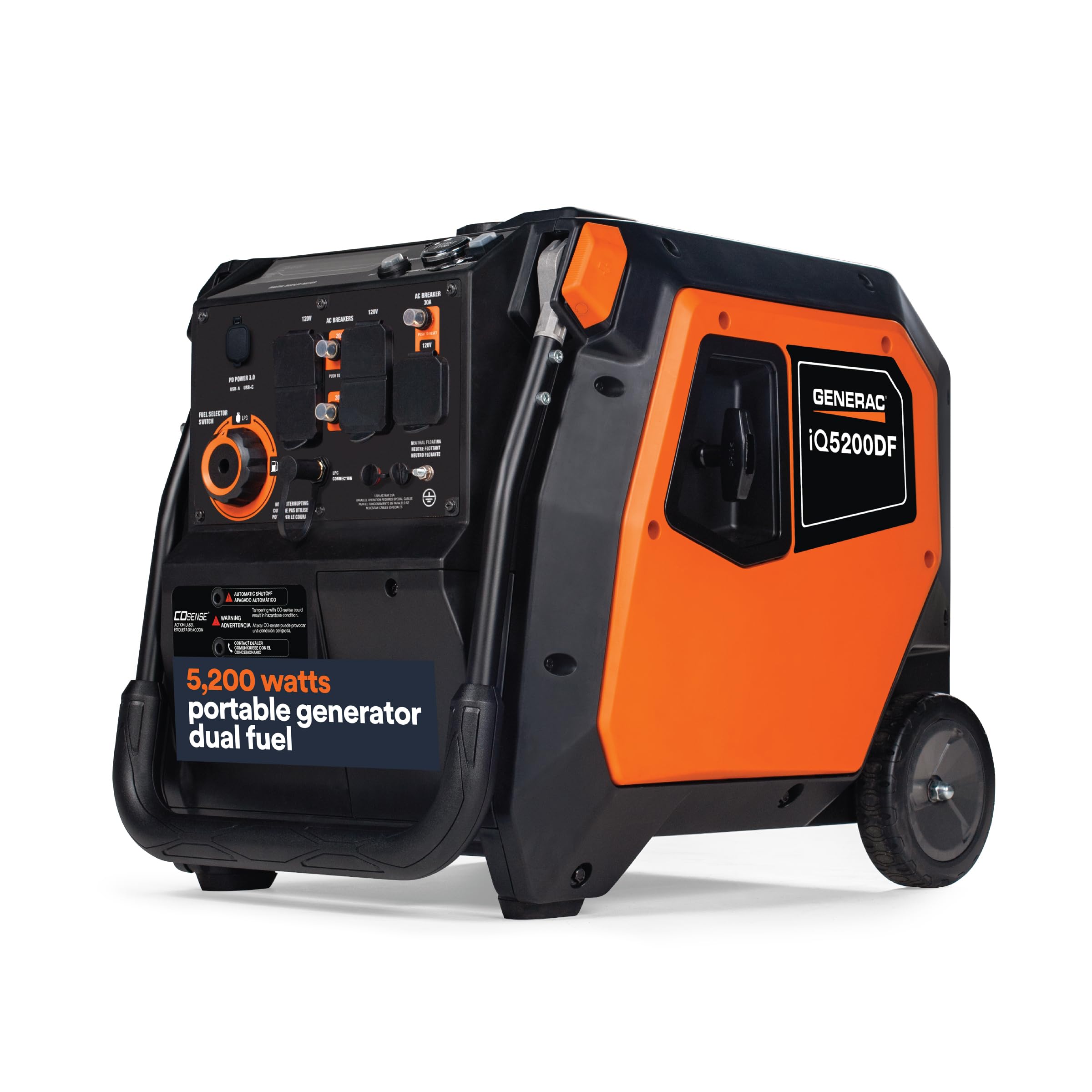
The Generac iQ5200 is a dual-fuel inverter generator that produces 5200 peak watts (5000 running watts) from a fully enclosed engine that operates very quietly for its power class. It runs on gasoline or propane, with electric start and a fuel selector that allows seamless switching between fuel sources without shutting down. The inverter technology produces clean power suitable for sensitive electronics.
The unit weighs 107 pounds, which is light for a generator in this power range, and the fully enclosed case reduces noise to levels owners describe as the quietest they have owned. It includes two USB ports and is parallel-ready for doubling output. The COsense technology automatically shuts off the generator if carbon monoxide builds up in an enclosed space.
The reliability data is mixed: while many owners report trouble-free operation and easy starting, there are reports of engine smoking after break-in and difficulty getting warranty service from Generac. As with any combustion generator, this unit requires fuel storage, oil changes, and spark plug maintenance, and it produces exhaust that requires outdoor operation. For buyers who prioritize quiet inverter power over solar independence, this is a strong contender.
Why it’s great
- Quiet operation for an inverter generator
- Dual fuel with seamless switching
- Clean power for sensitive electronics
Good to know
- Some reports of early engine failure
- Requires fuel storage and maintenance
12. DuroMax XP11000iH 11,000-Watt Dual Fuel Portable Digital Inverter Generator
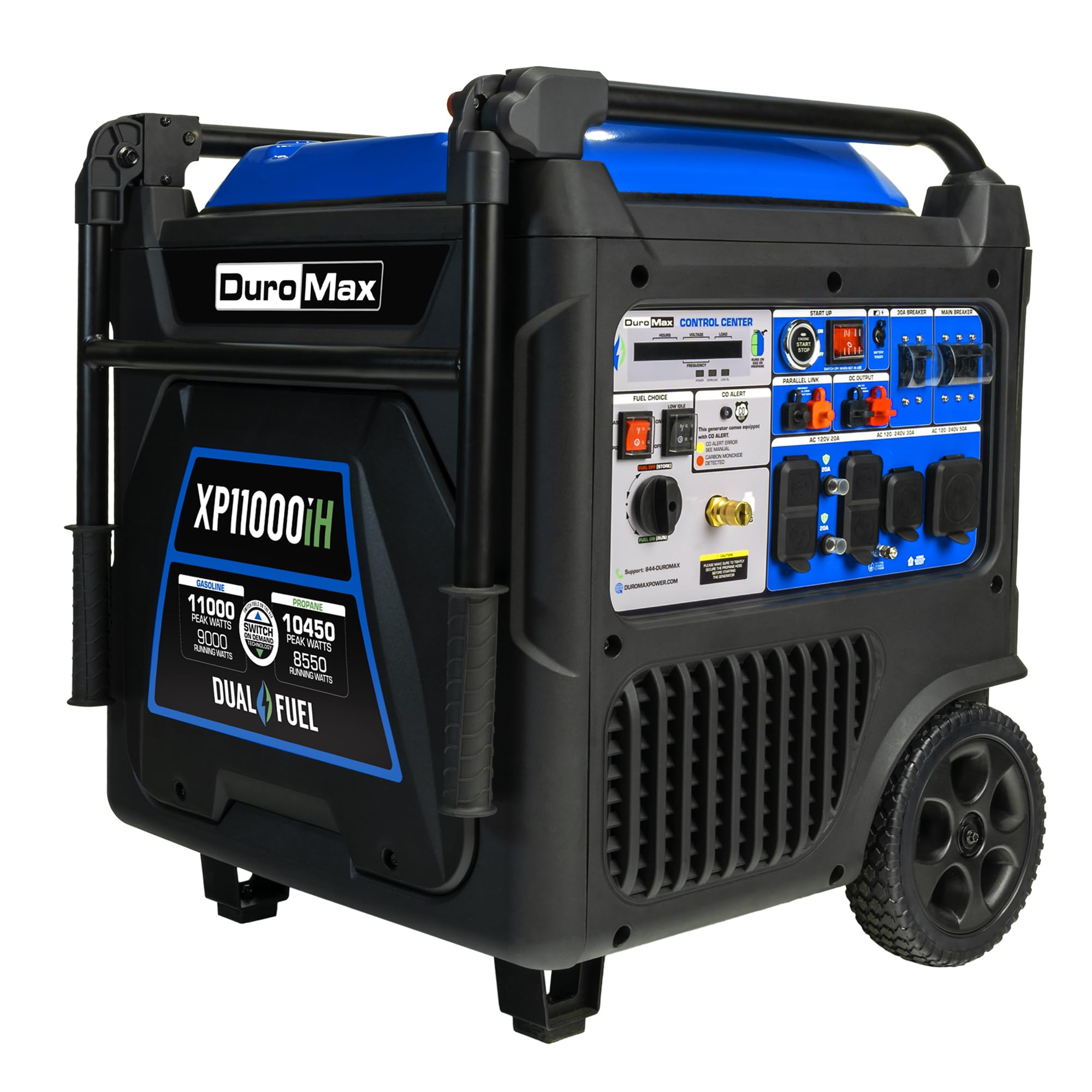
The DuroMax XP11000iH is a dual-fuel inverter generator that delivers 11,000 peak watts (9,000 running watts) on gasoline and slightly less on propane, with a 459cc 4-stroke engine and electronic ignition. It uses true inverter technology to produce clean power suitable for computers and TVs, and it includes a remote start key fob for convenient operation.
The unit is parallel-capable, allowing two XP11000iH units to be combined for 22,000 peak watts. It includes a CO sensor for automatic shutdown, a battery tender to keep the starter battery charged, and an ATS outlet compatible with automatic transfer switches. The 7.5-gallon fuel tank provides extended runtime, and owners report being able to run a 50-amp travel trailer with two AC units plus other loads simultaneously.
The generator weighs 216 pounds and is heavy to move without a hand cart. Some owners report that the oil dipstick is poorly positioned, making oil changes messy, and that the advertised noise level of 61 dB feels optimistic. One review mentions that a 3.5kW coffee machine caused the engine to stall, suggesting the surge handling may be less robust than advertised for some high-draw appliances.
Why it’s great
- High output with clean inverter power
- Parallel capable for doubled output
- Remote start and CO sensor included
Good to know
- Very heavy at 216 lbs
- Some reports of stalling under certain loads
13. Westinghouse 18000 Peak Watt Tri-Fuel Home Backup Portable Generator
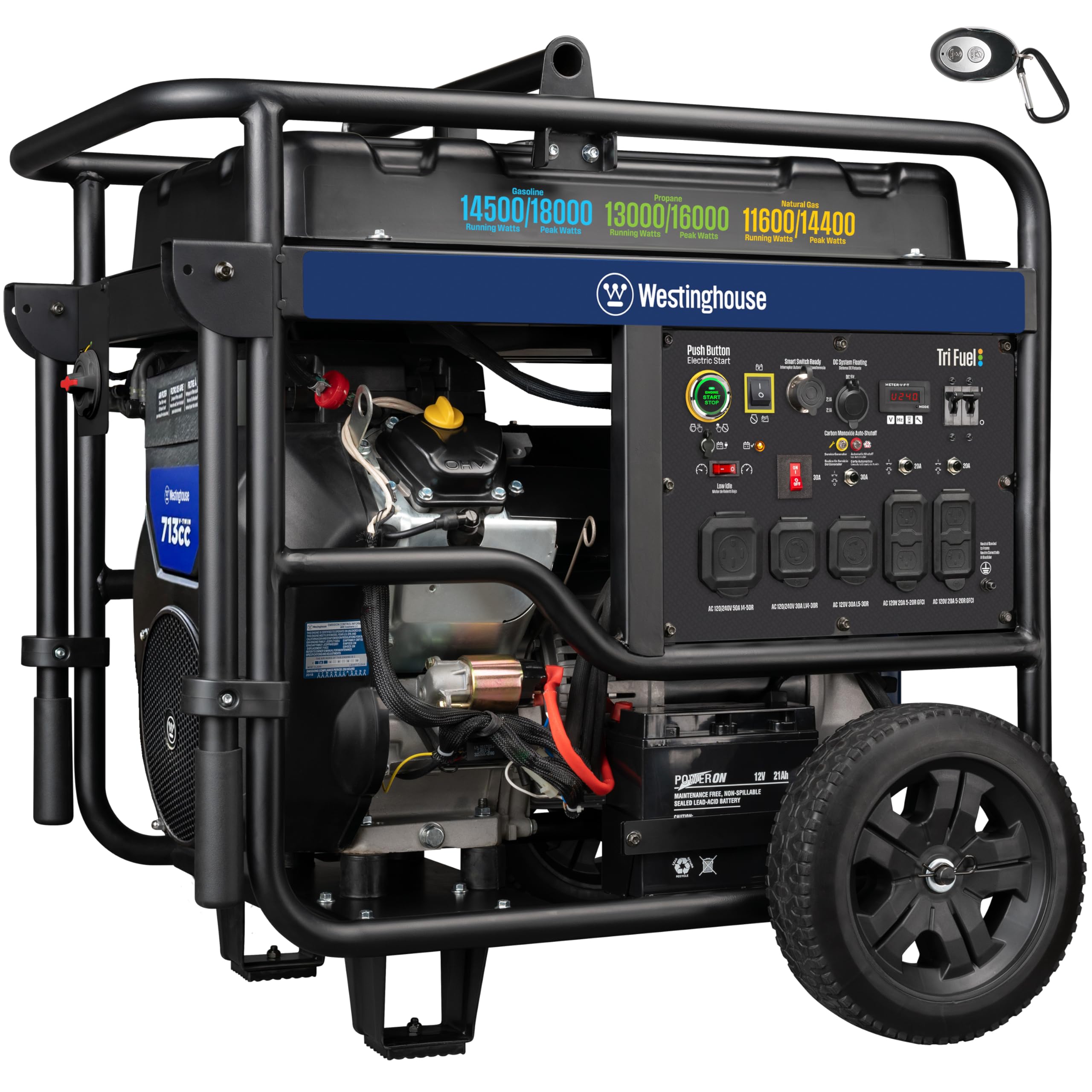
The Westinghouse WGen14500TFc is a tri-fuel generator that runs on gasoline, propane, or natural gas, producing 18,000 peak watts (14,500 running watts) on gasoline. It uses a 713cc V-Twin OHV engine and delivers less than 5% total harmonic distortion, making it safe for sensitive electronics. The unit includes remote start and a CO sensor for automatic shutdown.
The 10.5-gallon fuel tank provides up to 16 hours of runtime at 25% load on gasoline. It includes a 50-amp 14-50R outlet and a 30-amp L14-30R outlet, both transfer switch ready, plus two GFCI duplex outlets and two USB ports. The reinforced steel handle and lift bar make it easier to position despite the 348-pound weight.
Owners praise the tri-fuel flexibility, especially the ability to run on natural gas for unlimited fuel during extended outages. Some note that a separate natural gas hose is not included and that the battery switch must be manually turned off to prevent parasitic drain. The noise level at 74 dBA is loud enough to be noticeable but typical for a generator this size. For homeowners with a natural gas connection who need whole-house backup power, this generator offers the lowest fuel logistics burden of any combustion generator in this class.
Why it’s great
- Tri-fuel operation with natural gas option
- Very high power output for whole-house backup
- Low THD safe for electronics
Good to know
- Extremely heavy at 348 lbs
- Natural gas hose not included
- Battery switch must be manually turned off
FAQ
How many appliances can a 2000-watt solar generator run at once?
Can I leave a 2000-watt solar generator plugged in 24/7 as a UPS?
How long does a 2000-watt solar generator take to recharge from solar panels?
Can I connect third-party solar panels to any 2000-watt solar generator?
Final Thoughts: The Verdict
For most users, the 2000 watt solar generator winner is the Jackery Explorer 2000 v2 because it combines a lightweight 39.5-pound chassis, a full 2042Wh of LiFePO4 storage, and a 2200W pure sine wave inverter that handles most home essentials without weight or complexity. If you need native 240V output for a transfer switch, the BLUETTI Apex 300 provides split-phase power with expandable capacity. And for the highest surge capability in a single unit, the EF ECOFLOW Delta 3 Ultra delivers 7200W peak to start motor-driven appliances that would stall smaller inverters.