
Our readers keep the lights on and the weekend projects moving. As an Amazon Associate, I earn from qualifying purchases.
The jump from a home-theater-in-a-box or a soundbar to a dedicated two channel receiver transforms how you connect with music. You are not just buying an amplifier; you are choosing the centerpiece of a system built around stereo imaging, where clear separation between instruments and a silent noise floor define the listening experience rather than booming surround effects.
I’m Rikta — the co-founder and writer behind FitlyFast. I have spent hundreds of hours digging into the architecture of stereo receivers, comparing DAC chipsets, amplifier topologies, and signal-path purity to find the units that actually deliver on the promise of high-fidelity sound at every budget level.
Whether you are building a vinyl-first setup, upgrading from a dated AVR, or assembling a near-field desktop system, finding the best 2 channel receiver means focusing on the specs that matter your specific listening room — not the wattage race that manufacturers push.
How To Choose The Best 2 Channel Receiver
A 2 channel receiver is the heart of any serious stereo system. Getting the wrong one means leaving sound quality on the table, regardless of how good your speakers are. Focus on the actual engineering, not the flashy front panel.
Amplifier Topology: Class A/B vs. Class D
Class A/B amplifiers, like those in the Cambridge Audio AXR100 or the Dayton Audio HTA100, deliver a warmer, more natural musicality with a well-defined midrange and smooth harmonic character. They run hotter and are less efficient, but critical listeners often prefer their sound. Modern Class D implementations, like the TPA3255 chip in the Ampapa D1 or the WiiM Amp Ultra, have closed the gap dramatically, offering incredible power efficiency, low distortion (THD+N can be below -100 dB), and cool operation — ideal for compact or desktop setups. Listen to both and decide based on your speaker sensitivity and listening habits.
DAC Quality and Digital Connectivity
The digital-to-analog converter determines how much detail survives from your digital sources. Look for implementations based on premium chips like the ESS SABRE ES9080Q (found in the Yamaha R-N800A) or the ESS ES9039Q2M (in the WiiM Amp Ultra). These provide ultra-low jitter and high signal-to-noise ratios, translating to a cleaner, more spacious soundstage. Optical and coaxial inputs are standard, but HDMI ARC is a game-changer for integrating the receiver with a TV — it lets the receiver power high-quality stereo sound for movies and shows without needing a separate AVR.
The Phono Stage: For Vinyl Listeners
If a turntable is part of your plan, an integrated phono preamp saves you from buying a separate box. However, not all phono stages are equal. A moving magnet (MM) phono input with independent circuitry, like the one in the Onkyo TX-8470, preserves the delicate signal from your cartridge and minimizes noise. The Yamaha R-N800A includes a phono input but some users find it better to use an external pre-amp for critical listening. Assess the phono input quality based on your turntable’s output level and your tolerance for hum.
Built-in Streaming and App Control
Modern 2 channel receivers often replace a streamer entirely. A unit with built-in Wi-Fi, Apple AirPlay 2, and support for services like TIDAL or Spotify Connect simplifies your system and reduces wire clutter. The Onkyo TX-8470 and Yamaha R-N800A offer sophisticated streaming capabilities with companion apps that allow multi-room integration. For the ultimate in convenience, the WiiM Amp Ultra includes a touchscreen and room correction, automatically adjusting the sound to your space — a feature typically reserved for much more expensive gear.
Quick Comparison
On smaller screens, swipe sideways to see the full table.
| Model | Category | Best For | Key Spec | Amazon |
|---|---|---|---|---|
| Yamaha R-N800A | Network Receiver | Audiophile streaming with neutral accuracy | ESS ES9080Q DAC, YPAO room correction | Check Price |
| WiiM Amp Ultra | Streaming Amp | Smart, compact desktop system with room EQ | ES9039Q2M DAC, Wi-Fi 6, HDMI ARC | Check Price |
| Onkyo TX-8470 | Network Stereo Receiver | Feature-rich listening with high-res streaming | Discrete MM/MC phono board | Check Price |
| Cambridge Audio AXR100 | Stereo Receiver | Classic hi-fi performance with multiple inputs | 100W/ch at 8 ohms, dedicated subwoofer out | Check Price |
| Denon PMA-600NE | Integrated Amp | Musical flexibility for analog purists | 70W/ch @4 ohms, Analog Mode | Check Price |
| Dayton Audio HTA100 | Hybrid Tube/SS Amp | Warm musicality with tube preamp character | 50W RMS/ch, Bluetooth 5.0, USB DAC | Check Price |
| Sony STRDH190 Bundle | Starter Receiver | Simple & affordable vinyl-to-digital transition | 100W/ch, Phono input, Bluetooth | Check Price |
| Ampapa D1 | Desktop Amp | Near-field listening with digital VU meters | Class D TPA3255, HPF, Balanced Input | Check Price |
| Denon AVR-S970H | AV Receiver | Multi-channel home theater with 2-channel roots | 90W x 7 ch, 8K HDMI, Phono in | Check Price |
In‑Depth Reviews
1. Yamaha R-N800A Network Receiver

The Yamaha R-N800A is a network stereo receiver that leaves no feature unexplored. At its core sits the ESS SABRE ES9080Q Ultra DAC, a chip known for exceptional signal-to-noise performance, handling DSD 11.2 MHz native playback and PCM up to 384 kHz. This is paired with YPAO-R.S.C. (Reflected Sound Control), which analyzes and calibrates the output for your specific room’s acoustics, ensuring you hear the recording, not your listening space.
Delivering 100 watts per channel into 8 ohms, the amplifier section uses Yamaha’s ToP-ART (Total Purity Audio Reproduction Technology) mechanical structure and a low-impedance concept. This results in a sound that is incredibly clean, with a vast soundstage and excellent instrumental separation. Owners report that the sound remains consistently neutral and involving across all inputs — from CD and streaming to vinyl and Bluetooth. The phono input is present, but some critical listeners prefer a dedicated outboard preamp for top-tier analog performance.
Connectivity is thorough: built-in Wi-Fi, Bluetooth, Ethernet, Apple AirPlay 2, and support for TIDAL, Spotify Connect, Qobuz, and Roon Ready. The Yamaha MusicCast app is stable and intuitive, allowing multi-room audio integration. The build quality is exceptional, with a large toroidal transformer and substantial heat sinks that explain its weight. The remote feels less premium than the rest of the unit, but the front panel controls and the app offer full command. For an all-in-one solution that demands no compromise on sound fidelity, this is the benchmark.
Why it’s great
- ESS SABRE ES9080Q DAC delivers studio-grade clarity
- YPAO room correction optimizes sound for any space
- Neutral, organic sound across all sources
Good to know
- Phono stage is functional but not exceptional; an external preamp may be preferred
- Remote control feels inexpensive for a premium product
- YPAO EQ can muddy sound for some listeners; easy to bypass with Pure Direct
2. WiiM Amp Ultra
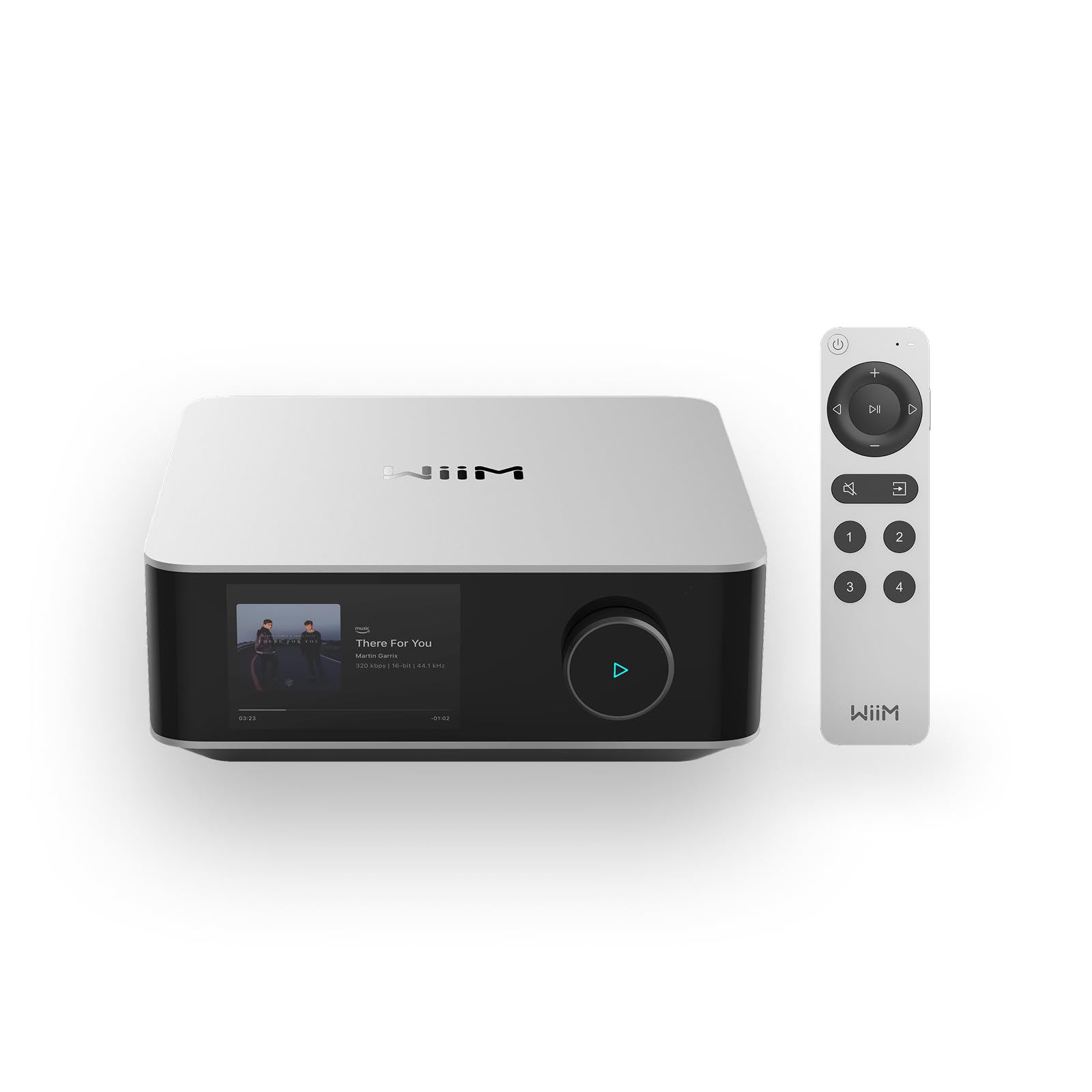
The WiiM Amp Ultra redefines what a compact streaming amplifier can achieve. Inside a unibody aluminum chassis with a glossy 3.5-inch touchscreen, it packs dual TI TPA3255 Class D amplifiers capable of 100W per channel with incredibly low distortion (-106 dB THD+N). The ESS ES9039Q2M SABRE DAC keeps the signal path pristine, while PFFB (Post-Filter Feedback) technology ensures consistent performance regardless of speaker impedance.
The standout feature is the built-in RoomFit Room Correction, which uses your phone’s microphone to automatically calibrate the output to your room’s acoustics — a revelation in this price tier. Users report it makes a dramatic difference, tightening the bass and clarifying the midrange. The included WiiM Home app gives you full parametric EQ, bass management, source routing, and volume limiting. Support for HDMI ARC makes TV integration seamless, allowing the receiver to power high-quality stereo from any streaming show.
Connectivity is next-generation: Wi-Fi 6, Bluetooth 5.3 with LE Audio, and support for TIDAL, Qobuz, Amazon Music, Spotify Connect, Roon Ready, and Chromecast. The touchscreen displays album art and settings, adding a modern premium feel. It is nearly silent in operation and runs cool even under load. Note that it does not support AirPlay. For users who want a sleek, powerful, and software-driven amplifier without the bulk, this is a superb option.
Why it’s great
- RoomFit room correction automatically optimizes sound for your space
- HDMI ARC for seamless TV audio integration
- Excellent app with parametric EQ and per-source settings
Good to know
- Does not support Apple AirPlay
- Bluetooth source can cause a slight delay; best used over Wi-Fi
- Lacks a dedicated coaxial digital input
3. Onkyo TX-8470

The Onkyo TX-8470 is a network stereo receiver designed with the vinyl revival in mind. Its patented discrete op-amp circuitry and isolated MM/MC phono board protect the delicate signal from your turntable, providing improved clarity and reducing distortion compared to generic phono stages. This makes it a strong candidate for anyone who splits time between LPs and digital streaming.
With a 2-channel amplifier optimized for high current drive, it delivers clean, powerful output that maximizes loudspeaker performance. Audio-grade capacitors and a gold-plated terminal further reduce noise. The unit handles up to 24-bit/192kHz playback and is Roon Ready, integrating seamlessly with high-end music management software. Wi-Fi and Bluetooth are built-in, along with HDMI connectivity for TV integration.
The interface uses a large remote with tiny buttons, which some users find complex. The bass and treble controls are only accessible via the remote, not on the unit itself, which can be a minor frustration. However, the sound quality is superb, particularly with analog sources, where the phono stage pulls out detail without harshness. For a modern receiver that treats vinyl with the respect it deserves while embracing digital convenience, the TX-8470 is a compelling choice.
Why it’s great
- Excellent discrete MM/MC phono stage for vinyl playback
- Built-in Roon Ready for high-end music management
- Clean, powerful amplification with gold-plated terminals
Good to know
- Bass and treble controls are not available on the front panel
- Setup can be complex; the manual is extensive
- Bluetooth pairing can be finicky for some users
4. Cambridge Audio AXR100

The Cambridge Audio AXR100 is a traditional stereo receiver built for enthusiasts who value a classic all-in-one approach. It delivers 100 watts per channel into 8 ohms, with a dedicated subwoofer output, digital inputs (optical and coaxial), and a built-in phono stage. The design is vintage-inspired with a clean, gray faceplate and large knobs, fitting seamlessly into a traditional hi-fi cabinet.
Sound quality is warm and balanced, with a wide soundstage. The phono stage is clean and loud, handling both MM cartridges. The built-in DAC is solid for the price, offering smooth treble without harshness. Owners report that even complex tracks like jazz and classical are handled with detail, and the A/B speaker switching allows you to run two pairs of speakers for different zones or simultaneous listening.
The primary weak point is Bluetooth connectivity, which has very limited range and can be interrupted by simple movements in the room — it is best used as a secondary input for convenience, not for critical listening. The remote is not backlit, making it hard to use in the dark. The unit runs completely silent with no fan noise, a major plus for quiet listening sessions. For a classic, well-built receiver with excellent fundamental sound, the AXR100 is a strong contender.
Why it’s great
- 100W/ch with a dedicated subwoofer pre-out
- Warm, balanced sound ideal for long listening sessions
- Completely silent operation with no fan noise
Good to know
- Bluetooth range is very poor and unreliable for movement
- Remote is not backlit, difficult to use in the dark
- No USB connectivity for direct digital playback
5. Denon PMA-600NE

The Denon PMA-600NE is an integrated amplifier that prioritizes signal purity through careful circuit design. It features Denon’s Advanced High Current (AHC) push-pull power amplifier, rated at 70 watts per channel into 4 ohms. The standout feature is the Analog Mode, which completely disengages the digital circuitry — including Bluetooth — to eliminate any potential digital interference from the analog signal path. This option is rare and valuable for purists wanting the cleanest possible sound from vinyl or CD.
The built-in DAC supports optical and coaxial inputs, and it includes a phono preamp for MM cartridges. The sound is described as warm and tube-like, similar to classic 1970s solid-state receivers, with a smooth midrange and non-fatiguing treble. The Pure Direct mode bypasses the tone controls for an even shorter signal path. The headphone amplifier is robust enough to drive 300-ohm Sennheisers, making it a versatile desktop or main system component.
Build quality is excellent, with a vibration-resistant chassis and a large power transformer. However, the LED indicators are dim, and the remote control can feel a bit laggy. Some users report noise in the signal path that required cable upgrades to resolve. At its price, it offers a level of musicality and flexibility — especially with the Analog Mode — that competitors find hard to match for two-channel listening.
Why it’s great
- Analog Mode disables digital circuits for pure analog playback
- Warm, tube-like sound character from solid-state design
- High-quality DAC and phono stage in one package
Good to know
- Analog Mode also disables Bluetooth connectivity
- Remote control volume is laggy
- Some users report noise in the signal path requiring cable upgrades
6. Dayton Audio HTA100

The Dayton Audio HTA100 is a hybrid tube amplifier that marries the warmth of a vacuum tube preamp with the power of a Class A/B solid-state amplifier. Delivering 50 watts RMS per channel, it provides a subtle amber tone character and a smooth, engaging listening experience. The exposed tubes on the front panel are visually striking, and the analog VU meters add to the vintage appeal.
Connectivity is versatile: RCA inputs, a built-in phono preamp for turntables, Bluetooth 5.0 for wireless streaming, and a USB DAC for direct connection to a computer. The USB input supports 24-bit/96kHz audio. The headphone jack on the front panel offers clear private listening. The bass and treble tone knobs give you control over the sound profile.
Owners report that the HTA100 delivers a warmer, more musical sound than many sterile Class D alternatives. It drives speakers like the Sony bookshelf models or Triangle Borea BR03 effortlessly, with a sound that is immersive and round. The remote control is reported as sluggish, and the Bluetooth connectivity is functional but not as clear as the optical input. The fan on the larger HTA200 is sometimes audible, but the HTA100 runs quieter. For those wanting tube aesthetics and sonic character without the cost or hassle of a pure tube amp, this is a fantastic entry point.
Why it’s great
- Hybrid design offers tube warmth with Class A/B power
- Stunning visual appeal with VU meters and glowing tubes
- Versatile inputs including phono, Bluetooth, and USB DAC
Good to know
- Remote control is sluggish and not backlit
- Bluetooth and USB clarity is inferior to optical input
- Fan noise can be audible at high volume on some units
7. Denon AVR-S970H

The Denon AVR-S970H is technically a 7.2 channel AV receiver, but its robust stereo performance and excellent phono input make it a flexible option for a hybrid system. It delivers 90 watts per channel across 7 channels, with support for Dolby Atmos and DTS:X. For pure 2-channel listening, it offers a dedicated Pure Direct mode, and the Audyssey setup mic calibrates sound for your room.
The phono stage is surprisingly good for an AVR, handling a vintage turntable without issue. The 8K HDMI inputs and outputs (6 in, 2 out) make it a centerpiece for a modern home theater, supporting VRR, QFT, and ALLM for gaming. HEOS multi-room integration allows easy streaming to other Denon speakers. The user interface is straightforward, with on-screen setup videos.
Because it is an AVR, the shared power supply means that power to the front left and right channels is reduced when driving a full surround setup. For serious 2-channel purists, a dedicated stereo receiver will sound better. Also, Zone 2 uses the rear surround speaker connections, reducing the main zone to 5.2. If your primary goal is a home theater that also handles 2-channel music well, the AVR-S970H represents excellent value.
Why it’s great
- Excellent phono stage for an AV receiver
- 8K HDMI connectivity for gaming and 4K/8K pass-through
- HEOS multi-room streaming and easy setup
Good to know
- Power is shared across 7 channels; stereo performance is not as pure as a dedicated 2-channel unit
- Zone 2 disables rear surround channels
- HEOS app is functional but less intuitive than some competitors
8. Sony STRDH190 Bundle

The Sony STRDH190 is a classic entry-level 2-channel receiver that prioritizes simplicity and reliable performance. It delivers 100 watts per channel (into 8 ohms) and features a dedicated phono input for turntables, Bluetooth connectivity with standby mode, and four analog audio inputs. The included bundle adds speaker wire and banana plugs, making this a turnkey solution for building a first stereo system.
Sound quality is clean and solid for the price. It drives speakers like the Klipsch RP-600Ms or Polk components with authority, and the adjustable bass and treble controls help tailor the sound to older recordings. The receiver excels in its role as a simple hub for a pair of speakers and a turntable, turning the smartphone into an instant source via Bluetooth.
The FM radio antenna connection uses a proprietary connector that is not compatible with standard coaxial or F-type antennas, limiting upgrades. Bluetooth pairs instantly but the receiver itself lacks advanced features like a subwoofer pre-out that you would find on more expensive models. For a budget build or a secondary room system, the STRDH190 is an unbeatable entry point into the world of 2-channel audio.
Why it’s great
- Excellent value for a complete system start
- Includes phono input for turntables
- Bluetooth with standby for smartphone convenience
Good to know
- FM antenna connector is proprietary, not standard
- No subwoofer pre-out for easy subwoofer integration
- Build quality is basic; not for high-power demands
9. Ampapa D1
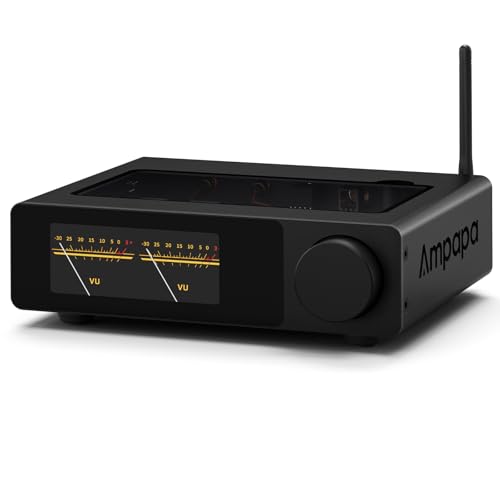
The Ampapa D1 is a compact 2-channel Class D amplifier from a collaboration between Ampapa and Douk Audio. It uses the TPA3255 chip, well-regarded for high efficiency and low distortion, and increases power output with a GaN 48V/5A power adapter. The standout feature is the digital OLED display that offers 7 retro-style VU meter configurations in yellow, blue, or black — a hit with those wanting both performance and aesthetics on a desktop.
It includes a variable high-pass filter (30-200 Hz) to offload bass to a subwoofer, a subwoofer pre-out, and both TRS balanced and RCA inputs. The pluggable NE5532 op-amps allow easy upgrade to LM4562 or MUSES 8902 for sonic tuning. PFFB technology ensures the load-dependent distortion is minimized, maintaining consistent sound quality across different speakers.
Build quality is high, with an aluminum chassis, glass top (allowing users to swap op-amps), and internal RGB lighting. The remote and 12V trigger add convenience. A known quirk is the non-defeatable 5-minute auto standby, which requires the remote to wake the unit. At its price point, it delivers exceptional near-field performance, making it a strong contender for anyone building a high-quality desktop audio system.
Why it’s great
- Digital VU meter display with 7 styles for a retro-modern look
- Adjustable high-pass filter protects speakers and integrates a subwoofer
- Swap-ready op-amps for custom sound tuning
Good to know
- Auto standby cannot be disabled; requires remote to wake up
- The glass top is removable and can fall out if not handled carefully
- Real-world output at 8 ohms is lower than spec but still loud enough for near-field listening
FAQ
Can I use a 2 channel receiver for a home theater system?
What is the difference between a receiver and an integrated amplifier?
Do I need a separate DAC if my receiver has one built-in?
Final Thoughts: The Verdict
For most users, the best 2 channel receiver winner is the Yamaha R-N800A because it combines a world-class ESS DAC, room correction via YPAO, and 100W of clean power into a single, flawlessly built package. If you want the best smart and compact system, grab the WiiM Amp Ultra. And for the warmest, most musical entry into hi-fi, nothing beats the Dayton Audio HTA100.