
Our readers keep the lights on and the weekend projects moving. As an Amazon Associate, I earn from qualifying purchases.
For homeowners with a half-acre or more, the time spent raking and bagging leaves every autumn adds up to a weekend of back-breaking labor. A backpack leaf blower shifts the weight of the engine to your hips and shoulders, freeing your arms to direct a concentrated stream of air that can move wet leaves, grass clippings, and even light snow in a fraction of the time.
I’m Rikta — the co-founder and writer behind FitlyFast. I’ve spent countless hours analyzing engine displacement specs, CFM and MPH ratings, harness ergonomics, and real-world owner experiences to build this guide exclusively for the home user who needs reliable power without commercial-grade complexity.
Whether you are clearing a driveway or a multi-acre property, the right choice delivers exactly the balance of airflow, weight, and starting reliability you need. This guide cuts through the noise to help you find the best backpack leaf blower for home use.
How To Choose The Best Backpack Leaf Blower For Home Use
Choosing a backpack leaf blower for home use means balancing three interdependent factors: engine power (displacement and air volume), physical comfort (weight and harness design), and ease of operation (starting system and maintenance). Ignoring any one of these can turn a smart purchase into a regret.
Air Volume vs. Air Speed: CFM is King
CFM (Cubic Feet per Minute) measures the total volume of air the blower moves, while MPH (Miles per Hour) measures the speed of that air at the nozzle. For moving large piles of wet leaves, CFM is the decisive spec. A unit with 500 CFM or higher will clear a driveway far faster than a model with 400 CFM and a higher MPH rating. Look for at least 450 CFM for any serious home use.
Engine Displacement and Fuel Efficiency
Engine size, measured in cubic centimeters (cc), directly correlates to the blower’s peak power and its ability to sustain high CFM under load. For a typical suburban lot, a 43cc to 52cc engine provides more than enough grunt without the 27+ pound weight penalty of a 75cc beast. A larger tank (around 1.5 liters) is worth more than raw displacement because it reduces refueling interruptions during a long session.
Harness Comfort and Weight Distribution
The difference between a tolerable hour and a miserable one lies in the harness. Look for padded, adjustable shoulder straps and a cushioned back panel that distributes weight across both shoulders and hips. A unit that weighs 26 pounds on the spec sheet can feel 10 pounds lighter if the harness transfers the load correctly. Budget models often skimp on strap padding and hip belts, which leads to fatigue quickly.
Starting Systems: Pull, Electric, or Automatic
Conventional pull starts are reliable but can be difficult for users with limited grip strength or shoulder issues. Electric push-button starts (which use a small rechargeable battery to spin the engine) eliminate the cord altogether but add a component that can fail. Automatic chokes and fuel-priming bulbs make cold starts more predictable, which is critical for a home-use tool that may sit for weeks between uses.
Quick Comparison
On smaller screens, swipe sideways to see the full table.
| Model | Category | Best For | Key Spec | Amazon |
|---|---|---|---|---|
| Echo PB-580T | Premium Gas | Reliable power for large lawns | 510 CFM @ 22.6 lbs | Amazon |
| PRORUN PBB2884 | High-End Gas | Maximum airflow on big acreage | 1020 CFM @ 75.6cc | Amazon |
| Troy-Bilt TB51BP | Mid-Range Gas | Balanced power and comfort | 600 CFM @ 220 MPH | Amazon |
| Vevor 63cc | Value Gas | Budget-friendly 63cc power | 63cc / 1110 CFM claimed | Amazon |
| Thalorus 52cc | Lightweight Gas | Easiest on the back | 550 CFM @ 13.6 lbs | Amazon |
| LawnMaster NPTBL31AB | Electric Start | No-pull starting for seniors | 470 CFM @ 31cc | Amazon |
| Wild Badger Power 43cc | Budget Gas | Entry-level price, decent power | 650 CFM @ 17.4 lbs | Amazon |
| Husqvarna 350iB | Premium Battery | Quiet, cordless convenience | 800 CFM @ 40V | Amazon |
| Echo PB-9010T | Pro-Level Gas | Extreme power for heavy debris | 1110 CFM @ 79.9cc | Amazon |
In‑Depth Reviews
1. Echo PB-580T

The Echo PB-580T occupies the sweet spot in the backpack blower market—enough power to handle a large property without the weight and noise of a commercial-class machine. Its 58.2cc engine delivers a measured 510 CFM, which owners repeatedly confirm cuts leaf-clearing time from over three hours to under 30 minutes. The tube-mounted throttle keeps the controls at your fingertips, reducing the need to shift your grip.
At 22.6 pounds, it is not the lightest option, but the harness design circulates air against your back to prevent sweat build-up, a detail that makes extended sessions far more bearable. The recoil starter is predictable, and the engine consistently fires on the first or second pull when cold, according to owner reports spanning multiple seasons.
The real strength of this model is its build pedigree. Backed by Echo’s reputation for reliability (owners cite 40-year chainsaw histories as confidence-builders), the PB-580T offers a lower upfront cost than the top-tier Echo PB-9010T while delivering roughly 80% of the performance. For the home user who wants a tool that will start reliably for years, this is the pick.
Why it’s great
- Reliable first-pull start even after storage
- Harness ventilation reduces back sweat
- Tube-mounted throttle improves control
Good to know
- Instructions are minimal, assembly requires some guesswork
- Heavier than some mid-range rivals by a few pounds
2. PRORUN PBB2884

The PRORUN PBB2884 enters the conversation for any home user facing heavy, wet leaves or multiple acres of hardwoods. Its 75.6cc two-stroke engine generates an advertised 1020 CFM and 240 MPH, figures that place it solidly in the commercial-grade bracket at a fraction of the price of a Stihl BR 800. Owners describe moving three-foot-high rows of leaves with a single pass.
At 32.8 pounds, this is a heavy unit—there is no way around it. However, the backpack harness distributes the weight effectively, and multiple reviews from users in their 60s report being able to run a full tank without back pain. The pull start is short and engages only in the last quarter of the pull stroke, which takes a moment to learn but then becomes consistent.
The build quality is solid for the price point, but the plastic housing and starter switch feel less robust than a premium Echo or Stihl. Owners who have used it for several months note the starter switch is tight and could be prone to breakage if handled roughly. For the home user who prioritizes raw moving force over refinement, this is a compelling value.
Why it’s great
- Class-leading CFM for the price
- Moves heavy wet piles with ease
- Harness distributes weight well despite heavy engine
Good to know
- Heavy at 32.8 pounds dry weight
- Starter switch feels thin and tight
3. Troy-Bilt TB51BP
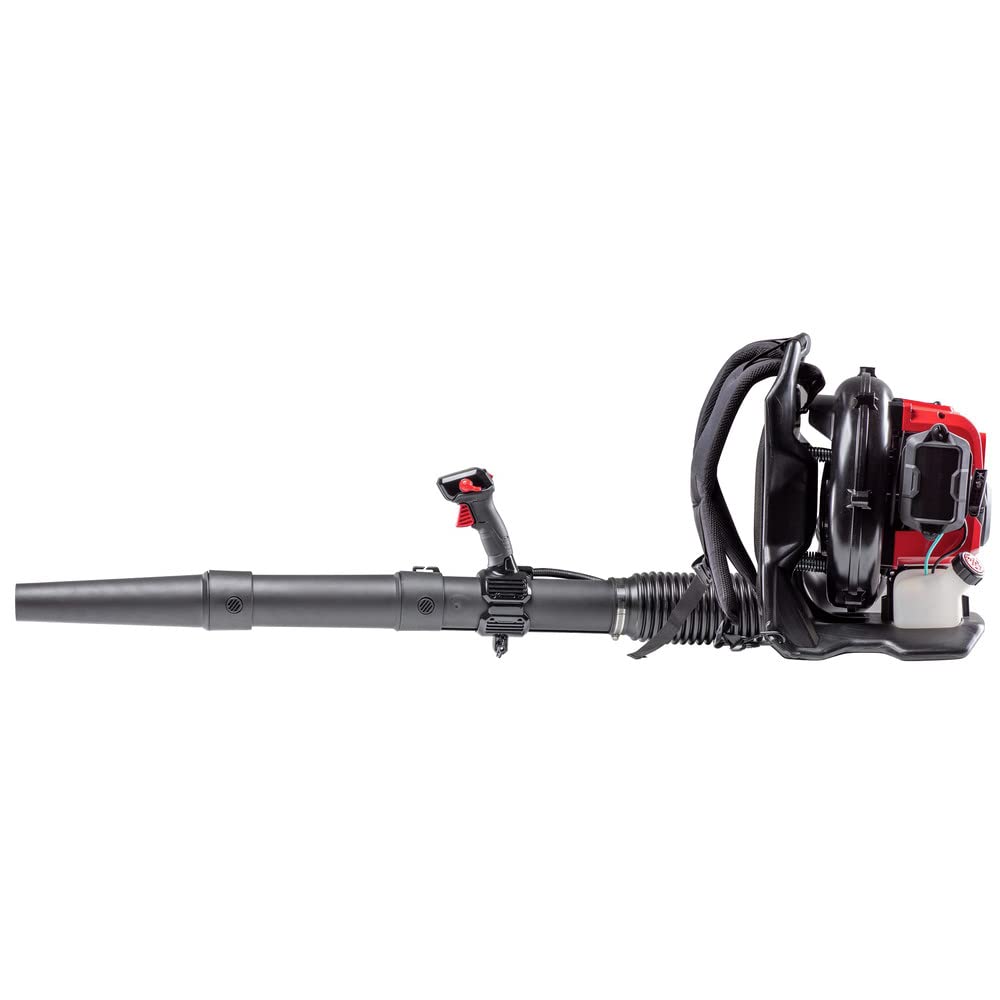
The Troy-Bilt TB51BP is a mid-range workhorse that pairs a 51cc engine producing 600 CFM and 220 MPH with a suspension harness designed to distribute weight across the shoulders and hips. This harness system—fully tensioned multi-material straps—is a genuine comfort upgrade over budget units, and owners with back issues report that it lets them work for hours without the pain that raking causes.
SpringAssist technology reduces the pull-start effort noticeably, which is a meaningful advantage for home users who may not have the arm strength for a hard-compression engine. The 26-pound weight is average for this power class, but the excellent harness makes it feel lighter than that number suggests. The gas tank is on the smaller side, however, and some users find they need to refuel mid-session on larger properties.
Durability reports are mixed. Several owners have experienced units that stopped starting after a single season, which raises a flag. That said, the majority of reviews praise its power and ease of assembly. For the home user on a typical suburban lot, the TB51BP offers a compelling balance of power and comfort at a reasonable entry point.
Why it’s great
- Excellent suspension harness reduces fatigue
- SpringAssist makes pull starts easier
- Good CFM output for the price tier
Good to know
- Small gas tank requires mid-session refills
- Some reports of durability issues after first season
4. Vevor 63cc Backpack Leaf Blower
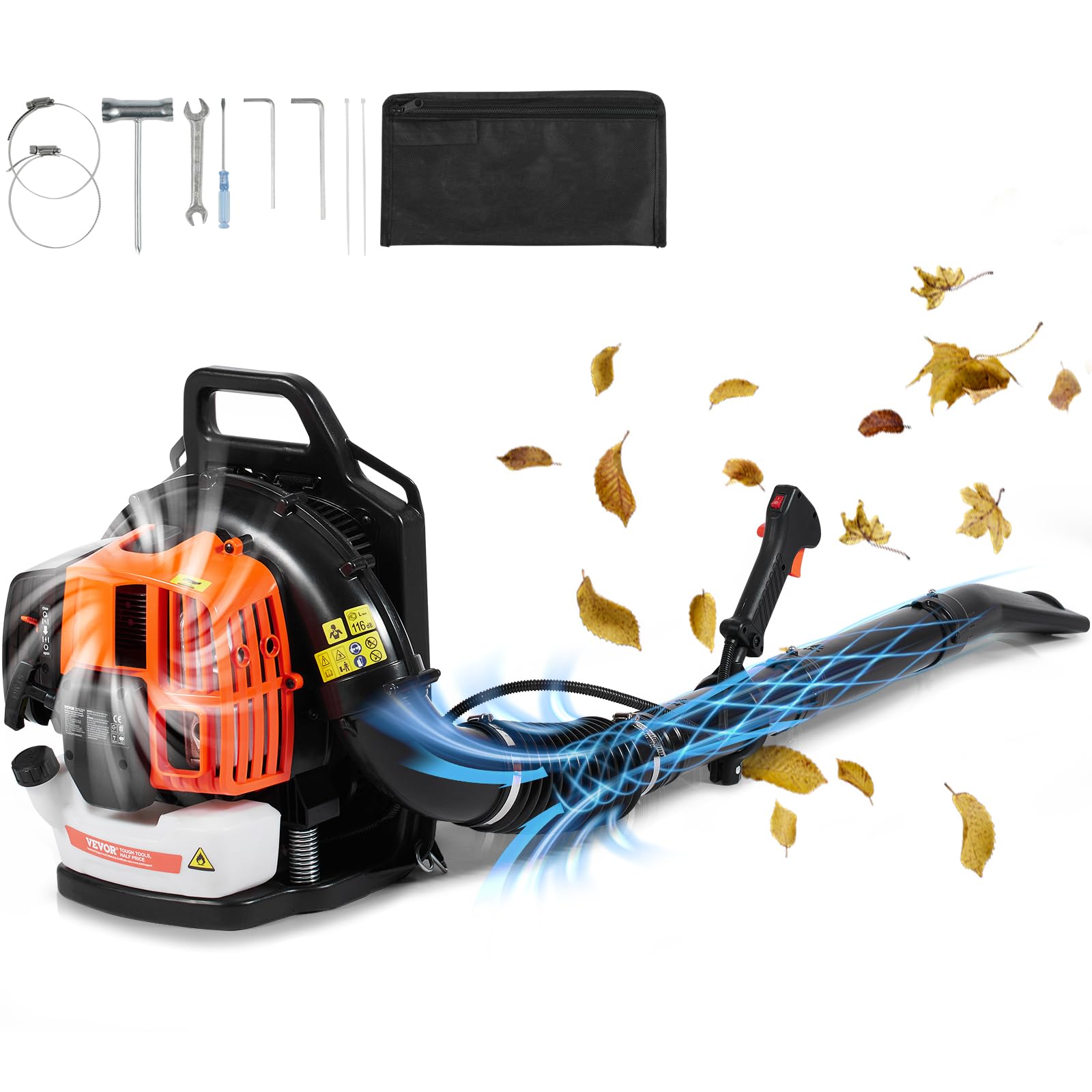
The Vevor 63cc delivers a massive displacement for its price tier, and owners confirm it handles wet leaves, grass clippings, and even light snow on a driveway without bogging down. The advertised figures of 1110 CFM and 220 MPH are almost certainly measured at the engine rather than the nozzle, but real-world performance lands somewhere near that of a 500-600 CFM unit—still plenty for most home users.
At 26.5 pounds, it is heavy, but the high-strength nylon backpack frame and thick cushioned padding do an adequate job of spreading the load. The included accessory kit is generous: noise-reducing earmuffs, a mixing bottle, a funnel, and a tool bag all come in the box, which is unusual at this price. Assembly is straightforward, though the primer bulb placement is awkward, requiring an odd reach to operate.
The most common complaint is that the engine tends to die at idle speeds, requiring a manual idle adjustment out of the box. The plastic tubing extensions also feel low-quality, and some owners plan to swap them with Echo parts. For the budget-conscious home user willing to tweak the carburetor, this is a high-displacement value.
Why it’s great
- 63cc engine offers premium displacement at a budget price
- Includes comprehensive accessory kit (muffs, tools, mixing bottle)
- Clears snow from driveways effectively
Good to know
- Needs idle adjustment out of the box often
- Tubing extensions feel cheap and may need replacement
5. Thalorus 52cc Backpack Leaf Blower
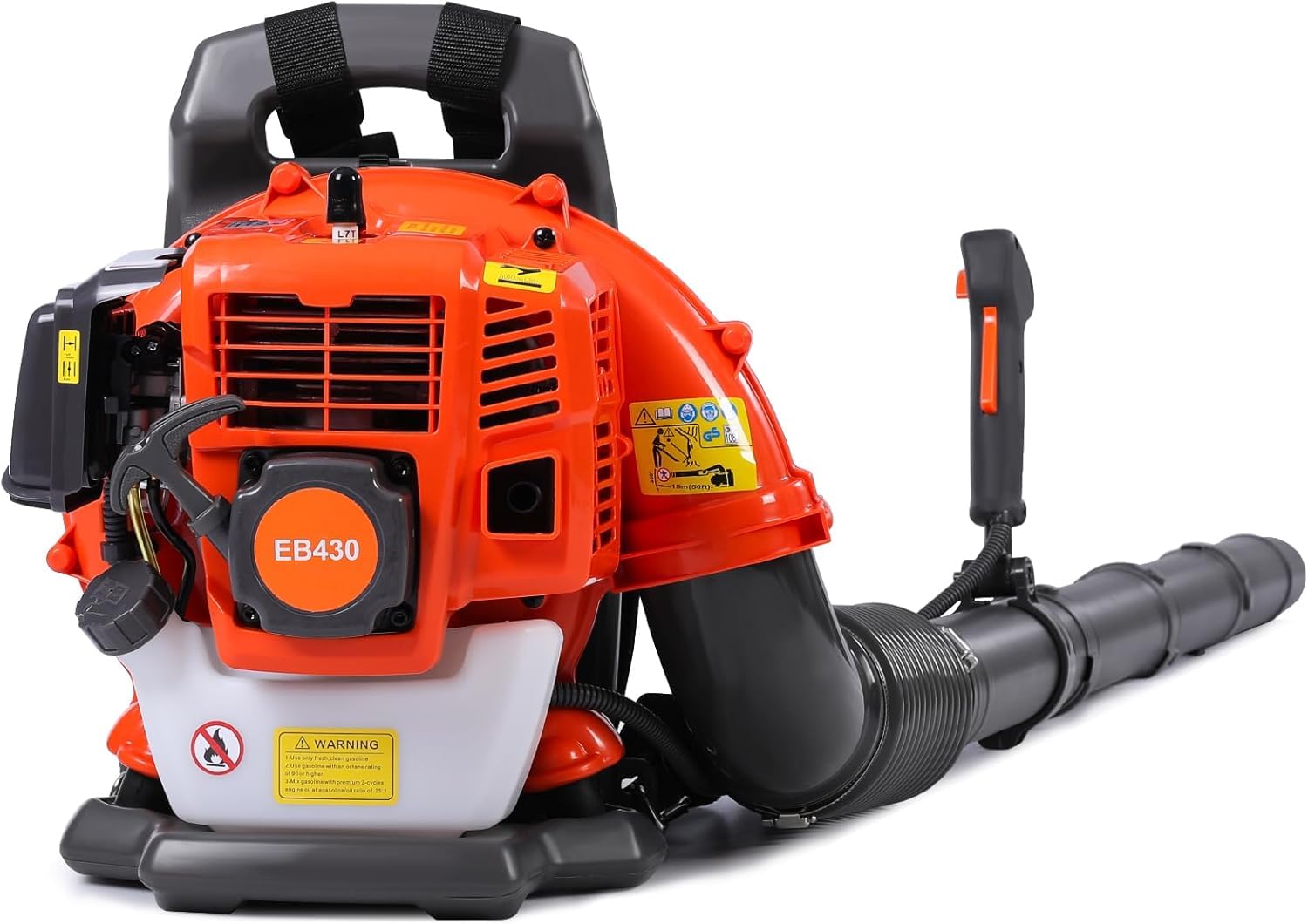
The Thalorus 52cc makes its name by weighing just 13.6 pounds—roughly 25% lighter than most competitors in its power class. This weight reduction comes from a compact engine design and a minimalist but effective harness. Owners consistently report that the backpack design eliminates the arm fatigue they experienced with handheld blowers, making it ideal for users who need to cover a medium property without physical strain.
The engine produces a respectable 550 CFM and 230 MPH, enough to handle wet leaves and light snow. The low-vibration harness is a genuine asset, reducing hand numbness during extended operation. Starting is reliable, with most users reporting ignition within two or three pulls, and the thumb throttle and cruise control give fine-grained airflow management.
The build does have some corners cut. The shoulder straps are shorter than ideal, particularly if you wear a heavy coat, and the screw that holds the trigger assembly in place has been reported to loosen and fall out on some units. Ear protection is mandatory given the noise level. For the home user who prioritizes low weight above all else, this is an excellent fit.
Why it’s great
- Remarkably lightweight at 13.6 pounds
- Low-vibration harness reduces hand fatigue
- Strong 550 CFM output for the weight class
Good to know
- Shoulder straps may be too short for bulky winter coats
- Trigger assembly screw can loosen over time
6. LawnMaster NPTBL31AB

The LawnMaster NPTBL31AB solves the single biggest frustration of gas blowers: pull-start difficulty. Its electric push-button start uses a rechargeable 7.2V battery that delivers up to 150 starts per charge, and the automatic choke means you simply press the button and wait for the 31cc engine to fire. For seniors, users with arthritis, or anyone who struggles with recoil starters, this feature alone justifies the purchase.
The 31cc engine is smaller than most competitors, producing 470 CFM and 175 MPH. This is adequate for clearing dry leaves and light debris from a typical suburban lot, but it will struggle with wet, matted leaves or heavy gravel. The unit weighs 18.5 pounds and has an adjustable, padded harness that makes it comfortable for shorter sessions.
The critical limitation is the lack of a backup pull-start mechanism. If the battery dies (owners report the battery lasts for only about five starts before needing a recharge), the unit is non-functional until the battery is recharged. Some owners have also reported engine lock-up after roughly 20 hours of use. For a home user with a small property who prioritizes ease of starting, this is a unique solution.
Why it’s great
- Push-button electric start eliminates pull-cord struggle
- Automatic choke for worry-free cold starts
- Lightweight and comfortable for smaller users
Good to know
- No backup pull starter; dead battery means no operation
- 470 CFM is on the lower end for heavy debris
7. Wild Badger Power 43cc

The Wild Badger Power 43cc is the quintessential entry-level backpack blower. Its 43cc engine produces a claimed 650 CFM, which is competitive with mid-range options, and the 17.4-pound weight is one of the lowest among gas backpack models. The ergonomic straps and cushioned backrest are adequately padded for short-to-medium sessions, and the 33.8-ounce fuel tank provides 50-60 minutes of continuous run time.
Assembly takes about 15 minutes and requires no special tools. The digital ignition system and tool-free air purge make starting relatively easy, with most users reporting ignition within five pulls. The anti-vibration system uses a three-point spring stabilizer that noticeably reduces handle vibration compared to cheaper handheld units.
However, durability is a significant concern. Several owners report the unit failing after one season (roughly 8-10 hours of use), with the gas cap seal tearing and the backpack straps breaking. Parts are not widely available, meaning a failure often forces a full replacement. For the home user on a tight budget who needs a tool for one season of light work, this is a functional stopgap, but it does not inspire long-term confidence.
Why it’s great
- Very low price for a gas backpack blower
- Lightweight at 17.4 pounds
- Decent 650 CFM output for the class
Good to know
- Reliability is questionable beyond one season
- Gas cap seal and backpack straps prone to failure
8. Husqvarna 350iB

The Husqvarna 350iB redefines what a battery-powered blower can do. Its brushless motor generates 800 CFM and 200 MPH, figures that rival many gas backpack blowers, but at just 10 pounds with zero emissions and low noise. For home users who need to clear a driveway or patio without disturbing neighbors, or who want to avoid the mess of mixing fuel, this is a transformative option.
The included 7.5 Ah 40V battery and charger deliver enough runtime for most suburban lots (roughly 20-30 minutes at full power, longer at lower speeds). The power boost mode adds 20% more thrust for tackling wet leaves, and the cruise control locks in a steady speed for consistent operation. The controls are intuitive—a simple keypad starts the blower instantly.
The trade-off is runtime. At full boost, the battery drains in 15-20 minutes, and replacement batteries are expensive. The unit is also handheld, not backpack, so the weight is carried in your hands and arms rather than on your back. Some owners have received units with dead-on-arrival batteries, and customer support from Husqvarna in those cases has been described as unresponsive.
Why it’s great
- Impressive 800 CFM from a quiet, zero-emission motor
- Very lightweight at 10 pounds
- Power boost mode adds 20% extra thrust
Good to know
- Battery lasts only 15-20 minutes at full boost
- No backpack harness—weight is in your hands
9. Echo PB-9010T

The Echo PB-9010T is the most powerful backpack blower in this guide. Its 79.9cc X Series engine churns out an astonishing 1110 CFM and 220 MPH, which owners describe as a “cat 4 hurricane on your back.” It can move wet leaves, acorns, pine straw, and even small rocks with ease. For a home user with multiple acres of heavy tree cover, this unit cuts clean-up time by 80% or more.
The tube-mounted throttle and cruise control give precise control over the immense airflow. At half throttle, it produces more thrust than many full-sized blowers. The harness is comfortable and well-padded, but the unit is heavy—owners estimate it feels like 24-28 pounds on the back. The recoil starter is smooth and reliable, with the engine firing within two pulls even after extended storage.
Noise is a real factor here. This blower is loud, and ear protection is mandatory. It is also fuel-hungry, burning through a tank more quickly than smaller models. The price is the highest in this guide, but for owners who have tried lesser blowers and been frustrated, the PB-9010T is a one-time purchase that will last for a decade or more of heavy seasonal use.
Why it’s great
- Class-leading 1110 CFM moves anything in its path
- Reliable starting and smooth operation
- Durable Echo build quality for long-term ownership
Good to know
- Very loud; ear protection is mandatory
- Heavy and fuel-hungry compared to smaller models
FAQ
Should I choose gas or battery power for home use?
What is the ideal CFM range for clearing wet leaves?
Final Thoughts: The Verdict
For most users, the backpack leaf blower for home use winner is the Echo PB-580T because it combines a reliable 58.2cc engine, proven starting, and a comfortable ventilated harness at a reasonable price. If you want the maximum raw power for moving heavy debris across a large property, grab the PRORUN PBB2884. And for a lightweight, no-fuss electric start that spares your shoulders, nothing beats the Thalorus 52cc.