
Our readers keep the lights on and the weekend projects moving. As an Amazon Associate, I earn from qualifying purchases.
The cold reality of avalanche rescue is that the window for a successful recovery is measured in minutes, not hours. Your choice of beacon directly determines whether a burial ends in a live recovery or a body recovery. This guide cuts through the marketing fluff to compare the core metrics that actually matter when the slide stops.
I’m Rikta — the co-founder and writer behind FitlyFast. I’ve spent hundreds of hours analyzing the technical specifications, real-world search patterns, and field-test data across the major beacon manufacturers to build this definitive comparison.
Whether you’re a first-time backcountry rider or a seasoned guide replacing outdated gear, this deep dive into avalaunch rescue technology will help you make an informed choice. Find the best avalanche beacon for your specific needs and budget without the sales pitch.
How To Choose The Best Avalanche Beacon
Selecting an avalanche beacon is a life-safety decision. The wrong choice can mean the difference between a fast recovery and a tragic outcome. You must prioritize features that aid a chaotic rescue, not just marketing checkboxes.
The Digital Signal War
Modern beacons process signals digitally. The key difference lies in the number of antennas and the sophistication of the filtering algorithm. A three-antenna beacon can better distinguish a victim’s signal in a “spaghetti bowl” of interference than a two-antenna model. Look for the number of antennas as a primary indicator of search reliability.
Search Strip Vs. Maximum Range
Maximum range is a headline number; search strip width is the real-world metric. A wider search strip (70m vs 50m) allows you to cover more ground faster during the initial coarse search. In a time-critical scenario, this efficiency is more valuable than the ability to detect a signal from 55m away. Prioritize the search strip width.
Multiple Burial Capabilities
The ability to mark and ignore found signals is crucial for multiple burials. A beacon with strong multiple burial processing will automatically mark the strongest signal and then switch to the next. This feature prevents operator error under extreme stress. Never buy a beacon that requires complex manual flagging.
Quick Comparison
On smaller screens, swipe sideways to see the full table.
| Model | Category | Best For | Key Spec | Amazon |
|---|---|---|---|---|
| Mammut Barryvox | Premium Standalone | Professional Rescue | 70m Search Strip | Amazon |
| BCA Tracker 3 (Standalone) | Mid-Range Pro | All-Around Backcountry | 3-Antenna System | Amazon |
| BCA Tracker 3 (Standalone 2) | Mid-Range Pro | Backcountry Skiing | 3-Antenna System | Amazon |
| BCA T3 Rescue Pkg | Value Package | First-Time Buyers | 50m Range | Amazon |
| BCA Tracker S | Entry-Level | New Backcountry Users | 50m Search Strip | Amazon |
In‑Depth Reviews
1. Mammut Barryvox Avalanche Beacon

The Mammut Barryvox sets the standard for professional-grade avalanche rescue. Its standout feature is the industry-leading 70-meter digital search strip width, which is significantly wider than the standard 50 meters offered by most competitors. This wider strip dramatically reduces the time required to cover the debris field during the initial coarse search, giving rescuers precious seconds.
On the display side, the background-lit screen remains legible even with polarized sunglasses, and the acoustic search guidance allows you to visually scan the avalanche path while the audio signal narrows down the location. The circular receiving field ensures near-identical range from both X and Y antennas, reducing the chance of missing a buried transceiver due to orientation.
For backcountry travelers who demand the fastest possible recovery, the Barryvox is the benchmark. Its ruggedized design and advanced signal processing make it a reliable partner in the worst conditions. This beacon is used by professional ski patrollers for a reason.
Why it’s great
- Class-leading 70m search strip width for faster coverage
- Excellent screen visibility with polarized glasses
Good to know
- Premium price point reflects professional-grade capability
- Learning curve for the advanced menu features
2. Backcountry Access Tracker 3

The BCA Tracker 3 is a proven workhorse in the backcountry community, known for its intuitive user interface and robust build quality. With a three-antenna system, it offers superior signal detection in complex burial scenarios compared to older two-antenna models. The motion-activated feature automatically switches the beacon from search to send mode if the wearer is motionless for a period, a vital safety net for a potential victim who survives the slide but is incapacitated.
Weighing just 7.6 ounces with batteries, it sits unnoticed on your harness. The 50-meter range is typical for this category, but the consistent reliability of the signal processing is what sets it apart. Users consistently report it performs flawlessly in beacon garden drills, providing clear direction and distance indications. The bright LED on the front is a nice touch for visual confirmation during a night rescue.
Its simplistic design philosophy means fewer bells and whistles, which reduces the chance of user error under duress. This beacon is the gold standard for guided groups and weekend warriors alike because it just works. It’s a safe, proven, mid-range investment for anyone serious about sidecountry safety.
Why it’s great
- Intuitive three-antenna digital processing for reliable finds
- Ultra-lightweight and low-profile harness design
Good to know
- 50-meter max range is standard, not exceptional
- No advanced features like a digital display or return link
3. BCA Tracker 3 Avalanche Transceiver

This is the same BCA Tracker 3 core unit sold as a standalone package, offering the same life-saving features as its bundled counterpart. The inclusion of a dedicated harness and batteries makes it ready to go out of the box. Its slim profile is a major advantage for riders, ensuring the beacon doesn’t catch on branches or gear when moving through tight trees.
The Multiple Burial Indicator is a critical feature for group travel. It automatically marks the strongest signal and switches to the next, simplifying the search process for multiple victims. The Auto Revert Mode is a passive safety feature that could save your life if you are incapacitated after a slide, automatically switching back to transmit mode after a period of inactivity.
For skiers and snowboarders who prioritize mobility, the low-profile design of this transceiver makes it a top choice. It integrates seamlessly with most avalanche airbag packs and body harnesses. While it lacks the wider search strip of the Mammut, its reliability and user-centric design make it a best-seller for a reason.
Why it’s great
- Low-profile design prevents snagging during active riding
- Auto Revert Mode provides a crucial safety buffer
Good to know
- Same specs as the bundled T3, just without the probe
- Batteries included but are basic alkaline, consider upgrading
4. BCA T3 Rescue Package

The BCA T3 Rescue Package is the perfect solution for new backcountry travelers who need to gear up properly. It bundles the excellent Tracker 3 transceiver with a B-1 EXT avalanche shovel and a Stealth 270 avalanche probe, the three essential components of the “holy trinity” of avalanche rescue gear. This package ensures you don’t forget a critical piece of equipment.
The B-1 EXT shovel is compact and has an ergonomic handle for efficient digging, while the Stealth 270 probe extends quickly and locks into place for precise probing. This combination is proven and widely recommended by avalanche instructors. The value of having a matched set of gear that fits together in your pack cannot be overstated.
For the rider who is moving from sidecountry into true backcountry and doesn’t want to worry about compatibility between different gear brands, this is the smartest purchase. It eliminates guesswork and gives you a complete, field-ready system at a mid-range total investment. The quality of the included shovel and probe is on par with BCA’s standalone offerings.
Why it’s great
- Complete rescue system in one box (beacon, shovel, probe)
- Proven transceiver performance from BCA
Good to know
- Shovel and probe are entry-level models, not carbon fiber
- Package is bulkier than buying a standalone beacon
5. BCA Tracker S Avalanche Beacon

The BCA Tracker S is designed explicitly for entry-level users who are taking their first avalanche safety course. Its “S” stands for simple, and that’s its greatest strength. The interface strips away advanced menus and focuses on the core functionality of transmitting and searching. This reduces cognitive load and helps new users master the basics without distraction.
With a 50-meter range and a 50-meter search strip, it meets the basic requirements for organized group travel. However, it features only two antennas, which means signal detection can be more sensitive to the beacon’s orientation in the snow. It is a capable transceiver for learning, but serious backcountry enthusiasts will soon outgrow its capabilities.
For riders who want a reliable backup beacon or a dedicated unit for children on family trips, the Tracker S is a strong budget-friendly option. It is not the tool for a professional guide or someone traveling in complex avalanche terrain with a high risk of multiple burials. It is a learning tool and a starter beacon, not a career beacon.
Why it’s great
- Extremely simple to operate for beginners
- High value for the price point
Good to know
- Two-antenna design is less robust in signal detection
- Limited functionality for advanced users
6. BCA Tracker 3 + SBD Probe
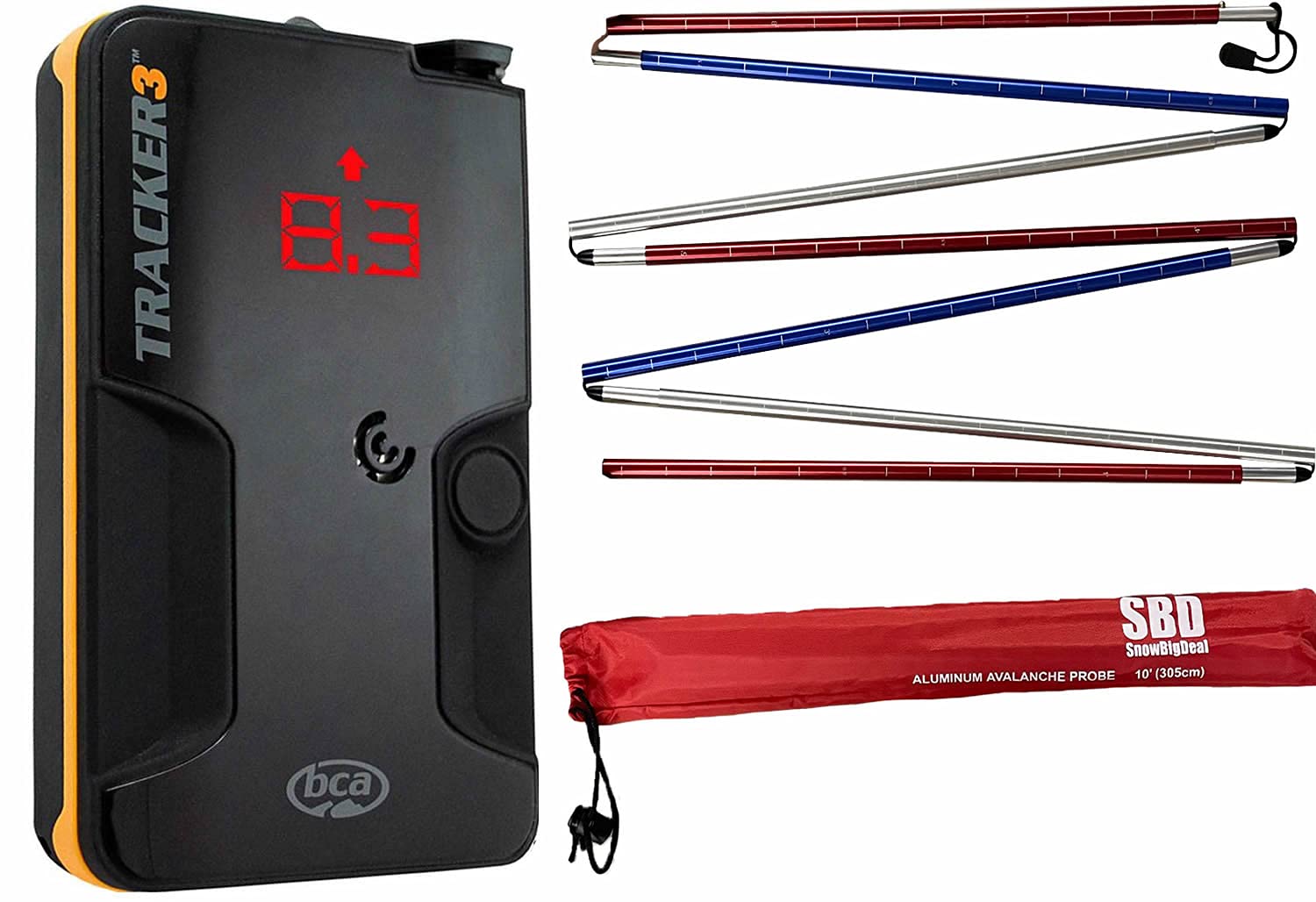
This bundle pairs the reliable BCA Tracker 3 beacon with a SnowBigDeal 10-foot (305cm) American aluminum avalanche probe, offering a complete search solution. The probe is a critical companion tool; you must be able to precisely locate the victim after the beacon pinpoints the search area. A longer probe is always preferable in deep snowpacks.
While the beacon is a proven performer, reviews for the included probe are mixed. Some users report that the probe segments are difficult to expand and break down, which is a major concern in a time-critical rescue. The locking mechanism on budget-friendly probes can be finicky, especially with cold hands or when wearing gloves.
For a rider on a specific budget who needs both a beacon and a probe, this bundle offers a convenient way to buy them in one transaction. The risk is the variable quality of the SBD probe. If the probe fails in the field, your beacon becomes significantly less effective. A smart alternative might be to buy the standalone Tracker 3 and a known-good probe separately.
Why it’s great
- Pairs a top-rated beacon with a probe for convenience
- Beacon itself is the reliable Tracker 3 platform
Good to know
- Included probe has durability and ease-of-use concerns
- Beacon search range inconsistencies have been reported
FAQ
How often should I practice with my beacon?
What does the 457 kHz frequency mean?
Is a 3-antenna beacon worth the extra money?
Final Thoughts: The Verdict
For most users, the best avalanche beacon winner is the Mammut Barryvox because its 70m search strip width gives you a significant speed advantage in a rescue, and its professional-grade signal processing is unmatched. If you want a proven, rugged tool with a simplified interface, grab the Backcountry Access Tracker 3. And for a complete first-time gear-up on a budget, nothing beats the all-in-one value of the BCA T3 Rescue Package.