
Our readers keep the lights on and the weekend projects moving. As an Amazon Associate, I earn from qualifying purchases.
Every runner knows the feeling: you’re three miles in, your phone is bouncing in your pocket, and your smartwatch is buzzing with emails and notifications you don’t want. A basic running watch strips away that noise and gives you exactly what you need — pace, distance, heart rate, and the battery life to go the distance. The challenge is finding a model that delivers accurate GPS, comfortable wear, and reliable metrics without paying for features you’ll never use.
I’m Rikta — the co-founder and writer behind FitlyFast. I’ve spent hundreds of hours analyzing GPS accuracy, battery performance under load, and sensor reliability across the current market to find the watches that actually serve a runner’s core needs.
Whether you’re training for your first 5K or logging daily miles, this guide breaks down the top contenders to help you buy with confidence. Finding the right basic running watch means understanding what matters most: satellite lock speed, heart rate precision, and real-world battery life on your wrist.
How To Choose The Best Basic Running Watch
A basic running watch is a tool, not a lifestyle accessory. The best ones prioritize lock-on GPS, reliable heart rate monitoring, and a battery that lasts through your training week. Here are the key factors to weigh before buying.
GPS Accuracy: Single-Band vs. Dual-Band
The core job of any running watch is tracking where you’ve been. Single-band GPS connects to one frequency and works well in open areas, but can drift around tall buildings or dense tree cover. Dual-band GPS accesses two frequencies simultaneously, cutting out signal reflection errors. If you run city streets or tree-lined trails, dual-band is worth the small premium. For open roads or tracks, single-band will serve you fine.
Optical Heart Rate Sensor: What Generation Matters
Wrist-based optical heart rate sensors have improved dramatically. Older models use green LEDs that struggle during interval workouts, while newer multi-LED designs with algorithm smoothing capture rapid changes more faithfully. Look for watches with at least four photodiodes and an updated sensor module if you train by heart rate zones. For steady-state runs, even a basic sensor will track accurately enough.
Battery Life: Daily Use vs. GPS-On Hours
Manufacturers quote two numbers: smartwatch battery life and GPS-on battery life. A watch that lasts 7–10 days in daily mode but only 15 hours of GPS is fine for weekday runners. If you’re training for a marathon or ultra, look for GPS battery life above 25 hours. Also check charge time — a 2-hour full charge is standard, but fast-charging models can give you hours of run time in 10 minutes.
Build and Comfort: Weight and Wrist Fit
A basic running watch should be light enough that you forget you’re wearing it. Target under 50 grams for a comfortable all-day and all-run experience. Button layout matters too — tactile buttons let you start/stop laps and scroll screens without looking, which is essential when you’re sweating or wearing gloves. Silicone bands should be long enough for larger wrists and secure enough to stay put during high-intensity work.
Quick Comparison
On smaller screens, swipe sideways to see the full table.
| Model | Category | Best For | Key Spec | Amazon |
|---|---|---|---|---|
| Garmin Forerunner 970 | Premium | Elite training & triathlon | 26 hrs GPS battery | Amazon |
| COROS PACE Pro | Premium | Serious runners & navigation | 38 hrs GPS battery | Amazon |
| COROS PACE 4 | Mid-Range | Lightweight daily training | 41 hrs GPS battery | Amazon |
| Polar Street X | Premium | Urban hybrid training | 43 hrs GPS battery | Amazon |
| Garmin Instinct E | Mid-Range | Rugged outdoor & durability | 16 days battery | Amazon |
| Amazfit Active Max | Mid-Range | Large display & music storage | 24 days battery | Amazon |
| CARBINOX Blaze | Mid-Range | Worksite & trail durability | IP69K waterproof | Amazon |
| Fitbit Charge 6 | Mid-Range | All-day health & activity | 7 days battery | Amazon |
| Mibro GS Pro2 | Entry-Level | Budget dual-band GPS | 20 days battery | Amazon |
In‑Depth Reviews
1. Garmin Forerunner 970

The Forerunner 970 is Garmin’s premium running watch that justifies its position with triathlon-specific auto-transition detection and a sapphire lens that resists scratches even after months of trail abuse. The multi-band GPS locks onto satellites within seconds, delivering accurate pace data under heavy tree cover and between city high-rises. Wrist-based running dynamics — cadence, stride length, ground contact time — give you the same metrics that once required a chest strap.
The built-in LED flashlight is brighter than expected and genuinely useful for early morning or late-night runs. Running economy data and step speed loss (with the optional HRM 600) provide a tangible window into how your form degrades as fatigue sets in. The Garmin Coach adaptive training plans are personalized and adjust based on your recovery status, making this a watch that grows with your training goals.
The 15-day smartwatch battery is real-world accurate, and a full charge takes under 90 minutes. The learning curve is steeper than simpler watches, but for the runner who wants professional-grade data without a subscription, this is the gold standard. Expect a premium price that matches the titanium bezel and sapphire display.
Why it’s great
- Multi-band GPS with rapid satellite lock
- Scratch-resistant sapphire lens and titanium bezel
- Triathlon auto-transition and comprehensive running dynamics
Good to know
- Premium price reflects the build quality
- Steeper learning curve for navigation and features
2. COROS PACE Pro

The COROS PACE Pro delivers the brightest AMOLED display in this category at 1500 nits, making it readable in direct sunlight without cranking the brightness. The always-on mode is genuinely usable, sipping battery while keeping pace and time visible. The new satellite chipset gives dual-frequency GPS accuracy that consistently tracks within 10 feet per mile, even on winding trails with heavy canopy.
Offline topographical maps with turn-by-turn navigation make this a legitimate choice for runners who explore unfamiliar routes. The 4GB onboard storage supports music playback without a phone, and the USB-C charging port with the included keychain adapter means one cable charges your watch and phone. The COROS app provides training status, custom workouts, and detailed recovery analysis without any hidden subscription.
Real-world battery life lands around 15–16 days with four GPS runs per week, and GPS-only mode pushes past 38 hours. The silicone band is stiffer than some competitors, and the watch face selection is narrower than Garmin’s, but the hardware and accuracy are exceptional for the price. This is the best mid-premium option for runners who want premium features without the premium price tag.
Why it’s great
- 1500-nit AMOLED display with always-on mode
- Dual-frequency GPS with offline topo maps
- USB-C charging with keychain adapter
Good to know
- Silicone band runs slightly stiff
- Limited third-party watch face options
3. COROS PACE 4
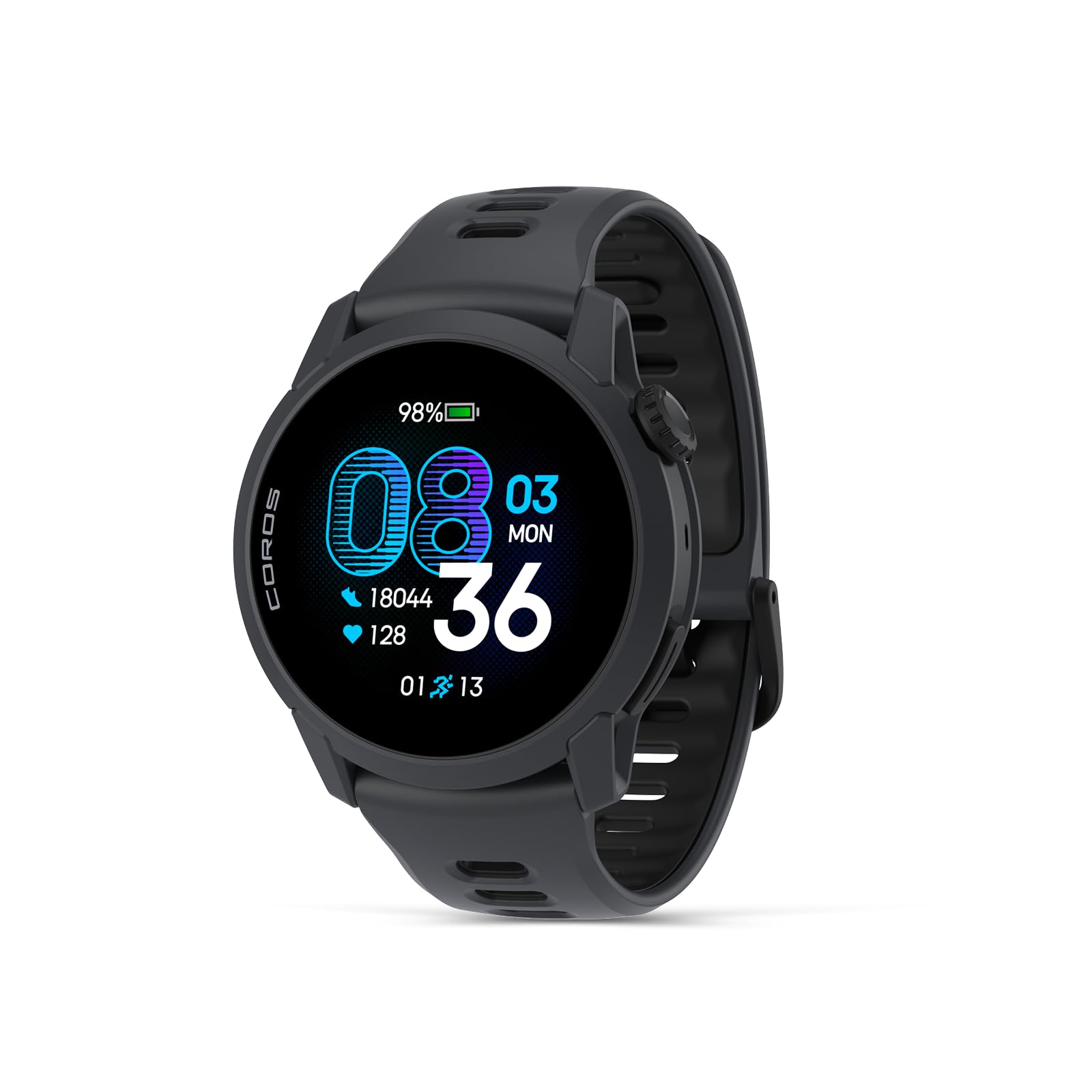
At 32 grams on the nylon band, the COROS PACE 4 is the lightest running watch that still delivers dual-band GPS and an AMOLED touchscreen. The 1.2-inch display has 164% higher resolution than the PACE 3, with auto-adjusting brightness that transitions seamlessly from indoor track to outdoor road. The tactile digital crown plus two physical buttons provide intuitive control even at high intensity without needing to look down.
The voice recording tool is a unique feature that lets you capture training logs mid-run by speaking notes, which sync to the COROS app post-activity. Voice control can set alarms or create target workouts hands-free. Recovery time, HRV, sleep stages, and menstrual cycle tracking give a complete picture of how your body responds to training load. The 41 hours of continuous GPS use cover even the longest training weeks.
The 4GB internal storage supports music playback and breadcrumb navigation, though the route mapping is less detailed than the PACE Pro’s topo maps. The 19-day daily battery is accurate with always-on display off. This watch is virtually unnoticeable on the wrist, making it ideal for runners who hate bulky hardware but demand dual-band accuracy and a full training suite.
Why it’s great
- Ultra-light 32g design with dual-band GPS
- 41 hours GPS battery for long training weeks
- Voice recording and voice control features
Good to know
- Offline maps less detailed than PACE Pro
- May need a screen protector for scratch prevention
4. Polar Street X
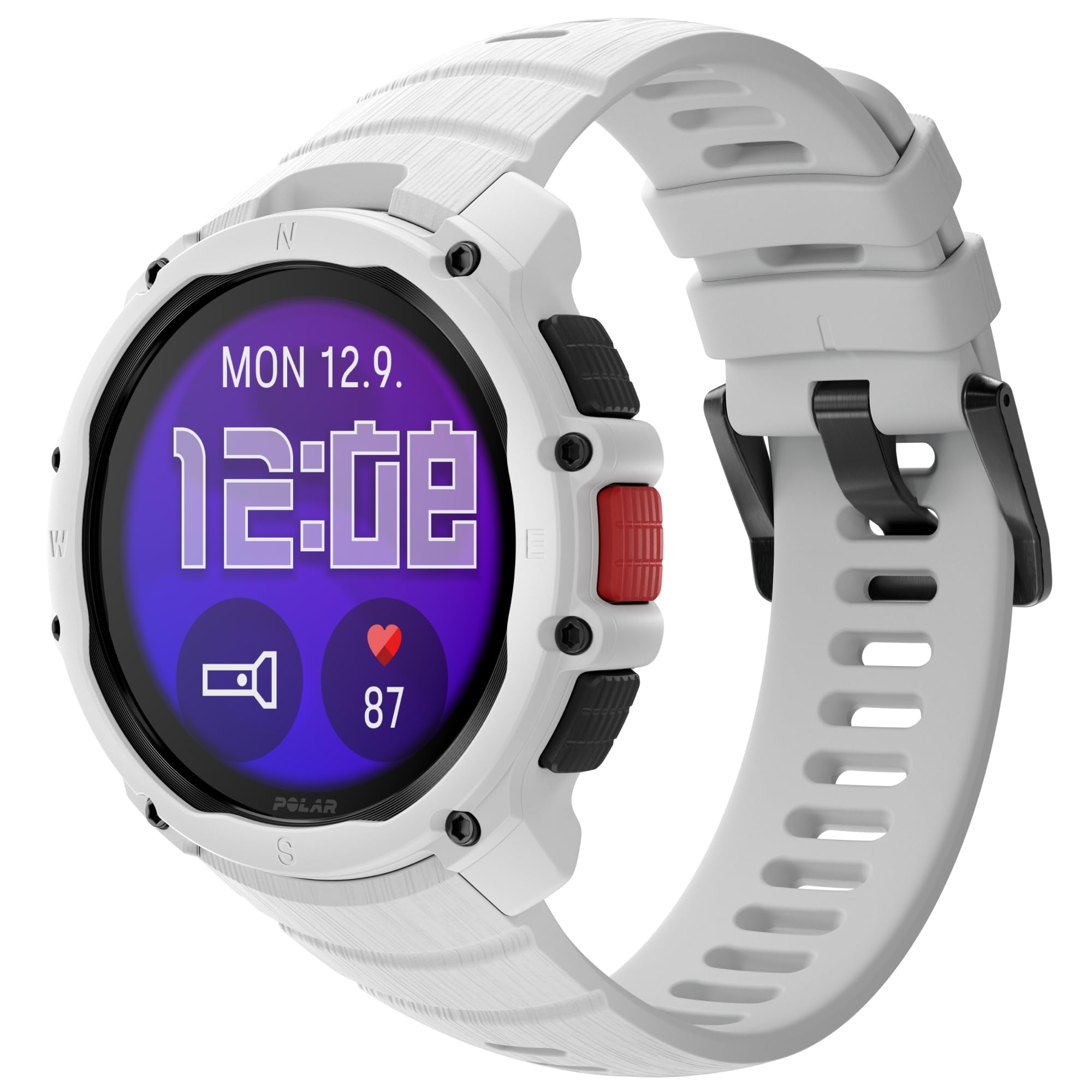
The Polar Street X is a hybrid sports watch designed for urban runners who mix road sessions with gym work. The 1.77-inch AMOLED display is large and easy to read without glasses, with three brightness levels and always-on mode that still delivers over a week of battery. The 170+ sport profiles cover everything from strength training to HIIT, and route guidance with back-to-start navigation keeps you oriented without pulling out your phone.
The built-in flashlight — white and red modes — is a standout safety feature. The red mode preserves night adaptation while keeping you visible. GPS locks quickly even between tall buildings, and the Polar Flow app provides extensive post-run data including elevation, calorie burn, and stress tracking directly on the map overlay. The 48-gram weight with soft silicone band makes it comfortable for all-day wear.
The main trade-off is the companion app, which captures workout data well but lacks deep watch control compared to Garmin or COROS. Watch face configurations must be done on the watch itself, not the app. There’s no built-in speaker or microphone for calls, and it uses a proprietary charger. For runners who want a bright display, solid GPS, and a safety flashlight in a lightweight package, the Street X delivers exceptional value.
Why it’s great
- Bright AMOLED display, large and easy to read
- Built-in flashlight with white and red modes
- Fast GPS lock with accurate route tracking
Good to know
- Watch face configs done on watch, not app
- Proprietary charger, no speaker or mic
5. Garmin Instinct E

The Garmin Instinct E is built to MIL-STD-810 standards for thermal and shock resistance, with 10 ATM water rating that handles swimming without a second thought. The 45mm fiber-reinforced polymer case is rugged and lightweight, offering 16 days of battery life in smartwatch mode. Real-world use stretches beyond 20 days when GPS usage is moderate, making this a low-maintenance companion for weekly runners.
Health monitoring covers wrist-based heart rate, Pulse Ox, advanced sleep tracking, and Body Battery energy monitoring. The 3-axis compass, barometric altimeter, and multi-GNSS support provide reliable navigation for trail running and hiking. Connect IQ Store access allows custom watch faces and data fields, adding personalization without needing a phone app for configuration.
The main complaint is the stock band width — multiple reviews note it runs short for average wrists, often requiring an aftermarket replacement. The monochrome display is less vibrant than AMOLED competitors, but its transflective technology stays readable in direct sunlight without backlight. This is the watch for runners who prioritize durability and battery life over screen brightness and touch features.
Why it’s great
- MIL-STD-810 durability with 10 ATM water rating
- Excellent battery life, often exceeding 20 days
- Reliable multi-GNSS and ABC sensors for navigation
Good to know
- Stock band may be too short for larger wrists
- Monochrome display, not AMOLED
6. Amazfit Active Max
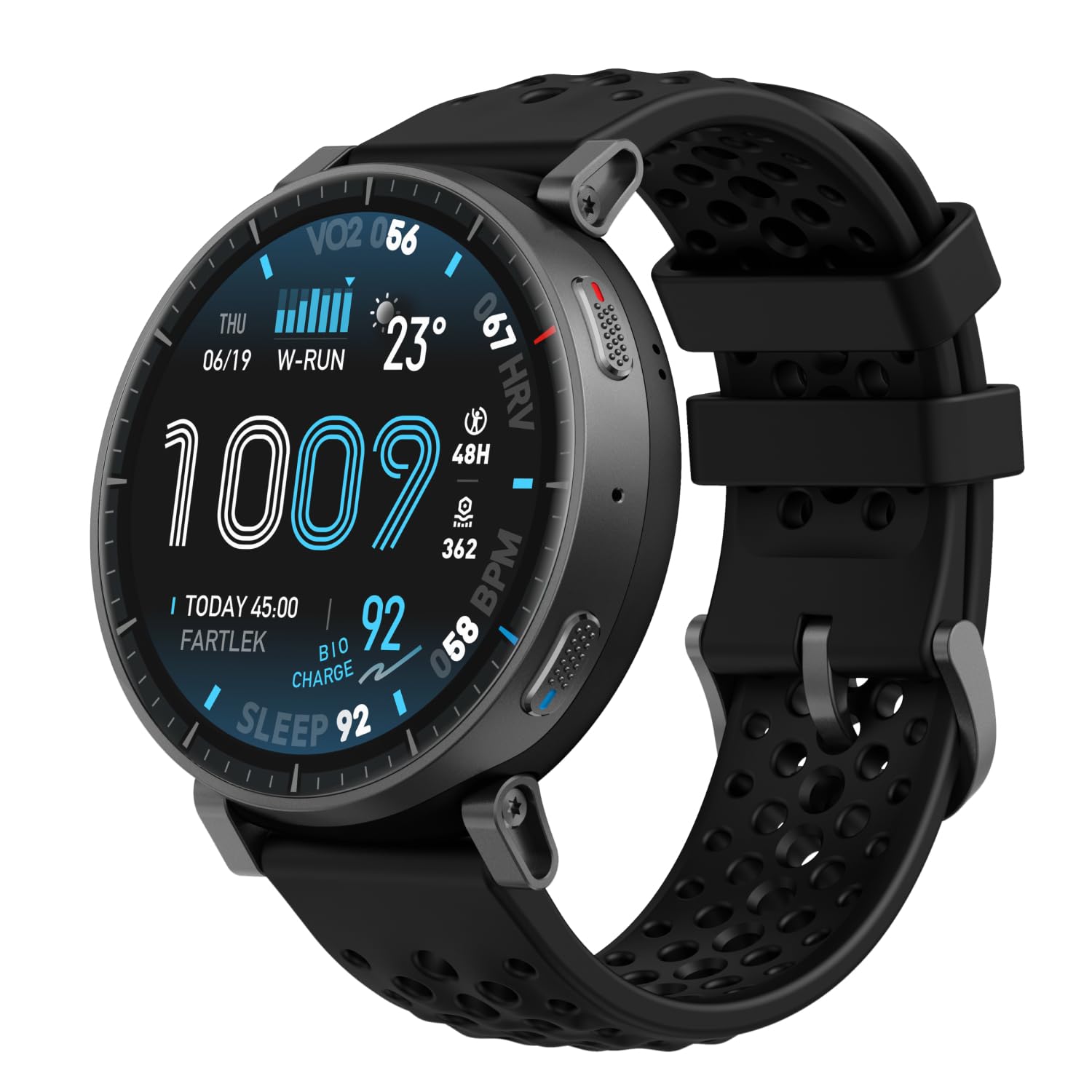
The Amazfit Active Max stands out with a 1.5-inch AMOLED display that hits 3000 nits brightness — readable even under direct midday sun. The 25-day battery life in daily mode is best-in-class for a watch with this screen size. Offline maps with turn-by-turn directions and 4GB storage for music mean you can leave your phone at home for shorter runs and still navigate unfamiliar routes.
BioCharge energy monitoring adjusts your readiness score based on daily workouts and stress levels, helping you decide when to push and when to rest. Zepp Coach provides AI-driven training plans for distances from 3K to full marathon, adapting based on your performance and recovery. The five satellite system positioning ensures fast and accurate GPS lock in various environments.
The 5 ATM water resistance covers pool swimming and rainy runs without concern. Bluetooth calling and Zepp Flow voice reply for Android users keep you connected mid-run. The Active Max does not support MyFitnessPal integration, and some users recommend a protective case for the large screen. This watch is ideal for runners who want a brilliant display, marathon-grade battery, and onboard music storage in a single package.
Why it’s great
- 3000-nit AMOLED display, best in class brightness
- 25-day battery with 4GB music storage
- AI-driven Zepp Coach training plans
Good to know
- No MyFitnessPal integration
- Large screen may benefit from a protective case
7. CARBINOX Blaze
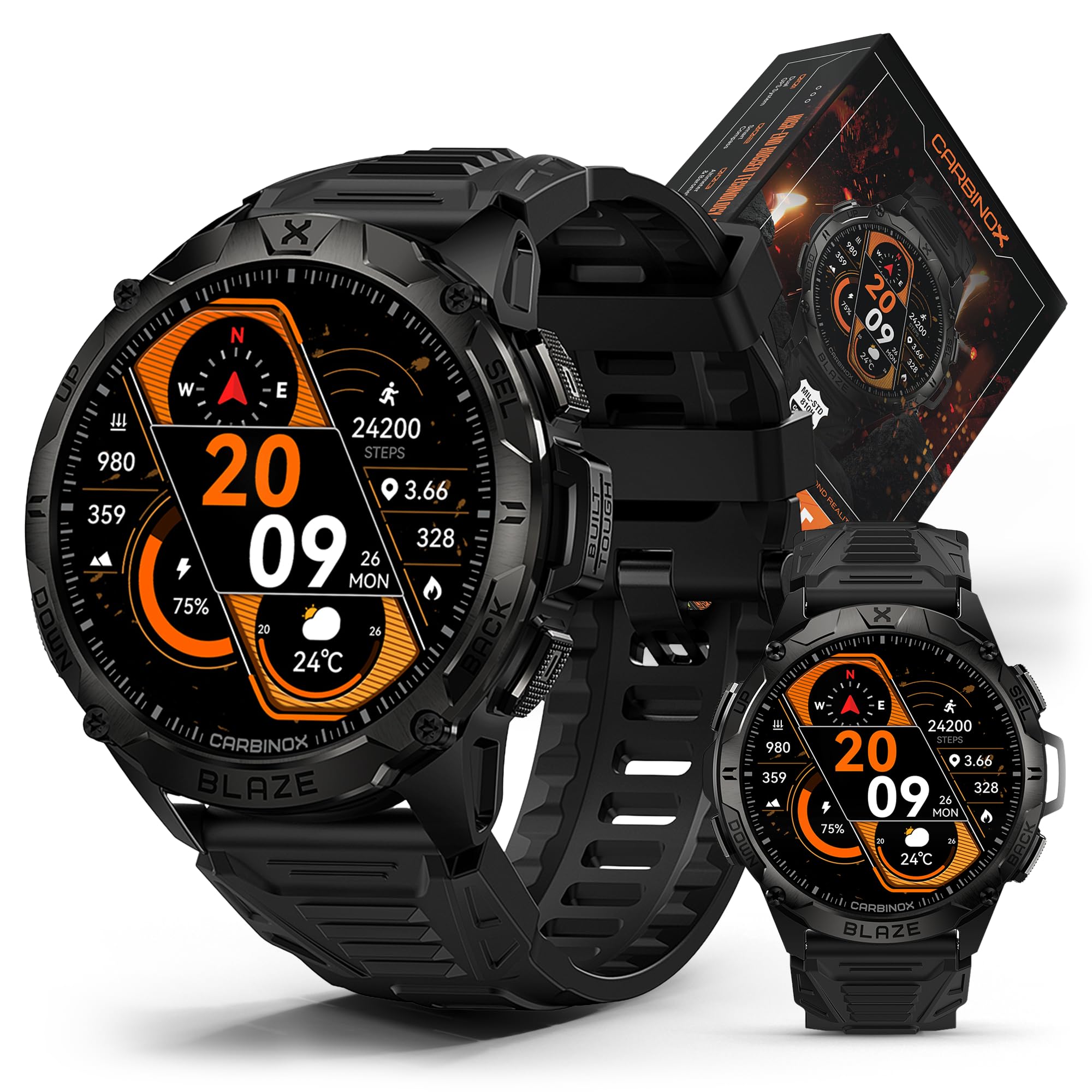
The CARBINOX Blaze is built for runners who need a watch that survives harsh conditions — IP69K rated against water, dust, and impacts. The alloy steel case and Gorilla Glass display resist scratches and shocks, and the reinforced straps keep the watch secure during heavy training or worksite use. Seven GPS outdoor modes cover running, cycling, skiing, mountaineering, and cross-country with mapped routes and precise metrics.
Essential ABC tools — altimeter, barometer, and compass — give you elevation, pressure readings, and direction for trail runs and mountain workouts. The 170+ sport modes include extreme sports, swimming, and strength training, with trend analysis to improve performance over time. Bluetooth calling and social app notifications keep you connected without reaching for your phone.
Battery life lands around a week with moderate GPS use, and the 480mAh cell supports extended sessions. The built-in compass is a standout feature for navigation-focused runners. Some users report occasional sleep tracking misses and note that the blood pressure reading is not clinically accurate. This is the watch for runners who demands durability over polish and need a tool that can work a construction site and then hit the trails after.
Why it’s great
- IP69K waterproof and shockproof build
- Altimeter, barometer, and compass for navigation
- 7 GPS outdoor modes for varied terrain
Good to know
- Blood pressure readings not clinically accurate
- Occasional sleep tracking misses reported
8. Fitbit Charge 6

The Fitbit Charge 6 is more fitness tracker than running watch, but its accurate baseline metrics and Google integration make it a valid option for casual runners. The slim design with stainless steel case wears like a bracelet, and the 7-day battery life supports continuous sleep tracking without mid-week charging. 40+ exercise modes include built-in GPS for outdoor runs, though GPS battery life is limited compared to dedicated running watches.
The ECG app records heart rhythm for signs of atrial fibrillation, adding clinical-grade screening that most basic watches lack. Google Maps turn-by-turn directions on your wrist and Google Wallet contactless payments reduce what you need to carry. The 3-month Google Health Premium membership provides personalized coaching and advanced analytics to understand your training data.
The Charge 6 lacks music controls beyond YouTube Music remote, and the Google Maps implementation has been reported as beta-quality with occasional unreliability. Calorie tracking can overestimate during certain activities, and the auto-detect exercise mode can be intrusive. This watch works best for runners who want a 24/7 health tracker that also logs runs, rather than a pure training tool with deep running metrics.
Why it’s great
- ECG app for heart rhythm screening
- Slim, comfortable design with 7-day battery
- Google Maps and Google Wallet integration
Good to know
- GPS battery limited compared to running watches
- Google Maps implementation is beta quality
9. Mibro GS Pro2
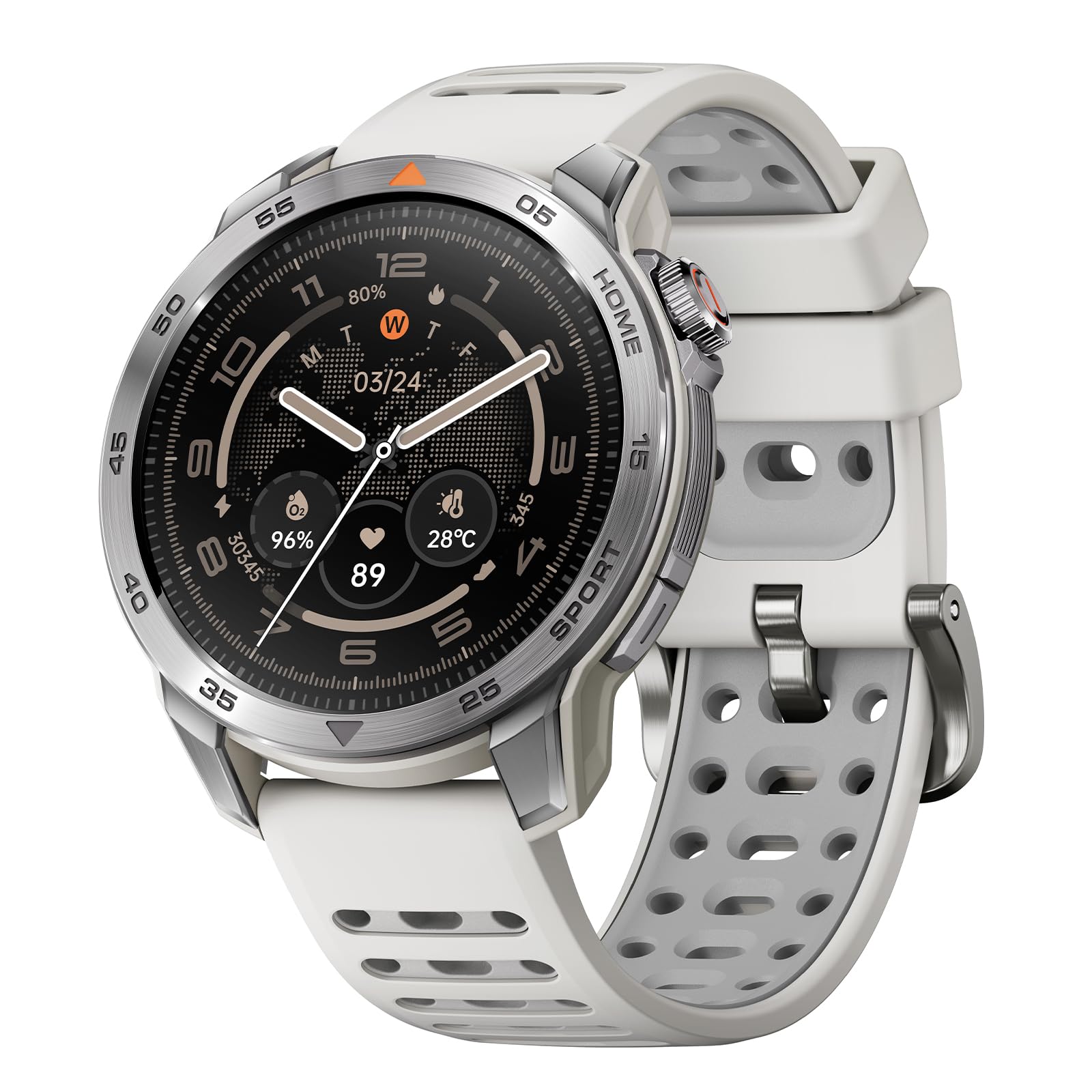
The Mibro GS Pro2 brings dual-band GPS to the entry-level price tier, delivering accurate route tracking in city environments where single-band watches lose signal. The 1.43-inch AMOLED display is vibrant and responsive, with 150+ workout modes covering running, cycling, swimming, and more. The 20-day daily battery and 20 hours of GPS mode are impressive for the price, reducing the need for frequent charging.
Mibro Coach creates personalized training plans based on your running habits, tracking pace, cadence, and stride length in real time. Heart rate, SpO2, training load, and recovery time metrics help you understand when to push and when to rest. The 5ATM water resistance handles pool swimming and rainy runs, and the dual-band GPS works reliably in urban canyons and under tree cover.
The included nylon and silicone bands add versatility for different activities. Some users note the wrist band runs short for larger wrists, and the padel shot type detection can be imprecise. The app pairs easily with Strava, and the overall build quality with a stainless steel case exceeds expectations for the price. This is the best entry-level option for budget-conscious runners who refuse to compromise on GPS accuracy and battery life.
Why it’s great
- Dual-band GPS at an entry-level price
- 20-day battery with 20 hours GPS mode
- Personalized Mibro Coach training plans
Good to know
- Wrist band may be short for larger wrists
- Padel shot detection can be inaccurate
FAQ
Is dual-band GPS worth paying extra for a basic running watch?
Can a basic running watch track heart rate without a chest strap?
How much battery life do I need for marathon training?
Do basic running watches need a subscription for training features?
Final Thoughts: The Verdict
For most users, the basic running watch winner is the COROS PACE 4 because it delivers dual-band GPS, an AMOLED display, and 41 hours of GPS battery in a 32-gram package — the perfect balance of lightweight comfort and training capability. If you want the brightest screen and offline topo maps, grab the COROS PACE Pro. And for rugged durability that survives worksites and trail abuse, nothing beats the Garmin Instinct E.