
Our readers keep the lights on and the weekend projects moving. As an Amazon Associate, I earn from qualifying purchases.
A leaking seam in a fish tank isn’t just a mess on the floor — it’s a slow-motion crisis for the entire aquatic ecosystem inside. The wrong sealant introduces fungicides that kill invertebrates, cracks under pressure, or never fully cures, leaving a ghostly white haze on the glass. The right formula bonds permanently to non-porous surfaces, stays flexible through temperature swings, and releases zero toxins into fresh or salt water.
I’m Rikta — the co-founder and writer behind FitlyFast. I’ve spent countless hours dissecting material safety data sheets and real-user build reports to separate aquarium-grade 100% silicone from construction caulk that only pretends to be safe.
These seven products represent the strongest options for resealing, repairing, and constructing glass habitats. This review of the best aquarium silicone covers cure times, bond strength, odor levels, and compatibility with acrylic, so you can pick the exact tube for your project size.
How To Choose The Best Aquarium Silicone
Aquarium silicone is a narrow chemical category — one ingredient substitution turns a safe sealant into a tank killer. Before you buy a tube, verify three things: the label says “100% silicone” with no added mildewcide, the cure chemistry matches your tank material, and the tube volume is appropriate for your repair scale.
Verify 100% Silicone With No Additives
General-purpose bathroom or kitchen caulk often contains anti-fungal agents designed to kill mold. Those same chemicals leach into aquarium water and wipe out sensitive fish, shrimp, and frogs. Only products explicitly labeled “aquarium safe” or “fish safe” guarantee the absence of those additives. A standard cure test: 100% silicone smells strongly of vinegar during curing — that acetic acid smell is actually a good sign because it means no solvent masking.
Match Cure Chemistry to Tank Material
Acetoxy-cure silicones (the vinegar-smelling ones) bond excellently to glass but can craze acrylic over time. If you are working with an acrylic tank or sump, look for a neutral-cure or low-odor formula that won’t stress the plastic. Cure time also matters — surface skin forms in 7–30 minutes depending on the brand, but full cure to 3mm of depth typically requires 24 hours. Thicker beads or cold, humid conditions can push that to 48 hours or more.
Choose the Right Volume for Your Project
A standard 10-ounce tube reseals a 20-gallon tank with enough leftover for one more application. For a 75-gallon or larger build, a two-pack or four-pack saves you from running out mid-seam. Small repairs like fixing a corner drip or attaching a decoration need less than a full tube, but the unused silicone in an opened tube cures inside the nozzle within weeks, so buying a single tube per project is usually more practical than trying to reseal a partially used cartridge.
Quick Comparison
On smaller screens, swipe sideways to see the full table.
| Model | Category | Best For | Key Spec | Amazon |
|---|---|---|---|---|
| Kraken Bond (2-Pack) | Mid-Range | Long-term tank resealing | 3-year flexible bond on glass | Amazon |
| Akfix 100AQ (2-Pack) | Mid-Range | Terariums & reptile enclosures | 7–13 min skin time | Amazon |
| LISRUX (4-Pack) | Premium | Multiple repairs & aquascaping | 30-minute surface dry | Amazon |
| SELSIL (2-Pack) | Premium | Low-odor, damp environment cure | ISO 11600 –F&G–25 LM certified | Amazon |
| Apel Mitreapel 100% Silicone | Budget | Fast-cure 1–2 hour tack-free | 24-hour full cure time | Amazon |
| BOSS 801 Neutral Cure | Budget | Hot tub & spa jet sealing | Chlorine-resistant neutral cure | Amazon |
| Smooth-On SIL-Poxy | Premium | Silicone-to-silicone repair & cosplay | High-elongation flexible weld | Amazon |
In‑Depth Reviews
1. Kraken Bond Aquarium Silicone Sealant Clear (2-Pack)
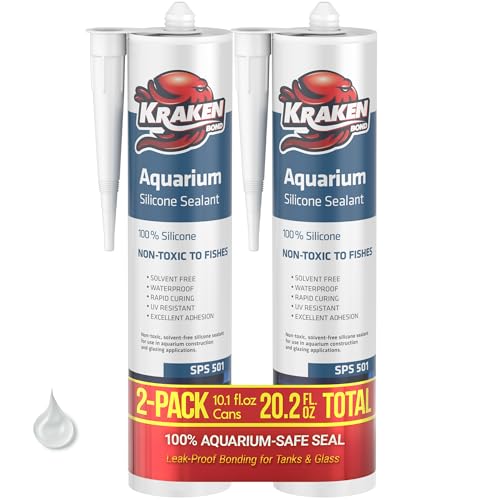
Kraken Bond delivers exactly what a serious resealing job needs: a clear 100% silicone formula that bonds aggressively to glass, aluminum, ceramics, and PVC without shrinking or cracking. Real-world testers report resealed 40-gallon tanks holding strong with no leaks after three full years, and the cured silicone stays flexible enough to absorb vibration from filters and pumps.
The two-pack provides enough volume for a 75-gallon rebuild, and the paste-like consistency applies smoothly through a caulk gun — though the tube threads are standard, so you may need to trim the nozzle at a 45-degree angle for precise seam control. The vinegar odor is strong during cure, as expected with any acetoxy silicone, so ventilation is mandatory.
Customers consistently note the 24-hour cure time printed on the tube is accurate — not the exaggerated 48–72 hours some competitors claim. For a mid-range price, this is the most reliable all-around option for glass tank construction and repair.
Why it’s great
- Proven 3-year bond without leaks in real tanks
- Smooth application with good bead control
- Cures reliably within 24 hours
Good to know
- Strong vinegar smell requires ventilation
- Not recommended for acrylic tanks
2. Akfix 100AQ Aquarium Sealant Clear (2-Pack)
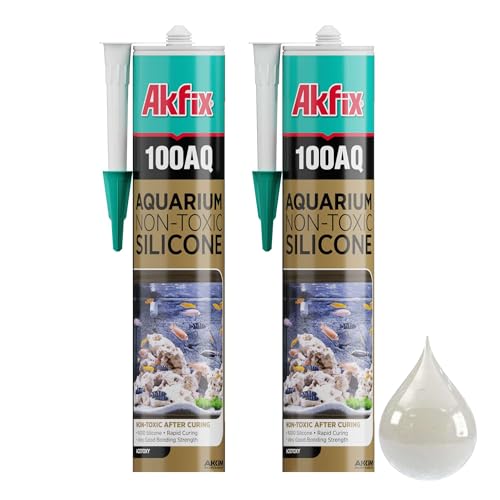
Akfix 100AQ stands out for its exceptionally fast surface skin — 7 to 13 minutes — which is critical when you are running a long bead along a 55-gallon tank rim and need the silicone to stay put without sagging. The formula is explicitly fish-safe and also certified for reptiles, amphibians, and invertebrates, making it a top choice for bioactive terrariums and dart frog enclosures.
The two-pack delivers 20.2 fluid ounces total, and the cartridge fits standard caulk guns without adapters. Users report impressive adhesion to glass, fiberglass, and acrylic, though some note that the “rapid cure” label can be misleading — full cure still takes up to 7 days for a 3mm bead, so do not rush water introduction. During cure, the odor is noticeably lower than typical acetoxy silicones.
Real-world feedback from paludarium builders confirms the seal holds up under constant humidity. The balance of fast skin, low odor, and broad material compatibility makes this a practical pick for complex builds where you cannot afford a messy drip.
Why it’s great
- Ultra-fast 7–13 minute skin formation
- Low odor compared to standard aquarium silicones
- Safe for reptiles, amphibians, and fish
Good to know
- Full cure depth takes up to 7 days
- Not the cheapest option per ounce
3. LISRUX Aquarium Silicone Clear Sealant (4-Pack)
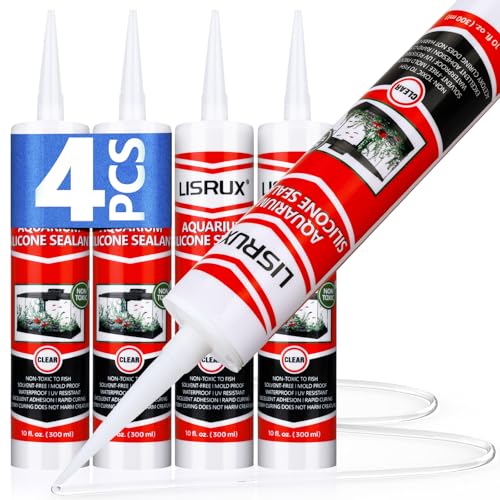
When you have multiple tanks, a large build, or a mix of aquarium and hydroponic projects, the LISRUX 4-pack delivers the best volume-to-cost ratio without sacrificing quality. Each 10-ounce tube is 100% silicone with no solvents, skins over in roughly 30 minutes, and reaches full cure within 48 hours under standard conditions. Users who reseal leaky tanks professionally report buying this pack repeatedly.
The cured silicone remains flexible across -50°C to 100°C, so outdoor ponds and tropical setups are equally safe. The consistency is smooth and easy to tool, leaving a clean bead that doesn’t require excessive wet finger smoothing. One caveat: the tube nozzles are standard open-end, so for precise work you will need to cut a small tip and use a caulk gun.
Real-world applications range from sealing hydroponic rail end caps to fixing outdoor bird baths and pond liners. The strong acetic acid smell is present during cure, but users confirm it dissipates completely once dry. If you need multiple tubes for a big project or want spares on hand, this is the most economical pick.
Why it’s great
- Four tubes provide excellent value for large projects
- 30-minute skin time allows efficient multi-pass work
- Flexible from -50°C to 100°C
Good to know
- Standard nozzles require precise cutting for detailed work
- Strong vinegar odor needs ventilation during cure
4. SELSIL Aquarium Silicone Sealant Clear (2-Pack)
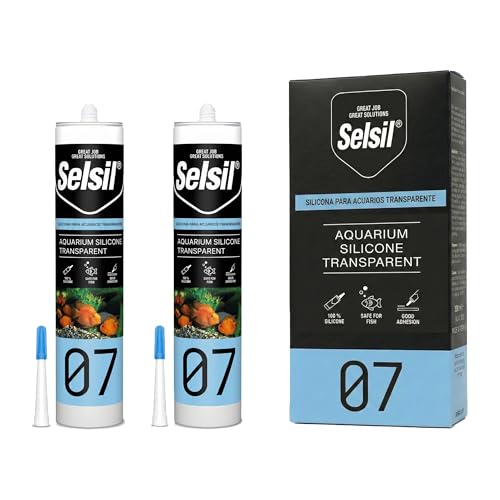
SELSIL’s formula stands apart in two specific ways: it carries ISO 11600–F&G–25 LM certification, a legitimate third-party standard for joint sealants, and it cures with notably less odor than typical acetoxy silicones. In damp environments where ventilation is limited — think basement sump tanks or sealed reptile rooms — users report the smell is tolerable with basic airflow rather than requiring respirators.
The bond strength is genuinely industrial-grade. Customers who have used 13 tubes across multiple reptile enclosures note that once cured, the silicone essentially welds to glass and ceramic — removal without breaking the substrate is impossible. The 24-hour cure time is realistic for thin beads, though thick applications in cold rooms below 41°F will slow dramatically.
One potential drawback: the clear color runs slightly less transparent than some competitors, leaving a faint haze on the glass if applied too thickly. For invisible seams on display tanks, you may need to apply a thin, smooth bead and tool it immediately. For structural repairs where appearance matters less, the strength is unmatched.
Why it’s great
- Low odor suitable for indoor, low-ventilation setups
- ISO 11600 certified for professional-grade sealing
- Extremely durable bond for permanent repairs
Good to know
- Clear finish can appear hazy if applied in thick beads
- Slow cure below 41°F application temperature
5. Apel 100% Silicone Sealant (10.4 fl. oz.)

Apel’s entry-level tube is a straightforward, 100% silicone sealant with no additives or fungicides, confirmed by real users sealing 25-gallon tanks successfully with no leakage after a month. The fast tack-free time of 1–2 hours is impressive for a budget product, and the full cure at 24 hours matches more expensive silicones. The pack includes a nozzle, but some shipments arrive without it — a common complaint worth verifying before your project starts.
The consistency is thicker than premium brands, making it less ideal for fine seam tooling but perfectly adequate for sealing bottom edges and attaching decorations. Users warn that the tube is physically stiff and difficult to squeeze without a caulk gun, so budget for one if you do not already own it. The vinegar odor is sharp, and one reviewer noted it burns the nose initially, so ventilation is non-negotiable.
The main trade-off at this price point: this silicone is not formulated for acrylic tanks. Multiple reviews explicitly warn against using it on anything except glass. For a first-time repair, a small tank patch, or a simple decoration glue job, this tube works reliably without breaking the budget.
Why it’s great
- Fast 1–2 hour tack-free time speeds up work
- Low upfront cost for small projects
- 100% silicone confirmed by real leak tests
Good to know
- Nozzle missing from some shipments
- Not safe for acrylic tanks
6. BOSS 02505CL10 801 Neutral Cure Silicone (10.3 fl. oz.)

BOSS 801 is a neutral-cure silicone, meaning it releases alcohol during curing rather than acetic acid — a critical distinction for acrylic tanks and spa components that acetoxy silicones can craze or etch. The low-odor, non-corrosive formula bonds well to ceramic, PVC, fiberglass, and wood, making it the go-to choice for hot tub jet seals, filter housing gaskets, and plumbing fittings around the aquarium stand.
Users specifically praise its chlorine resistance — one reviewer fixed a hot tub filter housing leak and found the seal lasted longer than the original factory gasket. The 10.3-ounce tube is smaller than standard aquarium options, but neutral-cure silicones are inherently more expensive to manufacture, so the volume matches the intended pool-and-spa use case rather than large tank construction.
The main limitation: this is not marketed as a fish-safe silicone, and while neutral-cure formulas are generally considered less toxic than acetoxy types, the lack of explicit aquarium certification means you should use it only for external repairs, plumbing, or equipment mounts — not for internal tank seams that contact water directly.
Why it’s great
- Neutral cure won’t craze acrylic or plastics
- Chlorine and moisture resistant for wet environments
- Low odor during application and cure
Good to know
- Not explicitly certified aquarium-safe for internal seams
- Smaller tube size limits large tank repairs
7. Smooth-On SIL-Poxy Rubber Silicone Adhesive (0.3 oz)
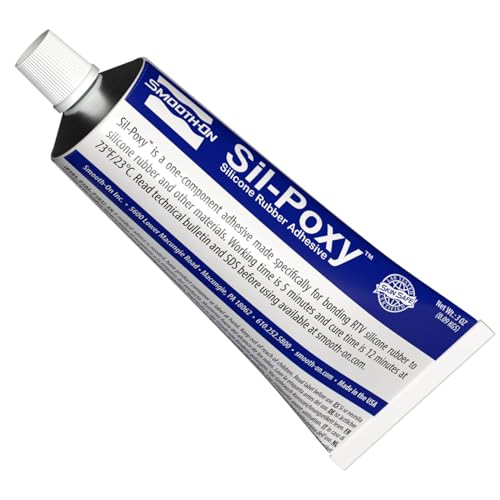
SIL-Poxy occupies a completely different niche from the other six products — it is a specialty adhesive designed to bond cured silicone rubber to itself or to other materials like fabric, plastic, and ceramic. In an aquarium context, this is the product you grab when you need to repair a torn silicone gasket on a canister filter, patch a wetsuit-style seal on a custom sump lid, or attach silicone tubing to a glass bulkhead fitting.
The cured bond is remarkably strong and stretchy — users report repairing mermaid tails, costume prosthetics, and silicone molds with invisible seams that withstand repeated flexing. The 0.3-ounce tube is tiny, but the yield is high: one tube can seal 60–70% of a 6-foot mermaid tail. The bond is waterproof and UV-resistant, so it holds up in direct sunlight and constant moisture.
The downsides are substantial for aquarium use: the tube is very small, the material cost is high per ounce, and the cure releases fumes that require proper PPE (respirator and nitrile gloves). This is not a general-purpose silicone for sealing tank seams — it is a precision tool for silicone-to-silicone repairs that no other product on this list can handle.
Why it’s great
- Creates an invisible, flexible weld on silicone rubber
- Waterproof and UV-resistant for long-term use
- Excellent for repairing filter gaskets and silicone parts
Good to know
- Very small tube (0.3 oz) at a premium price point
- Requires respirator and gloves during application
FAQ
Can I use regular bathroom silicone caulk on my fish tank?
How long should I wait before filling the tank after resealing?
Will aquarium silicone bond to acrylic or plastic surfaces?
What does the vinegar smell mean during curing?
Final Thoughts: The Verdict
For most users, the best aquarium silicone winner is the Kraken Bond 2-Pack because it combines proven long-term adhesion on glass, a reasonable 24-hour cure time, and a two-tube bundle that covers a full tank rebuild without waste. If you need ultra-fast skin formation for a complex build or terrarium project, grab the Akfix 100AQ. And for specialty silicone-to-silicone repairs that no other sealant can handle, nothing beats the Smooth-On SIL-Poxy.