
Our readers keep the lights on and the weekend projects moving. As an Amazon Associate, I earn from qualifying purchases.
A rough, burned edge on a finish cut isn’t just cosmetic — it often means the blade’s tooth count or hook angle is wrong for your material. Choosing a 12 inch chop saw blade comes down to matching the tooth geometry and kerf thickness to the lumber you cut most often, whether that’s pressure-treated framing lumber or walnut for a cabinet face.
I’m Rikta — the co-founder and writer behind FitlyFast. I’ve spent dozens of hours analyzing tooth configurations, carbide grades, and kerf measurements across the most popular 12-inch blades to separate general-purpose workhorses from true finish-cut specialists.
This guide compares seven blades across three price tiers, covering everything from a budget-friendly 48-tooth ripper to a micro-polished 100-toet h finish blade. You’ll learn exactly why best 12 inch chop saw blade choices depend on the balance between feed rate tolerance and edge quality for your specific saw and projects.
How To Choose The Best 12 Inch Chop Saw Blade
The right blade for your 12-inch chop saw isn’t the most expensive one — it’s the one whose tooth count, kerf, and hook angle align with the material thickness and finish quality you need. Here are the three specs that matter most.
Tooth Count: Speed vs. Finish Quality
Fewer teeth (40T to 48T) clear waste faster, making them ideal for ripping framing lumber and thick stock where a slightly rough edge is acceptable. Higher tooth counts (80T to 100T) produce finer edges with minimal tear-out, but require slower feed rates to avoid burning the wood. For mixed use, a 60T blade offers a reasonable compromise, but for dedicated finish work on hardwoods or plywood, 80T or 100T is the standard.
Kerf Thickness: Motor Load and Material Waste
Thin kerf blades (around 0.087 inches or less) remove less material with each pass, reducing strain on your saw’s motor and producing less dust. Full kerf blades (around 0.125 inches) are more rigid and less prone to deflection during heavy cuts, but demand more power from the saw. On a standard 15-amp chop saw, a thin kerf blade can make the difference between a clean cut and a stalled motor on dense hardwoods.
Hook Angle and Carbide Grade
A positive hook angle (15° to 20°) aggressively pulls the blade into the cut, which speeds up ripping but can cause chattering or self-feeding on a miter saw. A neutral or negative hook angle (0° to 5°) offers more control for crosscuts and precise trim work. C3 or C4 micro-grain carbide tips resist chipping longer than standard carbide, and a non-stick coating like Perma-SHIELD reduces heat buildup and resin buildup on the blade face.
Quick Comparison
On smaller screens, swipe sideways to see the full table.
| Model | Category | Best For | Key Spec | Amazon |
|---|---|---|---|---|
| DEWALT DWA112100 | Premium | Ultra-fine finish & LVP | 100 Teeth, .091″ Kerf | Amazon |
| Makita A-93734 | Premium | Hardwood & mirror finish | 100 Teeth, .091″ Kerf | Amazon |
| DEWALT DWA11280 | Mid-Range | General trim work | 80 Teeth, Thin Kerf | Amazon |
| BOSCH DCB1244 | Mid-Range | General purpose ripping | 44 Teeth, ATB Grind | Amazon |
| Diablo D1040W | Mid-Range | Beam & header cutting | 40 Teeth, TiCo Carbide | Amazon |
| WEN BL1200 | Budget-Friendly | Finish cuts on a budget | 100 Teeth, 2.8mm Kerf | Amazon |
| WEN BL1248 | Budget-Friendly | General wood building | 48 Teeth, 1-Inch Arbor | Amazon |
In‑Depth Reviews
1. DEWALT DWA112100
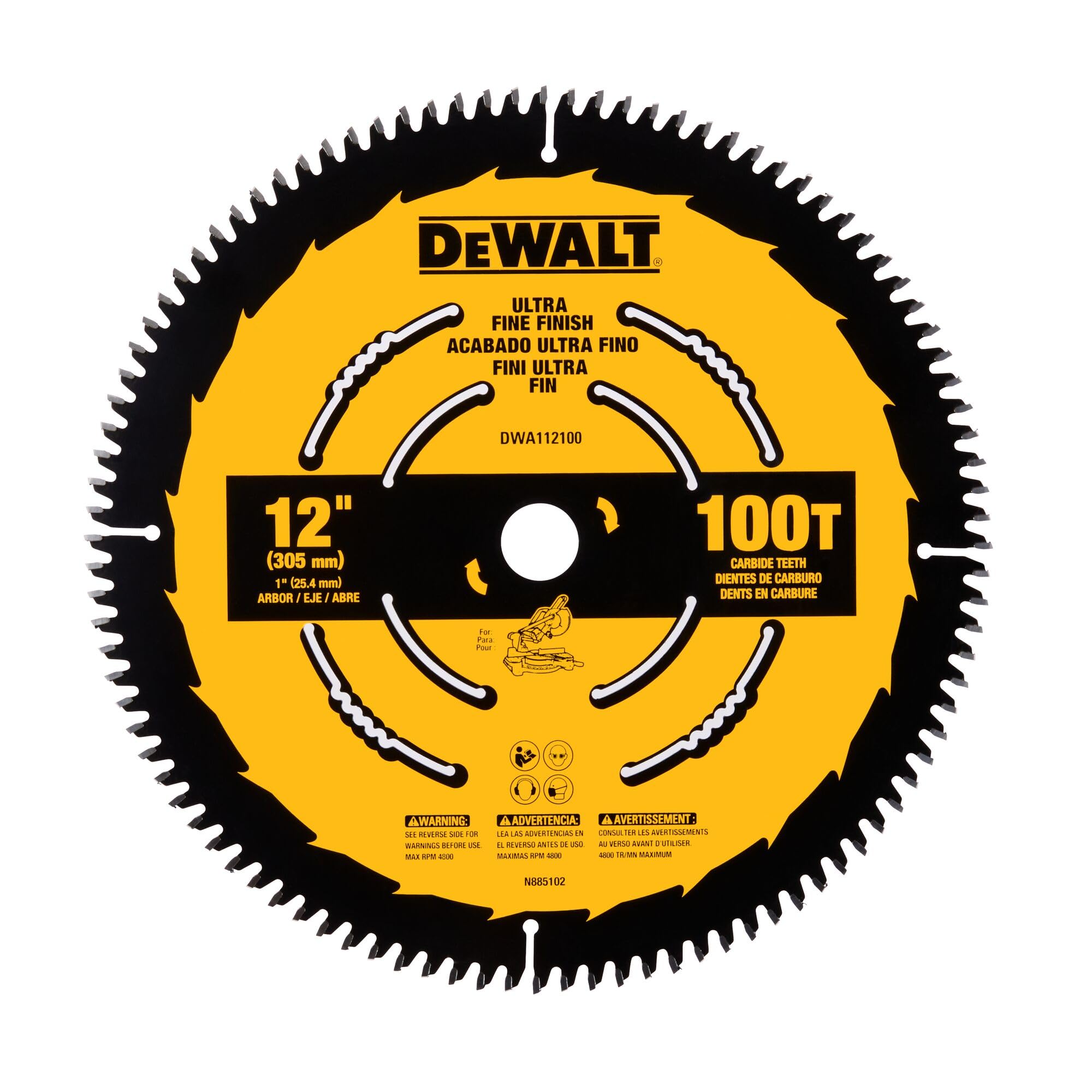
The DWA112100 is DEWALT’s highest tooth-count offering in the 12-inch format, with 100 ultra-sharp carbide tips and a patented body slot design that nearly eliminates vibration during finish cuts. This blade excels on LVP flooring, producing chip-free edges on laminates and engineered planks without slowing the feed rate. The thin kerf keeps dust manageable and motor load low, even on a standard 15-amp chop saw.
Users report clean crosscuts on hard maple and cherry without sanding between pieces, and the blade holds its edge through months of daily trim work. The optimized tooth geometry includes a negative hook angle that prevents self-feeding during miter cuts, giving you precise control on compound angles. For contractors running high-volume finish work, this is a top-tier upgrade.
One minor trade-off: the high tooth count means slower ripping through thick pressure-treated lumber. If your work is mostly framing, a 44T or 48T blade will clear material faster. But for crown molding, baseboards, and cabinet work, the cut quality justifies the price premium.
Why it’s great
- Ultra-smooth, splinter-free finish on hardwoods and laminates
- Patented slot design reduces vibration drastically
- Negative hook angle for controlled miter cuts
Good to know
- Not ideal for fast ripping of thick dimensional lumber
- Premium-tier price point
2. Makita A-93734
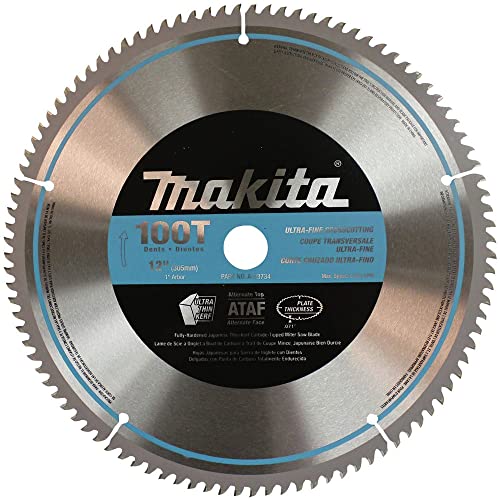
Makita’s A-93734 uses micro-grain carbide teeth honed to a 600-grit mirror finish, producing crosscuts on walnut, oak, and mahogany that feel sanded straight off the blade. The fully hardened, hand-tensioned steel plate ensures true rotation even after repeated heavy use, and the 5-degree hook angle provides a balanced feed that doesn’t grab aggressively on a sliding miter saw.
Users report extremely clean results on Baltic birch plywood and acrylic sheets with minimal splintering — often outperforming Diablo and Freud blades on the same material. The .091-inch ultra-thin kerf reduces waste significantly, which matters when you’re cutting expensive hardwood. Several contractors note the blade maintains its sharpness over three months of daily use without a noticeable drop in cut quality.
The arbor is a standard 1-inch, which fits most Makita and DEWALT miter saws without an adapter. A small minority of users have reported the blade running slightly out of true, suggesting quality control on tensioning can vary. If you get a good one, it’s arguably the finest-finish blade in this category.
Why it’s great
- Mirror-polished carbide produces sanded-quality edges
- Hand-tensioned plate for rotational accuracy
- Excellent on plywood, MDF, and acrylic
Good to know
- Inconsistent tensioning in a small batch of units
- Premium price comparable to DEWALT 100T
3. DEWALT DWA11280

The DWA11280 splits the difference between a fast ripping blade and a dedicated finish blade with 80 teeth and a thin kerf that keeps the saw running cool on long cuts. The patented body slot design reduces singing and vibration noticeably compared to older DEWALT blades, which is a real benefit when cutting thin aluminum trim or PVC fascia boards.
Users running this blade on a DW780 sliding miter saw report consistent, chatter-free cuts on cedar decking and hardwood flooring, with minimal burning even at moderate feed rates. The optimized tooth geometry seems to balance chip clearance and edge finish well — it won’t match a 100T blade for absolute smoothness on veneer plywood, but it’s fast enough for production trim work.
The arbor is a standard 1-inch, and the blade comes ready for miter saws and table saws alike. Some users note that it’s not ideal for thick ripping in 4×4 posts due to deflection at the higher tooth count, but for general trim and light framing, it’s a sharp, durable mid-range upgrade.
Why it’s great
- Low-vibration body slots for quiet, smooth cuts
- Balanced 80T configuration for trim and light ripping
- Holds edge well on softwoods and hardwoods
Good to know
- Not designed for thick crosscuts or heavy framing
- Some deflection reported on 4×4 lumber
4. BOSCH DCB1244

The Bosch DCB1244 is a 44-tooth general-purpose blade built around the Brute Carbide formula — a C3/C4 micro-grain blend that resists chipping better than standard carbide. The ATB (Alternate Top Bevel) grind delivers clean crosscuts and efficient ripping in plywood and dimensional lumber, and the Speed Coat anti-friction finish keeps the blade running cool on long, continuous cuts.
Users upgrading from stock saw blades consistently note a major improvement in cut smoothness and reduced burning on 2×4s and 2×6s. The thinner kerf (compared to full-kerf framing blades) reduces motor strain noticeably, making it a solid choice for older chop saws that lack the torque of newer models. It’s also quiet — the extra-hard steel body damps vibration well without additional dampeners.
One limitation: the 44-tooth count won’t produce the glass-smooth finish needed for exposed trim or veneer plywood. You’ll want a 60T or 80T blade for miters and finish work. But for rough framing, decking, and general construction cutting, this is one of the best value propositions in the category.
Why it’s great
- Brute Carbide resists chipping better than standard grades
- Speed Coat prevents gumming and heat buildup
- Thin kerf reduces motor load on older saws
Good to know
- Not recommended for fine finish or exposed trim
- 44T limits smoothness on plywood crosscuts
5. Diablo D1040W
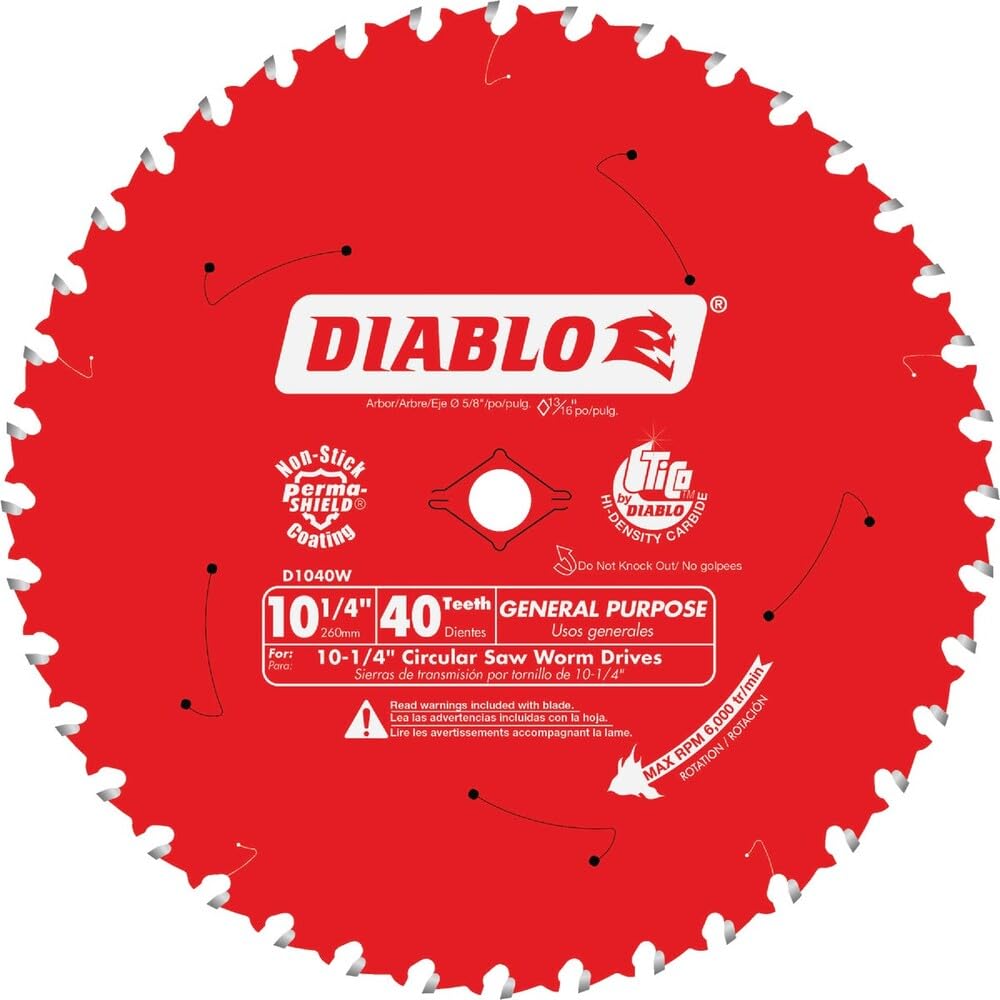
The Diablo D1040W is a 40-tooth blade designed specifically for wormdrive and sidewinder saws with a 5/8-inch arbor, making it unique in this list. Its TiCo Hi-Density carbide tips and Perma-SHIELD non-stick coating are engineered for cutting 4×4 headers, fence posts, and sandwiched 2× beams — the kind of dense, fast work that would overheat a standard general-purpose blade.
Users in construction and framing report that this blade cuts through pressure-treated lumber with minimal gumming and no burning, even when ripping stacked beams. The tri-metal shock-resistant brazing keeps carbide tips attached during kickback stress, and the super-thin laser-cut kerf (0.063-inch plate) reduces drag significantly on underpowered saws. It’s also a solid resaw blade on a table saw when paired with a stabilizer.
The biggest catch: the 5/8-inch arbor won’t fit most standard 12-inch miter or chop saws without a bushing adapter, and the 40-tooth count produces a rough edge on finish cuts. This is a specialized tool for beam cutting, not a replacement for your primary miter saw blade.
Why it’s great
- TiCo carbide resists wear on dense pressure-treated lumber
- Perma-SHIELD coating prevents resin buildup
- Tri-metal brazing withstands kickback stress
Good to know
- 5/8-inch arbor incompatible with most miter saws
- 40T produces rough edges on finish cuts
6. WEN BL1200

The WEN BL1200 packs 100 carbide-tipped teeth into a 12-inch blade at a fraction of the cost of premium 100T models. For the price, the cut quality on pine, poplar, and plywood is impressive — users report chip-free edges on crosscuts without sanding, and the 2.8mm kerf (approximately .110 inches) clears waste efficiently without bogging the saw motor.
Several users note that the blade produces straight, clean cuts on MDF and baseboards with minimal tear-out, making it a solid upgrade from entry-level saw stock blades. The heat-expansion slots help prevent warping during extended use, and the C4-grade carbide holds its edge through dozens of cuts in hardwood without a noticeable drop in sharpness.
The main durability concern is that the carbide tips wear faster than premium blades under heavy daily use. Jobsite contractors report needing to replace this blade more frequently than a DEWALT or Makita equivalent. But for a weekend woodworker or a dedicated finish blade for trim work, the performance-to-cost ratio is excellent.
Why it’s great
- 100 teeth produce splinter-free finish on softwoods and plywood
- Very affordable entry point for finish-cutting
- Heat-expansion slots prevent warping
Good to know
- Carbide wears faster than premium-tier blades
- Not ideal for heavy daily jobsite use
7. WEN BL1248

This 48-tooth WEN blade is the entry-level workhorse for builders who need a reliable, low-cost blade for framing, decking, and general construction cutting. The 1/10-inch kerf (2.6mm) is one of the thinnest in this comparison, which keeps motor strain low and reduces waste on every cut. Users report it cuts cleanly through pressure-treated pine, oak, and even dense exotics like purple heart with no stalling.
The 48-tooth count is a solid compromise for mixed cutting: fast enough for ripping 2×4s but with enough teeth to produce a relatively clean crosscut on plywood. It’s also compatible with most 12-inch miter, table, and jobsite saws thanks to the standard 1-inch arbor.
Where it falls short is finish work. The 48 teeth leave visible tool marks on exposed trim and produce occasional splintering when cutting veneered plywood. It’s not a finish blade, and expecting that performance would be unfair at this price point. For rough carpentry and budget-conscious shops, it’s a smart pick.
Why it’s great
- Ultra-thin kerf for low motor strain and less waste
- Impressive durability for the price point
- Fits most 12-inch saws with standard 1-inch arbor
Good to know
- Not suitable for exposed trim or veneer plywood finish cuts
- Carbide wears faster under heavy professional use
FAQ
Can I use a 12-inch blade on a 10-inch chop saw?
What does ATB mean on a chop saw blade?
Why does my blade burn the wood during a cut?
How do I know the arbor size of my chop saw?
Final Thoughts: The Verdict
For most users, the best 12 inch chop saw blade winner is the DEWALT DWA112100 because the 100-tooth configuration delivers a splinter-free finish on hardwoods and LVP that rivals sanded edges. If you want a premium hardwood finish with mirror-smooth crosscuts, grab the Makita A-93734. And for a budget finish blade that punches far above its weight class, nothing beats the WEN BL1200.