
Our readers keep the lights on and the weekend projects moving. As an Amazon Associate, I earn from qualifying purchases.
Buying a saw blade for butcher block is different from picking one for construction lumber. The dense, glued-up hardwood strips demand a blade that resists burning, chip-out, and deflection — or you ruin the surface before you even sand. A single pass with the wrong tooth count or kerf can turn an expensive slab into a splintered mess.
I’m Rikta — the co-founder and writer behind FitlyFast. This guide is built from hundreds of hours analyzing tooth geometry, carbide grades, kerf measurements, and real-world feedback from woodworkers who finish butcher block every day.
Whether you are crosscutting a butcher block countertop or ripping a cutting board blank, finding the right blade to cut butcher block comes down to balancing tooth count, kerf thickness, and material compatibility for a flawless finish.
How To Choose The Best Blade To Cut Butcher Block
Butcher block is not like solid lumber. Its glued-edge construction creates alternating grain directions that cause standard blades to chip, burn, or wander. Choosing the right blade avoids ruining a premium surface before installation begins.
Tooth Count: High Enough to Cut, Low Enough to Avoid Burning
For butcher block crosscuts, a blade with 60 to 100 teeth delivers the smooth edge you need with minimal sanding. Fewer than 40 teeth leaves visible tear-out on the face grain. Above 100 teeth risks burning on the dense glue lines, especially in hard maple blocks. Look for an Alternating Top Bevel (ATB) grind — the teeth shear through the wood fibers rather than splitting them.
Kerf: Thin for Waste, Thick for Stability
A thin kerf blade (0.090–0.100 inches) removes less material and places less strain on lower-powered saws like cordless circular saws. But thin kerf blades can deflect in thick butcher block slabs (1.5 inches or more). Full kerf blades (0.125 inches and above) stay true through deep cuts but require a saw with enough torque to push through without bogging down.
Carbide Grade and Body Construction
The glue lines in butcher block are abrasive. Blades with C3 or C4 micrograin carbide hold an edge longer than standard carbide. A hardened steel body resists warping from the heat generated during long rip cuts. Expansion slots or laser-cut stabilizer vents prevent the blade from overheating and burning the wood during continuous use.
Quick Comparison
On smaller screens, swipe sideways to see the full table.
| Model | Category | Best For | Key Spec | Amazon |
|---|---|---|---|---|
| Tenryu GM-25540 | Premium Combo | Near-gloss crosscuts on hardwood butcher block | 40 teeth, ATB grind, 0.098″ kerf | Amazon |
| CMT Orange 256.050.10 | Premium Combo | Re-sharpenable blade for long-term value on butcher block | 50 teeth, ATB + flat, 0.102″ kerf | Amazon |
| WEN BL1200 | Ultra-Finish | High-tooth count finish cuts on miter saws | 100 teeth, 2.8mm kerf, 12-inch | Amazon |
| WEN BL1232-2 Set | Two-Pack | Having dedicated ripping and finishing blades for butcher block | 32T + 80T, 2.6mm kerf, 12-inch | Amazon |
| Janchi 3-Pack Combo | Multi-Blade Set | Versatility across multiple saws and butcher block grain types | 32T, 60T & 80T, 0.095″ kerf, 10-inch | Amazon |
| Bosch DCB760 | Extra-Fine | Clean cuts on engineered wood and plywood butcher block | 60 teeth, ATB, thin kerf, 7-1/4-inch | Amazon |
| FOXBC Ultra Finish | Ultra Finish | Budget-friendly finish crosscut on miter saws | 80 teeth, ATB, 0.098″ kerf, 10-inch | Amazon |
In‑Depth Reviews
1. Tenryu GM-25540

The Tenryu GM-25540 delivers finish quality that rivals blades twice its price. Its 40-tooth ATB geometry produces crosscuts on hard maple butcher block that feel polished straight off the saw, with virtually no tear-out on the face grain. Users consistently report that it cuts 4/4 cherry and 8/4 maple with a glue-ready edge, saving hours of sanding on large countertop projects.
A key advantage for butcher block work is the blade’s exceptional balance and quiet operation. The Japanese manufacturer uses a laser-cut body with expansion slots that prevent the blade from warping or burning during long rip cuts on dense stock. This stability is critical when cutting thick butcher block slabs, where deflection causes burned edges and imprecise joints.
The Tenryu is not the cheapest option upfront, but its durability and re-sharpenability make it a long-term value. Professional woodworkers note that it can be re-sharpened multiple times, unlike budget blades that go straight to the bin. For anyone cutting butcher block regularly, this blade pays for itself in saved material and reduced finishing time.
Why it’s great
- Near-polished finish on butcher block edges, ready for glue or oil
- Superb blade balance reduces vibration for accurate cuts
- Re-sharpenable multiple times, extending useful life well beyond budget blades
Good to know
- Higher upfront cost than mid-range competitors
- 40-tooth count may leave slight roughness on end-grain strips if pushed too fast
2. CMT Orange Tools 256.050.10
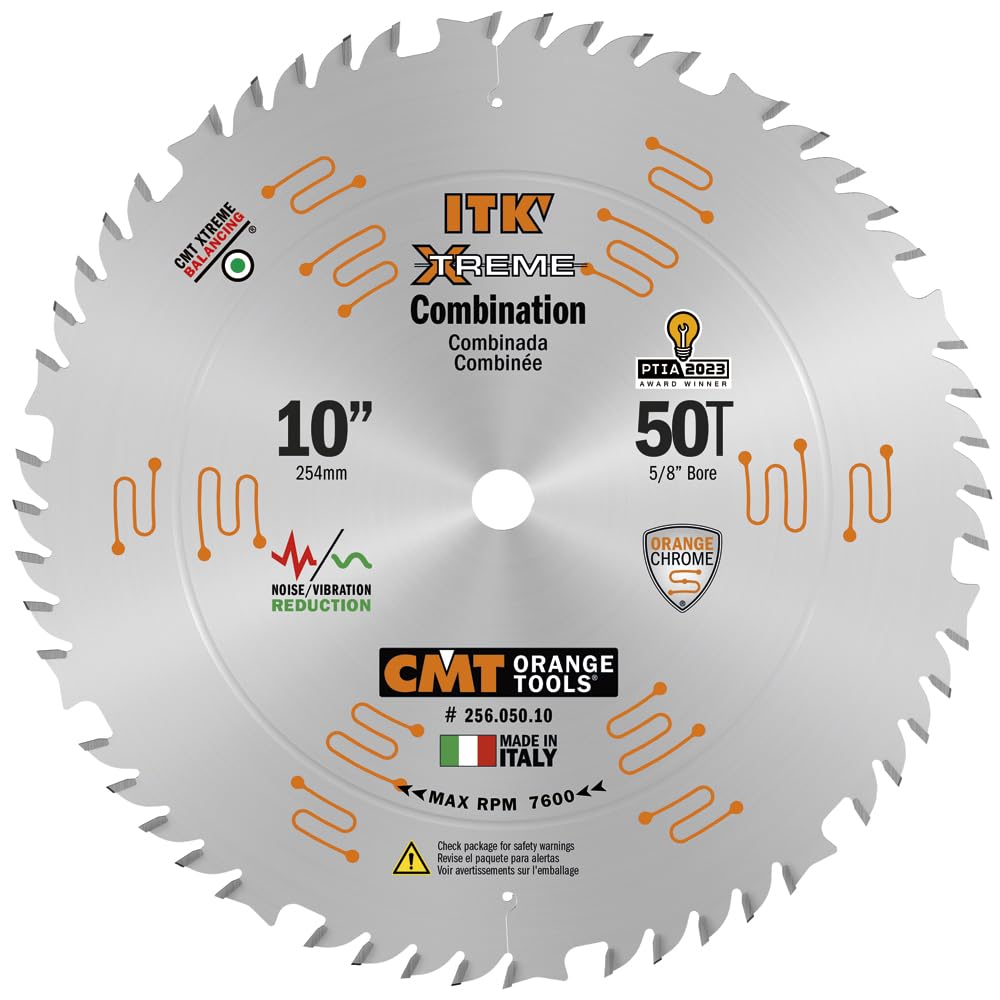
The CMT Orange 256.050.10 is a 50-tooth combination blade that handles both rip and crosscut tasks on butcher block without requiring a blade change. Its hybrid tooth set — 15 ATB teeth and one flat tooth — shears through glue lines while the flat tooth squares the bottom of the cut, reducing chip-out on the underside of the workpiece.
Woodworkers praise this blade for its low noise and vibration profile, even when mounted on compact jobsite saws. The thin kerf design (0.102 inches) places less demand on the motor, allowing lighter saws to push through thick butcher block without bogging. Yet the blade body is stiff enough to resist deflection, producing straight, clean cuts across 1.5-inch slabs.
The most compelling feature for butcher block buyers is the re-sharpenability. CMT uses a high-density carbide that holds its edge through abrasive glue lines, and the blade can be re-sharpened up to 20 times in many cases. For a mid-range price, this blade offers exceptional long-term cost per cut compared to disposable alternatives.
Why it’s great
- Re-sharpenable up to 20 times for exceptional long-term value
- Low vibration and noise even on compact jobsite saws
- ATB + flat tooth design reduces underside chip-out on butcher block
Good to know
- Thin kerf may still deflect in extremely thick or dense walnut blocks
- Requires occasional cleaning to prevent pitch buildup on carbide tips
3. WEN BL1200

The WEN BL1200 packs 100 teeth into a 12-inch diameter, making it a serious finish blade for miter saw crosscuts on butcher block. Each carbide-tipped tooth is ATB-ground to shear fibers cleanly, and users report cutting both pine and walnut butcher block without splinters or tear-out on the show face. The ultra-thin kerf (2.8 mm) removes less material, reducing waste on expensive hardwood slabs.
Heat management is a real concern with high-tooth blades on dense butcher block, but the WEN uses laser-cut expansion slots that allow the blade to expand and contract without warping. This prevents the burning that often appears as dark streaks on maple blocks. The blade is rated up to 6000 RPM, compatible with the majority of 12-inch miter saws and table saws found in home workshops.
The value proposition here is straightforward: you get a 100-tooth finish blade at a budget-tier price. Some users note that the edge wears faster than premium blades when cutting abrasive materials, but for weekend projects and DIY butcher block countertops, the BL1200 delivers a finish that typically requires blades costing several times as much.
Why it’s great
- 100 teeth produce a glass-smooth finish on butcher block crosscuts
- Laser-cut expansion slots prevent overheating and burning
- Excellent value for a high-tooth-count finish blade
Good to know
- 12-inch diameter limits use to larger miter saws with 1-inch arbor
- Wears faster than premium blades when cutting through glue lines
4. Janchi 3-Pack Combo

The Janchi 3-Pack bundle provides 32-tooth (general purpose), 60-tooth (fine finish), and 80-tooth (ultra-fine finish) blades in one package, covering every stage of butcher block cutting. The 32-tooth blade is ideal for rough ripping glued-up strips before final dimensioning, while the 80-tooth blade handles the finish crosscuts that determine the visible edge quality.
Each blade features a 0.095-inch thin kerf and ATB tooth geometry, designed to work with the majority of 10-inch miter saws, jobsite saws, and table saws. Users specifically mention the 60-tooth blade’s ability to cut plywood butcher block (baltic birch) without chip-out, a common challenge where thin veneer layers fracture under standard blades.
The titanium alloy coating on the blade body reduces friction and helps prevent pitch buildup, which is especially relevant when cutting butcher block with synthetic glue lines that can gum up unprotected steel. While the carbide on these blades is not as premium as the CMT or Tenryu, the three-blade set offers versatility for workshops that switch between rough and finish cuts frequently.
Why it’s great
- Three blades cover ripping, fine, and ultra-fine finish tasks
- Titanium coating reduces pitch buildup on glue lines
- Thin kerf reduces strain on lower-powered circular saws
Good to know
- Carbide edge life is shorter than premium single-blade options
- The 32-tooth blade leaves visible tear-out on end-grain butcher block faces
5. WEN BL1232-2 Set

The WEN BL1232-2 two-pack pairs a 32-tooth general-purpose blade with an 80-tooth fine-finish blade, offering a practical solution for woodworkers who need both rough cutting and final finishing on butcher block. The 32-tooth blade handles dimensioning and rip cuts where speed matters, while the 80-tooth blade delivers the smooth crosscut surface that butcher block projects demand.
Both blades feature a 2.6 mm ultra-thin kerf, which reduces material waste and allows lower-torque saws to cut efficiently. Users who installed these blades on older miter saws report that the thin kerf transformed performance, enabling clean cuts through hard maple butcher block without bogging down the motor or leaving burn marks on the wood surface.
The fine-cut blade in this set has proven especially popular among DIYers installing butcher block countertops. After over 100 cuts, users report consistently clean edges with minimal splintering. While the carbide on these blades is not as hard as premium grades, the two-blade set offers strong value for the price, particularly for one-time kitchen renovation projects.
Why it’s great
- Two blades cover both rough ripping and finish crosscutting
- Ultra-thin kerf minimizes waste and motor strain
- Consistent clean cuts reported after 100+ uses on butcher block
Good to know
- 32-tooth blade may cause some chip-out on thin veneer butcher block
- Carbide edge wears faster on abrasive glue lines than premium options
6. Bosch DCB760

The Bosch DCB760 is a 7-1/4-inch blade engineered for cordless circular saws, making it an excellent choice for on-site butcher block cuts where a miter saw cannot reach. Its 60-tooth ATB configuration delivers crosscuts smooth enough for finished edges, and the Brute Carbide (C3/C4 micrograin) formulation resists the impact stress of cutting through hardwood strips and the abrasive glue lines that separate them.
Bosch includes a Speed Coat anti-friction coating that prevents the blade from burning wood during continuous cutting. This feature is crucial when a circular saw is used to cut butcher block sheets on sawhorses, where a stuck or burned blade can ruin the show face. The hardened steel body resists bending and deflection, ensuring the cut stays straight even when guiding the saw freehand.
Users upgrading from stock saw blades report a significant improvement in cut quality, with one noting that the DCB760 performs comparably to premium Freud blades. The blade is specifically designed for engineered wood and solid wood — which matches the construction of most modern butcher block countertops — making it a reliable option for contractors who need portability without sacrificing finish quality.
Why it’s great
- 60-tooth ATB leaves a smooth edge on butcher block crosscuts
- Brute Carbide construction boosts impact resistance in dense hardwood
- Anti-friction Speed Coat prevents burning during continuous cuts
Good to know
- 7-1/4-inch size limits depth of cut on thicker butcher block slabs
- Not ideal for table saw use due to smaller arbor and diameter
7. FOXBC Ultra Finish
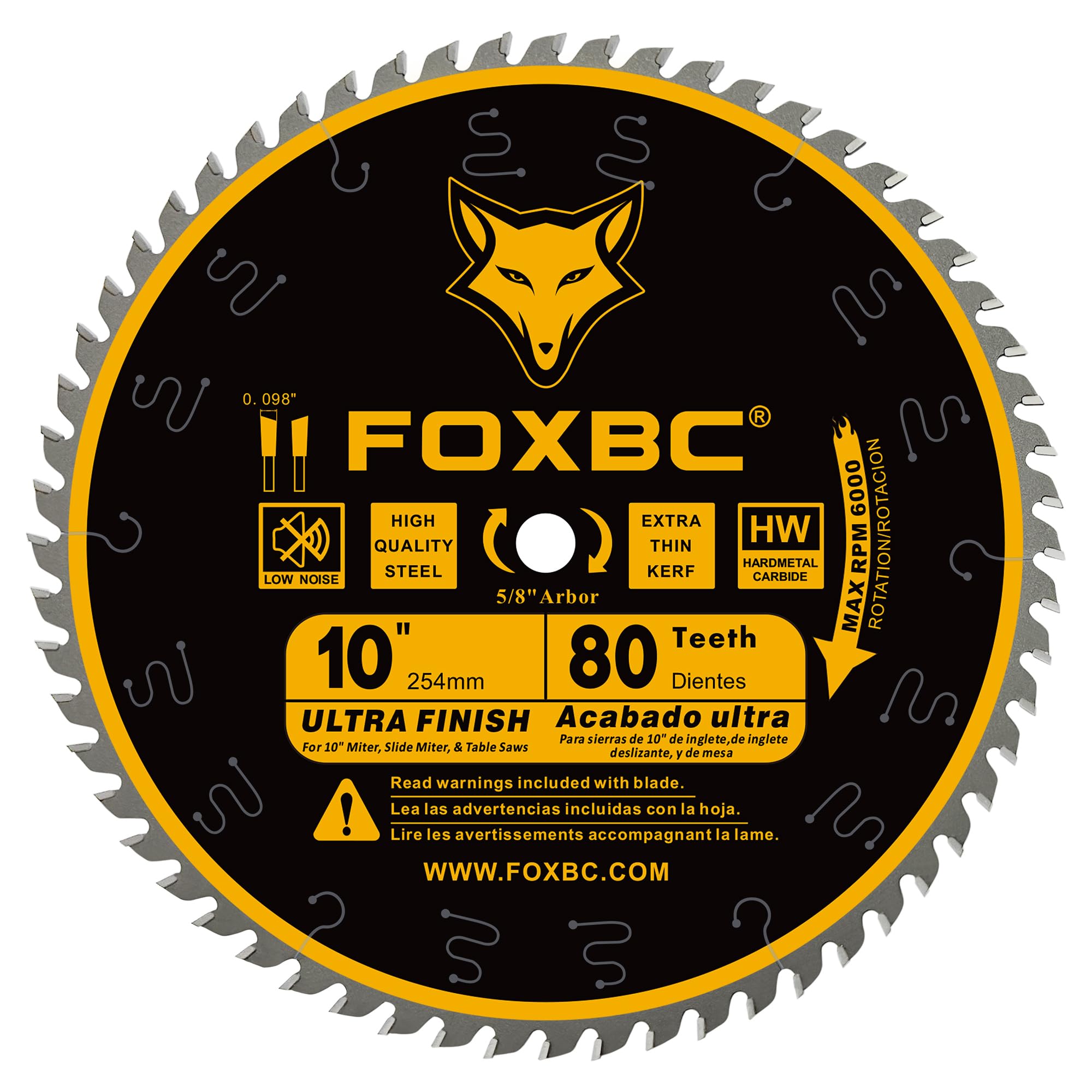
The FOXBC Ultra Finish 10-inch blade offers 80 ATB-ground teeth at a compelling price point for budget-conscious woodworkers. Its 0.098-inch thin kerf enables clean cuts through oak, pine, and melamine butcher block without overloading a standard miter saw motor. Users report that the blade performs on par with more expensive competitors in side-by-side testing, delivering zero tear-out on crosscuts of hardwood butcher block.
High-density tungsten carbide provides durability that exceeds expectations at this price tier. Reviewers specifically note that the cuts are smooth, quiet, and free of the vibration that often plagues budget blades. The blade is compatible with the majority of 10-inch miter saws and table saws from brands like DeWalt, Makita, and Skil, making it a versatile addition to any workshop.
The caveat is that some users found the advertised “extra thin kerf” to be not significantly different from a standard 40-tooth blade in practice. Additionally, the carbide may not hold its edge as long as premium blades when cutting through abrasive glue lines in dense maple butcher block. For light to moderate use, however, the FOXBC Ultra Finish delivers a finish that punches well above its price class.
Why it’s great
- Excellent cut quality rivaling blades at twice the price
- 80 teeth provide a smooth finish with zero tear-out reported
- Quiet and vibration-free operation on miter saws
Good to know
- Carbide edge wears faster on dense maple and glue lines
- Kerf labeling may not reflect a true ultra-thin difference from standard blades
FAQ
Can I use a standard framing blade to cut butcher block?
How does the glue in butcher block affect blade longevity?
Should I use a thin kerf or full kerf blade for butcher block?
Why does my blade burn the butcher block during the cut?
Final Thoughts: The Verdict
For most users, the blade to cut butcher block winner is the Tenryu GM-25540 because it delivers a polished finish on butcher block edges straight off the saw, with exceptional balance and re-sharpenability that makes it a long-term investment. If you want a re-sharpenable blade with low vibration on compact saws, grab the CMT Orange 256.050.10. And for budget-friendly versatility across multiple cutting tasks, nothing beats the FOXBC Ultra Finish.