
Our readers keep the lights on and the weekend projects moving. As an Amazon Associate, I earn from qualifying purchases.
Choosing the wrong base can turn a rabbit’s home into a damp, ammonia-heavy environment that leads to sore hocks and respiratory stress. The ideal material balances high absorbency, low dust, and enough texture to satisfy natural digging and chewing instincts without compacting into a wet slab by day three.
I’m Rikta — the co-founder and writer behind FitlyFast. I’ve spent hundreds of hours analyzing absorption rates, dust particle levels, fiber composition, and odor-lock technology across dozens of small-animal bedding lines to cut through the marketing fluff for this guide.
Whether you prioritize chewy grass mats, ultra-soft paper fluff, or long-lasting hemp fibers, every option here was selected for measurable performance in a real hutch. This guide delivers a curated list of the absolute best bedding for rabbit cage setups.
How To Choose The Best Bedding For Rabbit Cage
Rabbits spend the majority of their time directly on their bedding, so material safety, moisture wicking, and dust content directly affect their health. The wrong choice can cause pododermatitis (sore hocks) from rough surfaces or upper respiratory infections from airborne particulates.
Absorbency & Odor Locking
Paper-based beddings typically absorb up to six times their weight in liquid and use ammonia-neutralizing additives to extend freshness up to 14 days. Hemp absorbs roughly twice its weight but excels at wicking moisture away from the surface, keeping the top layer dry longer. Straw mats offer the least absorbency and are best used as a secondary chew layer or resting pad rather than the primary cage floor.
Dust & Respiratory Safety
Rabbits are obligate nasal breathers with highly sensitive airways. The most critical spec is “99% dust-free” — any bedding that doesn’t explicitly state this on the label has a high chance of causing sneezing, nasal discharge, or chronic inflammation. Kiln-dried wood shavings (especially pine and aspen) are often dustier than compressed paper or hemp, though hemp flakes are naturally low-dust when processed correctly.
Edibility vs. Structural Durability
Natural straw and grass mats double as both bedding and a chew toy. Rabbits will tear, eat, and dig into these mats, which provides dental wear but means the mat has a limited lifespan — often only a few weeks. Paper and hemp beddings are non-edible in large quantities but hold their structure longer, requiring less frequent replacement and offering a consistent surface for burrowing.
Quick Comparison
On smaller screens, swipe sideways to see the full table.
| Model | Category | Best For | Key Spec | Amazon |
|---|---|---|---|---|
| Kaytee Clean & Cozy White Paper | Paper Fluff | High absorbency & burrowing | Absorbs up to 6x its weight | Amazon |
| Kaytee Clean & Cozy Natural Odor Control | Paper Fluff | Extended odor neutralization | 14-day odor control guarantee | Amazon |
| Eaton Hemp Bedding | Hemp Flake | Hypoallergenic & low dust | Absorbs 2x more than traditional | Amazon |
| Fresh News Recycled Paper | Paper Pellet | Ammonia locking & value | Over 99% dust free | Amazon |
| Yesland 12-Pack Woven Mat | Straw Mat | Edible chew & resting pad | 12 mats per pack | Amazon |
| Tierecare 3-Piece Fleece Pad | Fleece Pad | Machine-washable lap pad | Hidden seams, 13.77″ x 10.63″ | Amazon |
| PINVNBY 6-Pack Grass Mat | Straw Mat | Budget multi-pack nesting | 11″ x 8.3″ per mat | Amazon |
In‑Depth Reviews
1. Kaytee Clean & Cozy White Paper Bedding

This expanded paper bedding locks moisture into each fiber — the white crumbles swell as they absorb, trapping liquid inside rather than letting it pool at the cage bottom. Customers consistently report two full weeks of odor-free freshness with weekly spot cleaning, a direct result of the 6x weight absorbency claim holding up in real hutch conditions.
The fluffy texture encourages natural burrowing behavior. Rabbits dig, nest, and tunnel through the soft paper without the sharp edges or dust clouds that wood shavings produce. The white color also makes droppings and wet spots instantly visible, turning cage maintenance into a quick visual scan rather than a full paw-through excavation.
Hind leg health is a major consideration for rabbits housed on hard surfaces. This bedding creates a deep cushion that reduces pressure on the hocks, and because it’s 99.9% dust-free, there’s minimal risk of respiratory irritation during cage cleaning or when the rabbit flips the bedding around during play.
Why it’s great
- Ultra-soft texture ideal for burrowing nests
- White color simplifies spot-cleaning visibility
- Expands dramatically — a 49.2L bag lasts weeks
Good to know
- Can cling to fur if bedding is too deep
- No added odor neutralizer compared to the Natural variant
2. Kaytee Clean & Cozy Natural Extreme Odor Control
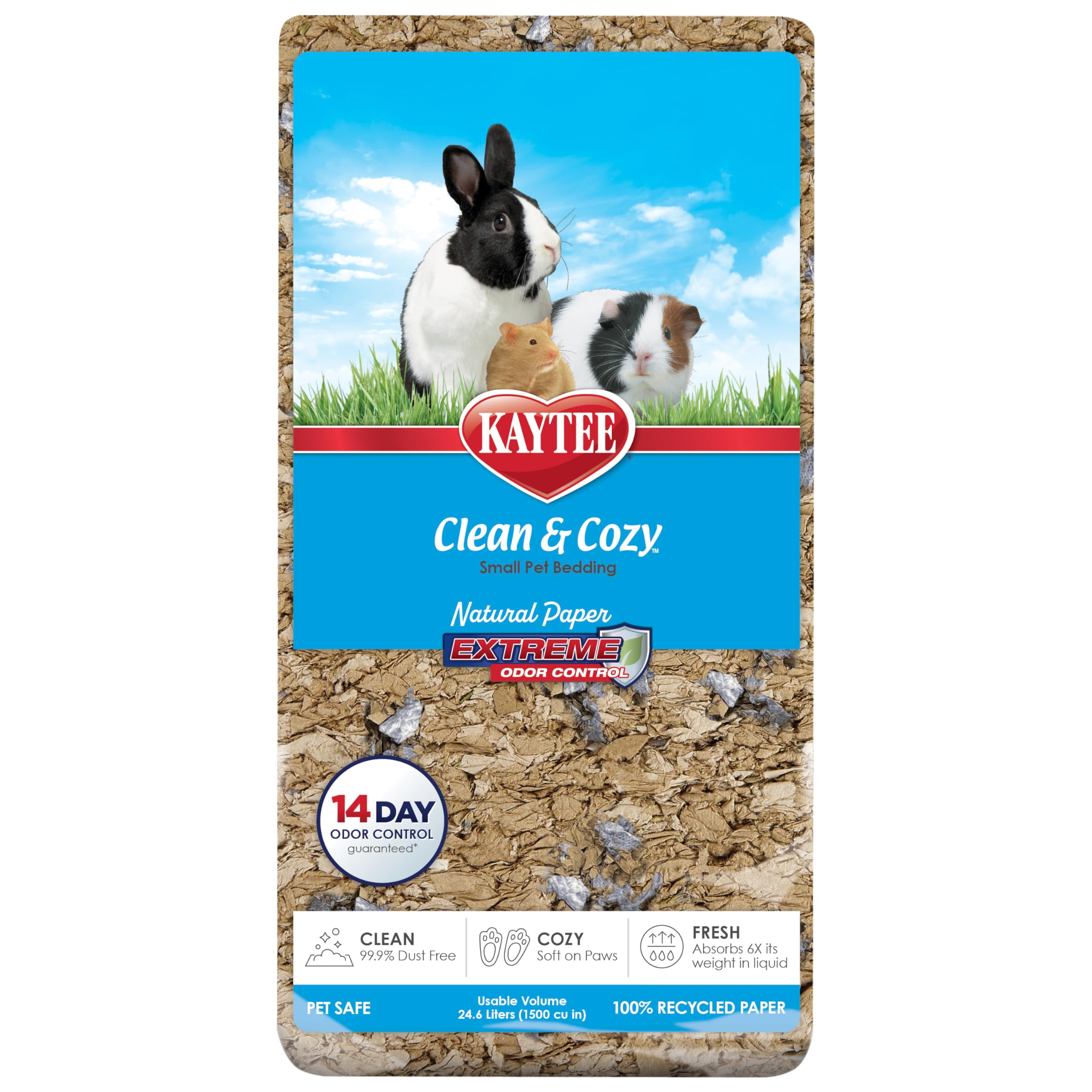
Where the white variant relies purely on absorption, the Natural Extreme Odor Control version adds an integrated ammonia-trapping technology that neutralizes urine smells before they hit your nose. Users with multiple rabbits or larger cage setups report the same bag lasting noticeably longer because the odor-lock holds even when the paper is damp.
The recycled paper base is fragrance-free and dyed a natural tan color that mimics an outdoor soil environment. Rabbits tend to be more active on this bedding compared to stark white, as the familiar earthy tone triggers less hesitation during exploration. The 99% dust-free rating holds consistent with the white version.
This fills the gap for owners who want paper fluff but need maximum odor suppression between weekly clean-outs. Because it’s the same Kaytee base material, it offers identical burrow-ability and hock cushioning, making it a straight upgrade for anyone who has ever walked into a room and smelled the cage from the doorway.
Why it’s great
- 14-day odor neutralization beats standard paper bedding
- Natural brown color calms nervous rabbits
- Fragrance-free — won’t irritate sensitive noses
Good to know
- Bulk density is slightly higher, requiring more product per fill
- Not recommended as a primary chew source
3. Eaton Pet and Pasture Hemp Bedding

Hemp bedding operates differently than paper. Instead of absorbing into a mushy mass, the hemp stalks wick moisture downward while staying dry on top, creating a surface that feels clean even several days after soiling. This is especially valuable for rabbits prone to urine scald or those housed in high-humidity environments.
Grown without pesticides or herbicides, the product emits a mild, earthy scent that fades quickly and doesn’t compete with the natural scent of the rabbit. The dust level is notably lower than kiln-dried pine shavings, which makes it a strong alternative for owners whose rabbits have confirmed respiratory sensitivity.
It’s the most sustainable option on the list — hemp grows densely without chemical inputs and the bedding is fully compostable after use. The tradeoff is that the 28L bag covers less area than an equivalent paper product, so it’s best suited for single-rabbit setups or owners who prioritize respiratory health over pure volume-per-dollar.
Why it’s great
- Nearly zero dust — ideal for rabbits with respiratory issues
- Wicks moisture down, keeping the top layer dry
- Grown pesticide-free, fully compostable
Good to know
- Absorbs less total liquid than paper per unit weight
- Bag size is relatively small for the price tier
4. Fresh News Recycled Paper Bedding

Fresh News takes a slightly different approach with smaller, more uniform paper particles that integrate with the cage floor rather than puffing up into a cloud. The Ammonia Locker technology is embedded in each particle, neutralizing urine odors on contact rather than just absorbing the liquid. Users consistently report this bedding eliminates smells better than generic paper litter.
The smaller particle size creates a denser floor surface that resists scattering, which is a major benefit for rabbits who like to kick bedding out of the cage. It’s also lighter than wood pellets, making full cage changes less of a back strain. The 40-liter bag is heavier than the Kaytee equivalent but compresses tighter, meaning more bedding mass per shipment.
Non-allergenic testing backs the claim, and the 99% dust-free rating stands up to inspection. A few users noted occasional plastic debris in the batch, though this appears to be an outlier rather than the norm. The material isn’t designed for burrowing the way expanded paper fluff is, so active diggers may prefer a deeper Kaytee layer instead.
Why it’s great
- Ammonia Lock technology outperforms basic paper beddings
- Small particles resist kicking and scattering
- Much lighter to haul than wood pellet options
Good to know
- Not as fluffy or burrow-friendly as expanded paper fluff
- Rare reports of debris in the mix
5. Yesland 12-Pack Woven Rabbit Mat

These woven grass mats are made from a blend of dried natural grasses rather than pure timothy hay, which gives them a tighter weave and slightly more durability. Rabbits treat them as a combination bed, chew toy, and foraging puzzle — they’ll lie on the mat, then shred it apart over the course of a few weeks. The 12-count pack provides enough mats to rotate fresh ones in as the current one gets destroyed.
Because the mats are fully edible, they function as a slow-release source of fiber alongside regular hay. This makes them especially useful for rabbits who tend to get bored with standard hay feeders. The weave holds up to moderate digging without disintegrating into a pile of loose hay strands immediately, which extends the mat’s life compared to cheaper single-layer grass pads.
The primary limitation is absorbency — these mats soak through quickly if used as the sole cage flooring over a solid surface. Owners solve this by laying them on top of paper bedding or inside a litter box, allowing the mat to serve as a dry resting surface while the paper below handles the moisture.
Why it’s great
- Bulk 12-pack offers excellent rotation value
- Edible grass provides dental wear and enrichment
- Tighter weave lasts longer than single-layer mats
Good to know
- Not absorbent enough as standalone cage bedding
- Rabbits can destroy one mat in under a week
6. Tierecare 3-Piece Plush Fleece Pad

These fleece pads are less a full-cage bedding solution and more a targeted comfort accessory. The double-sided plush fabric provides a warm, soft surface that rabbits gravitate toward during rest periods. The hidden seam construction prevents claws from snagging on stitching, a small detail that reduces the risk of torn nails or damaged fabric edges over repeated washing cycles.
Each pad measures roughly 13.8 by 10.6 inches, which fits neatly inside a litter box top, a sleeping hide, or the bottom of a travel carrier. Users report that the polyester filling resists wicking moisture upward if a rabbit pees on the surface, so the pad can often be used for several days before needing a wash. The machine-washable fabric survives delicate cycles with minimal pilling.
This isn’t a replacement for paper or hemp bedding — it’s designed to sit on top of the base layer as a cozy upgrade. For indoor free-roam rabbits who spend time on laps or couches, these pads create a familiar soft space that also catches occasional accidents without ruining furniture.
Why it’s great
- Hidden seams prevent claw accidents
- Warm, plush surface rabbits actively seek out
- Machine washing restores fluffiness reliably
Good to know
- Too small for full-cage coverage
- Heavy chewers may tear the fabric edge over time
7. PINVNBY 6-Pack Rabbit Grass Mat

PINVNBY’s mats are hand-woven from 100% natural straw with no glue or synthetic binders, making them fully digestible when rabbits inevitably shred and eat them. Each mat is roughly 11 by 8.3 inches with a thin 0.2-inch profile, designed specifically for nesting boxes or as a warm floor cover inside small pet carriers. The small size is intentional — it allows placement flexibility in corners or under hideouts.
Customers report that rabbits use these mats for multiple purposes: a sleeping pad to retain body heat, a chew target for dental wear, and a foraging surface to dig through. Because the weave is relatively loose, rabbits can pull individual straw strands out easily, which satisfies the same instinct as shredding cardboard or hay. The 6-pack ensures a continuous supply as each mat gets consumed.
The thin construction means these mats offer minimal impact absorption, so they work best over a thicker base layer of paper or hemp bedding. For owners looking to add a natural, edible surface element to the cage without spending on premium mats, this pack offers the lowest per-mat cost. Just note that the 8.3-inch width is narrower than a typical litter box bottom.
Why it’s great
- 100% natural straw — fully safe if eaten
- Multi-purpose: nesting, chewing, digging
- Lowest per-mat cost in the lineup
Good to know
- Very thin profile — limited shock absorption
- Dimensions too small for large breed rabbits
FAQ
How deep should I layer paper bedding in a rabbit cage?
Can I use straw mats as the only bedding in the cage?
Is hemp bedding better than recycled paper for a rabbit with allergies?
Final Thoughts: The Verdict
For most users, the best bedding for rabbit cage winner is the Kaytee Clean & Cozy White Paper Bedding because it delivers exceptional 6x absorbency, a 99.9% dust-free guarantee, and a fluffy texture that triggers natural burrowing instincts. If you want maximum odor neutralization between weekly changes, grab the Kaytee Natural Extreme Odor Control. And for a rabbit with respiratory sensitivity, nothing beats the zero-pesticide, near-zero-dust construction of the Eaton Hemp Bedding.