
Our readers keep the lights on and the weekend projects moving. As an Amazon Associate, I earn from qualifying purchases.
The difference between a good gaming session and a great one often comes down to the screen in front of you. Motion blur, screen tearing, and washed-out colors can kill immersion faster than a laggy connection, which is why choosing the right display is the single most important hardware decision a console or PC player can make.
I’m Rikta — the co-founder and writer behind FitlyFast. I’ve spent hundreds of hours analyzing panel technologies, refresh rate implementations, and input lag data to help gamers cut through the marketing noise and find a television that genuinely performs under the pressure of fast-paced gameplay.
Whether you prioritize deep OLED blacks, blistering refresh rates, or advanced VRR support, this guide breaks down the top contenders to help you find the best 4k tv for gaming that fits your setup and budget.
How To Choose The Best 4K TV For Gaming
Choosing a gaming TV isn’t about picking the most expensive model. It’s about matching the right set of gaming-focused features to your specific hardware and play style. Console players benefit from features like ALLM and HDMI 2.1 support for 4K/120Hz, while PC gamers might prioritize a native 144Hz panel and low input lag over Dolby Vision.
Panel Technology: OLED vs Mini-LED vs QLED
OLED panels offer per-pixel lighting, resulting in perfect blacks and infinite contrast, which makes HDR content in dark games like horror titles look spectacular. The downside is a risk of burn-in with static HUDs and lower peak brightness compared to Mini-LED. Mini-LED uses thousands of tiny backlights to get closer to OLED black levels while maintaining high brightness for well-lit rooms, but some blooming around bright objects on a dark background is inevitable. Standard QLED (without Mini-LED) offers good brightness and color volume but relies on edge or fewer local dimming zones, which means less precise contrast control.
Refresh Rate, VRR, and HDMI 2.1
A 120Hz native refresh rate is the baseline for smooth gaming on PlayStation 5 and Xbox Series X, providing fluid motion that transforms the feel of shooters and racing games. VRR (Variable Refresh Rate) syncs the TV’s refresh rate to the console’s frame output, eliminating screen tearing without the input lag penalty of traditional V-Sync. HDMI 2.1 ports are necessary to carry the full 4K/120Hz signal with HDR — look for four full-bandwidth HDMI 2.1 inputs if you own multiple consoles or a high-end PC.
Input Lag and Auto Low Latency Mode
Input lag is the delay between pressing a button and seeing the action on screen. A good gaming TV keeps this under 10ms in Game Mode. Auto Low Latency Mode (ALLM) automatically switches the TV into its lowest latency picture preset when it detects a gaming console, saving you from navigating menus every time you switch from a movie to a game.
Quick Comparison
On smaller screens, swipe sideways to see the full table.
| Model | Category | Best For | Key Spec | Amazon |
|---|---|---|---|---|
| LG OLED C4 42″ | OLED | Console & PC gaming | 144Hz / 0.1ms response | Amazon |
| Sony BRAVIA 5 65″ | Mini-LED | PS5 integration | XR Processor / 120Hz | Amazon |
| Hisense U7 55″ | Mini-LED | High frame rate budget | Native 165Hz refresh | Amazon |
| Samsung S90F 65″ | QD-OLED | Vibrant HDR gaming | 144Hz / NQ4 Gen3 AI | Amazon |
| TCL QM8K 65″ | Mini-LED | Bright room gaming | 288Hz VRR capability | Amazon |
| Samsung S85D 55″ | OLED | Cinema-like contrast | 120Hz Motion Xcelerator | Amazon |
| Roku Pro Series 55″ | Mini-LED / QLED | All-around streaming | 120Hz / FreeSync Premium Pro | Amazon |
| Amazon Fire TV Ember 55″ | Mini-LED | Smart home integration | 144Hz / FreeSync Premium Pro | Amazon |
| LG OLED C1 77″ | OLED | Large screen cinema | 120Hz / a9 Gen4 processor | Amazon |
| Sony BRAVIA XR8B 77″ | OLED | High-end PS5 gaming | XR OLED Motion | Amazon |
| Roku Plus Series 55″ | Mini-LED / QLED | Streaming & casual play | Mini-LED / Dolby Vision | Amazon |
In‑Depth Reviews
1. LG 42-Inch Class OLED evo C4 Series (2024)

The LG C4 sets the benchmark for gaming TVs in 2024. It combines a native 144Hz refresh rate with a blistering 0.1ms response time and full HDMI 2.1 bandwidth across all four inputs, making it the ultimate display for both PlayStation 5 and high-refresh-rate PC gaming. The a9 AI Processor Gen7 delivers exceptional upscaling and dynamic tone mapping that keeps HDR content consistently impressive regardless of the source.
Self-lit OLED pixels deliver infinite contrast with perfect blacks, creating an immersive experience in dark atmospheric games like Alan Wake 2 or horror titles where every shadow matters. The EVO panel technology boosts brightness significantly compared to earlier C-series models, making HDR highlights punchy enough to compete with mid-range Mini-LED sets. NVIDIA G-Sync and AMD FreeSync Premium Pro support ensure tear-free gameplay across all platforms.
WebOS 24 remains responsive, and the included Magic Remote makes navigation intuitive. The panel’s ability to handle 4K/144Hz input with near-instantaneous pixel response means even fast-paced esports titles look fluid without ghosting. It is also a strong choice for watching movies thanks to Dolby Vision and Filmmaker Mode support.
Why it’s great
- Self-lit OLED with infinite contrast for perfect black levels in dark scenes.
- Native 144Hz refresh rate with 0.1ms response time for blur-free motion.
- Four full-bandwidth HDMI 2.1 ports support multi-console setups.
Good to know
- Risk of burn-in with static HUD elements over long sessions, though mitigation features help.
- Peak brightness is lower than high-end Mini-LED sets, reducing impact in very bright rooms.
2. Sony BRAVIA 5 65 Inch Mini LED TV (K-65XR50)

The Sony BRAVIA 5 is engineered with PlayStation 5 owners in mind. Exclusive features like Auto HDR Tone Mapping and Auto Genre Picture Mode ensure that when you plug in a PS5, the TV automatically configures the best picture settings for gaming or streaming. The XR Processor with AI technology intelligently upscales lower-resolution content and adjusts contrast and color in real-time for an incredibly refined HDR presentation.
Thousands of Mini LEDs are controlled by the XR Backlight Master Drive, delivering high brightness with very good local dimming control that minimizes blooming around bright subtitles or HUD elements on a dark background. The 120Hz panel with XR Motion Clarity keeps fast camera pans in action games smooth without introducing the soap-opera effect. Dolby Vision, IMAX Enhanced, and DTS:X provide a cinematic audio-video experience for single-player blockbusters.
Google TV provides a clutter-free interface, and the inclusion of Apple AirPlay 2 makes screen mirroring seamless. The audio system supports Acoustic Multi-Audio, creating an immersive soundstage that tracks on-screen action well enough to reduce the immediate need for a soundbar in smaller rooms.
Why it’s great
- Deep integration with PS5 for automatic HDR and game mode switching.
- Excellent AI-powered upscaling that sharpens HD content to near-4K quality.
- High brightness with effective Mini-LED local dimming for HDR impact.
Good to know
- Only two of the four HDMI ports support full HDMI 2.1 bandwidth.
- Premium price positioning makes it a larger investment than comparable Mini-LED rivals.
3. Hisense 55″ U7 Mini-LED ULED (2026 New)
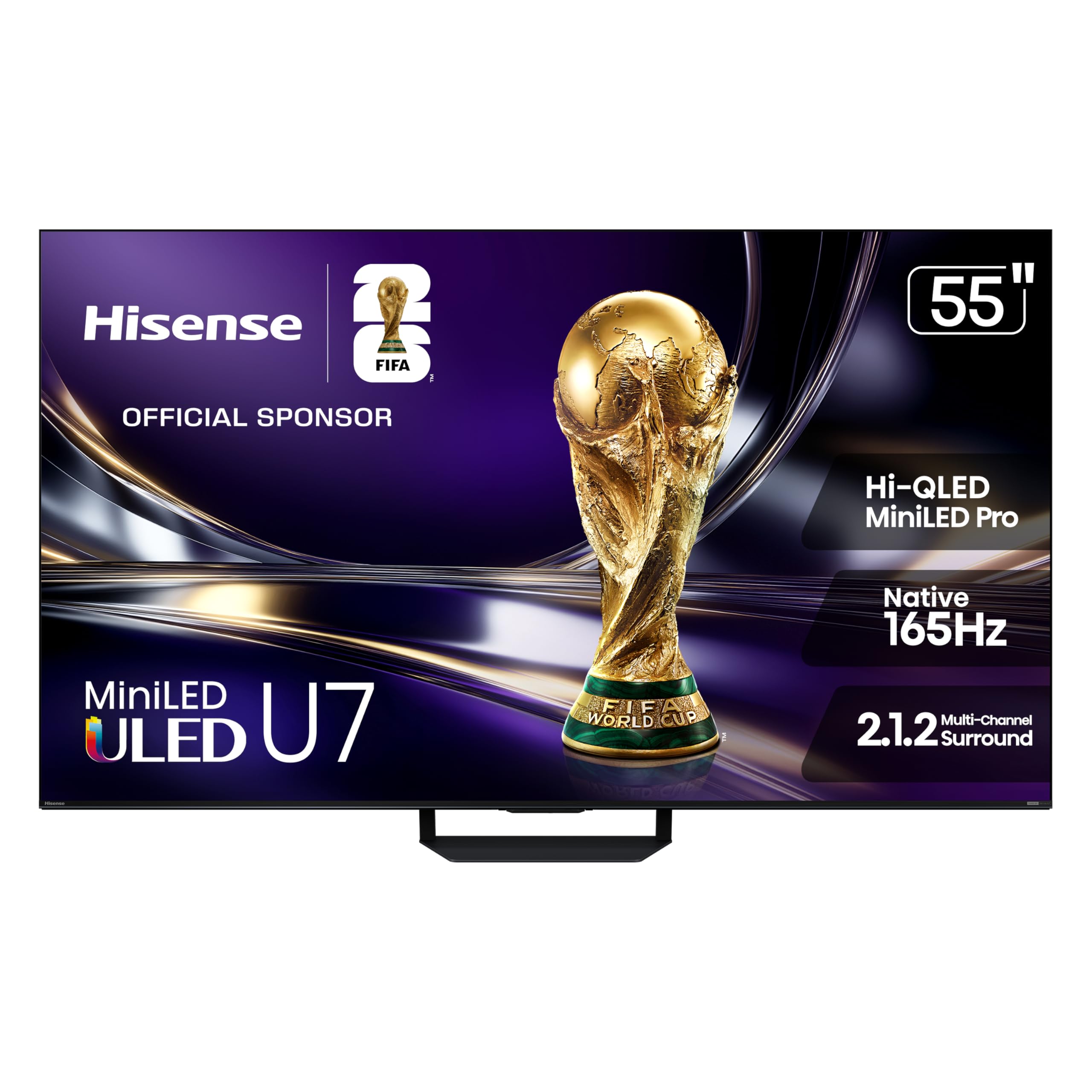
The Hisense U7 brings Desktop-class refresh rates to the living room with a native 165Hz panel that pushes beyond the standard 120Hz, giving PC gamers with capable graphics cards noticeably smoother motion in competitive shooters. The Mini-LED backlight system, combined with Hi-QLED technology, delivers vibrant colors with measured peak brightness that makes HDR content pop in well-lit environments.
One of the standout hardware features is the anti-reflection and glare-free coating on the screen. This dual-layer treatment significantly cuts down distracting reflections from windows and overhead lights, making it one of the best TVs for daytime gaming without closing the curtains. The Hi-View AI Engine Pro continuously analyzes incoming content and adjusts color, contrast, and sharpness dynamically, improving the look of both native 4K game assets and upscaled 1080p material.
Google TV offers a clean app layout and voice search functionality. The 2.1.2 channel audio system provides fuller sound than most built-in TV speakers, with dedicated up-firing drivers that add a degree of height presence to Dolby Atmos content. For gamers who want future-proofed frame rates without stepping into OLED pricing, the U7 delivers exceptional performance.
Why it’s great
- Native 165Hz refresh rate overshoots standard 120Hz for ultra-smooth PC gaming.
- Excellent anti-glare layer maintains image clarity in bright, sunlit rooms.
- High peak brightness and local dimming provide strong HDR performance for the price.
Good to know
- Sound clarity benefits from a dedicated external soundbar for full Dolby Atmos immersion.
- Viewing angles are narrower than OLED panels, with color shift noticeable off-center.
4. Samsung 65-Inch Class OLED S90F (2025 Model)

The Samsung S90F represents the next generation of OLED technology with its QD-OLED panel. Unlike traditional WRGB OLEDs, QD-OLED uses quantum dots to produce pure RGB light, resulting in a wider color volume that covers over 90% of the BT.2020 color space. This translates to more vivid, saturated colors in bright HDR scenes without washing out, giving games like Horizon Forbidden West an almost hyper-realistic vibrancy.
The NQ4 AI Gen3 processor, powered by 128 neural networks, analyzes scene content frame by frame to boost brightness in highlighted areas while maintaining deep blacks in shadows. Motion Xcelerator 144Hz supports up to 4K/144Hz VRR input, making it equally competent for both console and high-end PC gaming. The anti-glare coating is effective, but QD-OLED panels do show elevated black levels in direct ambient light, so darker room placement extracts the best performance.
Input lag is imperceptibly low, and the Game Bar interface provides easy access to refresh rate monitoring, screen ratio adjustments, and virtual aim point overlays. The minimalist remote with solar charging reduces battery waste, and Samsung’s Tizen OS offers smooth app navigation. For gamers who prioritize color accuracy and contrast above all else, the S90F is a top-tier choice.
Why it’s great
- QD-OLED panel delivers the widest color volume and vibrant HDR gaming.
- 144Hz VRR support with imperceptible input lag for competitive play.
- AI-powered upscaling and motion smoothing improve fast-action sports and esports.
Good to know
- Elevated black levels in bright rooms due to QD-OLED panel structure.
- Fragile screen coating requires careful cleaning to avoid micro-scratches.
5. TCL 65 Inch Class QM8K Mini LED QLED (2025 Model)
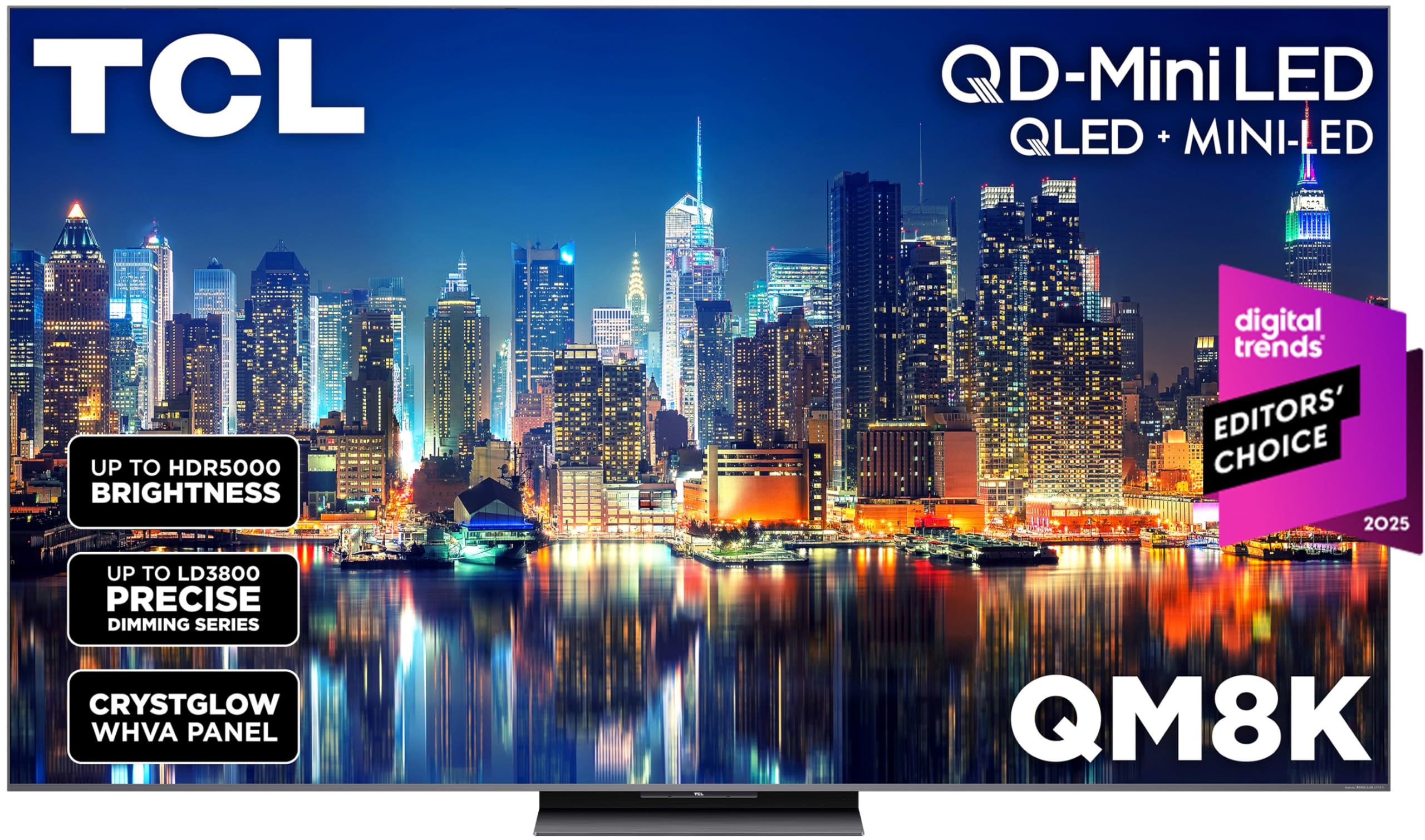
The TCL QM8K is built for gamers who refuse to compromise on brightness. The QD-Mini LED panel, paired with the TCL Halo Control System, delivers over 5000 nits of peak brightness, making it one of the few TVs that can genuinely reproduce HDR content the way mastering monitors intended. The advanced local dimming algorithm manages thousands of zones to minimize blooming around bright game HUDs on dark backgrounds.
The CrystGlow WHVA panel includes an anti-reflective layer that maintains contrast even when facing large windows, making this an excellent choice for living rooms with lots of natural light. The Game Accelerator 288 feature supports up to 288Hz VRR for compatible PC inputs, ensuring tear-free gameplay at extremely high frame rates. The Google TV interface is responsive, and the backlit premium voice remote adds convenience for navigating streaming services between gaming sessions.
The built-in audio system co-engineered with Bang & Olufsen delivers clear dialogue and surprising bass depth for integrated speakers, reducing the urgency of a soundbar purchase for many users. For gamers who value brightness, high refresh rate capability, and resistance to ambient light over the infinite contrast of OLED, the QM8K is a compelling value proposition.
Why it’s great
- Extremely high peak brightness (over 5000 nits) for impactful HDR highlights.
- 288Hz VRR capability supports ultra-high frame rate PC gaming.
- Excellent anti-reflective coating maintains image quality in bright rooms.
Good to know
- Local dimming is advanced but still exhibits some blooming in extreme contrast scenes.
- Viewing angles are narrower than OLED, with color washout at wide seating positions.
6. Samsung 55-Inch Class OLED S85D (2024 Model)

The Samsung S85D brings OLED technology into a more accessible package without sacrificing the core advantages of self-lit pixels. Pantone-validated color reproduction ensures that game environments are rendered with high accuracy, and the 120Hz Motion Xcelerator provides smooth motion for console gamers who play at 4K/120Hz. The Real Depth Enhancer algorithm improves perceived depth by increasing foreground contrast, making characters and objects seem more three-dimensional.
OLED HDR delivers impressive contrast with true blacks, making it particularly effective for story-driven single-player games where atmosphere is key. The Contour Design keeps the TV flush against the wall with an ultra-slim profile that fits into minimalist living spaces. Object Tracking Sound Lite uses virtual top-channel audio to create a sense of sound movement that follows on-screen action, improving immersion without needing a separate audio system.
The solar-powered remote eliminates battery waste, and Samsung’s Tizen OS provides access to major streaming apps. While it lacks the extreme brightness of Mini-LED competitors, the infinite contrast ratio of OLED means dark scenes in games like Diablo IV or Resident Evil look precisely as intended. It’s a strong choice for gamers who prioritize contrast ratio above raw brightness.
Why it’s great
- True OLED blacks deliver unmatched contrast for dark atmospheric games.
- 120Hz refresh rate with ALLM provides smooth, low-lag console gameplay.
- Pantone-validated color accuracy ensures natural-looking game graphics.
Good to know
- Peak brightness is moderate, making HDR less impactful in brightly lit rooms.
- No Dolby Vision support; relies on Samsung’s HDR10+ format.
7. Roku Smart TV – 55-Inch Pro Series QLED (2024 Model)
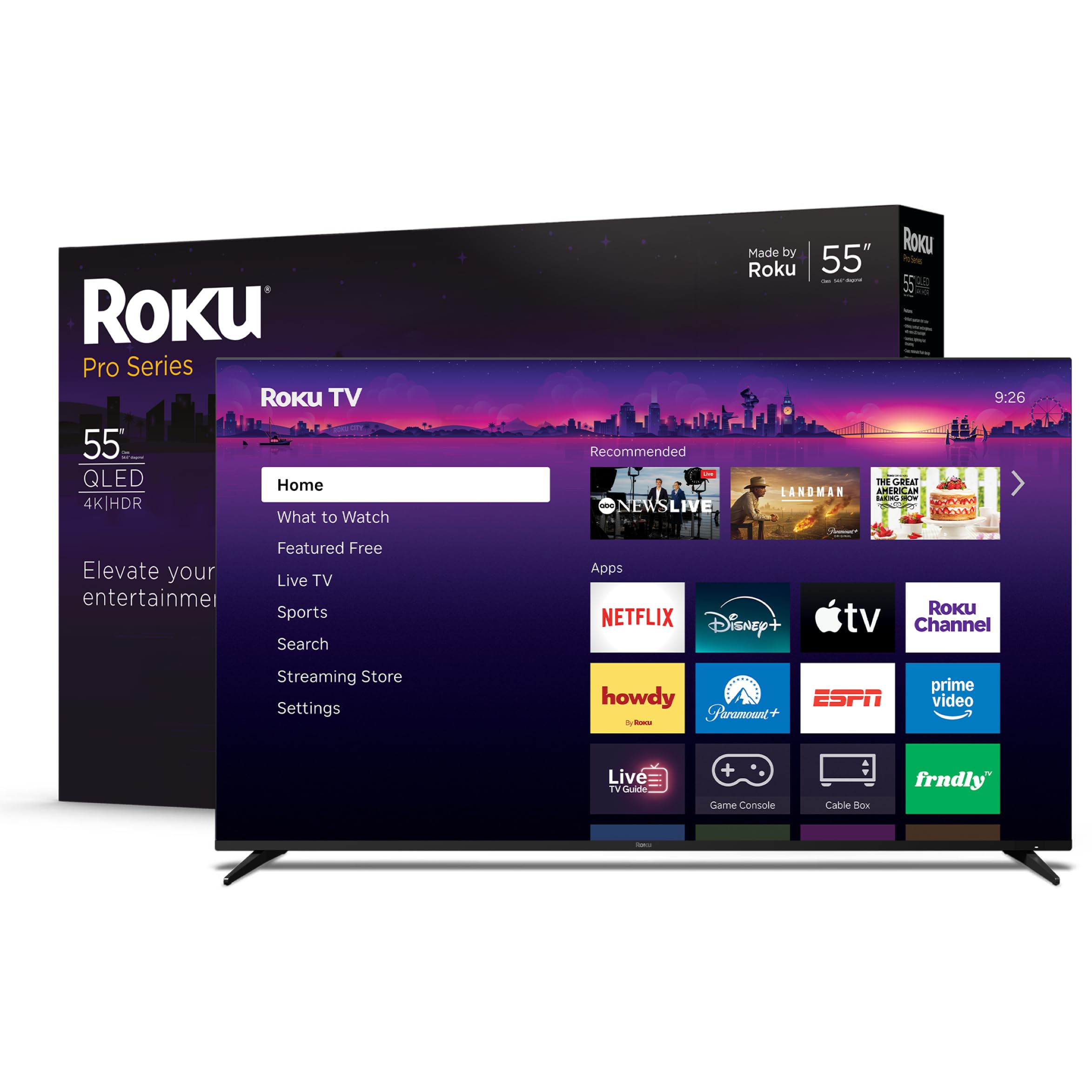
The Roku Pro Series TV targets the streaming-first buyer who still wants respectable gaming performance. The QLED panel with Dolby Vision IQ delivers accurate colors and bright highlights, while the Mini-LED backlight system with thousands of LEDs improves contrast significantly compared to edge-lit competitors. The 120Hz refresh rate, combined with AMD FreeSync Premium Pro and Auto Low Latency Mode, ensures tear-free gaming with low input lag for console players.
The Roku Smart Picture Max engine uses AI to clean up incoming TV signals and optimize color and sharpness dynamically, which benefits both streaming content and game visuals. Side-firing speakers and Dolby Atmos support create a wider soundstage than typical down-firing TV speakers, providing more immersive audio without external gear. The backlit Roku Voice Remote Pro is rechargeable and includes hands-free voice control for navigating apps with minimal friction.
The minimalist design with flush wall-mount compatibility makes it an attractive centerpiece. The Roku OS interface is widely considered the fastest and least cluttered smart TV platform, which translates to snappy app launches and less time navigating menus between gaming and streaming sessions. For gamers who spend equal time watching content and playing, the Pro Series strikes a balanced feature set.
Why it’s great
- Fast and intuitive Roku OS with minimal bloatware and frequent updates.
- 120Hz with FreeSync Premium Pro supports smooth, tear-free console gaming.
- Side-firing speakers with Dolby Atmos produce better soundstage than standard TV audio.
Good to know
- No HDMI 2.1 ports limits 4K/120Hz capability on some high-end consoles.
- Local dimming is less refined than premium Mini-LED competitors, showing some blooming.
8. Amazon Ember 55″ Mini-LED Series with Fire TV (Newest Model)
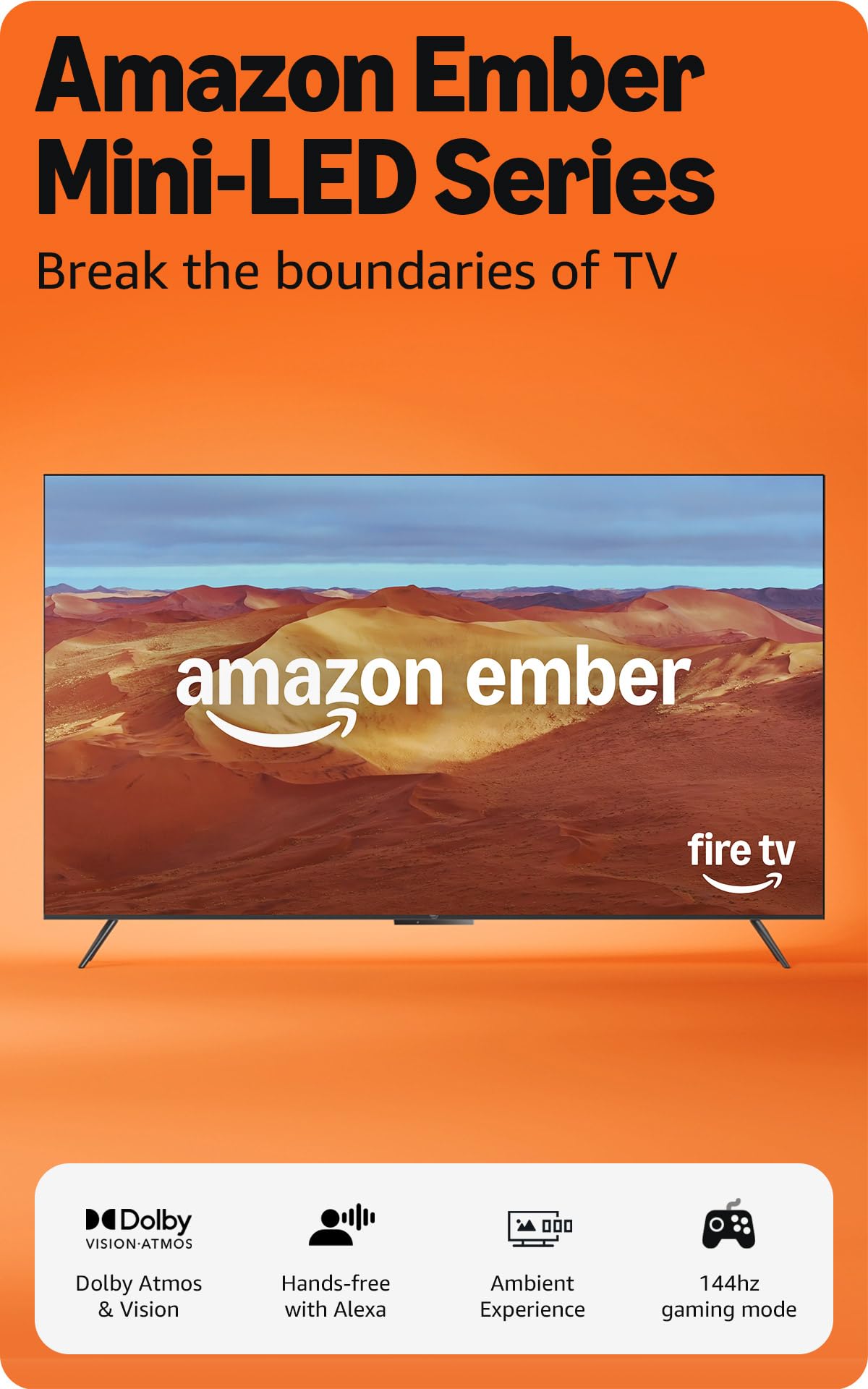
The Amazon Ember Mini-LED Series is designed for the connected home, integrating deeply with Alexa and the Fire TV ecosystem. The 4K QLED panel with Mini-LED backlighting delivers over a billion colors with Dolby Vision IQ support, which uses ambient light sensors to adjust HDR tone mapping based on room brightness. The 144Hz refresh rate and AMD FreeSync Premium Pro certification make it one of the most capable smart TVs for console gaming in the mid-range segment.
The 512 dimming zones provide noticeably better contrast than edge-lit sets, with deeper blacks and reduced blooming around bright objects. The Fire TV Intelligent Picture processor automatically fine-tunes HDR content scene by scene, maintaining consistent picture quality across different game titles. The 2.1 Dolby Atmos speaker system includes a built-in subwoofer, delivering richer bass than most integrated TV speakers for an engaging gaming audio experience.
The new Fire TV interface (2026 release) has been redesigned for faster navigation, and the hands-free Alexa functionality allows players to launch games, adjust volume, or control smart home devices without a remote. For Amazon ecosystem users who want a smart TV that doubles as a smart home hub, the Ember Series offers feature integration that standalone TVs cannot match.
Why it’s great
- Deep Alexa integration for hands-free gaming and smart home controls.
- 144Hz with FreeSync Premium Pro delivers fluid and tear-free gameplay.
- 512 dimming zones provide strong contrast and Mini-LED performance.
Good to know
- Fire TV interface includes Amazon ads and promotions that some users find intrusive.
- Software performance has been reported to slow down over time without add-on streaming devices.
9. LG OLED C1 Series 77” (2021 Model)

The LG C1 might be from 2021, but its 77-inch OLED panel remains one of the most impressive displays for cinematic gaming. The 120Hz refresh rate, combined with NVIDIA G-Sync and AMD FreeSync support, provides tear-free gameplay across console and PC platforms. The a9 Gen4 AI processor delivers excellent upscaling, cleaning up lower-resolution game assets to look sharp on the massive screen.
Self-lit pixels produce true black levels, and the large panel size creates an extremely immersive field of view for games that support wide FOV settings. The EVO panel variant in later production runs of the C1 provides slightly higher brightness than the original panel, though it still falls short of modern Mini-LED sets. Four HDMI 2.1 inputs allow simultaneous connection of PS5, Xbox Series X, and a gaming PC without needing to swap cables.
For gamers who prioritize immersion through sheer screen real estate, the 77-inch C1 delivers an experience smaller panels cannot replicate. The built-in WebOS interface includes Game Optimizer for quick access to display and sound settings, and the Magic Remote makes cursor-based menu navigation fast and precise.
Why it’s great
- 77-inch OLED panel provides the most immersive wall-to-wall gaming experience.
- G-Sync and FreeSync compatibility ensures smooth frame rates on any GPU or console.
- Four HDMI 2.1 ports eliminate the need for external switchers.
Good to know
- Peak brightness is moderate and best suited for dedicated media rooms with controlled lighting.
- WebOS interface includes promotional content on the home screen that cannot be fully removed.
10. Sony 77 Inch OLED TV BRAVIA XR8B (2025 Model)

The Sony BRAVIA XR8B represents the pinnacle of OLED gaming televisions for the PlayStation 5 ecosystem. Over 8 million self-lit pixels produce pure black levels with high brightness, while the XR Processor intelligently enhances every scene in real-time. The exclusive features for PS5 include Auto HDR Tone Mapping that allows the console to pass the TV’s metadata for optimized brightness and contrast without manual calibration, and Auto Genre Picture Mode that automatically switches between game and cinema presets.
XR OLED Motion eliminates blur in fast-moving sports and action games by analyzing motion patterns frame by frame, ensuring that camera pans remain clear without artifacts. Support for Dolby Vision, IMAX Enhanced, and DTS:X makes the XR8B equally competent for movie watching. The Acoustic Surface Audio+ technology uses the entire screen as a speaker to produce sound that matches the image position, creating a uniquely immersive audio experience that no traditional TV speaker array can emulate.
Google TV provides a smooth interface with hands-free Google Assistant, and the built-in Chromecast makes wireless streaming effortless. With its high price point, the XR8B is clearly aimed at the enthusiast who wants the best possible OLED performance combined with Sony’s processing prowess and PS5-first feature set.
Why it’s great
- Superior AI processing that produces accurate skin tones and natural HDR highlights.
- PS5 Auto HDR Tone Mapping eliminates manual calibration for optimal gaming HDR.
- Acoustic Surface Audio delivers positional sound that tracks with on-screen action.
Good to know
- OLED panels are susceptible to burn-in from static HUD elements in long sessions.
- Premium pricing puts it among the most expensive gaming TVs on the market.
11. Roku Smart TV – 55-Inch Plus Series Mini-LED
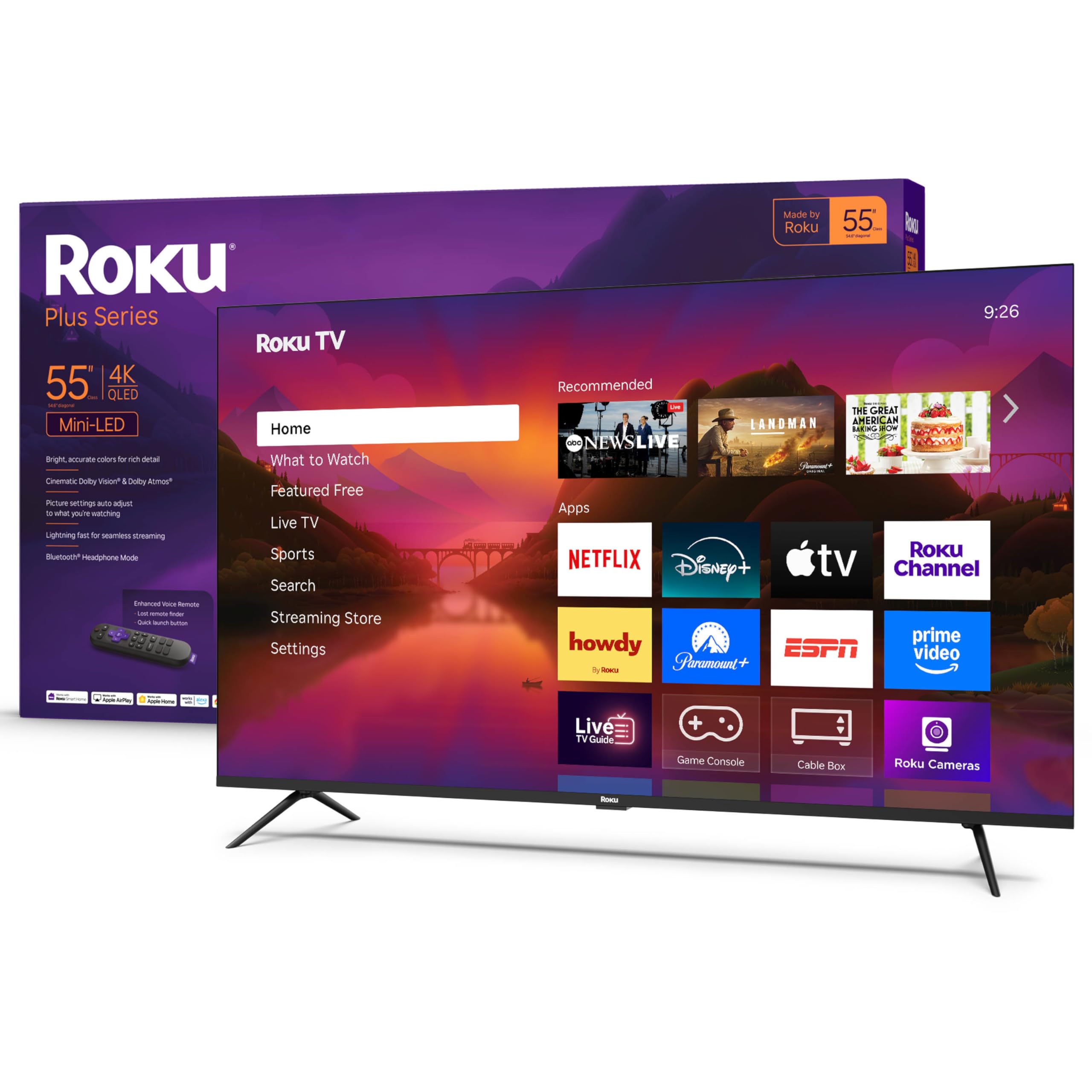
The Roku Plus Series brings Mini-LED backlighting and QLED color to a remarkably accessible price point, making it an excellent entry-level option for gamers migrating from a monitor or older 1080p television. The 4K resolution with Dolby Vision provides accurate HDR color reproduction, and the Mini-LEDs improve contrast noticeably over standard edge-lit TVs, revealing more detail in dark game scenes.
Dolby Atmos audio with a built-in subwoofer delivers fuller sound than expected at this tier, and Bluetooth headphone mode lets you game privately without disturbing others. The Game Mode reduces input lag for responsive gameplay, and while it lacks the 120Hz refresh rate and HDMI 2.1 bandwidth of higher-tier models, it accepts 60Hz console input reliably with minimal perceptible delay.
The Roku OS remains the gold standard for smart TV simplicity, with automatic updates and a huge free channel library through the Roku Channel. The included Enhanced Voice Remote includes a lost remote finder, a genuinely useful feature for households with deep couch cushions. The Plus Series is not for competitive esports players, but it is an outstanding value for casual and mid-core gamers who prioritize streaming library access and picture quality over maximum frame rate support.
Why it’s great
- Mini-LED backlighting provides solid contrast at one of the lowest entry prices.
- Dolby Vision and Dolby Atmos enhance both gaming and movie HDR content.
- Roku OS is the fastest, most content-focused smart TV platform available.
Good to know
- Limited to 60Hz refresh rate, which caps smoothness in fast-paced competitive games.
- No HDMI 2.1 ports, so it cannot display 4K/120Hz from current-gen consoles.
FAQ
Is 120Hz really necessary for console gaming?
Does Dolby Vision matter for gaming?
Can I use a 4K TV as a PC monitor for gaming?
Final Thoughts: The Verdict
For most users, the 4k tv for gaming winner is the LG OLED C4 42-Inch because it combines self-lit OLED contrast, a native 144Hz refresh rate, and four full-bandwidth HDMI 2.1 ports into a package that serves both console and PC gamers flawlessly. If you want deep PS5 integration and Sony’s best AI processing, grab the Sony BRAVIA 5. And for bright-room gaming with extreme refresh rates, nothing beats the TCL QM8K.