
Our readers keep the lights on and the weekend projects moving. As an Amazon Associate, I earn from qualifying purchases.
An aluminum repair that fails under a light twist or a harsh vibration isn’t a repair at all — it’s a lesson in wasted effort. Whether you’re fixing a boat hull, a cracked engine component, or a bicycle frame, the adhesive you choose must bridge the thermal expansion gap between aluminum and other materials without becoming brittle. That single requirement separates the true performers from the rest.
I’m Rikta — the co-founder and writer behind FitlyFast. This guide is the product of weeks of market research, spec analysis, and cross-referencing real-world performance data against technical datasheets to find the aluminum epoxy that actually delivers on its claims.
These seven candidates were selected for their focus on structural integrity, metal adhesion, and environmental resistance — everything you need to identify the best aluminum epoxy for your specific project.
How To Choose The Best Aluminum Epoxy
Choosing an aluminum epoxy isn’t a one-size-fits-all equation. The demands of a marine repair differ vastly from a home woodworking project that happens to involve an aluminum bracket. You need to match the epoxy’s physical properties to the specific stress, temperature, and exposure conditions of your job.
Shear Strength and Impact Resistance
The raw adhesion power, measured in PSI (pounds per square inch), tells you how much force the bond can withstand in a sideways pull. But for aluminum, which can flex and vibrate, a high shear strength must be paired with impact resistance. A rigid epoxy that cracks under shock is dangerous on a vehicle or a structural part. Look for formulations labeled “toughened” or “flexible” if the bond will experience movement.
Cure Time vs. Working Time
Fast-setting epoxies (5-10 minute working time) are tempting for quick fixes, but they leave zero margin for repositioning. Slow-curing formulas (up to an hour of working time) allow for precise alignment, which is critical for structural aluminum joints. Understand the difference between “set time” (when the bond holds itself) and “full cure time” (when it reaches maximum mechanical and thermal resistance).
Temperature and Environmental Resistance
Aluminum conducts heat efficiently, meaning an epoxy on an engine block or an outdoor railing must withstand thermal cycling without degrading. The service temperature range — from sub-zero to over 200 degrees Fahrenheit — is a hard spec to check. For marine or outdoor use, verify that the epoxy resists moisture, saltwater, and UV exposure, and that it can be applied to wet surfaces if needed.
Form Factor and Application Method
The physical form of the epoxy dictates how easily it goes on. Putty sticks are best for vertical or overhead repairs because they don’t sag. Liquid or gel two-part epoxies are ideal for bonding flat surfaces and filling small gaps. Paste-consistency formulas work well for filling deep cracks or rebuilding missing material. The right form factor reduces mess and improves bond integrity.
Quick Comparison
On smaller screens, swipe sideways to see the full table.
| Model | Category | Best For | Key Spec | Amazon |
|---|---|---|---|---|
| 3M Scotch-Weld DP420 | Liquid Epoxy | Structural metal-to-composite bonds | Shear strength 4000+ PSI | Amazon |
| Starbond 5-Minute Epoxy Pro | Clear Gel | Vibration-prone repairs | Shear strength 2600 PSI | Amazon |
| J-B Weld MarineWeld | Two-Part Gel | Underwater aluminum & fiberglass repairs | Cure time 15-24 hours | Amazon |
| J-B Weld SteelStik | Putty Stick | Quick, handheld repairs | Set time 5 minutes | Amazon |
| Mohawk Epoxy Putty Stick | Putty Stick | Furniture and wood repairs | Full cure 20 minutes | Amazon |
| Endhokn Epoxy Putty | Putty Stick | Underwater & multipurpose filling | 24-hour full cure | Amazon |
| PC Products PC-Masonry | Epoxy Paste | Concrete and masonry restoration | Service temp -20°F to +200°F | Amazon |
In‑Depth Reviews
1. 3M Scotch-Weld Epoxy Adhesive DP420

This is the professional-grade anchor for jobs where bond failure isn’t an option. The DP420 delivers exceptional shear and peel strength specifically engineered for metals, including aluminum, bonded to carbon fiber, composites, and other high-stress substrates. It’s a two-part structural epoxy that holds UL 94 HB certification, meaning it meets rigorous standards for flammability resistance — a detail that matters in automotive and industrial contexts.
The 20-minute working time is generous, allowing precise alignment of awkward parts before the bond locks. It reaches full cure in 24 hours at room temperature, and users report that warming the components to around 120 degrees Fahrenheit can accelerate that to about one hour without compromising strength. The black color is a practical feature on dark metals and composites, eliminating the need for a painted finish in hidden areas.
This is not a consumer-grade product — it’s labeled for industrial and occupational use, and it requires a separate dispensing gun and mixing nozzles. The price reflects its performance ceiling. For anyone bonding aluminum to carbon fiber, repairing aircraft-grade parts, or building custom metal structures, the DP420 is the benchmark that consumer epoxies cannot match.
Why it’s great
- Industry-leading shear and peel strength on metal
- 20-minute working window for precise positioning
- UL 94 HB certified for flame resistance
Good to know
- Requires a separate dispensing gun and nozzles
- Premium investment for a 50 mL Duo-Pak
2. Starbond 5 Minute Epoxy Pro Kit

The Starbond Pro Kit addresses the single biggest failure mode of fast-setting epoxies: brittleness. Its “flexible toughened” formula is engineered to absorb vibration and stress without cracking, which is exactly what an aluminum component needs when it’s mounted to a vehicle, a door frame, or any surface that experiences movement. The 2600 PSI shear strength is substantial enough for structural repairs, yet the cured bond retains a degree of give that standard epoxies lack.
The 1:1 mixing ratio by volume simplifies application, and the included screw-cap bottles, reusable mixing trays, and spatula make this a true “kit” rather than just a pair of syringes. It cures clear, which is helpful for visible repairs on wood or light-colored materials, and achieves handling strength in five minutes with full cure at 24 hours. Users consistently report that the flex prevents the crack propagation that ruins rigid epoxy bonds under cyclic stress.
One test on crown molding showed a butt joint failure on this epoxy while a competitor held, which suggests that its real strength lies in gap-filling and vibration absorption rather than pure lap-shear on precise joints. For general-purpose metal, plastic, and wood repairs where movement is expected, this is a smart choice.
Why it’s great
- Toughened formula resists vibration cracking
- Complete kit with mixing tools and bottles
- Cures clear for cosmetic repairs
Good to know
- Not the best for precision butt joints in wood
- 5-minute set requires quick work
3. J-B Weld 8272 MarineWeld

The MarineWeld is a specialized two-part gel designed to perform where moisture is a constant factor — on aluminum boat hulls, outboard motors, and underwater fittings. J-B Weld formulated this for bonding aluminum, metal, composites, and fiberglass, with the confidence that the cured bond retains its strength above or below the waterline. It sets in 4-6 hours and reaches full dark-grey cure at 15-24 hours, which is slower than consumer epoxies but typical for marine-grade systems that prioritize deep cross-linking.
Real-world use cases are revealing: one user repaired a broken aluminum e-bike kickstand, reporting that the hardened result functioned like a weld. Another sealed a hole in an outboard thermostat housing, and a kayak repair held up under prolonged water exposure. The ability to shape, tap, file, sand, and drill the cured material makes it a true cold-weld solution rather than just a glue.
The main trade-off is the extended cure window. If you need a same-day structural fix, this isn’t the one. But for any aluminum repair that will face water, salt, or humidity — and that needs to be machinable afterward — the MarineWeld is the correct tool.
Why it’s great
- Retains strength underwater after full cure
- Can be drilled, sanded, and tapped
- Specifically formulated for aluminum and marine composites
Good to know
- 15-24 hour cure requires patience
- Not ideal for quick, same-day repairs
4. J-B Weld 8267-S SteelStik

The SteelStik is the emergency-room champion of aluminum epoxy — a hand-mixable putty stick that sets in 5 minutes and cures fully in an hour. It’s steel-reinforced, meaning the cured material has a hardness and density that approaches the feel of actual metal, which is exactly what you want when you’re patching a hole in a tractor muffler or reattaching a car mirror mount. Users confirm that it held rock-hard in Florida sun and withstood heat and vibration from a four-hour drive on gravel roads.
The putty stick format is remarkably forgiving: you cut off what you need, knead the two parts together until uniform, and press it into place. It adheres to aluminum, steel, masonry, and many plastics, and can be shaped with a wet finger or tool before it sets. The high temperature resistance makes it suitable for exhaust and engine components where other epoxies would soften or burn.
The limitation is that it’s a putty, not a liquid glue. It’s not ideal for bonding large flat surfaces where a thin, even layer is needed. For filling holes, rebuilding broken tabs, and patching cracks in thick aluminum castings, it’s outstanding.
Why it’s great
- Sets in 5 minutes, cures in 1 hour
- Steel reinforcement for metal-like hardness
- High temperature resistance for engine repairs
Good to know
- Not for thin-layer bonding or gap-filling
- Fast set time leaves no room for repositioning
5. Mohawk Epoxy Putty Stick
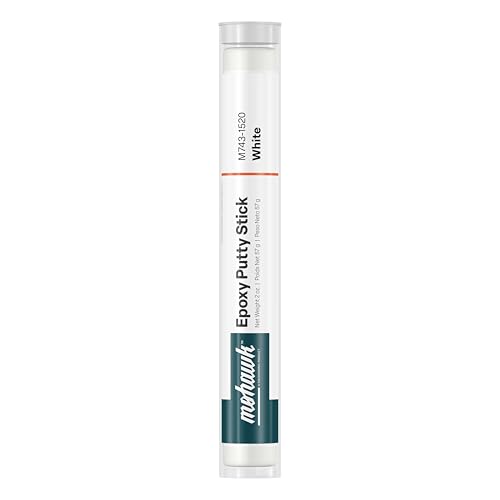
Mohawk’s epoxy putty is a specialist’s tool for wood repair, but its compatibility with aluminum, metal, and ceramic makes it a versatile addition to any workshop. The standout feature is its near-zero shrinkage after curing — the putty dries extremely hard and sands flush with the surrounding material, which is critical when filling knots, nail holes, or gaps in painted cabinetry. Users in the home improvement and furniture restoration trades keep this as an indispensable item.
It cures fully in just 20 minutes, which is remarkably fast for a putty that sands like real wood afterward. The white color can be painted or stained, though it may be slightly visible under light stain on a dark wood surface. The stick format is ready to use straight out of the tube; just knead the two parts together until uniform.
The trade-offs are the strong smell before curing and the premium price relative to the size of the stick. It’s a cost-effective tool only if you need its specific properties — no-shrink, fast-cure, sandable performance for fine furniture work. For general aluminum repairs, the SteelStik or MarineWeld are more appropriate.
Why it’s great
- Zero shrinkage after curing
- Full cure in 20 minutes
- Sands smoothly like wood
Good to know
- Small stick size relative to price
- Strong odor during application
6. Endhokn 10.5oz White Epoxy Putty

The Endhokn putty stick is the volume leader in this lineup — 10.5 ounces (300 grams) for a price that undercuts most competitors by a wide margin. It’s a genuine two-part epoxy putty that can be used underwater or above, making it suitable for pool repairs, pipe leaks, and general household fixes. The cured material can be drilled, polished, and painted after 24 hours, and it remains functional across a temperature range of -58°F to 266°F.
Users have filled two-inch holes for AC pipes and repaired broken ceramic figures with success, noting that the putty mixes easily and molds well. The kit includes two pairs of gloves and a scraper, which is a nice touch for a budget-tier product. The white color is unobtrusive for most repair scenarios.
The main caveat is that this is a commodity epoxy — it performs well for general repairs but doesn’t have the specialized metal-bonding enhancements of the J-B Weld products or the structural certification of the 3M. For the homeowner tackling a mix of aluminum, ceramic, and plastic repairs, it’s a strong entry-level option. For critical structural loads on aluminum, step up to a specialized formula.
Why it’s great
- Large 10.5 oz capacity for many repairs
- Works underwater for pool and pipe fixes
- Includes gloves and scraper
Good to know
- Not formulated specifically for high-stress metal bonds
- 24-hour cure requires planning
7. PC Products PC-Masonry Epoxy Paste

The PC-Masonry epoxy is the heavyweight for repairs involving aluminum anchored into or alongside concrete and masonry — think rebar bonding, stone steps, or concrete planters with structural aluminum inserts. It’s a two-part paste that does not sag, making it suitable for vertical and overhead applications. The service temperature range of -20°F to +200°F covers extreme outdoor conditions, and it can be applied to both wet and dry surfaces.
Users have used it to restore 45-year-old concrete planters by building up 1-inch layers over multiple days, and to reset fieldstone pavers and wrought-iron railings on concrete stairs where the bond is now stronger than the original concrete. The non-sag property means you can use it to rebuild missing corners on brick or concrete without the material dripping away.
This is a niche product — it is not designed for bonding aluminum to aluminum. Its purpose is to repair or embed metal elements in concrete and masonry. If your aluminum repair involves a concrete or brick substrate, this is the ideal choice. For standalone aluminum bonds, look at the MarineWeld or Scotch-Weld instead.
Why it’s great
- Non-sag paste for vertical and overhead work
- Service temperature range from -20°F to +200°F
- Bonds stronger than concrete itself
Good to know
- Formulated for masonry, not bare metal-to-metal bonding
- 15-minute working time is short for large projects
FAQ
Can I use a standard epoxy on aluminum, or do I need a specialized formula?
What surface preparation is needed before applying aluminum epoxy?
How long does aluminum epoxy need to cure before it can bear weight?
Can aluminum epoxy be painted after it cures?
Final Thoughts: The Verdict
For most users, the best aluminum epoxy winner is the Starbond 5 Minute Epoxy Pro Kit because its flexible toughened formula delivers the critical combination of high shear strength and vibration absorption that aluminum repairs require. If you need a marine-grade bond that can be drilled and tapped underwater, grab the J-B Weld MarineWeld. And for structural metal-to-composite or industrial-grade integrity, nothing beats the 3M Scotch-Weld DP420 with its dispensing system and UL certification.