
Our readers keep the lights on and the weekend projects moving. As an Amazon Associate, I earn from qualifying purchases.
Choosing the right audio interface feels like standing in the middle of a high-end electronics store with a wallet full of pocket change. Every spec sheet brags about pristine converters and vanishingly low noise floors, but the numbers blur together the moment you start comparing. The real task is finding a unit that delivers transparent preamps, reliable drivers, and enough connectivity to handle your mic and instrument setup without pushing your bank account to its breaking point.
I’m Rikta — the co-founder and writer behind FitlyFast. I’ve spent countless hours researching the budget-to-mid-range interface market, cross-referencing published specs, reading verified user reports, and analyzing the real-world trade-offs that separate a solid long-term purchase from a frustrating paperweight.
To help you make a confident decision, I’ve curated this lineup of the very best affordable audio interface options that balance clean preamp performance with essential features for home recording, podcasting, and live streaming.
How To Choose The Best Affordable Audio Interface
Every interface in this guide shares an entry-to-mid-range price bracket, yet they differ sharply in preamp quality, connectivity options, and driver reliability. Understanding a few core specs will help you pick the one that fits your recording or streaming setup without overspending.
Preamp Performance and Gain
Clean gain is the backbone of any interface. Look for models offering at least 55-60 dB of gain, especially if you plan to use dynamic microphones like the Shure SM7B or SM58. Low noise floor, measured in dBu EIN (Equivalent Input Noise), is equally critical—figures below -127 dBu are excellent and indicate quiet preamps that won’t hiss during quiet passages.
Phantom Power and Microphone Compatibility
If you own or plan to buy a condenser microphone, 48V phantom power is non-negotiable. Most modern interfaces include it, but check that the switch works per channel or globally. Some budget units omit phantom power on certain inputs, limiting your mic choices down the road.
Connectivity and Channel Count
Decide how many mics and instruments you need to record simultaneously. A 2-in/2-out interface works for solo podcasters and singer-songwriters recording one track at a time. If you host interviews or record live drums, you’ll need at least a 4-channel unit. Also check for Hi-Z instrument inputs if you plug in a guitar or bass directly, and look for MIDI I/O if you use hardware synthesizers or controllers.
Driver Stability and Latency
A great-sounding interface is useless with flaky drivers. Leading brands like MOTU, Rode, and Mackie have strong reputations for consistent Windows drivers and low-latency ASIO performance. Some budget models rely on generic drivers that drop out under load. Read recent user reviews focused on driver reliability before committing to an unfamiliar brand.
Build Quality and Portability
An interface is a long-term investment. Metal chassis units survive gig bags, studio bumps, and daily travel better than plastic shells. Compact models save desk space, but make sure the knobs and jacks are firmly mounted. Shure’s MVX2U series and the Rode AI-1 exemplify durable, portable builds that won’t fail on you mid-session.
Quick Comparison
On smaller screens, swipe sideways to see the full table.
| Model | Category | Best For | Key Spec | Amazon |
|---|---|---|---|---|
| MOTU M2 | Premium | High-fidelity home recording | 120 dB dynamic range | Amazon |
| Shure MVX2U Gen 2 | Premium | Portable XLR-to-USB workflows | 60 dB gain, 192 kHz max | Amazon |
| Shure MVX2U | Mid-Range | Streamers with XLR mics | 60 dB gain, Auto Level | Amazon |
| Rode AI-1 | Mid-Range | Dynamic mic podcasting | 24-bit / 96 kHz | Amazon |
| MAONO AME2 | Mid-Range | Live streaming and podcasting | 10 channels, 11 sound pads | Amazon |
| Mackie Onyx Producer 2-2 | Mid-Range | Rugged mobile recording | 24-bit / 192 kHz | Amazon |
| Pyle PMXU43BT | Budget | Live mixing with Bluetooth | 4 channel, 48V phantom | Amazon |
| Tenlamp Bundle G10-P15 | Budget | Beginner podcast plus mic | Voice changer, denoise | Amazon |
| Y.D.F AR001 | Budget | Trial-level USB interface | 24-bit / 96 kHz | Amazon |
In‑Depth Reviews
1. MOTU M2 2×2 USB-C Audio Interface with XLR-XLR Cable Bundle

The MOTU M2 punches far above its price tier thanks to the ESS Sabre32 Ultra DAC, the same converter technology found in premium interfaces costing four times as much. Measured dynamic range hits 120 dB on the outputs, and the mic preamps achieve -129 dBu EIN — figures that rival professional-grade units. The bundled XLR cable is a nice head start for new buyers.
Musicians and podcasters who switch between high-impedance studio headphones and condenser microphones will appreciate the clean, noise-free headphone output that drives 250-ohm cans without additional amplification. The full-color LCD display shows real-time levels for both inputs, which is rare at this level. Users consistently report stable ASIO drivers on Windows, a major advantage over budget competitors.
If you are looking for an affordable interface that genuinely sounds transparent and will grow with your setup as you upgrade microphones and monitors, the MOTU M2 is the benchmark in its class. The bundle saves a small step, but even standalone, the value proposition is unmatched.
Why it’s great
- ESS Sabre32 DAC delivers audiophile-grade output clarity
- -129 dBu EIN preamps are whisper-quiet
- Drives high-impedance headphones without extra gear
Good to know
- Requires a quality USB-C cable to avoid connection issues
- No included DAW software in some regions
2. Shure MVX2U Gen 2 XLR-to-USB-C Digital Audio Interface
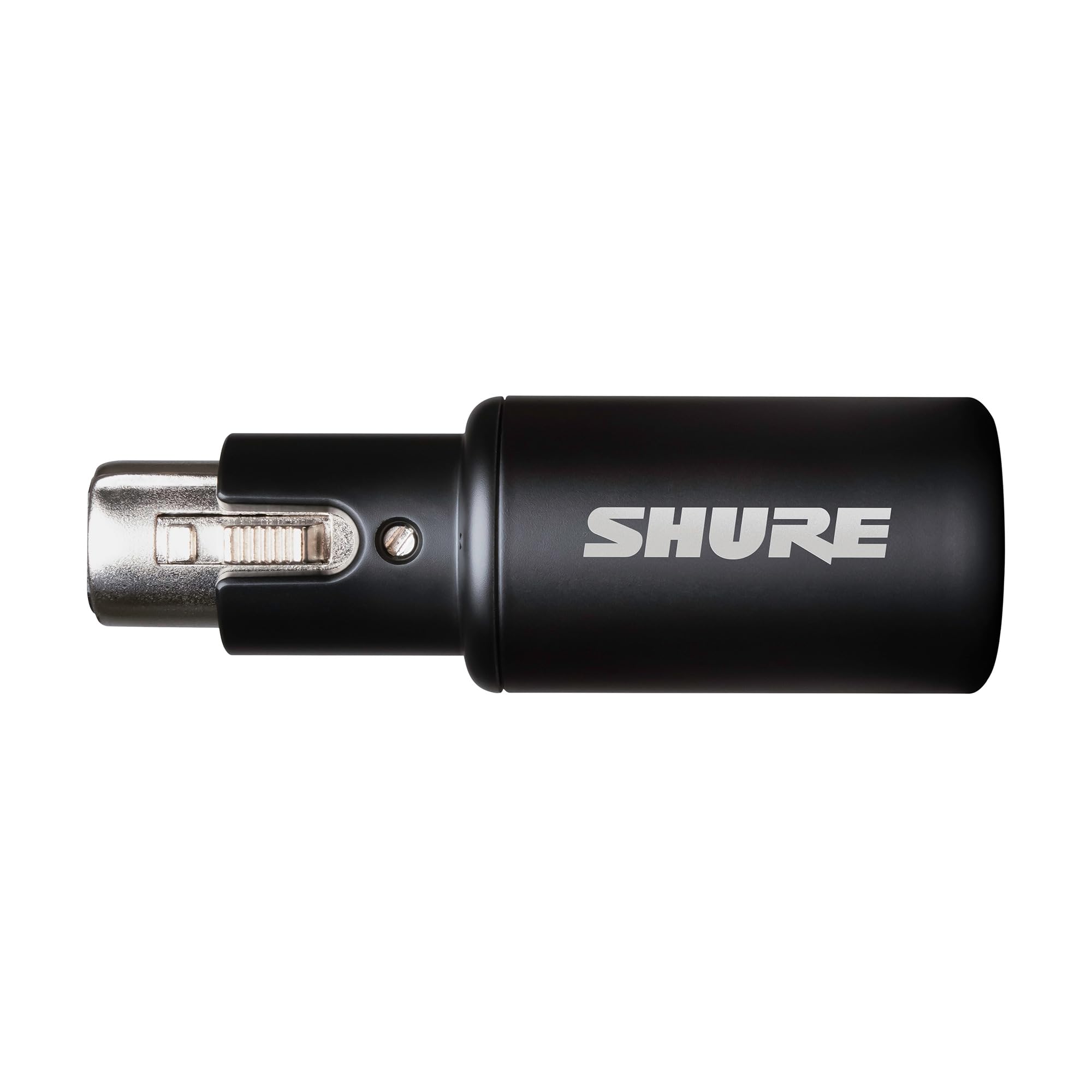
The Shure MVX2U Gen 2 is a purpose-built XLR-to-USB-C adapter that transforms any dynamic or condenser microphone into a plug-and-play streaming and recording tool. Apple MFi certification guarantees seamless compatibility with iPhones and iPads, and the 60 dB of clean gain means even a high-output mic like the SM7B does not require an inline booster. Onboard digital processing includes Auto Level Mode, Real-Time Denoiser, and Digital Popper Stopper — all operating at zero latency.
This unit is ideal for podcasters and streamers who move between desktops and mobile devices. The small form factor clips directly onto the mic or sits inline, and the MVX2U saves its settings when disconnected, so your custom EQ and compression profile persists between sessions. The MOTIV app offers granular control over tone, compression, and limiting without needing a DAW open.
The main limitation is its single XLR input — it handles one mic at a time, which is perfect for solo creators but not for multi-mic interviews. Also, the Gen 2 retains the same compact body as the original, so the headphone jack is on the unit itself, requiring a short extension cable for easy desk access.
Why it’s great
- 60 dB gain without extra inline preamp
- Zero-latency monitoring with onboard DSP
- Works natively with iOS via MFi certification
Good to know
- Single-input only — no simultaneous multi-mic recording
- Headphone jack placement requires cable management
3. Shure MVX2U XLR-to-USB Digital Audio Interface

The original Shure MVX2U brought professional-level XLR-to-USB conversion to a tiny form factor and remains a strong contender for streamers and solo podcasters who value simplicity. Its 60 dB of clean gain pairs with 48V phantom power, so you can plug in a condenser mic without needing a separate power supply. Auto Level Mode continuously adjusts gain to prevent clipping during dynamic performances, making it especially beginner-friendly.
Build quality is classic Shure — the metal housing feels substantial for its 100-gram weight, and the dual mounting options (inline or direct on-mic) add flexibility on crowded desks. The headphone jack delivers zero-latency monitoring, and the included USB-C cable connects directly to Mac or Windows without driver downloads. Reviewers consistently praise its plug-and-play reliability on both PC and macOS.
The MVX2U does cap sample rate at 48 kHz, which is fine for streaming and most spoken-word work, but a limitation if you plan to record high-resolution audio later. It also has a single-channel input, so multi-mic scenarios are off the table. For a dedicated XLR-to-USB bridge with proven driver stability, this is a top-tier choice.
Why it’s great
- 60 dB gain eliminates need for Cloudlifter
- Zero-latency monitoring with auto level control
- Compact, rugged build ideal for mobile setups
Good to know
- Maximum sample rate of 48 kHz
- Single XLR input only
4. Rode AI-1 USB Audio Interface

Rode built the AI-1 with the same philosophy behind its legendary microphones: rock-solid construction and no-compromise audio clarity. The single-preamp unit delivers 24-bit/96 kHz recording with exceptionally low noise, and the preamp gain is enough to drive dynamic mics like the SM57 cleanly without hiss buildup. The all-metal enclosure weighs just one pound yet feels like it could survive being dropped down a flight of stairs.
Podcasters and content creators who rely on a single dynamic mic will find the AI-1’s signal path refreshingly clean. The independent headphone output with volume control provides zero-latency direct monitoring, and the USB-C bus power means no wall wart needed for mobile recording sessions. Users on both Windows and macOS report a stable plug-and-play experience after applying Rode’s beta firmware update that resolved early reconnect issues.
The AI-1’s single-channel design limits future expansion to two-track recording. You cannot record two microphones simultaneously, and there is no MIDI I/O, ruling it out for hardware synth users. If your workflow is one-mic podcasting or solo instrument tracking, however, this might be the last interface you buy.
Why it’s great
- Low-noise preamp perfect for dynamic mics
- USB-C bus-powered and portable
- All-metal enclosure that endures daily travel
Good to know
- Single input — no simultaneous multi-mic recording
- No MIDI I/O for synth users
5. MAONO MaonoCaster AME2 10-Channel Podcast Mixer

The MAONO AME2 is less a traditional audio interface and more a complete live-streaming command center. It packs a 10-channel mixer with independent volume control for each input, 11 customizable sound pads (three recording up to 60 seconds, eight at 20 seconds), six reverb modes, 12-step auto-tune, and a built-in denoiser. The preamp delivers up to 60 dB of gain with 48V phantom power, supporting both XLR condenser and dynamic mics.
Streamers who bounce between YouTube, TikTok, and live platforms will appreciate the dedicated Live Output jacks that feed a separate mix to your streaming device while you monitor a different mix via headphones. Bluetooth input lets you stream music from a phone directly into the mix, and the AUX-in expands to a third audio source. The included TRRS cables make it easy to integrate with smartphones without adapters.
Long-term reliability is a concern — some users report USB-C port failure after several months, and the headphone monitoring mix can sound slightly different from the final stream output. It is also relatively heavy at just over two pounds. For all-in-one podcasting at a competitive price point, the AME2 offers unmatched feature density for beginners and intermediate creators.
Why it’s great
- 10-channel mixer with independent input control
- 11 custom sound pads for live effects
- Bluetooth input and dual live outputs for streaming
Good to know
- USB-C port reliability issues reported
- Headphone monitor mix can differ from stream output
6. Mackie Onyx Producer 2-2 USB Audio Interface

Mackie’s Onyx Producer 2-2 continues the brand’s “built-like-a-tank” legacy with a metal chassis that has survived years in backpacks and studio bags. The two boutique-quality Onyx mic preamps deliver 24-bit/192 kHz resolution with transparent gain, and the combo XLR/TRS inputs accept mic, line, and Hi-Z instrument sources. This makes it a flexible hub for singer-songwriters who record vocals and guitar simultaneously.
MIDI I/O is a standout feature in this price tier, allowing connectivity with external synthesizers, drum machines, and controllers without an extra USB adapter. Zero-latency direct monitoring is available for both inputs, and the dedicated monitor outputs are clean enough for critical listening. USB bus power keeps the setup cable-free, and users consistently praise the plug-and-play driver experience on Windows 10 and 11.
The headphone output is powerful but not optimized for high-impedance studio headphones, so users with 250-ohm cans may need an external amp. The Onyx Producer 2-2 is a durable, well-rounded interface that prioritizes reliable, clean preamps and MIDI connectivity over flashy extras.
Why it’s great
- Rugged metal build proven over years of field use
- MIDI I/O included for hardware synth integration
- Clean Onyx preamps with Hi-Z instrument input
Good to know
- Headphone output not ideal for 250-ohm cans
- Requires direct USB port on computer, not a hub
7. Pyle Professional Audio Mixer PMXU43BT

The Pyle PMXU43BT blurs the line between audio interface and compact live mixer, offering Bluetooth wireless streaming, four input channels, and a 16-bit DSP effects processor in a rugged steel chassis. Each mic channel features a three-band EQ, and the +48V phantom power switch works globally across the XLR inputs. This is a true mixing board — not just a recording interface — designed for small venue gigs, karaoke, and seminar setups.
Users with electric drum sets or those who need to blend a microphone with music from a phone or laptop appreciate the Bluetooth input and USB/MP3 compatibility. The main fader controls overall volume, and the headphone output allows private monitoring. Experienced sound engineers note that the stereo image is not true stereo on channels 1-2 (no pan pot), but for spoken word and mono sources, that limitation is harmless.
The PMXU43BT is not ideal for high-fidelity home recording — the 16-bit DSP and USB recording output are limited for serious studio work. It also draws substantial current, so the included power supply is necessary (no USB bus power). For a budget-friendly mixer that doubles as a recording interface, the Pyle offers impressive versatility for live and practice applications.
Why it’s great
- Bluetooth audio streaming for wireless music input
- Four input channels with three-band EQ per channel
- Rugged steel chassis with sealed rotary controls
Good to know
- Not true stereo on channels 1-2
- Requires external power adapter, not bus-powered
8. Tenlamp Podcast Microphone Bundle G10-P15
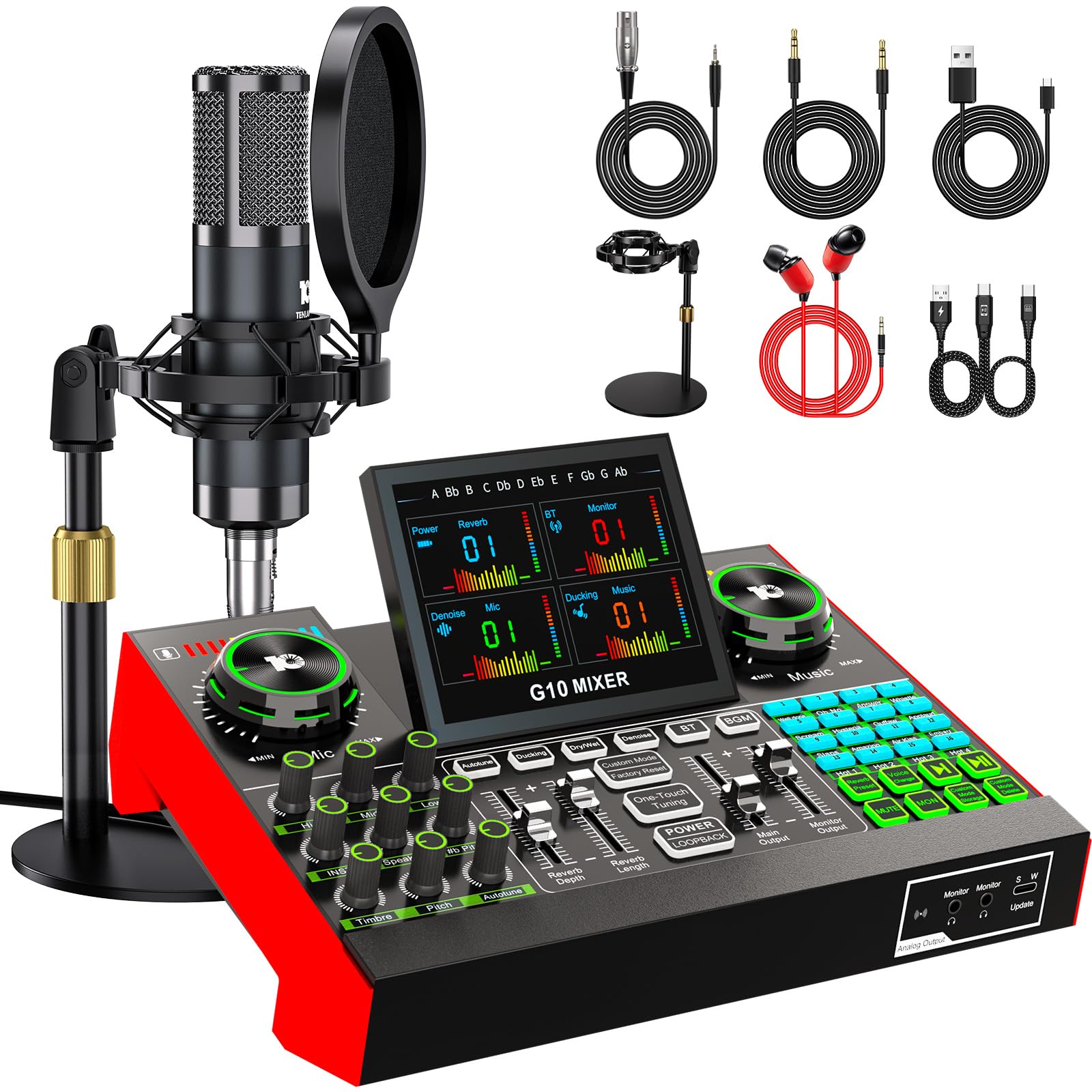
Tenlamp’s bundle includes a compact audio mixer and a 3.5mm condenser microphone, creating a complete plug-and-play podcast kit for absolute beginners. The mixer offers bass, treble, reverb, and pitch adjustment knobs, plus a built-in voice changer with effects like applause and laughter. The follow-singing mode lets the performer hear the original vocal track privately while the audience hears only the cleaned mix.
This setup is clearly aimed at TikTok, Instagram Live, and casual streaming where creative effects outweigh studio transparency. The voice changer and denoiser work well enough for social media vocals, and the bundle comes with all necessary cables for immediate use with PC, phone, or tablet. Reviewers consistently highlight the “fun factor” and easy setup for non-technical users.
The 3.5mm condenser mic included in the bundle is entry-level and noticeable for background noise compared to dedicated XLR alternatives. The mixer is more of a sound card than a professional mixer, lacking XLR inputs, so upgrading microphones later requires a separate interface. For the price of a complete system, it provides a low-risk entry point into live streaming and vocal performance.
Why it’s great
- Complete bundle includes mixer, mic, and cables
- Voice changer and sound effects for engaging streams
- Follow-singing mode for live performances
Good to know
- 3.5mm condenser mic has limited sound quality
- No XLR inputs for future microphone upgrades
9. Y.D.F AR001 USB Audio Interface

It offers 24-bit/96 kHz recording, a built-in mic preamp with 48V phantom power, and stereo 1/4-inch line inputs. The form factor prioritizes portability above all else, making it attractive for musicians who need a backup interface for travel or a super-budget entry into home recording.
Initial sound quality impressions from first-time buyers are surprisingly positive, with several comparing the preamp clarity to higher-priced brands. The interface is compatible with popular DAWs like Ableton Live, Pro Tools, and Cubase (though no software is included). The stereo 1/4-inch inputs can accept two line-level sources or one stereo instrument pair, expanding beyond typical single-mic workflows.
Reliability reports are mixed — a significant number of users report units that failed after a few months, with symptoms including static noise, playback toggle failure, and sudden full-volume feedback. The drivers appear to be generic USB audio class drivers rather than optimized ASIO drivers, leading to higher latency and occasional dropouts on Windows. The AR001 is a gamble on durability, but for a budget-conscious first purchase where low cost outweighs long-term reliability, it may suffice.
Why it’s great
- Extremely portable and lightweight design
- Surprisingly clean preamp for the price tier
- 48V phantom power for condenser microphones
Good to know
- Inconsistent build quality and reliability reports
- No included DAW recording software
FAQ
Do I need a 192 kHz sample rate for podcasting?
Can I use a USB microphone with these audio interfaces?
Why does my interface produce crackling noises during recording?
Final Thoughts: The Verdict
For most users, the affordable audio interface winner is the MOTU M2 because it marries ESS Sabre32 converter quality with ultra-low noise preamps and robust driver support — a combination that rivals units several times its price. If you need a portable, zero-fuss XLR-to-USB solution for streaming, grab the Shure MVX2U Gen 2. And for live-streaming creators who want sound pads, Bluetooth, and multi-device output in one box, nothing beats the MAONO AME2.