
Our readers keep the lights on and the weekend projects moving. As an Amazon Associate, I earn from qualifying purchases.
A 1GB internet plan is wasted the moment your router chokes on its own traffic. You pay for gigabit throughput, but most budget boxes deliver 300-500 Mbps over Wi-Fi and buffer the instant five devices connect. The gap between your modem’s potential and your actual experience is almost always the router sitting in the corner.
I’m Rikta — the co-founder and writer behind FitlyFast. I’ve spent hundreds of hours analyzing router hardware specifications, real-world throughput benchmarks, and latency patterns so you can separate marketing speed claims from actual gigabit performance at home.
Whether you’re upgrading an older Wi-Fi 5 setup or building a new wired home network, this guide identifies the components that matter — CPU throughput, Wi-Fi generation, and port configuration — so you can confidently choose the 1gb router that actually delivers on your internet service plan.
How To Choose The Best 1GB Router
The gap between a gigabit plan and actual Wi-Fi speed is almost never the modem — it’s the router’s CPU, port configuration, and Wi-Fi chipset. Three factors separate a box that delivers 950 Mbps from one that tops out at 400.
CPU Throughput vs. Rated Wi-Fi Speed
Manufacturers advertise theoretical Wi-Fi speeds (AX5400, BE9700) that are impossible to reach in real homes. What matters is the router’s CPU clock and core count — a quad-core 1.8 GHz processor can route gigabit traffic without bottlenecking, while a dual-core 800 MHz chip will drop packets under load regardless of the Wi-Fi label on the box.
WAN Port Speed Is the Gatekeeper
A router with gigabit LAN ports but only a 1Gbps WAN port cannot exceed 940 Mbps in real throughput due to Ethernet overhead. For a true 1GB connection, look for a 2.5Gbps or higher multi-gig WAN port — this headroom prevents the port itself from capping your speed during peak usage hours.
Wi-Fi Generation and Device Compatibility
Wi-Fi 6 (802.11ax) is sufficient to saturate a 1GB connection when paired with a compatible client device. Wi-Fi 7 offers headroom for future multi-gig plans but does not improve 1GB speeds today on its own. Older Wi-Fi 5 (802.11ac) routers rarely exceed 500 Mbps in real-world conditions — upgrading the generation directly unlocks the capacity you already pay for.
Quick Comparison
On smaller screens, swipe sideways to see the full table.
| Model | Category | Best For | Key Spec | Amazon |
|---|---|---|---|---|
| TP-Link Archer BE600 | Wi-Fi 7 | Future-proofing with multi-gig WAN | 10 Gbps WAN/LAN port | Amazon |
| GL.iNet Flint 3 | Wi-Fi 7 VPN | VPN performance and ad blocking | Wireguard up to 680 Mbps | Amazon |
| ASUS RT-BE88U | Wi-Fi 7 | Wired port density (2x 10G + 2.5G) | 34G total WAN/LAN capacity | Amazon |
| NETGEAR RS700S | Wi-Fi 7 | Maximum coverage (3,500 sq. ft.) | 19 Gbps tri-band throughput | Amazon |
| TP-Link ER707-M2 | Multi-Gig VPN | Business-grade wired routing | 500,000 concurrent sessions | Amazon |
| Davolink Bob | Wi-Fi 6 Mesh | Compact mesh for 100+ devices | 1.77 Gbps dual-band speed | Amazon |
| Netgear RAX50 | Wi-Fi 6 Renewed | Budget-friendly Wi-Fi 6 upgrade | 2,500 sq. ft. coverage | Amazon |
In‑Depth Reviews
1. TP-Link Archer BE600

The Archer BE600 packs a 10 Gbps WAN/LAN port and three 2.5 Gbps LAN ports into a tri-band Wi-Fi 7 chassis rated at BE9700 speeds. For a 1GB plan, the multi-gig WAN port eliminates the 940 Mbps Ethernet bottleneck, giving you full saturating throughput from your fiber modem without needing a separate switch. Six internal antennas and Beamforming cover up to 2,600 square feet across 120 simultaneous devices.
Real-world testing shows a 2x-3x speed boost over Wi-Fi 5 routers, even when older Wi-Fi 6 clients connect to the same SSID. The 320 MHz channel width on the 6 GHz band delivers the lowest latency for gaming and 4K streaming. Setup is handled through the Tether app or web interface — both take under ten minutes for a basic configuration.
The HomeShield security suite provides real-time IoT protection and parental controls without a subscription wall. The main trade-off is the web interface, which dedicates excessive space to large icons and a non-dismissable Tether ad, reducing the usable configuration area compared to prosumer alternatives.
Why it’s great
- True 10 Gbps WAN/LAN port saturates 1GB fiber without overhead
- Tri-band Wi-Fi 7 with 320 MHz channels reduces congestion
- Beamforming covers 2,600 sq. ft. with strong signal penetration
Good to know
- Web UI includes a non-dismissable Tether ad banner
- MLO feature may cause rebooting issues on early firmware
- No 6 GHz dedicated backhaul for mesh expansion
2. GL.iNet Flint 3 (GL-BE9300)

The Flint 3 is the only router at this tier that delivers Wireguard VPN speeds up to 680 Mbps — enough to saturate a 1GB plan even with full VPN encryption active. Its DDR4 1GB RAM and eMMC 8GB storage run a custom OpenWrt-based operating system that supports AdGuard Home for DNS-level ad blocking directly on the router, removing the need for browser extensions on every device.
All five Ethernet ports are 2.5 Gbps, making the Flint 3 a true multi-gig wired backbone for homes with NAS systems or gaming PCs. MLO technology on the tri-band Wi-Fi 7 radio aggregates bands for stronger connections, particularly useful when moving through the home during video calls. Range tests show solid coverage through wood and drywall up to 2,000 square feet.
Configuration is done entirely through the browser-based admin panel — no app required. Built-in Bark parental controls let you filter websites and set usage limits without installing software on children’s devices. The main limitation is USB 3 NAS performance, which drops to around 30 MB/s, and the Wi-Fi range is noticeably tighter than the ASUS or NETGEAR options above.
Why it’s great
- Wireguard VPN at 680 Mbps — no bottleneck for encrypted 1GB traffic
- AdGuard Home built-in eliminates ads at the network level
- All five ports are 2.5 Gbps for full multi-gig wired routing
Good to know
- Wi-Fi range is noticeably shorter than premium competitors
- USB 3 NAS performance limited to ~30 MB/s
- No app — browser-only setup may feel dated to some users
3. ASUS RT-BE88U

The RT-BE88U is built for wired network density: dual 10G ports (one SFP+, one RJ-45) plus four 2.5G LAN ports and four standard gigabit LAN ports — totaling 34 Gbps of WAN/LAN capacity. For a 1GB plan, the 10G SFP+ WAN port provides massive headroom, and the eight LAN ports let you wire up a gaming console, NAS, and two PCs without an external switch.
Its quad-core 2.6 GHz 64-bit CPU handles AiProtection Pro (powered by Trend Micro), site-to-site VPN, and up to five guest SSIDs simultaneously without frame drops. AiMesh compatibility means you can wirelessly extend coverage with other ASUS routers later. The 2.4 GHz and 5 GHz signals show excellent penetration through brick walls in homes up to 3,000 square feet.
Pre-installed AdGuard Home and changeable admin credentials (no forced default) are welcome security touches. A known firmware issue causes a red-light internet drop at midnight during automatic update checks, though manual firmware updates have resolved this for most users. The router lacks a dedicated 6 GHz band — it operates as dual-band with 5 GHz prioritized, which is fine for 1GB users today but limits Wi-Fi 7 bandwidth aggregation.
Why it’s great
- Dual 10G ports (SFP+ and RJ-45) with 34G total capacity
- 8 LAN ports — no switch needed for wired home networks
- AiProtection Pro with no subscription fees
Good to know
- No dedicated 6 GHz band — dual-band only on Wi-Fi 7
- Midnight firmware check may cause temporary internet drop
- Large footprint — requires shelf space
4. NETGEAR Nighthawk RS700S

The RS700S delivers the widest single-unit coverage in this list — up to 3,500 square feet of 360-degree Wi-Fi 7 signal, enough to cover a three-story home or reach into a detached garage without a mesh satellite. Its BE19000 tri-band rating is the highest on paper, and real-world tests confirm full 1Gbps throughput on the 6 GHz band at close range.
A 10 Gig internet port serves as the WAN connection, and four gigabit LAN ports handle wired devices. The antenna design leverages NETGEAR’s engineering to focus 5 GHz signal through brick and concrete better than the TP-Link and ASUS alternatives — the 5 GHz band penetrates walls without requiring line of sight. The app-based setup works in 60-90 minutes, and the monitoring dashboard provides detailed traffic graphs.
The unit’s main drawback is firmware maturity: the 6 GHz band has shown intermittent dropouts on firmware version 1.0.7.86, and Smart Connect can cause connectivity issues with Apple devices unless disabled. The subscription for Netgear Armor (-/year) adds unnecessary cost, though the hardware itself is not subscription-locked for basic routing functions.
Why it’s great
- Unrivaled 3,500 sq. ft. coverage — penetrates brick and concrete
- 10 Gig WAN port for full 1GB throughput
- 5 GHz band maintains strong signal through multiple walls
Good to know
- 6 GHz band may have intermittent dropouts on certain firmware
- Smart Connect causes Apple device issues unless disabled
- Netgear Armor subscription required for advanced security
5. TP-Link ER707-M2
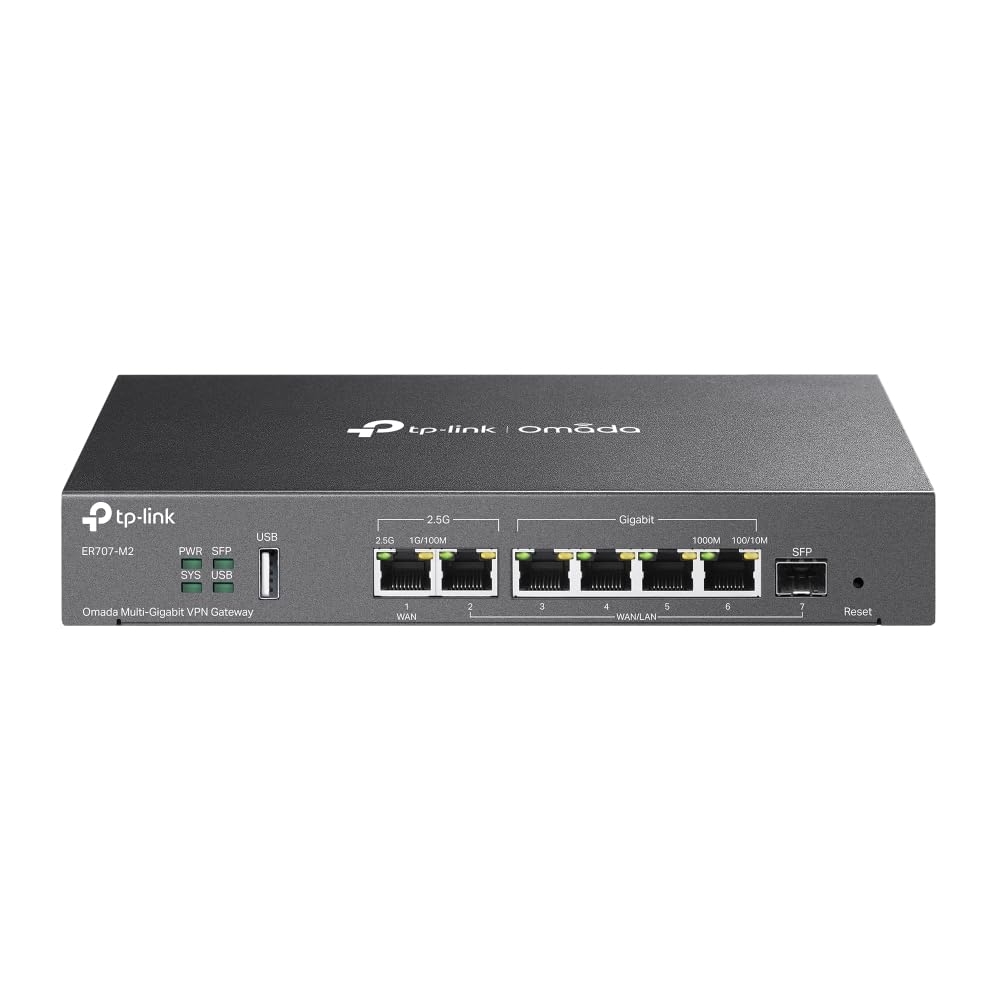
The ER707-M2 is not a Wi-Fi router — it is a wired VPN gateway with dual 2.5 Gbps WAN ports and a gigabit SFP port designed for business networks that prioritize stability over wireless. Its 500,000 concurrent session capacity handles over 1,000 clients, making it the right choice for small offices, co-working spaces, or advanced home labs where Wi-Fi is handled by separate access points.
The dual-WAN configuration supports ISP failover with a sub-15 second switch time — the end user never notices the internet drop. It supports up to 100 LAN-to-LAN IPsec VPN tunnels, 66 OpenVPN, and 60 L2TP connections simultaneously, which covers remote worker access. The Omada SDN integration means you can manage the entire network (router, switches, access points) from a single cloud interface.
One 2.5G port is dedicated WAN, and the second is shared WAN/LAN, so you get true multi-gig wired throughput only on the WAN side — the four gigabit LAN ports will still cap at 1 Gbps. Setup is straightforward via the Omada app or web interface, though TP-Link’s color scheme and terminology can be confusing for first-time business users. The lack of built-in Wi-Fi is intentional — you pair it with a dedicated access point for best performance.
Why it’s great
- 500,000 concurrent sessions — handles 1,000+ clients
- Dual 2.5G WAN with failover under 15 seconds
- Supports 100 IPsec VPN tunnels for remote access
Good to know
- No built-in Wi-Fi — requires separate access point
- LAN ports are 1Gbps, not 2.5Gbps
- TP-Link’s terminology can be confusing for new users
6. Davolink Minions Bob

The Davolink Bob (and its sibling Kevin for Wi-Fi 6E) is a compact mesh node that punches above its size. It delivers dual-band Wi-Fi 6 at up to 1.77 Gbps aggregate speed and supports up to 100 simultaneous devices through 2×2 MIMO and OFDMA. Designed as a mesh extender system, you can deploy multiple units without cabling between them — the wireless bridging fills dead zones without running Ethernet.
Each unit includes a 1 Gbps WAN/LAN port for wired backhaul if preferred. The standout feature is the ability to set up seven separate login profiles to segment traffic — ideal for homes where one band is dedicated to work devices and another for gaming or IoT. Users report excellent performance as a dedicated router for wireless PCVR (Quest 3), achieving ~35 ms latency on the 6 GHz band (with the Kevin variant).
The initial setup requires the mobile app, which some users find less intuitive than a web interface. Early units had an auto-update bug that caused the main router to reboot; customer service resolved it by disabling automatic firmware updates. The physical design (yellow and blue, Minion-like) is polarizing — it looks like a toy but performs like a serious Wi-Fi 6 mesh system.
Why it’s great
- Wireless mesh bridging eliminates dead zones without cables
- Supports 100+ devices with OFDMA traffic management
- Excellent low-latency performance for wireless VR gaming
Good to know
- App-only setup — no web admin interface available
- Auto-update bug can cause rebooting; requires manual fix
- Playful design may not suit all home aesthetics
7. Netgear Nighthawk RAX50 (Renewed)

The Nighthawk RAX50 is the entry-level Wi-Fi 6 router in this list, delivering AX5400 speeds (up to 5.4 Gbps aggregate) over 2,500 square feet. It connects to any modem via gigabit WAN and provides four gigabit LAN ports for wired devices. For a 1GB plan, the gigabit WAN port will cap throughput at around 940 Mbps, but that still represents a dramatic upgrade over any Wi-Fi 5 router.
The 1.8 GHz tri-core processor handles up to 25 devices comfortably, covering HD streaming, video conferencing, and light gaming. The USB 3.0 port enables personal cloud storage that you can access remotely from any device. Setup via the Nighthawk app is straightforward, though the app is required for initial configuration — there is no browser-based setup option, which annoys some users.
The renewed unit is significantly more budget-friendly than the retail version, but quality control varies. Reviews report that some units arrive defective (app fails to detect the router, browser shows unsecured connection), and returning a third-party renewed unit adds friction. Netgear Armor subscription (-/year) is aggressively promoted during setup but is optional — you can cancel without losing core routing functions.
Why it’s great
- AX5400 Wi-Fi 6 for less — best bang-for-buck in the budget tier
- USB 3.0 port enables personal cloud storage access
- 2,500 sq. ft. coverage handles typical three-bedroom homes
Good to know
- App-only setup — no browser admin option
- Renewed units may arrive defective; quality control inconsistent
- Netgear Armor subscription promoted during setup
FAQ
Does a Wi-Fi 6 router bottleneck a 1GB connection?
What is the difference between a 1Gbps WAN and a 2.5Gbps WAN port?
Can I use a business-grade router like the ER707-M2 for a home network?
Final Thoughts: The Verdict
For most users, the 1gb router winner is the TP-Link Archer BE600 because its 10 Gbps WAN port eliminates the Ethernet bottleneck and its tri-band Wi-Fi 7 handles 120 devices without congestion. If you want VPN performance that stays fast even under encryption, grab the GL.iNet Flint 3. And for a massive wired network with eight LAN ports and dual 10G connections, nothing beats the ASUS RT-BE88U.