
Our readers keep the lights on and the weekend projects moving. As an Amazon Associate, I earn from qualifying purchases.
Bringing Jupiter’s cloud bands and Saturn’s rings into crisp focus doesn’t require a lab budget. The real challenge is cutting through specs like aperture, focal length, and mount stability to find a scope that actually delivers planetary detail without breaking your wallet. Beginner telescopes often fail at high magnification because their tripods wobble or their optics simply can’t gather enough light—two problems that are entirely avoidable with the right pick.
I’m Rikta — the co-founder and writer behind FitlyFast. This guide is built on hundreds of hours analyzing optical specifications, customer field reports, and durability assessments across nearly a dozen models to determine which affordable telescopes genuinely reward your curiosity with sharp planetary views.
If you’re after a clear, stable view of the Moon, Jupiter, and Saturn without overpaying, the affordable telescope to see planets you choose must balance aperture size for light gathering with a steady mount for high-magnification tracking.
How To Choose The Best Affordable Telescope To See Planets
Buying a telescope for planetary observation around the budget-friendly to mid-range tier requires focusing on three pillars: light gathering ability, mount stability, and optical quality. A large aperture with a shaky mount is useless, just as a steady mount with small optics will never reveal Jupiter’s belts.
Aperture Is Everything for Planets
A telescope’s aperture—the diameter of its main lens or mirror—determines how much light it collects. More light means brighter images and higher useful magnification. For planetary viewing, an aperture of at least 80mm is recommended, while 90mm to 130mm offers noticeably better detail on Saturn’s rings and Jupiter’s banding. Reflectors (mirror-based) offer larger apertures per dollar than refractors, but refractors require less maintenance.
Mount Type: AZ vs. EQ
An altazimuth (AZ) mount moves up-down and left-right. It is intuitive and quick to set up—great for beginners. An equatorial (EQ) mount must be aligned with the North Star but allows you to track celestial objects with a single knob, keeping planets centered at high magnification without constant readjustment. For planetary viewing at 200X+, an EQ mount significantly improves the experience.
Optical Coatings and Glass Quality
Fully multi-coated (FMC) glass transmits more light and reduces internal reflections, resulting in higher contrast on planetary features. Cheaper coatings may wash out fine detail on Jupiter’s surface. For an affordable scope, look for “fully coated” or “multi-coated” optics—this gives you the contrast needed to see Cassini’s division in Saturn’s rings.
Quick Comparison
On smaller screens, swipe sideways to see the full table.
| Model | Category | Best For | Key Spec | Amazon |
|---|---|---|---|---|
| MEEZAA 150EQ | Reflector | Deep sky & planets | 150mm aperture / 650mm FL | Amazon |
| Celestron StarSense 114AZ | Tabletop Dob | App-guided planet finding | 114mm aperture / 1000mm FL | Amazon |
| Gskyer 130EQ | Reflector | High magnification stability | 130mm aperture / 650mm FL | Amazon |
| Hawkko 90mm | Refractor | Lunar & bright planets | 90mm aperture / 900mm FL | Amazon |
| Celestron StarSense 80LT | Refractor | Easiest setup for beginners | 80mm aperture / 400mm FL | Amazon |
| MEEZAA 90mm | Refractor | Portable planetary kit | 90mm aperture / 800mm FL | Amazon |
| Dianfan 90mm | Refractor | Versatile terrestrial/space | 90mm aperture / 800mm FL | Amazon |
| Koolpte 90mm | Refractor | Best accessory bundle | 90mm aperture / 700mm FL | Amazon |
| Gskyer 80mm | Refractor | Entry-level budget pick | 80mm aperture / 400mm FL | Amazon |
In‑Depth Reviews
1. MEEZAA 150EQ Newtonian Reflector Telescope
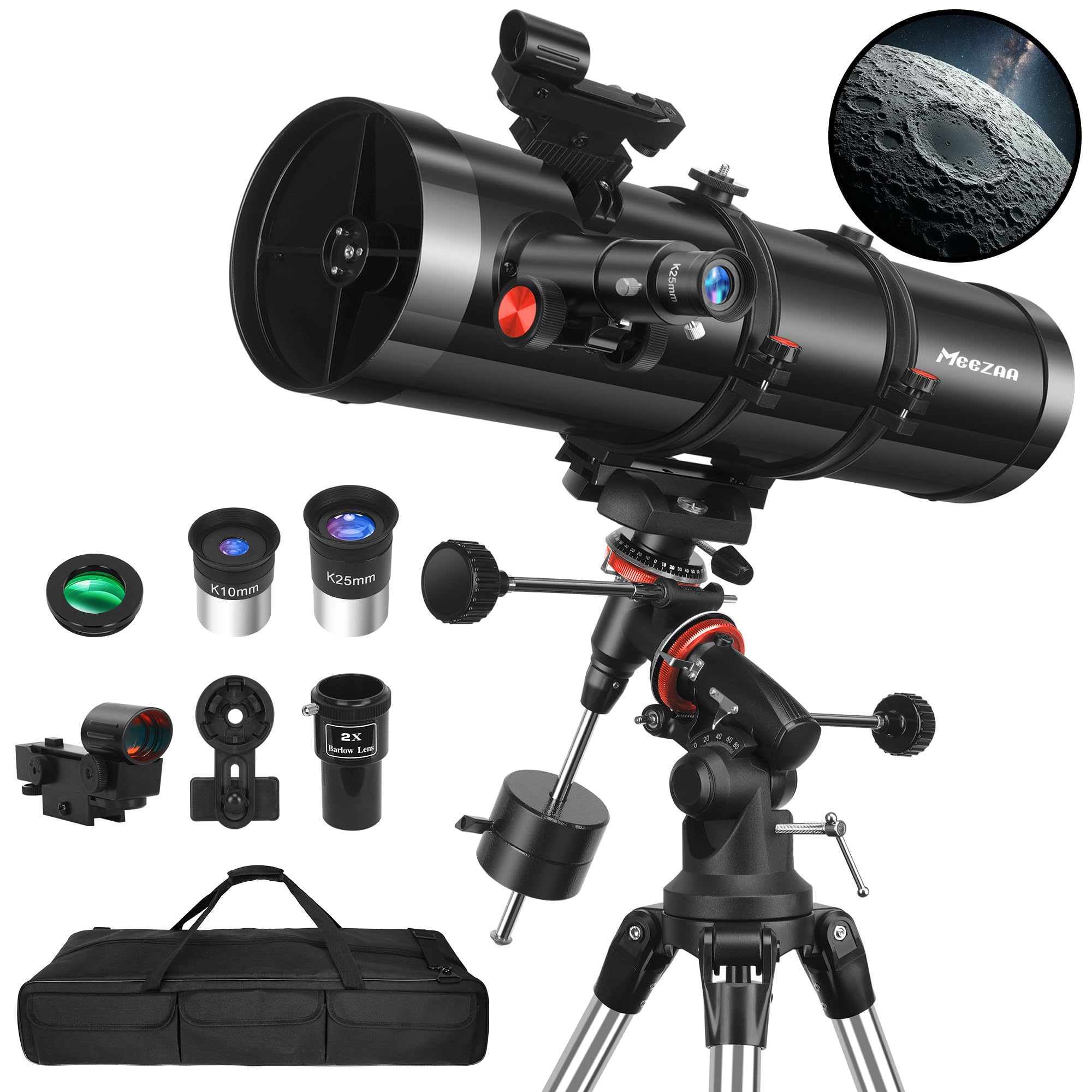
The MEEZAA 150EQ delivers the largest aperture in this roundup, making it a true light bucket for planetary observation. With a 150mm parabolic mirror and 650mm focal length (f/4.3), this reflector gathers well over three times more light than an 80mm refractor. In practice, this means Jupiter’s Great Red Spot and Saturn’s Cassini Division become achievable targets even under suburban skies. The equatorial mount, complete with slow-motion control knobs, keeps planets centered at high magnification without the constant chasing required by AZ mounts.
Assembly takes longer than a simple refractor due to the EQ mount’s polar alignment process, but the payoff is a steady platform for 130X planetary viewing. The included phone adapter and moon filter add genuine utility, while the large carry bag protects the 150mm tube during transport. Users report sharp lunar craters and recognizable Saturn ring structure right out of the box.
Collimation of the Newtonian mirror is required periodically, and the entry-level eyepieces are functional but benefit from eventual upgrades. Despite these minor trade-offs, the 150EQ offers a performance-to-price ratio that redefines what an affordable telescope can deliver for the dedicated planet watcher.
Why it’s great
- 150mm aperture reveals fine planetary detail others miss
- EQ mount with slow-motion controls for smooth tracking
- Includes moon filter and phone adapter for easy sharing
Good to know
- Requires collimation for optimal performance
- Heavier build—less portable than compact refractors
2. Celestron StarSense Explorer 114AZ
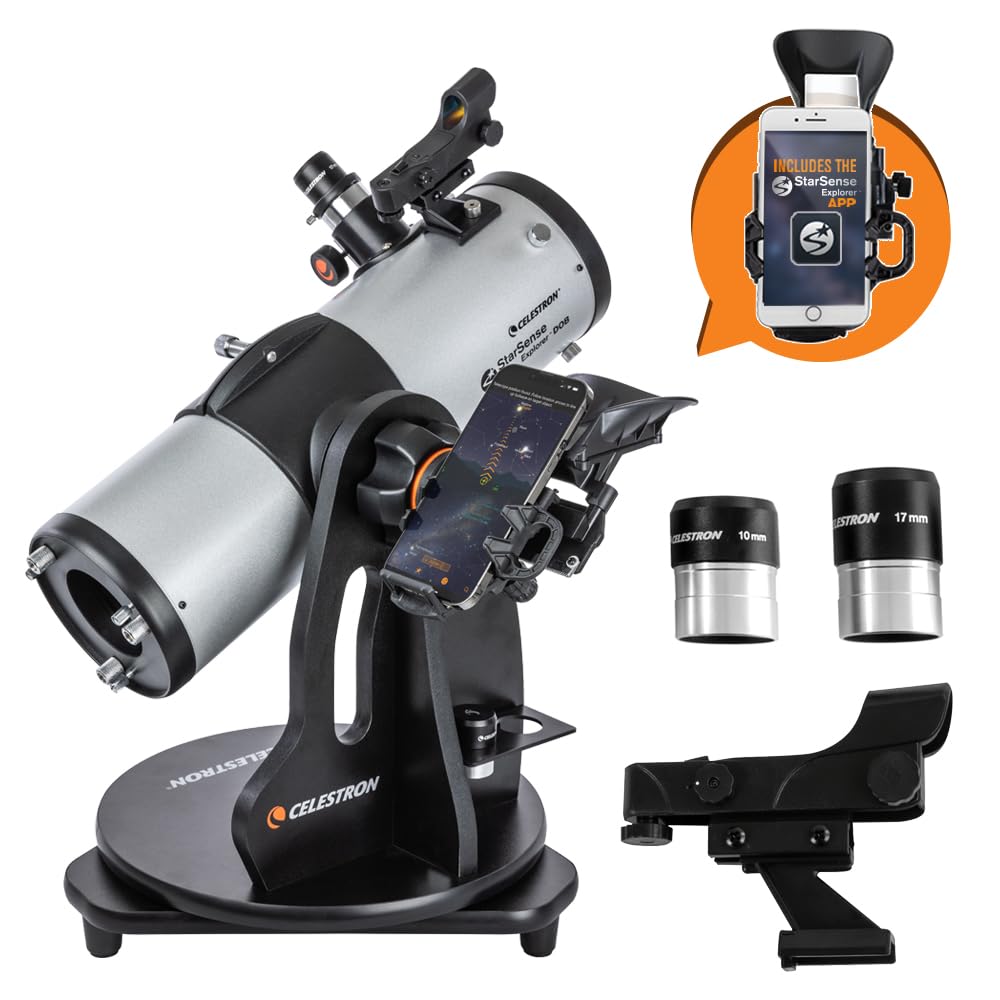
The Celestron 114AZ combines a generous 114mm Newtonian reflector with the StarSense smartphone guidance system, solving the biggest hurdle for beginners: finding planets in the first place. Dock your phone, launch the app, and on-screen arrows direct you to Jupiter, Saturn, or Mars—the object appears centered in the eyepiece when the bullseye turns green. This cuts the learning curve from weeks to minutes, making it the most beginner-friendly entry into serious planetary observing at this tier.
The tabletop Dobsonian base is rock-solid for its size, though it requires a flat surface like a table or sturdy cooler. With a 1000mm focal length, the 114AZ provides excellent magnification potential for moon craters and planetary bands. The 17mm and 10mm Kellner eyepieces deliver crisp views, and the red dot finder serves as backup. Users consistently report clear Saturn ring separation and Jupiter moon detail.
Portability is a factor—the pressboard base is heavy and not designed for frequent car travel. Assembly is straightforward, but some users note that the manual could be clearer and that drilling may be required for the base handle. If you plan to observe exclusively from a backyard deck or patio, the StarSense guidance makes this the easiest path to rewarding planet views.
Why it’s great
- StarSense app eliminates guesswork in locating planets
- 1000mm focal length provides strong planetary magnification
- Stable tabletop Dob base reduces vibration at high power
Good to know
- Base is heavy and not ideal for frequent transport
- Requires a flat elevated surface for use
3. Gskyer 130EQ Professional Astronomical Reflector

The Gskyer 130EQ packs a 130mm (5.1-inch) parabolic mirror into a package that competes directly with larger refractors at a fraction of the weight. With a 650mm focal length (f/5), this fast Newtonian reflector excels at gathering light, making it capable of showing Jupiter’s belts and Saturn’s rings at 130X magnification with good atmospheric conditions. The German EQ mount, once polar aligned, tracks celestial motion smoothly via the slow-motion cables—a huge upgrade from cheap AZ mounts that jitter with every touch.
Build quality is solid for its tier. The toothless focusing base is a welcome refinement that prevents image shift during focus, which plagues many budget scopes. The included three eyepieces (SR4mm, H12.5mm, H20mm) plus a 3X Barlow lens cover a broad magnification range, though the highest settings push against the atmosphere’s limits. Users highlight the clarity of the moon’s surface and the ability to see Jupiter’s moons distinctly.
The EQ mount’s counterweights and assembly do require a learning curve—beginners should budget time to understand polar alignment. The mount can feel slightly under-specced for the tube, with some users reporting slip under heavy eyepieces. That said, for the price, the 130EQ delivers planetary light-gathering that easily outclasses sub-100mm refractors, making it a serious contender for budget-minded astronomers who want EQ precision.
Why it’s great
- 130mm mirror collects light for clear planetary details
- EQ mount enables smooth manual tracking
- Toothless focuser prevents image shift
Good to know
- EQ alignment takes practice for beginners
- Mount can feel under-speced with heavy accessories
4. Hawkko 90mm Aperture 900mm Refractor

The Hawkko 90/900 refractor is built for high-contrast lunar and planetary viewing. Its 900mm focal length (f/10) is inherently less prone to chromatic aberration than shorter tubes, meaning the moon appears crisp without the purple fringing that plagues fast refractors. The fully multi-coated optics transmit around 73% more light than uncoated glass, producing bright, contrasty images of Jupiter’s bands and the Cassini division when atmospheric conditions permit. The AZ mount with slow-motion alt control provides smooth vertical tracking, though azimuth requires manual nudging.
Setup is straightforward at under 15 minutes, and the stainless steel tripod lends significant stability for a refractor at this price. The complete kit—10mm and 25mm Plossl-style eyepieces, 3X Barlow, phone adapter, and carry bag—means nothing else is needed to start. Users consistently note the sharp moon views and the ease with which Jupiter’s moons are resolved. Saturn’s ring is visible as a distinct shape even at the 25mm eyepiece.
The straight-through finderscope can be awkward to use, especially for taller observers, and the mount’s altitude rod can slip if not tightened firmly. While the 90mm aperture falls short of deeper deep-sky objects, it is perfectly matched to its intended mission: delivering stunning lunar and bright-planet performance without the complexity of an EQ mount.
Why it’s great
- Long 900mm focal length reduces chromatic aberration
- Fully multi-coated optics for high-contrast planetary views
- Stable stainless steel tripod with smooth alt control
Good to know
- Straight-through finder can be uncomfortable to use
- AZ mount lacks full slow-motion in azimuth
5. Celestron StarSense Explorer LT 80AZ

The Celestron StarSense Explorer LT 80AZ brings the same smartphone-powered navigation as its bigger sibling but in a lightweight, highly portable refractor package. The StarSense app uses sky recognition technology to analyze star patterns overhead, then guides you to planets, nebulae, and star clusters with on-screen arrows. For a beginner, this transforms the frustrating process of manually scanning the sky into a guided tour. The 80mm aperture is a solid entry point for the moon and bright planets, and the short 400mm focal length (f/5) provides wide fields ideal for initial target acquisition.
The manual altazimuth mount features a sliding-rod altitude adjustment for smooth vertical movement. With the 25mm eyepiece, you get 16X—perfect for sweeping to Saturn. Switching to the 10mm eyepiece (40X) reveals planetary detail, and the 2X Barlow lens pushes to 80X for closer looks at Jupiter’s bands. Users report easily seeing Saturn’s rings, Titan, and Jupiter’s banding, though some note the red-dot finderscope can arrive non-functional. Celestron’s US-based support and 2-year warranty provide peace of mind.
The 80mm aperture inherently limits how much light it can gather compared to larger reflectors, meaning deep-sky objects remain faint. However, for someone who values ease of use, portability, and app-guided discovery over raw aperture, this is the most frustration-free entry to planet spotting. The ability to set up in minutes and be guided to a target by your phone is unmatched at this tier.
Why it’s great
- StarSense app eliminates finder frustration for beginners
- Lightweight and portable—true grab-and-go design
- Backed by Celestron’s 2-year US warranty
Good to know
- 80mm aperture limits planetary detail at very high power
- Red-dot finder quality can be inconsistent
6. MEEZAA 90mm Aperture 800mm Refractor

The MEEZAA 90/800 refractor strikes an impressive balance between aperture, focal length, and affordability for planetary observation. The 800mm focal length (f/8.88) is long enough to keep chromatic aberration minimal while providing excellent native magnification potential. The fully multi-coated glass delivers high contrast on Jupiter’s belts and makes the moon appear brilliantly defined. The slow-motion altitude control on the AZ mount allows smooth vertical tracking, which is especially helpful when observing Saturn’s rings at 192X with the 10mm eyepiece plus 3X Barlow.
Setup is consistently reported as a 10-minute task, and the stainless steel tripod offers good stability even at higher magnifications. The included phone adapter works well for capturing moon shots or sharing planetary images. Users emphasize the clarity of the moon’s craters—this scope resolves dozens of impact features along the terminator. The carry bag adds genuine travel value for camping or star parties.
The finderscope is a straight-through design, which can be uncomfortable for taller observers. The mount’s azimuth motion lacks fine adjustment, so tracking planets at high power requires occasional manual nudging. For a beginner who wants a reliable, portable refractor with good planetary performance and a rock-solid price-to-feature ratio, the MEEZAA 90/800 is a top contender.
Why it’s great
- 800mm focal length with FMC glass for high-contrast views
- Quick 10-minute assembly with no tools required
- Sturdy stainless steel tripod with smooth alt control
Good to know
- Straight-through finderscope can be awkward for tall users
- AZ mount lacks fine azimuth adjustment for high-power tracking
7. Dianfan 90mm Aperture 800mm Refractor

The Dianfan 90/800 refractor mirrors many of the same specs as the MEEZAA but distinguishes itself with a 45-degree erect-image diagonal. This makes it equally useful for daytime birdwatching and terrestrial observation—great for a family that wants one scope for both nature walks and night sky exploration. The fully coated 90mm objective gathers enough light to show Jupiter’s moons clearly, and the 800mm focal length provides good native magnification without pushing too hard against atmospheric limits.
Setup averages around 15 minutes, and the stainless steel tripod holds firm even in light breezes. The included phone adapter captures moon images with surprising clarity. Users report sharp views of Saturn’s rings as a distinct shape and the moon’s surface appearing “breathtaking.” The wide carry bag fits the entire assembly, including the tripod, making transport convenient.
At higher magnifications (240X with the Barlow lens), the image can get dim, and the mount’s stability begins to show its limits. The finderscope requires calibration before first use. For a beginner who wants a single telescope capable of satisfying both day and night curiosity, the Dianfan offers genuine dual-use value without sacrificing planetary capability.
Why it’s great
- 45-degree erect-image diagonal for daytime terrestrial view
- 800mm focal length delivers strong planetary magnification
- Includes wide carry bag for easy transport
Good to know
- High magnification image dims significantly
- Finderscope calibration needed before first use
8. Koolpte 90mm Aperture 700mm Refractor
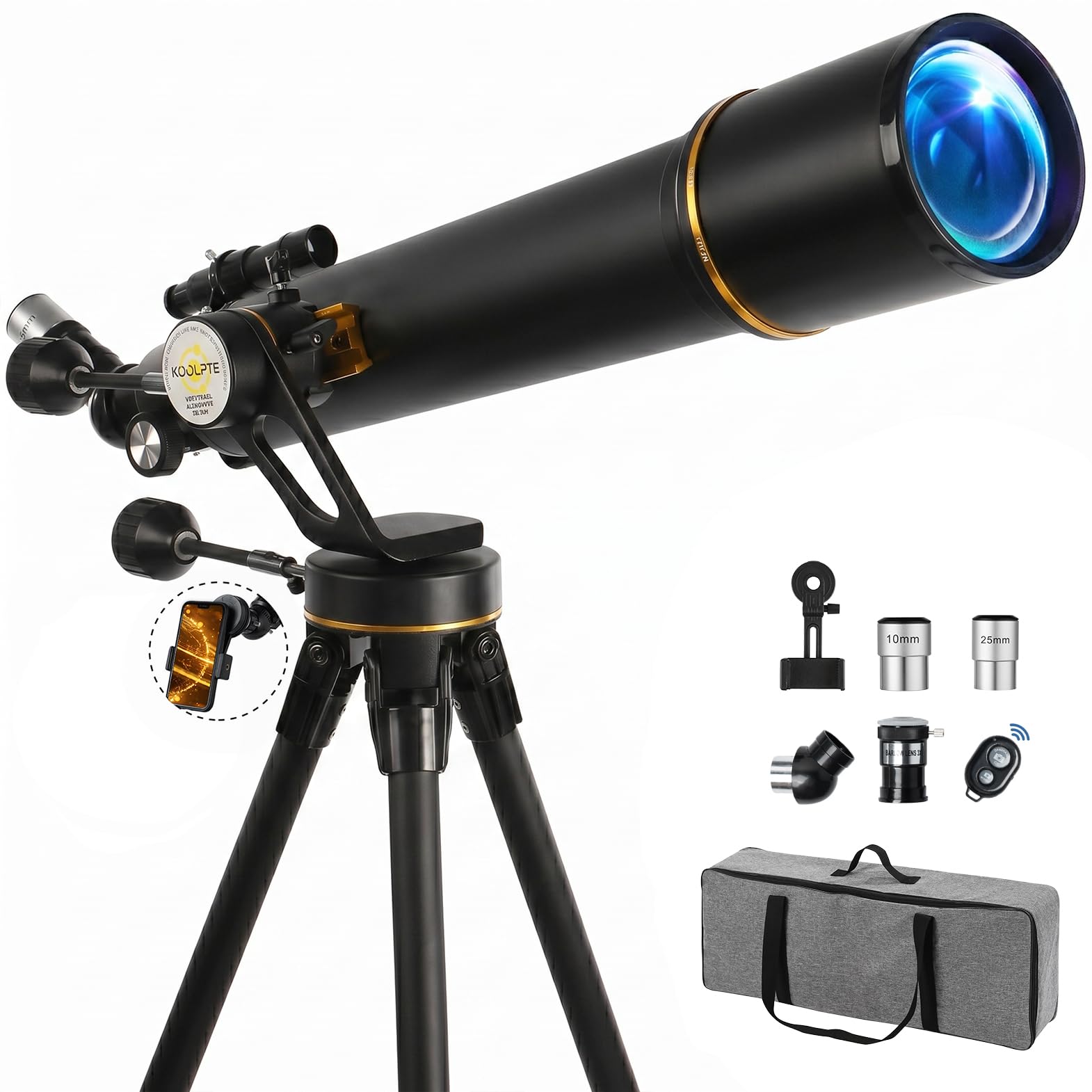
The Koolpte 90/700 stands out primarily for its comprehensive accessory bundle, including a wireless remote for hands-free phone photography and a generous carrying bag. The 90mm aperture with fully multi-coated (FMC) glass delivers 99% light transmission, making moon craters leap into view. With a 700mm focal length, it offers a slightly wider field than the 800mm refractors, which can be helpful for locating planets before zooming in. The Vertisteel AZ mount with slow-motion altitude control provides smoother tracking than many competitors at this price.
Setup is genuinely tool-free and takes under 10 minutes—the included carrying bag houses the tripod, tube, and all accessories. Users consistently note the crispness of the moon at 28X with the 25mm eyepiece, and Jupiter’s moons are resolved as distinct points. The wireless remote allows group photo capturing of the Moon without shaking the scope.
Some users report that the tripod leg adjustments can feel stiff, and a small number of units have arrived with loose internal components. The 700mm focal length, while wider-field, provides slightly less native magnification for planetary detail compared to an 800mm or 900mm tube at the same eyepiece. For a family or group that wants maximum accessories and a smooth-start experience, the Koolpte delivers exceptional value.
Why it’s great
- Includes wireless remote for shake-free phone photography
- Vertisteel AZ mount with smooth slow-motion altitude control
- Tool-free setup in under 10 minutes
Good to know
- 700mm focal length slightly less reach for planetary detail
- Occasional quality control issues reported
9. Gskyer 80mm AZ Space Astronomical Refractor

The Gskyer 80mm is the entry-level champion of this list—an accessible, no-fuss refractor that introduces planetary observation without overwhelming a beginner. Its 400mm focal length provides 16X with the supplied 25mm eyepiece, enough to resolve Jupiter’s four Galilean moons and see Saturn’s ring as a distinct shape under good conditions. The 80mm fully coated objective captures adequate light for bright planets and the moon, making it a low-risk introduction to astronomy for kids or teens.
Setup is quick and the adjustable aluminum tripod allows for comfortable viewing positions. The included 3X Barlow lens pushes magnification to 80X with the 10mm eyepiece, but the tripod’s stability becomes a limiting factor at that power. Users praise its small storage footprint when disassembled and its appealing design for younger stargazers.
At high magnification, the image can grow dim and the lightweight mount may wobble with wind or touch. The finderscope bracket can arrive loose, requiring a simple DIY fix. For those not yet ready to invest in a larger aperture but wanting to confirm their interest in planet seeing, the Gskyer 80mm provides a proven, budget-friendly path into the hobby.
Why it’s great
- Low price removes barrier to entry for planet observation
- Quick, tool-free setup suitable for kids and families
- Compact when disassembled with small storage footprint
Good to know
- 80mm aperture limits detail at high magnification
- Lightweight tripod can wobble under wind or touch
FAQ
What is the minimum aperture needed to see Saturn’s rings?
Should I choose a refractor or a reflector for planet viewing?
What magnification do I need to see Jupiter’s bands?
Final Thoughts: The Verdict
For most users, the affordable telescope to see planets winner is the MEEZAA 150EQ because its 150mm aperture collects enough light to resolve Cassini’s Division and Jupiter’s belts, while the equatorial mount provides smooth tracking at high magnification—all at a price that resets expectations for the entry-level market. If you want the easiest guided finding experience, grab the Celestron StarSense 114AZ. And for a portable, high-contrast refractor that delivers stunning lunar and planetary views with zero maintenance, nothing beats the Hawkko 90mm.