
Our readers keep the lights on and the weekend projects moving. As an Amazon Associate, I earn from qualifying purchases.
A 3500-watt generator sits at the sweet spot — powerful enough to run a refrigerator, lights, a well pump, and a window AC during an outage, yet light enough to toss in the back of an SUV for a weekend camping trip. The problem is that most buyers grab the first cheap unit they see and end up with a noisy, 100-pound brick that surges voltage and kills sensitive electronics. This guide exists to make sure that doesn’t happen to you.
I’m Rikta — the co-founder and writer behind FitlyFast. I’ve spent hundreds of hours parsing inverter vs. conventional engine specs, analyzing total harmonic distortion (THD) claims versus real-world output, and comparing dual-fuel carburetion systems to find the 3500 watt generator that delivers actual clean power without the weight penalty or the noise complaints.
Whether you need something to keep the fridge cold during hurricane season or a portable companion for your 30-amp RV, this deep-dive compares 11 models by THD percentage, fuel efficiency, starting ease, and parallel capability to help you spend your money on the right machine the first time.
How To Choose The Best 3500 Watt Generator
Choosing the right generator in this power class isn’t about the highest peak watt number on the box. It’s about matching the inverter topology, fuel flexibility, physical weight, and noise profile to your actual use case — whether that’s home backup, RV life, job site power, or tailgating.
Inverter vs. Conventional: Why THD Matters
The single most important technical distinction in the 3500-watt class is inverter versus conventional (brushed) alternator. Inverter generators use a multi-step process to produce power: they generate AC, rectify it to DC, then invert it back to a clean AC sine wave. This produces total harmonic distortion (THD) below 3%, which is safe for sensitive electronics like laptops, CPAP machines, and variable-frequency refrigerators. Conventional generators often produce THD above 6%, which can cause buzzing, overheating, and eventual failure in modern electronics. Every generator recommended here is an inverter model.
Dual Fuel vs. Single Fuel: The Storage Equation
Gasoline degrades in as little as 30 days and can gum up a carburetor if left untreated. Propane (LPG) stores indefinitely and burns cleaner, extending oil life and reducing maintenance frequency. A dual-fuel generator gives you the option to run on whichever fuel is available — critical during extended outages when gas stations may be closed or sold out. The trade-off is slightly lower peak wattage on propane (typically 10-15% less) and a slightly higher upfront cost. If you plan to use the generator primarily for emergency backup, dual fuel is worth the premium.
Noise Level and Portability: The Real-World Constraints
A traditional 3500-watt open-frame generator can push 70-80 dBA — loud enough to require hearing protection and annoy neighbors in an RV park. Inverter generators in this class typically operate at 52-65 dBA, which is conversational-level or quieter. Weight matters just as much: a 50-pound inverter generator can be lifted into a truck bed by one person, while a 79-pound dual-fuel unit with wheels is better suited for rolling on flat ground. Match the portability to your physical comfort and the terrain you’ll be navigating.
Starting System: Recoil, Electric, or Remote
Recoil (pull-start) is the most reliable mechanism — no battery to die, no solenoid to fail — but can be frustrating in cold weather or for users with limited upper-body strength. Electric start eliminates the pull cord but relies on a lead-acid battery that needs occasional charging. Remote start (key fob) adds convenience but adds another component that can fail. The best configuration? A generator with both electric and recoil backup, so you’re never stranded by a dead battery.
Quick Comparison
On smaller screens, swipe sideways to see the full table.
| Model | Category | Best For | Key Spec | Amazon |
|---|---|---|---|---|
| WEN 56455i | Premium Gas | Heavy Home Backup | 4500W surge, 8.5h at half load | Amazon |
| WEN DF480iX | Premium Dual Fuel | RV + Home Backup | 4800W gas surge, 78.5 lbs | Amazon |
| Champion 200977 | Premium Dual Fuel | Long Runtime Backup | 4250W gas surge, 22h runtime | Amazon |
| maXpeedingrods MXR3500S | Premium Dual Fuel | Remote Start Camping | 3500W gas surge, 55 lbs | Amazon |
| Generac GP3300i | Premium Gas | Portable Home Backup | 3300W rated, 59.5 lbs | Amazon |
| GENMAX GM3500iAD | Mid Dual Fuel | Dual Fuel Camping | 3500W gas surge, 62 dBA | Amazon |
| WEN DF360iX | Mid Dual Fuel | Light Dual Fuel Use | 3600W gas surge, 49 lbs | Amazon |
| WEN 56360i | Mid Gas | Ultralight Camping | 3600W surge, 46 lbs | Amazon |
| PowerSmart DB5068 | Budget Gas | Quiet Camping | 3800W surge, 59 dBA | Amazon |
| Aceup Energy AI4000s-1 | Budget Gas | Compact RV Storage | 4000W surge, 50 lbs | Amazon |
| PowerSmart DL5035C | Budget Gas | Budget Home Backup | 3600W surge, 50.7 lbs | Amazon |
In‑Depth Reviews
1. WEN 56455i Super Quiet 4500-Watt RV-Ready Portable Inverter Generator

The WEN 56455i is the closest thing to a do-everything generator in this class. Its 212cc engine punches out 4500 surge watts and 3500 rated watts — enough to start and run a 15,000 BTU RV air conditioner, a refrigerator, and a sump pump simultaneously. The half-load runtime of 8.5 hours on the 2.2-gallon tank means you can sleep through the night without refueling, and the dual-start system (keyless electric plus recoil backup) means you’re never stranded by a dead battery.
This is a gasoline-only unit, which keeps the price reasonable but means you lose the storage flexibility of propane. At 99.2 pounds, it’s the heaviest generator in this comparison — the onboard wheels and pull handle help, but lifting it into a truck bed solo is a challenge. The digital display shows runtime, voltage, frequency, and fuel level, giving you real-time feedback that cheaper units lack.
Owner reports confirm the electric start works reliably out of the box, and the noise level in Eco mode is genuinely low — users describe it as a “gentle purr” from inside an RV. The prep process (oil fill via flexible tube, battery cover fit) has drawn mild complaints, but once past that initial setup, the 56455i delivers consistent, clean inverter power with a three-year warranty backing it.
Why it’s great
- Highest surge wattage (4500W) in the comparison
- Electric + recoil dual-start for reliability
- Digital display with runtime and fuel data
- Three-year warranty
Good to know
- Gasoline only — no dual fuel option
- 99.2 lbs is heavy; wheels are essential
- Oil fill and battery cover assembly are finicky
2. WEN DF480iX Quiet 4800-Watt Dual Fuel Inverter Generator
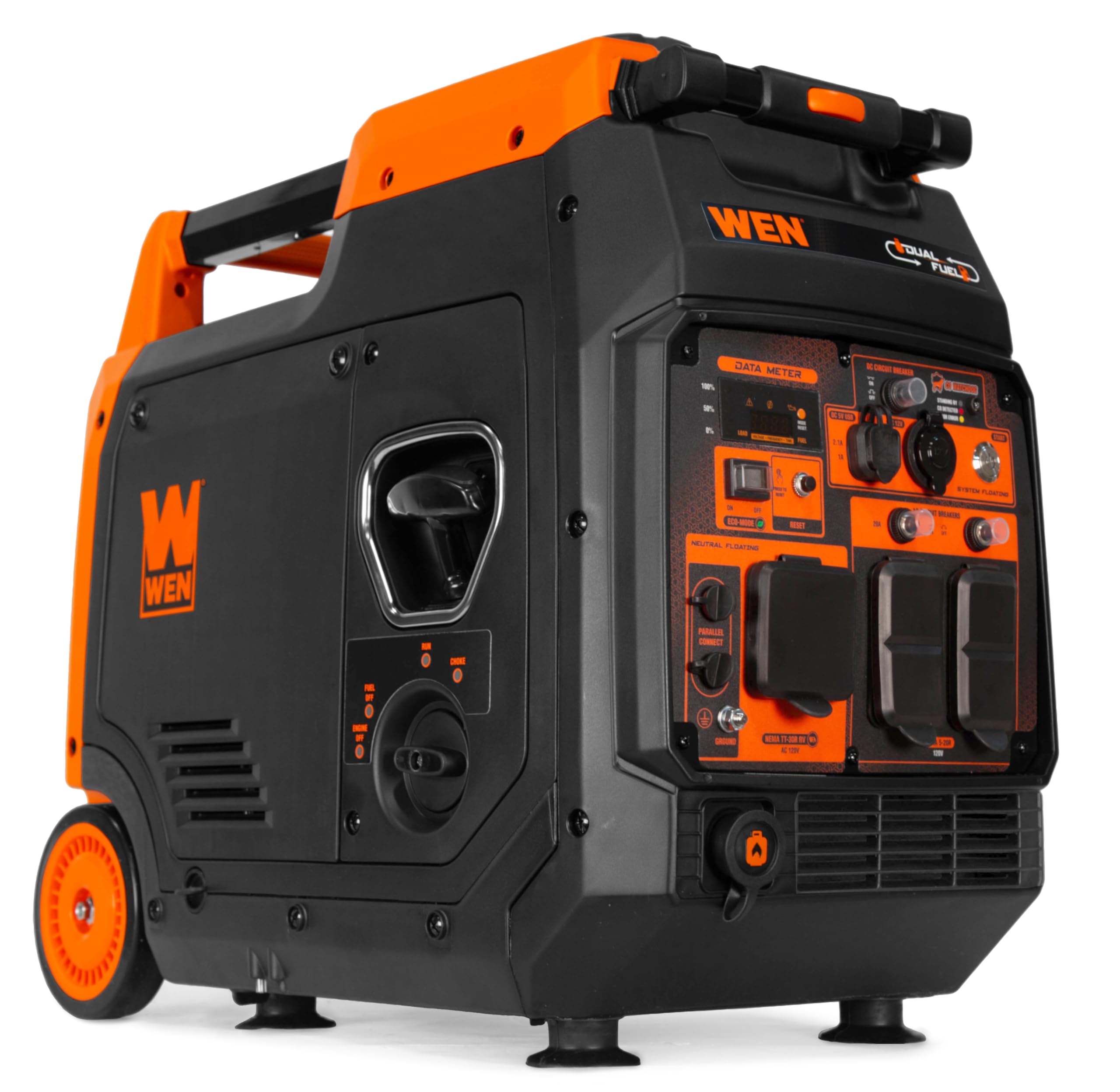
The DF480iX takes the 224cc engine platform and turbocharges the spec sheet: 4800 surge watts on gasoline, 4320 on propane, and 4000 rated watts on both fuels. That puts it in a power tier that overlaps with 4000-watt conventional generators while keeping the clean sine wave output (THD under 3%) that RV electronics and modern refrigerators demand. The telescoping pull handle and onboard wheels move the 78.5-pound package easily across pavement or grass.
Dual-fuel operation is the headline story here. Run it on gasoline for maximum power during a hurricane, then switch to a 20-pound propane tank for indefinite storage without worrying about carburetor gumming. The WEN Watchdog CO Shutdown Sensor automatically kills the engine if carbon monoxide builds to dangerous levels — a critical safety feature for anyone tempted to run the generator close to an open window or garage door.
Real-world owners report 8 hours of runtime on a 10-pound propane cylinder while powering a refrigerator, freezer, lights, and CPAP machine. The electric start fires reliably with the battery connected, and the tool-free LPG quick-connector makes the fuel switch a 30-second affair. The main trade-off is weight: at nearly 80 pounds, this is a roll-it-don’t-carry-it machine, best suited for RV compartments with level ground access.
Why it’s great
- Highest rated watts (4000W) of any dual fuel here
- CO Watchdog auto-shutdown for safety
- Onboard wheels + telescoping handle for easy rolling
- Tool-free LPG quick-connector
Good to know
- 78.5 lbs — requires rolling, not lifting
- Battery connection panel is awkward to reattach
- No auto-switch between gas and LPG
3. Champion Power Equipment 200977 Dual Fuel Inverter Generator

Champion’s 200977 claims the runtime crown in this comparison: 22 hours on gasoline and 21 hours on propane at 25% load, thanks to the 224cc engine and a fuel-efficient Economy Mode. That translates to three full nights of managing an RV refrigerator, lights, and a CPAP machine without touching the gas can. The 4250 surge watts (3500 rated on gas) and 3150 rated watts on propane are solid for a 30-amp RV setup or essential home circuits.
The Intelligauge display monitors voltage, frequency, and operating hours — letting you track runtime for oil-change intervals and spot load issues before they become failures. Parallel capability allows you to pair a second Champion inverter for up to 7000 watts of combined power, though the parallel kit is sold separately. The 64 dBA noise rating is quiet enough for most campgrounds but not silent — audible as a low hum from inside an RV with windows closed.
Owner feedback is polarized. Many report reliable first-pull starts and flawless performance during week-long hurricane outages. A vocal minority reports ignition module failures shortly after purchase, and Champion’s warranty policy has drawn criticism for denying coverage to users running the generator as a primary power source. If you buy this unit, break it in carefully and document every service interval.
Why it’s great
- 22-hour runtime on gas at 25% load
- Intelligauge display for voltage, frequency, hours
- 50% quieter than conventional 3500W units
- Three-year warranty with lifetime tech support
Good to know
- 79 lbs requires wheels for transport
- Ignition module failures reported in some units
- Warranty restrictions on primary power use
4. maXpeedingrods MXR3500S Dual Fuel Inverter Generator

The maXpeedingrods MXR3500S packs three starting methods — remote key fob, push-button electric, and recoil backup — into a 55-pound dual-fuel package. That makes it the most versatile starting system in this price tier, ideal for users who want to start the generator from inside the RV on a cold morning without walking outside. The 3500W surge (3200W rated) on gasoline and 3100W surge (2800W rated) on propane is adequate for a 15k BTU RV AC unit with power management.
Runtime claims are impressive: approximately 11 hours on gasoline and 24 hours on propane at 25% load. The digital display panel shows fuel level, runtime, voltage, and frequency in real time, so you can see exactly when the tank is running low. The included wheel and handle kit is functional for rolling on flat surfaces, and the battery comes pre-installed (no separate purchase needed).
Owner reports are mixed but lean positive. Users who use the generator for RV camping and mobile detailing praise the remote start and quiet operation. A significant minority reports dead batteries on arrival and hard manual starting after a few uses, with the seller’s overseas support being slow to respond to battery replacement requests. If you keep the battery charged with a trickle maintainer during storage, the MXR3500S is a strong value for the remote-start convenience.
Why it’s great
- Three start methods including remote key fob
- 55 lbs — one of the lightest dual-fuel units
- 24-hour LPG runtime at 25% load
- Digital display with real-time data
Good to know
- Battery quality concerns; dead-on-arrival reports
- Proprietary battery; seller support can be slow
- Not as quiet as advertised (63-65 dB measured)
5. Generac GP3300i Inverter Generator

Generac brings its TruePower and PowerRush Advance technologies to the 3300-watt class. PowerRush Advance delivers over 50% more starting capacity, meaning this generator can start a motor-driven load (like a 1/2 HP well pump or a refrigerator compressor) that would stall a standard 3300-watt unit. The GP3300i is gasoline-only with a 1.47-gallon tank, producing 3300 rated watts and a clean sine wave suitable for laptops and phone chargers.
The COsense technology automatically shuts down the generator if carbon monoxide accumulates, and the parallel-ready capability lets you pair two units for up to 6600 watts. LED indicators for low oil, overload, and ready status simplify operation for first-time generator owners. The 59.5-pound weight and compact dimensions (22.3″ x 13.4″ x 18.4″) make it one of the most portable premium options in the test.
Real-world testing shows the GP3300i is genuinely quiet — owners describe it as barely audible during evening conversation from 20 feet away. The Economy Mode adjusts engine speed to match load, stretching fuel to roughly 9 hours at quarter load. Some users at altitude report reduced output (max 1950W at 5000 feet), which is a limitation of all naturally aspirated engines. A small number of long-term owners report failures around 500-1100 hours of use, with service options being limited outside of Generac dealers.
Why it’s great
- PowerRush Advance delivers 50% more starting capacity
- COsense auto-shutdown for safety
- 59.5 lbs — genuinely portable
- TruePower clean sine wave electronics-safe
Good to know
- Gasoline only; no dual-fuel option
- Output drops significantly at altitude
- Long-term durability concerns beyond 1000 hours
6. GENMAX GM3500iAD Dual Fuel Inverter Generator

The GENMAX GM3500iAD checks all the modern safety boxes: dual-fuel operation (gasoline or propane), a built-in CO detect sensor that automatically shuts off the generator when unsafe levels are detected, and clean inverter power with THD under 3%. The 145cc engine delivers 3500 surge watts (3200 rated) on gasoline and 3100 surge watts (2800 rated) on propane — enough for a 15k BTU RV air conditioner or essential home circuits during outages.
The telescoping rod and two rolling wheels are included, making the 56.2-pound unit easy to roll across a campsite or driveway. Parallel capability allows you to pair two GENMAX units for 7000 total peak watts, though the parallel kit is sold separately. The 62 dBA noise rating is quiet enough for conversation nearby but slightly louder than the whisper-quiet PowerSmart units in this list.
Owner experiences vary widely. Many report first-pull starts and reliable operation on both fuels, with the propane hose included (not always advertised). However, a notable subset of customers reports defective units that run on propane but won’t start on gasoline, with the company’s customer support sending the wrong replacement carburetor and refusing shop repair. This inconsistent quality control makes the GM3500iAD a gamble — when it works, it’s great; when it doesn’t, support is frustrating.
Why it’s great
- CO detect auto-shutdown for safety
- Dual-fuel with included LPG hose
- Telescoping handle + wheels for easy rolling
- Parallel-ready for 7000W combined
Good to know
- Quality control issues; some defective units
- Customer support can be unhelpful
- 62 dBA is not the quietest inverter option
7. WEN DF360iX Quiet Dual Fuel Inverter Generator

The DF360iX is WEN’s lightest dual-fuel inverter generator at 49 pounds, making it the best option for anyone who needs to carry a generator up stairs, into a truck bed, or onto a boat. The 149cc engine produces 3600 surge watts (2900 rated) on gasoline and 3500 surge watts (2600 rated) on propane — slightly less power than the DF480iX but still adequate for a 13,500 BTU RV air conditioner and a refrigerator simultaneously.
The WEN Watchdog CO Shutdown Sensor is standard, and the fuel shut-off valve helps prevent carburetor gumming by running the carb dry before storage. The tool-free LPG quick-connector makes switching to propane a 30-second process, and the digital display shows voltage, frequency, runtime, and fuel level. The included three-year warranty is the longest in this comparison for a dual-fuel inverter.
Owners consistently praise the quiet operation and easy starting on both fuels. A common minor complaint is that the 20A household outlets hold plugs loosely — not a functional failure but annoying enough to note. The DF360iX is also receptive to external propane tanks, with users reporting 20+ hour runtimes on a 20-pound cylinder when running at quarter load. If you want dual-fuel flexibility without the weight penalty, this is the sweet spot.
Why it’s great
- Only 49 lbs — best portable dual-fuel option
- CO Watchdog auto-shutdown safety feature
- Three-year warranty
- Tool-free LPG quick-connector
Good to know
- Lower rated watts (2900W gas) than competitors
- 20A outlet plugs fit loosely in some units
- No electric start; recoil only
8. WEN 56360i Quiet 3600-Watt Inverter Generator

At 46 pounds, the WEN 56360i is the lightest 3500-watt-class inverter generator in this comparison — light enough that most people can lift it with one hand. The 149cc engine produces 3600 surge watts and 2900 rated watts, with the fuel shut-off valve ensuring the carburetor runs dry before shutdown to extend lifespan. The single control switch (choke/run/stop) simplifies operation, making this an excellent choice for first-time generator buyers.
The outlet panel includes two three-prong 120V receptacles, one TT-30R RV receptacle, one 12V DC receptacle, and two 5V USB ports — enough to power an RV, charge devices, and run essential appliances simultaneously. The noise level is genuinely low; owners describe it as a “gentle purr” from inside a camper. The three-year warranty adds peace of mind for a unit in this price class.
Real-world owners report reliable first-pull starts even at 14°F, and the generator handles a 13,000 BTU RV air conditioner without stumbling. Fuel consumption is about 1 gallon for 5 hours under typical RV loads. The lightweight construction does mean the frame feels slightly less robust than the heavier dual-fuel units, and there is no electric start. If ultralight portability is your top priority, the 56360i is hard to beat.
Why it’s great
- 46 lbs — lightest unit in the comparison
- Fuel shut-off for extended carburetor life
- Single control switch for easy operation
- Three-year warranty
Good to know
- Gasoline only; no dual fuel
- 2900 rated watts is below the 3500W class peak
- No electric start; recoil only
9. PowerSmart DB5068 3800W Inverter Generator
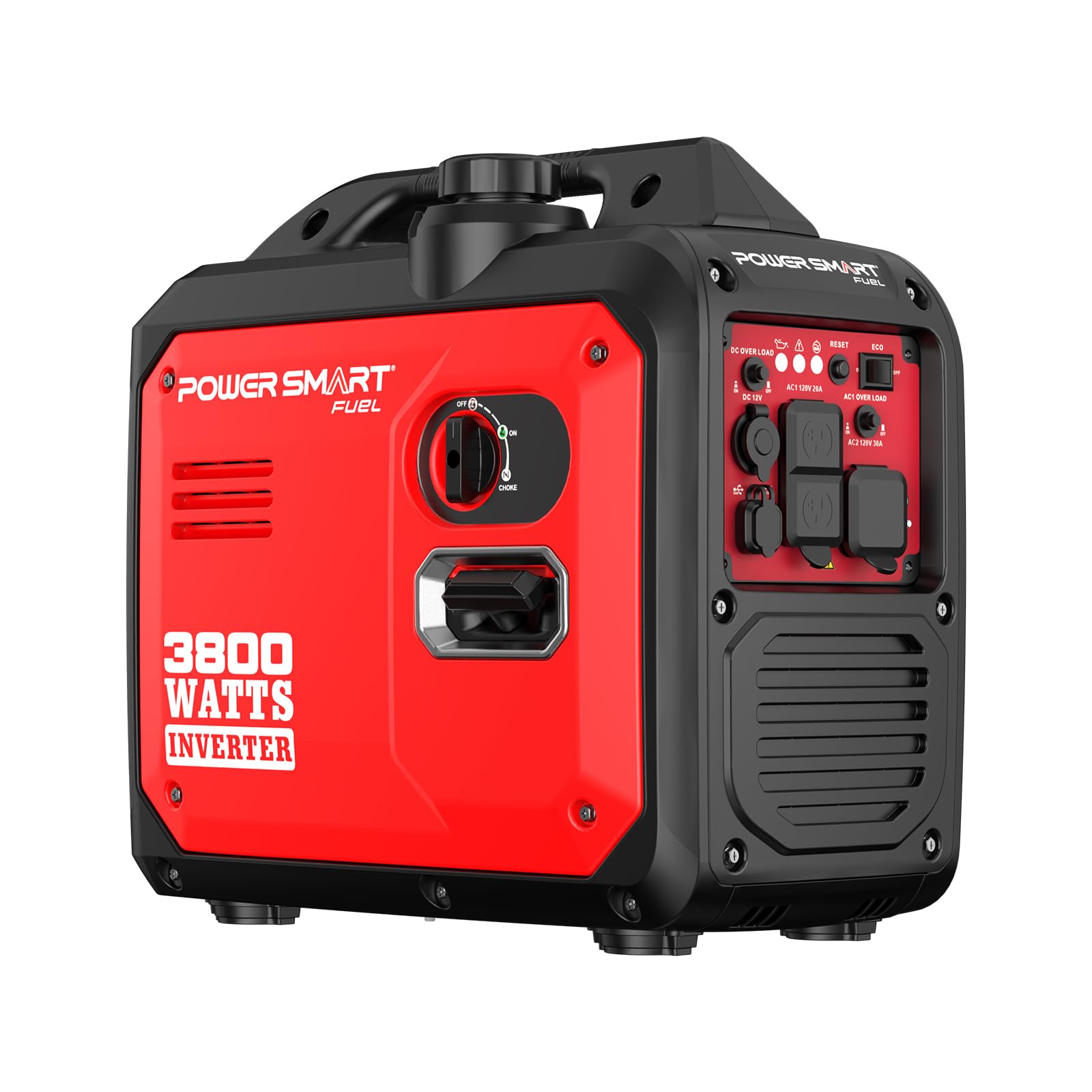
The PowerSmart DB5068 delivers 3800 starting watts and 3200 rated watts at 59 dBA — the quietest noise rating in this comparison and quieter than a normal conversation. The 143cc 4-stroke OHV engine sips from a 1.19-gallon tank for up to 4.5 hours at 50% load, and the Economy Mode automatically adjusts engine speed to match load, stretching fuel further when running light loads like lights and a refrigerator.
The 52-pound weight and ergonomic handle make the DB5068 easy to carry for short distances, though the lack of a wheel kit means you’ll be lifting it into vehicles. Parallel capability allows connecting two units for 6400 combined rated watts, though the parallel kit is sold separately. The two-year warranty is standard for the price tier.
Owners are uniformly impressed with the noise level — many describe it as “inaudible inside with the door closed” while powering multiple appliances. The easy start (no choke needed, starts in one to two pulls) is a recurring theme in reviews. Some users note the lack of a fuel shut-off valve, meaning you need to be diligent about running the carburetor dry before storage to prevent gumming. For the price, the DB5068 offers exceptional quietness and reliability.
Why it’s great
- 59 dBA — quietest unit in the comparison
- 3800W surge is above the 3500W class average
- Easy start; no choke needed
- Parallel-ready for power scaling
Good to know
- No fuel shut-off valve
- No wheel kit included
- 1.19-gallon tank limits runtime vs. competitors
10. Aceup Energy AI4000s-1 4000W Inverter Generator
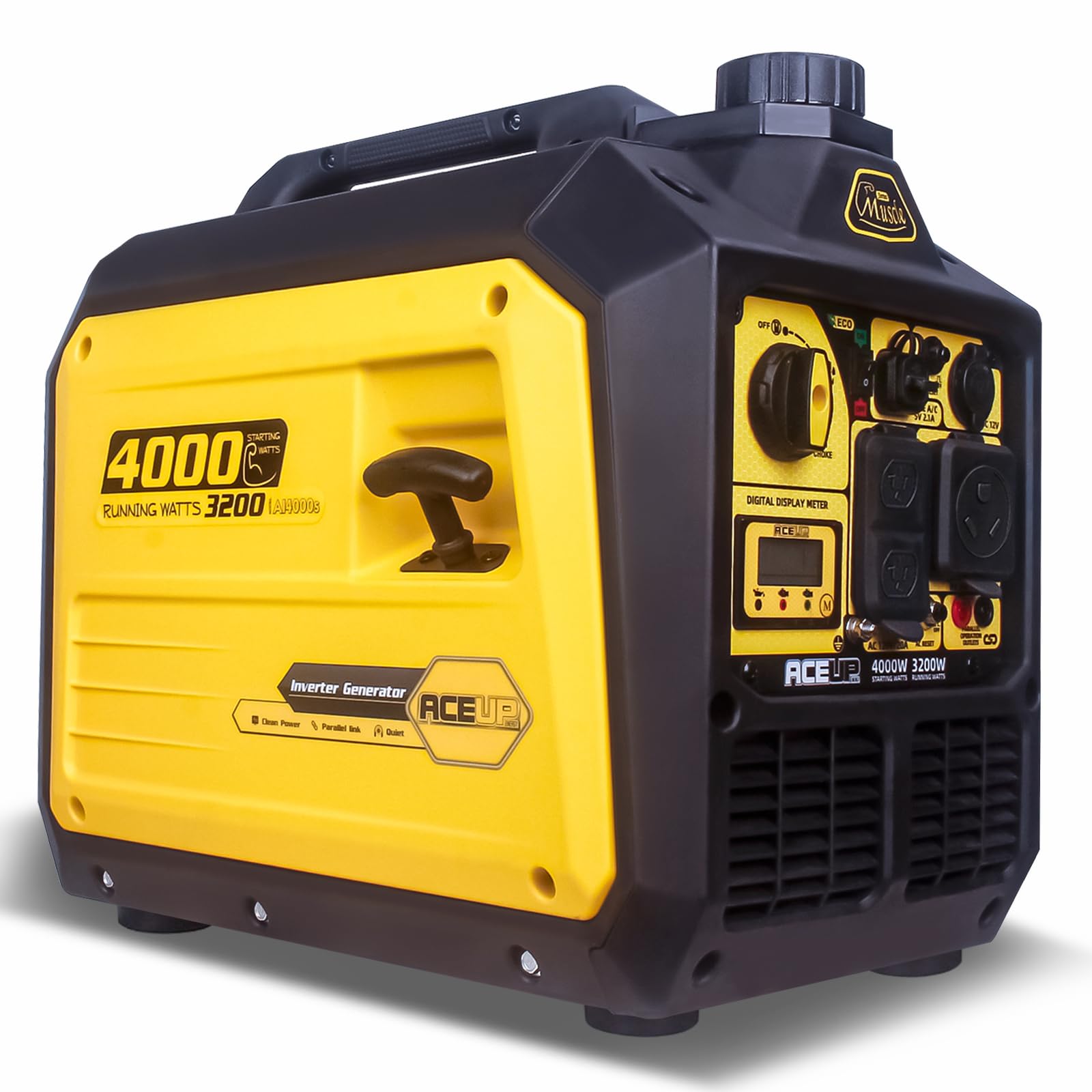
The Aceup Energy AI4000s-1 punches above its price class with a 5-in-1 control knob that integrates fuel on/off, engine on/off, and choke into a single switch — reducing the learning curve for new generator owners. The 149cc engine produces 4000 peak watts and 3200 rated watts, with the intelligent gauge tracking voltage, runtime, fuel level, hertz, and power output simultaneously.
Fully enclosed design reduces noise levels noticeably, and the compact dimensions (19.66″ x 11.78″ x 17.71″) make this the most storage-friendly unit in the comparison — several owners report it fits perfectly in the side compartment of their camper. The 50-pound weight is manageable for one person to lift, and the parallel-ready capability allows pairing two units for double output.
Owner feedback is very positive for the price. Users report quiet enough operation for conversation 23 feet away, easy first-pull starts, and enough power to run a refrigerator, three lamps, two fans, and internet for two weeks during an outage. A small number of owners note a tank collapsing issue under certain conditions, recommending proper venting. The two-year warranty and lifetime technical guidance add confidence for first-time buyers.
Why it’s great
- Compact footprint — fits RV compartments
- 5-in-1 control knob simplifies operation
- Digital display with voltage, hours, fuel data
- 50 lbs — genuinely portable
Good to know
- Gasoline only; no dual fuel
- Possible tank collapse with improper venting
- Long-term durability not yet proven
11. PowerSmart DL5035C 3600W Inverter Generator

The PowerSmart DL5035C is the entry-level champion of the 3500-watt class. The 149cc 4-stroke OHV engine delivers 3600 starting watts and 3200 rated watts with a steady 26.7A output — enough to handle a 15,000 BTU RV air conditioner, refrigerator, and power tools simultaneously. Advanced inverter technology keeps THD below 3%, making it safe for laptops, workstations, and smartphones.
The 1.3-gallon fuel tank provides up to 8 hours of runtime at 25% load, and the parallel connection capability allows linking two units for 6400 combined rated watts. At 50.7 pounds with an integrated carry handle, the DL5035C is portable enough for camping or job site use. The two-year warranty is standard for the price point.
Owners consistently praise the easy start (first pull, even in cold weather) and quiet operation for its size. The 30A RV plug is present but requires an adapter for direct RV connection. A common observation is that the DL5035C is quieter and lighter than comparably priced conventional generators, making it an excellent value for budget-conscious buyers who still want clean inverter power. The only consistent negative is the lack of a fuel gauge, requiring you to pop the cap to check fuel level.
Why it’s great
- Excellent price for inverter clean power
- 8-hour runtime at quarter load
- 50.7 lbs with integrated carry handle
- Parallel-ready for power scaling
Good to know
- No fuel gauge
- RV plug requires adapter for direct connection
- Gasoline only; no dual fuel
FAQ
What is the difference between an inverter generator and a conventional generator?
Can I run my RV air conditioner on a 3500-watt generator?
What does “parallel-ready” mean and should I care?
Is dual fuel worth the extra cost?
How quiet is a 59 dBA generator in real-world terms?
Final Thoughts: The Verdict
For most users, the 3500 watt generator winner is the WEN 56455i because its 4500W surge, dual-start system, and 8.5-hour runtime deliver the most usable power with the least hassle for both home backup and RV use. If you want dual-fuel flexibility with a lightweight chassis, grab the WEN DF360iX at 49 pounds. And for maximum runtime on a single tank, nothing beats the Champion 200977 with its 22-hour gas runtime.