
Our readers keep the lights on and the weekend projects moving. As an Amazon Associate, I earn from qualifying purchases.
Rust doesn’t sleep. Once oxidation takes hold on metal, it spreads like an infection—eating through car frames, trailer hitches, farm equipment, and garden tools from the inside out. The difference between a quick patch and a permanent fix comes down to one thing: the chemistry inside the can, not just the color on the label.
I’m Rikta — the co-founder and writer behind FitlyFast. My approach to this guide focused on analyzing the chemical formulations, cure mechanisms, and real-world test data behind each coating to determine which products actually seal out moisture and oxygen long-term versus which just look good for a few months.
Whether you’re restoring a classic car or protecting a boat trailer, the right formula can add years of life to your metal. This guide cuts through the marketing to find the best anti rust paint for your specific project and surface condition.
How To Choose The Best Anti Rust Paint
Picking the wrong coating means blisters, peeling, and rust returning within a season. Three factors determine whether a paint actually stops corrosion: the chemistry type, the surface condition it was designed for, and the cure mechanism. Skip any of these and you’re just decorating the rust.
Understand the Three Chemistry Types
Not all anti rust paints work the same way. Rust converters use tannic acid to chemically turn iron oxide into a stable black layer. Encapsulators seal existing rust under a moisture-proof film. Barrier paints simply block oxygen and water from reaching clean metal. Know which type matches your project’s surface condition—converter on light surface rust, encapsulator on pitted metal, barrier on new steel.
Match the Cure Mechanism to Your Environment
Standard paints dry by solvent evaporation. Moisture-cured urethanes harden by reacting with humidity in the air. The moisture-cure route creates a denser, more chemically resistant film that bonds aggressively to rusty surfaces. If your project lives outside or sees road salt, prioritize moisture-cure products that form a non-porous barrier rather than paints that just dry to a hard film.
Check the Salt Spray Test Hours
The most meaningful metric for anti rust paint is how many hours it survives in a salt spray chamber before corrosion appears. Budget-friendly coatings might pass 100 hours. Premium encapsulators can exceed 1,500 hours. For automotive underbodies or marine gear, look for coatings that publish a salt spray test result of 500 hours or more—the number is a direct measure of long-term moisture resistance.
Quick Comparison
On smaller screens, swipe sideways to see the full table.
| Model | Category | Best For | Key Spec | Amazon |
|---|---|---|---|---|
| POR-15 Rust Preventive Coating | Moisture-Cure Urethane | Long-term chassis protection | 3-step system with metal prep | Amazon |
| KBS Coatings RustSeal | Moisture-Cure Urethane | High-heat engine parts | Withstands 600°F continuously | Amazon |
| Eastwood Rust Encapsulator Platinum | Encapsulator | Minimal-prep rusty surfaces | 1,500-hour salt spray resistance | Amazon |
| Magnet Paint Chassis Saver | Barrier Paint | Large truck frames & underbodies | 1-gallon coverage for big jobs | Amazon |
| Meuvcol Rust Converter & Primer | Converter + Encapsulator | Rust conversion with brush-on ease | 35 oz can with brush & gloves | Amazon |
| Rust-Oleum Farm & Implement Enamel | Enamel Barrier | Farm equipment & trailers | 130 sq ft coverage per quart | Amazon |
| Rust-Oleum Cold Galvanizing Compound | Zinc-Rich Primer | Touch-ups on galvanized steel | 12 sq ft coverage in 16 oz | Amazon |
In‑Depth Reviews
1. POR-15 Rust Preventive Coating

POR-15 is the gold standard for a reason—its moisture-cure urethane chemistry forms a hammer-tough, non-porous barrier that bonds directly to rusted metal. Unlike standard paints that dry by evaporation, POR-15 hardens by reacting with humidity, creating a denser film that resists chemical attack, road salt, and moisture penetration. The three-step system—cleaner degreaser, metal prep (which etches and zinc-phosphates the surface), then the coating—is the most proven restoration protocol in the industry.
The gloss silver finish dries to the touch in roughly 3 hours and cures fully within 5 hours, which means you can recoat the same day. Customer reviews consistently highlight its ability to convert rust into a stable, paintable surface when the metal prep is applied correctly. The coating also bonds aggressively to wood, fiberglass, and concrete, giving it versatility beyond automotive frames.
The primary trade-off is the required surface prep—skipping the degreaser or metal prep stage dramatically reduces adhesion. Also, the can lid tends to seal permanently if paint gets on the threads, so plan to transfer unused product to a separate container. For anyone serious about stopping rust permanently on a vehicle frame or heavy equipment, this is the benchmark.
Why it’s great
- Moisture-cure urethane creates a denser barrier than evaporation-dry paints
- Three-step system chemically converts rust and zinc-phosphates bare metal
- Bonds aggressively to rusted, pitted, and porous surfaces
Good to know
- Requires the full 3-step system for maximum adhesion
- UV-sensitive; must be top-coated if exposed to direct sunlight
- Lid can seal permanently—transfer unused paint to another container
2. KBS Coatings RustSeal

KBS RustSeal is a direct competitor to POR-15 with a few distinct advantages. Both use moisture-cure urethane chemistry, but RustSeal is rated for continuous service up to 600°F, making it the better choice for engine blocks, exhaust components, and other high-heat metal surfaces. The satin black finish flows out with minimal brush marks, and once fully cured it resists fuels, oils, acids, and graffiti—useful for garage floors and workshop tooling.
The quart covers approximately 50 square feet, and customers report that it hardens overnight to a finish that can be sanded and recoated. Reviews on marine applications—saltwater trolling motors, boat hulls, chain lockers—praise its ability to seal out moisture without peeling. The coating is also VOC compliant, which matters for indoor or enclosed spray applications.
The most consistent complaint is the lid: once paint gets on the sealing surface, the lid bonds permanently and cannot be resealed. Plan to use the entire can in one session or transfer the remainder to a glass jar with a tight lid. It’s a small inconvenience for a coating that outperforms powder coating in abrasion and chemical resistance.
Why it’s great
- Withstands continuous 600°F heat, ideal for engine and exhaust parts
- Repels fuels, oils, and most acids—good for marine and workshop use
- Brush marks flow out to a near-powder-coat finish
Good to know
- Lid seals permanently if product gets on threads—use entire can
- Requires UV-resistant topcoat for outdoor-exposed metal
- Must be applied in thin coats to avoid runs
3. Eastwood Rust Encapsulator Platinum

Eastwood’s Rust Encapsulator Platinum is engineered for minimal surface prep—exactly the scenario most DIYers face. The advanced formulation penetrates deep into rust pores and bonds at temperatures as low as 40°F, which is unusual for a moisture-cure coating. The standout stat is the 1,500-hour salt spray test result, indicating the cured film can withstand years of road salt exposure before rust reappears.
The silver metallic finish is UV-resistant, meaning it doesn’t require a topcoat for outdoor use. It can be brush-applied, rolled, or sprayed, and it bonds directly to both bare steel and existing surface rust. Reviews from classic car restorers report excellent adhesion on floor pans, firewalls, and subframes, with the ability to sand and top-coat with any high-quality paint system.
The product is thinner than some competitors—more like a thin liquid than a thick paint—which can cause drips if applied too heavily. The can is also challenging to open and close, with some users reporting the lid sticks. But for someone who wants professional-grade rust encapsulation without sandblasting, this is the most forgiving option.
Why it’s great
- 1,500-hour salt spray resistance—industry-leading for an encapsulator
- UV-resistant silver finish does not require a topcoat
- Bonds well with minimal surface prep, down to 40°F
Good to know
- Thin consistency can drip if applied too thickly
- Lid can be difficult to reseal after opening
- Not designed for high-heat applications like engine parts
4. Magnet Paint Chassis Saver
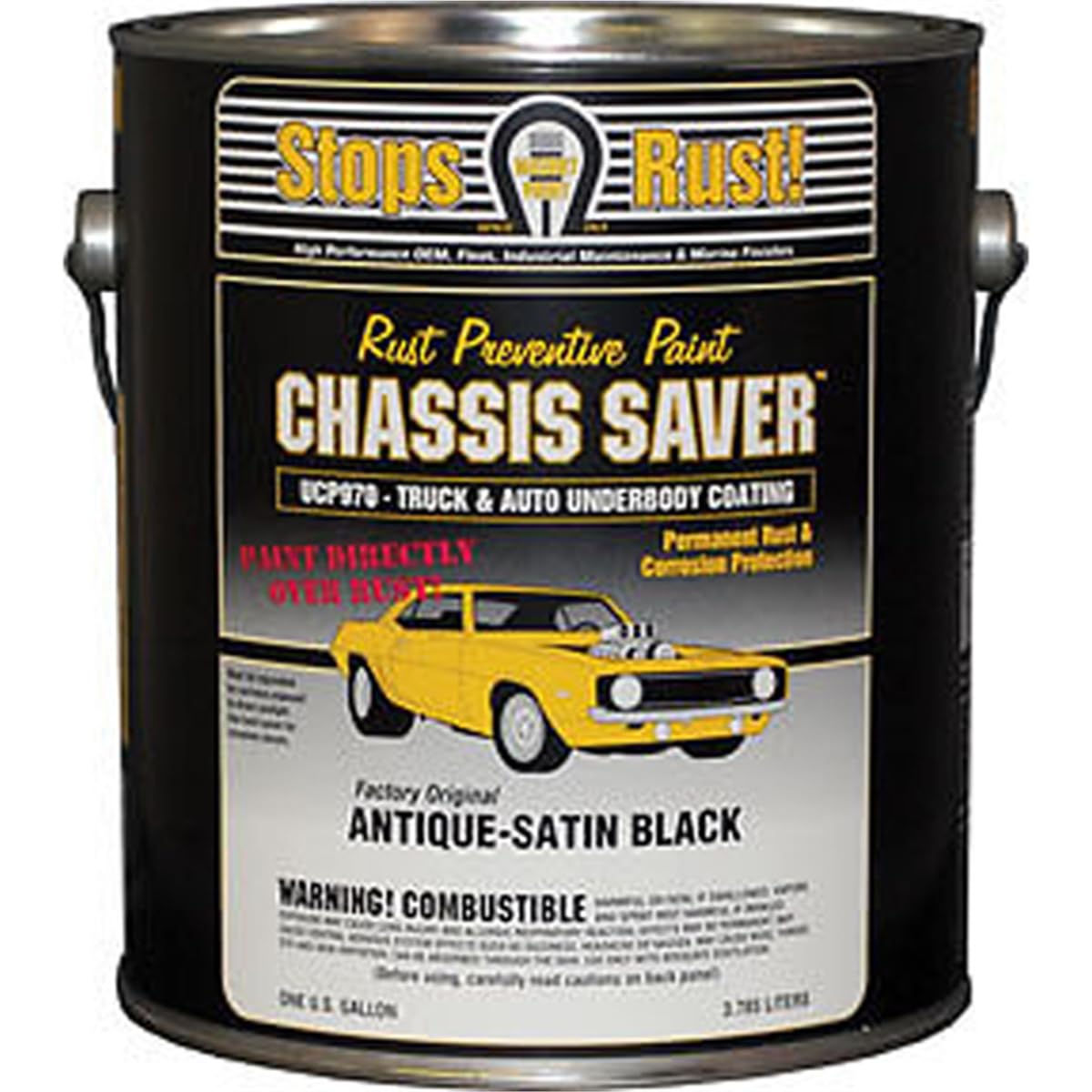
Chassis Saver is the volume king—one gallon covers significantly more area than any quart-sized competitor, making it the go-to choice for full truck frames, underbody coatings, and large trailers. The chemistry is a high-solids, moisture-cure urethane that forms a rock-hard yet flexible glaze that bonds directly to tightly adhered rust after only wire-brushing and scraping. No primer or topcoat is required.
The satin black finish produces a durable, non-porous film that isolates metal from oxygen and moisture. Customers report that it hardens to a finish similar to a catalyzed paint, yet no mixing of hardeners is needed. Reviews compare it favorably to POR-15, noting that Chassis Saver is thicker and covers more area, though it doesn’t penetrate into cracks as effectively and is slightly less tough against sharp impacts.
The main drawbacks are the strong odor—requires a respirator for indoor use—and the difficulty of removing the product from skin (solvent required). Also, foam brushes disintegrate when used with this paint; a bristle brush or roller is essential. For budget-conscious restorers with large surface areas, the value per square foot is unmatched.
Why it’s great
- 1-gallon size offers the lowest cost per square foot for large projects
- Moisture-cure urethane forms a hard, flexible glaze without hardeners
- Can be applied directly over wire-brushed rust with minimal prep
Good to know
- Thick consistency doesn’t penetrate deep into cracks like thinner coatings
- Foam brushes fall apart—use a bristle brush or roller
- Strong odor requires a respirator and good ventilation
5. Meuvcol Rust Converter & Primer
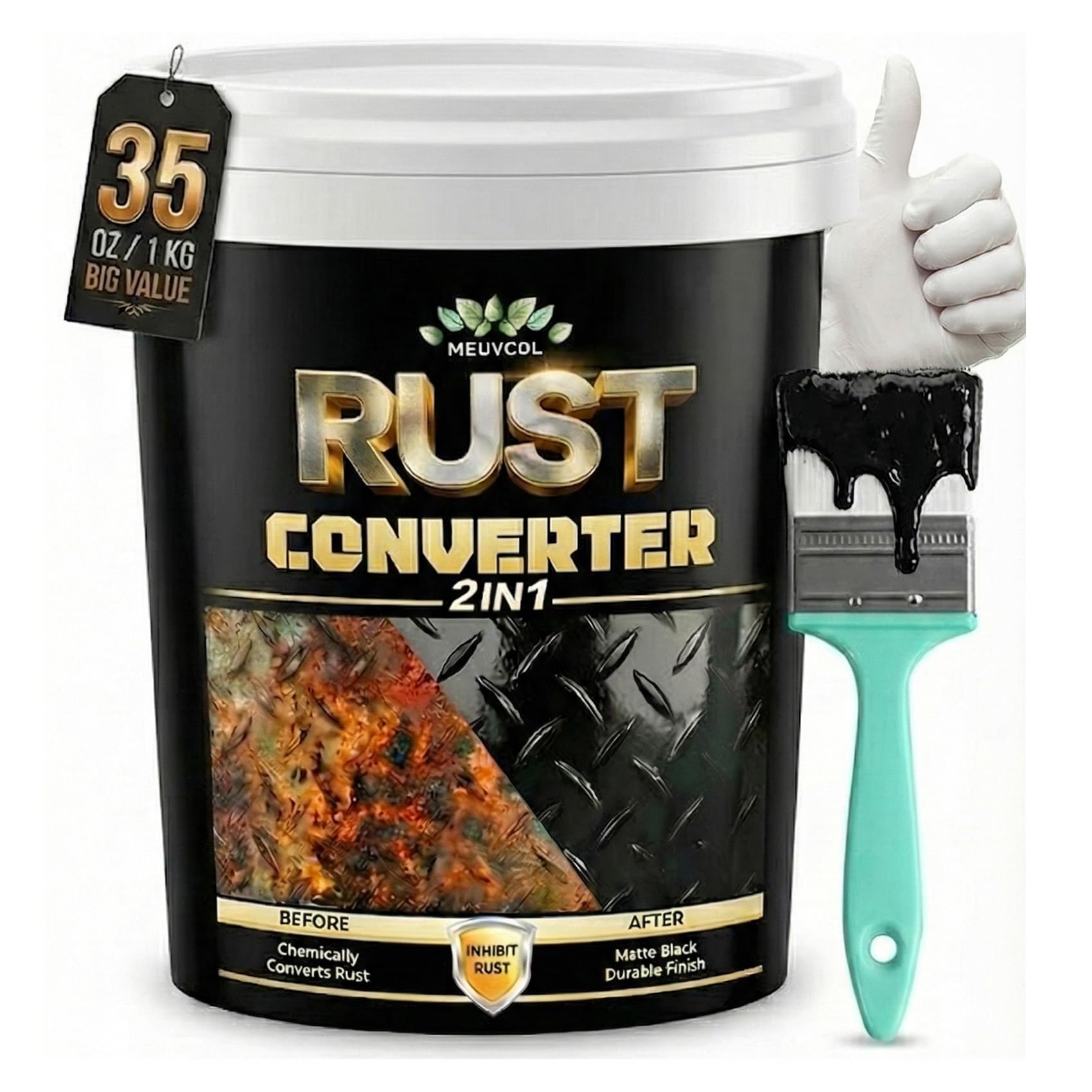
Meuvcol combines two actions in one formula—chemical rust conversion and surface encapsulation. The converter component uses acid chemistry to turn iron oxide into a stable black layer, while the encapsulator seals that layer under a waterproof film. The result is a single-coat solution that works on both rusted and bare metal, saving time on multi-step processes.
The 35-ounce can is generous for the price, and it comes with a brush and gloves in the package. The matte black finish dries to the touch quickly and forms a thick coating that reviewers describe as rubbery and durable. Users have applied it to RV underbellies, vintage car floors, and boat trailers with good results, noting that it stops existing rust from spreading and prevents new corrosion.
The potential concern is that the chemical converter may not penetrate deep enough into heavy pitting compared to a dedicated converter followed by a separate encapsulator. Some reviewers wondered if the coating was just a thick paint rather than a true chemical conversion—but for light to moderate rust, the convenience is hard to beat. Use in a well-ventilated area due to strong fumes.
Why it’s great
- Combines rust converter and encapsulator in one step
- Generous 35 oz can includes brush and gloves
- Thick, waterproof coating forms quickly with brush-on application
Good to know
- Chemical conversion may not penetrate heavy pitting
- Strong odor—requires ventilation during application
- Longevity on outdoor surfaces is not yet proven in long-term reviews
6. Rust-Oleum Farm & Implement Enamel

Rust-Oleum’s Farm & Implement Enamel is a value-oriented enamel formulated specifically for tractors, trailers, lawn equipment, and other farm machinery. It’s not a moisture-cure urethane—it’s an alkyd enamel that dries by solvent evaporation—but it offers excellent coverage at roughly 130 square feet per quart, making it very budget-friendly for large equipment.
The low-gloss black finish matches original equipment manufacturer colors, which matters for restoration projects where factory appearance is important. The paint resists chipping and weather damage, and the 2-4 hour dry time means you can finish a tractor in a day. Customers report that adding a hardener improves durability significantly, making it closer to a catalyzed finish for automotive and trailer applications.
The enamel requires a primer on bare metal for best rust protection, and the finish is softer than urethane coatings—it can chip under heavy impacts. If you’re repainting a Sunday mower or a light-duty trailer, the value and ease of application are hard to beat. For a heavy-use farm vehicle that sees rocks and salt, consider stepping up to a moisture-cure product.
Why it’s great
- Exceptional coverage area for the cost—great for large equipment
- Low-gloss finish matches OEM tractor and trailer colors
- Dries to the touch in 2-4 hours for same-day recoating
Good to know
- Not a moisture-cure urethane; softer and more prone to chipping
- Requires primer on bare metal for optimal rust protection
- Adding hardener improves durability but adds cost and complexity
7. Rust-Oleum Cold Galvanizing Compound

This is not a general-purpose anti rust paint—it’s a zinc-rich compound designed for touch-ups on galvanized steel and welding repairs. The zinc content provides sacrificial protection, meaning the coating corrodes before the underlying steel does, which is the same principle as hot-dip galvanizing. It’s ideal for repairing damaged galvanized roofs, fence posts, and metal building panels.
The gloss silver finish matches existing galvanized surfaces reasonably well. The 16-ounce can covers only about 12 square feet, which reflects the high zinc solids content—you’re paying for the protective chemistry, not coverage volume. Customers report excellent results on metal roofs, with rust stopped for years when biannual inspections catch new spots early.
The compound is not suitable for painting large bare-metal surfaces—it’s a repair tool, not a full coating. The coverage is limited, and the 12-hour dry time plus 24-hour full cure is slower than enamel options. But for its specific niche—repairing galvanized coatings—it outperforms any paint-based solution because the zinc actually works electrochemically.
Why it’s great
- Zinc-rich formula provides sacrificial protection like hot-dip galvanizing
- Perfect for repairing damaged galvanized roofs and fence posts
- Built-in primer stops rust on welding repairs and scratched metal
Good to know
- Low coverage at 12 sq ft per can—designed for touch-ups, not large areas
- 12-hour dry time with 24-hour full cure is slower than most paints
- Not formulated for painting large bare-metal surfaces
FAQ
Can I apply anti rust paint over existing rust without sandblasting?
What is the difference between a rust converter and a rust encapsulator?
Final Thoughts: The Verdict
For most users, the best anti rust paint winner is the POR-15 Rust Preventive Coating because its moisture-cure urethane chemistry and three-step system provide the most reliable long-term rust protection for automotive and heavy equipment frames. If you want a coating that withstands high heat on engine parts, grab the KBS Coatings RustSeal. And for large-budget projects like full truck frames or underbody coatings, nothing beats the Magnet Paint Chassis Saver for value per square foot.