
Our readers keep the lights on and the weekend projects moving. As an Amazon Associate, I earn from qualifying purchases.
A deep-space image is built over seconds, not clicks. Any flex in the legs, any drift in the head, and those 30-second subs turn into a smeared mess. An astrophotography tripod needs to be a rigid platform first and a portable gear second — the opposite of what many general-purpose travel sticks deliver.
I’m Rikta — the co-founder and writer behind FitlyFast. Over many hours of cross-referencing load ratings, leg-tube diameters, and twist-lock designs across the mid-range to premium bracket, I’ve separated the gear that truly holds a guided telescope or a telephoto rig from the models that introduce micro-vibrations at the worst possible moment.
Whether you are framing the Orion Nebula or tracking a lunar eclipse, the right support determines how sharp each pixel lands. This guide breaks down the nine most capable contenders in the astrophotography tripod category by the specs that matter — leg-section thickness, payload overhead, and head stability.
How To Choose The Best Astrophotography Tripod
The night sky punishes weak support. A breeze you do not feel on your face can turn a 30-second sub-frame into a blur. Choosing the right tripod starts with three hard constraints that every astrophotographer needs to evaluate before turning the first lock.
Leg Material and Tube Diameter
Carbon fiber wins for vibration damping — it absorbs high-frequency jitter better than aluminum. However, the tube diameter matters more than the material label. Look for upper-leg tubes of at least 28 mm; thinner legs flex under a telescope or a long telephoto lens. A 32 mm or 40 mm top section adds stiffness that lets you shoot at full extension without a wobble.
Load Capacity and Real-World Margin
Manufacturer load numbers are static lab values. In the field, you need at least 2.5x your actual gear weight. If your camera, lens, and tracking mount weigh 10 lb, choose a tripod rated for 25 lb or more. That margin keeps the assembly stable when you add a counterweight bag or a guide scope.
Head Type for Night Work
Ball heads are compact and light, but many lack the fine tension control needed to prevent drift when you lock the composition. Fluid heads and geared heads offer smoother micro-adjustment, especially when you need to frame a target in complete darkness. Look for a head that has a separate pan lock and a separate tilt lock — single-knob combos introduce unwanted movement.
Quick Comparison
On smaller screens, swipe sideways to see the full table.
| Model | Category | Best For | Key Spec | Amazon |
|---|---|---|---|---|
| INNOREL CT404C | Heavy-Duty Carbon | Large telescopes and guide rigs | 40 mm leg tubes / 88 lb load | Amazon |
| INNOREL GT324C | Pro Compact CF | Studio-to-field hybrid work | 32.5 mm leg tubes / 10-layer carbon | Amazon |
| K&F Concept X-Series | Mid-Range CF | Travel with heavier glass | 28 mm leg tubes / 35.2 lb load | Amazon |
| SIRUI ST-124+VA-5 | Video Hybrid | Video and long-lens tracking | Carbon fiber / fluid head included | Amazon |
| NEEWER LITETRIP LT32 | Ultralight CF | Backcountry astro hikes | 1.18 kg weight / 22 lb load | Amazon |
| Vortex High Country II | Aluminum All-Rounder | Spotting scopes and binocular astro | 22 lb load / Arca-Swiss plate | Amazon |
| SIRUI Traveler 7C | Travel CF | Lightweight APO refractors | 17.6 lb load / convertible monopod | Amazon |
| NEEWER TP74 | Aluminum Video Stand | Budget-friendly guided setups | 17.6 lb load / 75 mm bowl base | Amazon |
| K&F Concept A255C2+BH-36L | Entry-Level CF | Starting out and light mirrorless rigs | 33 lb load / detachable monopod | Amazon |
In‑Depth Reviews
1. INNOREL CT404C

The CT404C is the heaviest hitter in this group — 40 mm upper leg tubes in a carbon fiber wrap that eliminates any flex even with a full astro rig on top. The 88 lb static rating means you can mount a mid-sized Schmidt-Cassegrain telescope or a heavy EQ mount without worrying about the legs creeping during a 5-minute sub-exposure.
Twist locks with a smooth quarter-turn action let you adjust height in the dark without fumbling. The included stone bag and gravity hook add field-tested stability when the wind picks up, and the retractable stainless spikes dig into grass or dirt to prevent lateral shift. Weighing just over 5 lb for the legs alone, it sacrifices some portability for uncompromising rigidity.
The kit also arrives with a CNC magic arm, phone clip, and a generous carrying bag. You pay a premium, but for anyone running a dedicated guided setup, this is a one-time purchase that replaces the need for a second tripod.
Why it’s great
- 40 mm leg tubes provide industry-leading stiffness for heavy payloads
- Stone bag and spikes improve stability on uneven terrain
- CNC accessories included for attaching monitors or guide cameras
Good to know
- Heavier than travel-focused carbon models at over 6 lb with head
- Ball head not included — you need a separate fluid or geared head
2. INNOREL GT324C

The GT324C delivers serious stiffness in a package that folds to 24.4 inches. The 32.5 mm top leg section is thicker than most mid-range tripods, and the 10-layer carbon fiber layup damps vibrations faster than standard 8-layer tubes. This model is ideal when you need to pack a solid platform into a carry-on but still support a DSLR with a heavy telephoto or a small refractor.
Its special-shaped triangular center column is more compact than a round column of equal strength, and the low-profile ball head with a 44 mm ball diameter offers solid holding torque without adding height. Three leg-angle stops let you go from full standing height to a near-ground macro position quickly, which helps when aligning a star tracker low on the horizon.
Minor trade-off: the ball head can introduce a small sag when the tension knob is released, so pre-loading the lock is advised. The kit includes a short center column for extreme low-angle work and three stainless spikes, making it versatile for both studio and field night shoots.
Why it’s great
- Thick 32.5 mm legs rival larger tripods in stability
- Triangular center column saves space without losing strength
- Includes spare center column and spikes for ground-level shooting
Good to know
- Ball head has slight sag when releasing camera — requires careful lock sequence
- Folded length is longer than dedicated travel models at 24.4 inches
3. K&F Concept X-Series
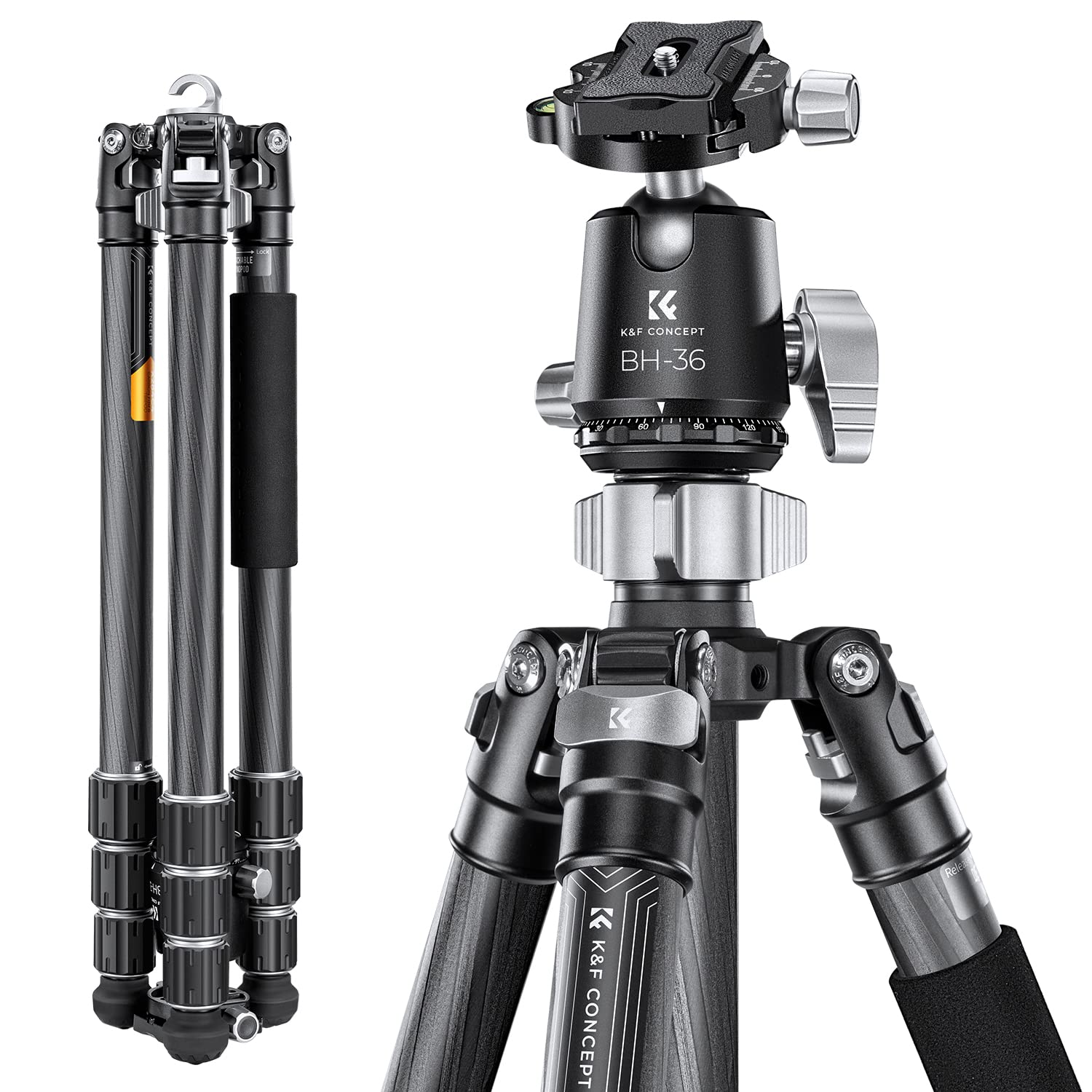
The K&F Concept X-Series hits a sweet spot between weight and capability. The 28 mm full carbon tubes hold up to 35.2 lb, giving you a comfortable safety margin for a mirrorless body, a small star tracker, and a 200 mm lens. The 36 mm CNC-machined metal ball head provides smooth panning with a distinct 360° scale for panoramic stitching of Milky Way segments.
Weighing only 1.55 kg with the head, this tripod is easy to carry on a long hike to a dark-sky site. The twist locks on the four-section legs are reliable and require little force to secure. The center column includes a hook for hanging a counterweight bag, a feature that becomes essential when shooting in a breeze at full extension.
The only compromise is the ball head’s lack of a spring-loaded plate release — the knob-based design demands extra attention when swapping cameras to avoid accidental drops. For most astrophotographers using a dedicated camera on a tracker, this is a manageable workflow nuance rather than a deal-breaker.
Why it’s great
- Lightweight carbon build at 1.55 kg with head
- High 35.2 lb static load provides real margin for mid-range rigs
- CNC metal ball head offers smooth 360° panning
Good to know
- Ball head lacks spring-loaded QR release — must use caution when swapping cameras
- Center column must be removed from bottom for low-angle astro shots
4. SIRUI ST-124+VA-5

The ST-124+VA-5 is one of the few bundles that pairs a carbon fiber leg set with a proper fluid video head. The VA-5 head uses high-density aluminum alloy and a hard anodized process to deliver smooth, drag-controlled pans and tilts — ideal for tracking satellites, the moon, or time-lapse sequences where you need micro-adjustments without jarring movement.
The triangular center column design reduces rotational flex compared to round columns of the same cross-section. Legs feature retractable stainless spikes that retract into rubber feet, letting you switch from a smooth studio floor to loose gravel without swapping parts. The 62.2-inch maximum height is tall enough for most standing eyepiece or camera work.
Users note the leg locks need slightly more twisting force than some competitors, but the trade-off is a consistently tight lock that prevents any leg creep during long sessions. The head’s side drop-in plate makes mounting a scope or camera easier in the dark compared to top-loading designs. A small number of owners prefer the older VA-5 head version, but the current model delivers excellent value for an integrated video-astro setup.
Why it’s great
- Fluid video head included — rare in carbon fiber bundles at this level
- Triangular center column improves torsional stiffness
- Retractable spikes handle both indoor and outdoor terrain
Good to know
- Leg twist locks require more turns than some competitors
- Center column needs extra tightening to prevent wobble at full height
5. NEEWER LITETRIP LT32

At 1.18 kg with a 22 lb load rating, the NEEWER LT32 is purpose-built for the hiking astrophotographer. The 100% carbon fiber legs use spring-loaded flip buckles instead of twist locks, making setup and breakdown faster in cold conditions where fine finger dexterity drops. It folds to 17 inches, fitting inside most backpack side pockets.
The ±15° quick leveling ball head base lets you level the camera platform without adjusting leg lengths individually — a major time-saver when setting up a star tracker on uneven ground. The dual 1/4-inch accessory threads on the spider allow you to attach a guide scope or a dew heater controller directly to the legs, keeping your rig organized.
The compromises are typical for an ultralight design: at full 62-inch extension, the rig feels less confident under heavy telephoto lenses, so maintaining a lower leg angle or using the center column hook for a counterweight is recommended. The included ball head also has slight portrait-mode creep under heavier cameras, but upgrading the head later is straightforward given the standard Arca-Swiss plate.
Why it’s great
- Extremely lightweight at 1.18 kg for ultralight backpacking
- Spring flip buckles enable rapid deployment in cold weather
- ±15° leveling base speeds up star tracker alignment
Good to know
- Not as stable at full extension under heavy gear — use counterweight hook
- Ball head may allow minor portrait creep with heavier cameras
6. Vortex High Country II

The High Country II is a machined aluminum tripod with a 2-way pan head built for spotting scopes and binoculars, but it translates well to lunar and planetary imaging where sweeping pan adjustments are common. The 22 lb max load is conservative; the leg structure feels solid under heavier optics without the jitter that affects ultralight aluminum frames.
Three-angle leg pivot locks give you the flexibility to drop low for ground-level shooting while the Arca-Swiss quick-release system makes swapping between a scope and a camera body fast. A detachable counterweight hook lets you add a bag for extra stability on breezy nights. The 62.5-inch maximum height is sufficient for most standing observation or eyepiece projection work.
The main limitation for deep-sky work is the 2-way head — it lacks independent pan and tilt lock knobs, which makes micro-adjustments for framing a target more fiddly than a dedicated ball head or fluid head. The aluminum construction also transfers more vibration than carbon fiber, so a remote shutter and a delay timer become critical for exposures longer than 10 seconds.
Why it’s great
- Built for heavy spotting scopes with a solid, no-flex feel
- Arca-Swiss quick-release system compatible with many astronomy accessories
- Vortex unlimited lifetime warranty covers defects and damage
Good to know
- 2-way pan head is less precise for deep-sky framing than a ball head
- Aluminum legs transfer more vibration than carbon fiber
7. SIRUI Traveler 7C

The Traveler 7C excels when you need a compact platform that doubles as a monopod for daytime hikes. The carbon fiber legs extend to 65.55 inches while folding down to 18.9 inches, and the center column inverts for macro and low-angle astro shots. The 17.6 lb load rating is adequate for a mirrorless body with a moderate zoom lens or a small APO refractor.
Four-section carbon legs with twist locks provide quick height changes, and the 360° ball head has separate knobs for pan and tilt, giving you independent control when composing a Milky Way arch or a tracked wide-field shot. The center column hook lets you hang a bag to dampen wind-induced vibration, a feature that noticeably improves stability at full extension.
The main trade-off: the included Arca-Swiss plate is proprietary to Sirui and not fully compatible with all standard Arca clamps, so you may need to replace the plate if you frequently swap between tripod heads. Also, the plastic leg caps on early production runs were a known weak point, though current stock has reinforced construction.
Why it’s great
- Compact folded size of 18.9 inches for airline travel
- Converts to a full-height monopod for daytime versatility
- Center column hook adds stability with a hanging weight
Good to know
- Arca plate is proprietary and may not fit all standard clamps
- Not suitable for heavy telephoto or large telescopes at full extension
8. NEEWER TP74

The NEEWER TP74 delivers surprising stability for an entry-level aluminum video tripod. The double-tandem aluminum alloy legs and the mid-level spreader create a rigid base that holds a 17.6 lb payload without wobble. The fluid drag pan head supports 360° rotation and -75°/+90° tilt, making it suitable for tracking the moon across the sky or panning a tracked constellation.
The 75 mm bowl base includes a 360° scale for precise panoramic positioning, and the bubble level helps you achieve accurate alignment in the dark. The telescopic handle stores neatly when not in use. Several users have praised its stability for long-duration astro work with compact scopes like the Dwarf 2 telescope.
The downsides are typical for aluminum: it weighs over 10 lb, so it is not a hike-to-dark-site option, and the twist-lock leg adjustment is slower than flip-lock alternatives. The fluid head also has an auto-leveling spring that pushes the camera up unless the tilt knob is tightened firmly, requiring a brief adjustment period to master.
Why it’s great
- Heavy-duty aluminum build with mid-level spreader for vibration control
- Smooth fluid head for panning lunar and planetary targets
- 74-inch height accommodates tall users for standing observation
Good to know
- Heavy at over 10 lb — not for backpacking
- Fluid head has auto-leveling spring that requires careful tilt lock management
9. K&F Concept A255C2+BH-36L

The K&F Concept A255C2 is the most accessible carbon fiber option for someone entering astrophotography without a massive budget. The aerospace-grade carbon legs support a claimed 33 lb load, and the 36 mm metal ball head offers oil-free damping for smooth panoramic rotation. The 180° reflex design folds the tripod to 19.2 inches, and the entire setup with head weighs only 1.3 kg.
The detachable monopod feature is genuinely useful — you can unscrew one leg, attach the ball head, and have a stable walking stick that doubles as a quick support for grab-and-go moon shots. The 5-section legs give you a wide height range from 18.8 inches to 62 inches, covering ground-level wide-field work up to standing telescope eyepiece height.
Several users note the ball head uses plastic components on the lock ring and quick-release mechanism — upgrading to an all-metal head is a common first mod. The twist locks are functional but not as fast as flip-lock designs, and the leg tubes can produce a very slight twist under maximum load. For a beginner using a lightweight DSLR or mirrorless on a star tracker, however, the A255C2 delivers carbon fiber stability at an entry-level investment.
Why it’s great
- Affordable carbon fiber construction with a 33 lb load rating
- Converts to a full-height monopod for daytime versatility
- Ultralight at 1.3 kg — easy to carry to remote dark sites
Good to know
- Ball head uses plastic components on the lock ring — consider a metal head upgrade
- Legs show minor torsional flex under maximum load
FAQ
Can I use any standard tripod for astrophotography?
Should I choose a ball head or a fluid head for deep-sky imaging?
How important is the center column hook for night shooting?
Final Thoughts: The Verdict
For most users, the astrophotography tripod winner is the INNOREL CT404C because its 40 mm leg tubes and 88 lb load rating deliver rock-solid stability for heavy telescopes and guided rigs while still being manageable for fieldwork. If you want a lighter setup for backpacking to dark-sky sites, grab the NEEWER LITETRIP LT32. And for a video-centric hybrid that handles both lunar tracking and daytime spotting, nothing beats the SIRUI ST-124+VA-5.