
Our readers keep the lights on and the weekend projects moving. As an Amazon Associate, I earn from qualifying purchases.
The narrow blade structure of Bermuda grass makes it tough and resilient through summer heat, but that same density creates a canopy where broadleaf weeds like clover, dandelion, and spurge thrive. Hit them with the wrong chemistry, and you risk thinning the very turf you’re trying to protect. The challenge isn’t finding a weed killer — it’s finding one that targets broadleaf invaders without setting back your Bermuda lawn.
I’m Rikta — the co-founder and writer behind FitlyFast. I’ve spent hundreds of hours analyzing herbicide labels, reviewing mix-rate math, and cross-referencing active ingredients against warm-season grass safety data to build this guide with the precision a Bermuda lawn deserves.
After combing through real-world testing results and application feedback across dozens of formulations, I’ve narrowed the field to the seven most effective options that balance fast knockdown, turf safety, and seasonal versatility. Here is my definitive list of the best broadleaf weed killer for bermuda grass.
How To Choose The Best Broadleaf Weed Killer For Bermuda Grass
Bermuda grass is a warm-season workhorse that spreads through stolons and rhizomes, but its aggressive growth habit makes it sensitive to certain herbicides during active growth. Choosing the wrong active ingredient — or applying at the wrong rate — can yellow the turf and stall green-up for weeks. Start by identifying the weeds you’re fighting: clover, dandelion, and chickweed respond well to 2,4-D and dicamba blends, while crabgrass requires quinclorac or mesotrione. For perennial tough weeds like dallisgrass or nutsedge, MSMA or a higher-concentration selective product is necessary. Always check the label for the words “safe for use on Bermudagrass” — if the label lists bentgrass, St. Augustine, or fine fescue but omits Bermuda, do not use it.
Active Ingredient Compatibility
The three-way blend of 2,4-D, dicamba, and mecoprop-p (found in products like SpeedZone) is the gold standard for cool-weather broadleaf control on Bermuda. Quinclorac is the go-to for crabgrass without harming Bermuda, but it can be weak on clover. Mesotrione (Tenacity’s generic equivalent) is effective pre- and post-emergent but can temporarily bleach or stunt Bermuda if applied during peak heat or on drought-stressed lawns. MSMA remains a powerful tool for grassy weeds like dallisgrass but requires precise mixing to avoid turf burn. Avoid products with high rates of sulfonylureas unless the label explicitly states Bermuda tolerance.
Application Timing and Turf Stress
Bermuda grass enters full growth when soil temperatures reach 65°F — this is the window for post-emergent applications. Spraying during a summer heatwave (above 90°F) significantly increases the risk of leaf burn, especially with products containing carfentrazone or mesotrione. Early spring applications before green-up can be made with certain dormant-safe products like mesotrione, but most broadleaf killers should wait until the turf is actively growing and not stressed. Late-season applications after the first fall frost may kill the weeds, but the Bermuda will not recover until the next spring, so aim for treatments before late September in cooler zones.
Quick Comparison
On smaller screens, swipe sideways to see the full table.
| Model | Category | Best For | Key Spec | Amazon |
|---|---|---|---|---|
| SpeedZone EW | Selective Liquid | Fast knockdown of broadleaf weeds | 2,4-D + Dicamba + Carfentrazone | Amazon |
| Select Source Quinclorac 75 | Selective Powder | Crabgrass control on Bermuda | 75% Quinclorac granules | Amazon |
| Liquid Harvest Mesotrione | Pre/Post Liquid | Dormant Bermuda weed clearing | 8 oz Mesotrione concentrate | Amazon |
| The Andersons Surge Weed & Feed | Granular Feed | Season-long broadleaf prevention | 16-0-9 + four-way herbicide | Amazon |
| PBI/Gordon Trimec | Selective Liquid | Hard-to-kill weeds at scale | 1 gallon Trimec concentrate | Amazon |
| Target 6 Plus MSMA | Grassy Weed Liquid | Dallisgrass and nutsedge on Zoysia/Bermuda | 48.2% MSMA (2.5 gal) | Amazon |
| Airmax Shoreline Defense | Aquatic Herbicide | Shoreline and pond weed control | Glyphosate 1 gal concentrate | Amazon |
In‑Depth Reviews
1. SpeedZone EW Lawn Weed Killer

SpeedZone EW is the benchmark for rapid broadleaf control on Bermuda grass. The four active ingredients — 2,4-D, dicamba, carfentrazone, and mecoprop-p — work in synergy to deliver visible wilting within hours, not days. Users consistently report full weed death in 48 hours for clover, dandelion, ground ivy, and spurge, with no measurable damage to established Bermuda when mixed at the label rate of 1.8 fl oz per gallon for warm-season turf.
The cool-weather performance sets SpeedZone apart from competitors that require warmer soil temperatures for activation. This product remains effective even when applied in early spring or late fall, making it a season-extender for northern Bermuda transition zones. Results are rainfast in as little as three hours, which reduces the risk of wash-off from unexpected showers.
One caution: the concentrate is potent, and users should measure carefully — the cap holds roughly 0.2 fl oz, so a graduated measuring cup is recommended for consistent mixing. Over-application beyond the label’s maximum two annual treatments can stress the turf and may require reseeding patches.
Why it’s great
- Visible results within hours, full kill in 2 days
- Labeled safe for Bermuda, zoysia, tall fescue
- Rainfast in 3 hours — low wash-off risk
Good to know
- No measuring cup included; cap holds ~0.2 fl oz
- Limit 2 applications per year for optimal turf health
2. Select Source Quinclorac 75 Herbicide
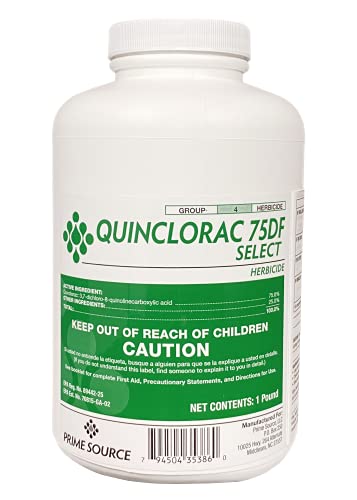
For Bermuda grass lawns battling a crabgrass invasion, Quinclorac 75 is the most targeted solution in this lineup. The granular formulation mixes into a liquid spray at just 0.367 oz per gallon — roughly 1.4 teaspoons — making it economical for large properties. Users document crabgrass death within three to five days of application, with full root kill in under two weeks, while Bermuda grass remains completely unharmed even at slightly elevated concentrations.
This product is also effective on dallisgrass and barnyardgrass, but its strength is its selectivity: it targets grassy weeds without affecting the desirable Bermuda turf. Pre-germination applications can prevent crabgrass emergence entirely, giving it dual utility as both a post-emergent eradicator and a mild pre-emergent barrier.
Mixing accuracy is critical — the powder is fine and can drift in windy conditions. Users recommend adding a non-ionic surfactant to improve leaf adhesion and avoiding applications above 90°F to prevent volatilization. The large container lasts multiple seasons for most residential lawns.
Why it’s great
- Fast-acting on crabgrass, visible results in 3-5 days
- Completely safe on Bermuda seed and established turf
- Economical — 1 lb treats large areas for multiple seasons
Good to know
- Label mix rate is hard to convert; use a scale for precision
- Requires surfactant for best results; not included
3. Liquid Harvest Mesotrione Concentrate

Liquid Harvest Mesotrione is the closest generic equivalent to branded Tenacity, making it a budget-friendly option for pre-emergent and early post-emergent broadleaf control. The active ingredient works by inhibiting photosynthesis — affected weeds turn white before dying — and it is one of the few herbicides labeled for application on dormant Bermuda grass without risk of injury. Users report excellent results on clover, wild violet, crabgrass, and bentgrass, with full weed death visible two to three weeks after treatment.
Activation is critical: the label requires 0.15 inches of water within 10 days of application. Without rain or irrigation, the chemical sits on the leaf surface and degrades before reaching the root zone. The product mixes at 1 tsp per 2 gallons of water for general spot spraying, making the 8 oz bottle stretch across several treatments for a medium-sized lawn.
Note that mesotrione can temporarily bleach or stunt actively growing Bermuda if applied during peak summer heat. Users in transition zones report best results when spraying in early spring before green-up or in late fall after the first frost. A spray dye is recommended to prevent overlapping and double-dosing.
Why it’s great
- One of the few herbicides safe for dormant Bermuda
- Effective on 46 weed species including crabgrass and clover
- Highly concentrated — 8 oz goes a long way
Good to know
- Requires water activation within 10 days of application
- May bleach or stunt Bermuda if applied during heat stress
4. The Andersons Professional Surge Weed and Feed
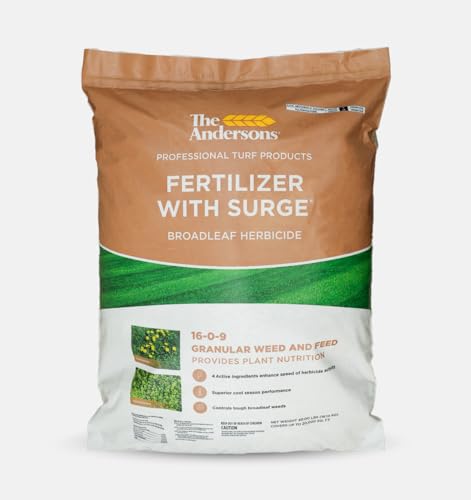
The Andersons Surge is a professional-grade granular weed-and-feed that combines a 16-0-9 fertilizer with a four-way herbicide blend targeting over 250 broadleaf weeds. The small-particle formulation ensures dense coverage — up to 16,000 sq ft per 40 lb bag — and the herbicide component works post-emergently on dandelion, clover, chickweed, and plantain while the fertilizer encourages thicker Bermuda growth to outcompete future weeds.
Users report strong greening within two weeks and visible weed suppression within 7-10 days. The product performs well in both spring and fall applications, even in cooler temperatures where liquid sprays often lose efficacy. It is particularly useful for homeowners who want a single annual treatment that both feeds the lawn and controls broadleaf weeds without needing a sprayer.
This product is not labeled for Floratam St. Augustine, dichondra, or carpetgrass, and users with mixed lawns should spot-check compatibility. The creeping Charlie (ground ivy) sometimes shows resistance, requiring a follow-up spot spray for complete eradication.
Why it’s great
- Treats 16,000 sq ft in one application — high coverage
- Dual action: feeds Bermuda while killing 250+ weeds
- Effective in cool spring and fall temperatures
Good to know
- Not for Floratam St. Augustine or dichondra lawns
- Ground ivy may require supplementary spot treatment
5. PBI/Gordon Trimec Lawn Weed Killer

PBI/Gordon Trimec is a three-way selective herbicide built for tackling tough, deeply rooted broadleaf weeds that resist lighter formulations. The 1-gallon size covers 32,000 to 64,000 sq ft at standard mix rates, making it the most economical option for large properties with heavy weed pressure. Users specifically praise its performance on creeping Charlie, wild violet, and Virginia buttonweed — weeds that often survive first-pass treatments from other products.
The active chemistry — a proprietary Trimec blend of 2,4-D, dicamba, and mecoprop — is designed for cool-season grasses but is safe on established Bermuda when applied according to the label. The key is adjusting the mix rate upward for heavy infestations: some users report doubling the Trimec portion relative to water for stubborn weeds, but this should be done cautiously to avoid Bermuda stress. At standard rates, the formula is gentle enough to not yellow the turf.
One downside: the product bottle sometimes ships with a different branded label (Weed-Out by ferti-lome), but the chemistry is identical. Users should also plan for multiple applications on perennial weeds, as buttonweed may take two weeks to fully die back.
Why it’s great
- Covers up to 64,000 sq ft — best value for large lawns
- Effective on creeping Charlie, violet, and buttonweed
- Gentle on Bermuda when mixed at label rates
Good to know
- May require double-strength mix for heavy infestations
- Some shipments arrive with alternate branding (same formula)
6. Target 6 Plus MSMA Turf Herbicide

Target 6 Plus MSMA is a heavy-duty solution for grassy weeds like dallisgrass, johnsongrass, and nutsedge that escape conventional broadleaf herbicides. With 48.2% MSMA concentration per gallon, this 2.5-gallon jug is designed for golf courses, sod farms, and commercial properties, but it scales down well for residential use at a mix rate of 2 oz per gallon of water. Users with Japanese zoysia and Bermuda lawns report complete dallisgrass elimination after two applications, with no damage to the desired turf.
The MSMA formulation is potent and works quickly — visible wilting within 24-48 hours, with full kill in under a week. Users from five years ago report the jug still has active product, a testament to the chemical’s stability when stored properly. The selective action targets grassy invaders without harming warm-season turf, making it a specialty tool for Bermuda lawns with persistent grassy weed problems that spot-sprays can’t control.
Precision mixing is non-negotiable: at 1.25 tbsp per 2 gallons, the product is strong enough to brown Bermuda if overdosed. One user noted that an accidental over-application combined with drought stress sent the lawn into dormancy. Follow the label rates exactly, and avoid spraying when temperatures exceed 95°F.
Why it’s great
- Highly effective on dallisgrass and nutsedge — tough weeds
- Fast results: visible death within 48 hours
- Long shelf life; one jug lasts many seasons
Good to know
- Overdosing can brown or stress Bermuda grass
- Best used as a spot treatment, not broad coverage
7. Airmax Shoreline Defense Emergent Weed Control
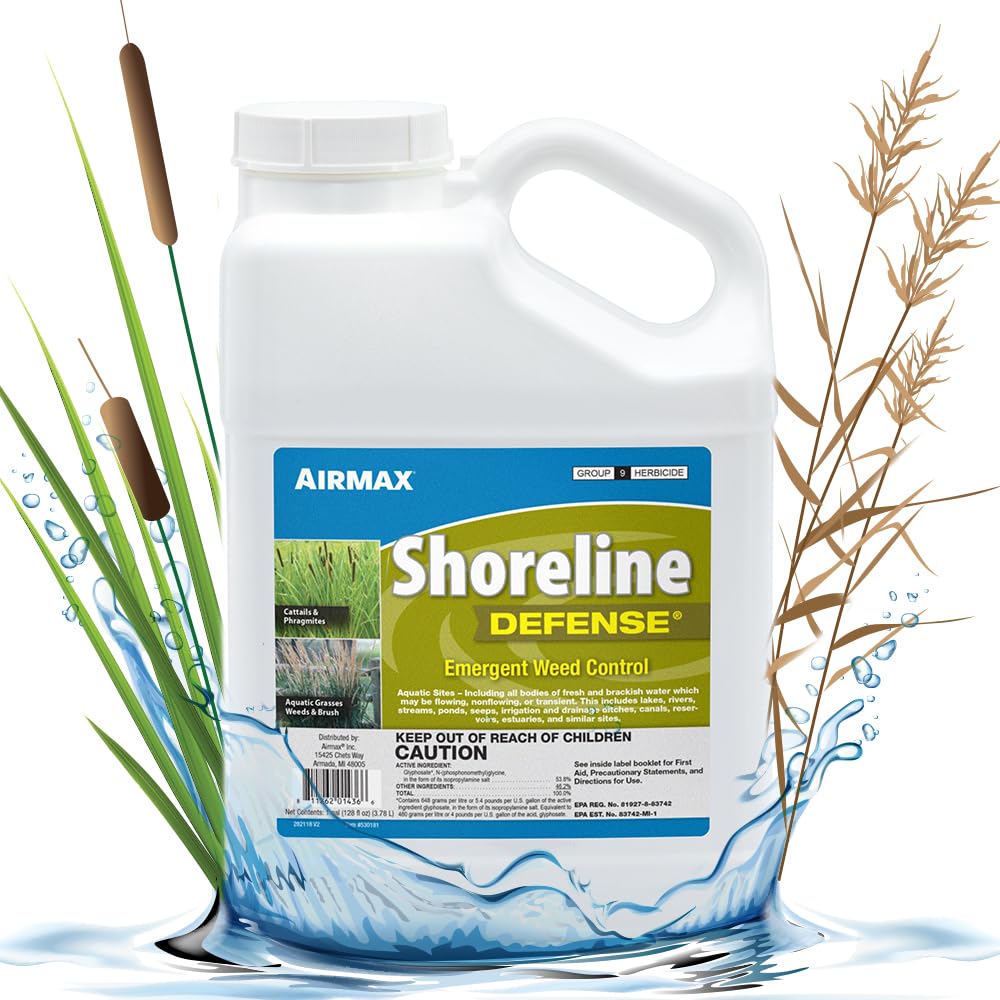
Airmax Shoreline Defense is a specialized aquatic herbicide for controlling emergent weeds like cattails, phragmites, and shoreline grasses that encroach on ponds, lakes, and drainage ditches — not a standard lawn product, but included here for properties where Bermuda grass borders water features. The glyphosate-based formula kills down to the root system, providing long-term control for shoreline weeds that would otherwise spread into the turf.
The product is mixed with a surfactant (not included) to improve adhesion on waxy aquatic plant leaves, and results are typically visible within two weeks of application. Users with lakefront properties report effective clearance around docks and beaches, with no harm to fish, birds, or other aquatic life when used according to the label. The 1-gallon jug covers approximately 10,000 sq ft of emergent vegetation.
This is not a selective product — glyphosate will kill any plant it touches, including desirable grasses if overspray occurs. For Bermuda grass lawns adjacent to water, use a shield or low-pressure spray tip to avoid drift onto the turf.
Why it’s great
- Effective on tough shoreline weeds: cattails, phragmites
- Root-kill action prevents regrowth
- Safe for fish and aquatic life when label directions are followed
Good to know
- Requires surfactant for leaf adhesion; not included
- Non-selective — keep spray off Bermuda grass
FAQ
Can I use SpeedZone on dormant Bermuda grass?
How long after spraying can I water the lawn?
Will quinclorac kill clover in my Bermuda lawn?
Can I reseed Bermuda after applying these herbicides?
Final Thoughts: The Verdict
For most users, the best broadleaf weed killer for bermuda grass winner is the SpeedZone EW because it delivers fast visible results within hours, works reliably in cooler weather, and is explicitly labeled safe for Bermuda grass when mixed correctly. If you need to target crabgrass without harming your turf, the Select Source Quinclorac 75 is the specialist choice. And for a single-application granular option that feeds the lawn while controlling broadleaf weeds across large areas, nothing beats the coverage of The Andersons Surge Weed and Feed.