
Our readers keep the lights on and the weekend projects moving. As an Amazon Associate, I earn from qualifying purchases.
Switching from a smartphone to a dedicated camera for your content is a game-changer, but the market is flooded with options that promise 4K yet deliver poor stabilization, horrific low-light performance, and confusing menu systems. The single biggest pain for vloggers is finding a compact camera that balances genuine image quality with the audio and autofocus tools needed for “set it and forget it” shooting. Your time is better spent creating, not fighting with camera settings.
I’m Rikta — the co-founder and writer behind FitlyFast. I’ve spent countless hours dissecting sensor sizes, codecs, and stabilization technologies to separate the real vlogging tools from the spec-sheet hype.
Whether you are starting your YouTube channel or upgrading your gear for higher production value, this guide to the best 4k vlogging camera breaks down seven top-tier, mid-range, and budget models based on real-world specs that matter for content creators.
How To Choose The Best 4K Vlogging Camera
Picking the right camera for your channel is a balance of portability, image quality, and audio capability. Here are three critical specs that will define your shooting experience.
Sensor Size and Low-Light Performance
A larger sensor is the single biggest factor for video quality. A 1-inch CMOS sensor, like the one found in the Sony ZV-1 series, captures significantly more light than a standard smartphone sensor. This directly translates to cleaner footage with less grain when you are filming indoors or at dusk. For a vlogger, this means your “golden hour” vlog isn’t ruined by noise.
Stabilization: Gimbal vs. Electronic
Shaky footage is the fastest way to lose viewers. A 3-axis mechanical gimbal, such as on the DJI Osmo Pocket 3, physically counteracts hand movement for buttery-smooth walking shots. In contrast, electronic image stabilization (EIS) crops into the sensor to stabilize footage, which can reduce field of view. For a vlogger on the move, a mechanical gimbal is a massive advantage.
Autofocus and Subject Tracking
When you are talking to the camera and walking, you cannot manually adjust focus. Look for cameras with phase-detection autofocus (PDAF) and real-time eye tracking. This feature ensures the camera stays locked on your face even when you move quickly, hold up a product, or spin around. Sony’s Real-Time Eye AF and Canon’s Dual Pixel CMOS AF II are the gold standards here.
Quick Comparison
On smaller screens, swipe sideways to see the full table.
| Model | Category | Best For | Key Spec | Amazon |
|---|---|---|---|---|
| DJI Osmo Pocket 3 Creator Combo | Premium Compact | Ultra-smooth walking vlogs | 1” CMOS + 3-Axis Gimbal | Amazon |
| Sony ZV-1 (Original) | Premium Point & Shoot | Studio vlogging & product showcases | 1″ Exmor RS + 24-70mm f/1.8-2.8 | Amazon |
| Canon PowerShot V1 | Mid-Range Hybrid | Long streaming & multipurpose use | 1.4-Type Sensor + Cooling Fan | Amazon |
| Sony ZV-1F Creator’s Kit | Mid-Range Bundle | Complete starter setup for beginners | 1″ Sensor + 20mm Ultra-Wide | Amazon |
| Canon EOS R50 V | Mid-Range ILC | Interchangeable lenses & vertical video | APS-C + Dual Pixel AF II | Amazon |
| DJI Osmo Nano Standard Combo | Budget Action Cam | Sports & hands-free POV vlogging | 1/1.3″ Sensor + Magnetic Mounts | Amazon |
| Sony ZV-1F | Budget Starter | Easy entry-level vlogging | 1″ Sensor + Product Showcase Mode | Amazon |
In‑Depth Reviews
1. DJI Osmo Pocket 3 Creator Combo

The Osmo Pocket 3 sets the benchmark for handheld vlogging with its 1-inch CMOS sensor combined with a true 3-axis mechanical gimbal. This combination produces exceptionally stable 4K footage at up to 120fps, allowing for silky-smooth slow-motion clips. The 2-inch rotatable touchscreen is perfectly designed for quick switching between horizontal and vertical framing, making it ideal for cross-platform creators.
ActiveTrack 6.0 ensures you stay centered in the frame even during dynamic movements like spinning or jumping, while the included DJI Mic 2 transmitter delivers broadcast-quality audio right out of the box. The Creator Combo also adds a battery handle, mini tripod, and carrying case, making it a complete, ready-to-shoot package for the serious vlogger.
The key trade-off is the fixed wide-angle lens, meaning you cannot zoom optically for distance shots. Also, the gimbal mechanism is somewhat fragile and requires careful handling. However, for pure, stable cinematic footage without the bulk of an interchangeable lens rig, this is the definitive choice.
Why it’s great
- Incredible 3-axis mechanical stabilization eliminates shaky footage.
- High-quality 4K at 120fps for creative slow-motion.
- Excellent built-in subject tracking with ActiveTrack 6.0.
Good to know
- Fixed wide-angle lens with no optical zoom.
- Integrated gimbal is delicate and not waterproof without a housing.
2. Sony ZV-1 Digital Camera

The original Sony ZV-1 remains a powerhouse for studio vlogging and controlled content creation. It houses a 20.1MP stacked 1-inch Exmor RS sensor behind a fast Zeiss Vario-Sonnar T lens with a 24-70mm equivalent focal length and a bright f/1.8-2.8 aperture. This allows for excellent subject separation (bokeh) right out of the lens, even without a large sensor.
Its hybrid image stabilization is effective for subtle hand-shake, but it does not match the gimbal-defined smoothness of the Pocket 3. Where the ZV-1 excels is its audio features: a side-articulating screen, a directional 3-capsule mic with a windscreen, and a standard 3.5mm mic jack. This makes it incredibly simple to get good audio in one take, a rare convenience for a compact camera.
The Product Showcase Setting seamlessly transitions focus from your face to an object you hold up, which is perfect for review and unboxing videos. However, the battery life is mediocre, often lasting only about 45 minutes of continuous recording, and the 4K footage can be prone to overheating in hot environments. It is the ideal desktop companion for a creator investing in a permanent studio setup.
Why it’s great
- Excellent image quality with a fast, zoom-capable lens.
- Best-in-class autofocus with Real-Time Eye tracking.
- Clear audio capture with a dedicated windscreen and mic jack.
Good to know
- Battery life is short; spare batteries are essential.
- Can overheat during extended 4K recording in warm conditions.
3. Canon PowerShot V1

The Canon PowerShot V1 is a hybrid camera built for vloggers who also want a strong stills performance. It features a unique 1.4-Type sensor (larger than a 1-inch but smaller than APS-C) that delivers 22.3MP for photos and 18.7MP for video, alongside a built-in 16-50mm f/2.8-4.5 ultra-wide-angle zoom lens. This gives you considerable optical zoom versatility in a pocketable body.
One distinct advantage this model has over its peers is an internal cooling fan, which extends high-resolution 4K recording times dramatically. This makes it a strong contender for live streaming or extended interview shoots where overheating would be a concern on most other compact cameras. It also offers Canon Log 3 with 10-bit color depth, giving editors significant latitude for color grading.
While the body is bulkier than the Sony ZV-1, it is still compact enough for a large jacket pocket. The electronic stabilization works well, but it crops the image and is less effective for walking shots than a mechanical gimbal. The lack of an included battery charger (USB-C only) is a minor inconvenience. This is the right choice for creators who shoot long form content or prioritize color grading in post.
Why it’s great
- Internal fan prevents overheating during long shoots and streams.
- Versatile optical zoom lens (16-50mm) in a compact body.
- Canon Log 3 with 10-bit color depth for advanced color grading.
Good to know
- Body is larger than typical 1-inch sensor compacts.
- No battery charger included; relies on USB-C charging.
4. Sony ZV-1F Content Creator’s Ultimate Kit

The Sony ZV-1F is essentially the ZV-1’s core imaging engine optimized for a fixed, ultra-wide 20mm f/2.0 lens. This focal length is perfect for arm’s-length selfie-style vlogging, ensuring you, your background, and even a guest fit easily into the frame. The 1-inch sensor combined with a fast f/2.0 aperture provides a beautiful background defocus effect and good low-light performance.
This kit transforms the ZV-1F into a complete starter studio. It includes a SanDisk Extreme Pro 128GB memory card, a U-grip for stabilized handheld shooting, a sturdy tripod, a microphone, a video light, and editing software. The inclusion of a UV filter protects the fixed lens, which is a welcome addition for outdoor vloggers who often worry about scratches or dust.
The trade-off compared to the standard ZV-1 is that the ZV-1F lacks optical zoom entirely. If you need to zoom in on a subject without moving, you will lose resolution. The battery life is also average, requiring spare batteries for a full day of shooting. As a complete “everything you need” package for the absolute beginner, it is fantastic value.
Why it’s great
- Excellent ultra-wide lens for easy selfie-style framing.
- Comes with all essential accessories (card, mic, tripod, light, bag).
- Background defocus button makes achieving cinematic look simple.
Good to know
- Fixed lens means no optical zoom capability.
- Battery life is average; consider buying a spare.
5. Canon EOS R50 V Mirrorless Camera
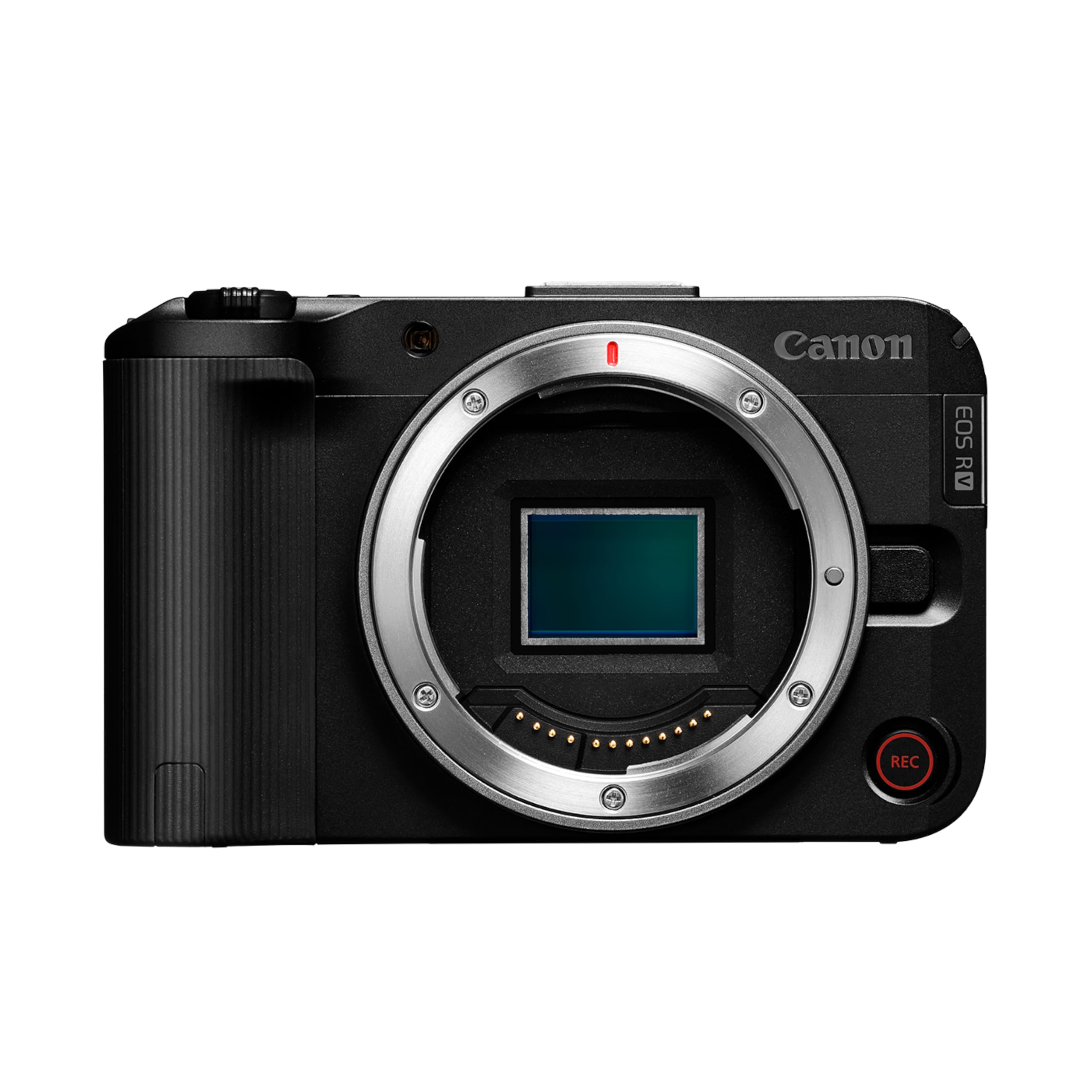
The Canon EOS R50 V is a dedicated video-first interchangeable lens camera (ILC) designed from the ground up for content creators. It features a 24.2MP APS-C sensor and the DIGIC X processor, capable of recording 4K at 59.94p with a crop and 4K at 29.97p full-width from the entire sensor area. The true highlight is Canon’s Dual Pixel CMOS AF II, which offers industry-leading subject detection for people, animals, and vehicles.
The body is redesigned for vertical video, including a dedicated front record button and a handy tripod mount aligned with the optical axis for stable vertical shooting. The absence of a viewfinder is a deliberate choice for vloggers who rely purely on the flip-out screen, keeping the body compact and light. The RF mount gives you access to a huge catalog of excellent and compact RF lenses, like the 28mm f/2.8 or the 50mm f/1.8.
This is a body-only package, meaning you need to invest in a lens. While it is small for a mirrorless camera, it is still larger than a fixed-lens compact. The battery life, while good for a mirrorless camera, is still a step down from a DSLR. For creators wanting the quality of a larger sensor with the flexibility to swap between a wide-angle for vlogs and a portrait lens for photos, this is the perfect step up.
Why it’s great
- Large APS-C sensor for superior video quality and depth of field.
- Interchangeable lens system allows for creative flexibility.
- Best-in-class Dual Pixel AF with subject detection.
Good to know
- Body only; requires additional purchase of a lens.
- Larger and heavier than a point-and-shoot vlogging camera.
6. DJI Osmo Nano Standard Combo
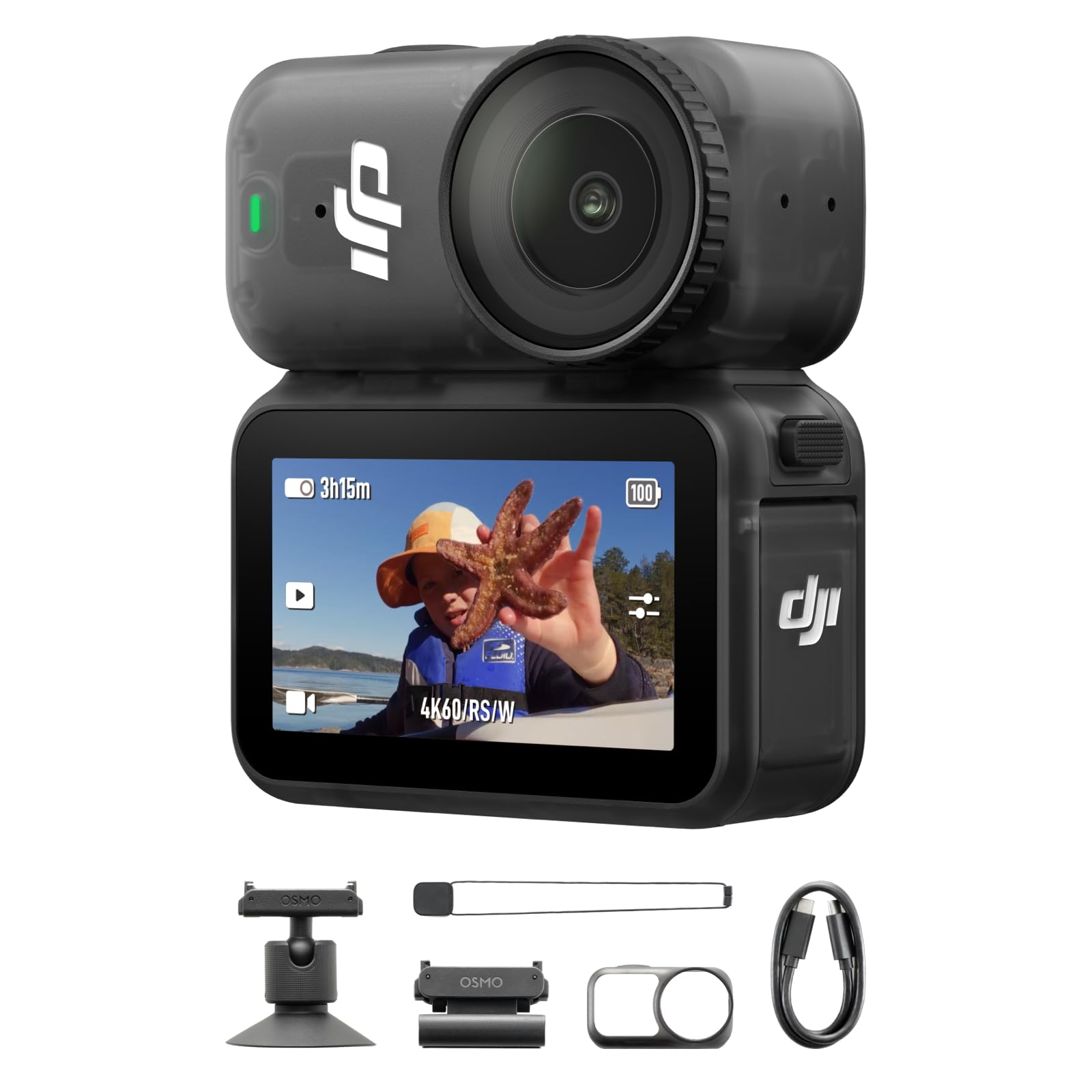
The DJI Osmo Nano is a new breed of action camera that prioritizes a small form factor and an ultra-wide perspective for immersive POV vlogging. Its 1/1.3-inch sensor records crisp 4K video at 60fps with a massive 143-degree field of view, and magnetic mounting accessories allow you to attach it to hats, bags, or lanyards for truly hands-free operation. This is the ideal tool for “walk and talk” content, travel vlogs, or documenting active hobbies like biking or climbing.
The built-in 128GB storage is a significant convenience, allowing you to start filming immediately without buying an SD card. The camera boasts up to 200 minutes of battery life with the vision dock, and it is waterproof up to 10 meters without a housing, making it extremely rugged for outdoor use. The magnetic system is incredibly versatile, letting you quickly switch from a chest mount to a handheld grip in seconds.
The main limitation is that it lacks a screen for precise framing, meaning you need to connect to the DJI Mimo app for composition, which can be a hassle in bright sunlight. Also, while it supports external microphones via the OsmoAudio ecosystem, the direct connection is limited to DJI mics. This is a specialty tool for creators who need a durable, compact camera that can capture unique first-person perspectives their main camera cannot.
Why it’s great
- Ultra-lightweight and compact with versatile magnetic mounting.
- Waterproof to 10m and durable for outdoor action vlogs.
- Large built-in storage of 128GB and excellent battery life.
Good to know
- Requires a smartphone app for framing shots.
- External mic compatibility is limited to DJI microphones.
7. Sony ZV-1F Vlog Camera

The Sony ZV-1F is the entry point into the Sony vlogging ecosystem, offering a 1-inch sensor and a fixed 20mm ultra-wide lens at a budget-friendly price point. This combination provides a clear step up in video quality from a smartphone, with real background defocus and excellent low-light performance. The side-articulating touchscreen is a necessity for self-view, and the red recording tally light ensures you never accidentally miss a take.
For a beginner, the interface is extremely approachable. The “Background Defocus” button instantly blurs your background, and “Product Showcase Mode” smoothly transitions focus from your face to an object in your hand. The directional 3-capsule microphone with the supplied wind screen does a great job of capturing clear audio in moderately noisy environments, removing a common barrier for new creators.
The key limitations are the fixed lens and the basic digital image stabilization. The 20mm lens means you cannot zoom in at all, and the stabilization is effective only for minor camera shake, not for walking shots. The battery life is short, a common trait in this class, so a power bank or spare batteries are a must. However, as a tool to learn the fundamentals of good framing, lighting, and audio without a steep learning curve, it delivers excellent value.
Why it’s great
- Low barrier to entry with a simple, beginner-friendly interface.
- Excellent image quality from a 1-inch sensor for the price.
- Clear audio capture with dedicated mic and wind screen.
Good to know
- Fixed lens offers no optical zoom.
- Digital stabilization is weak for walking footage.
FAQ
What is the best 4K vlogging camera for walking and moving shots?
Is a 1-inch sensor good enough for professional vlogging?
Why do vlogging cameras need a microphone input?
Is 4K 60fps necessary for a vlogging camera?
Which is better for vlogging, DSC-RX100 or ZV-1?
Final Thoughts: The Verdict
For most users, the best 4k vlogging camera winner is the DJI Osmo Pocket 3 Creator Combo because it uniquely combines a large 1-inch sensor with mechanical 3-axis stabilization, producing buttery smooth, cinematic 4K video in a truly pocketable package. If you want a versatile studio camera that excels at controlled filming and offers optical zoom, grab the Sony ZV-1. And for an entry-level price that buys you the all-important 1-inch sensor and a super easy interface, nothing beats the Sony ZV-1F.